Questions To Ask Myself

“When you are tempted to walk toward vanity, look at Christ’s holy walk and ask yourself…

  • Am I like Him in my thoughts and in the way I spend my time?
  • If He were physically living on earth right now, would He do what I am doing?
  • Would He not choose His words more carefully than I do?
  • Would silly speech come from His lips?
  • Would He enjoy my friends?
  • Would He spend a fortune pampering His body, and swallow enough food at one meal to feed hungry people for a week?
  • Would He be fashion-conscious, even if that made His appearance ridiculous and offensive?
  • Would His hands be busy with games that drive time away?
  • Should I do anything that would make me unlike Christ?”

—William Gurnall, in The Christian In Complete Armor

A Leader Must Be Consistent

There was a man…whose name was Job (Job 1:1).

Job is described by the author of this book like this: “that man was blameless and upright, and one who feared God and shunned evil. … This man was the greatest of all the people of the East” (vv. 1, 3).

God Himself described Job like this: “There is none like him on the earth, a blameless and upright man, one who fears God and shuns evil” (1:8). Even after Job’s calamities, God repeats this description and adds, “and still he holds fast to his integrity” (2:3).

satan acknowledged that Job feared God (1:9). But that slanderer accused Job of being a mercenary—that is, he said Job only feared and obeyed God because of what he got out of the bargain (1:10). But the liar missed something: Job’s obedience came before God’s blessing, and Job’s worship came after Job lost all his earthly possessions.

“In all this Job did not sin nor charge God with wrong” (1:22), and “in all this Job did not sin with his lips” (2:10).

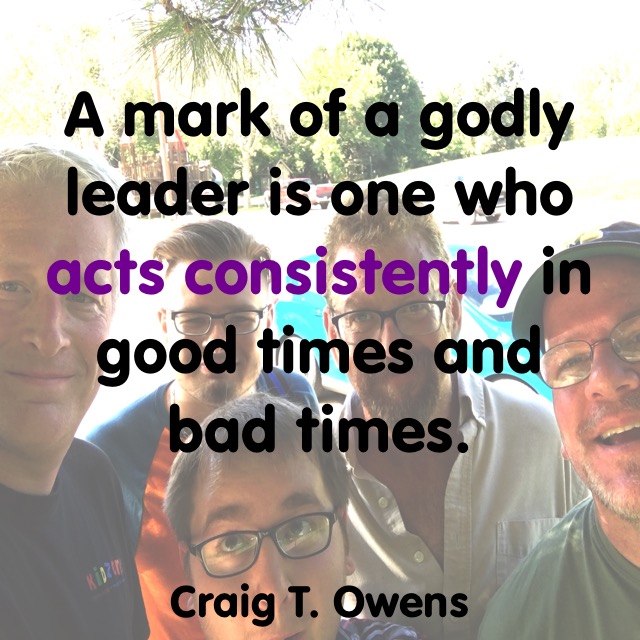
A mark of a godly leader is one who acts consistently in good times and bad times.

It’s a good question for godly leaders to ask: why do I obey God? why do I trust Him? why do I fear Him? is it so that I can get something out of it? is it because I’ve already received something? is it so that I can avoid punishment?

Or do I obey, trust, and fear God because He is worthy of all that—and more!—regardless of anything else? Godly leaders consistently ask both sets of questions and answer an assured “Yes” to the last question.

This is Part 14 in my series on godly leadership. You can check out all of my posts on this topic by clicking here.

Saturday In The Psalms—Why?

Why? (four times in five verses of Psalm 43).

We seem to ask this question a lot! Just listened to a small child trying to learn about his world, “Why … why … why…?” And in this psalm, we find a grown man still asking, “Why … why … why…?

“God, You are my strength, so why does it seem like You’re ignoring me? why are my enemies seeming to prevail?”

The psalmist then asks for enough light to find his way to the place of worship—here is where he finds reassurance of God’s majesty; here is where he is filled with joy.

Now his why? is directed to himself—not to God. He asks his soul, “What reason do you have to be downcast? God is on His throne—hope is still burning brightly—His help is coming. Now is the time to worship His majesty!”

My whys? need to be pointed the right direction: “My soul, why are you downcast when you have access to such a loving and powerful Father?”

Go ahead and ask your whys? Your loving Heavenly Father wants to hear from you!

13 Introspective Questions From “Longing For A Changed World”

As Ralph Lehman made his case for Christian to (re)establish a prayer focus for revival in his book Longing For A Changed World, he asked several penetrating questions. Here are a few of them for you to consider.

“[Josiah’s revival] was one revival that began with the leaders of government. Are we praying for our leaders?”

“Our government has entered many areas that were once considered to be the Church’s sphere of ministry. How can we lead our churches back into these areas?”

“Have you considered that you are grieving the Spirit when you deprive Him of conversing with God by choosing not to pray?”

“As men of prayer, should we not strive to be like the great prayer warriors of the Bible?”

“Tertullian, a church father who lived in the Roman Empire around 200 A.D., stated that the Roman emperor and his armies benefited greatly from the prayers of the Christians who interceded on their behalf. Can we present the same argument to our political leaders today?”

“What would we be willing to leave or to set aside for the sake of more time in prayer, seeking the Kingdom and righteousness of God?”

“Do we seek the Lord of revival, or merely desire His blessings?”

“If we do not enjoy God’s presence, through His Word and prayer, we are missing the true blessing God intends for us—the blessing of Himself. If we will not seek the presence of God day by day, how can we expect Him to go with us in our daily lives?”

“If God was willing to take the Israelites into the Promised Land without His presence [Exodus 33:3-4], what does this say to the proponents of the ‘health and wealth’ gospel?”

“Even though we have been blessed immeasurably by living here in the United States, do our hearts long for God’s rule to be acknowledged in our land? Do we yearn to abide in His presence? Or are we idle in our contentment with the milk and honey?”

“Sometimes, our areas of giftedness become spheres where we fail to ask God for strength. Have you considered your strengths may be the very areas that satan exploits?”

“Are we praying for revival, are we also praying that we would conduct ourselves in such a way that the world would take notice, even if this meant for us to suffer?”

“Is the God of today’s church big enough to surprise us?”

You can check out some other quotes from Longing For A Changed World by clicking here, and my full book review is available here.

Attend To The Questions

“For people burdened to say and defend the goodness and truthfulness of Christianity, it is tempting to hurriedly skip past the questions in our rush to demonstrate our answers. Such an impulse makes sense. Christianity, after all, has the most profound answers to offer the world’s most difficult questions. But if the work of apologetics involves more than building up the faithful, its primary orientation should be toward helping those who are already traveling to arrive. It is persuasion that apologetics hopes for, not only defenses or justifications of the Christian position as true or reasonable. We should point the way home rather than shout from the balcony of our bedrooms about how good looking it is. We have to care about the means of travel, not just the intellectual destination. We have to attend to the questions if we are going to help people find answers.” —Matthew Anderson, in A New Kind Of Apologist

For other quotes from this book, please click here.

Thursdays With Oswald—What’s Holding You Back?

Oswald ChambersThis is a weekly series with things I’m reading and pondering from Oswald Chambers. You can read the original seed thought here, or type “Thursdays With Oswald” in the search box to read more entries.

What’s Holding You Back?

[In these quotes, Oswald Chambers is commenting on a story recorded in Mark 10:17-22.]

    One thing you lack.” Do I really want to be perfect? Do I really desire at all costs to every other interest that God should make me perfect? Can I say with Robert Murray McCheyne—“Lord, make me as holy as You can make a saved sinner”? Is that really the desire of my heart? … 

     “Go, sell everything you have and give to the poor…. Then come follow Me.” These words mean a voluntary abandoning of riches and a deliberate, devoted attachment to Jesus Christ. We are so desperately wise in our own conceit that we continually make out that Jesus did not mean what He said, and we spiritualize His meaning into thin air. Jesus saw that this man depended on his riches. If He came to you or me He might not say that, but He would say something that dealt with whatever He saw we were depending on. …

     Never push an experience you have had into a principle by which to guide others. If you take what Jesus said to this man and make it mean that He taught we were to own nothing, you are evading what He taught, by making it external. Our Lord told the rich young ruler to loosen himself from his property because that was the thing that was holding him. …

     One of the most subtle errors is that God wants our possessions. He does not; they are not of any use to Him. He does not want my property, He wants myself.

From So Send I You

God wants you. All of you. He wants you without any strings attached to anything else.

“Is that really the desire of my heart?”

Listen closely to His voice. What is He asking you to loosen your hold on, so that you can hold on exclusively to Him? Don’t let temporary things hold you back from being perfectly His forever!

Are There Ghosts?

As a part of our annual Q Series, this was a question that was turned in: Are there ghosts?

Check out the video below…

The Scriptures I reference in this answer:

For other Q&As from this series, check out discussions about the Bible here, and questions about the mark of the beast here, and a question about a Christian losing his/her salvation here.

Can A Christian Lose Their Salvation?

As a part of our annual Q Series, this was a question that was turned in: Can a Christian lose his or her salvation?

Check out the video below…

Some of the Scriptures I reference in this answer:

For other Q&As from this series, check out discussions here and here.

Islam Booklets (book review)

Last week I reviewed a book calling Christians to pray for Muslims to come to a personal relationship with Jesus Christ. Prayer must be our first priority. But often times prayer will open the door for us to speak and act in love to share our faith with our Muslim friends.

I recently read a quarter of booklets that I would highly recommend to you—

  • The Shadow Of The Crescent 
  • What Christians Need To Know About Muslims
  • Sharing Your Faith With Muslims
  • Questions Muslims Ask

These booklets will help you understand the mindset of Muslims, learn more about the questions Muslims ask of Christians, some thoughtful ways to answer those questions, and the lifestyle that will be the most appealing for Muslims to open their hearts to Christians.

In one of the booklets, Ron Peck says, “It is our prayer that this knowledge [in these booklets] will encourage true believers in Jesus to reach out in love and share the life-changing gospel of Christ with Muslims God has brought to our shores. We also pray it will challenge Christ’s followers to take a stand against the missionary efforts of Islamic governments overseas as they endeavor to Islamize our nation.”

Given the fact that about 15 percent of all U.S. immigrants each year are followers of Islam, and that most statisticians agree that in the United States there are about 25,000 converts to Islam every year, now is the optimal time for Christians to be prepared to share their faith in Jesus with their Muslim neighbors.

The Q Series—Parables, End Times, And Prayer

Our annual Q Series is where folks send their questions to me on a variety of subjects and we do our best to answer them. This week we tackled questions like:

  • What does Christ’s Parable of the Sower mean?
  • Can people lose their salvation?
  • Are micro-chips implanted in humans the start of “the mark of the beast”?
  • What does “666” stand for?
  • Why aren’t all of my prayers answered?

Here’s what we discussed, along with the time this discussion appears on the video:

  • The Parable of the Sower [1:27]
  • What is a parable? [2:19] **Be sure to check out What Was Jesus Teaching In The Parables? on Biblegateway
  • Who is the farmer in this parable? [4:30]
  • “The best commentary on Scripture is Scripture” [5:14]
  • Can someone lose their salvation? [7:42]
  • Keep sowing seed [11:51]
  • Eternal security? [13:50]
  • The Scripture has “a lot of faces” [17:20]
  • Are micro-chips “the mark of the beast”? [20:37]
  • What is gematria? How does this fit with 666? [22:58]
  • 666 falls short of God’s perfection [25:54]
  • The antichrist is a parody of Jesus Christ [26:08]
  • What is the significance of 666 on the right hand and forehead? [27:31]
  • To understand the future, look to an historic event [29:05]
  • A lesson from the socialism of the Nazis and Adolf Hitler [29:49]
  • A quote from Dr. Erwin Lutzer [31:15]
  • Why did Jesus talk about material possession so much? [32:48]
  • Why aren’t all my prayers answered? [36:36] **Be sure to check out Praying With Authority on Biblegateway.
  • How do we pray “in Jesus’ name”? [37:07]
  • How did Jesus speak to His Father in prayer? [39:10]
  • James on unanswered prayers [41:32]
  • Perseverance in prayer [43:30]

We will be answering your questions one more time next Sunday. Please click here to find all the ways you can submit your questions.