15 Quotes From “Run Today’s Race”

Oswald Chambers mastered the art of stimulating deep thinking and introspection with just a few short statements. Run Today’s Race is designed to be read each day for a full year. Trust me, the short seed thoughts you read each morning will keep you thinking all day long. Check out my full book review by clicking here.

“It is a great moment when we realize we have the power to trample on certain moods, a tremendous emancipation to get rid of every kind of self-consciousness and heed only one thing: the relationship between God and myself.”

“It is easy to turn our religious life into a cathedral for beautiful memories, but there are feet to be washed, hard flints to be walked over, people to be fed. Very few of us go there, but that is the way the Son of God went.”

“Prayer with most of us is turned into pious platitude, it is a matter of emotion, mystical communion with God. It is no use praying unless we are living as children of God. Then Jesus says—‘Every one that asketh receiveth.’”

“There is only one purpose for your life, and that is the satisfaction of the Lord Jesus Christ.”

“If there is the tiniest grudge in your mind against any one, from that second, your spiritual penetration into the knowledge of God stops.”

“We have judged our fellow men as sinners. If God should judge us like that we would be in hell. God judges us through the marvelous Atonement of Jesus Christ.”

“God delights to put me in a place where He can make me wealthy. ‘Follow Me, and thou shalt have treasure in heaven.’”

“The more complicated the actual conditions are, the more delightfully joyful it is to see God open up His way through.”

“When we try to reserve our strength it works out in weariness. Spend to the hilt all we have got and God’s recreating power is greater than all the expended power.”

“My personal life may be crowded with small, petty incidents altogether unnoticeable and mean [commonplace], but if I obey Jesus Christ in the haphazard circumstances, they become pinholes through which I see the face of God and when I stand and face to face with God I shall discover that through my obedience thousands were blessed.”

“Whenever the insistence is on the point that God answers prayer, we are off the track. The meaning of prayer is that we get hold of God, not of the answer.”

“One of the most amazing revelations of God comes when we learn that it is in the commonplace things that the Deity of Jesus Christ is realized.”

“As long as there is a human being who does not know Jesus Christ, I am his debtor until he does. The mainspring of [the Apostle] Paul’s service is not love for men but love for Jesus Christ.”

“As long as the devil can keep us terrified of thinking, he will always limit the work of God in our souls.”

“By prayer and Bible reading and meditation, the drab life (drab externally) has glorious holiday hours with God in which the soul is restored even in the valley of deep darkness.” 

More quotes coming soon, so stay tuned.

Godly Leaders Prayerfully Plan

“… I pray…grant me mercy in the sight of this man [King Artaxerxes]…” (Nehemiah 1:11).

Nehemiah prayed this in the month of Chislev. Four months later—in the month of Nisan—we read Nehemiah’s words, “So I prayed to the God of heaven” (2:4).

It took four months before God began to answer Nehemiah’s prayer, but he definitely wasn’t idle during this time!

During these four months, Nehemiah did more than pray; he planned. In Nisan, the king asked Nehemiah why he seemed heartsick.

“This is nothing but sorrow of heart,” said the king. “What’s bothering you, Nehemiah?”

“My hometown is in ruins,” replied Nehemiah.

Then the king asked, “What would you like to do?”

“So I prayed to the God of heaven. And then I said to the king…” (vv. 2-5).

Nehemiah’s request to King Artaxerxes was very specific.

  • He told the king how long he would be gone
  • He told him the building supplies he would need
  • He requested a letter from the king granting him safe passage
  • He requested another letter authorizing him to have access to the forest for lumber

“And the king granted them to me according to the good hand of my God upon me” (v. 8). Not only that, but the King gave Nehemiah an armed escort back to Jerusalem!

Nehemiah prayed and planned, allowing God to determine the perfect timing. Nehemiah didn’t just pray and wait; he worked while he waited.

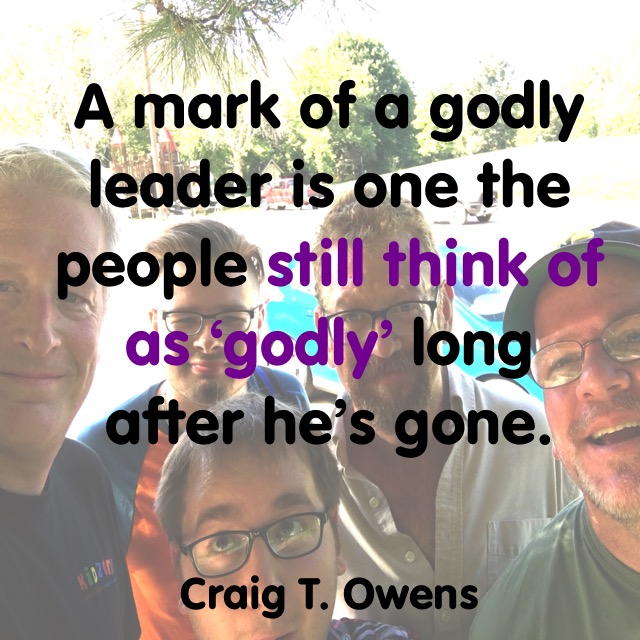
A mark of a godly leader is one who prayerfully plans his strategy.

My prayer—May all my plans be made with prayer to You for guidance. You know the best plans and the perfect timing, so I will pray and plan; plan and pray.

This is Part 4 in my series on godly leadership. To read my other posts, please click here.

A Godly Leader’s “We”

When Nehemiah heard about the devastation in Jerusalem, the first thing he did was a very good thing: “I sat down and wept, and mourned for many days; I was fasting and praying before the God of heaven” (Nehemiah 1:4).

An important mark of a godly leader is one who exchanges “you” and “me” for “we.”

Godly leaders identify themselves with their people; they don’t think of themselves more highly nor look down on others.

Nehemiah said in his prayer, “BOTH my father’s house and I have sinned. WE have acted corruptly against You” (vv. 6, 7). Given the fact that this is 70 years after Judah went into captivity, it is doubtful that Nehemiah was captured in Jerusalem, but he was probably born in exile. Yet he said WE sinned against God.

He also asks God to “be attentive to the prayer of Your servant, AND to the prayer of Your servantS” (v. 11). Once again Nehemiah identifies himself with all the people by not claiming that his prayer carries any more weight than anyone else’s prayer. Every prayer, in Nehemiah’s mind, was equally as pleasant to God’s ears.

My prayer—Help me to be a “we” leader.

This is Part 23 in my series on godly leadership. To read my other posts, please click here.

Godly Leaders Must Do Hard Things

“Arise, for this matter is your responsibility. We also are with you. Be of good courage, and do it” (Ezra 10:4).

Leaders have to do hard things. The responsibility is theirs, and the team is imploring their leader to take the responsibility to lead!

Ezra had to deal with a difficult issue. The issue was intermarriage between the Israelites and pagan nations. To complicate matters, Ezra discovered that “the hand of the leaders and rulers had been foremost in this trespass” (Ezra 9:2). I would guess these leaders had committed the sin of commission (intermarrying themselves or allowing their children to do so), and of omission (not speaking out against trespassers).

But those “who trembled at the words of the God of Israel” were greatly grieved at this national sin (v. 4).

Ezra’s first response was a good one: he fasted and prayed, confessing the sins of the people and identifying himself with them (notice the use of “we” in his prayer). Ezra knew there was a window of opportunity for revival that was about to close, so he must act quickly (vv. 5-15).

Prayer is a great start, but after prayer there must be action: “Arise … and do it”!

I am sure looking transgressors in the eye—especially those who were leading men and women in the community—and calling out their sin wasn’t an easy thing nor a pleasant thing for Ezra to do, but it had to be done.

A mark of a godly leader is one who does the hard good things that must be done.

Ezra doing the hard good thing opened the door for God’s blessing to fall on the people. This is still true for godly leaders today.

My prayer—Lord, strengthen me to “arise and do it” when the hard good things must be done.

This is Part 2 in my series on godly leadership. To read my other posts, please click here.

Godly Leaders Raise Up Godly Leaders

“…as the hand of the Lord my God was upon me…I gathered leading men of Israel to go up with me” (Ezra 7:28).

A mark of a godly leader is one who raises up other godly leaders. He doesn’t want to walk alone; he doesn’t want to keep God’s blessings to himself. He knows that there can never be too many God-fearing leaders.

How did Ezra raise up more godly leaders?

  1. Ezra made sure his team had everyone it needed to be successful. When he discovered his team had no Levites to oversee functions in the temple, he made an appeal for a Levite to join his team. “Then, by the good hand of our God upon us” God sent Ezra nearly 250 Levites (Ezra 8:18-20)!
  2. Ezra made sure his team would be adequately cared for. He prayed and fasted as he asked for God’s direction and protection for his team (vv. 21-23).
  3. Ezra trusted his teammates. He entrusted them with precious, irreplaceable treasures (vv. 24-34).

What Ezra did became contagious. The leading men that came to follow Ezra all brought other potential leaders with them as well.

Godly leaders are never content arriving at their destination alone—they want as many other godly leaders alongside them as possible.

My prayer—God, place Your good hand on me to empower me to raise up godly leaders.

This is the first part of my series on godly leadership. To check out all of the posts, please click here.

9 More Quotes From “The Christian In Complete Armour”

William Gurnall penned wise words for Christian warriors nearly 400 years ago, but their timelessness is still evident today. Check out a few more quotes from The Christian In Complete Armour

“The devil cannot think of anything he had rather glory in than to wound God’s name with His own sword. He coaxes man to sin and then brags that God made him do it. … Instead of letting satan wrest Scripture from us by his wily stratagems, let us be excited to bless God for the sword He has furnished us out of His grace.”

“The Sword of the Spirit in another person’s hand will not defend you.”

“God calls all mankind—some by the voice of natural conscience and others by the loud shout of His Word—to join Him ‘against the mighty’ (Judges 5:23). He does this not because He needs our help but because He prefers to reward obedience rather than to punish rebellion.”

“‘The eyes of the Lord are in every place, beholding the evil and the good’ (Proverbs 15:3). He sees when you close your closet door to pray in secret and rewards your sincerity; but He also sees when the door is closed for you to sin in secret—and He will not fail to reward your hypocrisy.”

“When the Spirit convicts you of sin, satan will try to convince you, ‘It is such a little one—spare it.’ Or he will bribe the soul with a vow of secrecy: ‘You can keep me and your good reputation, too. I will not be seen in your company to shame you among your neighbors. You may shut me up in the attic of your heart, out of sight, if only you will let me now and then have the wild embraces of your thoughts and affections in secret.’”

“The Christian ought to rely on divine strength because this plan results in the greatest advancement of God’s own glory (Ephesians 1:4, 12). If God had given you a lifetime supply of His grace to begin with and left you to handle your own account, you would have thought Him generous indeed. But He is magnified even more by the open account He sets up in your name. Now you must acknowledge not only that your strength comes from God in the first place, but that you are continually in debt for every withdrawal of strength you make throughout your Christian course.”

“Here is a word for Christians. Knowing your strength lies wholly in God and not in yourself, remain humble—even when God is blessing and using you most. Remember, when you have your best suit on, who made it and who paid for it! God’s favor is neither the work of your hands nor the price of your own worth. How can you boast of what you did not buy? If you embezzle God’s strength and credit it to your own account, He will soon call an audit and will take back what was His all along.”

“As an earthly parent you rejoice to see your own good qualities reproduced in your children. God, the perfect Parent, longs to see His attributes reflected in His saints. It is this image of God reflected in you that so enrages hell; it is this at which the demons hurl their mightiest weapons. When God defends you, He also defends Himself. Now knowing that the quarrel is God’s, surely He will not have you go forth to war at your own expense!”

“Your Heavenly Father is so eager to care for you, that while you are timidly asking for a nibble of peace and joy, He is longing for you to open your mouth wide so He can fill it. The more often you ask, the better; and the more you ask for, the more He welcomes you.”

You can read my full review of William Gurnall’s book by clicking here. I have shared other quotes from The Christian In Complete Armour here and here.

How Guys Unintentionally Sabotage Their Relationships

There is a relationship killer that seems to be particularly hard for men. It’s hard because men’s brains are designed in a way that sometimes prohibits them from even seeing this issue.

Bill & Pam Farrel wrote a book called Men Are Like Waffles, Women Are Like Spaghetti. The Farrels identify how men tend to compartmentalize their lives. That is, guys can be so absorbed in one “box” in their life that they are completely oblivious to the other boxes. For instance, when a man is at work he seldom thinks about the other areas of his life (his wife, his kids, the bills that need to be paid, what he’s going to have for lunch).

In addition, men’s brains are also designed to stay in those boxes where things can be quickly fixed. A guy likes fixing things, so the boxes where he can do something and see an immediate result is a box he’s going to keep going back to again and again.

Here’s the trouble… Relationships don’t fit in nice, neat boxes. Neither are relationships something that can be “fixed.” And relationships are never, ever fixed or improved quickly.

So if a guy isn’t aware of these things, he can be unintentionally sabotaging the relationships around him.

King David illustrated this in his unintentional lack of involvement in three of his sons’ lives—

  • Amnon pursued an unhealthy relationship with his step-sister. David got mad but never did anything about it (2 Samuel 13:21).
  • Absalom got revenge for what Amnon did and then fled the country. When David finally allowed him to return to Israel, they never met to resolve what went wrong (2 Samuel 14:28).
  • Adonijah wanted to be king after David, but the Bible says, “His father had never interfered with him by asking, ‘Why do you behave as you do?’” (1 Kings 1:6).

Dave Wills wrote, “We all tend to craft a self-focused view of the world where we emerge as either a hero or a victim in every scene. We’re never the villains in the story. The truth is, though, that we’ve all been the bad guy more often than we’d like to admit. A life of love requires that we look in the mirror and give an honest and humble self-assessment.”

The way to defeat this relationship killer is to become aware of it through humble self-assessment. David learned this truth and shared his prayer with us: “Search me, O God. Show me any areas in my life where I am off-track” (Psalm 139:23-24).

In response to this prayer, the Holy Spirit must have showed David how he had unintentionally starved his relationships with Amnon, Absalom, and Adonijah, because he became highly involved in his son Solomon’s life.

So much so that as Solomon talked to his children about how they should live, he also told them where he had learned how to do this—his father taught him (Proverbs 4:1-4).

Guys, it doesn’t matter how long you’ve been unintentionally in another box. It doesn’t matter how strained the relationship may have become. If you will humbly ask God to search you, reveal to you where you’ve messed up, and ask Him to help you get better … your relationships WILL begin to improve!

Don’t wait another day to pray that “Search me” prayer!

The Promised Power Of Pentecost

When the Israelites were delivered from Egypt on the night of Passover, fifty days later they arrived at Mount Sinai where God delivered the Ten Commandments to them. This became the birth of the Jewish nation. For millennia following this, not only did the Jewish people observe Passover but they also celebrated “The Feast of Weeks” (also known as Pentecost) fifty days following Passover.

But on the first Pentecost after Christ ascended to Heaven, something amazing happened which was a game-changer for the new Christians. An event which became the birth of the Christian nation.

On that Pentecost Sunday, the Holy Spirit was poured out on Christ’s followers in a way never before seen in history. Although this had never been seen before, it was the fulfillment of something God had promised thousands of years before.

  1. Promised

This blessing of the Holy Spirit had been hinted at when God first called Abraham, as He promised that from Abraham would come a blessing for all peoples on earth (Genesis 12:3). Jesus said that this blessing would be realized with the outpouring of the Holy Spirit, and then Peter tied the Day of Pentecost experience to the fulfillment of those promises (Acts 2:38-39).

  1. Commanded

Jesus had this empowerment of the Holy Spirit and He wanted all of His followers to have it too, so His directive to His follower is not a suggestion. Twice when Jesus tells His followers to receive the baptism in the Holy Spirit, the verbs He uses are commands (see Luke 24:49 and Acts 1:4).

  1. Normal Experience

For the first Christians, the baptism in the Holy Spirit was a normal experience for them following salvation. This baptism gave them power to…

  1. Initial Evidence

The baptism in the Holy Spirit is accompanied by an initial physical evidence of speaking in a language you’ve never studied. This is to be an unmistakable proof—primarily to you—of the Spirit’s outpouring. But the ongoing development of Christlike character is the continual evidence of the baptism in the Holy Spirit.

So what’s the controversy? Why do people spend so much time arguing this baptism isn’t for us, or for now? If we start down that path, what else are we going to say is outdated or exclusive for some?

Doesn’t it seem much more logical to simply accept what God promised all His people?!

So here’s the question I would ask you—Have you been baptized in the Holy Spirit? If not, why not?

Poetry Saturday—Ready To Blaze

If we with earnest effort could succeed
   To make our life one long connected Prayer,
As lives of some perhaps have been and are:—
If—never leaving Thee—we had no need
Our wandering spirits back again to lead
   Into Thy presence, but continued there,
   Like angels standing on the highest stair
Of the sapphire throne―this were to pray indeed!
   But if distractions manifold prevail,
   And if in this we must confess we fail,
Grant us to keep at least a prompt desire,
   Continual readiness for Prayer and Praise—
An altar heaped and waiting to take fire
   With the least spark, and leap into a blaze! ―Richard Trench

Thursdays With Oswald—God’s Surgery

Oswald ChambersThis is a weekly series with things I’m reading and pondering from Oswald Chambers. You can read the original seed thought here, or type “Thursdays With Oswald” in the search box to read more entries.

God’s Surgery

     It is difficult to realize that it is God who arranges circumstances for the whole mass of human beings; we come to find, however, that in the Providence of God there is, as it were, a surgical knife for each one of us individually, because God wants to get at the things that are wrong and bring us into a right relationship to Himself. … 

     The nature of any dominating lust is that it keeps us from arriving at a knowledge of ourselves. For instance, a covetous man will believe he is very generous. Thank God for the surgery of providence by means of which He deals with these absurdities. … The surgery of the providence of God will break up all ignorance of ourselves. … 

     The Holy Spirit continually urges us to sign away our right to our individual self to Jesus. “Learn of Me,” says Jesus, “for I am meek and lowly in heart.” How few of us do learn of Him! We cling to our individuality like a drowning man to a straw. … Individuality must be transfigured by the indwelling of the Holy Spirit, and that means a sword going through the natural. … 

     God’s providence seems to pay no attention whatever to our individual ideas because He is after only one thing—“that they may be one, even as We are one.” It may look like a thorough breaking up of the life, but it will end in a manifestation of the Christian self in oneness with God. 

From The Soul Of A Christian

In Psalm 139 David confesses how thoroughly God already knows him, but then he prays, “Search me!” David recognizes that there may be part of his individuality that is keeping God from using him completely.

Jesus taught us to pray, “Your kingdom come; Your will be done.” That means my kingdom has to go, and my will has to be set aside.

Christian, we must continually allow the Holy Spirit to search our heart and then perform the necessary surgery to remove the unhealthy clinging to our own kingdom. This is the only way for us to fully know the manifestation of the Christian self in oneness with God.