Links & Quotes

link quote

“Such is the Christ with Whom we have to do, full of grace and truth. Let us draw near; let us keep near; let us allow Him to pour out His love on us; let us bring others to Him to be partakers of the same overflowing love.” —Horatius Bonar

“O soul, if you trust Christ, the blood is on your brow today; before the eye of God there is no condemnation. Why, then, do you need to fear? You are safe, for the blood secures every soul that once is sheltered thereby. Believe in the Lord Jesus Christ, and you shall be saved, but if you believe not, trust where you may, you shall be damned.” —Charles Spurgeon

“I can’t believe that there are any heights that can’t be scaled by a man who knows the secrets of making dreams come true. This special secret, it seems to me, can be summarized in four Cs. They are curiosity, confidence, courage, and constancy, and the greatest of all is confidence.” —Walt Disney

“You have a body. But it is not yours. ‘You have been bought with a price: therefore glorify God in your body’ [1 Corinthians 6:20]. You are always in a temple. Always worship [1 Corinthians 10:31].” —John Piper

Speaking of our bodies, more young men are having heart attacks. Check this out to protect your health.

Have you ever thought about God being reasonable? T.M. Moore has an insightful post on this—God Who Reasons.

Brett Kunkle shares a great apologetic piece on an early and reliable account of Christ’s resurrection.

Taking a Sabbath rest is a reward, not a restriction.

[VIDEO] God wrote a book—

Links & Quotes

link quote

“The Son of God suffered (really suffered!) to deliver me from sinning. I cannot believe He suffered to make me miserable. Therefore, what He died to purchase must be more wonderful than the pleasures of sin.” —John Piper

“They who are Christ’s are kings. Take care that you wear your crown, by reigning over your lusts.” ―Charles Spurgeon

“Human beings are story-making engines, and when we’re confronted with randomness, we make up an egocentric version of what happened, and it involves us. So when things randomly go well, we give ourselves a pat on the back, a reminder of why we deserved it. And when they don’t, we seek out the ghost in whatever machine did us wrong and come up with a reason. … All the time we spend inventing reasons is probably better spent responding to what occurs.” —Seth Godin

Helpful medical health information: 9 Signs Of Improper Blood Circulation.

Here is another good reason to quit smoking.

[VIDEO] A heart-touching story of a family who adopted a beautiful girl names Sunflower―

Links & Quotes

link quote

Some good reading from the last couple of days …

“The blood of Jesus can cover your sins, but it does not make you dependent on Him. Miracles can deliver you from satan’s power, but they can’t make you dependent. You can be led by God and still not lean wholly upon the Lord. God has to strip us of all self-assurance and destroy all that remains of self-righteousness, spiritual pride and boasting. He must (and He does) humiliate all who are destined to inherit His great spiritual blessings.” —David Wilkerson

Fast Company shares why thankful people are happier and healthier. And Dr. Tim Elmore shares 5 ways leaders can show gratitude.

“May God grant that no doctrinal belief may ever dry up the milk of human kindness in our souls! … May we feel that no dogma can be scriptural which is not consistent with a sincere love to men.” —Charles Spurgeon

“The enemy never quite knows how to deal with a humble man; he is so used to dealing with proud, stubborn people that a meek man upsets his timetable. And furthermore, the man of true humility has God fighting on his side—who can win against God?” —A.W. Tozer

The problem with problems is that they always keep us from focusing on opportunities.” Read more of Seth Godin’s post The Problem With Problems.

Links & Quotes

link quote

Some good reading from today…

15 good quotes from Soren Kierkegaard.

For the singles, here is 10 guys you should never date and 8 types of women you should never date.

“I can neither teach nor live by the faith of others. I must live by my own faith as the Spirit of the Lord has taught me through His Word.” —Menno Simons

Pretty cool! We just landed a robot on a comet!

Coaches & Parents, Tim Elmore tells us how athletes hide behind their talent and what we can do about it.

Human touch is just as nutritious as the food we eat. So go hug someone!

“The notion that the careless sinner is the smart fellow and the serious-minded Christian, though well-intentioned, is a stupid dolt altogether out of touch with life will not stand up under scrutiny. Sin is basically an act of moral folly, and the greater the folly the greater the fool.” —A.W. Tozer

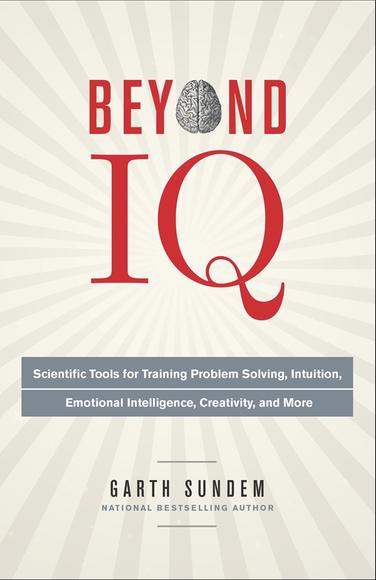
14 Quotes From “Beyond IQ”

Beyond IQI found Beyond IQ by Garth Sundem to be engaging because of both the research he presents, and the engaging exercises he incorporates to make the research applicable to us. You can read my full book review by clicking here. Here are some of the quotes I especially appreciated.

“First, here’s why insight can be difficult: it requires a paradoxical mix of experience with openness. Usually, experience leads to set-in-stone ways of doing things. Typically, openness is only present when you’re forced by inexperience to remain available in your search for solutions. Experience mixed with openness is a rare cocktail. … Rather than opening your mind to insight, [John] Kounios and [Mark] Jung-Beeman show that if you want insight, the best thing you can do is to close it. A closed mind shows up on an fMRI as activation of the anterior cingulate cortex, your brain’s home of inhibiting distraction. It’s as if your ACC is a pair of noise-canceling headphones, and with these headphones in place you’re more able to hear your brain’s quiet, insightful whispers.” 

“Science has known that during sleep the brain’s hippocampus—the structure responsible for encoding new memories—replays the day’s experiences from short-term storage and filters them into the neocortex, where experiences are integrated into… ‘pre-existing knowledge representations.’ Insight is the novel connection of knowledge, and sleep knocks knowledge into new configurations.”

“[Robert] Sternberg and his frequent collaborator, Richard Wagner, showed that situational judgment tests…designed to measure practical intelligence are a much better predictor then IQ of job performance in business managers, bank managers, and graduate students. IQ doesn’t lead to success. Practical intelligence does.” 

“The language of problem-solving is: initial state, constraints, operations, and goal state. … [Richard] Mayer says that the most striking feature of people who successfully solve real-world problems is the time they spend studying the initial state and the constraints—the extra time they spend clarifying the problem.”

“University of California-San Bernardino researcher James Kaufman knows the recipe for creativity. It’s equal parts intrinsic motivation, experience, and something he calls low personal inhibition. Intrinsic motivation is pretty self-explanatory, but beware of the danger of ‘replacing intrinsic motivation and a natural curiosity with external rewards,’ says Kaufman. If a parent wants a child to become a creative pianist, the parent should encourage interest in the piano but not incentivize this interest with ice cream. Creativity blooms in fields you’re drawn to, not in fields into which you’re pushed. … Kaufman’s research has shown that creative people are hard workers with background knowledge and expertise in their creative domains. ‘It’s the “learn the rules so you can break them” approach,’ he says.” 

“Dean Keith Simonton of UC Davis found that the nineteenth-century scientists who wrote the most-cited papers also wrote the least-cited papers. … The more scientific papers or sonatas or sonnets a person writes, the greater chance that one or more will be especially creative.”

“In any kind of cognitive activity you have two kinds of things going on. You have intelligence, but there’s also learning and skill and knowledge based on practice. The more the second develops, the less important the first becomes. … Even more importantly, we’ve shown that with enough practice and hard work, you can actually change the neurophysiology of the brain. For example, practice can encourage the brain to grow greater myelin coating on neurons. Thus our behaviors become literally hard-wired. Developing expertise literally makes certain thought patterns more efficient than others.” —Paul Feltovich 

“Florida State researcher K. Anders Ericcson shows that it’s not only experience that creates expertise but a step-by-step method of sculpting experience that he calls deliberate practice. To Ericsson, famous for his theory that 10,000 hours of practice creates expertise in any field, the four-step path to expertise includes performing your skill, monitoring your performance, evaluating your success, and figuring out how to do it better next time. Completing only the first step—performing the skill itself—leads to automated, low-level, rote performance in which you perform the skill the same way every time. Monitoring, evaluating, and adjusting your skill allows you to modify it after every pass, helping skill evolved toward expertise.”

“The more you use your brain, the longer you’ll be able to use it. … People with ‘cognitively protected’ brains were those who challenge themselves through a lifestyle that included reading, writing, attending lectures, and doing word puzzles—in other words, they followed a self-imposed regimen of cognitive involvement. … Cognitive involvement is only one tine of a three-pronged approach to brain health in later life. The second tine is a healthy body. … In fact, your cardiovascular health in middle age is even more important for your later brain health than the same risk factors in old age itself. … The third tine: social interaction. … Nothing forces the brain to work like interacting with other brains.” 

“Moral reasoning and wisdom are linked. Specifically (and this is kind of cool albeit technical), for those who possess strong moral reasoning, wisdom increases with age. If you have lower moral reasoning, you gain no wisdom as you get older. So if you want wisdom later, train your moral reasoning now.”

“Wisdom requires thought and action without yourself in mind, and sociologist Monika Ardelt of the University of Florida shows that selflessness is also the best predictor of successful aging. In fact, the wisdom born of selflessness beats out physical health, income, socioeconomic status, physical environment, and even social relationships in predicting life satisfaction in old age.”

“Pressure…sits like a lead weight in your working memory, claiming space that could otherwise hold useful information. And because working memory is a mainline to general intelligence, space claimed by pressure makes you measurably dumber. … Pressure flips a mental switch from implicit to explicit thought, making you apply a layer of analysis to things that should be automatic. … Chronic pressure can make you chronically prioritize the quick rewards of drugs and alcohol while discounting their long-term risk. … So beware. Stress plugs your working memory, analysis paralysis forces you to try to use it anyway, and your dopamine circuits cry for a quick, risky solution.”

“Students with high emotional intelligence (EI) have lower rates of drug use and teachers with high EI get more support from their principals. Employees with high EI have higher job performance, especially when their IQ is low (implying that emotional intelligence can help compensate for low general intelligence—and also that these skills are distinct). EI is even implicated in resilience—the more EI you have, the higher your chances of bouncing back after trauma or negative life events.” 

“If IQ is the strength of the bulb in your lighthouse, willpower is the lens that focuses it into a beam.”

Links & Quotes

link quote

Some good reading from today…

“Therefore it is the duty of a brave man not to shut his eyes when anything threatens, but to put it before him and to search it out as it were in the mirror of his mind, and to meet the future with foreseeing thought, for fear he might afterwards have to say: This has come to me because I thought it could not come about. If misfortunes are not looked for beforehand, they quickly get a hold of us.” —Ambrose

Sad: The Presbyterian Church (USA) votes to NOT denounce infanticide. Seriously?!?

Turn off the tube: “The study involved more than 13,200 adults in Spain who were all college graduates, and were around 37 years old at the study’s start. Participants were followed for about eight years, over which there were 97 deaths. Those who watched three or more hours of TV a day were twice as likely to die over the study period, compared with those whose watched TV for one hour or less daily, the study found. And, oddly, even compared to other activities that are sedentary—like driving a car or using a computer—watching TV still appears to be deadlier.”

A good overview of ISIS in Iraq.

A challenging thought from Dr. Tim Elmore for anyone who works with students: Addictions: One Reason Not To Take The Easy Road.

“Act as if what you do makes a difference. It does.” —William James 

“Small deeds done are better than great deeds planned.” —Peter Marshall


Thursdays With Oswald—All Of Me

ChambersThis is a weekly series with things I’m reading and pondering from Oswald Chambers. You can read the original seed thought here, or type “Thursdays With Oswald” in the search box to read more entries.

All Of Me

     Never run away with the idea that you are a person who has a spirit, has a soul and has a body; you are a person that is spirit, soul and body. Man is one; body, soul and spirit are terms of definition. My body is the manifest “me.” Some of us are so dominated by the body that our spirit lives only in the physical domain, instead of the physical being slowly taken into the spiritual by a series of moral choices. Our spirit goes no further than we bring our body. 

From Conformed To His Image

God created us as a three-part, integrated being. Quite simply, all parts are interdependent on each other.

If my body is diseased, it’s hard for me to develop my soul and spirit. If my emotions are out-of-balance, it adversely affects by body and spirit. If my spirit is still weighed down by sin, it cannot but affect my body and soul.

I love the brief description Dr. Luke gives us about how Jesus grew up: Jesus grew in wisdom and in stature and in favor with God and all the people (Luke 2:52). Let me state this verse differently. Jesus grew healthily…

  • …in wisdom (His mind)
  • …in stature (His physical body)
  • …in favor with God (His soul)
  • …in favor with all the people (His emotions and relationships)

Jesus showed us well-round, healthy growth. If you are diseased in your body, talk to a doctor about remedies; if you are diseased in your soul, talk to a counselor or psychologist about your emotional health; if you are diseased in your spirit, talk to God about forgiveness.

Don’t let one part of you hold you back from being all the you God created you to be!

Links & Quotes

link quote

These are links to articles and quotes I found interesting today.

“The patience of hope does not turn men and women into monks and nuns, it gives men and women the right use of this world from another world′s standpoint.” —Oswald Chambers

The proper place of science in our culture: Science And Its Limits

Astronomers, cosmologists and physicists are always trying to explain the “missing” parts of their evolutionary theories: Missing Galaxy Mass Found

Very good! The Non-Physical Sides Of Sex

“You may think it out of place for me to say so, but in our churches today we are leaning too heavily upon human talents and educated abilities. We forget that the illumination of the Holy Spirit of God is a necessity, not only in our ministerial preparation, but in the administrative and leadership functions of our churches.” —A.W. Tozer

“It is not the man who has too little, but the man who craves more, who is poor.” —Seneca

“Selfish religion loves Christ for His benefits, but not for Himself.” —David Brainerd

“Few marriages can make it if both partners are hiding out from God. Show me a marriage without one partner that is close to Jesus, and I’ll show you a marriage with little chance of survival. At least one of the partners must be in daily consultation with the Lord. It is best when both husband and wife are talking to Him, but if one partner is running from God, it is all the more important that the other be able to run to a secret closet of prayer for help and direction. A praying wife can often save her marriage, as can a praying husband. Love alone is not enough to keep a marriage strong—only God’s power can do that. That power is at work right now, healing and keeping marriages. Where Jesus rules, the marriage can make it.” —David Wilkerson

An Extra Hour Of Sleep

I’m a morning person. I absolutely love getting up early and spending some quiet time alone with my Bible. This is the time of day I most absorb all that God is saying to me. It’s my most creative time too. In fact, I so love getting up early that most mornings I’m awake before my alarm clock goes off.

But not this morning.

Today my alarm clock began playing Way-FM and I felt like I was in a fog. It took me a minute or so to even open my eyes and sit up.

I was about to press ahead with my morning, when I thought, “I should sleep some more.”

You see, I’ve learned a few things about myself. When I’m tired…

  • I have a shorter attention span.
  • I’m not as creative.
  • I’m not as patient.
  • I am more prone to give in to temptation.
  • I make decisions that are too short-sighted.
  • I’m more susceptible to colds and flu.

So I re-set the alarm and slept another hour.

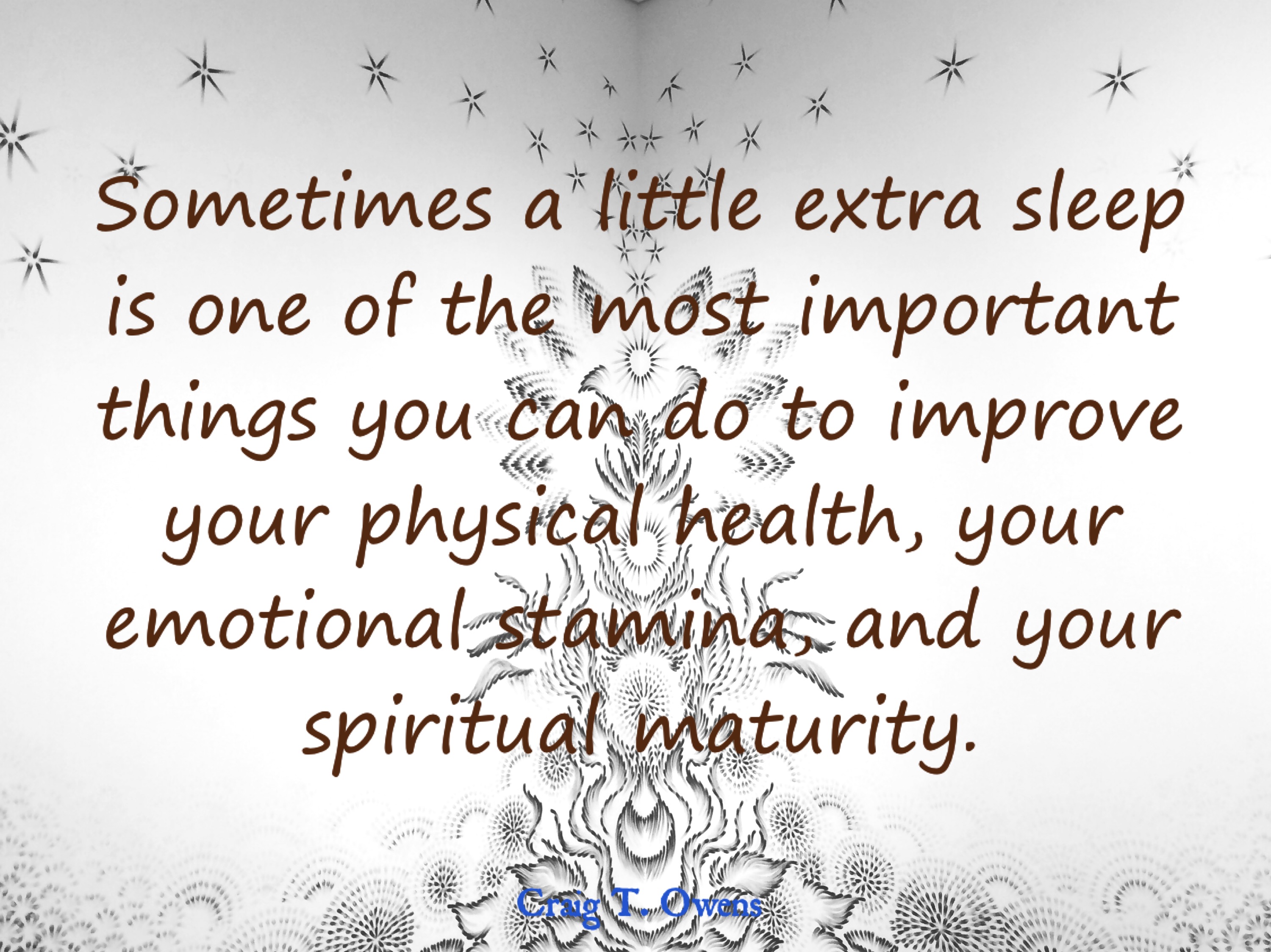
Sometimes a little extra sleep is one of the most important things you can do to improve your physical health, your emotional stamina, and your spiritual maturity.

UPDATE: In my book Shepherd Leadership: The Metrics That Really Matter I have five chapters about a leader’s health—mental, physical, spiritual, and emotional health is vital to a leader’s effectiveness and longevity.

A Healthy Breakfast

Listen to the podcast of this post by clicking on the player below, and you can also subscribe on AppleSpotify, or Audible.

Health experts say breakfast is the most important meal of the day. Your body has been without food (or fasting) during the hours you are asleep, so in the morning you are breaking your fast = break-fast.

Do you want to lose weight? Eat breakfast. Studies show that those who do best on their diets eat breakfast every morning.

Do you want to fire up your metabolism to burn more calories during the day? Eat breakfast. The way you stoke your body’s engine in the morning determines how it will run all day.

Do you want to maintain a stable blood sugar level so you don’t get sleepy mid-morning? Eat breakfast. A good breakfast regulates your insulin and blood sugar levels.

Do you want to learn more? Eat breakfast. Studies show those who eat breakfast regularly have longer attention spans and greater learning capacities.

What you put in your body in the morning determines the course of the rest of your day.

What you put in your mind in the morning determines the course of the rest of your day, too.

Even if you’re not a “morning person” your mind is highly receptive in the hours right after you wake up. So a healthy mental breakfast goes a long way toward how you will deal with the situations that face you throughout your day.

Just a few things to consider—

  • What’s on your wake-up playlist in the morning? Not-so-cheery headline news? Coarse radio hosts with crude humor? Music with lyrics that are not very uplifting? A harsh buzzer? Perhaps you could rethink your morning mental breakfast with something more positive and affirming.
  • How do you speak to yourself when you wake up? “Ugh, I just gotta get through today”? “I need a vacation”? “Grrr, I hate my job”? Try thinking instead of all of the blessings you have: a roof over your head, a bed of your own, clothes to wear, a family to love, and a family that loves you.
  • How do you speak to others when you wake up? “Leave me alone”? “<Grrrr!>”? Maybe you could serve others the good mental breakfast they need with some kind, encouraging words.
  • What fuel do you put in your mind? Talking heads on the morning TV shows? Your horoscope? Perhaps switching to something more substantial would help fuel your mind for the challenges you are going to face today.

The psalmist David had a God-diet each morning, “Let me hear of Your unfailing love each morning, for I am trusting You. Show me where to walk, for I give myself to You” (Psalm 143:8, The Living Bible).

Jesus had a healthy mental breakfast, too: “Very early in the morning, while it was still dark, Jesus got up, left the house and went off to a solitary place, where He prayed” (Mark 1:35).

So let me ask you: What’s your morning mental breakfast like? do you need to make a diet change? I think a few tweaks and you will begin to see some remarkable changes for the better! Try it out and let me know.

►► Would you please prayerfully consider supporting this ministry? My Patreon supporters get behind-the-scenes access to exclusive materials. ◀︎◀︎