My book Shepherd Leadership has five chapters dedicated to the health and wellbeing of pastoral leaders. One important principle: Only healthy shepherds can help their sheep get healthy.
I have lots of new content every week, which you can check out on my YouTube channel.
Clinton Manley has a great post on the way the Holy Spirit empowers a Christian’s life. He tells of this work in terms of an adventure: “We were made to go to God, the Home for our souls, made to enjoy God more and more forever, to really live. And the only way to get there is by following the Way crossing the only Bridge that brings us to God (John 14:6; 1 Peter 3:18). And we can only walk that Way when God’s own breath fills our lungs and animates our steps, when His Spirit sets us walking in a new direction as new creations on new adventures.”
Even among the reformers, Conrad Grebel was consider something of a radical. “Grebel was convinced that the city councilmen should have no authority over the church and its practice — more so, they should have no authority over the word of God itself. On the flip side, he didn’t think the church should have authority over the state either, and he opposed compulsory tithing and the like. The seeds of a separation between church and state were germinating. To us, this separation is as familiar as the air we breathe; to them, it was revolutionary.” Read more about both Grebel and other reformers here.
“If we would rise into that region of light and power plainly beckoning us through the Scriptures of truth, we must break the evil habit of ignoring the spiritual. We must shift our interest from the seen to the unseen.” —A.W. Tozer
“Success is dangerous. One begins to copy oneself and to copy oneself is more dangerous than to copy others.” —Pablo Picasso
Christian apologist J. Warner Wallace has a great strategy for responding to skeptics who claim that the Bible contradicts itself.
Listen to the podcast of this post by clicking on the player below, and you can also subscribe on Apple, Spotify, or Audible.
We do ourselves and the world around us a huge disservice if we are constantly striving for a stress-free life.
First, I don’t think that is even possible! Adam and Eve in the perfection of the Garden of Eden faced a stressful decision. And Jesus, the Perfect Man, was constantly dealing with the stressors that pushed in on Him.
But more importantly, stress is vital for healthy growth. In this case, I am talking about the healthy stress that doctors call eustress. This is the push against the forces that would ultimately pull down our physical health, our relationships, our mental health, and a host of other things if we simply opt to “go with the flow.”
“In a world that often sells ways to avoid stress, it’s crucial to remember that stress can be healthy in moderation. Stress and anxiety can trigger neural and chemical processes in your body designed to help you respond to challenges. Stress researcher Daniela Kaufer explains that ‘some amounts of stress are good to push you to the level of optimal alertness for behavioral and cognitive performance.’ Her research on stress in rats has even demonstrated that intermittent stressful events can create new brain cells in the rats that actually improve their future mental performances.”
The Bible makes it clear that persevering through the stressors that come against us can make us stronger, healthier, and better equipped for the next challenge. We are also fortified to help others through their times of stress (James 1:2-4; Romans 5:3-5; 2 Corinthians 1:3-5).
The poet Epictetus noted this about the mighty Hercules—
“What would have become of Hercules do you think if there had been no lion, hydra, stag or boar—and no savage criminals to rid the world of? What would he have done in the absence of such challenges?
“Obviously he would have just rolled over in bed and gone back to sleep. So by snoring his life away in luxury and comfort he never would have developed into the mighty Hercules.
“And even if he had, what good would it have done him? What would have been the use of those arms, that physique, and that noble soul, without crises or conditions to stir into him action?” —Epictetus, The Discourses
So the next time you are thinking about avoiding something that causes stress in your life, why don’t you reframe that thought. Instead, think about how you can become stronger, healthier, and more empathetic toward others because you are committed to successfully navigating that stressful situation.
Don’t ask God to get you out of this situation, but ask Him to help you get something out of this situation.
Listen to the podcast of this post by clicking on the player below, and you can also subscribe on Apple, Spotify, or Audible.
I do my best to take care of my physical body. I exercise every day, l try to watch what I am eating, and I attempt to get the correct amount of sleep. I attend to all of these things because I want to keep my body as healthy as I can.
But in all of these efforts, I would never presume that I could determine how long I’m going to live. I thought of this the other day when I read an interesting statement from Jesus.
In my Bible, this section of Luke’s Gospel has been given the heading “Do Not Worry.” Jesus tells us that we shouldn’t fret about our lives, our food, or our clothing because our Heavenly Father will take care of those things. Then Jesus says, “Since you cannot do this very little thing, why do you worry about the rest?” (v. 26).
What is this “very little thing” Jesus says I cannot do? In the previous verse, He says, “Who of you by worrying can add a single hour to his life?”
I don’t know about you, but that seems like a very big thing to me! How could I add any time to my life!? I have no idea when my time is up. If I think that controlling the number of days I have left to live is a big thing, then the daily concerns of providing food, clothing, and shelter, seem small by comparison.
But Jesus says determining the length of my days is a very little thing. If that’s how He sees it, how infinitesimal it must be for Him to provide the basics of life for His trusting children!
This is why Jesus says to us over and over again, “Do not worry.”
Listen to the podcast of this post by clicking on the player below, and you can also subscribe on Apple, Spotify, or Audible.
Of all the things that rob a Christian of peace and robust mental health, stress has to be near the top of the list. There are so many stressors in our lives that to not find a way to actively de-stress is to choose to remain stressed. This is sort of like fertilizing the weeds, as we learned in our second mental health strategy.
A certain amount of stress is good for us—doctors call this eustress. Our bodies have been designed by God with a hormone called cortisol that helps us respond to stressful situations, and He also designed that the unused cortisol be flushed from our bodies as we sleep and exercise. However, when we become stressed, many times sleep and exercise are squeezed out of our lives.
Men’s Health magazine reported, “You personally may dictate when you’ll die. After studying 1633 men for 30 years, Purdue scientists found that worrying takes 16 years off your life. Negative thinking triggers the release of cortisol, a stress hormone that can be dangerous when elevated for long periods of time.”
The eustress can degrade into distress if we’re not attentive to this downward slide. The excess cortisol that is allowed to remain in our bodies leads to unhealthy responses—like sleeplessness, starvation or binge eating, and little to no exercise. These unhealthy factors are further exacerbated by our diminished coping skills that come from the damage done to the hippocampus in our brain. Lingering cortisol kills the neurons in this memory center of our brains, which makes it harder for us to recall past lessons that could help us resolve stress.
Sadly, distress can become its own downward cycle as the unhealthy responses and diminished coping skills negatively impact our lives, creating even more stressors.
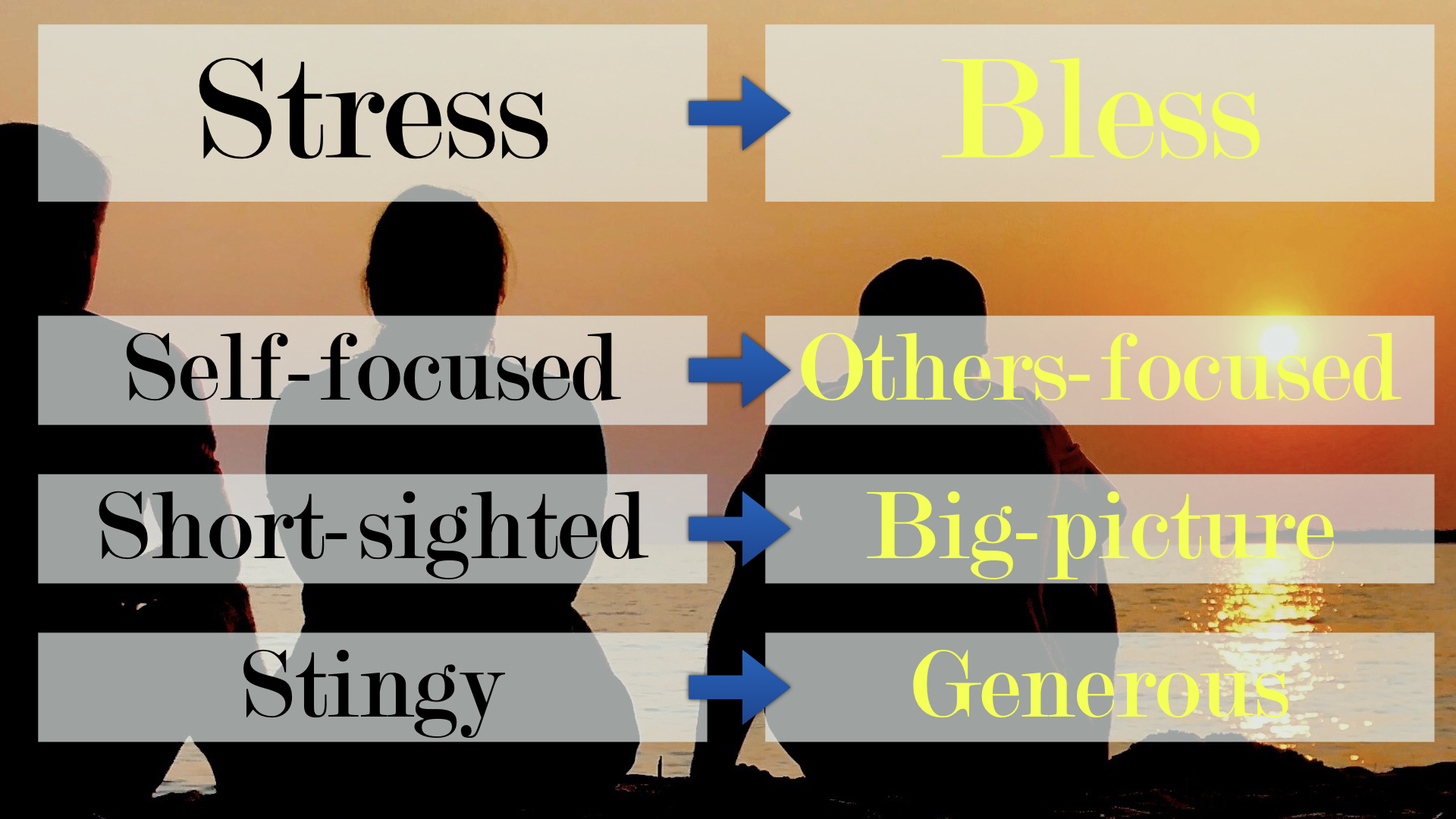
Stress makes us:
Self-focused
Short-sighted
Stingy with our time, possessions, and even God’s promises
But there is a word of hope for us. William James noted, “The greatest weapon against stress is our ability to choose one thought over another.”
I want to give you one thought—one word, one action—to combat stress: Bless.
Blessing others takes the focus off myself. Blessing God puts the focus on Him.
In the Gospels, we see people who had suffered the ravages of stress, encounter Jesus, find freedom, and then begin to bless others as a preventative to returning to their stress-filled lives. We can see a few examples in healed women, a man delivered from demons, and a woman who had lived a less-than-virtuous life (Luke 8:1-3, 26-39; 7:36-50).
Frequently, the Old Testament psalmists shared how blessing God and others brought them out of their stressful situations. A great example comes from David when he chose to bless God in a stressful place, and ended up being a blessing to other afflicted people around him (Psalm 34:1-6).
Instead of remaining self-focused we become others-focused
Instead of being short-sighted we get a big-picture orientation
Instead of being stingy with our possessions and God’s promises we become generous
Remember that in the distress cycle I mentioned earlier the brain cells in the hippocampus were being damaged? The excess cortisol literally kills those neurons. The good news is that the hippocampus is one of the few places in the brain that experiences neurogenesis after cortisol is flushed. When you replace stressing with blessing, and the cortisol is regularly flushed from your body, brain cells are regenerated in your hippocampus. In essence, you are developing both a new brain and a new mind.
The apostle Paul wrote, “Put off, concerning your former conduct, the old man which grows corrupt according to the deceitful lusts, and be renewed in the spirit of your mind, and that you put on the new man which was created according to God, in true righteousness and holiness” (Ephesians 4:22-24 NKJV).
Don’t let stress steal life from your years and years from your life. De-stress by blessing God and blessing those around you.
Listen to the podcast of this post by clicking on the player below, and you can also subscribe on Apple, Spotify, or Audible.
Doctors and scientists have repeatedly shown how important sleep is for us physically, mentally, emotionally, and even spiritually. So it’s an important question to ask: Are you getting enough sleep?
Listen to the podcast of this post by clicking on the player below, and you can also subscribe on Apple, Spotify, or Audible.
It has always been extremely heart-wrenching for me to see pastors and other ministry leaders get so frazzled that they throw in the towel. Many of them not only resign from the churches where they served, but they end up resigning their ministerial credentials too.
I know this breaks God’s heart as well.
When I was interviewed on The Church Lobby podcast, Karl Vaters wanted to discuss some preventative steps that pastors could take to avoid this ministry burnout.
Listen to the podcast of this post by clicking on the player below, and you can also subscribe on Apple, Spotify, or Audible.
Jesus was the healthiest Person to ever walk planet Earth. When Luke, a physician, tells us about the growth of Jesus, he says first that “Jesus grew in wisdom.” (Luke 2:52). That is our indication that a healthy mind is at the foundation for every other aspect of health.
But mental health doesn’t stay in your mind—it affects every other part of your life. Likewise, all of the other parts of your life can enhance or drain your mental health. We are created as interconnected beings. For instance, it’s hard to think correctly when you’re physically tired, spiritually drained, or involved in an unhealthy relationship. It’s also true that it’s hard to make good decisions about your physical health, stay focused on God, or handle your relationships successfully if you aren’t thinking correctly.
Dear friend, I pray that you may enjoy good health and that all may go well with you, even as your soul is getting along well. (3 John 2)
Now may the God of peace make you holy in every way, and may your whole spirit and soul and body be kept blameless until our Lord Jesus Christ comes again. (1 Thessalonians 5:23 NLT)
When my laptop is disconnected from the monitors I use at our church building, the message on the screen tells me to “check your inputs.” That’s not just for inanimate technology, but for us too: To maintain good overall health, we need to check our physical, spiritual, mental, and emotional inputs.
Let’s start with the physical inputs. When we are active during the day our bodies release a stress hormone called cortisol. Stress is not a bad thing—it’s a normal thing. A body that isn’t stressed will atrophy and become susceptible to disease. Balanced, healthy stress is called eustress, and unbalanced, unhealthy stress is called distress.
Cortisol is naturally flushed from the body in two ways: exercise and sleep. Exercise is important to keep our bodies moving effectively, and sleep helps us recover and helps our brains catalogue our memories (see 1 Timothy 4:8; Psalm 3:5). To fuel our exercise and our sleep requires the energy which we get from a healthy diet.
So if you’re not thinking healthy thoughts, check your physical inputs: Am I getting the proper amount of sleep? Am I exercising regularly? Am I eating properly? Do I see a doctor for a checkup?
How about spiritual inputs? Somewhat surprisingly, our spirits are kept healthy very much along the same lines as our physical bodies—proper food, appropriate exercise, and a time of rest. Our spiritual food is God’s Word, our exercise is working out what we’ve studied in the Bible, and our rest is called sabbathing (Jeremiah 15:16; Matthew 7:24-27; James 2:17). Jesus demonstrated all of these in His life and we, too, should follow His example.
If you’re not thinking healthy thoughts, check your spiritual inputs: Am I reading the Bible regularly? Am I putting what I learn into practice? Am I sabbathing properly?
Then there our emotional inputs, or the relationships that build us and relationships that drain us. You are always going to encounter people in need, and ministering to those needs is draining (Luke 8:45-46). We also need to be alert to those antagonistic people who purposely drain us (2 Timothy 4:14-15). We can make decisions to place people in our lives who build us up and be cautious of those who drain us (Proverbs 27:3, 5-6, 9, 17).
Once again, if you’re not thinking healthy thoughts, check your emotional inputs: Do I have healthy people investing in my life? Am I sharpening the iron of others?
Finally, let’s not forget the mental inputs. Computer programmers are well aware of the acronym GIGO: garbage in, garbage out. If you don’t like the results that are coming out, check what is going in. The apostle Paul gives us an outstanding checklist in Philippians 4:8.
If your mental health isn’t as healthy as you would like it to be, perhaps you need to talk to your doctor about your physical health, or a mature spiritual friend about your spiritual health, or a Christian counselor about your emotional health. As you consult with these wise people, continue to pray for God’s help. As your Creator, He knows you better than anyone else could and He can give you the wisdom you need as you check your inputs.
This is part 5 in our series on a Christian’s mental health. If you’ve missed any of the other messages I’ve shared, you can find them all by clicking here.
Listen to the podcast of this post by clicking on the player below, and you can also subscribe on Apple, Spotify, or Audible.
I had a great time on the Thriving In Ministry podcast with Kyle Willis while his podcast partner Dace Clifton was on sabbatical.
There is a profound truth in a simple observation about how Jesus grew: “And Jesus grew in wisdom and stature, and in favor with God and man” (Luke 2:52). Jesus was healthy in all of these areas. That means He had the proper work-rest balance in each of these areas too.
We should learn from this example and find different ways to rest and recover mentally, physically, spiritually, and relationally, just as Jesus did.
I encourage you to take a listen to this part of our conversation.
How can you take a mental rest? Perhaps by reading or listening to something uplifting, or maybe simply taking time to think about what you’ve been thinking about.
For physical rest, you might take a nap, schedule a vacation, or contemplate changing something in your diet.
For spiritual rest, you could sing a worship song or quietly meditate on a passage of Scripture.
For relational rest, you could have breakfast with a good friend or go for a walk with your spouse.
And don’t forget to tap into the wisdom and expertise of others in these areas. Talk with a mental health professional about your mental health, see a doctor about your physical health, visit with a wise mentor to discuss your spiritual health, or see a counselor about your relational health. You don’t have to come up with all of the answers on your own.
I am really looking forward to a new series of sermons that I am launching this Sunday. This will be a once-per-month series for the remainder of the year and it’s simply called A Christian’s Mental Health. If you don’t have a home church in the west Michigan area, I would love for you to join me in person, but the sermons will also be posted on my YouTube channel.
T.M. Moore has an outstanding post called The Essence of the Lie. In one part, Moore writes, “Thus the lie claims to be the truth, but, at the same time, it insists that truth is personal, relative, pragmatic, and utilitarian. Truth, from this perspective, is not absolute, but dynamic, changeable rather than fixed. It is conditioned by circumstances of time and place. At the end of the day, people are the final arbiters of truth, and truth is whatever they find to be useful for their purposes. Ultimate truth is that which people impose on others by one or another kind of force, whether intellectual, political, or physical.” Check this one out!
Harvard University has been studying a group of individuals since 1938 to try to determine the main factors that contribute to a long and healthy life. The director and assistant director of this study just published an article that sums up what they have learned over all these years—“[If] we had to take all 85 years of the Harvard Study and boil it down to a single principle for living, one life investment that is supported by similar findings across a variety of other studies, it would be this: Good relationships keep us healthier and happier. Period. If you want to make one decision to ensure your own health and happiness, it should be to cultivate warm relationships of all kinds.”
“The battle for control and leadership of the world has always been waged most effectively at the idea level. An idea, whether right or wrong, that captures the minds of a nation’s youth will soon work its way into every area of society, especially in our multimedia age. Ideas determine consequences.” — The American Covenant
“The storms of life are no longer our point of reference when [Jesus] is our focal point.” —Dutch Sheets
John Stonestreet was intrigued by a street reporter asking, “What are men good for?” There were a lot of soft, ambiguous answers given, but John quipped, “Men are good for fathering, protecting, loving, providing, leading, fighting for what’s right with their lives if need be, and obeying, in a masculine way, the creation mandate of the God who made us male and female and declared both ‘very good.’ Was that so hard?” Amen!
Listen to the podcast of this post by clicking on the player below, and you can also subscribe on Apple, Spotify, or Audible.
I thought it was very appropriate that I got to be a guest on the Thriving In Ministry podcast with Kyle Willis while his podcast partner Dace Clifton was on sabbatical. It was appropriate because Kyle and I talked about the importance of pastors finding time to rest.
Proper rest is absolutely vital for longevity and vitality. I hope you will listen to this short segment from this conversation.
I shared with Kyle two main roadblocks to sabbathing.
(1) Trying to be something you’re not.
We are all wired differently. God wired us that way on purpose. So if you’re an early bird, guard those morning hours for your creative work and use the evenings for rest. If you’re a night owl, don’t try to copy the early birds, but rest early in the day and do your creative work when you are at your best.
→ So the key concept to overcoming this roadblock is personalization.
(2) Getting distracted by the non-essentials.
Two things have really helped me with this one: Sticking to sustainable daily routines, while at the same time being sensitive to the Holy Spirit’s redirection (check out my post on the idea I call I.T.L.W.).









 Craig T. Owens