8 Ways Pastors Can Minister Like The Apostle Paul

PreachingThe Apostle Paul reminded the Thessalonians of how he ministered among them (“You know…” [1 Thessalonians 2:1]). This gives all of us pastors now an example of how to minister.

(1) “With the help of God we dared to tell you His gospel” (v. 2). I cannot minister out of my own strength; everything must flow from God’s strength.

(2) The message “does not spring from error or impure motives, nor are we trying to trick you” (v. 3). I must constantly allow the Holy Spirit to check my motives and check my theology.

(3) “We speak as men approved by God to be entrusted with the gospel”( v. 4a). I am merely a vessel that God chooses to use to share His gospel. This must keep me humble.

(4) “We are not trying to please men but God, Who tests our hearts” (v. 4b). I minister only for God’s approval, only for the applause of Nail-Scarred hands. “We were not looking for praise from men” (v. 6).

(5) “We were gentle among you, like a mother caring for her little children … We dealt with each of you as a father deals with his own children, encouraging, comforting and urging you to live lives worthy of God” (vv. 7, 11, 12).

(6) “We loved you so much that we were delighted to share with you not only the gospel of God but our lives as well” (v. 8). Paul didn’t just show up to preach, but he was in day-to-day interaction with the saints.

(7) “We worked night and day in order not to be a burden to anyone while we preached the gospel of God to you” (v. 9). My salary should not be too much of a burden for my congregation.

(8) “Holy, righteous and blameless we were among you” (v. 10). My life of integrity adds weight to the message that I preach (v. 5).

May all of us who are pastors live and minister like this!

Praying For Your Congregation

I heart my churchPastors often ask for their congregation to pray for them. This is a good thing! But the Apostle Paul gives pastors a model for praying for their congregation.

In his letter to the Church at Philippi, Paul says, “And this is my prayer…” (Philippians 1:9).

First, notice the motivation for Paul’s prayer: thankfulness. He’s not skeptical nor cynical. He doesn’t browbeat them for any shortcomings. He doesn’t think, “Ministry would be great if it weren’t for these people.” No! He was full of thanks that bubbled up in joyful prayer for these precious people (vv. 3, 4).

Paul also had an attitude of confidence for this congregation. He believed they could carry out ministry responsibilities, and that in the process they could continue to mature in Christ (vv. 5, 6).

Paul had affection for this church: he really liked these people! It’s one thing to love someone (after all, Jesus commanded us to do that), but something entirely different when we like being around people. The King James Version says Paul greatly longed after these folks. The Greek is even better—it says he doted on them (v. 8).

With this in mind, look how Paul prayed for these precious folks on whom he doted. He prayed that…

  • …their love might abound
  • …they would increase in knowledge and insight
  • …their level of spiritual discernment would help them always see the best
  • …their purity and blamelessness would remain intact all the days of their life
  • …they would be filled with God’s righteousness
  • …they would bring glory to God

Pastor, this is a great prayer to pray over the precious people on whom you dote!

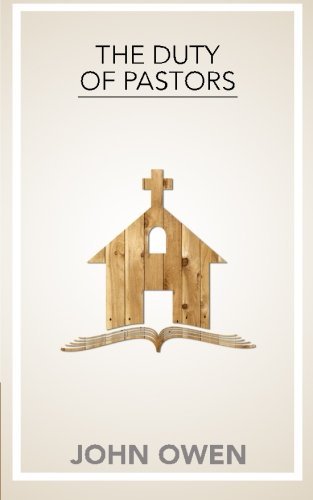
The Duty Of Pastors (book review)

The Duty Of PastorsJohn Owen is one of the influential and powerful voices of the Puritans from the mid-17th century. One of the things that makes him influential is the source of his wisdom: Everything he writes is thoroughly grounded in Scripture. This is especially true for his book The Duty Of Pastors.

Originally this book was entitled The Duty Of Pastors and People Distinguished. As you might be able to tell from this original title, Owen lays out from Scripture the roles of ministers and pastors. These two titles and roles are distinct, although many people want to lump them together. Owen points out that any one who is a Christian can minister to people (and thus be called a “minister”), but there are special God-appointed roles for those called “pastors.”

Owen writes, “The first and principal duty of a pastor is to feed the flock by diligent preaching of the Word.” Indeed, this is one of the main thing which distinguishes pastors from ministers.

Owen also takes to task those in religious circles who would put artificial (in other words, things not commanded in Scripture) barriers for people to answer God’s call to the pastorate.

This is not a very long book, but given that fact that it is older, it is a bit of a challenging read. But for anyone who is interested in the roles of pastors and ministers, or for anyone who wants to know how to support their pastors, The Duty Of Pastors is well worth your time and effort.

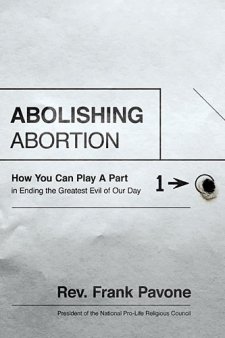
7 Quotes From “Abolishing Abortion” For The Church

Abolishing AbortionFather Frank Pavone writes persuasively and passionately about the role all of us can play in abolishing abortion throughout the world. One group that definitely needs to step to the forefront of this battle is the Church! Here are some quotes from Father Pavone specifically talking to Christians.

“People need to know that to oppose abortion does not mean to oppose those who have had one. … The Church has the perfect spiritual and psychological balance necessary for those who have been involved in an abortion. The last thing such a person needs to hear is, ‘What you did is no big deal.’ The nature of post-abortion grief is that the individual involved in the abortion has begun to realize precisely what a big deal it was. Now this person needs someone to tell her that she should not feel silly for feeling sad, that there is indeed reason for the grief in her heart, and that what her heart is telling her is true: her child was killed. A great disservice was done both to her and her child when someone convinced her that the abortion would be ‘no big deal.’ Accepting that line was a major act of denial. Healing can begin when she breaks out of denial and calls the evil what it is. … At the same time, the other line she does not need to here is, ‘You are rejected; there is no hope.’ As she realizes the evil that has occurred, she will be tempted to say this to herself. The Church, however, contradicts that despair with the clear message of forgiveness.” 

“Those in the pain of abortion are not helped by silence. Some pastors refrain from preaching about abortion out of the sincere desire to not hurt women who have had abortions. Yet that silence does not interpret itself. The person grieving over abortion can infer from our silence that we do not know her pain, or that we do not care, or that there is no hope. None of this is true. With clear and compassionate messages, pastors can break through the silence that led to a woman to this disastrous choice in the first place.”

“Those who attend church regularly are statistically the most likely to be pro-life and the most likely to be pro-life activists. Within America’s Christian churches there are people enough and resources enough to end abortion, armed as the pro-life movement is with the supernatural gifts of truth and grace. It is clear that the full activation of the Church is a critical step for ending abortion. This does not primarily mean creating new structures. It simply means infusing the existing structure with greater vigor and effectiveness.”

“The pro-life movement is not primarily a response to Roe v. Wade. It is a response to Jesus Christ. His teachings not only show us why we are to be pro-life but also show us how. They give us the virtues we need to have in doing this work.”

“The Church is the only institution that has a divine guarantee that it will prevail over the culture of death. ‘The gates of hell shall not prevail against it,’ the Lord Himself said (Matthew 16:18 KJV). Now, gates do not run out on the battlefield to attack the enemy. Rather, they stand still and defend the city against the enemy attacking it. To say that the gates of hell will not prevail against the Church is to say that it is the Church that takes the offense and storms the gates of hell to win ground for Jesus Christ. Gates of hell cannot withstand the power of heaven. The gates of death fall in the presence of eternal life. Sin melts in the presence of saving grace. Falsehood collapses in the presence of living truth. These are the tools with which Christ has equipped His Church.”

“Love is found on Calvary. Love’s best symbol is not the heart but the Cross. … What Christ revealed to the world through the Cross about the meaning of love, we must also reveal through our own sacrifice for those we love.”

“Abortion is the exact opposite of love. Loves says, ‘I sacrifice myself for the good of the other person.’ Abortion says, ‘I sacrifice the other person for the good of myself.’ And isn’t it amazing that the very same words used by the culture of death to justify abortion are the words used by our Lord to proclaim life and salvation and love: ‘This is My body!’ … ‘This is My body,’ Jesus said, ‘given for you’ (see Luke 22). He did not cling to His body so that we would die but rather gave it away so that we could live. These are the words that define our mission in the world: spouse saying to spouse, parents saying to children, clergy saying to their congregation, all of us saying to our brothers and sisters, ‘This is my body, my time, my efforts, my resources, my life—given for you, that you may live!’”

I have shared other quotes from Abolishing Abortion which you can read here and here.

And be sure to check out my book review of Abolishing Abortion here.

10 Ways To Pastor Like Paul

Apostle PaulI don’t think anyone who has studied the New Testament would argue that Paul was a premier pastor, evangelist and missionary. In his farewell address to the elders from Ephesus, Paul used his life as an example—“you know how I lived the whole time I was with you” (Acts 20:18).

Here are 10 things Paul demonstrated as a pastor:

  1. Great humility (v. 19)
  2. Preached the “hard messages” they needed to hear (v. 20a)
  3. Preached publicly and house to house (v. 20b)
  4. Made our Lord Jesus the central message of his sermons (v. 21)
  5. In constant contact with the Holy Spirit (vv. 22-23)
  6. Desired to finish the race and complete the task God had given him (v. 24)
  7. Lived innocently (v. 26)
  8. Always proclaimed the whole will of God, not just select topics (v. 27)
  9. Didn’t covet a luxurious lifestyle, but supplied my own needs by working as a tentmaker (vv. 33-34)
  10. Worked hard to be charitable to everyone (v. 35)

Because Paul lived like this, he had the moral authority to call these elders to live a similar lifestyle. He challenged the Ephesian pastors to:

  • Keep watch over yourselves
  • Keep watch over the flock
  • Stay in tune with the Holy Spirit’s oversight
  • Shepherd the Church
  • Remember the Church is the Bride of Christ (v. 28)
  • Be on your guard! (v. 31)

If you are a pastor, pay attention to these words!

If you love your pastor, help him or her stay true to these words!

Links & Quotes

link quote

“How may I tell when satan hinders me? I think you may tell thus: first by the object. satan’s object in hindering us is to prevent our glorifying God. If anything has happened to you which has prevented your growing holy, useful, humble, and sanctified, then you may trace that to satan. If the distinct object of the interference to the general current of your life has been that you may be turned from righteousness into sin, then from the object you may guess the author.” —Charles Spurgeon

“Every step on satan’s ground deprives us of the security of the promises of God. Often has ruin followed by not refraining from the first step (cp. Mark 14:54, 71). The only safety is in flight (Genesis 39:10, 12). Run then into ’thy hiding-place, and behind thy shield,’ and boldly bid thy tempter ‘depart from thee’ (Psalm 119:114, 115; cp. Matthew 4:10).” —Charles Bridges

“The corruption of the first sinner consists not in choosing some evil thing (there are no evil things for him to choose) but in preferring a lesser good (himself) before a greater (God).” —C.S. Lewis

“We may think we’re living in dark days, that things are going from bad to worse, and there’s no end in sight. But the truth is just the opposite. satan is back on his heels, bound and reeling; the rulers of this world are deceived and deceiving; the Church is complacent, at least in the West, but always a spiritual tinder box, ready for a new spark of the Spirit; and the Kingdom of God is advancing wherever men and women cling to Jesus’ compelling vision and seek the Kingdom of God as their highest priority in life.” —T.M. Moore

“Science and research are proving that porn harms the brain, damages relationships, and is also linked to prostitution and sex trafficking. Porn is a fantasy that is proven to make it harder for users to have real loving relationships.” Read more reasons why pornography is harmful.

Pastors, check out Rev. Dave Barringer’s spot-on post: confronting the diva pastor.

Sheriff David Clarke has some facts that refute the “Black Lives Matter” chatter.

[VIDEO] Ted Cruz is exactly right. The media doesn’t care about substance, but about style—

Links & Quotes

link quote

“Suppose you talk about depending on God and how wonderful it is, and then others see that in your own immediate concerns you do not depend on Him a bit, but on your own wits, it makes them say, ‘Well, after all, it’s a big pretense, there is no Almighty Christ to depend on anywhere, it is all mere sentiment.’ The impression left is that Jesus Christ is not real to you.” —Oswald Chambers

“The law is meant to lead the sinner to faith in Christ by showing the impossibility of any other way.” —Charles Spurgeon

“The truth is that evil is not a real thing at all, like God. It is simply good spoiled. That is why I say there can be good without evil, but no evil without good. You know what the biologists mean by a parasite—an animal that lives on another animal. Evil is a parasite. It is there only because good is there for it to spoil and confuse.” —C.S. Lewis

“The great missionary hope is that when the gospel is preached in the power of the Holy Spirit, God Himself does what man cannot do—He creates the faith that saves.” —John Piper

“Men do less than they ought unless they do all that they can.” —Thomas Carlyle

“Pastors—and not just pastors—avoid confronting issues such as cohabitation, divorce, consumerism, materialism, and greed rather than risk negative outcomes if we confront. But we do each other no favors by assiduously avoiding conflicts over faith and morality. When we do, individuals suffer, the Church suffers, and the culture has a heyday pointing out our hypocrisy.” Read more from Jim Tonkowich’s devotional here.

Dan Reiland speaks mostly to church leaders in his post Desperate Leaders. He writes, “Desperate leaders need people more than they lead people. When you are under pressure, lack confidence, and not sure how to make things work, it’s easy to want more from your people than for your people.”

[VIDEO] Tim Dilena tells us how God helps us when we are people of integrity.

Links & Quotes

link quote

“What a great responsibility God has laid upon us preachers of His gospel and teachers of His Word. In that future day when God’s wrath is poured out, how are we going to answer? How am I going to answer? I fear there is much we are doing in the name of the Christian church that is wood, hay and stubble destined to be burned up in God’s refining fire. A day is coming when I and my fellow ministers must give account of our stewardship: What kind of a gospel did we preach? Did we make it plain that men and women who are apart from Christ Jesus are lost? Did we counsel them to repent and believe?” —A.W. Tozer

“Prayer pursues God’s glory by treating Him as the inexhaustible reservoir of hope and help. In prayer, we admit our poverty and God’s prosperity, our bankruptcy and His bounty, our misery and His mercy.” —John Piper

“We love beauty with simplicity, and we love the pursuit of knowledge without effeminacy. We employee wealth properly, for use rather than for noisy display, and we do not consider poverty to be a disgrace but do regard it as shameful for someone not to seek to escape poverty through labor. We citizens of Athens care for both our own domestic concerns and for the affairs of state; those of us engaged in business are not lacking in understanding of public matters. For we alone consider those who avoid engagement in public affairs not as ‘uninvolved’ but as useless. And we, as we judge and reflect carefully on matters, do not consider words to be a hindrance to actions. Rather, the real hindrance to action is to enter into whatever must be done without taking forewarning through discussion.” —Pericles, speaking about Athenian culture, quoted in the Archaeological Study Bible

The serious mental health costs of watching pornography. Don’t be fooled: porn is dangerous!

Tim Dilena talks about the difference between truth and “viral fame” in this video.

Truth! Why marriage shouldn’t end your dating life.

I like Seth Godin’s thoughts on our vocabulary. “It’s not about knowing needlessly fancy words (but it’s often hard to know if the fancy word is needless until after you learn it). Your vocabulary reflects the way you think (and vice versa). It’s tempting to read and write at the eighth-grade level, but there’s a lot more leverage when you are able to use the right word in the right moment.” Read more in Does Vocabulary Matter?

Links & Quotes

link quote

“Authority never comes from you, but from God through you, therefore let God introduce or withhold as He chooses.” —Oswald Chambers

“The best of men are men at best; and, apart from the work of the Holy Spirit, and the power of divine grace, hell itself does not contain greater monsters than you and I might become.” —Charles Spurgeon

“The Bible is the grand repository … It is the complete system of divine truth, to which nothing can be added, and from which nothing can be taken, with impunity. Every attempt to disguise or soften any branch of this truth, in order to accommodate it to the prevailing taste around us, either to avoid the displeasure, or to court the favor, of our fellow mortals, must be an affront to the majesty of God, and an act of treachery to men.” —John Newton

“Seeking the Kingdom of God is not a matter of doing first things first. Seeking the Kingdom is not just the first thing on the Christian’s daily to-do list. Seeking the Kingdom is a first things always proposition, so that whatever is on our to-do list on any given day, seeking the Kingdom is the first things pursuit which defines and directs everything else we do.” —T.M. Moore

Eric Metaxas said, “Children are being sexually abused in Afghanistan, and our soldiers are being told to turn a blind eye. That’s got to stop.” Read more in his commentary Their Custom, Our Complicity.

In the style of C.S. Lewis’ Screwtape Letters, Burk Parsons writes a letter to pastors.

A thought-provoking piece from Nancy Pearcey, in light of the Kim Davis situation and the Obergefell decision: The Bait-and-Switch Over Same-Sex ‘Marriage.’

Seth Godin points out, “Thinking of one’s self as a failure is not the same as failing.” Read more from On Feeling Like A Failure.

Preach Like John

John the BaptistThis is a post for my fellow preachers (but the rest of you are free to listen in as well).

When Jesus says someone is the greatest preacher in history, it gets my full attention. Think about what John didn’t have…

  • No church building
  • No platform or pulpit
  • No worship team
  • No sound system
  • No Logos software
  • No library or study
  • No commentaries
  • No PowerPoint or handouts

He only had the Word of God and the Holy Spirit.

His sermons were thoroughly grounded in Scripture (Luke 3:4-6).

His sermons were anointed by the Holy Spirit (Luke 1:66).

His message was simple: “Repent from your sins, and produce fruit in keeping with repentance” (Luke 3:3, 8).

His messages prompted people to ask, “What should we do?” and he gave them Spirit-anointed answers (Luke 3:10-14).

His messages “exhorted the people” and brought “the good news to them” (Luke 3:18).

His sermons unashamedly called out sin (Luke 3:19).

And he will go on before the Lord, in the spirit and power of Elijah, to turn the hearts of the fathers to their children and the disobedient to the wisdom of the righteous—to make ready a people prepared for the Lord. (Luke 1:17)

Fellow preachers, may we be of the same spirit in our preaching!