The Joy Of Giving

Listen to the podcast of this post by clicking on the player below, and you can also subscribe on AppleSpotify, or Audible. 

In our series on six important spiritual disciplines, our key phrase is “so that”—

  • I get stronger so that we can get stronger. 
  • For discipline #1: I study my Bible so that I have something to apply to my life. 
  • For discipline #2: I take time for solitude so that I can respond in a God-glorifying way in stressful situations. 

Our third spiritual discipline makes people nervous: Giving. So perhaps if I give you the “so that” up front that will help you stick with me. Here it is: I practice the spiritual discipline of giving so that I can encourage others and experience God’s greater blessings. 

Jesus has a caution about giving: Don’t give to get earthly recognition (Matthew 6:1-4). He states this with two don’ts and one do:

  • do not announce your giving 
  • do not calculate or reckon your reward for giving
  • do expect God’s reward for your giving

The stark contrast is seen between Joseph Barnabas and Ananias and Sapphira in Acts 4:34-5:4. Barnabas gave everything he had received from the sale of a piece of property without expecting anything in return. Ananias and Sapphira pretended to give everything they had received from the sale of a piece of property fully expecting some sort of recognition. The results are just as stark and clear: Barnabas was honored by both the church and God, while Ananias and Sapphira were severely punished by God. 

When Jesus tells us in Matthew 6 that our giving should be in “secret,” He clearly doesn’t mean that no one knows that we have given. Clearly, in our examples in Acts, people knew that Barnabas had given money to the church. 

In two of his public letters, Paul gave public thanks to the church at Philippi for their financial gifts to him, and he called out the church at Corinth for their failure to give as they had promised they were going to (Philippians 4:10; 2 Corinthians 8:11). 

Paul noted that the Philippians gave because they knew there was a need, and Paul praised them for this and told them that they would see God’s reward for their generosity (Philippians 4:10-20). We can see our “so that” idea here: Paul was encouraged, he said that the Philippians would have all their needs met, and God was glorified. 

Paul used this example of the Philippians as an encouragement to the Corinthians (see 2 Corinthians 8:1-12, 9:5-8). Paul encouraged them to make sure they had a “get to” attitude about giving, not a “have to” obligation. He noted that God blesses the cheerful, get-to giver. 

Notice how similar the blessings of God sound to these two churches: 

And God is able to bless you abundantly, so that in all things at all times, having all that you need, you will abound in every good work. (2 Corinthians 9:8) 

And my God will meet all your needs according to the riches of His glory in Christ Jesus. (Philippians 4:19) 

When the Bible talks about giving, it is never restricted to money, although that is part of it. The Bible talks about giving in three categories. We could call these The three Ts

  1. Treasure—our tithes and offerings.
  2. Time—giving our service to those in need. 
  3. Talent—using the abilities God has given each believer to build up the Kingdom of God.  

How much of our treasure, time, and talent should we give? We should never look for the bare minimum, but we should be lavish givers. C.S. Lewis said it this way in his book Mere Christianity:

“I do not believe one can settle how much we ought to give. I am afraid the only safe rule is to give more than we can spare. In other words, if our expenditure on comforts, luxuries, amusements, etc., is up to the standard common among those with the same income as our own, we are probably giving away too little. If our charities do not at all pinch or hamper us, I should say they are too small. There ought to be things we should like to do and cannot do because our charities expenditure excludes them.”

For myself, I am trying to think of spiritual discipline #3 as this prayerful declaration: 

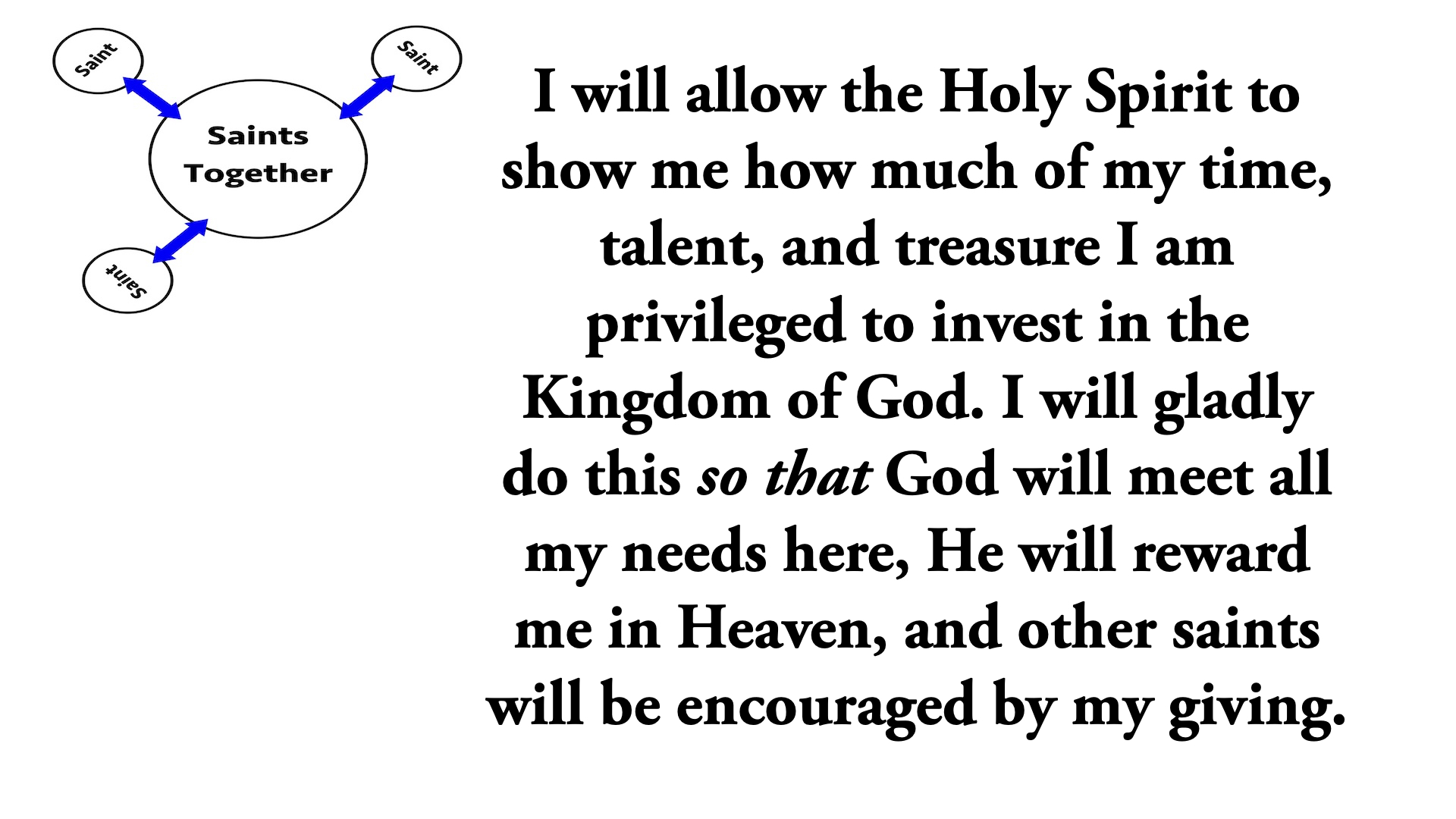
I will allow the Holy Spirit to show me how much of my time, talent, and treasure I am privileged to invest in the Kingdom of God. I will gladly do this so that God will meet all my needs here, He will reward me in Heaven, and other saints will be encouraged by my giving. 

I hope you will join me in making this your declaration as well. 

If you have missed any of the messages in our series called Saints Together, you can find the full list of messages by clicking here. 

►► Would you please prayerfully consider supporting this ministry? My Patreon supporters get behind-the-scenes access to exclusive materials, like a map and an app I just shared to help with your personal Bible study time. ◀︎◀︎

Book Reviews From 2013

BookshelfHere are the books I read and reviewed in 2013. Click a title to read the review…

10 People Every Christian Should Know

A Harmony Of The Gospels

Alive To Wonder

All In

Alone

Altar Ego

Andrew Murray Daily Reader

Dear Abba

Decision Points

Did The Resurrection Happen … Really?

Draw The Circle

Fight

Firsthand

Francis

God’s Favorite Place On Earth

God’s Workmanship

Habitudes

He Shall Glorify Me

I Never Thought I’d See The Day

If Thou Wilt Be Perfect

If Ye Shall Ask

It Is Finished

Jesus Is _____.

Jesus: A Theography

Knocking At God’s Door

Love To The Uttermost

One Year Book Of Personal Prayer

Outliers

Plastic Donuts

Pouring Holy Water On Strange Fire

Promotion

Raising Your Child To Love God

Seven Men

Smith Wigglesworth On Healing

Sometimes You Win, Sometimes You Learn

Stopping Words That Hurt

The 13th Resolution

The Baptism With The Holy Spirit

The Bare Facts

The Five Levels Of Leadership

The Highest Good

The Hobbit

The Man Who Knew Too Much

The Purpose Of Christmas

The Ragamuffin Gospel

The Reagan Diaries

The Secrets Of Intercessory Prayer

Things We Couldn’t Say

Understanding Sexting

Unfinished

Unstoppable

Visioneering

Who Do You Think You Are?

You Don’t Need A Title To Be A Leader

For my book reviews of 2011 click here, and for 2012’s list click here.

Plastic Donuts (video review)

Plastic DonutsHere is a video review Waterbrook Multnomah Press asked me to do on Plastic Donuts. This review is especially for other pastors, but I think you’ll see how much I liked this book. If you would like to read my full book review, you may do so by clicking here, you may also read some of my favorite quotes from the book by clicking here.

Calvary Assembly of God, get ready … you’re going to hear more about Plastic Donuts soon. And I’ve got a special gift for you too! Stay tuned.

10 Quotes From “Plastic Donuts”

Plastic DonutsPlastic Donuts is a fresh look at the biblical concepts of tithing and giving offerings. You can read my full book review by clicking here. These are some of the quotes that caught my eye—

“What I didn’t realize was that my lifestyle had frozen my giving at the 10 percent level. When it came to my finances, my lifestyle had all the influence. The issue is not about my needing to sacrifice my lifestyle. The issue is about my giving a gift that is connected to my heart.”

“In His Sermon on the Mount, Jesus provided instructions on giving, praying, and fasting. For each, He focused on the heart standard but did not provide an amount standard (see Matthew 6:1-18).”

“David praised God seven times a day. Daniel prayed to God three times a day. Moses fasted from food and water twice, for forty days straight. Daniel fasted twenty-one days from rich foods and wine. Where did these faith heroes get their standards? They determined them. It’s human nature to seek something that is concrete, an inviolable guideline, clear marching orders. … But let’s be honest. Are we looking for a rule to follow so we can check it off the list? Or does a strict rule help to soothe a sense of guilt and confusion? It’s always easier to follow rules than to follow a living God. The absence of rules can cause tension in determining the amount of our gifts. Shouldn’t there at least be a minimum? If not, suddenly it’s wide open. Multiple options appear.”

“God is not looking for the same gift from all His children. He wants a personal gift.”

“You may not think you have the ability to give. But if you pay attention, you’ll be surprised at just what abilities you really do have.”

“Tapping your true giving ability will require countercultural lifestyle choices—such as debt-free living or a reduction in your spending.”

“If you want to grow your faith, grow your gratitude. To grow your gratitude, take time to count your blessings.”

“No matter what your ability or inability, God can be pleased with your gift.”

“Could it be that a giving lifestyle apart from love and obedience to God is simply philanthropy?”

“In the end, it is the condition of the giver’s heart that makes the gift pleasing to God.”

Plastic Donuts (book review)

Plastic DonutsEvery once in awhile a book comes along that addresses a topic in such an innovative way, that I get an insight I had never considered before. Plastic Donuts by Jeff Anderson is just such a book.

Tithes. Offerings. Missions support. Building funds. It seems pastors cringe when they think about addressing these subjects, and congregants squirm when they hear their pastor addressing these subjects! “After all,” many think, “every church-attending Christian knows they should give, right? We know it and the pastor knows it, so why do we need to talk about it?”

But Plastic Donuts will give you a take on church giving that you probably haven’t considered before. It all comes from an insight Jeff Anderson got when his young daughter served him some plastic donuts.

The book is short, but powerfully-packed. I would say that its size would make you think it could be read quite quickly, but the content is so thought-provoking and eye-opening, you may find yourself taking time to rethink what you thought you knew on this subject.

Here’s my final word: Get this book. Get it for yourself and get it for your pastor. Everyone will be grateful that you did.

I am a Waterbrook Multnomah book reviewer.

UPDATE: 

  • To read some of my favorite quotes from this book, click here.
  • To watch a video review I did of this book for Waterbrook Multnomah, click here.

Money And The Church

Unfortunately, far too many financial scandals have tainted the church, and therefore any pastor who mentions tithes or offerings or missions support is usually viewed skeptically.

So sad! Especially because it should NEVER be this way!

The Apostle Paul gives an excellent teaching on financial gifts for church ministry in 2 Corinthians 8-9. I love this example he gives about the Christians in the impoverished area of Macedonia—

Out of the most severe trial, their overflowing joy and their extreme poverty welled up in rich generosity. (2 Corinthians 8:3)

Severe trial … extreme poverty rich generosity…. Want to see this in a modern-day setting? Check out this video:

Wow!! If the homeless can give like that, why can’t we?

Here are some principles Paul lists about giving:

  • Give because God compels you, not because a man compels you (2 Corinthians 8:3-4)
  • Give yourself to God before you give your income (8:5)
  • Give excellently (8:7)
  • Give sincerely (8:8)
  • Give like Jesus gave (8:9)
  • Give what you say you’re going to give, and do it quickly (8:10-15)
  • Give where there is proper accountability and proven credibility (8:16-24)
  • Give generously (9:1-6)
  • Give cheerfully (9:7)
  • Give where God is glorified (9:8-15)

Giving according to these principles removes the taint of anything shady, and puts the focus on God.

Mammon

It’s a funny-sounding word, but it has deadly consequences!

Jesus said we cannot serve both God and mammon (Luke 16:13 KJV). That word mammon had no direct translation in the English language, so the translators of the King James Version of the Bible simply did a transliteration: they took the Greek word and carried the same word into English. The translators of the New International Version did something different with this word: they made it Money, with a capital M.

The idea behind this word is placing our trust or reliance in anything except God. For us, the means of our security and basic living needs seems to be money, so Money (with a capital M) seems like an appropriate way to translate mammon.

Jesus recommended giving an offering—above and beyond our tithe—as a way to defeat the Mammon Monster. Giving our tithe is simply obedience to God’s commands. But giving our offering shows our trust in God’s provision.

Giving an offering to God is counterintuitive.

After all, less money is less than more money! If I receive money, I tend to hang on to it. I tell myself, “This might come in handy if the economy nosedives, or if something unexpected comes up.” When I start thinking this way, I start to make money Mammon, because I see money as my provider, instead of God.

What an appropriate way to wrap up our Live Dead series yesterday, as we made faith promises to God. We said, “God, I believe You will provide the amount of money I should give as an offering. And when You do provide, I promise to give it.” Placing my trust in God not only helps me to live dead to the pull of Mammon, but also Jesus promised—

Give, and it will be given to you. A good measure, pressed down, shaken together and running over, will be poured into your lap. For with the measure you use, it will be measured to you. (Luke 6:38)

I don’t give to get. I give because I trust God to provide.

P.S. By the way, all of the offerings that come in as a result of these faith promises will be going directly to missions. Calvary Assembly of God will not be keeping one cent of these faith promise offerings.

If you’ve missed any messages in our series called Live Dead, you can find them all by clicking here.

Less Giving = Less Good News

We just finished talking about what the Bible says about tithes and offerings at Calvary Assembly of God. Right on the heels of this, I noticed this article in the Grand Rapids Press: “Study reveals church giving at lowest point since Great Depression.”

Here are some of the sad findings:

  • Regular church attendees aren’t even tithing. The average giving is only 2.4% of the attendees’ income.
  • While giving to churches is down, giving to other faith-based organizations is up.
  • The study’s authors noted a “long-term turning inward of congregations.” In other words, of the money that is given to churches, less and less of it is going to needs outside of the church’s walls.
  • Church’s spending on benevolence has dropped 47% since 1968, and now stands at just 0.35% of attendees’ income.
  • “Fewer people are seeing churches as the primary conduit for meeting the larger (charitable and evangelistic) need.”

Paul wrote to the church in Corinth about the overflowing joy of giving to help the needs of others. He commended those with rich generosity, and encouraged the church to excel in this grace of giving.

Here’s the sad fact: The less we give, the less the Good News about God’s love is shared.

God wants us to give because we want to give. Paul even said I am not commanding you to give, but instead…

Each of you must make up your own mind about how much to give. But don’t feel sorry that you must give and don’t feel that you are forced to give. God loves people who love to give. (2 Corinthians 9:7)

Let’s change this around. Let’s buck the nationwide trend. Remember…

MORE GIVING = MORE GOOD NEWS

!

Mmmm, You Smell Good

Smell is one of the most potent of our five senses. It is strongly tied to memory and emotion. Maybe that’s why a “smelly phrase” appears so often in God’s requirements for the sacrifices the Israelites would offer Him:

An offering made by fire, an aroma pleasing to the Lord….

As a New Testament follower of Christ, instead of bulls or sheep or goats or birds, I have something more valuable to sacrifice to God: myself.

When I offer myself to God, it’s a powerful aroma that is pleasing to the Lord. Check this out:

Therefore, I urge you, brothers, in view of God’s mercy, to offer your bodies as living sacrifices, holy and pleasing to God—this is your spiritual act of worship. (Romans 12:1)

But thanks be to God, who always leads us in triumphal procession in Christ and through us spreads everywhere the fragrance of the knowledge of Him. For we are to God the aroma of Christ…. (2 Corinthians 2:14-15)

Offer your entire self to God and you’ll smell really good to Him.

WARNING: In order for a sacrifice to release its full fragrance it has to go through the fire. It’s especially true in the tough times that you can release the best aroma of Christ. So don’t run away from the challenging times—stay in them and release your God-pleasing aroma.

You are the pleasing aroma, so go smell good today!