One of the loudest, most persistent advertising messages is about speed: Take action now, get immediate results as soon as you sign up, don’t miss out, act today! Because of this sentiment that appears all around us, many people often think that any life changes they make should bring about immediate and lasting results.
I’ve often joked that I wish I had the superpower to zap myself or a friend—“<Poof!> There, you’ve got it now. You’re all set!” Unfortunately, that’s usually not how it works.
Instead, we need to be ready for a lengthy process—possibly even a lifelong process—of the Holy Spirit helping us to make the micro-adjustments that are necessary.
Check out this part of my conversation with Jim and John as we discussed this idea.
If you would like to watch this full interview on the Leading From Alignment podcast, please go here.
I’ll be sharing more clips from this interview soon, so please stay tuned. My book Shepherd Leadership: The Metrics That Really Matter is available in print or ebook, and in audiobook through either Audible or Apple.
This is a weekly series with things I’m reading and pondering from Charles Spurgeon. You can read the original seed thought here, or type “Thursdays With Spurgeon” in the search box to read more entries.
Listen to the podcast of this post by clicking on the player below, and you can also subscribe on Apple, Spotify, or Audible.
The Proof In The Longing
My soul is consumed with longing for Your laws at all times. (Psalm 119:20)
Can you say that your heart pines for God as the watcher through the midnight sighs for the dawn, or as the traveler over burning sand longs for the shadow of a great rock? Oh, then, though I would not have you rest in longings; indeed, I know you never can. Yet they are a proof that you are spiritually alive! Heart longings are far better tests than attendance at sacraments, for men who are dead in sin have dared to come both to baptism and the Lord’s Supper. Eager desires prove spiritual life much better than supposed attainments, for these supposed attainments may all be imaginary. But a heart breaking for the longing that it has for God’s Word is no fancy. It is a fact too painful to be denied! …
We have not reached perfection, but do not let us, therefore, be discouraged, for the apostle of the Gentiles said, ‘Not as though I had already attained, either were already perfect’ (Philippians 3:12). … When a man thinks himself so good that he cannot be better, he is probably so bad that he could not be worse. …
The fuller a man is of grace, the more he hungers for grace! Strange it is to say so, but the paradox is true—the more he drinks and the more he is satisfied and ceases to thirst in one sense, the more he is devoured with thirst after the living God! … This it is to be a true child of God: To always have a yearning soul toward God’s Word, to be eager after His commandments at all times. May the Holy Spirit keep us ever hungering and thirsting after God and His truth.
From Holy Longings
In a recent interview that I did, I was asked how someone should deal with the fact that they are struggling to be balanced in their leadership. My reply was, “The very fact that they are feeling the struggle should be a great encouragement to them. People who don’t feel the tension of wanting to get better are blinded to their deficiencies and never seek help.”
The proof of our growing maturity is in our longing for growing maturity.
The psalmist in this great chapter is thrilled with what God’s Word has already accomplished in his life, and yet he is still longing for the Holy Spirit to do an even greater work in his heart. This is the tension in which every maturing Christian should live. The devil would love to whisper to your heart, “Your longing for more proves that you are still immature.” This is an utter lie! As Spurgeon reminds us, the more of God we have, the more of God we will crave.
Immature people only want to do the bare minimum, but mature people want to do more than is expected of them. Jesus called these people those that went the second mile. That was a topic in my most recent Monday Motivation series.
I am a big fan of The Babylon Bee. If you haven’t checked out their satirical wit, please do so! One post that caught my eye this week is called What Your Favorite Book Of The Bible Says About You. Wow, did this one make me laugh! If you would like to check out some real Bible studies, I have some here and here.
Cold-case detective and Christian apologist J. Warner Wallace discusses how Jesus impacted other world religions—
The drought in north Texas has revealed some more dinosaur tracks, raising some new questions about these massive animals that roamed Earth.
The devil loves to try to pervert the conviction of the Holy Spirit into condemnation. Here is the freeing truth we can stand on: There is NO condemnation for those who are in Christ Jesus.
This is a weekly series with things I’m reading and pondering from Charles Spurgeon. You can read the original seed thought here, or type “Thursdays With Spurgeon” in the search box to read more entries.
Listen to the podcast of this post by clicking on the player below, and you can also subscribe on Apple, Spotify, or Audible.
Aids Of Self-Judgment
My soul is consumed with longing for Your laws at all times. (Psalm 119:20)
Spiritual desires are the shadows of coming blessings. What God intends to give us, He first sets us longing for. Therefore, prayer is wonderfully effective because it is the embodiment of a longing that is inspired by God because He intends to bestow the blessing prayed for! What are your longings, then, my hearer? Do you long to be holy? The Lord will make you holy! Do you long to conquer sin? You will overcome it by faith in Jesus! Are you pining after fellowship with Christ? He will come and make His abode with you! Does your soul thirst, yes, even pant after God as the hart for the water brooks? Then you will be filled with all His fulness….
I say not that it is so with all human wishes, for ‘the sluggard desires and has nothing’ [Proverbs 13:4] and many a man has such evil cravings within his heart that it were contrary to the purity of God for Him to grant them. But where there are intense, heartbreaking earnings of a holy order, depend upon it, they are tokens of good things to come!
Where the grace of God reigns in the soul, it makes a man become a stranger among his fellows…. Worldly men care nothing for the judgments of God. No, they care nothing for God Himself! But when a man becomes born anew, a citizen of heaven, there grows up within his spirit a spiritual appetite of which he had felt nothing before—and he longs after God and His Holy Word. See to it, brothers and sisters, whether your souls cry out for God, for the living God, for again I say, by your longings you may test yourselves—by your heart’s desires you may forecast the future—and by your hungering and thirsting you may judge whether you are men of this world or citizens of the world to come. With such aids to self-judgment, no man ought to remain in doubt as to his spiritual condition and eternal prospects.
From Holy Longings
I am currently teaching a series of lessons called Craving. We are learning in these sermons that God created our souls to long intensely, to have cravings. But we go astray when what we crave are things that will merely last during this world.
John told us, “This world is fading away, along with everything that people crave. But anyone who does what pleases God will live forever” (1 John 2:17 NLT). So by its very definition, worldly things will never satisfy our cravings because the world is temporary. Only an eternal God can give us eternal satisfaction.
As Spurgeon teaches us here, examining our longings is the best aid of self-judgment and will help us determine our future. Craving God’s presence will bring God’s blessing and His eternal fulfillment of our cravings. Craving anything else will lead to frustration and eternal disappointment.
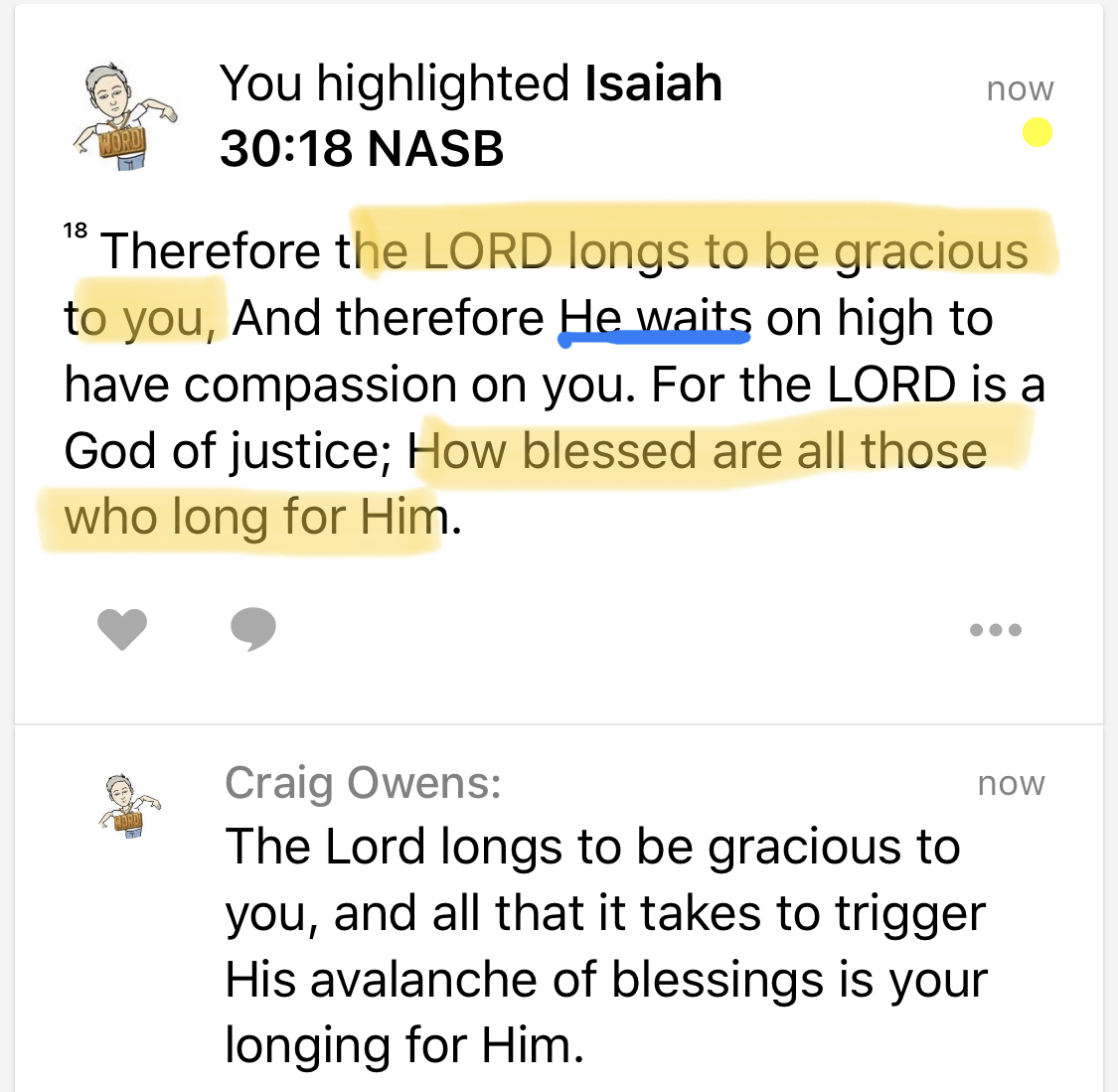
God longs to bless us (Isaiah 30:18) as long as we are craving Him!
Listen to the podcast of this post by clicking on the player below, and you can also subscribe on Apple, Spotify, or Audible.
King Solomon nailed it pretty succinctly with this verse: Dead flies putrefy the perfumer’s ointment, and cause it to give off a foul odor; so does a little folly to one respected for wisdom and honor. (Ecclesiastes 10:1)
As a Christian leader, I always have mixed emotions when I hear of another prominent Christian leader who has stumbled. Part of me is angry because I know that all Christian leaders will get painted with the same brush. Another part of me is incredibly sad to hear of a brother or sister who has squandered the trust that was placed in them. Finally, part of me becomes quite self-reflective, because I don’t want to repeat their mistakes.
Tom Peters said, “There are no minor lapses of integrity.” King Solomon would agree. And so do I.
Godly leadership can be such a beautiful thing, but just a couple of dead flies can putrefy the whole thing!
Here are four things that I have seen in the lives of those leaders who haven’t finished well. These are the things all of us need to watch carefully in our own lives.
(1) They compromised in “the little things.” None of them started off by saying, “I’m going to completely ruin my reputation as a godly leader.” But they allowed themselves to indulge in things that were just “little things” in their minds. Perhaps they thought, “It won’t hurt if I indulge in this one little thing.” The apostle Paul warns us, “So, if you think you are standing firm, be careful that you don’t fall!” (1 Corinthians 10:12).
(2) Pride crept in. They thought they were better than others. Peter said it this way: “All of you, clothe yourselves with humility toward one another, because, ‘God opposes the proud but shows favor to the humble’” (1 Peter 5:5). I addressed this topic in my book Shepherd Leadership: The Metrics That Really Matter like this—
Did you catch that? God stands back from the proud person who will not admit his error nor ask for help, let alone ask for forgiveness. On the other hand, God lavishes His grace on the humble one who admits both his error and his need for help. Admission of an inappropriate action or reaction brings God’s help!
Friends, the mark of a maturing shepherd is not one who never misspeaks or never makes a mistake. No, the mark of a maturing shepherd is the one who is closing the gap between his mess up and his confession.
Pride will keep us from confessing the “little sins” and keep us from God’s help. But humility quickly admits the smallest of slip-ups and therefore receives God’s grace and help.
(3) They lowered their standards. If anything, leaders should raise their standards as they become more successful. Think of it this way: when I was young and immature, I didn’t give much thought to my diet or my exercise routine. As I became older (and hopefully more mature), I became much more tuned-in to these things. Physically, the older I get, the more I need to pay attention to my health. The same thing is true in our leadership: maturity should lead to higher standards and higher levels of scrutiny.
(4) They stopped listening to others. The combination of little compromises, pride, and lowered standards doesn’t easily invite accountability nor transparency. The track record is pretty consistent among those who have fallen short: they stopped listening to people who tried to correct them.
I want to finish well. I don’t want a leadership stumble in my life to rob God of glory, nor to cause others to stumble in their Christian walk. I am committed to living my life in a way that will allow Jesus to say to me at the end, “Well done, good and faithful servant.”
I pray that all Christian leaders will join me in this.
Listen to the podcast of this post by clicking on the player below, and you can also subscribe on Apple, Spotify, or Audible.
I had a great time on the Thriving In Ministrypodcast with Kyle Willis and Dace Clifton.
Dace asked me what I wished I had learned earlier on in my pastoral career. The answer that sprang quickly to my mind is this: God takes me through things on purpose.
At the time we may not be able to see what God is teaching us, but He wastes no opportunities. Everything we have gone through has a purpose.
How true it is: God doesn’t prepare the path for me, but He prepares me for the path.
My book Shepherd Leadership: The Metrics That Really Matter is proof of this! I never thought God would call me to pastor a church—let alone write a book about pastoral leadership—but as I wrote the book, the Holy Spirit brought back to my remembrance so many lessons that I learned along the way.
I’ve already shared several clips from this Thriving In Ministry interview which you can find by clicking here, and I’ll be sharing more clips soon, so please stay tuned.
Shepherd Leadership: The Metrics That Really Matter is available in print or ebook, and in audiobook through either Audible or Apple.
Listen to the podcast of this post by clicking on the player below, and you can also subscribe on Apple, Spotify, or Audible.
I was teaching a class for my team members, and at one of the breaks a new employee came up to me to say how much he was enjoying the day, and to tell me that he would like to do what I was doing. I asked him, “But do you want to do what I did in order to do what I’m doing?” When I explained that I read about 10-12 books for this training time, and that it took me about 40 hours to prepare for our 4-hour class, he didn’t seem as interested.
Most people don’t want to put in the work, but they just want the results. As Christians we need to remember these words from William Penn: “No pain, no palm; no thorns, no throne; no gall, no glory; no cross, no crown.”
The human Jesus understands and empathizes with our painful struggles, and the divine Jesus helps us endure through these painful struggles to get the rewards on the other side.
What do we mean by divine? The dictionary simply defines it as things relating to God or gods, so we need to use some context to help us understand who this divine Jesus is. After all, the New Testament refers to both Jesus and Artemis as divine (Romans 1:20; Hebrews 1:1-3; Acts 19:27).
One way we can distinguish is by doing what the writer of Hebrews advised: “Remember your leaders, who spoke the word of God to you. Consider the outcome of their way of life and imitate their faith” (Hebrews 13:7). We see that the so-called worshippers of Artemis were more interested in their own financial gain than they were her divinity (Acts 19:23-27). In contrast, the apostle Paul demonstrated a totally Jesus-focused lifestyle: “However, I consider my life worth nothing to me; my only aim is to finish the race and complete the task the Lord Jesus has given me—the task of testifying to the good news of God’s grace” (Acts 20:24).
Paul was following Jesus, and called all Christians to do the same. He noted that Jesus gave up all of His divine privileges to become our human Jesus, but because of this obedience, God made the divinity of Jesus shine more gloriously than anything else in creation! Then Paul transitioned to a word specifically for Christians:
Therefore, my dear friends, as you have always obeyed—not only in my presence, but now much more in my absence—continue to work out your salvation with fear and trembling, for it is God who works in you to will and to act in order to fulfill His good purpose. (Philippians 2:12-13)
In essence this is like Jesus saying, “I want you to have what I have, but you will have to do what I did to get it: That is, go through the painful struggles of life. But I will be right here with you every single step of the way!”
The writer of Hebrews echoes this idea by reminding us that Jesus was made perfect through suffering, and so are we. So he calls us to “not throw away your confidence; it will be richly rewarded.” He also reminds us that although the times of suffering are not pleasant, there is an unimaginable reward on the other side (Hebrews 2:9-11; 10:35-39; 12:1-11).
I especially like this conclusion: “No discipline seems pleasant at the time, but painful. Later on, however, it produces a harvest of righteousness and peace for those who have been trained by it” (Hebrews 12:11).
The divine Jesus has made it possible for us to be rewarded as He was rewarded! His divine power leads to our divine nature. And His divine power helps us defeat the world’s weapons (2 Peter 1:3-4; 2 Corinthians 10:4)
Jesus asks, “Do you want to do what I did in order to do what I’m doing?” The power of the divine Jesus can help us be perfected, but we only get to this perfected place by suffering as He suffered. That’s why we need to know our human Jesus understands, empathizes, and helps.
Most people don’t want to put in the work, but they just want the rewards. Our divine Savior helps us work out what God has worked in us. He helps us get the rewards!
This is a weekly series with things I’m reading and pondering from Charles Spurgeon. You can read the original seed thought here, or type “Thursdays With Spurgeon” in the search box to read more entries.
Listen to the podcast of this post by clicking on the player below, and you can also subscribe on Apple, Spotify, or Audible.
Standing Firm
Superficial brilliance is always afraid of fire, but gold is not. The paste gem dreads to be touched by the diamond, but the true diamond fears no test. People who have a kind of confectionery godliness will wish to be preserved from temptations, for they cannot endure them. But the Christian counts it all joy when he falls into different trials, knowing that ‘tribulation produces perseverance; and perseverance, character; and character, hope. Now hope does not disappoint, because the love of God has been poured out in our hearts by the Holy Spirit who was given to us’ (Romans 5:3-5). My dear friends, if your faith is only a sunshiny faith, get rid of it! …
So our gracious God, beloved, glorifies Himself by permitting His people to be subjected to trials and by enabling them to endure the strain. We would never know the music of the harp if the strings were left untouched. We would never enjoy the juice of the grape if it were never trod in the winepress. We would never discover the sweet perfume of cinnamon if it were not pressed and beaten. And we would never know the warmth of fire if the coals were not utterly consumed. The excellence of the Christian is brought out by the fire of trouble. The wisdom of the great Workman and the glory of His skill and power are discovered by the trials through which His vessels of mercy are permitted to pass. …
Depend upon it, beloved, those who suffer as I have described are the children of God, for they show it. They show it by the way in which they bear their trials. In the worst times there is always a clear distinction that marks them as separate from other men. If they cannot shout, ‘Victory!’ they bear patiently. If they cannot sing to God with their mouth, yet their hearts bless Him. There is a degree of light even in their worst darkness…. If they get into the mire, they do not perish there. They cry for help when their woes surround them, and in the very nick of time, when everything appears to be lost, their heavenly Father hastens to their aid.
From The Believer Sinking In The Mire
I shared a series of messages called Thankful In The Night. Another psalmist wrote, “Yet the Lord will command His loving-kindness in the daytime, and in the night His song shall be with me” (Psalm 42:8).
Notice that this psalmist was praising God IN the night, not praising Him FOR the night. Many people have gone through what has been called “the dark night of the soul.” I don’t think anyone has ever given thanks because of being in a dark time, but certainly they have given thanks afterward because of the lessons learned in that dark time.
Quite simply put, there are some things God wants to teach us that we can learn in no other way than to go through a dark night. So we can learn to be thankful even IN those nights. IN those nights, we can learn to say, as Spurgeon did, “I believe in my Lord because He is a God who cannot lie. He is faithful and true to His every word and, therefore, let the whole creation go to rack and ruin, my faith will not waver or give up its confidence.”
This is a weekly series with things I’m reading and pondering from Charles Spurgeon. You can read the original seed thought here, or type “Thursdays With Spurgeon” in the search box to read more entries.
Listen to the podcast of this post by clicking on the player below, and you can also subscribe on iTunes or Spotify.
Forgiven And Forgiving
Forgiving one another, even as God for Christ’s sake has forgiven you. (Ephesians 4:32)
Now observe how the apostle puts it. Does he say, ‘forgiving another’? No, that is not the text. If you look at it, it is ‘forgiving one another.’ One another! Ah, then that means that if you have to forgive today, it is very likely that you will, yourself, need to be forgiven tomorrow, for it is ‘forgiving one another.’ … Let us begin our Christian career with the full assurance that we will have a great deal to forgive in other people, but that there will be a great deal more to be forgiven in ourselves! …
Note again: When we forgive, it is a poor and humble business compared with God’s forgiving us, because we are only forgiving one another—that is, forgiving fellow servants. But when God forgives us, the Judge of all the earth is forgiving, not His fellows, but His rebel subjects, guilty of treason against His majesty! For God to forgive is something great—for us to forgive, though some think it great—should be regarded as a very small matter. … What we owe to God is infinite, but what our fellow creature owes to us is a very small sum. …
If anyone here who is a Christian finds a difficulty in forgiveness, I am going to give him three words that will help him wonderfully… Here they are again: ‘For Christ’s sake.’ …
I do not know how to put this next word I am going to say. It is a paradox. You must forgive or you cannot be saved. But at the same time, you must not do it from compulsion, you must do it freely. … Remember, it is of no use for you to put your money into that offering box as you go out unless you remember, first, to forgive your brother. God will not accept the gifts, prayers, or praises of an unrelenting heart. … The very prayer that teaches you to ask for mercy bids you say, ‘And forgive us our debts, as we forgive our debtors’ (Matthew 6:12). Unless you have forgiven others, you read your own death warrant when you repeat the Lord’s Prayer!
From Forgiveness Made Easy
We honor the forgiveness that God has extended to us by liberally forgiving others. And our forgiveness of others shows them just how loving and forgiving our God is too!
I add my prayer to Charles Spurgeon’s that you would grasp the truth that we can forgive one another for Christ’s sake because God has forgiven us for Christ’s sake. Let’s all grow in this Christian maturity!