Links & Quotes

We’ve added things that we think should be in our prayer vocabulary. But kingdom praying should be as natural as talking to the most loving Father you can imagine! Check out more thoughts in my series of posts called Kingdom Praying. I have lots of new content every week, which you can check out on my YouTube channel.

“Obstacles don’t have to stop you. If you run into a wall, don’t turn around and give up. Figure out how to climb it, go through it, or work around it.” —Michael Jordan

In the post-Flood rock layers, fossils are often found of animals that were much larger than are currently observed. This has been called giantism. “Evolutionists claim that adaption occurs as random mutations make some organisms better fitted for their environment, and the less-fit organisms then die off. … This supposed, random, trial-and-error process requires long periods of time waiting for the ‘right’ random mutation to occur. In contrast, ICR gives credit to Jesus. He designed organisms with built-in sensors that enable them to detect changes in their environment. Internal genetic programming then allows these organisms to rapidly adapt to these changes in predictable ways. Such adaptation is often too rapid for natural selection to be the correct explanation. This design-based paradigm of adaptation is called continuous environmental tracking (CET).” This is an excellent article. 

“If the stone falls on the pot, alas, for the pot; if the pot falls on the stone, alas for the pot.” —Jewish proverb, based on Psalm 118:22 and Luke 20:17-18

Godly leaders need…

  • …ears consecrated to hear God’s voice and the voice of the people
  • …hands dedicated to ministering in love and obedience
  • …feet that only walk in God-directed paths

Godly leaders don’t minister to please people, but to lead people to God. So godly leaders are ever aware that in all they do, they must hear God say, “Well done, good and faithful servant.”

Prepared To Pass The Test

Listen to the podcast of this post by clicking on the player below, and you can also subscribe on AppleSpotify, or Audible. 

The prayer that Jesus taught His follower is a prayer for citizens of the Kingdom of Heaven. These are not just some magical words to pray whenever we don’t know what to pray. 

We come to a part of the prayer that has confused some people. Jesus instructed us to pray, “And lead us not into temptation, but deliver us from the evil one” (Matthew 6:13). 

So some people have asked, “Does God tempt us?” 

No, He doesn’t! The temptations flare up when the ungodly desires within us are given an opportunity to seize what we think will make us happy (see James 1:13-15). 

All three of the synoptic Gospels tell us that Jesus was led by the Holy Spirit to the place where the devil would tempt Him (Matthew 4:1; Mark 1:12-13; Luke 4:1-2). 

Jesus went through all of this so that He would be assured that He was fully equipped for the intense scrutiny He was going to undergo for the next 3+ years. At the end of that time neither the Sanhedrin, Pontius Pilate, nor Herod Antipas could find any semblance of sin in His life. 

The word Jesus uses for temptation in Matthew 6:13 comes from the root word peirazo, which means to assay. We don’t use that word too often today, but it means a testing, an experiment, or a trial, to prove something’s fidelity, integrity, or virtue. 

Just like an assayer would test a rock for the quality and quantity of a precious metal found in it, so we are tested to determine our fitness for what God has in store for us. Remember that the beginning of this prayer is a desire for God’s name to be hallowed and His Kingdom to be made visible through our lives. 

Jesus endured His intense time of testing for you and me. The writer of Hebrews tells us that Jesus underwent every temptation we would ever face, without once giving in and sinning. He did all of this so He could be the perfect High Priest that knows how to intercede for us in our time of testing (Hebrews 2:14; 4:15; 2:10, 18; 5:7-9, 4:16). 

Hebrews 5:9 says that Jesus was perfected (the Greek word is telios), which is exactly what Jesus wants for us—Be prefect [telios] even as your Heavenly Father is perfect [telios] (Matthew 5:48).

In order to know this perfecting process, we have to be tested and assayed (James 1:12, 2-4). 

Temptations reveal hidden sins in our lived, and temptations keep us humbly reliant on God (Psalm 19:12; 1 Corinthians 10:12-13; James 4:1-7). 

Like all of the other phrases in this prayer, this one is both an acknowledgment (I will face temptations) and a petition (I need Your help to overcome the temptation). This is not necessarily a prayer to keep us from temptation, but to keep us through the temptation. We want to be empowered to pass the test. 

A loving teacher prepares us for the test, gives us the test, and then gives us the results so that we know we are prepared for the next level. So remember that this prayer is addressed to our loving Heavenly Father. He prepares us for the test so that we can pass the test. We never walk an unknown path—we never are given a test unless He has fully prepared us for it. 

So let me give you four thoughts to consider:

  1. Don’t rush ahead because that’s pride. Jesus went when the Holy Spirit led Him.
  2. Don’t lag behind because that’s fear. Think of the Israelites who fearful of the “giants” in the land and wouldn’t move forward. 
  3. Don’t be discouraged by a temporary failure. The phrase immediately before this says, “Forgive us our debts.” If you fall short, ask for forgiveness and move forward again. 
  4. Do give in to the righteousness Jesus has made available for you. This is what will help you stand firm in your time of testing (1 Peter 1:6-7).

Just like Jesus, our Father wants to perfect you and lead you up to higher levels. 

If you’ve missed any of the previous messages in this series looking at the model prayer Jesus taught us, you can find them all here. 

►► Would you please prayerfully consider supporting this ministry? My Patreon supporters get behind-the-scenes access to exclusive materials. ◀︎◀︎

Links & Quotes

Unforgiveness keeps our eyes on our offenders and off our God. Free yourself by forgiving those who have hurt you. You can check out this full sermon hereI have lots of new content every week, which you can check out on my YouTube channel.

“At the moment of truth, there are either reasons or results.” —Chuck Yeager

As I have shared before, I am so impressed with the He Gets Us social media campaign! Some people are still trying to figure out exactly what this campaign is. Sean McDowell and his podcast partner Scott Ray had a great conversation with Ed Stetzer about this. Check out the video!

Some people have been critical of the He Gets Us commercials that aired during the Super Bowl, but I thought they were outstanding! This is a social media outreach designed and funded by some of the most biblically-grounded, evangelistically-minded people I know. It is a social media campaign. It is not designed as a sermon (which is why there are no Bible verses shown in the commercial). The idea is to get past the barriers and misconceptions skeptics have come to believe about Jesus, and then be enticed to go to the hegetsus.com website. It is at this site that the Gospel message is introduced and visitors are given Bible verses and other materials to go deeper.

John Stonestreet wrote, “Before it was the corporate creation of greeting card companies, it was a day to remember third-century Christian martyr Valentinus of Rome.” This post is a good reminder of what Christians really should be remembering on Valentine’s Day, as well as the higher definition of love.

“The important thing is to learn a lesson every time you lose.” —John McEnroe

Faith To Forgive

Listen to the podcast of this post by clicking on the player below, and you can also subscribe on AppleSpotify, or Audible. 

I shared this in my forthcoming book When Sheep Bite

In January 1647, Oliver Cromwell captured King Charles I during the British Revolution. Within just a few months, Charles escaped and was able to raise another army. A year later, in August 1648, Cromwell’s forces once again defeated the army Charles had raised, and once again Charles was taken prisoner. 

Oliver Cromwell put Charles on trial for his crimes, and after the guilty verdict was pronounced, Charles I was executed. A total of 59 people signed the former king’s death warrant. 

Fast forward eleven years and Oliver Cromwell had died and his son Richard had taken his place as Lord Protector of England. Unlike his father, there was great discontent with Richard’s leadership. As a result, the Loyalists were able to sweep Charles II into power. 

After assuming the throne of England, Charles II wanted the 59 death warrant signers put on trial, but fifteen of them had already died. That little fact didn’t stop King Charles II. He ordered that their bodies be exhumed, placed on trial, convicted of their crimes, and then hung. 

I’m no psychologist, but I think it’s safe to say that Charles II might have had a slight problem with unforgiveness!  

This is from a chapter I entitled “The ties that no longer bind.” The insidious nature of unforgiveness is that it ties us to the one who injured or offended us. 

Jesus taught us to pray, “Forgive us our debts, as we also have forgiven our debtors” (Matthew 6:12). The word He uses for “debts” means something justly or legally due, or an offense or sin that has been committed. So a debtor is one who morally or legally owes another for the wrong committed. 

So for these debts, we are taught to ask for forgiveness of God and to give that same forgiveness to others. Jesus uses the same root word for both “forgive” and “forgiven,” but there are nuances that make the picture quite clear. 

  • When we ask God to forgive our debts, it is the active voice (I have to ask for it) and it is stated in the second person (I have to receive it). When I ask my Heavenly Father for this, my offense has been paid-in-full because the legal and moral requirements aren’t due any longer. I couldn’t pay this debt on my own, but Jesus paid it for me (2 Corinthians 5:21).  
  • When I forgive someone who has wronged me, it is again the active voice (I have to give it), but it is now in the first person (I don’t wait around for the other person to ask for forgiveness). I let it go. I don’t hinder the other person or myself with waiting for the penalty to be paid any longer. 

This is the only part of this model prayer for which Jesus gives a commentary afterwards (in Matthew 6:14-15). With this, Jesus is teaching us that to say, “I’m forgiven” is also to say, “I’m forgiving.” 

Unlike Charles II, when we are forgiven and forgiving, the inevitable result is freedom for both ourselves and our offenders. 

If we practice this relentlessly, we are both freed ourselves and freeing others! 

When we ask God to forgive us, He forgives us immediately and completely (Psalm 103:12; Isaiah 1:18). We are to forgive our debtors just as quickly. 

When we pray, “Forgive as we also have forgiven,” we are both acknowledging His power to forgive us and requesting the faith need to be forgiving people. As C.S. Lewis noted, “To be a Christian means to forgive the inexcusable, because God has forgiven the inexcusable in you.” 

The Bible describes satan’s activity as stealing, killing, and destroying. He’s called the father of lies, so he uses slander to try to steal, kill, and destroy. His slander is: “God can’t forgive that” and “You shouldn’t let them off the hook for what they did to you.” 

These two thoughts are linked, just as “I’m forgiven” and “I’m forgiving” are linked. If I begin to  think that what someone did to me was too big for me to forgive, then I can also believe that there is a sin I have committed that is too big for God to forgive. But when I live both receiving and giving forgiveness, I can tune out this lie from hell. 

If you’ve missed any of the messages in this series called Kingdom Praying, you can find all of them here. 

►► Would you please prayerfully consider supporting this ministry? My Patreon supporters get behind-the-scenes access to exclusive materials. ◀︎◀︎

Links & Quotes

Our anxiety is usually tied to our insecurity about our needs being met. Philippians 4:6-7 counsels us to turn those anxieties into prayer. It’s not what we can provide for ourselves, but trusting what our Heavenly Father has already provided for us. Check out this amazing series on prayer. I have lots of new content every week, which you can check out on my YouTube channel.

A recent post at the Institute for Creation Research says, “despite popular perception, the impact theory of dinosaur extinction has problems and is still a source of contention among even conventional scientists.” In fact, “Despite uniformitarian claims to the contrary, these rocks and fossils are best explained by the Genesis Flood that covered the earth about 4,500 years ago. All the air-breathing, land-dwelling creatures outside the Ark perished. However, the representatives of these animals that God brought on board the Ark, including dinosaurs, survived, reproduced, and spread across the Earth after the Flood. Many ancient peoples wrote about and described what appear to be dinosaurs, even though they called them by other names, e.g., dragons. In the creation Flood model, impacts may have hit the earth during the Flood, but none of them caused the dinosaurs to go extinct.” This article is a good overview of the geological and paleontological evidence that supports the biblical account of the Flood.

“Scripture teaches us that there are two points of view from which we may regard Christ’s death upon the Cross. The one is the redemption of the Cross: Christ dying for us as our complete deliverance from the curse of sin. The other, the fellowship of the Cross: Christ taking us up to die with Him and making us partakers of the fellowship of His death in our own experience. … O Christian, when the world crucified Christ, it crucified you with Him, when Christ overcame the world on the Cross, He made you an overcomer too. He calls you now, at whatever cost of self-denial, to regard the world, in its hostility to God and His kingdom, as a crucified enemy over whom the Cross can ever keep you conqueror. What a different relationship to the pleasures and attractions of the world the Christian has who by the Holy Spirit has learned to say: ‘I have been crucified with Christ;…[the crucified] Christ lives in me!’ (Galatians 2:20).” —Andrew Murray

Sullivan and Addie Chainey were both deaf, but that didn’t stop them from becoming premier missionaries in the Assembly of God fellowship. Their work with other deaf people was amazing! I love this concluding thought in this short biography of their ministry work: “The Chaineys’ story testifies that God can empower those who are marginalized in society to do redemptive work in their own communities and beyond.”

“Earth, I think, will not be found by anyone to be in the end a very distinct place. I think earth, if chosen instead of Heaven, will turn out to have been, all along, only a region in Hell: and earth, if put second to Heaven, to have been from the beginning a part of Heaven itself.” —C.S. Lewis, in The Great Divorce

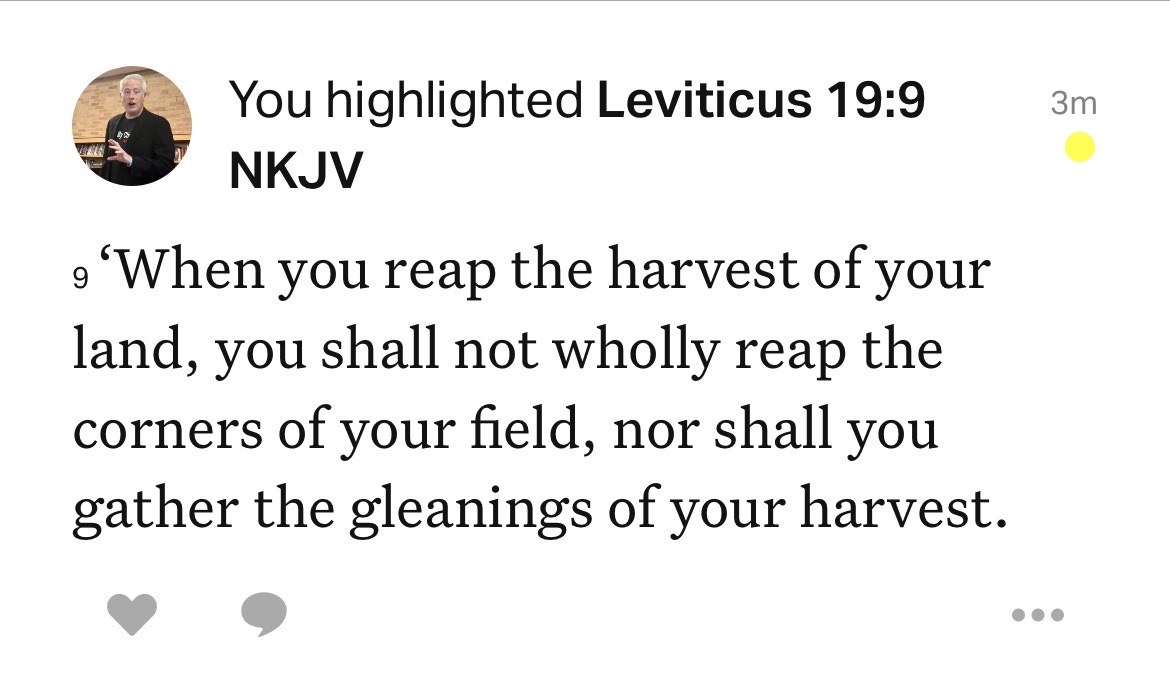
Years later, Boaz was obeying this commandment in Leviticus 19:9. That allowed Ruth to be in his field, which led to a marriage that began the family line of King David, which traces all the way to Jesus! Obedience matters. Just imagine if Boaz had been disobedient in this. The Messiah still would have come, but Boaz and Ruth (and their children and grandchildren) would have missed out on this blessing.

The Danger In Plenty

Listen to the podcast of this post by clicking on the player below, and you can also subscribe on AppleSpotify, or Audible. 

Jesus is teaching us to pray as citizens of the Kingdom of Heaven, and each phrase of this prayer is a reminder of how we interact with the King of Heaven—Our Father in Heaven, hallowed be Your name. Your Kingdom come, Your will be done on earth as it is in Heaven.  

We all have a desire to feel secure—to feel our needs are going to be met. In fact, our anxiety level is usually tied directly to how insecure we may feel. The problem for many of us, however, is that we have mistaken wants for needs, and when those aren’t met as we think they should be, we again experience increasing levels of anxiety. 

We see this on full display in Luke 12. First, Jesus addresses a man who is greedily desiring his share of his father’s inheritance. Jesus says, “Life does not consist in an abundance of possessions.” 

To illustrate this point, Jesus tells a parable of a rich landowner who harvested more crops than he knew what to do with—a harvest which he calls “plenty.” His solution was to build bigger barns for his abundant harvest, to which God announced, “You fool” (Luke 12:13-21). 

This man was not called a fool because he was successful. He was not called a fool because he had plenty. Rather, he was called a fool because his “plenty” caused him to forget his heavenly Father.   

This is an invaluable lesson. Sadly, we tend to be a very forgetful people! 

After God delivered His people from their bondage in Egypt, and they almost immediately start worrying and then complaining about whether their needs will be supplied. God tells them that He will supply every day exactly what they need (Exodus 16:1-35). 

This provision of manna every single morning when they got up was intended to keep them reliant on God and thankful for His provision. But after a while they thought they deserved more—they wanted plenty (Numbers 11:4-6). Later on, Asaph would pinpoints the main culprit of the Israelites’ stumbled throughout their history: forgetfulness (Psalm 78:11, 22-25). 

Jesus taught us to come to God in prayer as Our Father. Just as Jesus was daily dependent on His Father, so He teaches us to have that same level of daily abiding. 

Jesus reminds us what the daily supply of manna really signified; namely, that He would be our Bread from Heaven for all of eternity (John 6:28-40)! 

So that’s why we pray, “Give us today our daily bread.” Once again, this is an acknowledgement that no one else can provide for us, and it is a request that we would stay daily dependent on Him. It’s not, “Give us today our weekly bread.” Or, “Give us today our daily wants.” Or even, “Give us today plenty of things.” 

We need our Father for daily bread so that we never, ever forget or vital, indispensable connection to Him!  

Even when we don’t have plenty, we are told not to worry but instead to look to our Heavenly Father for His daily supply (Luke 12:22; Philippians 4:6-7).

If you’ve missed any of the other messages in this series on prayer, you can check them all out here. 

►► Would you please prayerfully consider supporting this ministry? My Patreon supporters get behind-the-scenes access to exclusive materials. Like some exclusive quotes from a book I just reviewed. ◀︎◀︎

Becoming Childlike

Listen to the podcast of this post by clicking on the player below, and you can also subscribe on AppleSpotify, or Audible. 

I hope you’ve noticed so far that the parts of Christ’s model prayer that we’ve looked at so far are both an acknowledgement of the holiness of God and the greatness of His Kingdom, and also a request for us to be empowered to live in a way that makes those things known to Earthlings. 

One of the ways we live to make these things seen is found in the next phrase: Your will be done on earth as it is in Heaven (Matthew 6:10). 

In A Christmas Carol, Charles Dickens shows us a scene where the Ghost of Christmas Present has taken Scrooge to his nephew’s home. After dinner, these young adults begin playing games. Dickens says, “For it is good to be children sometimes, and never better than at Christmas, when its mighty Founder was a child Himself.” 

Jesus loved children! Being around “the littles” lately at on our school campus, I have a whole new appreciation for this. Because Jesus loved children, their parents wanted them around Him, and He wanted them around too (see Matthew 19:13-15; Mark 10:14-16; Luke 18:15-17).

Children are loud, busy, adventurous, and easily distracted. But they are also loving, trusting, curious, innocent, and easily comforted. And Jesus loved to bless them!   

What does this have to do with “Your will be done on earth as it is in Heaven”? Jesus taught us to address our praying to “Our Father.” That means we are to interact with Him as His children.  

Jesus wants us to be childlike not childish. 

  • trusting not posturing—Matthew 6:7-8 
  • honest not hypocritical—Luke 18:9-14 
  • persistent not whining—Luke 11:9-13 
  • humbly dependent not scheming—Matthew 18:1-4 

[Check out these passages here] 

Children love to do the will of their parents. They’re not trying to earn their approval, but joyfully obeying out of innocence. When we obey God as loving children, we are doing His will on earth as it is done in Heaven! 

So once again, this is both an acknowledgement and a request. 

In Psalm 131, David uses this same picture of a contented child for us. 

Childlike is lovingly dependent. Childish is selfishly independent. Childlike is trusting someone wiser. Childish is believing I know best. 

Our prayer request should always be, “Father, may I trust You and obey You as an innocent child.” 

This is part 4 of our series on prayer called Kingdom Praying. You can check out all of the other messages in this series here. 

►► Would you please prayerfully consider supporting this ministry? My Patreon supporters get behind-the-scenes access to exclusive materials. Like some exclusive quotes from a book I just reviewed. ◀︎◀︎

Living In Kingdom Power

Listen to the podcast of this post by clicking on the player below, and you can also subscribe on AppleSpotify, or Audible. 

Last week I shared a quote about this Kingdom Prayer from the YouVersion reading plan The Prayer That Turns The World Upside Down. Let me remind you of one phrase: “This prayer is dangerous, overturning the kingdom of the principalities and powers of this world.” 

We live on Earth but we are citizens of the Kingdom of God. This prayer is a desire for that eternal Kingdom to be seen by Earthlings so that they will also obtain citizenship. So we saw last week that the phrase “Hallowed be Your name” is both an acknowledgement of God’s greatness and a request that we would display His greatness in our lives. The next phrase—Your Kingdom come (Matthew 6:10)—has that same two-part motivation: acknowledgment and request. 

I wrote Shepherd Leadership to address the non-biblical practices in our churches that had taken on biblical weight. I think this is something that invades many Christian’s thinking about what “the Kingdom of God” actually is. 

Here’s two things I know for sure: (1) Kingdom power ≠ political power, and (2) Kingdom power ≠ religious power. 

A.W. Tozer wrote—

“In Christian circles today, the church that can show an impressive quantitative growth is frankly envied and imitated by other ambitious churches. Numbers, size and amounts seem to be very nearly all that matters…. The great goddess, Numbers, is worshiped with fervent devotion, and all things religious are brought before her for examination. Her Old Testament is the financial report, and her New Testament is the membership roll. To these she appeals as the test of spiritual growth and the proof of success or failure in most Christian endeavors. A little acquaintance with the Bible should show this up for the heresy it is.” 

Jesus was clearly focused on His Father’s Kingdom. The phrase “Kingdom of God” is used over 50 times in the Gospels, and Jesus uses words like “Heaven,” “Hell,” and “eternal life” over 120 times. 

In teaching us to pray, Jesus called us to focus on the eternal. We want people to see “Our Father in Heaven”—in all His hallowed majesty and glory—not merely in the ways we attempt to “Christianize” life on Earth. 

Alan Redpath said, “Before we can pray, ‘Lord, Thy Kingdom come,’ we must be willing to pray, ‘My Kingdom go.’” 

Jesus constantly taught like this, “The Kingdom of Heaven is like….” He said, “The coming of the Kingdom of God is not something that can be observed” (Luke 17:20). Or better stated: The Kingdom of God doesn’t arrive because I oversee something and announce it. 

Peter summed up the ministry of Jesus like this, “How God anointed Jesus of Nazareth with the Holy Spirit and power, and how He went around doing good and healing all who were under the power of the devil, because God was with him” (Acts 10:38).

Jesus told us to live the same way—“When Jesus had called the Twelve together, He gave them power and authority to drive out all demons and to cure diseases, and He sent them out to proclaim the kingdom of God and to heal the sick” (Luke 9:2). 

The early Church was known for living differently—cared for the poor, the young, the sick, the elderly; honored marriage; built hospitals. They were not known because they had political clout. 

Our living Kingdom-focused is the answer to our prayer for God’s Kingdom to come. 

For the kingdom of God is not a matter of talk but of power. (1 Corinthians 4:20) 

We hallow God’s name and we make His Kingdom visible when we seek Him as our only priority. Both of these phrases are acknowledgments of His absolute sovereignty and our desire to be empowered to be anointed by the Holy Spirit to go around doing good and delivering all who are under the power of the devil. 

I love this short verse from A.B. Simpson—

Help me to work and pray, 
help me to live each day, 
that all I do may say, 
‘Thy kingdom come.’

Check out the other messages in our series Kingdom Praying by clicking here. 

►► Would you please prayerfully consider supporting this ministry? My Patreon supporters get behind-the-scenes access to exclusive materials—like this recent Bible study insight from the Gospels. ◀︎◀︎

Praying To Hallow God’s Name

Listen to the podcast of this post by clicking on the player below, and you can also subscribe on AppleSpotify, or Audible. 

We said our protocol in approaching Almighty God in prayer is found in just two words: Our Father. 

Notice the transition: your Father (3x in Matthew 6:6, 8) to Our Father (6:9). How does this happen? Jesus makes it possible and the Holy Spirit continually reminds us of Christ’s completed work (Hebrews 2:11; John 14:13-14; Romans 8:15-16). 

It’s not just “our Father” but “our Father in Heaven.” Let’s remember that our Father is both All-loving and All-powerful. The phrase in Heaven reminds us of His absolute sovereignty. “Our God is in heaven; He does whatever pleases Him” (Psalm 115:3). What pleases Him? To give us His kingdom (Luke 12:32). 

Then there’s another phrase that is vital: Our Father in Heaven, hallowed be Your name. 

Hallowed means both to acknowledge His greatness and to keep Him separate from any profane things. What is profane? The dictionary says it is irreverence or contempt for God. The opposite of profane is holiness—something set apart exclusively for God. This is not something better than something else, but something exclusively that will bring glory to our Father in Heaven.

The root word for hallowed is “holy.” We see this literally translated in the name Holy Spirit. It is a word also referring to Jesus when He is called “the Holy One of God” (see Mark 1:24). The angel uses the word twice when he says, “The Holy Spirit will come on you, and the power of the Most High will overshadow you. So the Holy One to be born will be called the Son of God” (Luke 1:35). 

And that same word translated hallowed and holy is also translated saints. Literally that means “holy ones” or set apart people. 

Jesus is teaching us that our prayer is BOTH an acknowledgment of how God’s name is to be hallowed AND a request that He would empower us to pray and live in ways that makes that happen. 

This means our attitude needs to be focused on God’s reputation not my reputation (as in Matthew 6:5, 7:21-23). 

Our Father in Heaven, hallowed be Your name” is both an attitude of prayer and a lifestyle. 

We hallow God’s name when our prayer and daily lifestyle bring Him the supreme glory that is due exclusively to His awesome name! When we keep our eyes and hearts on Him, He will provide everything else we need (see Matthew 6:32-33). 

To follow along with all of the message in this prayer series called Kingdom Praying, please click here. 

►► Would you please prayerfully consider supporting this ministry? My Patreon supporters get behind-the-scenes access to exclusive materials. Like this exceptional Bible study tool to help with Creation apologetics. ◀︎◀︎

Links & Quotes

Salvation doesn’t arrive on Air Force One. This simple but profound reminder from Chuck Colson should send Christians to prayer instead of seeking a merely political solution. Check out my full message about trusting God vs. trusting the government hereI have lots of new content every week, which you can check out on my YouTube channel.

Matthew Walker, director of the Center for Human Sleep Science, says, “Sleep is the universal health care provider: whatever the physical or mental ailment, sleep has a prescription it can dispense.” It’s not just medical science, but the Bible also talks about the value of sleep, as Scott Hubbard explains in this post. I’ve also shared some posts about sleep here, here, and here.

Don’t you love the beautiful melody of songbirds? Being a percussionist, I’m attracted to the woodpeckers. Scientists have found that woodpeckers are the only non-songbird that share an identical genetic marker in their brains with songbirds. That means that the drumming of woodpeckers is actually a song!  Check out some additional fascinating insights about our drumming friends in this post. 

I love this story from the early 1900s! Small prayer meetings began to converge to become a Pentecostal revival in the Pacific Northwest. 

“What is the best thing in the world? To please its Creator. What is His will? To fulfill what He commanded, that is, to live rightly and dutifully to seek the Eternal; for duty and justice are the will of Him Who is dutiful and right. How do we seek this goal? By application. Then we must apply ourselves in duty and justice. What helps to maintain this practice? Understanding, which, while it winnows the remainder and finds nothing solid to rest in amongst those things which the world possesses, turns in wisdom to the one thing which is eternal.” —Columbanus

“Jesus taught us to pray that the Kingdom would come on earth in the same way that it exists in heaven. … Jesus made praying for the Kingdom the highest priority in our prayers after praising and honoring God. The Kingdom is more important than our daily needs. The Kingdom is more to be desired than that our sins should be forgiven or that we should be rescued through temptation [Matthew 6:9-13].” —T. M. Moore

Stephen O. Presley wrote, “If our modern world resembles the ancient one, perhaps we could glean some wisdom from the ways the early church navigated these murky waters. As Polycarp testifies, the Scriptures were essential to the early Christian apologetic. Passages such as Romans 13:1 and Matthew 22:21, alongside the examples of Old Testament figures such as Joseph and Daniel, guided the church’s vision for engaging the unbelieving world.” His post especially caught my eye after I shared a very similar message to my flock this past Sunday.

Sean McDowell sits down with an Old Testament professor to discuss 10 of the most bizarre OT passages (as selected by Sean’s X followers).