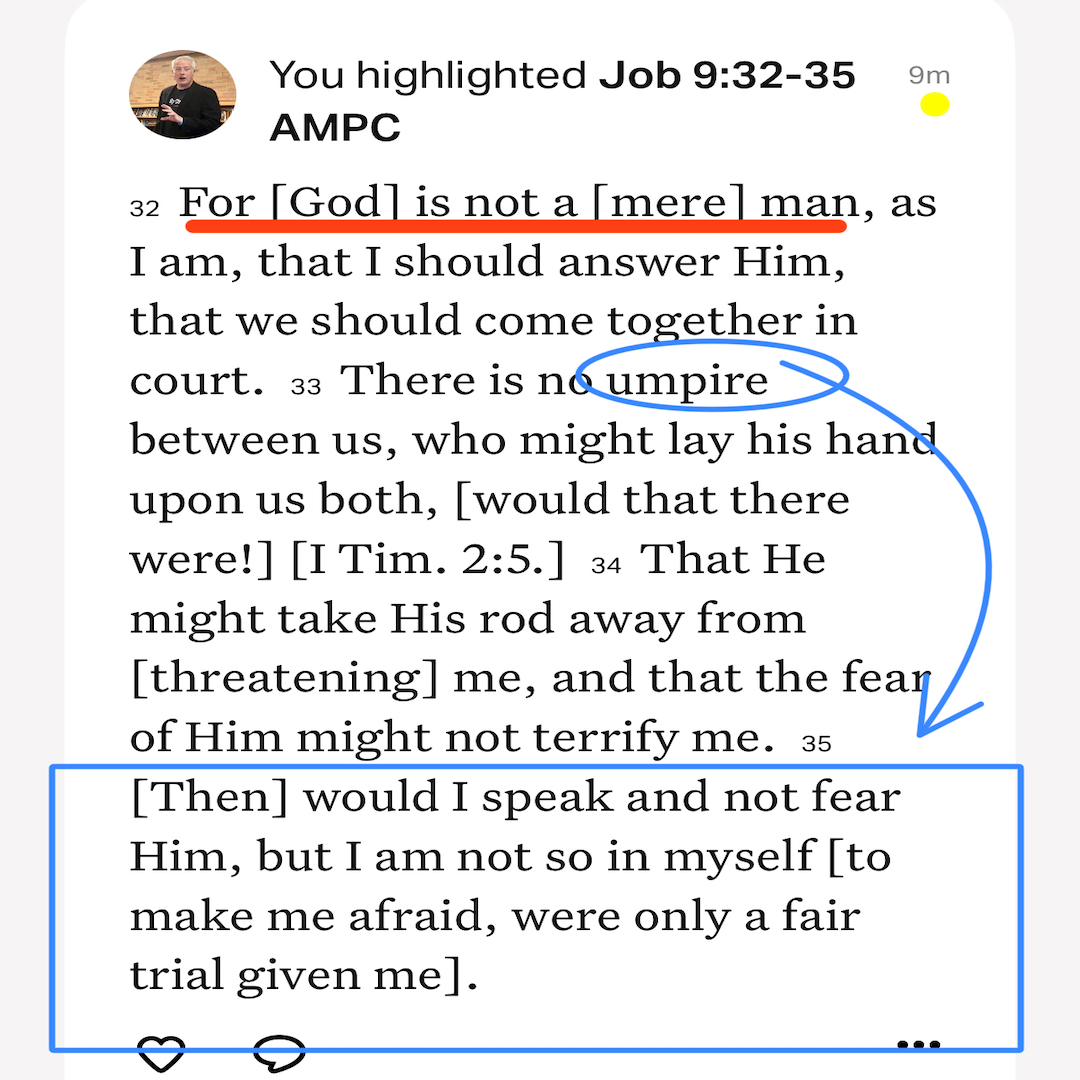
For God is not a mere man, as I am, that I should answer Him, that we should come together in court. There is no umpire between us, who might lay his hand upon us both—would that there were! That He might take His rod away from threatening me, and that the fear of Him might not terrify me. Then would I speak and not fear Him, but I am not so in myself to make me afraid, were only a fair trial given me. (Job 9:32-35 AMPC)
The “umpire” or mediator for whom Job was longing is Jesus.
Both Paul (Galatians 3:19-20; 1 Timothy 2:5) and the writer of Hebrews (8:6, 9:15, 12:24) make it clear that what Job said was true: Man cannot come before God on his own, let alone attempt to argue his case.
Listen to the podcast of this post by clicking on the player below, and you can also subscribe on Apple, Spotify, or Audible.
The dictionary defines a rhetorical question this way: A question asked solely to produce an effect or to make an assertion of affirmation or denial. In other words, the question is asked with the assumption that the answer is obvious.
The apostle Paul does this five times in five consecutive verses at the end of Romans 8 (see verses 31-35). These questions are Paul’s way of getting us to reaffirm our rock-solid assurance of just how amazing it is that God holds us so securely.
Even though these are rhetorical questions, I want to add the extra assurance by giving you the answer to each question.
(1) Who can stand against me? No one!
Because Almighty God is for me.
(2) Who can cause God’s blessings to be withheld from me? No one!
Because God didn’t withhold His Son Jesus, He won’t withhold any other lesser blessing either.
Because Jesus intercedes for me and imputes His righteousness to me.
(5) Who can separate me from God’s love? No one!
Not a single thing, person, or circumstance can diminish any part of God’s love for me.
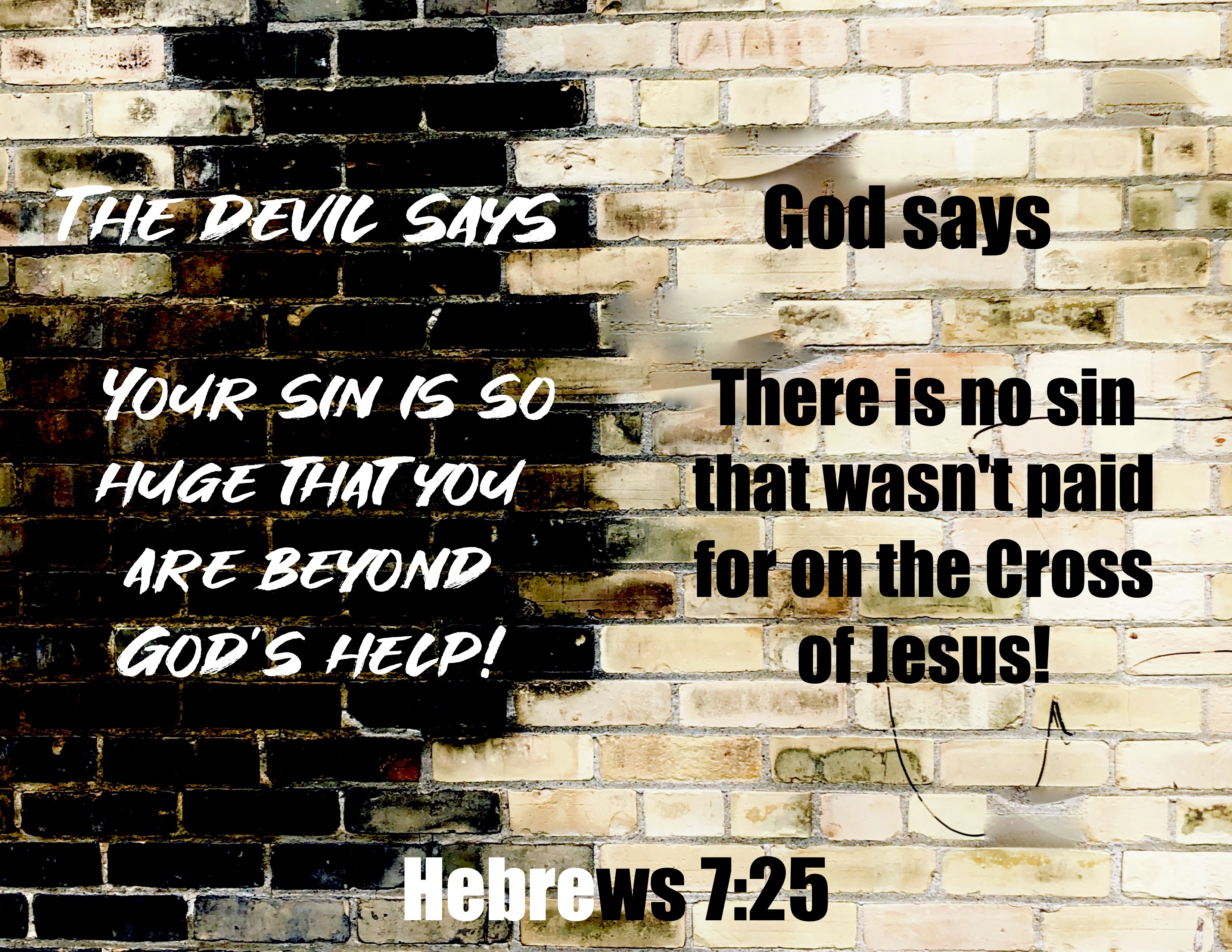
Don’t ever buy into the devil’s lies—not even for a second—that somehow you have put yourself in a place where God’s love for you is questionable. Whenever you hear these lies, return again and again to these five powerful rhetorical questions to reassure your heart, mind, and soul of just how securely you are held in God’s grip of grace.
This is a weekly series with things I’m reading and pondering from Charles Spurgeon. You can read the original seed thought here, or type “Thursdays With Spurgeon” in the search box to read more entries.
Listen to the podcast of this post by clicking on the player below, and you can also subscribe on iTunes or Spotify.
Love So Amazing
Forgiving one another, even as God for Christ’s sake has forgiven you. (Ephesians 4:32)
The first phrase to think about is ‘for Christ’s sake.’ We use these words very often, but probably we have never thought of their force. … All the good things that God has bestowed upon us have come to us ‘for Christ’s sake.’ But especially the forgiveness of our sins has come ‘for Christ sake.’ …
It is His very love as well as His holiness and His justice that, if I may use such a term, compels Him to severity of judgment so that sin cannot and must not be blotted out till atonement has been presented. There must, first of all, be a sacrifice for sin, that, mark you, the great Father, to show His love, supplies, for it is His own Son who is given to die! And so the Father Himself supplies the ransom through His Son, that Son is one with Himself by bonds of eternal unity, mysterious but most intense. If God demands the penalty in justice, He Himself supplies it in love. …
I want you to consider, for a moment, how readily God may now blot out sin since Christ has died. … God, for Christ’s sake, has accepted us in Him, has forgiven us in Him, and looks upon us with infinite love, changeless in Him. This is how all our blessings come to us, in and through Christ Jesus. And if we are indeed in Him, the Lord does not only forgive us our sins, but He bestows upon us the boundless riches of His grace in Him. In fact, He treats us as He would treat His Son. He deals with us as He would deal with Jesus! …
And you, big evil sinner, if you will go to God at this moment and say, ‘Lord, I cannot ask You to forgive me for my own sake, but do it out of love for Your dear Son,’ He will do it…. Christ took the shame that He might magnify His Father, and now His Father delights to magnify Him by blotting out the sin.
From Forgiveness Made Easy
I’ve lost track of the number of times someone has told me, “I’ve messed up for so long—I’ve done such atrocious things—there is no way God could forgive me.” This is one of satan’s lies that keeps people from accepting God’s forgiveness.
Don’t wait another moment: If you haven’t asked God to forgive you “for Christ’s sake,” do it right this very minute! I’d love to chat with you about this, so reach out to me and let’s talk more about this amazing new relationship you now have with Almighty God because you are forgiven for Christ’s sake.
Listen to the podcast of this post by clicking on the player below, and you can also subscribe on Apple or Spotify.
Jesus lived out the example of wholly healthy growth. The way Dr. Luke records it, the pinnacle of Christ’s health (and our health too) is seen in our relationships with other people.
Why is relational maturity at the peak of the pinnacle? How else could you know whether you truly have mental, physical, and spiritual health unless it’s put to the test? And the ultimate test is how we react when we’re caught off guard. Our so-called Freudian slips can reveal an area of immaturity. C.S. Lewis reminds us that the suddenness of the provocation that caused the slip didn’t create our immature response, but it actually revealed what is really inside our hearts. Surely our unplanned reactions are a better indicator of our spiritual maturity than our planned actions!
Jesus told us that our “slips” reveal what’s really inside (Matthew 15:19), but are these really unknown to us? If we’re really honest, how many times do we think unpleasant things without saying them or doing them? The Holy Spirit—the Spirit of Truth—knows so well what’s on the inside (Psalm 139:1-4).
When we experience one of these slip ups, the devil loves to pounce! Paul calls it “sin seizing an opportunity” (Romans 7:7-11). But even as sin pounces, Paul assures us, “Therefore there is no condemnation for those who are in Christ Jesus” (Romans 8:1).
What is the “therefore” there for? After the “therefore” the Holy Spirit as the Spirit of Adoption reminds us we are in Jesus and children of God, and the Holy Spirit as the Spirit of Intercession help us pray perfect, childlike prayers. So what comes before the “therefore” must be something that makes us feel unworthy, distant, and condemned.
Paul explains that “we died to sin” (Romans 6:2). That word “died” means to be separated from one thing which brings about the destruction of the other thing. When we are separated from God by our sin we are dead, when are separated from our sin by God we are alive. At that moment of salvation, we stand before Almighty God justified—just as if I’d never sinned. That is irrevocable: God will never go back on that, we will never slip away from His grace. But that moment of salvation also begins a lifelong process of sanctification—or as I like to say it saint-ification.
Remember that pyramid of growth Jesus demonstrated for us? Paul says, “I myself in my mind am a slave”(Romans 7:25). The mind is where the Spirit of Truth begins His maturing, saint-ifying process in us. As our minds are transformed, then our bodies and our mouths can live out a Christlike lifestyle (see Romans 12:1-2). It’s this mind and body transformation that matures our spiritual health, which is then revealed in our relationships with others.
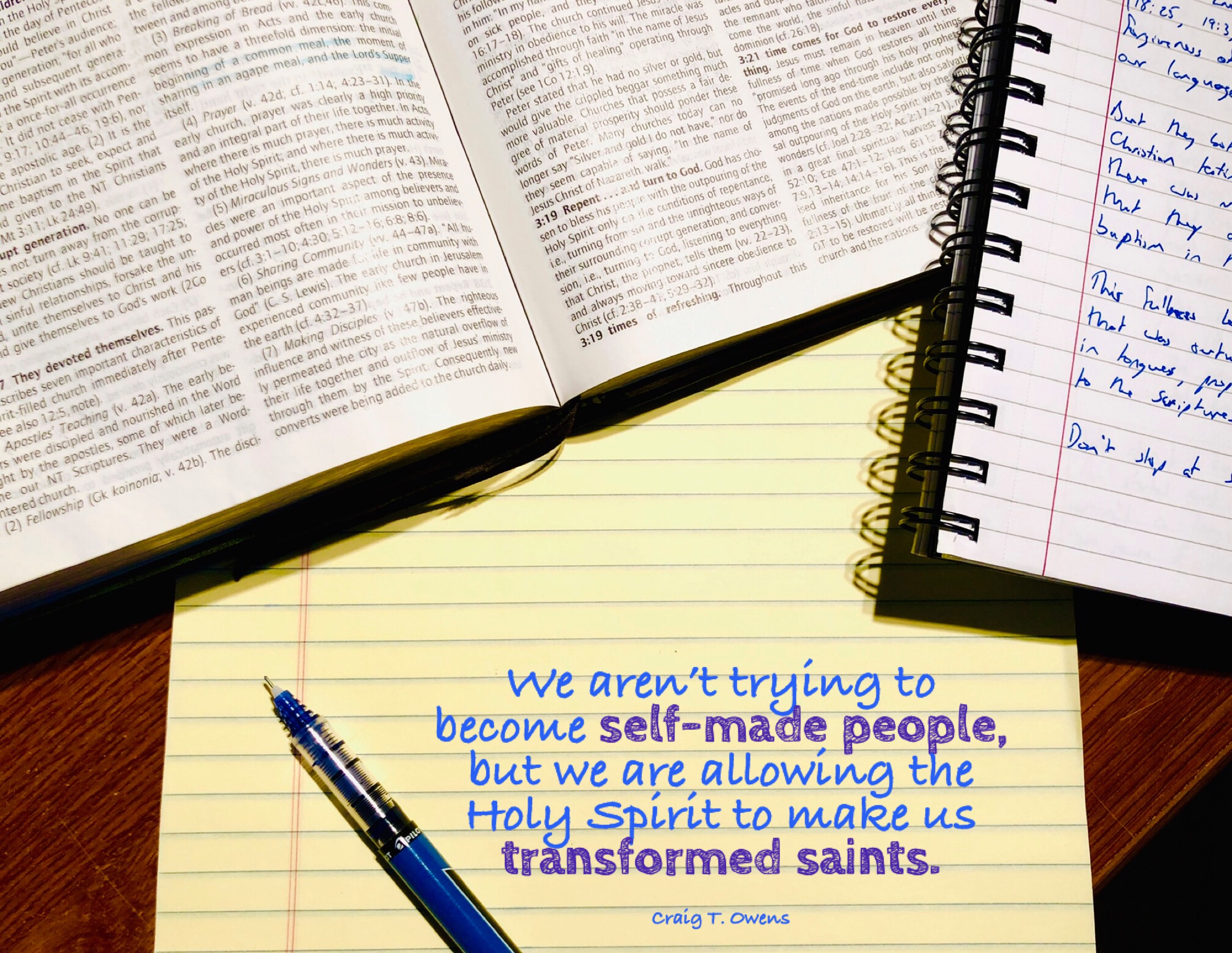
Notice that it is after we have been through this transformation of mind, body, and spirit that Paul tells us the standard for God-honoring living. This is where we see even our unplanned reactions becoming more and more Christ-like (Romans 12:9-21). We cannot live out this Romans 12 mandate solely on our own willpower. We aren’t trying to become self-made people, but instead, we are allowing the Holy Spirit to make us transformed saints. Transformed saints that are known by their unplanned Christlike reactions.
This is why I keep stressing for Christians to not stop at salvation, but to press on to be baptized in the Holy Spirit.
This is a weekly series with things I’m reading and pondering from Charles Spurgeon. You can read the original seed thought here, or type “Thursdays With Spurgeon” in the search box to read more entries.
Listen to the podcast of this post by clicking on the player below, and you can also subscribe on iTunes or Spotify.
The Joyful Journey To Realization
And [Abram] believed in the Lord, and [God] accounted it to him for righteousness. (Genesis 15:6)
Brothers and sisters, this everyday faith is the faith of God’s elect! There are persons who imagine saving faith to be a barren conviction of the truth of certain abstract propositions, leading only to a quiet contemplation upon certain delightful topics, or separating ourselves from all sympathy with our fellow creatures. But it is not so! Faith, restricted merely to religious exercise, is not Christian faith. It must show itself in everything. …
There may be some of you here today who have been called by divine grace from darkness into marvelous light. You have been led to look to Jesus and you believe you have received pardon of your sin, and yet, for lack of knowledge, you know little of the sweet meaning of such words as these: ‘accepted in the Beloved’ (Ephesians 1:6); ‘perfect in Christ Jesus’ (Colossians 1:28); ‘complete in Him’ (Colossians 2:10). You are doubtless justified, though you scarcely understand what justification means. And you are accepted, though you have not realized your acceptance. And you are complete in Jesus Christ, though you have, today, a far deeper sense of your personal incompleteness than of the all-sufficiency of Jesus. …
But there will come a time, beloved, when you who are called will clearly realize your justification and will rejoice in it! It will be intelligently understood by you and will become a matter of transporting delight—lifting you to a higher platform of experience and enabling you to walk with a firmer step, sing with a merrier voice, and triumph with an enlarged heart!
From Justification By Faith
I was once asked, “If you could have a superpower, what would it be?” After a moment’s thought, I answered, “I’d like the power to just go <poof> for someone and they would be able to fully comprehended God’s love for them, or they would instantly realize how to live out their Christian faith.”
Alas, there is no such superpower. But you and I have something far, far better: the Holy Spirit!
Abram (who would later become Abraham) obediently followed God, even though the Bible said he didn’t fully grasp where he was going nor how God was going to give him many descendants. But he followed, and he trusted, and he listened, and slowly God began to reveal more and more to him.
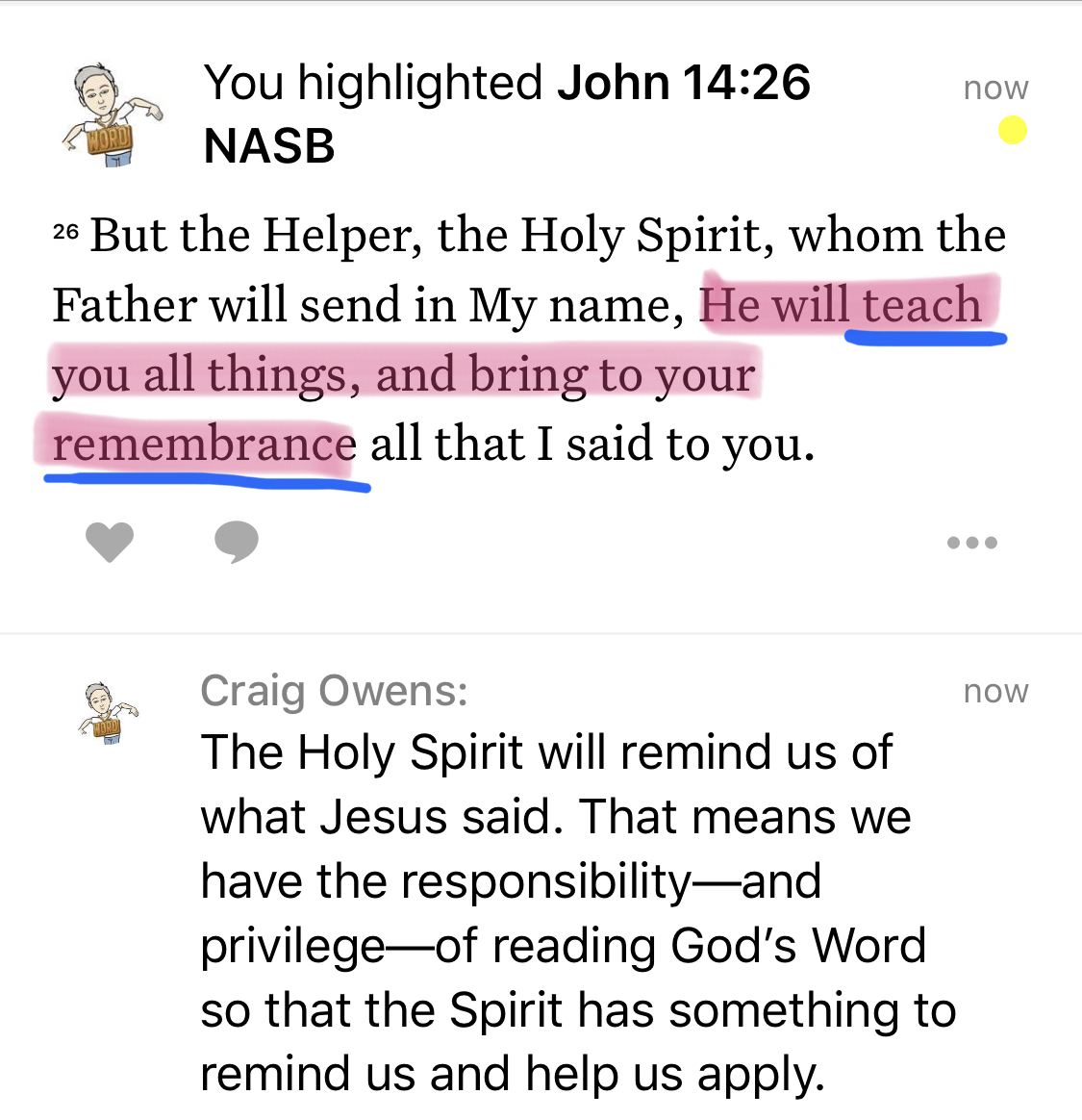
Jesus said the Holy Spirit would guide us into all truth. He didn’t say, “The Holy Spirit will go <poof> and you will immediately and fully understand everything.” Like Abram, we believe what God says about us, we follow, we trust, we listen, we obey, and the Spirit will begin to illuminate God’s Word to us. We’ll discover more each day what He’s asking of us, and we will notice that both our joy in Him and our effectiveness for the Kingdom of God are increasing along the journey!
Don’t bail out early! Stick with it! I promise you that the joy still to be revealed along this journey is beyond compare with anything which would tempt you to stay behind to acquire.
Throughout the story of Job, there is very little insight from the story’s narrator. Other than the first two chapters which set up the story, and the epilogue in the last chapter, the narrator barely utters a word.
That is until a fourth man, who has been on the scene the whole time Job and his friends have been debating, finally cannot help but speak out. His name is Elihu.
Elihu has been present the whole time Job has been speaking with his other friends, but because Elihu is the youngest, he has held his tongue, awaiting an opportunity to speak. Now the narrator tells us that Elihu “became very angry with Job for justifying himself rather than God. He was also angry with the three friends, because they had found no way to refute Job, and yet had condemned him. … When he saw that the three men had nothing more to say, his anger was aroused.”
The phrase “anger was aroused” is used 31 times in the Bible. Every single instance refers to God’s anger except here. In fact, God uses the same phrase in chapter 42 that Elihu uses here.
Two things seem to arouse the anger of both God and Elihu (whose name, but the way, means “He is my God”):
Job justifying himself rather than God
Job’s friends condemning Job without evidence; in other words, they put themselves in the place of God the Judge
Here’s what Elihu knew—
To not get angry at the things that anger God is itself a sin.
I need to pay attention to my anger, and I need to express my anger in a respectful, appropriate way. It is wrong to ignore or suppress godly anger, but it is equally wrong to sin in the way that I express godly anger. Remember that the apostle Paul doesn’t say, “Don’t get angry,” but he says, “When you get angry, do not sin” (Ephesians 4:26).
When God finally speaks in this story, He expresses His anger at the same things Elihu addressed. Interestingly, God says to the oldest friend Eliphaz, “I am angry with you and your two friends,” but God doesn’t call out Elihu for any of his words.
God gets angry, perhaps more than anyone else in the Bible does, but He never sins in the expression of His anger. We need to make sure that what makes us angry is also what makes God angry. And we need to make sure that our anger is never expressed sinfully.
This is a weekly series with things I’m reading and pondering from Charles Spurgeon. You can read the original seed thought here, or type “Thursdays With Spurgeon” in the search box to read more entries.
Righteous Father
O righteous Father! The world has not known You, but I have known You; and these have known that You sent Me. And I have declared to them Your name, and will declare it, that the love with which You loved Me may be in them, and I in them. (John 17:25-26)
In the sublime transactions of Calvary, God manifests all the love of a tender Father’s heart and all the justice of an impartial Ruler’s sword! …
When we see in a man unconditional submission to the justice of God and yet a trustful hopefulness in His boundless love, we may be sure that he is a renewed man. He cries, “You are righteous, O my God, and if You destroy me, I can say nothing. But, Father, You will not destroy me, for I perceive that You are love. Though I see You grasp your sword of fire, yet do I trust You, for I still believe You to be gracious and loving.” …
They would not have come to know the righteous Father unless there had been a change in their character worked by the Spirit of God, and that once done they know Him as of necessity. … To know the only true God, and Jesus Christ whom He has sent, is the climax, the essence, the sum total of wisdom! …
In Christ Jesus, God is just and yet our Justifier! We are so safe that we begin to challenge opposition and cry, “Who shall bring a charge against God’s elect?” (Romans 8:33). We take up a triumphant note and sing with exceeding joy, “If God is for us, who can be against us?” (Romans 8:31). If God is righteous and yet my Father, then I am saved and saved in such a way that the attributes of God are glorified by my salvation, and therefore I am most securely and certainly saved!
From The Righteous Father Known And Loved
Jesus prayed that we might know the Father as He knew Him—both just and the Justifier.
When we know God this way, we also know ourselves and our position in Him more clearly. We are both guilty and worthy of God’s full wrath AND justified and an object of God’s favor. We can never earn this on our own, but we stand in this precious and secure place only because we stand in the righteousness of Jesus.
Jesus wants us to know His Father this way. Do you?
I like to think of Horatius Bonar as a tour guide as I read through the Bible, pointing out themes and insights I might have otherwise missed. Check out my full review of Light and Truth—Old Testament by clicking here.
“The elders[1 Chronicles 21:16]. They acknowledge the stroke and the sin: ‘It is the Lord.’ They clothe themselves in sackcloth, they fall upon their faces. So far as we know, they had not shared David’s sin, yet they at once place themselves by his side in confession and humiliation. David had sinned (v. 8), Israel had sinned (2 Samuel 24:1). They identify themselves with both. It is thus that we should take up a ruler’s sin, or a brother’s sin, or a nation’s sin; not blazoning it abroad in private gossip, or in the newspapers, but taking it on ourselves, and carrying it to God.”
“We do great injustice to the Old Testament saints and to their privileges, and no less so to the God who made them what they were, when we conceive of them as possessing an imperfect justification, or an imperfect and uncertain knowledge of their justification. Paul’s declaration was explicit on this point: ‘I know Whom I have believed’; and yet it was not a jot more explicit than that of Job: ‘I know that my Redeemer lives.’ When Paul said, ‘It is God that justifies, who is he that condemns?’ he was only speaking what Job had spoken in ages before: ‘I know that I shall be justified. Who is he that will plead with me?’” [Job 13:18-19]
“Everything in God’s character, has by the Cross of Christ been turned into a reason for trusting Him. The more man knows of Him the more he trusts. Trust is the natural and inseparable response of the soul to the divine revelation of the character of God. It is not what man sees in himself, of his good deeds or good feelings, of his graces, or his repentance, or his regeneration, or his faith; but what he sees in God, that calls out confidence.”
“It is with no distant, unheeding God that we have to do; but with that God who fixes the bounds of our habitation, who counts our hairs, who feeds the ravens, notes a sparrow’s death, clothes the lilies of the field. He is nearer to us than the nearest earthly object or being; more closely in contact with us than we are with one another.”
“We disjoined God from creation, and so see nothing in it of divine life and power. … The separation of God from His works is one of the awful features of human unbelief. How much more of Him should we know, were we to interpret His works aright. … These skies of His are not bent over us in beauty without a meaning. These seas of His do not roll for nothing. These flowers of His are not fragrant and fair for nothing. They do not say to us, ‘God is your enemy, He hates you’; but ‘God is your friend, He pities you, yearns over you, wishes to make you happy.’ How full a gospel does creation to preach to us, according to its kind and measure!”