O the Spirit-filled life; is it thine, is it thine?
Is thy soul wholly filled with the Spirit Divine?
O thou child of the King, has He fallen on thee?
Does He reign in thy soul, so that all men may see
The dear Savior’s blest image reflected in thee?
Has He swept through thy soul like the waves of the sea?
Does the Spirit of God daily rest upon thee?
Does He sweeten thy life, does He keep thee from care?
Does He guide thee and bless thee in answer to prayer?
Is it joy to be led of the Lord anywhere?
Is He near thee each hour, does He stand at thy side?
Does He gird thee with strength, has He come to abide?
Does He give thee to know that all things may be done
Through the grace and the power of the Crucified One?
Does He witness to thee of the glorified Son?
Has He purged thee of dross with the fire from above?
Is He first in thy thoughts, has He all of thy love?
Is His service thy choice, and is sacrifice sweet?
Is the doing His will both thy drink and thy meat?
Dost thou run at His bidding with glad eager feet?
Has He freed thee from self and from all of thy greed?
Dost thou hasten to succor thy brother in need?
As a soldier of Christ dost thou hardness endure?
Is thy hope in the Lord everlasting and sure?
Hast thou patience and meekness, art tender and pure?
O the Spirit-filled life may be thine, may be thine,
In thy soul evermore the Shekinah may shine;
It is thine to live with the tempests all stilled,
It is thine with the blessed Holy Ghost to be filled;
It is thine, even thine, for thy Lord has so willed. —Lettie Cowman
Only let your conduct be worthy of the gospel of Christ… (Philippians 1:27).
The apostle Paul wanted the Philippians’ living to be their preaching. Much like Francis of Assisi said years later: “Preach always; if necessary, use words.”
The big question is—what does conduct “worthy of the gospel of Christ” look like? I believe Paul identifies at least 15 characteristics in just the next 20 or so verses…
Heavenly Father, may it always be said of my life that it is one that is worthy of the gospel of Christ. May I always be sensitive to the nudges of the Holy Spirit to keep my life aligned in this way. In Jesus’ name I pray, Amen!
I have not stopped thanking God for you. I pray for you constantly. (Ephesians 1:16)
Paul didn’t pray just a one-and-done prayer, but every time he thought of his friends he was grateful and prayerful.
What a prayer Paul prayed! He didn’t want his friends just barely eking out an existence, but he desired for their lives to experience explosive growth and joy!
He prayed for them to experience…
I like the way Eugene Peterson captures this prayer in The Message:
That’s why, when I heard of the solid trust you have in the Master Jesus and your outpouring of love to all the followers of Jesus, I couldn’t stop thanking God for you—every time I prayed, I’d think of you and give thanks. But I do more than thank. I ask—ask the God of our Master, Jesus Christ, the God of glory—to make you intelligent and discerning in knowing Him personally, your eyes focused and clear, so that you can see exactly what it is He is calling you to do, grasp the immensity of this glorious way of life He has for His followers, oh, the utter extravagance of His work in us who trust Him—endless energy, boundless strength!
Spiritual leaders should be working for and praying for the ever-growing maturity of those under their care. When they see that growth, they should burst out into grateful prayer. And if they don’t see the growth they anticipated, they should pray in faith believing that maturity will soon be visible.
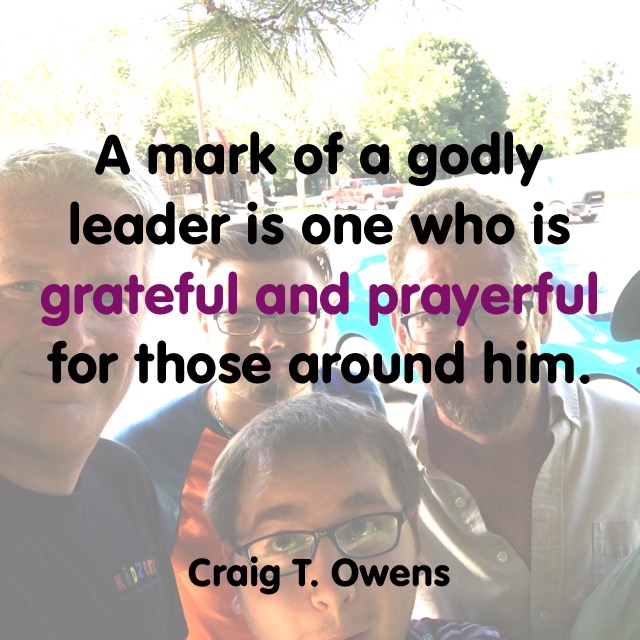
Let me say it again: The mark of a godly leader is one who is grateful and prayerful of those around him.
This is part 40 in my series on godly leadership. You can check out all of my posts in this series by clicking here.
Notice that the title of this post says “when” not “if.” Maybe this will be a newsflash for some of you (but I highly doubt it): Christians will face trials.
Even the apostle James says, “Dear brothers and sisters, when troubles of any kind come your way, consider it an opportunity for great joy” (James 1:2). Wait, trials are “an opportunity for great joy”? How can that be?!
→ Trials teach us lessons that we can learn in no other way! ←
How much more mature, and wise, and empathetic would we become if instead of trying to get out of the trials that come our way, we would instead see what we could get out of that trial!
We can rejoice, too, when we run into problems and trials, for we know that they help us develop endurance. And endurance develops strength of character, and character strengthens our confident hope of salvation. And this hope will not lead to disappointment. For we know how dearly God loves us, because He has given us the Holy Spirit to fill our hearts with His love. (Romans 5:3-5)
So the next time a trial comes your way, ask the Holy Spirit to show you what lessons you can learn by going through the trial.
…And because of this I rejoice. Yes, and I will continue to rejoice (Philippians 1:18).
Paul is in prison, yet he tells his friends that he is choosing to rejoice. Wow!
Not only that, but this same imprisoned man also reminds his friends to…
John Maxwell has noted that most people have uphill dreams but downhill habits. That is definitely not a winning combination!
Paul is making his friends aware of the possible downhill habits that may hold them back from their uphill dreams, and using himself as an example. This first step—awareness—is vital if we are going to break free of the things that are pulling us away from our God-given dreams.
Solomon wrote, “The path of life leads UPWARD for the prudent to keep them from GOING DOWN to the realm of the dead” (Proverbs 15:24).
Being prudent is saying, “I’m always on the lookout for what’s best.”
None of us can go UP by ignoring our downhill habits, or even trying to coast through life. The only way to achieve our uphill dreams is to ask the Holy Spirit to reveal our downhill habits so that we can make a plan to turn those around.
Check out these characteristics that Paul shares—
A good prayer for all of us who have uphill dreams that we want to achieve—Holy Spirit, reveal to me my downhill habits. I acknowledge that I need Your help to see and break these habits. Then help me to replace them with Christ-honoring uphill habits that will allow me to achieve the purpose God has for my life.
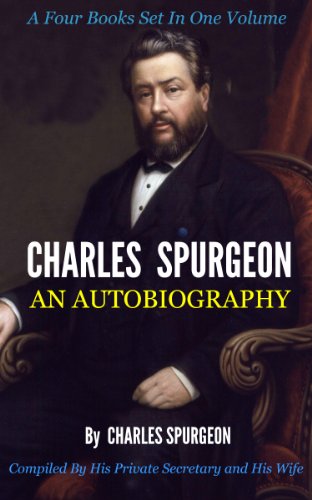
Charles Spurgeon lived exactly as he preached. What a delight that is! Check out my full book review of his Autobiography by clicking here. Also, be sure to check out my weekly Thursdays With Spurgeon series, where I share longer passages from this Prince of Preachers.
“My sole hope for heaven lies in the full atonement made upon Calvary’s Cross for the ungodly. On that I firmly rely. I have not the shadow of a hope anywhere else.”
“While my brief term on earth shall last, I should be the servant of Him who became the Servant of servants for me.”
“For I am persuaded there are more delights in Christ, yea, more joy in one glimpse of His face than is to be found in all the praises of this harlot-world, and in all the delights that it can yield to us in its sunniest and brightest days.”
“I have found, in my own spiritual life, that the more rules I lay down for myself, the more sins I commit. The habit of regular morning and evening prayer is one that is indispensable to a believer’s life, but the prescribing of the length of prayer, and the constrained remembrance of so many persons and subjects, may gender unto bondage and strangle prayer rather than assist it.”
“There is nothing that more tends to strengthen the faith of the young believer than to hear the veteran Christian, covered with scars from the battle, testifying that the service of his Master is a happy service, and that, if he could have served any other master, he would not have done so, for His service is pleasant and His reward everlasting joy.”
“I went to my chamber and told my little griefs into the ears of Jesus. They were great griefs to me then, though they are nothing now. When on my knees I just whispered them into the ear of Him who had loved me with an everlasting love, oh, it was so sweet! If I had told them to others, they would have told them again, but He, my blessed Confidant, knows all my secrets, and He never tells again.”
“That God predestined, and yet that man is responsible, are two facts that few can see clearly. They are believed to be inconsistent and contradictory to each other. If, then, I find taught in one part of the Bible that everything is foreordained, that is true; and if I find, in another Scripture, that man is responsible for all his actions, that is true. And it is only my folly that leads me to imagine that these two truths can ever contradict each other.”
“It was said of an old Greek philosopher that he wrote over his door, ‘None but the learned may enter here.’ But Christ writes over His door, ‘He who is simple, let him turn in hither.’”
“I used to think, sometimes, that if they had degrees who deserved them, diplomas would often be transferred and given to those who hold the plow handle or work at the carpenter’s bench; for there is often more divinity in the little finger of a plowman than there is in the whole body of some of our modern divines. ‘Don’t they understand divinity?’ someone asks. Yes, in the letter of it, but as to the spirit and life of it, D.D. often means Doubly Destitute.” 😀
“When I came to New Park Street Chapel, it was but a mere handful of people to whom I first preached; yet I can never forget how earnestly they prayed. Sometimes they seemed to plead as though they could really see the Angel of the covenant present with them, and as if they must have a blessing from Him. More than once, we were all so awestruck with the solemnity of the meeting that we sat silent for some moments while the Lord’s power appeared to overshadow us. All I could do on such occasions was to pronounce the benediction and say, ‘Dear friends, we have had the Spirit of God here very manifestly tonight; let us go home and take care not to lose His gracious influences.’ Then down came the blessing; the house was filled with hearers, and many souls were saved. I always give all the glory to God, but I do not forget that He gave me the privilege of ministering from the first to a praying people.”
“It is the extremity of unwisdom for a young man, fresh from college or from another charge, to suffer himself to be earwigged by a clique, and to be bribed by kindness and flattery to become a partisan, and so to ruin himself with one half of his people.”
“It is of no use to rise before an assembly and hope to be inspired upon subjects of which one knows nothing. If anyone is so unwise, the result will be that, as he knows nothing, he will probably say it, and the people will not be edified. But I do not see why a man cannot speak extemporaneously upon a subject that he fully understands. Any tradesman, well versed in his line of business, could explain it without needing to retire for meditation, and surely I ought to be equally familiar with the first principles of our holy faith. I ought not to feel at a loss when called upon to speak upon topics that constitute the daily bread of my soul.”
Paul and Timothy, bondservants of Jesus Christ, to all the saints in Christ Jesus who are in Philippi, with the bishops and deacons (Philippians 1:1).
In just his opening line, Paul lists three types of servant-leaders: bondservants, bishops, deacons.
The servant-leaders are all called to put the needs of the saints ahead of their own needs. They all serve so the saints can shine! And as the saints shine, they attract others to Jesus Christ.
Jesus is our example of the Ultimate Servant (Philippians 2:5-8), and we are called to follow His example (John 13:12-17).
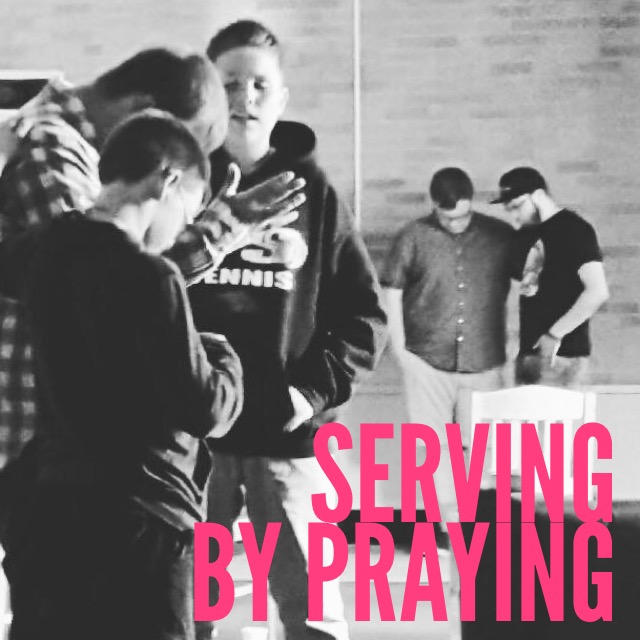
One thing that clearly kept Paul, Timothy, and the other servant-leaders in Philippi in this servant’s posture was prayer. Even the physical posture of kneeling in prayer is a posture of a servant who is actively serving.
Here are four powerful lessons for all Christians to live out…