Leaders must resist trying to rush in “to save the day.” We need to let our teammates learn how to rescue themselves through a time of productive struggle. Check out the full conversation Greg and I had in our episode “The struggle is real (but necessary).”
I have had an ongoing series of posts and videos called “Is that in the Bible?” Many times we discover that a phrase we think is biblical isn’t found in the Scripture or it is being used out of context. John Stonestreet addresses this same concern. He writes, “Selective proof-texting points to how widespread and deep biblical illiteracy is. In addition to an ignorance of the actual content of the Bible, there is ignorance about what the Bible even is, and how Christians throughout the ages have used it. It’s bad when this ignorance shows up in politics. It’s sad when it shows up in our churches and Christian subcultures.”
“Strength does not come from winning. Your struggles develop your strengths.” —Arnold Schwarzenegger
Marcus Buckingham shared something fascinating: “I studied 3000 Disney housekeepers. Eight of them told me what they loved about their work. One vacuums herself out of every room to make perfect carpet lines. Another lies on every bed to test the ceiling fan because dust falling means guests think the room is dirty. A third arranges kids’ toys in elaborate scenes—Mickey with the TV remote, Minnie with french fries. All breaking Disney’s rules. All excellent for completely different reasons. Stop building competency models for leaders. The best leaders are super different from each other. Average is homogenous. Excellence is idiosyncratic.”
Some human employers may ask us to do business for them without giving us a good example or enough resources. But when Jesus told us to be about the Father’s business, He gave us an example and the full empowerment of the Holy Spirit! Check out this full sermon.
“Compromise is a costly word; non-compromise, even more so.” —Bono
Shane Morris said, “But as much as AI’s potential can cause harm, blaming it alone misses the point and likely makes these problems worse. Humans are the fallen ones, and that fallenness manifests in all kinds of destructive ways. Machines, strictly speaking, don’t have morals or intentions. They can only reflect ours.” Check out his podcast AI is not the problem, we are.
“I do not believe that a nation dies save by suicide. To the very last every problem is a problem of will; and if we will we can be whole. But it involves facing our failures as well as counting our successes.” —G.K. Chesterton
I love reading and I have a long list of what I would like to read next. Scott Hubbard addresses this question: “Perhaps the question ‘What should I read or listen to?’ would come into sharper focus if we had a better sense of why we read at all. ‘Why read?’ has more than one right answer. We read to learn, to rest, to deepen friendship with fellow readers, to enjoy the craft of skilled wordsmiths. But alongside these good reasons, consider three others that put our reading into the service of greater loves.”
“I only hope that we never lose sight of one thing—that it was all started by a mouse.” —Walt Disney
“The scientific man does not aim at an immediate result. … His duty is to lay the foundation for those who are to come, and point the way.” —Nikola Tesla
This week marked the 100th anniversary of a court case that was known as “the trial of the century,” perhaps you have heard it called the Scopes Monkey Trial. It was, and has been, more sensation than substance. Check out this post that puts this trial in its proper perspective.
Timothy D. Padgett asks, “Is there such a thing as Judeo-Christianity?” This is an interesting read, but I especially liked this passage: “This is key. When we speak of Judeo-Christianity, we’re not talking about salvation. We are talking about philosophy, even worldview. A Christian worldview must be just that: Christian. A faithful Jew apart from Christ is no more saved than a devout Muslim or an honest atheist, and any philosophy that leaves out the Incarnation will lack its ultimate hope.”
“A human being without a friend is like a beast: for he lacks someone with whom he can share his joy in prosperity and his sadness in adversity, to whom he may unburden his mind when he is preoccupied, with whom he may talk whenever he has had a particularly sublime or illuminating insight…That person is completely alone who has no friend.” —Aelred of Rievaulx
John Stonestreet and Dr. Glenn Sunshine point out that there are some “who believe that AI is a vehicle through which trans-dimensional, non-human intelligences are communicating with us.” Their post is called The Rise of Technopaganism. Of course, this is nothing new: The apostle Paul addressed mankind creating its own god and worshiping it, just as some are now doing with AI.
“It’s better to look ahead and prepare than to look back and regret.” —Jackie Joyner-Kersee
Whether you call it grit or stick-to-it-iveness, those who don’t give up easily are the ones who will become leaders by their example. Check out the conversation we had on The Craig and Greg Show.
I was thrilled to be asked to write an article for Influence Magazine about the biting sheep that every pastor has experienced. I am praying that this article will help pastors recover and thrive in their shepherding ministry.
“Knowing our lowliness and Christ’s worthiness, we neither grovel nor saunter into the presence of God. And we do not go home flippant or weeping. In Christ, we will receive what we ask or what we should have asked.” —David Mathis
In 1 Thessalonians 5:19, the apostle Paul warns us not to quench the Holy Spirit. T.M. Moore asks, “How do we quench the Spirit?” and then gives Christians seven warning signs to avoid this quenching. Check out his post Joy In His Spirit.
I really enjoy these archeological biographies of biblical people and places. The Bible Archeology Report writes, “The Neo-Babylonian king, Amēl-Marduk (biblical Evil-Merodach) is only mentioned twice in Scripture (in 2 Kings 25:27–30 and the parallel passage, Jeremiah 52:31–34), both times in connection with the restoration of Jehoiachin, king of Judah.” In a separate post, John Stonestreet shares an archeological discovery in a Roman cemetery in Frankfurt of an amulet that shows that “the Gospel spread farther and faster than historians thought.”
Shepherd leaders cannot allow past hurts to negatively impact their current situations. Don’t give in to the natural fight-or-flight response, but ask God to help you response with supernatural faithfulness. I unpack this idea in greater depth in my book When Sheep Bite.
I have lots of new content every week, which you can check out on my YouTube channel.
In responding to an evolutionary biologist’s claims that the material world is all that matters, John Stonestreet invokes the timely wisdom of G.K. Chesterton and C.S. Lewis. One of my favorite quotes from Lewis appears in this post: “A theory which explained everything else in the whole universe but which made it impossible to believe that our thinking was valid, would be utterly out of court… It would be an argument which proved that no argument was sound—a proof that there are no such things as proofs—which is nonsense.”
“Good leaders love leading the people they lead more than they love leading people.” —John Maxwell
Gerrit Scott Dawson writes about how the Bible helps us see ourselves more clearly. “The truth-telling mirror of Scripture exposes and composes us. Imagine a mirror that would make you as appealing as you could hope to be. Imagine a well of clear water that not only reflected but washed you clean of dirt and blemishes. When we read Scripture with open hearts and in reliance on the Spirit, that’s what happens.”
“Twice in the book of Hebrews we are urged to ‘consider Jesus.’ In Hebrews 3:1, the writer exhorts us to consider Jesus (κατανοήσατε) so that we will continue believing in and confessing Him throughout our lives. This word means to pay attention to something through direct observation, with the implication of also thinking about it, meditating on it, and returning to it often, just as one might carefully observe an object in creation or a work of art. … In Hebrews 12:3, the writer calls us again to consider Jesus, but this time as a work of rational analysis (ἀναλογίσασθε), a theological analysis, as opposed to an aesthetical contemplation. This suggests the need to study, read, think deeply, meditate, talk with others, and know Jesus in terms appropriate to His uniqueness and mission.” —T.M. Moore
“Be silent, if you choose; but when it is necessary, speak—and speak in such a way that people will remember it.” —Wolfgang Amadeus Mozart
Listen to the podcast of this post by clicking on the player below, and you can also subscribe on Apple, Spotify, or Audible.
John Stonestreet used an interesting term (pre-political) that got me thinking about how many government programs would be unnecessary if the Church was doing what Jesus called the Church to do.
Here’s the full quote from John Stonestreet: “Christian political engagement should hit its fever pitch notduring elections. The only way to relieve the political pressures of our day is to build up the pre-political aspects of our life together, especially the family and the Church. When we care well for our children, our neighbors, and our communities, the state doesn’t have to.”
Listen to the podcast of this post by clicking on the player below, and you can also subscribe on Apple, Spotify, or Audible.
Much like Jude who had a message he wanted to deliver to the saints, but was compelled by the Holy Spirit to address something concerning him (Jude 3-4), I, too, was excited to deliver the next message in our series on discovering your gifts and then living in your gift zone. But I am deeply concerned about the words and actions of Christian saints during these past election cycles.
I recently heard John Stonestreet say, “Currently, politics is carrying far more cultural weight than it is able to bear.” I agree: Christians are putting far too much emphasis on political candidates than the Bible would suggest.
I frequently quote something from Charles Colson that always makes people smile. He said, “Salvation will never arrive in Air Force One.” The flip side is true as well: Neither will the Apocalypse arrive on Air Force One.
We have to remember that the Most High is sovereign over all the nations of the earth, and He gives them to whom He choose (Daniel 4:25, 32). When we think that our candidate or our party is the only way our nation can be saved, aren’t we elevating the political process above God’s plan?
I hope this doesn’t come as a shock to anyone, but there are no perfect candidates, perfect political parties, nor perfect party platforms. We can study our Bibles, pray, study the candidates’ lifestyle and policies, but ultimately we will have to cast a ballot for an imperfect candidate.
God doesn’t have an “R” or “D” next to His name. He has not endorsed a political candidate. You may be sitting next to someone right now that is going to vote for the opposite political party that you will be voting for. And the way we interact with those people—whether they are fellow Christians or not—is deeply concerning to me.
Moses saw a couple of fellow Israelites fighting each other, and he asked them, “Why are you hitting your fellow Hebrew” (Exodus 2:13). The Hebrew word rea means a friend who is also a fellow citizen. These Hebrews were citizens of Zion, but they were living in Egypt, and they definitely weren’t treating each other in a way that would be a testimony to the Egyptians.
When Stephen retold this portion of the story in his sermon, he phrased it this way, “Men, you are brothers” (Acts 7:25-26). Stephen used the Greek word adelphos which literally means “from the same womb.” But the Christians used this word to mean brothers and sister in Christ—people with whom we will spend eternity.
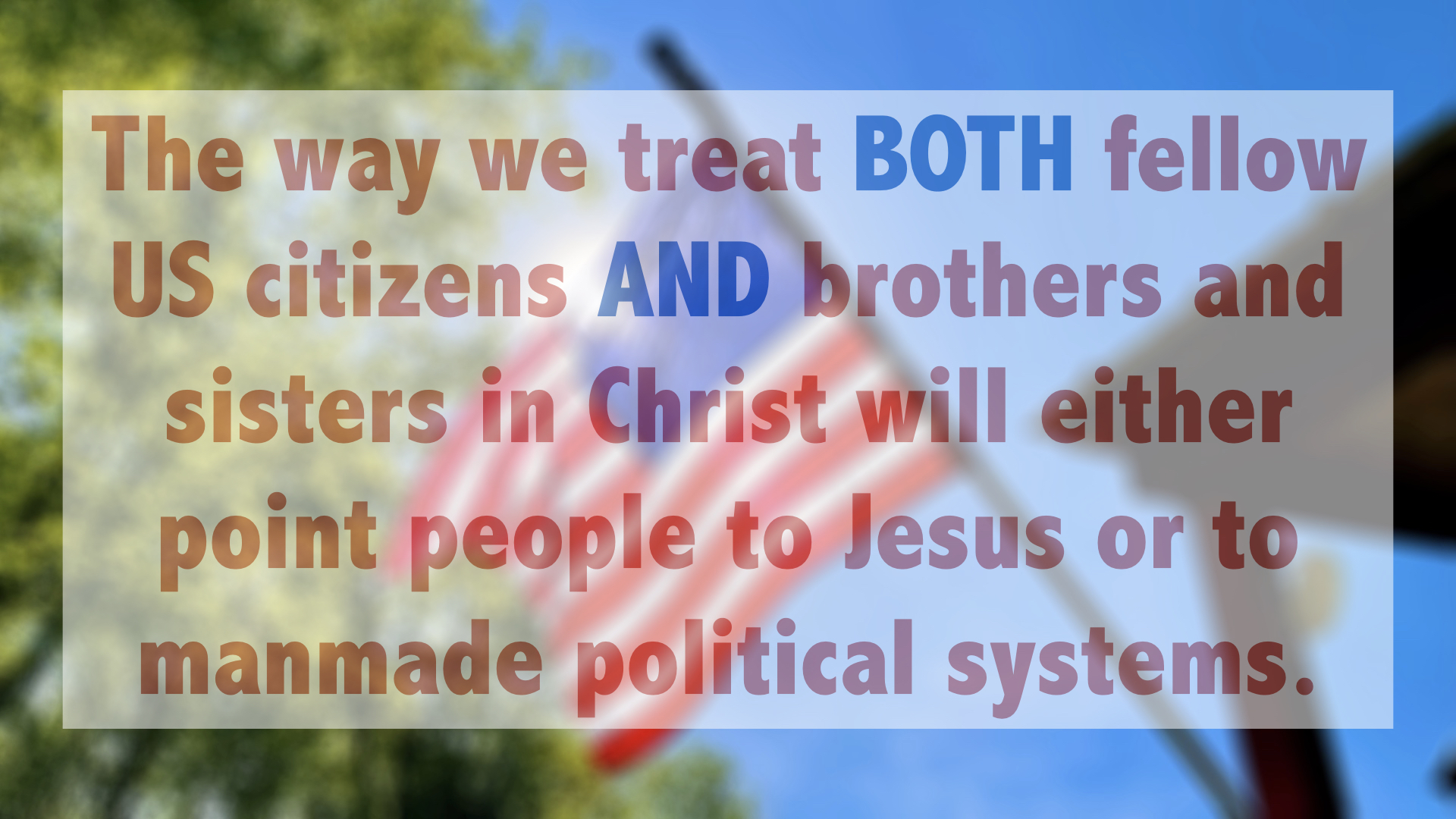
Let us always remember that others who are participating in the American political process are BOTH fellow US citizens AND brothers and sisters in Christ.
In J.R.R. Tolkien’s Return of the King, when Gandalf sees fellow citizens and friends at each other’s throats, he exclaims, “Work of the enemy! Such deeds he loves: friend at war with friend, loyalty divided, and confusion of hearts.” Indeed, the enemy of our souls would love to see the chaos of a nation at war with itself; especially to see Christians at odds with each other.
Paul said, “Therefore, as we have opportunity, let us do good to all people,especially to those who belong to the family of believers” (Galatians 6:10). On the flip side, Jesus said that when we think or speak poorly of a fellow human, we are in danger of judgment (Matthew 5:22).
Listen to Paul’s appeal to his friends at Philippi—
Therefore if you have any encouragement from being united with Christ, if any comfort from His love, if any common sharing in the Spirit, if any tenderness and compassion, then make my joy complete by being like-minded, having the same love, being one in spirit and of one mind.
I plead with Euodia and I plead with Syntyche to be of the same mind in the Lord. Yes, and I ask you, my true companion, help these women since they have contended at my side in the cause of the gospel, along with Clement and the rest of my co-workers, whose names are in the book of life. (Philippians 2:1-2, 4:2-3)
The politicians we have are always downstream from culture, which means we have allowed those sorts of politicians to be in place.
John Stonestreet used a phrase I hadn’t heard before, but I think it’s appropriate: “Christian political engagement should hit its fever pitch notduring elections. The only way to relieve the political pressures of our day is to build up the pre-political aspects of our life together, especially the family and the Church. When we care well for our children, our neighbors, and our communities, the state doesn’t have to.”How true this is!
I wrote something this summer based on Isaiah 3:4-5. In essence, I wrote that God gives nations the “leaders” they deserve. They are leaders in that they occupy an office, but they don’t lead people nor care for the citizens—they don’t have wisdom to lead nor do they care about anyone but themselves. This is the inevitable result for a nation that turns its back on God! So if we think our political and civic leaders are self-focused, unskilled, and childish, we should look in the mirror. It’s not “them,” it’s us. We have to change—turning wholeheartedly to God—and only then God can change our leadership.
We need to be praying for our governmental leaders, not vilifying them. We need to be speaking well of our fellow US citizens. We need to be especially treating our fellow brothers and sisters in Christ well.
Our hope is not in the results of an election. Our hope is in Jesus. The way we treat BOTH fellow US citizens AND brothers and sisters in Christ will either point people to Jesus or to manmade political systems.
I pray we can do better at pointing people to Jesus! I pray I can do better!
Christians should run their entire race with joy—we should soar across the finish line! Check out this full sermon on Psalm 132.
I have lots of new content every week, which you can check out on my YouTube channel.
“Joy is never in our power and pleasure often is.” —C.S. Lewis
John Piper points out that thinking and knowing are essential for Christian maturity, but there is also a danger in knowledge. How do we find the correct balance?
I talked about a Christian’s self-examination this week, and then I came across this from T.M. Moore: “Christians do not fear to examine themselves. Especially when it seems something may be lacking in our walk with and work for the Lord, we need to heed the words of the apostle Paul and do some serious soul-searching and altering of our life course (2 Corinthians 13:5). Examining ourselves involves carefully considering how we use our time (Ephesians 5:15-17) as well as what’s going on in our soul and our life. We must not fear to examine ourselves nor resent when others may encourage us to do so.”
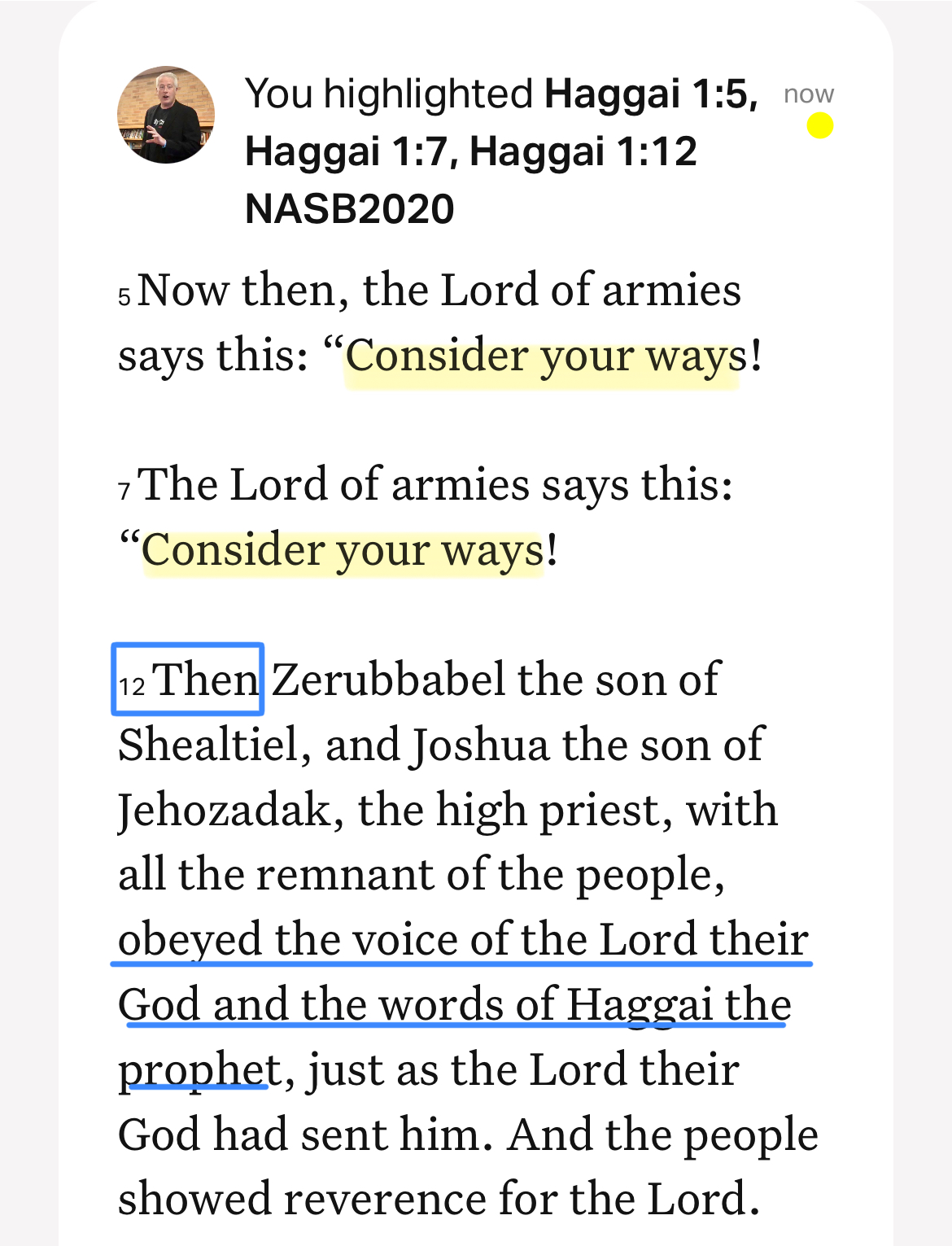
God’s messengers call people to consider the way they are currently living in comparison to the way God has called them to behave. Wise people will heed this call and repent from any ways that deviate from God’s way. I talked in more depth about Haggai and his message of considering our ways in my series on the minor prophets.
“Come to Jesus by quitting every other hope, by thinking of Him, believing God’s testimony about Him, and trusting everything to Him. If you thus come to Him, the rest which He will give you will be deep, safe, holy, and everlasting.” —Charles Spurgeon
One more from T.M. Moore: “We will only hunger and thirst for more of the Lord and His promises as we consider how far short of that might and greatness we fall. … I suspect that most Christians today are fairly satisfied with the state of their faith. They have a ‘good enough’ experience of Jesus and they’re not really thirsting for much more. But the work of shepherds is to help people realize that splashing around in the mud puddle of faith is not to be compared with sailing on the ocean of God’s grace and power.”
You are a one-of-a-kind creation on purpose! God’s plan for your life is as unique as you are. I had the privilege of speaking at Country Chapel’s week-long revival services, and this is a clip from my sermon.
I have lots of new content every week, which you can check out on my YouTube channel.
What “began 90 years ago in Seattle as ‘an agency to supply candidates for the ministry to our churches and on the mission field,’” is now celebrating its 90th anniversary as Northwest University. It is really cool to see the hand of God supplying in miraculous ways for those who were so passionate about this endeavor.
“How thankful we are, Father God, for a crucified Redeemer. Nothing in heaven or earth is such an amazing wonder as this; nothing can compete with it for excellence. May all the many charms of sin be overcome by this ravishing love, which bubbles up in every drop of our Redeemer’s blood. How can we, with thoughts of the Cross alive in our hearts, sin against so much tenderness, compassion, and grace, and all the other perfections of You, our God, which sound so loud in our ears from the Cross of Jesus?” —Stephen Charnock
“Where shall language be found which shall describe Your matchless love, Your unparalleled love, toward the children of men? Your love is so vast and boundless that, as the swallow skims the water without diving into its depths, so all descriptive words merely touch the surface of Your love, while depths immeasurable lie beneath. … The most inspired mind must utterly fail to fathom this love. Here is love! And truly it is love that surpasses knowledge. Oh, let this love fill our hearts with adoring gratitude and lead us to practical manifestations of its power.” —Charles Spurgeon
When a leader admits a need for help to his or her team, it actually increases the level of respect the team has for that leader.
What does pornography have to do with loneliness? “Dr. Gary Brooks, a psychologist who has worked with people struggling with unwanted porn habits for the last 30 years, explains that ‘Anytime [a person] spends much time with the usual pornography usage cycle, it can’t help but be a depressing, demeaning, self-loathing kind of experience.’”
Fellas, the godly superwomen in our lives have unlocked our leadership potential. What are you going to do with that? You have only two choices: steward it or squander it. We only honor these godly women when we steward that potential well. Watch the full Father’s Day sermon here.
I have lots of new content every week, which you can check out on my YouTube channel.
Dan Reiland addresses an important topic for busy leaders: busy work vs. real work. “Doing the easy stuff makes us feel good, doing the hard stuff helps other people live better. When we focus on our real work over busywork, we see intentional progress toward a focused vision or goal, rather than just checking things off a list.” Check out the four things Dan calls leaders to focus on.
“Because of what Jesus did for us through His life, death, and resurrection, we are no longer the worst things we have ever done. We are now the best thing God has ever done for us! That’s what God saved us from.That is our history. Now the question is, what has God saved us for? That is our destiny!“ —Jim Wiegand, in the Everything Begins With Purpose reading plan on YouVersion
A good reminder for pastors. “Call your own soul often to account; examine the temper, the frame, and the motions of your heart with all holy severity, so that the evidences of your faith in Jesus, and your repentance for sin, and your conversion to God, be many and fair, be strong and unquestionable; that you may walk on with courage and joyful hope toward heaven, and lead on the flock of Christ thither with holy assurance and joy.” —Isaac Watts
“The fellow who never makes a mistake takes his orders from one who does.” —Herbert Brocknow
“‘The fear the Lord.’ This refers to an awesome respect for God, which is a good thing. Without it, people are presumptuous before God. Those who do not fear God fail to respect His awesome power and righteousness, and they do not recognize the infinite distance between their sins and His holiness.“ —Quest Study Bible commentary on Psalm 128:1
“Our Lord did not ask us to give up the things of earth, but to exchange them for better things.” —Fulton J. Sheen
“Abortion advocates have long labeled humans in the earliest stages of development as ‘nothing but’ clumps of cells. This description is like calling Michelangelo’s David ‘a clump of marble.’ The only difference is that while art historians know every detail of this statuary masterpiece, scientists are still unlocking the secrets of the embryo.” John Stonestreet shares some astounding new research about the ways that the cells of a baby develop in a way that can only be attributed to an All-Wise Creator.
The unrighteous always seek to pull down those who hold to God’s righteous standard. How sad that they think it easier to pull the righteous down than to repent of their own evil. God sees this: He rewards the righteous who do not compromise and He punishes the unrepentant unrighteous who try to force the righteous to compromise.



 Leaders must resist trying to rush in “to save the day.” We need to let our teammates learn how to rescue themselves through a time of productive struggle. Check out the full conversation Greg and I had in our episode “The struggle is real (but necessary).”



 Craig T. Owens