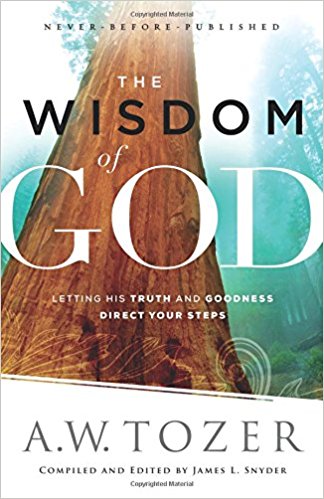
10 Prayers From A.W. Tozer In “The Wisdom Of God”

A.W. Tozer’s book The Wisdom Of God is a call to see Wisdom as a Person, not as a quality. As such, Tozer opens each chapter with a short prayer that we would bolster our relationship with Wisdom. Here are a few phrases from those prayers. 

“Let me not succumb to the limitations of my own reasoning and knowledge but leap beyond that and stepped into the reality of Thy Holy presence. Amen.” 

“Pour into my soul that which will enable me to see Thee as Thou wouldst have me to see Thee.” 

“O Wisdom, the incarnate Christ, fill my heart with desires that please Thee and show to the world around me Thy amazing grace.” 

“O God, Thou Eternal Wisdom, may I embrace that which You have created me for, and may out of my life flow the thanks and praise You so desire. Let me live my life by the wisdom of Thy Son, the Lord Jesus Christ.” 

“May Thy wisdom flow into me and out to the world around me, creating in me a vessel for Thy glory.” 

“O Holy Spirit, I praise Thee through the divine wisdom that Thou hast poured into my life, enabling me to understand who I am and who Thou art and how we come together.” 

“Let me not stay my heart till I have discovered Thee in all Thy fullness.” 

“Manifest Thy grace and wisdom in my life today as a witness to those around me.” 

“O Lord God, Thy wisdom has been poured into my heart, creating such a longing for Thee that nothing in this world can satisfy.” 

“Heavenly Father, open my eyes to recognize Thy hand in my life. … May I be aware of my surroundings in light of what Thou art doing.” 

You can check out my full book review of The Wisdom Of God by clicking here. And be sure to read some of the quotes I shared from this book by clicking here.

Is It Really The 11th Hour?

When we’re down to the last minutes before a crucial deadline, we often refer to it as “the eleventh hour.” 

Have you been there? You’re sweating it out, wondering if God is going to come through for you. Or perhaps thinking about what you might need to handle yourself in order to meet the deadline. And then God comes through for us, and we let out a deep sigh of relief and gratitude. 

But why a sigh? Were we worried that God wouldn’t come through? Did we think God’s supply was limited? And what made us think that it was “the eleventh hour” anyhow? 

What we often think is the eleventh hour is really God’s first hour! God is never late. He’s never scrambling to come up with what we need. We might be the ones “scrambling,” but God never is. He always has the perfect resources at the perfect moment. 

We should know this because the Bible tells us: God who did not spare His own Son, but gave Him up for us all—how will He not also, along with Him, graciously give us all things? (Romans 8:32) 

Jesus tells a story about an eleventh-hour situation in Matthew’s Gospel. Men were waiting around to work for the day when a landowner came along to hire them. He hired some guys first thing in the morning and agreed to pay them a full day’s pay. He hired some other workers at 9:00 AM and promised to pay them fairly, and then he hired even more workers at noon and at 3:00 PM, also promising to pay them what was fair. Finally, he hired some workers at 5:00 PM—literally at the eleventh hour—without any mention of pay. 

At the end of the day, every single worker was paid a full day’s wage. Every single one of them. Jerry Bridges notes why this is significant: 

“Each worker, regardless of how long he had worked, received a day’s wages. He received not what he had earned on an hourly basis, but what he needed to sustain his family for a day. … Those eleventh-hour workers were hired because they needed to receive a day’s wages. They had been standing all day waiting for someone to hire them so they could earn money to support their families. They needed to work more than the landowner needed their work. He hired them, not because of his need, but because of their need.” (emphasis added)

You see, God knows what you NEED and He generously supplies that NEED right on time.

Jesus taught us to pray, “Give us this day our daily bread.” The problem comes when we start looking down the road wondering what’s going to happen tomorrow, and the next day, and the next day (see Matthew 6:11, 31-34). 

God’s favor toward us is out of all proportion to our work or sacrifice. He gives exactly what we need, exactly when we need it. 

If you’re feeling anxious—like the clock is ticking down to the eleventh hour—perhaps you should recall how God has provided for you in the past. Then discipline your thoughts from running ahead to tomorrow as you pray, “Give me this day what I need.” 

Here’s a prayer I’m praying—

“God, I remember the wonderful deeds You have done for me. They are constantly in my thoughts. I cannot stop thinking about Your mighty works in the past. Therefore, I ask you today for my daily bread. Let my heart be on guard against scrambling as though I were in an eleventh-hour situation. You are my all-loving, all-gracious Father. You know what I have need of even before I ask. May my attitude be one of assured contentment in your abundant, right-on-time supply. May you be glorified as others see this confidence in my attitude.”

7 Quotes From “The Wisdom Of God”

A.W. Tozer never pulls his punches! The Wisdom Of God is no different as he calls the corporate church and individual Christians back to the biblical understanding of God’s wisdom. Check out my full book review by clicking here. 

“What would wisdom and spiritual understanding, for example, make out of man? Would the man filled with wisdom and spiritual understanding write cheap poetry? I would certainly hope not. What then does he do? Walk around in a brown robe and pull loose from the world, hiding in a cloister or an ivory tower? Absolutely not.

“What is the purpose then of this baptism of the ancient wisdom of God into the heart of a man? The old wisdom man said it was to make a man a friend of God. Paul said, ‘That ye might walk worthy of the Lord unto all pleasing, being fruitful in every good work, and increasing in the knowledge of God; strengthened with all might, according to His glorious power, unto all patience and longsuffering with joyfulness’ (Colossians 1:10-11). This is the practical meaning of this infusion of divine wisdom into the man walking with God.” 

“The purpose of God in Redemption is not just to save us from hell. The purpose of God in redemption is to save us unto heaven. To be totally saved, He has to save us from something in order to save us unto something. We are saved from sin, which is the negative side. We are saved unto holiness, which is the positive side. We are saved from hell, but we are saved unto heaven. We are saved from the devil, but we are saved unto Christ.” 

“When we deal with our sin, repent, and the Lord has taken our sin away, we are as wise as the angels and as discrete and as knowing as the seraphs before the throne, for we have an afflatus of that wisdom.” 

“In our day, we have degraded Christianity to be a kind of soft vaccine against hell and sin. We gather people, stick them with a religious needle, and say, ‘If you just accept Jesus you will not go to hell, you will go to heaven when you die. Keep living as well as you can, and when you die you’ll go to heaven.’ Many are preaching what I refer to as a kind of lifeboat salvation, and even the songs today reflected that idea.

“Certainly, this is an inadequate concept of Christianity. The purpose of God in redeeming man was not to save them from hell only, but to save them to worship, and to allow them to be born into that eternal wisdom that was with the Father, which is synonymous with that eternal life that was with the Father and was revealed unto men.” 

“You can promote religion without divine wisdom and power. You can promote your denomination. You can promote and build up your church numerically and financially, but in these ways, you cannot promote true Christianity.” 

“The evangelical church waivers today because it has burst out in two directions: One, in the direction of entertainment and pleasure for the like-minded ones. The other, in the direction of scholarship for the serious-minded. This is the new evangelicalism of today. An effort to do by scholarship what can only be done by wisdom and power. It is a glass eye trying to see.” 

“What I am praying for is that God Almighty would come upon this generation of Christians and make them dissatisfied with the cold, humanistic, intellectual evangelicalism of our time, and make us so thirsty for an afflatus of divine wisdom and power that they press through and receive that baptism.” 

Do People Know That You Know That God Is Good?

Listen to the podcast of this post by clicking on the player below, and you can also subscribe on AppleSpotify, or Audible.

If you’ve been reading or watching my series on God’s favor the last few weeks, I hope you truly know this: God is for you! 

But the key question for Christians comes down to this—Do others know that you know that God is for you? 

You see, God is for you because God is joyful and happy, and He wants you to not only know this but to radiate this joy and happiness to those around you. 

Here’s how it works:

(1) Joy is an inside job. The dictionary defines joy as “a feeling of great delight caused by something exceptionally good or satisfying.” When we know by our personal experience with Him how good God is, joy is birthed in our hearts as we see Him as All-Good and All-Satisfying. 

(2) Joy is regardless of my external circumstances. Some people try to pursue happiness apart from joy. Trying to get happy without having the foundation of joy is like having a flower that has been picked from the plant. Happiness may be pretty for a short while, but it is already fading because it is completely dependent on the environment around it. True happiness isn’t dependent on external circumstances because it is rooted in something far greater. 

(3) Knowing God’s favor fuels our joy. There is a Hebrew word for know which means “knowledge through intimate, personal experience.” Psalm 100 describes happy people and their joyful praise. Their joy comes from this: They know that their Lord is God and that He is good. This joy comes from seeing and savoring God’s favor.  

(4) Our internal joy should bubble up into external happiness. All throughout the Bible, we read how those who are filled with joy as they get to know this exceptionally good, all-satisfying God cannot help but burst out in songs of happy praise (see Psalm 28:7 and Luke 10:21).

(5) Our external happiness becomes our testimony. In Psalm 126 we read that God’s people who were full of God’s joy burst out into happy praise. When they did the people around them recognized that God had done great things for them. 

Check this out—

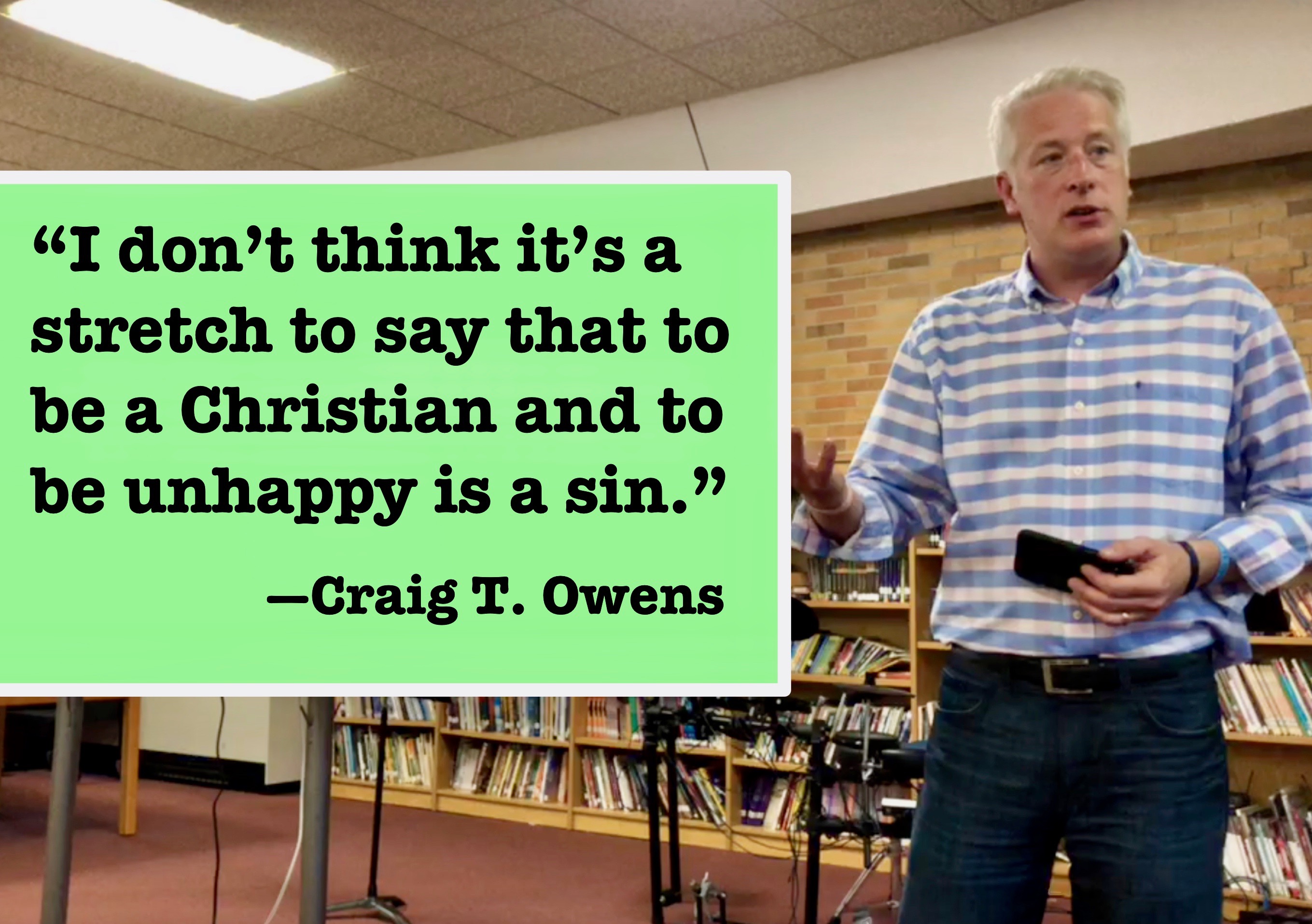
“I don’t think it’s a stretch to say that to be a Christian and to be unhappy is a sin. An unhappy Christian gives God no praise, robs Him of glory, and paints God in a bad light. A happy Christian knows the Lord is his strength, his comfort, his supply. The happy Christian lifts God high and invites others to know this All-Good, All-Happy God too!” —Craig T. Owens 

So let me ask you again: If you call yourself a Christian, do people know that you know that God is for you? Are you making God look All-Good and All-Satisfying by your deeply fueled joy and your face-brightening happiness? 

What a testimony it is when God’s people are happy in Him! 

►► Would you please prayerfully consider supporting this ministry? ◀︎◀︎

If you have missed any of my other posts about God’s favor, you may check them out by clicking here.

Thursdays With Oswald—Jeremiah 2-3

Oswald ChambersThis is a weekly series with things I’m reading and pondering from Oswald Chambers. You can read the original seed thought here, or type “Thursdays With Oswald” in the search box to read more entries.

Jeremiah 2-3

[These are notes from Oswald Chambers’ lecture on Jeremiah 2-3.]

     God is the “adornment” of His people; but God says, “My people have forgotten Me days without number”; the dead set of their life has been away from God (Jeremiah 2:32). Forgetting as an infirmity of mere consciousness is one thing; but forgetting by steadfastly refusing to recognize is another thing. These people had deliberately turned out of God’s way. They were wantoning after some other god than the God Who was holy (2:33). …  

     The thing that shocks us most is not the thing that shocked Jesus most. Social immorality shocks us till we don’t know where we are; but what struck the heart of Jesus Christ with horror was immorality against God, pride against Himself (see Luke 16:15). …  

     The innocence arising from evil is always like this—“I’ve done nothing.” It is the innocence we are all born with; sooner or later it takes its stand with evil and only knows good by contrast; whereas the innocence arising from the presence of the Spirit of God takes its stand with good and knows evil only by contrast. If we hand our hearts over to God we need never know in experience what Jesus Christ says of the human heart is true (see Mark 7:20-23). 

From Notes On Jeremiah

This is a tough concept that takes some quiet introspection in the presence of the Holy Spirit. Christians should ask themselves: Do I know the difference between good and evil because I’m doing evil and the opposite of what I’m doing is good, or because I’m doing good and the opposite of what I’m doing is evil? 

Originally, Eve knew evil only as the opposite of how she was living. But when satan tempted her to take the forbidden fruit, Eve now knew evil as something she was doing. Jesus said evil is what would naturally come out of our heart, unless “we hand our hearts over to God” and allow His Spirit to supernaturally bring out of us the Christlike fruit He produces. Is this happening in your life? 

10 Quotes From “You!”

Max Lucado has given us a collection of short passages that will reaffirm to you how much God values YOU! This book could be a great pick-me-up for you, or a life-saving helper to your friend who is in crisis. Check out my full book review by clicking here. 

“Since you are God’s idea, you are a good idea. What God said about Jeremiah, He said about you: ‘Before I made you in your mother’s womb, I chose you. Before you were born, I set you apart for a special work’ (Jeremiah 1:5).” 

“God ‘personally formed and made each one’ (Isaiah 43:7 MSG). … And if you aren’t you, we don’t get you. The world misses out.” 

“You are a custom design; you are tailor-made. God prescribed your birth. Regardless of the circumstances that surrounded your arrival, you are not an accident. God planned you before you were born. The longings of your heart, then, are not incidental; they are critical messages. The desires of your heart are not to be ignored; they are to be consulted. As the wind turns the weather vane, so God uses your passions to turn your life. God is too gracious to ask you to do something you hate.” 

“God never called you to be anyone other than you. But He does call on you to be the best you you can be.” 

“God promises no applause for self-promoters. But great reward awaits God promoters: ‘Good work! You did your job well’ (Matthew 25:23 MSG).” 

“Don’t confuse God’s love with the love of people. The love of people often increases with performance and decreases with mistakes. Not so with God’s love. He loves you right where you are. He loves you just the way you are, but He refuses to leave you that way.” 

“Enough of this self-deprecating ‘I can’t do anything.’ And enough of its arrogant opposite: ‘I have to do everything.’ No, you don’t! You’re not God’s solution to society, but a solution in society.” 

“When asked to describe the width of His love, Jesus stretched one hand to the right and the other to the left and had them nailed in that position so you would know He died loving you. But isn’t there a limit? Surely there has to be an end to this love. You think so, wouldn’t you? But David the adulterer never found it. Paul the murderer never found it. Peter the liar never found it. When it came to life, they hit rock bottom. But when it came to God’s love, they never did.” 

“There are two extremes of poor I-sight. Self-loving and self-loathing. … Self-elevation and self-deprecation are equally inaccurate. Where is the truth? Smack-dab in the middle. Dead center between ‘I can do anything’ and ‘I can’t do anything’ lies ‘I can do all things through Christ who strengthens me’ (Philippians 4:13). … Not self-secure or insecure, but God-secure—a self-worth based in our identity as children of God. The proper view of self is in the middle.” 

“Each time we do our best to thank God for giving His, we worship.” 

Common Sense Or Trust

“God expects of us the one thing that glorifies Him—and that is to remain absolutely confident in Him. … 

“Can you trust Jesus Christ where your common sense cannot trust Him? ‘Abide in Me,’ says Jesus, in spiritual matters, in money matters, in every one of the matters that make life what it is.” —Oswald Chambers, in Run Today’s Race

8 Quotes From “How To Listen So People Will Talk”

In How To Listen So People Will Talk you will learn some invaluable skills for taking your relationships and your leadership deeper. Becky Harling has given us an amazing resource! Check out my full book review by clicking here. 

“Honestly, it’s impossible to be a good listener without developing a humble spirit. Think about it. When you’re listening and fully engaged, you allow the other person to have all the attention. Listening forces you to lay aside your agenda. It challenges you to let go of your need to share your opinions, theories, and assumptions in favor of listening to another’s feelings, thoughts, and sentiments. That decision can only come from a heart of humility.” 

“Resist the urge to dive in with your own story. … Whenever you dive in with your own story, you are stealing the microphone from the person who is telling their story. … The best advice is to remember to let someone be the star of their own show. Keep the focus on the person talking.” 

“How is it that we who have problems ourselves are so quick to try to fix someone else’s problem? James was spot on when he wrote, ‘Everyone should be quick to listen, slow to speak’ (James 1:19). I’d like to suggest that a great paraphrase for this verse is, ‘Let everyone be quick to listen and slow to give advice!’” 

“Don’t tell people what to do; ask them questions. … You gain greater insight, they gain greater self-awareness, and the two of you grow closer. … When we dare to ask someone what they want, we give them the opportunity to verbalize their need. … The best questions allow people to explore what’s in their hearts.” 

“When you validate another person’s feelings, you’re basically saying, ‘Your feelings make sense.’ You compassionately acknowledge that the person’s feelings are important and that those feelings are understandable. You don’t correct feelings or instruct a person on how to feel. You simply offer understanding. … Validating someone’s feelings doesn’t necessarily mean you agree with the actions of the other person. … Feelings are neither right nor wrong. They’re just feelings. It’s what we do with those feelings that determines whether or not we sin. … Validate feelings, but only validate actions that line up with Scripture.” 

“In your relationships, what does it look like for you to mimic Jesus and show others how valuable they are? How does your face send the signal, ‘I want to hear what you have to say’? Your nonverbal signals act as a green light, inviting others to share their feelings.” 

“Conflict can be transformational. In the chaos of an argument, if you will listen to understand and focus on meeting the others need, you’ll be more able to work as a team, coming up with a solution that satisfies both. In the end, your relationship will emerge stronger and more resilient.” 

“People are dying to feel heard, and unless we’ve purpose in our hearts to offer our full presence to others, we’ll drift through life distracted and dishonor those who matter to us in the process.” 

A Double Portion

“I am convinced that we don’t get a double portion of God’s Spirit by watching Elijah walk away while standing at Jericho. When we choose to remain behind, we also leave behind all that God desires to do in us and for us and through us. If we want to inherit a double portion of the spirit of Elijah, we need to walk in the steps of Elijah until he leaves no more footprints. …

“Don’t wait to be asked—volunteer. Volunteer to go forward. Volunteer to go further. Volunteer to go harder. You cannot pioneer out of obligation. It is not an adventure if it is not your choice. You have to want it. You have to want more. If you are going to be greedy, this is the right place to be greedy. Want everything God has for you. Want more than others think you can obtain. Why settle for a single portion if a double portion can be yours for the asking? …

“Perhaps the reason so few of us have received a double portion of God’s Spirit is that the lives we have chosen require so little of God because they require so little of us. … I want to live the kind of life that cannot be lived without the fullness of Christ in my life.” —Erwin McManus, in The Last Arrow (emphasis added)

How To Listen So People Will Talk (book review)

If this title was the switched, I’ll bet a lot of people would snap it up. Why? Because all of us want to be heard. In fact, some people are dying to be heard! Which is exactly why Becky Harling hits the nail on the head for ultimate, intimate, life-changing conversations in her book (very aptly titled) How To Listen So People Will Talk.

If Christians are going to follow the teachings of Jesus, there are two relationship principles that must be followed: (1) Love others and (2) serve others. There is no better way to love and serve those around us than by letting them know how deeply we are listening to them. 

Becky introduces us to at least eight major principles to raise our listening game. She uses her own life experiences, lessons that Jesus taught, the wisdom from Scripture, and even some insights from those in the psychological fields. Becky says, “People feel more loved and valued if we are actively and attentively listening to them.” And these principles will help you do just that. 

In addition to Becky’s insightful teachings, she concludes each chapter with some follow-up lessons and exercises to help us begin to apply the lessons to our conversations. 

How To Listen So People Will Talk is a game-changing book! I encourage all leaders—pastors, parents, teachers, coaches—as well those who want to enrich the relationships they have in their lives to get a copy of this book. 

I am a Bethany House book reviewer.