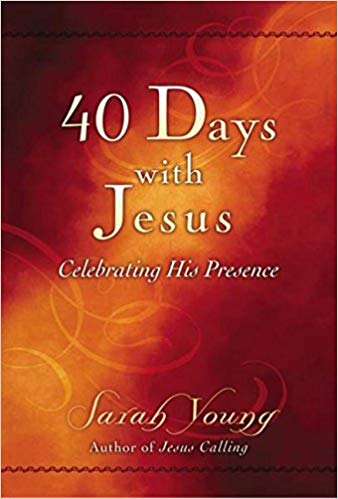
40 Days With Jesus (book review)

Martin Luther said, “The Bible is alive, it speaks to me.” Truly, the Bible is God’s Word speaking to us every time we peer into its pages, so I love how Sarah Young strings passages of Scripture together to allow us to hear Jesus speaking to us in a first-person voice. 

40 Days With Jesus was designed as a series of readings during the Lenten season, as we walk with Jesus to the Cross and His resurrection from the dead. But any time is a good time when we can walk with Jesus and hear His unmistakable voice reassuring our hearts. 

Are you walking through a dark time in your life? Know that Jesus is walking with you. 

Do you want to live a life of purpose and lasting value? Listen to Jesus counsel you. 

Are you standing at a crossroads trying to make the right decision? Let Jesus point the way. 

Each time I read a Sarah Young book, it reignites my heart to read the Bible as though Jesus is personally speaking to me. Because He is! 

40 Days With Jesus is a great starting point for you to learn to hear Jesus speaking to you every time you open your Bible. The Holy Spirit will then use those words read in your quiet time to continue to bring you direction and reassurance all throughout your day (John 14:26). 

I highly recommend this book (or any other book by Sarah Young)!

Poetry Saturday—Let It Be On Earth

Psalm 93
The Lord sits upright on His throne, 
draped in a mountain, rising through 
the clouds, forever changeless, new, 
eternally impervious to 
all storms or time, a growing stone 
of splendor and unmeasured girth:
As there, Lord, let it be on earth!

Psalm 45:6-8
What sweetness bathes our every sense!
What radiating gladness swells 
around us! What delightful smells 
engulf, what happy music tells
Your glory! Joys beyond expense 
from You and from Your throne pour forth:
As there, Lord, let it be on earth!

Psalm 47
They gather in Elysian Fields, 
a vast and varied, joyful host, 
with one objective uttermost—
their King to celebrate and toast!
There, casting down their crowns and shields, 
they tell His holy, matchless worth:
As there, Lord, let it be on earth!

Revelation 4, 5
Throughout the vast, far-flung expanse 
a chorus rises, joyous, strong:
Unnumbered hosts, an endless throng, 
their voices joined in glorious song, 
extol their King’s eminence, 
rejoicing in His matchless worth:
As there, Lord, let it be on earth!

Hebrews 12:1
Now let us focus on one saint, 
one from that boisterous crowd of those 
who prays together, dressed in clothes 
of linen white. See how he glows 
in mien and body! No restraint 
impedes his holy, joyful mirth:
As there, Lord, let it be on earth!

Hebrews 1:7 
Christ speaks, and angels all obey, 
and hurry off to implement
His Word. They are as servants sent, 
a holy, unseen regiment, 
to guard and guide us on our way.
Of faithfulness they know no dearth:
As there, Lord, let it be on earth!

Psalm 97:1-6
Fire flows to mark His path, and burns 
away His foes by righteousness 
and justice, oozing forth to bless 
the world and overpave the mess 
we men have made of things. He turns 
this way and that in all His worth:
As there, Lord, let it be on earth!T.M. Moore

Toot! Toot!

Do we begin again to commend ourselves?… (2 Corinthians 3:1)

Paul didn’t bring letters of reference to Corinth, nor did he ask the Corinthians to write any testimonials on his behalf.

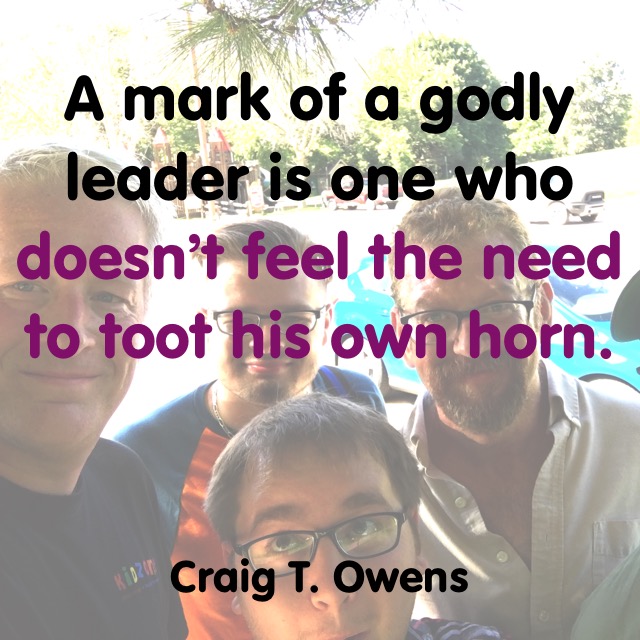
A mark of a godly leader is one who doesn’t feel the need to toot his own horn.

 Paul’s focus was not on what he could get now, but on what would be his in eternity—

  • any “letters of recommendation” would be written on peoples hearts (v. 3)
  • any skills he had came through Jesus (vv. 4-6)
  • he had hope that God was keeping accurate records (vv. 7-11)
  • he had the freedom to speak boldly in love because he wasn’t trying to win man’s approval (vv. 12-13, 18)
  • he saw transformed lives as his real trophy (v. 18)
  • his ministry was through God’s mercy so he remained humbled and encouraged (4:1)
  • he didn’t feel the need to concoct a “marketing plan” nor leverage his pulpit for personal gain (v. 2)
  • he focused on glorifying God alone (vv. 3, 4, 6)
  • his sermons weren’t me-focused, but always others-focused as he became a bondservant to those to whom he ministered (v. 5)
  • he worked only for eternal rewards (vv. 7-12, 16-18)
  • he spoke only what he had already appropriated and faithfully applied to his own life (vv. 13-15)

Our prayer could be very similar to what Paul taught and probably prayed for himself—“May I lead by serving. May I not look for human praise—nor even be tempted to toot my own horn—but lead and minister only to hear applause from the nail-scarred hands of Jesus.” 

As R.T. Kendall reminds us—

“Every day we breathe in and out—in and out—thousands of times a day. There is a day fixed, that unless Jesus comes first, you and I will only breathe out. No amount of money, power, or prestige can alter the date that we each have with death. And at that moment the only thing that will matter is whether we have known Christ and served Him well—that our lives have made a difference. In short: that we are popular in heaven—and famous in hell.”

This is part 37 in my series on godly leadership. You can check out all of my posts in this series by clicking here.

Poetry Saturday—A Debtor To Mercy Alone

A debtor to mercy alone,
Of covenant mercy I sing,
Nor fear, with God’s righteousness on,
My person and off’rings to bring.
The terrors of law and of God
With me can have nothing to do;
My Savior’s obedience and blood
Hide all my transgression from view. 

The work which His goodness began,
The arm of His strength will complete;
His promise is Yea and Amen,
And never was forfeited yet.
Things future, nor things that are now,
Not all things below or above,
Can make Him His purpose forego,
Or sever my soul from His love. 

My name from the palms of His hands
Eternity will not erase;
Imprest on His heart, it remains
In marks of indelible grace.
Yes! I to the end shall endure,
As sure as the earnest is giv’n;
More happy, but not more secure,
When all earthly ties have been riv’n. —Augustus Toplady

Thursdays With Spurgeon—A Firm Doctrine

This is a weekly series with things I’m reading and pondering from Charles Spurgeon. You can read the original seed thought here, or type “Thursdays With Spurgeon” in the search box to read more entries.

A Firm Doctrine

     If a tree has to be taken up two or three times a year, you will not need to build a very large loft in which to store the apples. When people are always shifting their doctrinal principles, they are not likely to bring forth much fruit to the glory of God. It is good for young believers to begin with a firm hold upon those great fundamental doctrines that the Lord has taught in His Word.

From The Autobiography Of Charles Spurgeon 

This is true of any endeavor—can you imagine constantly shifting the way you learn math, or biology, or cooking, or anything else? There’s always a “learning curve” in every new endeavor that brings a momentary setback before there are new gains.

Thankfully, the Bible has a consistent message from Genesis to Revelation. Getting into the Word regularly and attending a Bible-preaching church will help you immensely. 

There is no “right way” to read the Bible. In fact, Spurgeon had a great response to a man who told him that he “read my Bible on my knees.” Spurgeon said—

“I think you read the Bible in a very uncomfortable posture, and if you had read it in your easy chair, you would have been more likely to understand it. Pray, by all means, and the more, the better, but it is a piece of superstition to think there is anything in the posture in which a man puts himself for reading.”

The point is not in what posture you read the Bible, or in what translation, or at what time of day, but the point is that you are regularly reading God’s Word. Get into the Word, and let the Holy Spirit get the Word into you. 

The Devil’s “Likes”

But you said in your heart, “I will ascend to heaven; I will raise my throne above the stars of God, and I will sit on the mount of assembly In the recesses of the north. I will ascend above the heights of the clouds; I will make myself like the Most High.” —what God said about satan (Isaiah 14:13-14)

“For God knows that in the day you eat from it your eyes will be opened, and you will be like God, knowing good and evil.” —satan (Genesis 3:5)

No wonder, for even satan disguises himself like an angel of light. —what the Apostle Paul said about satan (2 Corinthians 11:14)

Be of sober spirit, be on the alert. Your adversary, the devil, prowls around like a roaring lion, seeking someone to devour. —what the Apostle Peter said about satan (1 Peter 5:8)

Jesus is all reality. He is the All-Sufficient I AM. He knew the end from before the beginning. He is THE King of kings. The devil is only like a king, or like an angel, or like a lion.

The devil can only pretend to have answers. Everything he produces is a counterfeit. No wonder Jesus called him the “father of lies,” since lies are all he has to offer. 

The devil tries to look like God, he tries to lure us to disobey God, he pretends to be what he’s not. So don’t fear his pretend roar. Instead, give yourself completely to God’s care, then you can stand firm against the devil’s attempts to seduce you, and he will be forced to flee from you (James 4:7)!

Poetry Saturday—Every Fallen Soul

Every fallen soul, by sinning,
Merits everlasting pain;
But Thy love without beginning,
Has redeem’d the world again:
Countless millions
Shall in life, through Jesus reign.

Pause, my soul, adore and wonder:
Ask, “Oh, why such love to me?” 
Grace hath put me in the number
Of the Saviour’s family:
Hallelujah!
Thanks, eternal thanks to Thee!

Since that love had no beginning,
And shall never, never cease;
Keep, oh, keep me, Lord, from sinning;
Guide me in the way of peace:
Make me walk in
All the paths of holiness.

When I quit this feeble mansion,
And my soul returns to Thee,
Let the power of Thy ascension
Manifest itself in me;
Through Thy Spirit,
Give the final victory.

When the angel sounds the trumpet;
When my soul and body join;
When my Saviour comes to judgment,
Bright in majesty divine,
Let me triumph
In Thy righteousness as mine. —Anonymous

9 Quotes From “Shepherding God’s Flock”

T.M. Moore has given pastors a phenomenal training resource in Shepherding God’s Flock. Please be sure to check out my full book review by clicking here. 

“The work of church leaders today—and especially of that class of leaders called elders, with which this study is concerned—has been shaped and conditioned more by the temper of our times than by the teaching of God’s Word.” 

“According to Paul, any church that does not have in place elders—and other leaders working with them—who are functioning as shepherds is a church that is not in order.… A church without a strong ministry of shepherding is a flock without genuine pastoral care, oversight, and equipping. It may be very active, even happy, and may be ‘growing’ in what some consider impressive ways. But without shepherding as the framework and integrating dynamic, such a church will always be something less than what God intends.” 

“Where the work of shepherding is being faithfully pursued, the gospel goes forth with power, lost sheep are located, and the flocks of God grow as He adds new souls to the fold.” 

“Where faithful shepherds are at work, the Lord’s sheep will be well fed. Both milk and the meat of the Word will be their daily diet, according to the needs and callings of each. Well-fed sheep are healthy, strong, and fruitful in their own contributions.” 

“The work of shepherding begins in relationships of mutual love and trust, spiritual friendships where sheep and shepherd know, love, and care about one another.” 

“Only when the people feel known and loved, and only when they know and love those who are called to lead them—only then will they be willing to follow where the shepherds of the church are seeking to take them.” 

“In the Christian life, people tend to live up to or achieve, not the level of their abilities, for their abilities are virtually limitless, given the presence of the indwelling Spirit of God. Rather, they tend to live up to the level of their vision—of what they see for their lives in Christ. Unless we are leading them into God’s vision for their lives, the people of God will settle for something less than the prize of the upward call of God in Christ Jesus.” 

“When temptation arises we can follow one of two courses. Either we will fall through temptation into sin, or we will grow through temptation into a higher stage of sanctification. … The shepherd’s task is twofold: first, he must help the Lord’s sheep to recognize temptation, by grounding them firmly in the law and Word of God; second, he must equip and encourage them in finding the way of escape from temptation, so that they may grow as the Lord intends.” 

“Jesus’ approach to bearing witness was thus energetic, proactive, continuous, compassionate, and pioneering. Should we expect anything less from the shepherds He has left to bring other lost sheep into His fold?”

Shepherding God’s Flock (book review)

T.M. Moore founded the Fellowship of Ailbe, a ministry patterned after the example of the Irish Christians who kept the spread of the Gospel alive during history’s dark times. A key component of the Fellowship’s ministry is the equipping of pastors for their tasks, and Shepherding God’s Flock masterfully lays out the role of pastors like few other resources. 

Throughout the Scriptures, God uses the picture of a shepherd caring for his sheep as a consistent image of how God cares for His people, and how He desires for pastors/elders to care for those under their care as well. God has stern warnings for shepherd-leaders who misuse or abuse their positions, but He also showers His blessings on those shepherd-leaders whose hearts beat with God’s heart. David talked lovingly of the Lord being our Shepherd, Jesus called Himself the Good Shepherd, and the Apostle Peter called for elders in the church to shepherd the flock under their care. 

Shepherding God’s Flock helps pastors work through the practicalities of their shepherding role. And I do mean work through these concepts. This book is as much a workbook as it is a textbook. T.M. Moore gives valuable insights for pastors, but he intersperses penetrating discussion questions throughout his teaching. You will also need to keep your Bible handy while reading Shepherding because Moore will send you to passage after passage to undergird the principles he is teaching. 

I can’t recommend this book highly enough to both current pastors and those preparing to enter into pastoral ministry. It would probably be a good idea for lead pastors to read this book alongside their elder/deacon boards. 

As Moore notes in his closing words, “Shepherding is the work God has chosen for the care and nurture of His flocks. We’ve neglected this ministry for too long. Let us resolve to bring the work of shepherding to bear on the task of building Christ’s Church.” 

To that, I add my hearty “Amen!”

Thursdays With Spurgeon—Our Fight For Faith

This is a weekly series with things I’m reading and pondering from Charles Spurgeon. You can read the original seed thought here, or type “Thursdays With Spurgeon” in the search box to read more entries.

Our Fight For Faith

     Our faith at times has to fight for its very existence. The old Adam within us rages mightily, and the new spirit within us, like a young lion, disdains to be vanquished; and so these two strong ones contend, till our spirit is full of agony. …

     Christ alone was tempted in all points as we are, though without sin. No one man is tempted in all points exactly like another man, and each one has certain trials in which he must stand alone amid the rage of war, with not even a book to help him, or a biography to assist him—no man ever having gone that way before except that one Man whose trail reveals a nail-pierced foot. He alone knows all of the devious paths of sorrow. Yet even in such byways, the Lord is with us, helping us, sustaining us, and giving us grace to conquer at the close. … 

     So satan, loath to leave a soul, pursues it hotfoot. He will have it back if he can; and often, soon after conversion, there comes a time of dreadful conflict, when the soul seems as if it could not live. … 

     Once, when the tempter had grievously assailed me, I went to see my dear old grandfather. I told him about my terrible experience, and then I wound up by saying, “Grandfather, I am sure I cannot be a child of God, or else I should never have such evil thoughts as these.” 

     “Nonsense, Charles,” answered the good old man. “It is just because you are a Christian that you are thus tempted. These blasphemies are no children of yours; they are the devil’s brats, which he delights to lay at the door of a Christian. Don’t you own them as yours; give them neither house-room or heart-room.” 

From The Autobiography Of Charles Spurgeon

The apostle Peter says our adversary the devil continually prowls around looking for a follower of Jesus that he can devour. This shouldn’t be surprising to us since Jesus said that the devil’s agenda was to steal, kill, and destroy. (See 1 Peter 5:8-9; John 10:10.)

But the apostle Paul also tells us that we aren’t supposed to be unaware of the devil’s schemes. Instead, we are to capture every thought and make them obedient to Jesus (2 Corinthians 10:5). That means, as Spurgeon’s grandfather counseled him, we recognize those evil thoughts as the devil’s brats and don’t allow them to take up room in our house nor our heart. 

Stand firm—those who are in Christ are more than conquerors!