Thursdays With Oswald—Cynical Or Satisfied

Oswald ChambersThis is a weekly series with things I’m reading and pondering from Oswald Chambers. You can read the original seed thought here, or type “Thursdays With Oswald” in the search box to read more entries.

Cynical Or Satisfied

     It is no use trying to find true joy in being either a fool or a wise man. Solomon drives us back every time to the one thing, that a man’s chief end is to glorify God and enjoy Him for ever. … 

     The only way we can enjoy our “tree of life” is by fulfilling the purpose of our creation. Jesus Christ prayed “that they may have My joy fulfilled in themselves.” The thing that kept Jesus Christ all through was not that He held aloof from actual things, but that He had a kingdom within. … Our Lord’s whole life was rooted and grounded in God, consequently He was never wearied or cynical. 

From Shade Of His Hand

In this book, Oswald Chambers is commenting on Solomon’s words in Ecclesiastes. Solomon tried everything he could think of to try to make sense of life and to try to find lasting joy. But everything he tried left him flat.

That’s because we weren’t created to find ultimate fulfillment or purpose in the things of earth, but to find purpose, joy and contentment in a personal relationship to our Creator. Jesus lived His life on earth as a blazing example of a what a joy-filled, purpose-centered, God-glorifying life looks like. The wonder of the Incarnation is that He shows us the kind of eternal life we were meant to have.

So here’s the choice Solomon presents to us: Try to find fulfillment under the sun and end up cynical, or find fulfillment in the Son of God and know truly satisfying, eternal joy. Which will you choose this Advent season?

7 Quotes From “The Dawning Of Indestructible Joy”

the-dawning-of-indestructible-joyThe Dawning Of Indestructible Joy is a wonderful book from John Piper to prepare your heart for celebrating Christ’s First Advent! It’s arranged as a 25-day countdown until Christmas morning. Check out my review of this book here, and then enjoy a few quotes that caught my attention.

“The coming of Jesus was a search-and-save mission. ‘The Son of Man came to seek and save the lost’ [Luke 19:10]. So Advent is a season for thinking about the mission of God to seek and to save lost people from the wrath to come. … ‘As the Father has sent Me, even so I am sending you’ (John 20:21). It’s the story of how the vertical advent of God in the mission of Jesus bends out and becomes the horizontal advent of Jesus in the mission of the church. In us.”

“If there is a longing in your heart this Advent for something that the world has not been able to satisfy, might not this longing be God’s Christmas gift preparing you to see Christ as consolation and redemption and to receive Him for who He really is?”

“Christmas is about the coming of the Son of Man who ‘came not to be served but to serve, and to give His life as a ransom for many.’ These words in Mark 10:45, as a brief expression of Christmas, are what I hope God will fix in your mind and heart this Advent. Open your heart to receive the best present imaginable: Jesus giving Himself to die for you and to serve you all the rest of eternity.”

“Take the very personal words of the Apostle Paul and make them your own. ‘The life I now live in the flesh I live by faith in the Son of God, who loved me and gave Himself for me’ (Galatians 2:20). This is how Jesus destroyed the works of the devil and rescued us from our sin. Don’t leave Christmas in the abstract. Your sin. Your conflict with the devil. Your victory. He came for this.”

“The point is that when Jesus comes, He confirms the truth of all God’s promises. He shows that God is trustworthy; He keeps His word. … Christ came to prove that God tells the truth, that God keeps His promises. Christmas means that God can be trusted.” 

“It is God’s message of hope this Advent that what is good need never be lost and what is bad can be changed. The devil works to take the good and bring the bad. And Jesus came to destroy the works of the devil [1 John 3:8].”

“This is what God does again and again. He may be doing it for you this Advent season—graciously and tenderly frustrating you with life that is not centered on Christ and filling you with longings and desires that can’t find their satisfaction in what this world offers, but only in the God-man. What a Christmas gift that might be! Let all your frustrations with this world throw you onto the Word of God. It will become sweet—like walking into paradise.”

The Dawning Of Indestructible Joy (book review)

the-dawning-of-indestructible-joySometimes I am concerned that even those who know the story of the Incarnation of Jesus miss out on the stunningly powerful miracle that took place in Bethlehem. Instead of being awed by the majesty of Christ’s First Advent, we merely give lip service to His birth. John Piper’s book The Dawning Of Indestructible Joy will give you a fresh perspective of the miracle of Christ’s birth and all that it means.

The Dawning Of Indestructible Joy is written in 25 chapters, building an exciting countdown from December 1 until Christmas morning. Each day John Piper will awaken your heart and mind again to the unimaginable gifts that Jesus Christ made available to us through His incarnation. Gifts such as freedom from sin, intimacy with God, eternal life, and soul-lifting joy.

Each chapter is short enough to serve as an ideal family reading time, perhaps each evening around the dinner table in December. The Scripture passage for each day is short enough, too, for everyone to memorize so that they are prepared to share with anyone else the joy that comes with the miracle of the Advent.

Make this book a part of your family Christmas tradition.

I Know You

jesus-always

A wonderfully encouraging reminder…

“I call you by name and lead you. I know you—I know every detail about you. You are never a number or statistic to Me; My involvement in your life is far more personal and intimate than you can comprehend. So follow Me with a glad heart. After My resurrection, when Mary Magdalene mistook Me for the gardener, I spoke one word: ‘Mary.’ Hearing Me say her name, she recognized Me and cried out in Aramaic, ‘Rabboni!’ (which means teacher). Beloved, I also speak your name in the depths of your spirit. When you read your Bible, try inserting your name into appropriate passages. … Take time to ‘hear’ Me speaking to you personally in Scripture, reassuring you of My love.” —Jesus (in Sarah Young’s book Jesus Always)

What Child Is This Anyway?!

christ-the-kingA couple of years ago as we were setting up for our Living Nativity, I was wrapping a towel around the doll we were going to use for the infant Jesus. A young boy from the community was carefully watching me and he asked, “Is that baby Santa?”

“No, it’s not Santa,” I said. “See this manger? We’re getting things setup to tell the story about the very first Christmas, long before St. Nick came on the scene. Maybe you’ve heard about Mary and Joseph?”

The young lad’s eyes lit up as he seem to get the answer. “Oh! Is that baby Moses?!”

Clearly, people don’t know all the facts surrounding the first Advent of Jesus. Sometimes things in culture and church get jumbled—what belongs to which? Is Christmas a pagan holiday? Where do Christmas trees come in? Was the birth of Jesus actually on December 25? What does it all matter anyway?

Instead of running from these questions, Christians should use them to point people in the right direction. 

Have you heard the tune called Greensleeves? It’s been around longer than anyone knows. William Shakespeare referenced it in two of his plays and didn’t feel the need to explain it to his audience. The tune has been set to some pretty bawdy words about New Year’s Eve parties, and even as a mocking song to some folks about to go to the gallows. And then in the mid-1800s William Chatterton Dix used this tune to write words about Christ’s birth in What Child Is This?

What an excellent question! Who exactly is this Child? Is Jesus merely a line on the pages of history? Or is His birth something more? Oswald Chambers noted, “The tremendous revelation of Christianity is not the Fatherhood of God, but the Babyhood of God—God became the weakest thing in His own creation, and in flesh and blood He levered it back to where it was intended to be. No one helped Him; it was done absolutely by God manifest in human flesh.”

The first-century historian Luke simply records that Mary is pregnant with “a child.” That is, until Jesus is taken to the temple in Jerusalem eight days later, and we see that a man named Simeon didn’t just see this Child as any baby, but as a fulfillment of prophecy (see Luke 2:25-32; Isaiah 7:14 and 9:6).

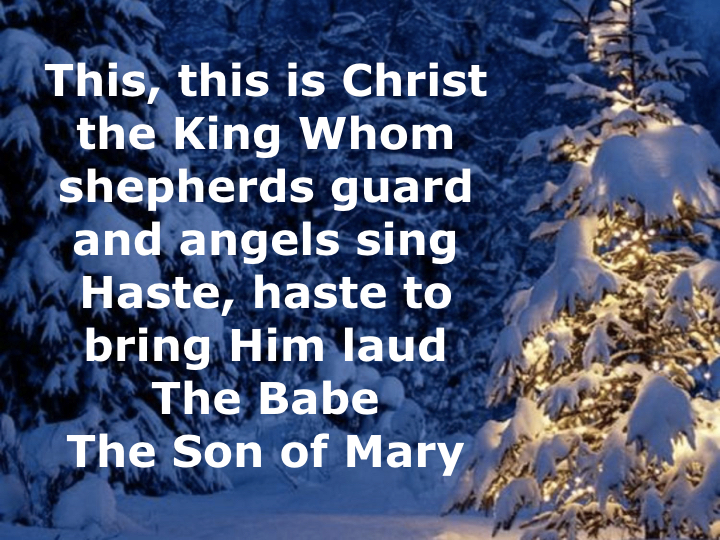
This Child is much more than just a historic person. He not only split history into BC and AD, but He has changed my life, and countless others’ lives as well! That’s why the chorus of this Christmas carol joyfully announces, “This, THIS is Christ the King!”

People may be confused about what tradition belongs to culture or Christendom. You may even be confused about what belongs to which. But none of that should stop us from knowing the Child we celebrate this Christmas. None of that should stop us from helping seekers to find Jesus as their own Savior. None of that should stop us from enthroning Jesus Christ as King and giving Him the highest praise He deserves!

Jesus used common, everyday things—farmers, fish, trees, weather, children’s songs—to tell people about a Heaven that was prepared for them. Paul used the cultural idols and poets to point his community to Jesus. Philip used the Scripture a governmental official was reading to point him to Jesus.

So we, too, can use whatever is around us to point people to Jesus this Christmas! What Child is this? This, THIS is Christ MY King! Merry Christmas!!

If you’ve missed any of the messages in our series The Carols Of Christmas, you can find the full list here.

Poetry Saturday—Everywhere, Everywhere Christmas Tonight

christmas-stockings-and-treeEverywhere, everywhere, Christmas tonight!
Christmas in lands of the fir tree and pine,
Christmas in lands of the palm tree and vine;
Christmas where snow-peaks stand solemn and white,
Christmas where corn-fields lie sunny and bright;
Everywhere, everywhere, Christmas tonight.

Christmas where children are hopeful and gay,
Christmas where old men are patient and gray,
Christmas where peace, like a dove in its flight,
Broods o’er brave men in the thick of the fight;
Everywhere, everywhere, Christmas tonight.

For the Christ-child who comes is the Master of all,
No place too great and no cottage too small;
The Angels who welcome Him sing from the height,
“In the city of David, a King in His might.” 
 Everywhere, everywhere, Christmas tonight.

Then let every heart keep its Christmas within
Christ’s pity for sorrow, Christ’s hatred for sin.
Christ’s care for the weakest, Christ’s courage for right,
Christ’s dread of the darkness, Christ’s love of the light.
Everywhere, everywhere, Christmas tonight.

So the stars of the midnight which compass us round
Shall see a strange glory, and hear a sweet sound,
And cry, “Look! the earth is aflame with delight,
O sons of the morning, rejoice at the sight.” 
Everywhere, everywhere, Christmas tonight. —Phillips Brooks 

Thursdays With Oswald—A New Look At Some Old Bible Studies

This is a weekly series with things I’m reading and pondering from Oswald Chambers. You can read the original seed thought here, or type “Thursdays With Oswald” in the search box to read more entries.

A New Look At Some Old Bible Studies

     It is important to notice the difference between the Wisdom of the Hebrews and the Wisdom of the Greeks. The Wisdom of the Hebrews is based on an accepted belief in God; that is, it does not try to find out whether or not God exists, all its beliefs are based on God, and in the actual world of things as they are, all its mental energy is bent on practical living. The Wisdom of the Greeks, which is the wisdom of our day, is speculative; that is, it is concerned with the origin of things, with the riddle of the universe, etc., consequently the best of our wits is not given it to practical living.

     The value of the Book of Job is not in what it teaches, but that it expresses suffering, and the inscrutability of suffering. In the Book of Psalms, Wisdom is applied to things as they are and to prayer. The Book of Proverbs applies Wisdom to the practical relationships of life, and Ecclesiastes applies Wisdom to the enjoyment of things as they actually are; there is no phase of life missed out, and it is shown that enjoyment is only possible by being related to God. 

     The record of the whirl of things as they are is marvelously stated in these books of Wisdom: Job—how to suffer; Psalms—how to pray; Proverbs—how to act; Ecclesiastes—how to enjoy; Song of Solomon—how to love. … 

     Solomon sums up the whole thing as follows: If you try to find enjoyment in this order of things, you will end in vexation and disaster. If you try to find enjoyment in knowledge, you only increase your capacity for sorrow and agony and distress. The only way you can find relief and the right interpretation of things as they are it is by basing your faith in God, and by remembering that man’s chief end is to glorify God and enjoy Him forever. Jesus Christ is the One Who can transmute everything we come across.

From Shade Of His Hand

Sometimes the “wisdom” books of the Bible can be difficult to understand in our modern day, Western culture. But perhaps you may be able to read them differently with these insights that Oswald Chambers shares.

Why not try giving a new look at some old Bible studies, and then comment below on how it worked for you.

The First Noël

romans-3-22When I worked in the business field, I was invited to be a teacher for a program called GROW (Grand Rapids Opportunities for Women), where I taught a class on marketing. Then later on, I served as a reviewer as the students turned in their marketing plans.

One of the main points I tried to drive home to my students is a basic Marketing 101 principle which says—you can’t be all things to all people. You have to pick a niche market and then try to dominate that market. There are two general ideas here: (1) Make your product or service pricey and therefore exclusive to a select group, or (2) Make your product or service affordable and accessible for the mass market.

The Incarnation of Jesus totally violates this Marketing 101 principle. (Which goes to show you that God knows more than all the world’s so-called “experts”!)

First, there was a marketing message to shepherds (see Luke 2:8-11). This would have been the “mass market” as shepherds represented the every-day, working-class man. The first two verses of The First Noël carol addresses these “certain poor shepherds in fields where they lay.”

But then there is this appearance of a very exclusive group of Magi (see Matthew 2:1-2, 11). These men were highly educated and had gained great influence and affluence. Verse 3 of The First Noël references these “wise men…from country far” who could present such lavish gifts to Jesus.

God did exactly what I told my GROW students they shouldn’t do if they wanted to be successful!

The Incarnation of Jesus is one of those rarest of rare things that actually can be all things to all people! Why? Because ALL people need what the Incarnation of Jesus brings. That’s why the final verse of The First Noël calls for ALL of us to join in singing our praise to God because of the salvation Jesus had purchased for ALL mankind.

Here’s the reason—

  • ALL we like sheep have gone astray (Isaiah 53:6)…
  •    …and the penalty for that straying from God is death for ALL sinners (Romans 6:23).
  • But Jesus came to ransom ALL from that penalty (Mark 10:45)…
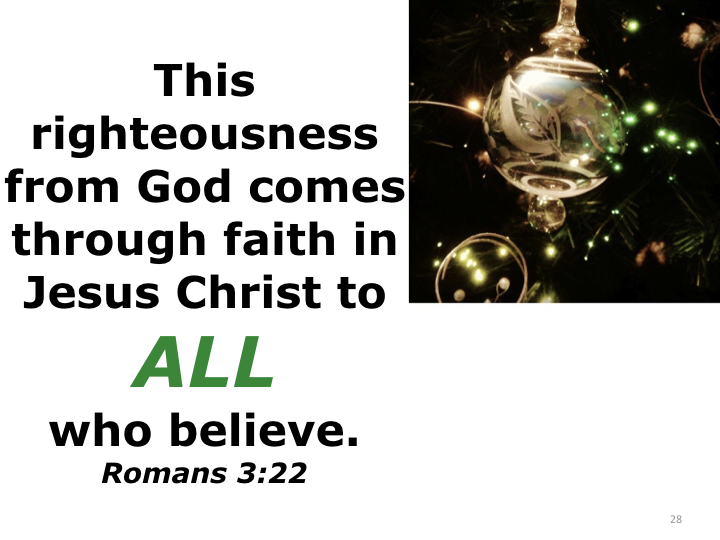
  •    …so that ALL who believe in Him will be saved (Romans 3:22)!

“The coming of Jesus was a search-and-save mission. ‘The Son of Man came to seek and save the lost.’ So Advent is a season for thinking about the mission of God to seek and to save lost people from the wrath to come. … ‘As the Father has sent Me, even so I am sending you’ (John 20:21). It’s the story of how the vertical Advent of God in the mission of Jesus bends out and becomes the horizontal Advent of Jesus in the mission of the church. In us.” —John Piper

You have been rescued, now go be a rescuer. Take this Noël message to ALL … young/old, rich/poor, Black/white, educated/illiterate, healthy/sick, friend/enemy…. the message in the First Noël and every Noël is for everyone! 

If you’ve missed any of the messages in our series The Carols Of Christmas, you can find the full list here.

Poetry Saturday—Plea To Science

Ella Wheeler WilcoxO Science, reaching backward through the distance,
   Most earnest child of God,
Exposing all the secrets of existence,
   With thy divining rod,
I bid thee speed up to the heights supernal,
   Clear thinker, ne’er sufficed;
Go seek and bind the laws and truths eternal,
   But leave me Christ.

Upon the vanity of pious sages
   Let in the light of day;
Breaking down the superstitions of all ages—
   Thrust bigotry away;
Stride on, and bid all stubborn foes defiance,
   Let Truth and Reason reign:
But I beseech the, O Immortal Science,
   Let Christ remain.

What canst thou give to help me bear my crosses,
   In place of Him, my Lord?
And what to recompense for all my losses,
   And bring me sweet reward?
Thou couldst not with thy clear, cold eyes of reason,
   Thou couldst not comfort me
Like One who passed through that tear-blotted season
   In sad Gethsemane!

Through all the weary, wearing hours of sorrow,
   What word that thou hast said
Would make me strong to wait for some tomorrow
   When I should find my dead?
When I am weak, and desolate, and lonely—
   And prone to follow wrong?
Not thou, O Science—Christ, my Savior, only
   Can make me strong.

Thou art so cold, so lofty, and so distant,
   Though great my need might be,
No prayer, however constant and persistent,
   Couldst bring thee down to me.
Christ stands so near, to help me through each hour,
   To guide me day by day
O Science, sweeping all before thy power—
   Leave Christ, I pray! —Ella Wheeler Wilcox

John Maxwell On Helping Others

In John Maxwell’s book Think On These Things, he encourages us to think about our world the way Jesus thinks about the world. This must lead to us loving and serving others!

maxwell-stooping“The way to the top is not ‘stepping on others,’ but ‘stooping to help others.’”

“How many lives are wasted and destroyed because the world’s attitudes and actions toward needy people say ‘I couldn’t care less’? How beautiful this world would be if this unchristian philosophy was replaced with Christian attitudes until people would begin saying, ‘I couldn’t care more.’ If I am to say to my world, ‘I couldn’t care more,’ I must open my eyes and look for hurting people.”

“Jesus was concerned that others would see the hurts of humanity and respond with care. Too many times we, like the disciples, see only the problems of people. We feel the frustration of their failures and the weight of their weaknesses. We remember only the reliance upon our strength and forget our obligation to freely give what we have received.” 

“My helping hand to a needy world is empty unless love is the motive. Material handouts are a poor substitute for love and understanding. People do not need more trinkets, they need more tenderness.”

“The next time you want to help someone who is in difficulty, stop and think. Why not change your approach? Instead of ‘telling it like it is’ why not ‘tell it like it could be.’ Before you begin to question my motives, let me state that I am not asking you to be dishonest. I did not say, ‘Tell it like it could never be.’ I said, ‘Tell it like it could be!’ … When you ‘tell it like it could be’ you help others to see things more clearly. There is no better way to change a problem than to help someone see a solution. Many times people with problems become slaves to their situation because they can see nothing but problems.” 

If you would like to read my review of Think On These Things, please click here. And you can read some other quotes I shared from this book by clicking here.