A.L.I.V.E.—The “I” Is For It Is Finished

Throughout history, lots of martyrs have died for what they believe. But only One had been resurrected from the dead to prove that what He believed and taught was true.

Jesus, however, is not a martyr. His life and His work weren’t cut short. Calvary didn’t happen to Jesus, but He came specifically to die on a Cross. He knew what was going to happen to Him. Check this out…

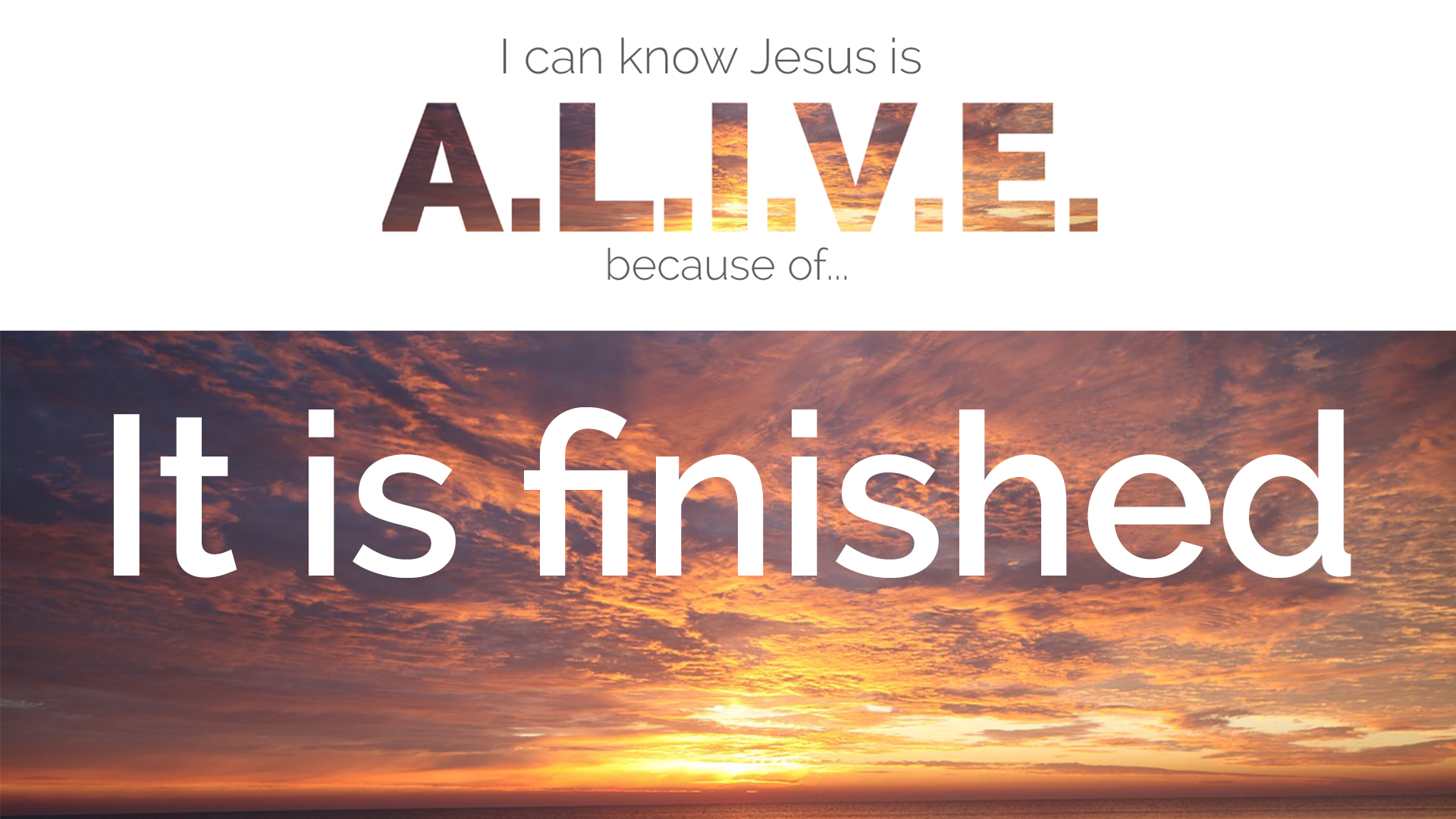
So we can know Jesus is alive by His “It is finished” declaration from the Cross—

Later, knowing that everything had now been finished, and so that Scripture would be fulfilled, Jesus said, “I am thirsty.” … When He had received the drink, Jesus said, “It is finished.”

Actually His “It is finished” wasn’t just a statement, it was a yell that reverberated throughout the countryside. The Greek words Mark uses are megas phōnē, which sounds a lot like our word megaphone. Jesus wanted to make sure everyone heard Him, and then look at the result:

Then Jesus uttered another loud cry and breathed His last. And the curtain in the sanctuary of the Temple was torn in two, from top to bottom.

The curtain that separated God’s presence from mankind was torn in two. The writer of Hebrews notes, “Our High Priest offered Himself to God as a single sacrifice for sins, good for all time. Then He sat down in the place of honor at God’s right hand.”

What do you conclude from all this? C.S. Lewis offered this challenge:

“A man who was merely a man and said the sort of things Jesus said would not be a great man or a moral teacher. He would either be a lunatic—on the level with the man who says he is a poached egg—or else he would be the devil of hell. You must take your choice. Either this was, and is, the Son of God; or else a madman or something worse. You can shut Him up for a fool… or you can fall at His feet and call Him Lord and God. But let us not come with any patronizing nonsense about His being a great human teacher. He has not left that open to us.”

Jesus told us that He would die, how He would die, when He would die, why He would die, and that He would be resurrected. If you heard all of these claims before His crucifixion, you might think He was a lunatic or a braggart. But after His It Is Finished! declaration, we have only one logical conclusion: Jesus is exactly who He said He was. It was out of love for you that Jesus laid down His life and picked it up again. Will you put your faith in Him today?

We are working our way through 5-parts of this series: “I can know Jesus is A.L.I.V.E. because of….” We’ve already covered:

Thursdays With Oswald—Isaiah 6

Oswald ChambersThis is a weekly series with things I’m reading and pondering from Oswald Chambers. You can read the original seed thought here, or type “Thursdays With Oswald” in the search box to read more entries.

Isaiah 6

[These are the notes on Oswald Chambers’ lecture on Isaiah 6.]

     My vision of God depends upon the state of my character. Character determines revelation. … Until I am born again and enter the Kingdom of God I see only along the line of my prejudices. …  

     The purpose of the vision is to enable me to see “the arm of the Lord” behind all circumstances (see Isaiah 53:1). God never gives a man the power to say “I see” until his character proves itself worthy of its purification. What hinders the purging of our perception is that we will build our faith on our experiences instead of on the God who gave us the experiences. My experience is the evidence of my faith, never the ground of it, and is meant to reveal to me a God who is bigger than any experience. …  

     The symbol of the live coal ‘from off the altar’ represents the twofold nature of the substitution of Christ, not only Christ for me, but Christ in me. … 

     God only gives us visions of Himself for one purpose, that we may work them out into character. … After God has given us a time of face-to-face contact with Himself and then puts us into tumults, the temptation is to sit down and say “Where is the blessedness I had when I first knew the Lord?” The Spirit of God holds us steady until we learn to know God, and the details of our lives are established before Him, then nothing on the outside can move us.

From Notes On Isaiah

There are specific reasons God will give us a clearer revelation of Himself—

  1. to purify godly character in us
  2. to help us deal with our own sin
  3. to see God at work in everyday affairs
  4. to keep us energized through trying times
  5. to make us more aware of what Jesus has done for us and in us
  6. to be His messenger among needy people

God doesn’t give visions or revelations just to thrill us or give us an experience. God is perfectly purposeful in everything He does. His visions are for His glory.

Thursdays With Oswald—Isaiah 1

Oswald ChambersThis is a weekly series with things I’m reading and pondering from Oswald Chambers. You can read the original seed thought here, or type “Thursdays With Oswald” in the search box to read more entries.

Isaiah 1

[These are notes from Oswald Chambers’ lecture on Isaiah 1.]

     There is no such thing as fate; a human being always has the power to do the incalculable thing. There are fatal issues, not fate. When God’s decrees come to pass it is because men will not turn. God’s will is supreme, but God never fights against us; it is self-will that fights against God. …  

     If God were love according to our natural view of love He ought never to cause us pain, He ought to allow us to be peaceful; but the first thing God does is to cause us pain and to rouse us wide awake. He comes into our lives all along with ideals and truths which annoy and sting us and break up our rest, until He brings us to the one point, that it is only moral and spiritual relationships which last. That is why God looks cruel judged from the human sentimental standpoint; He loves us so much that He will not prevent us being hurt. …  

     Many a life is paralyzed because this is not realized—“I know God has forgiven me, I know I am right with God, but every now and again I remember the things I did that damaged other lives.” If I put the wrong right with my fellow men, have I become right with God? No, get right with God and He will put you on the way to be right with your fellow men. 

From Notes On Isaiah

Isaiah 1 opens with God taking His people to task for merely going through the motions of worship, with their hearts being far away from Him. Chambers reminds us that this self-will that fights against God will often bring its own pain. Why? Because God loves us too much to let us go unmolested down the path to eternal destruction. Instead, God longs for us to turn our hearts unreservedly to His love and purpose for our lives.

A “Hallelujah!” Lifestyle

David shows us a picture of a man who made prayer the cornerstone of all he did. He’s quick to cry, “Help!” when he’s in trouble, and he doesn’t hold back when he’s crying out to God.

But he also shows us that prayer isn’t just for times of trouble. Prayer should be an ongoing conversation with God so that we can get to know His heart. God knows what’s going to happen (Isaiah 46:10), and He wants us to ask Him to make things clear to us (Jeremiah 33:3).

In Psalm 145, David challenges us to lift up our praise to God, as well as our prayers. This psalm of praise teaches us that we don’t have to only praise God for what He’s done—although that’s a great thing to do—but we can also praise God simply for Who He is!

In this psalm, David says God is…

…worthy of praise (v. 3a) 
…great beyond comprehension (v. 3b) 
…majestic (v. 5)
…awesome (v. 6)
…abundantly good (v. 7)
…gracious, compassionate, slow to anger, rich in love (v. 8)
…good to all (v. 9)
…mighty (v. 11)
…everlasting (v. 13)
…strong (v. 14)
…righteous and loving (v. 17) 
…near to us (v. 18)
…fulfilling (v. 19)
…watchful (v. 20)

Let’s not be known just for our petitions, but for our praise.

Let’s not be known just for our “Help!” but for our “Hallelujah!

Please join me in our continuing look at the Prayers Of David.

Thursdays With Oswald—His!

Oswald ChambersThis is a weekly series with things I’m reading and pondering from Oswald Chambers. You can read the original seed thought here, or type “Thursdays With Oswald” in the search box to read more entries.

His!

     “They were Yours; You gave them to Me” (John 17:6). It is this aspect of a disciple’s life that is frequently forgotten. We are apt to think of ourselves as our own, of the work as our work. A great point in spiritual nobility has been reached when we can really say, “I am not my own.” … The Son of God is the Highest of all, yet the characteristic of His life was obedience. We have to learn that God is not meant for us, it is we who are meant for God. … “Do you not know…you are not your own” [1 Corinthians 6:19]. 

     His! Does that apply to us? Have we realize that our body is not our own, but His—“the temple of the Holy Ghost”! Have we realized that our hearts and affections are not our own, but His? If so, we shall be careful over inordinate affection. Have we realized that all the ambitions of life are His? We are out for one thing only, for Jesus Christ’s enterprises. …  

     “Since you have kept My command to endure patiently” [Revelation 3:10]. This is not the patience of pessimism, nor of exhaustion, but the patience of joyfulness because God reigns. It may be illustrated by likening the saint to a bow and arrow in the hand of God. God is aiming at His mark, He stretches and strains until the saint says—“I cannot stand anymore,” but God does not heed. He goes on stretching until His purpose is in sight, then He lets fly, and the arrow reaches His mark. … 

     It takes the endurance which comes from a vision of God to go on without seeing results. We are not here for successful service, but to be faithful. Had Jesus any results? Before we go into work for Him we must learn that the disciple is not above his master. We cannot be discouraged if we belong to Him, for it was said of Him—“He shall not fail nor be discouraged” [Isaiah 42:4]. Discouragement is “disenchanted egotism.” “Things are not happening the way I expected they would, therefore I am going to give it all up.” To talk like that is a sure sign that we are not possessed by love for Him, but only by love for ourselves. Discouragement always comes when we insist on having our own way. 

From So Send I You

Can Jesus say of you that you are His? Are you trying to make your own way, or are you simply following Jesus? Are you letting God stretch you until He is ready to release you, or are you becoming exhausted and discouraged in the waiting? Is your love for Jesus absolute, or does it come with conditions?

3 Manger Lessons

Listen to the podcast of this post by clicking on the player below, and you can also subscribe on AppleSpotify, or Audible.

Only Luke uses the Greek word for manger in all of the New Testament, with three of those instances being closely linked with the story of Christ’s birth in Bethlehem (Luke 2:4-16).

Luke is a prolific writer, but also a very specific writer. Luke uses more unique Greek words in his two books of the Bible than any other New Testament author. Because Luke is so precise, we need to pause to ask: what message was Luke trying to highlight in the fact that Jesus was born in a manger.

Here are three manger lessons…

  1. The manger shows us God’s PLAN.

The birthplace of Jesus was predicted 700 years before He was born (Micah 5:2). God moved the heart of the most powerful man in the world (Caesar Augustus) to issue a decree that would bring a nearly unknown Joseph and Mary to Bethlehem, and cause them to cross paths with a bunch of unnamed shepherds.

  1. The manger shows us God’s PRIORITY.

Jesus was not born to a handsome family (Isaiah 53:2), nor was He born to an influential family (Philippians 2:7). If He had been born to the high and mighty class, He would not only be unmoved by the desperate conditions of the least and the lost, but He would also be inaccessible to them.

Think about this—Who would you be more likely to have access to: a King or a peasant? Jesus came not to be served but to serve (Matthew 20:25-28).

  1. The manger shows us God’s PLEASURE.

God is pleased to deliver His good news to the disempowered, the downcast, the over-burdened, the desperate (Luke 2:14; Matthew 11:25-26). And what is this good news? The good news is that Jesus came to make it possible for us to be linked with Him forever! (see Matthew 11:28-30).

Jesus was born in a manger to show us that (1) God’s plans always prevail; (2) His priority is to rescue those who are unable to rescue themselves; and (3) He has immense pleasure to yoking us to Him forever and ever! 

May this good news of Christ in manger bring you joy this Christmas season!

►► Would you please prayerfully consider supporting this ministry? My Patreon supporters get behind-the-scenes access to exclusive materials. ◀︎◀︎

If you’ve missed any of the other Christmas carols we have already looked at, you can check them out by clicking here.

Silent Night? Holy Night!

A little boy wanted to do something special for his family, so he thought he would do something he had seen his mother do dozens of times: bake a cake. Quickly he looked through a cookbook and got to work.

Dad was the first one to come home and heard an unusual clatter in the kitchen. Peeking around the corner he saw his son wearing his wife’s apron, slightly dusted in flour, and vigorously stirring a big bowl of batter.

“What are you doing, son” Dad asked.

Without looking up from his work the boy proudly answered, “I’m making a cake, Dad!”

Dad looked around the kitchen and saw all the proper ingredients out, so he was somewhat assured when he asked, “So how’s it going?”

The little boy paused and looked up at him, “Pretty good I think. I’m just having a little trouble with the ‘tbls” and ‘tsps.’”

For those of you who have done any baking, you know that “tbls” are tablespoons and “tsps” are teaspoons. If you get those mixed up, the cake might not turn out very well. For instance, adding a teaspoon of baking powder when the recipe calls for a tablespoon might result in a flat cake. Or adding a tablespoon of salt when the recipe asks for a teaspoon might making a rather salty cake.

Abbreviations only work if everyone is on the same page with you. If they’re not, it could be rather unsavory or maybe even dangerous.

In 1816, Joseph Mohr penned the words to what some have called the best-known Christmas carol in the world: Silent Night! Holy Night!

I’m not really sure how “silent” the night Jesus was born really was: a village so filled with people that no bedrooms were available, a mother in labor, a crying newborn, animals in a stable disturbed by the mother and child, singing angels, and curious shepherds. But let’s leave that part alone for a while.

Although it may not have been a silent night, it most assuredly was a Holy Night! That full title gives us the full impact of what happened at Christ’s First Advent.

Holy means something unlike anything else; someone or something devoted to God; something divine; something with God’s fingerprints all of it. I see at least three divinely holy things in this carol.

  1. The virgin birth of Jesus. 

Not only was the birth of Jesus a fulfillment of prophesy (see Isaiah 7:14 and Matthew 1:18-25), but it was also an indication of God’s miracle-working power. The fact the Luke gives so many specific details about that birth night (see Luke 2:1-2) also lets us know that this isn’t a “once upon a time” myth.

  1. The involvement of angels in the affairs of humans. 

Angels bring messages to key people before the birth of Jesus (Luke 1:11, 26; Matthew 1:20) and on the night of His birth (Luke 2:9-14). John also gives us a peek behind the scenes of the massive spiritual warfare taking place the night of Christ’s birth (see Revelation 12:1-5). Paul tells us that we, too, are involved in this spiritual battle, but that because of Christ’s Advent we’re more than conquerors through Jesus (Ephesians 6:12; Romans 8:37).

  1. The full deity and the full humanity of Jesus. 

Jesus was fully Man and fully God (see Philippians 2:5-7; Matthew 26:63-64; John 8:54-58). This is so important, because without this we would be lost. If Jesus wasn’t fully Man, He wouldn’t know how to help us; if He wasn’t fully God, He couldn’t help us.

So when you hear this carol playing, ask someone if they know the title. More than likely they will say, “Silent Night.” To which you can easily reply, “Actually it’s Silent Night! Holy Night! and I’d like to tell you three amazing, holy things that took place!”

Let’s never abbreviate away the miracles. It may or may not have been a Silent Night, but it most certainly was a Holy Night! These supernatural miracles surrounding Christ’s First Advent provided us freedom from sin, and a rock-solid hope of our eternal reward in Heaven at Christ’s Second Advent.

If you’ve missed any of the other Christmas carols we have already looked at, you can check them out by clicking here.

The Advent “Nicknames” Of Jesus

Most of us who have nicknames didn’t receive them at birth, but they were given to us later on. It might have been because of a memorable incident, or even a character trait that we are known for.

But think about Jesus. Even before His first Advent, He was given numerous “nicknames” or titles that foretold what He was going to do. In the Christmas carol “O Come O Come Emmanuel” four of Christ’s nicknames/titles are key for us today.

It’s so important for us to look back at these First Advent titles because they give us perspective for today and hope for Christ’s Second Advent.

Paul makes it clear that we are living in a time of both already and not yet. We have redemption (Ephesians 1:7), and we are waiting for the day of redemption (Ephesians 4:30). Jesus has already paid for our freedom (First Advent), but we are still awaiting the rewards that will come with His Second Advent.

O come, O come…

  1. …Emmanuel

Literally, this means “God is with His people.” The prophesy was originally given to the prophet Isaiah (see 7:14 and 8:6-10), but it was repeated when Jesus was born (Matthew 1:23). Only One Who was fully God and fully Man could pay the price for our ransom from sin.

  1. …Rod of Jesse 

David, the son of Jesse, prayed, “Who am I, Sovereign Lord, and what is my family, that You have brought me this far?” (2 Samuel 7:18). Yet God was going to continue to keep David’s family line alive (although at times it looked like the dead stump of a long-forgotten tree) to give a throne to Jesus as the King of kings that would once and for all crush satan’s tyranny.

  1. …Dayspring 

When I think of Dayspring, I think of light exploding immediately into the darkness (Isaiah 9:2 and Luke 1:77-78). Jesus Himself told us of His victory over the darkness: I have told you these things, so that in Me you may have [perfect] peace and confidence. In the world you have tribulation and trials and distress and frustration; but be of good cheer [take courage; be confident, certain, undaunted]! For I have overcome the world. [I have deprived it of power to harm you and have conquered it for you] (John 16:33, AMP).

  1. …Key of David

Only Jesus holds the key to open wide our heavenly home (Isaiah 22:22; Revelation 1:8)!

What do you need? 

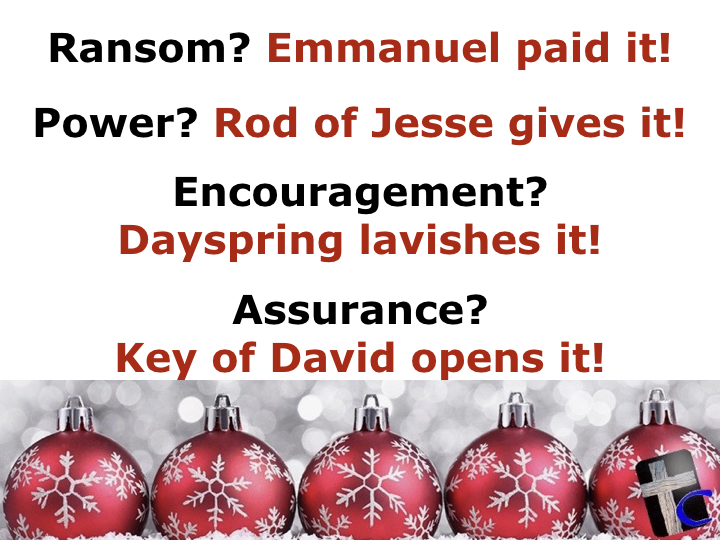
  • Ransom? Emmanuel paid it! 
  • Power to defeat satan? The Rod of Jesse gives it! 
  • Encouragement to press on? The Dayspring lavishes it! 
  • Assurance of your eternal home in Heaven? The Key of David opens it! 

All our longings—all our O come! O come!—are satisfied in Jesus. His First Advent is the already, and His Second Advent gives us hope for the not yet.

If you’ve missed any of the other Christmas carols we have already looked at, you can check them out by clicking here.

Thursdays With Oswald—Where Are Your Feet?

This is a weekly series with things I’m reading and pondering from Oswald Chambers. You can read the original seed thought here, or type “Thursdays With Oswald” in the search box to read more entries.

Where Are Your Feet?

“Where did Jesus placed His feet? He placed them by the sick and the sorrowful, by the dead, by the bad, by the twisted and by the good. He placed His feet exactly where we have to place ours…, in the ordinary rough and tumble of human life as it is. ‘I will make the place of My feet glorious [Isaiah 60:13].’” 

From Run Today’s Race

Run Today’s Race contains short statements from Oswald Chambers intended to stimulate Christians to ponder things like:

  • All of Isaiah 60 is about God’s glory being revealed on earth through Jesus Christ. Am I letting Christ’s glory shine through my life?
  • Do I only look for “super-spiritual” moments, or am I aware that God can make wherever I place my feet a glorious place?
  • Am I willing to go wherever God needs me to go?

Thursdays With Oswald—Becoming Bread

Oswald ChambersThis is a weekly series with things I’m reading and pondering from Oswald Chambers. You can read the original seed thought here, or type “Thursdays With Oswald” in the search box to read more entries.

Becoming Bread

     It is the plough that prepares the ground for sowing the seed. The hard way through the field is the same soil as the good ground, but it is of no use for growing corn because it has never been ploughed. … 

     “The heart is deceitful above all things, and it is exceedingly corrupt: who can know it?” (Jeremiah 17:9). The way through the field which has been battered hard by men’s feet is an illustration of the human heart. The human heart should be the abode of God’s Holy Spirit, but it has been trampled hard by passions until God has no part in it, and the plough has to come into the desecrated place. … 

     Standing corn has to be cut down and go through the process of reaping, threshing, grinding, mixing and baking before it is good for food; and sanctified souls must be told that their only use is to be reaped for God and made into bread for others. It is time we got away from all our shallow thinking about sanctification. … 

     The sound of millstones is music in the ears of God. The worldling does not think it music, but the saint who is being made into bread knows that his Father knows best, and that He would never allow the suffering if He had not some purpose. … 

     “Be content, ye are His wheat growing in our Lord’s field. And if wheat, ye must go under our Lord’s threshing instrument, in His barn-floor, and through His sieve, and through His mill to be bruised, as the Prince of your salvation, Jesus, was (Isaiah 53:10), that ye may be found good bread in your Lord’s house” (Samuel Rutherford). … 

     When by the sanctifying power of the grace of God we have been made into bread, our lives are to be offered first of all to Jesus Christ. … The saints who satisfy the heart of Jesus make other saints strong and mature for God. 

From The Sacrament Of Saints

Do you want to be useful for God? Then you must let Him prepare you to be bread that He can use to nourish others. Chambers reminds us that this preparation process entails the painful processes of ploughing, reaping, threshing, grinding, mixing and baking. But God knows best! He only allows this pain so that He can use you to bless others.