
Thursdays With Spurgeon—Judging By First Appearances

This is a weekly series with things I’m reading and pondering from Charles Spurgeon. You can read the original seed thought here, or type “Thursdays With Spurgeon” in the search box to read more entries.

Listen to the podcast of this post by clicking on the player below, and you can also subscribe on Apple, Spotify, or Audible. 

Judging By First Appearances 

     A good horse cannot be a bad color, and a really good preacher can wear what he likes, and none will care much about it; but though you cannot know wine by the barrel, a good appearance is a letter of recommendation even to a plowman. Wise men neither fall in love or take a dislike at first sight, but still the first impression is always a great thing even with them; and as to those weaker brethren who are not wise, a good appearance is half the battle.

     What is a good appearance? Well, it’s not being pompous and starchy and making oneself high and mighty among the people, for proud looks lose hearts, and gentle words win them. … When a man is as proud as a peacock, all strut and show, he needs converting himself before he sets up to preach to others. The preacher who measures himself by his mirror may please a few silly girls, but neither God nor man will long put up with him. The man who owes his greatness to his tailor will find that needle and thread cannot long hold a fool in a pulpit. …  

     At the same time, the preacher should endeavor, according to his means, to dress himself respectably; and, as to neatness, he should be without spot, for kings should not have dirty footmen to wait at their table, and they who teach godliness should practice cleanliness. … A worn coat is no discredit, but the poorest may be neat, and the men should be scholars rather than teachers till they are so.

From John Ploughman’s Talks of Plain Advice For Plain People

Like it or not, people do form first impressions on external appearances, and all leaders (and especially pastors) would do well to measure these words from Charles Spurgeon. 

I think Spurgeon is talking about honesty here. I need to be honest with who I am, while at the same time being honest about the office that I hold. I’m not playing dress-up, but I also need to be aware that I am representing the King of kings so an appropriate dress and lifestyle are required. 

I also need to be honest that people are forming first impressions the moment they see me, but also that I cannot try to dress or act in a way to please or attract people. 

I remember meeting a group of “seasoned saints” who all showed up at our church one morning. When I engaged them in conversation, they told me that their new pastor appeared to be too young for their style. They formed an opinion about him before ever giving him a chance. I told them that I knew their pastor and that I liked him a lot. I directed them to return to their home church and give their best support to their pastor for at least six months before they made any decisions. Thankfully, during that time they got to know this pastor and remained in that church with him. 

I am in the position I am in because God placed me there. I am working to hear Him say, “Well done, good and faithful servant.” I don’t want my appearance to get in the way of people hearing the message. I don’t want to try to be someone I’m not. I need to remain sensitive to the Holy Spirit’s direction in how I should dress, talk, and live. If my conscience is clear before God, then I won’t have to pay attention to the opinions of others.

►► Would you please prayerfully consider supporting this ministry? My Patreon supporters get behind-the-scenes access to exclusive materials. ◀︎◀︎
Thursdays With Spurgeon—Our Tricky Tongues

This is a weekly series with things I’m reading and pondering from Charles Spurgeon. You can read the original seed thought here, or type “Thursdays With Spurgeon” in the search box to read more entries.

Listen to the podcast of this post by clicking on the player below, and you can also subscribe on Apple, Spotify, or Audible. 

Our Tricky Tongues

I said, “I will guard my ways, lest I sin with my tongue; I will restrain my mouth with a muzzle, while the wicked are before me.” I was mute with silence, I held my peace even from good; and my sorrow was stirred up. My heart was hot within me; while I was musing, the fire burned…. (Psalm 39:1-3)

     Tongue sins are great sins; like sparks of fire ill words spread and do great damage. ‘I will guard my ways, lest I sin with my tongue’ (v. 1). If believers utter hard words of God in times of depression, the ungodly will take them up and use them as a justification for their sinful courses. If parents’ own children rail at them, no wonder if their enemies’ mouths are full of abuse. 

      Our tongue always wants watching, for it is fidgety as an ill-broken horse, but especially must we hold it in when the sharp cuts of the Lord’s rod excite it to rebel. 

     David was not quite so wise as our translation would make him; if he had resolved to be very guarded in his speech, it would have been altogether commendable. When he went so far as to condemn himself to entire silence, ‘even from good,’ there must have been at least a little sullenness in his soul.

From Spurgeon And The Psalms

Oh, how often our tongues trip us up! More times than we would like to admit, our tongues completely undo the good example we have previously shown. James spends almost an entire chapter talking about the fire our tongues can kindle, concluding that our tongues are “a restless evil, full of deadly poison” (James 3:1-18)! 

Part of David’s solution was to notice who was around him so that his words would not add fuel to their skepticism about God. But notice that he went too far because he didn’t speak out the good that he should have spoken. 

Clearly, there is a time to speak and a time to be silent. David’s son Solomon talked about the wisdom of speaking the appropriate words at the appropriate time (see especially Proverbs 10).  

In Mere Christianity, C.S. Lewis talks about a valuable discipline: A personal review of our words and actions at the end of the day. After all, it’s hard to correct something of which we are unaware. Here’s what Lewis wrote—

“When I come to my evening prayers and try to reckon up the sins of the day, nine times out of ten the most obvious one is some sin against charity; I have sulked or snapped or sneered or snubbed or stormed. And the excuse that immediately springs to mind is that the provocation was so sudden or unexpected. I was caught off my guard, I had not time to collect myself…. Surely what a man does when he is taken off guard is the best evidence of what sort of man he is. Surely what pops out before the man has time to put on a disguise is the truth. If there are rats in the cellar you are most likely to see them if you go in very suddenly. But the suddenness did not create the rats; it only prevents them from hiding. In the same way the suddenness of the provocation does not make me an ill-tempered man: it only shows what an ill-tempered man I am.” 

We would do well to pause and ask the Holy Spirit to show us the rats in our cellar—evil words spoken that shouldn’t have been uttered, and helpful words left unspoken at the moment they should have been said. If we will humbly listen, the Holy Spirit will help us mature in this vital area of taming our tricky tongues. 

►► Would you please prayerfully consider supporting this ministry? My Patreon supporters get behind-the-scenes access to exclusive materials. ◀︎◀︎

Attitude Adjustment

Listen to the podcast of this post by clicking on the player below, and you can also subscribe on Apple, Spotify, or Audible. 

Imagine if 700 years before you were born there was a prophecy given about you (Matthew 3:3). Or if on the day of your birth your father said, “And you, my child, will be called a prophet of the Most High; you will go on before the Lord to prepare the way for Him” (Luke 1:76). 

This was John the Baptist.

With these kinds of announcements and the stamp of approval from God Himself, it’s really quite astounding how humble John remained:

  • “After me comes One Who is more powerful than I, Whose sandals I am not worthy to carry” (Matthew 3:11). 
  • “[Jesus] must increase, but I must decrease” (John 3:30). 

The confidence that he was God’s man for the hour gave John boldness to speak truth to religious leaders, wealthy people, and Roman soldiers (Matthew 3:7-12; Luke 3:7-20). Yet his humility was almost his undoing. 

John preached boldly, fulfilling the prophecies that were made about him. But when Jesus came to him to be baptized, John’s humility caused him to defer initially. Then Jesus reminded him that His baptism was necessary “to fulfill all righteousness. Then John consented” (Matthew 3:13-15). 

Whether I am lacking confidence to speak or lead boldly, or lacking humility to let someone else take the lead, I need to return to the Word of God—just as John did. Both his confidence and his humility were balanced by words spoken over him by God. So it must be for you and me too. 

Confidence without humility or humility without confidence can trip me up and cause me to miss out on all that God needs me to do. So my daily prayer must be: Holy Spirit, may I be sensitive to every correction and adjustment You need to make in me. Illuminate the Scriptures that I need to apply to my life that will keep me in a healthy, balanced place. 

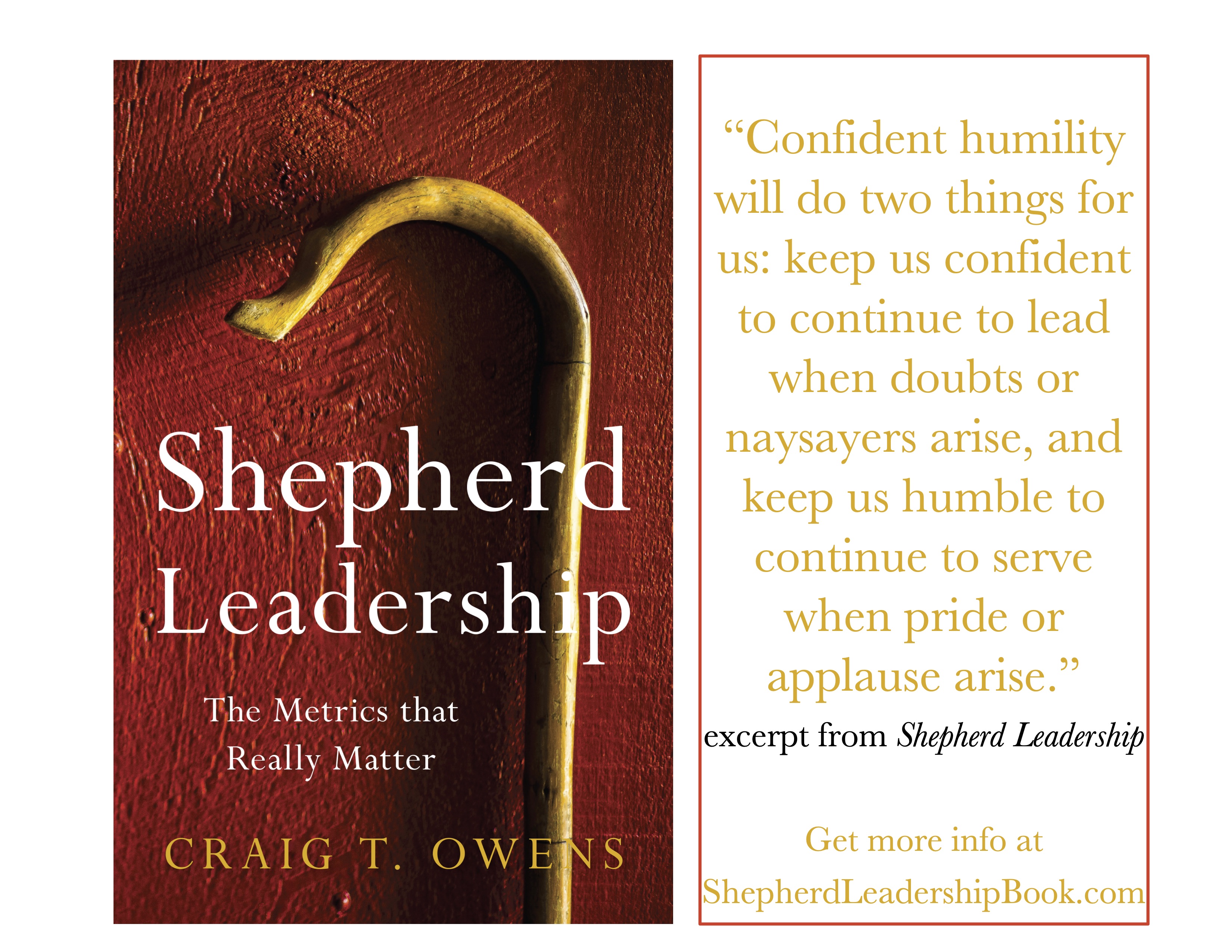
I wrote about this tension between confidence and humility in my book Shepherd Leadership. This was also a topic of conversation in two interviews I did, which you can find here and here. Healthy leaders need the proper balance of confidence and humility to keep their leadership in a place that God can use powerfully. 

►► Would you please prayerfully consider supporting this ministry? My Patreon supporters get behind-the-scenes access to exclusive materials. ◀︎◀︎
Help With Our Blind Spots

Listen to the podcast of this post by clicking on the player below, and you can also subscribe on Apple, Spotify, or Audible. 

Check out a snippet of this conversation I had with John Opalewski and Jim Wiegand on the Leading From Alignment podcast. If you want to watch the full 30-minute interview, check out this link. 

I’m not sure if you’ve noticed, but I have posted quite a bit this week about a leader’s self-awareness—from my book review of John Maxwell’s The Self-Aware Leader, to my training with a pastoral team in South Carolina, to the clip I just shared from this interview. This aspect is so crucial for leadership success. 

As one of my friends commented to me this week, “Your timing on this is incredible—I was just thinking about self-awareness this morning. It’s probably my biggest fear as a leader: am I accurate in my own self-assessment? am I who I think I am?” These are questions that all leaders should be asking regularly. 

I’ll be sharing more clips from this Leading From Alignment interview soon, so please stay tuned. Shepherd Leadership: The Metrics That Really Matter is available in print or ebook, and in audiobook through either Audible or Apple.

►► Would you please prayerfully consider supporting this ministry? My Patreon supporters get behind-the-scenes access to exclusive materials. ◀︎◀︎

Thursdays With Spurgeon—Heart’s Desire

This is a weekly series with things I’m reading and pondering from Charles Spurgeon. You can read the original seed thought here, or type “Thursdays With Spurgeon” in the search box to read more entries.

Listen to the podcast of this post by clicking on the player below, and you can also subscribe on Apple, Spotify, or Audible. 

Heart’s Desire

Do not fret because of evildoers, nor be envious of the workers of iniquity. For they shall soon be cut down like the grass, and wither as the green herb. Trust in the Lord, and do good; dwell in the land, and feed on His faithfulness. Delight yourself also in the Lord, and He shall give you the desires of your heart. (Psalm 37:1-4) 

     There is no room for fretting if we remember that God is ours; there is every incentive for sacred enjoyment of the most elevated and ecstatic kind. Every name, attribute, word, or deed of Jehovah should be delightful to us, and in meditating on it our souls should be as glad as the epicurean who feeds delicately with a profound relish for his dainties. 

     A pleasant duty is here rewarded with another pleasure. People who delight in God desire or ask for nothing but will please God; hence it is safe to give them carte blanche.

From Spurgeon And The Psalms

When we only have eyes for our God, when our heart craves for only what our Savior can provide, when we have ears that tune out all but what the Holy Spirit whispers to us, then we are living in a place where our hearts are continually delighted with what God provides. 

We have to trust the One who gave us His unshakable promises—Be delighted with the Lord. Then He will give you all your heart’s desires (v. 4 TLB). Be delighted with Him and He will—not “may” or “hopefully He will” but He will—give you ALL your heart’s desires! That’s because your desires align with His. 

There is an ultimate reward in Heaven but there are incredibly satisfying rewards along the journey to Heaven as well. Take time every day to meditate on the boundless love that God has toward you, and let your heart be transformed so that you only crave the very best that your Heavenly Father has for you!

►► Would you please prayerfully consider supporting this ministry? My Patreon supporters get behind-the-scenes access to exclusive materials. ◀︎◀︎

How I Learned To Stop Sabotaging My Sabbath

Listen to the podcast of this post by clicking on the player below, and you can also subscribe on Apple, Spotify, or Audible. 

We all know that it’s impossible for a leader to be “on” 24 hours a day, seven days per week. Yet many leaders continue to operate as though they are supposed to be “on” all the time. The Bible not only calls for us to take a Sabbath rest, but it is something that God Himself demonstrated for us. 

I enjoyed my time on the Thriving In Ministry podcast with Kyle Willis while his podcast partner Dace Clifton was on sabbatical. Kyle and I didn’t plan this, but he mentioned a passage from Hebrews 4 that the Holy Spirit used years ago to get my attention. 

I would make my plans for a day off, or even a break in the middle of a busy day, only to find myself allowing work to consume that time. I was sabotaging my sabbath time until I saw three life-changing words in Hebrews 4:10. 

It is a very humbling thing to recognize that it is “my own work” that is sabotaging my sabbath rest. God is aware of my need for sabbathing, but I have to submit my plans to His plan. As I mentioned in this interview, and in a previous blog post, writing “ITLW” at the top of my daily To Do list has helped me immensely. It is a reminder to me that God knows what I need to be doing, with whom I need to be speaking, and what ministry needs to be accomplished each day far, far better than I ever could. I must listen to the Holy Spirit and submit “my own work” to God’s will. 

I talk about some other strategies that helped me in this area in my book Shepherd Leadership. It is a part of a 5-chapter section where I discuss how leaders can achieve wholly healthiness—mental, physical, spiritual, and relational health. I hope you will pick up a copy for yourself.

I’ll be sharing more clips from this Thriving In Ministry interview soon, so please stay tuned. Shepherd Leadership: The Metrics That Really Matter is available in print or ebook, and in audiobook through either Audible or Apple. 

►► Would you please prayerfully consider supporting this ministry? My Patreon supporters get behind-the-scenes access to exclusive materials. ◀︎◀︎

Thursdays With Spurgeon—Understanding Repentance

This is a weekly series with things I’m reading and pondering from Charles Spurgeon. You can read the original seed thought here, or type “Thursdays With Spurgeon” in the search box to read more entries.

Listen to the podcast of this post by clicking on the player below, and you can also subscribe on Apple, Spotify, or Audible. 

Understanding Repentance

     Repentance is an old-fashioned word, not much used by modern revivalists. 

     “Oh!” said a minister to me one day, “it only means a change of mind.” This was thought to be a profound observation. “Only a change of mind”; but what a change! A change of mind with regard to everything! 

     Instead of saying, “It is only a change of mind,” it seems to me more truthful to say it is a great and deep change—even a change of the mind itself. But whatever the literal Greek word may mean, repentance is no trifle. You will not find a better definition of it than the one given in the children’s hymn:

     Repentance is to leave
     The sins we loved before
     And show that we in earnest grieve,
     By doing so no more.

From The Soul Winner

The Greek word Spurgeon references that is rendered as repentance is metanoia. Many have translated this as a “new mind.” But a more literal translation is “with new understanding.” When my carnal mind has been replaced by a spiritual mind, I now see everything differently—I understand everything differently. 

The Amplified Bible elaborates it like this: Bring forth fruit that is consistent with repentance—let your lives prove your change of heart (Matthew 3:11). 

More than just an about-face away from my old sinful habits, repentance is a more profound understanding of just how grievous my sinful lifestyle was to God. It repulses me to even consider indulging in those sins again because now that I understand how joy-filled my relationship with Jesus is when I walk in righteousness, I never want to even dabble in that slime again! 

I don’t want to see how close I can get to sin, but I want to see how close I can get to Jesus! When I truly have repented of my sins, the Holy Spirit has given me a whole new understanding of both the pain of sin and the joy of righteousness. Let’s become people so quick to repent anytime the Holy Spirit convicts us of even the smallest of sins.

►► Would you please prayerfully consider supporting this ministry? My Patreon supporters get behind-the-scenes access to exclusive materials. ◀︎◀︎

Complacency Is Deadly

Listen to the podcast of this post by clicking on the player below, and you can also subscribe on Apple, Spotify, or Audible. 

At that time I will search Jerusalem with lamps and punish those who are complacent… (Zephaniah 1:12). 

When I taught a series on the minor prophets, I noted that Zephaniah wanted to share some really, really good news, but first, he had to make his audience confront the really bad news. The really bad news is that we all have sinned and fall short of God’s righteous standard. The really, really good news is that God has provided forgiveness for our sins through Jesus. 

Sadly, one of the things that keeps us from addressing the sin in our heart is complacency. The King James Version of Zephaniah 1:12 says that the people were “settled in their complacency.” If you look up the definition of the Hebrew word here, it literally means settled on their lees. 

Look at the full verse in the NIV: “At that time I will search Jerusalem with lamps and punish those who are complacent, who are like wine left on its dregs, who think, ‘The Lord will do nothing, either good or bad.’” 

This phrase—“who are like wine left on its dregs”—puts the people at a tipping point. The lees or dregs of a barrel is where the wine is at its finest color and flavor. But wine that has “settled” is right at the point of curdling. 

God is addressing people who have become self-satisfied. They have reached the place that they have called their “good life.” They want nothing to disturb them; especially not any teaching or preaching that may bring the conviction of the Holy Spirit. 

So they have deluded themselves. They have said, “If everything seems to be going well for me, then I must be doing everything right. Don’t tell me anything that might make me uncomfortable.” Outward appearances and circumstances can be deceiving. We have to listen for the voice of the Holy Spirit. We must never become complacent in our relationship with Jesus. 

A very similar warning is sounded for the church in Laodicea. Jesus called them complacent when He said that they were neither hot nor cold, but lukewarm. They, too, had also stopped listening to the Holy Spirit because they had complacently said to themselves, “I am rich; I have acquired wealth and do not need a thing.” 

Laodicea was at the point where they should have been at their finest, but instead their complacency had brought them to a place of curdling—a place where Jesus threatened to spit them out of His mouth! 

Complacency is deadly! 

The solution: listen to the rebuke and discipline that the Holy Spirit brings, and repent of complacency. If we do, we will discover the inestimable, eternal riches that only a vibrant relationship with Jesus can give us (Revelation 3:14-22). 

Let us never become settled on our lees, but let us be ready to be poured out for our Master’s enjoyment and glory. May I suggest that we all regularly pray the prayer of David: “Search me, O God. Point out any sin that I have complacently allowed to remain in my heart” (Psalm 139:23-24). And when that sin is revealed, don’t wait to repent because your wine is just about to curdle! But the restoration that repentance will bring to your heart will allow the richness and vibrancy of your life to be pleasing to your Savior! 

►► Would you please prayerfully consider supporting this ministry? My Patreon supporters get behind-the-scenes access to exclusive materials. ◀︎◀︎

Thursdays With Spurgeon—The Proof In The Longing

This is a weekly series with things I’m reading and pondering from Charles Spurgeon. You can read the original seed thought here, or type “Thursdays With Spurgeon” in the search box to read more entries.

Listen to the podcast of this post by clicking on the player below, and you can also subscribe on Apple, Spotify, or Audible. 

The Proof In The Longing

My soul is consumed with longing for Your laws at all times. (Psalm 119:20) 

     Can you say that your heart pines for God as the watcher through the midnight sighs for the dawn, or as the traveler over burning sand longs for the shadow of a great rock? Oh, then, though I would not have you rest in longings; indeed, I know you never can. Yet they are a proof that you are spiritually alive! Heart longings are far better tests than attendance at sacraments, for men who are dead in sin have dared to come both to baptism and the Lord’s Supper. Eager desires prove spiritual life much better than supposed attainments, for these supposed attainments may all be imaginary. But a heart breaking for the longing that it has for God’s Word is no fancy. It is a fact too painful to be denied! … 

     We have not reached perfection, but do not let us, therefore, be discouraged, for the apostle of the Gentiles said, ‘Not as though I had already attained, either were already perfect’ (Philippians 3:12). … When a man thinks himself so good that he cannot be better, he is probably so bad that he could not be worse. … 

     The fuller a man is of grace, the more he hungers for grace! Strange it is to say so, but the paradox is true—the more he drinks and the more he is satisfied and ceases to thirst in one sense, the more he is devoured with thirst after the living God! … This it is to be a true child of God: To always have a yearning soul toward God’s Word, to be eager after His commandments at all times. May the Holy Spirit keep us ever hungering and thirsting after God and His truth.

From Holy Longings

In a recent interview that I did, I was asked how someone should deal with the fact that they are struggling to be balanced in their leadership. My reply was, “The very fact that they are feeling the struggle should be a great encouragement to them. People who don’t feel the tension of wanting to get better are blinded to their deficiencies and never seek help.” 

The proof of our growing maturity is in our longing for growing maturity. 

The psalmist in this great chapter is thrilled with what God’s Word has already accomplished in his life, and yet he is still longing for the Holy Spirit to do an even greater work in his heart. This is the tension in which every maturing Christian should live. The devil would love to whisper to your heart, “Your longing for more proves that you are still immature.” This is an utter lie! As Spurgeon reminds us, the more of God we have, the more of God we will crave.

My friend, never be satisfied with what you have already attained. Be delighted with what God has done, but crave that He will continue to do more and more and more! These longings not only delight God but bring Him great glory.

►► Would you please prayerfully consider supporting this ministry? My Patreon supporters get behind-the-scenes access to exclusive materials. ◀︎◀︎

You Have To Be Tuned In To Yourself

Listen to the podcast of this post by clicking on the player below, and you can also subscribe on Apple, Spotify, or Audible. 

I had a great time on the Thriving In Ministry podcast with Kyle Willis while his podcast partner Dace Clifton was on sabbatical.

From all of the podcasts and interviews they had done, Kyle shared with me how so many pastors find it difficult to take a Sabbath break. Kyle noted that a pastor’s day of rest seems to bump into everyone else’s day of work. 

I’ve found this to be true for anyone in leadership, even if they’re not a pastor. It seems that a leader’s work is never done, making it very easy to try to maintain a 24/7 availability. If you feel like rest is a difficult thing to maintain, you’re in good company because Jesus had the same struggle. 

That passage in Mark 6 that I mentioned is instructive for leaders in a couple of ways. First, Jesus was looking out for His teammates. He saw that they were tired and He called them to a place of rest. Good shepherds are always tuned in to the needs of the flock around them. As David said in Psalm 23, the Good Shepherd knows when to lead us to quiet pastures and still waters. 

Second, I see that Jesus was also tuned in to Himself. Even though He was trying to get to a quiet place, He took time to minister in teaching and food to a crowd that was described as “sheep without a shepherd.” When this time was finished, Jesus took time alone to pray (Mark 6:46). 

I think sometimes leaders have sabotaged their own health and effectiveness by saying things like, “This is quitting time” or “This is my day off.” Instead, we should listen to the Holy Spirit giving us insight like, “Take a break now. It’s time to go to a quiet pasture. It’s time to recharge in prayer.” 

Leaders, don’t stick rigidly to your schedule but stay tuned in to yourself. Listen for the unmistakable voice of the Holy Spirit giving you wisdom. I have a section of five chapters in my book Shepherd Leadership that deal with every aspect of a leader’s health. Please pick up a copy today.

I’ll be sharing more clips from this Thriving In Ministry interview soon, so please stay tuned. Shepherd Leadership: The Metrics That Really Matter is available in print or ebook, and in audiobook through either Audible or Apple.

►► Would you please prayerfully consider supporting this ministry? My Patreon supporters get behind-the-scenes access to exclusive materials. ◀︎◀︎