Helping Others Follow Jesus

Listen to the podcast of this post by clicking on the player below, and you can also subscribe on Apple, Spotify, or Audible. 
Remember your leaders… (Hebrews 13:7). 

As the writer of Hebrews closes his epistle, he speaks to the saints about how they should interact with their leaders (Hebrews 13:7-21). He concludes this section by saying their confidence in their leaders brings joy to their leaders. 

But I would like to flip the script on this to describe how leaders are supposed to live in a way that makes it a joy for people to follow their leadership. 

So, leaders, let’s make sure we are…

…speaking the Word of God, not any kinds of “strange teachings” (vv. 7, 9). 

…living a life worthy of imitation. This requires a consistent and steadfast example of Christ-like living (vv. 7-8). 

…strengthening people with grace, not man-made strategies (v. 9). 

…not giving ourselves special privileges just because we are in leadership positions (v. 10). 

…not concerned with public perceptions while we stand for Jesus (vv. 11-13). 

…keeping in mind that our reward is in Heaven, so we don’t look for human accolades here but in “the city that is to come” (v. 14). 

…setting the example in hospitality (v. 16). 

…leading with the integrity and gentleness that makes it easy for saints to have confidence in our leadership (v. 17a). 

…serving with sober joy (v. 17b). 

…praying for others to be empowered “to live honorably” and with a clear conscience (vv. 18-19). 

A mark of a godly leader is one who makes it desirable for others to follow Jesus. 

Jesus is “that great Shepherd of the sheep” (v. 20). We are merely under-shepherds of small flocks, but we have been appointed to this pasture by Him. 

He will equip us “with everything good for doing His will” (v. 21a), which means we don’t have to attempt to equip ourselves. Instead, we can operate in His empowerment. 

He will also work in us “what is pleasing to Him” (v. 21b). We are not trying to please people, but we should want to please the One to Whom we must give an account. 

All “glory for ever and ever” goes to Him! We are not serving as His under-shepherds so that we can be recognized, but so people can draw closer to Him. We shepherd people to make Jesus known. 

If we will keep these things in mind, we are free to serve. Leaders who are secure—who are humbly confident in their calling—are leaders who are easy to follow. 
Let’s pray: Holy Spirit, help me to lead in a way that allows others to see Jesus because of my lifestyle. I want to be an example that helps others draw ever closer to Him. Amen! 

This is part 88 in my series on godly leadership. You can check out all of my posts in this series by clicking here. And you may also want to check out my books for church leaders—Shepherd Leadership and When Sheep Bite. 

►► Would you please prayerfully consider supporting this ministry? My Patreon supporters get behind-the-scenes access to exclusive materials. ◀︎◀︎
Don’t Get Tripped Up

Therefore, since we are surrounded by such a great cloud of witnesses, let us throw off everything that hinders and the sin that so easily entangles. And let us run with PERSEVERANCE the race marked out for us, fixing our eyes on Jesus, the Pioneer and Perfecter of faith. For the joy set before Him He ENDURED the Cross, scorning its shame, and sat down at the right hand of the throne of God. Consider Him who ENDURED such opposition from sinners, so that you will not grow weary and lose heart. (Hebrews 12:1-3) 

The words perseverance (v. 1) and endured (2x in vv. 2-3) are all the Greek word hupomone. This word means: not swayed from the goal, not hesitating to run the race, pushing forward no matter what. 

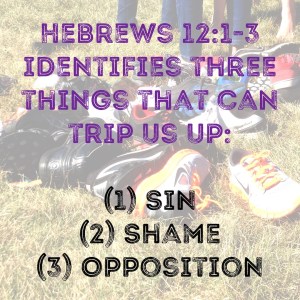
These three verses also identify three thing that could trip us up: 

  1. Sin. Not just blatant sin, but any area where I am hesitating to respond to the Holy Spirit. 
  2. Shame. Paying attention to how I look in the eyes of others, and then feeling ashamed that I don’t measure up to their standard. 
  3. Opposition. The attacks from the devil and his willing agents. 

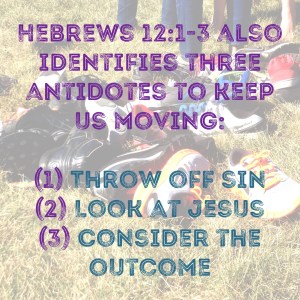
Fortunately, this same passage also tells us the three ways to avoid these trip-ups: 

  1. Throw off the sin! Make the changes the Holy Spirit has shown me—do it immediately. 
  2. Keep my eyes on Jesus. After all, it doesn’t matter what anyone else things of me. If I keep my eyes on my Savior, I can be fueled by the same joy that kept Him from getting tripped up. 
  3. Consider the opposition. The Greek word for “opposition” is literally a combination of “anti” and “logic.” The opposition has opinions that are illogical, but I have the logical Truth in Jesus! 

No regression. No hesitation. Only upward and onward every single day! 

Check out these related posts:

Power To Defeat Temptation

Listen to the podcast of this post by clicking on the player below, and you can also subscribe on Apple, Spotify, or Audible. Check out the video content in this post by clicking here. 

The first temptation of mankind was to doubt the God was good and that He was trustworthy. That’s why satan tempted Adam and Eve by saying they could become “like God.” Every Christian faces temptation, and one of the biggest is still satan’s same strategy: to try to get us to handle things on our own. 

The baptism in the Holy Spirit is to help us realize that we cannot rely on ourselves, but we must rely totally on His power. 

David Wilkerson said, “This is an ongoing problem with many Christians. We look to the Holy Spirit as some kind of booster shot to empower or energize our human will. We expect Him to build up our supply of grit and determination, so we can stand up to temptation the next time it comes. We cry, ‘Make me strong, Lord! Give me an iron will, so I can withstand all sin.’ But God knows this would only make our flesh stronger, enabling it to boast.”  

Overcoming temptation is not about willpower but Spirit-power. Paul said this in 2 Corinthians 12:9.  

(Check out all of the Scriptures in this post by clicking here.)

Being tempted to sin is not a sign that God has abandoned me or that I am living apart from Him. Jesus was perfect and yet we are told He was tempted in every way (Hebrews 4:15). So we can easily determine that temptation is not a sin because Jesus was tempted (Luke 4:3-13). This story is told in all three synoptic Gospels (Matthew 4:1-10; Mark 1:13). 

Look at what preceded this temptation: Jesus was baptized in the Holy Spirit (Matthew 3:13-17; Mark 1:9-12; Luke 3:21-22, 4:1-2). The Spirit was the One Who led Jesus into the wilderness specifically to face temptation. 

Temptation comes the the Latin word meaning “to stretch.” Oswald Chambers noted, “Every temptation of satan is perfectly wise. The wisest, shrewdest, subtlest things are said by satan, and they are accepted by everybody as the acme of human philosophy; but when the Spirit of God is at work in a man, instantly the hollow mockery at the heart of what satan is trying to do, is seen. When we understand the inwardness of the temptation we see how satan’s strategy is turned into confusion by the Spirit of God.” 

Temptation is not a sin, but a stretching. It is a call for us to give up our willpower and trust the Spirit’s power. 

When Jesus came to earth, He gave up His rightful prerogatives as God. The stretching test here was this: Would He continue to rely on the Spirit’s power or would He try to reclaim the power He surrendered? 

It’s the same question for us when we are tempted: Will we take matters into our own hands, or will we leave ourselves in the Spirit’s hands? In one paragraph, James tells us both the blessing of overcoming temptation and where temptations originate—

Blessed is the one who perseveres under trial because, having stood the test, that person will receive the crown of life that the Lord has promised to those who love Him. When tempted, no one should say, “God is tempting me.” For God cannot be tempted by evil, nor does He tempt anyone, but each person is tempted when they are dragged away by their own evil desire and enticed. Then, after desire has conceived, it gives birth to sin; and sin, when it is full-grown, gives birth to death. (James 1:12-15) 

The Spirit shows us the way to have the mind of Christ in overcoming temptation (1 Corinthians 10:13). 

Just before Jesus was tempted, we see the help that is promised to all of us through the baptism in the Holy Spirit (Matthew 3:11; Mark 1:8; Luke 3:15-16). 

There are some things we will learn about ourselves in a time of temptation that we cannot learn in any other way. Being baptized in the Holy Spirit is about empowerment, but it is really the power to submit—full and unconditional surrender to the only One who can bring me safely through (Hebrews 4:15; 5:7-9; 2:17-18). 

As we talked about last week, the Spirit of Truth gives us the mind of Christ (John 16:13, 15; 1 Corinthians 2:16). 

We, just like Jesus, can be victorious over these temptations by doing what Jesus did. (1) He was fully submitted to His Heavenly Father, (2) He was sensitive to go where the Holy Spirit led Him, and (3) He uncovered the shrewd and subtle arguments of satan by using the Word of God. 

Instead of saying, “I gave in to temptation,” we can say, “I gave in to the Holy Spirit, Who helped me defeat temptation!” 

Check out all of the other messages in our series We Are: Pentecostal by clicking here. 

►► Would you please prayerfully consider supporting this ministry? My Patreon supporters get behind-the-scenes access to exclusive materials. ◀︎◀︎
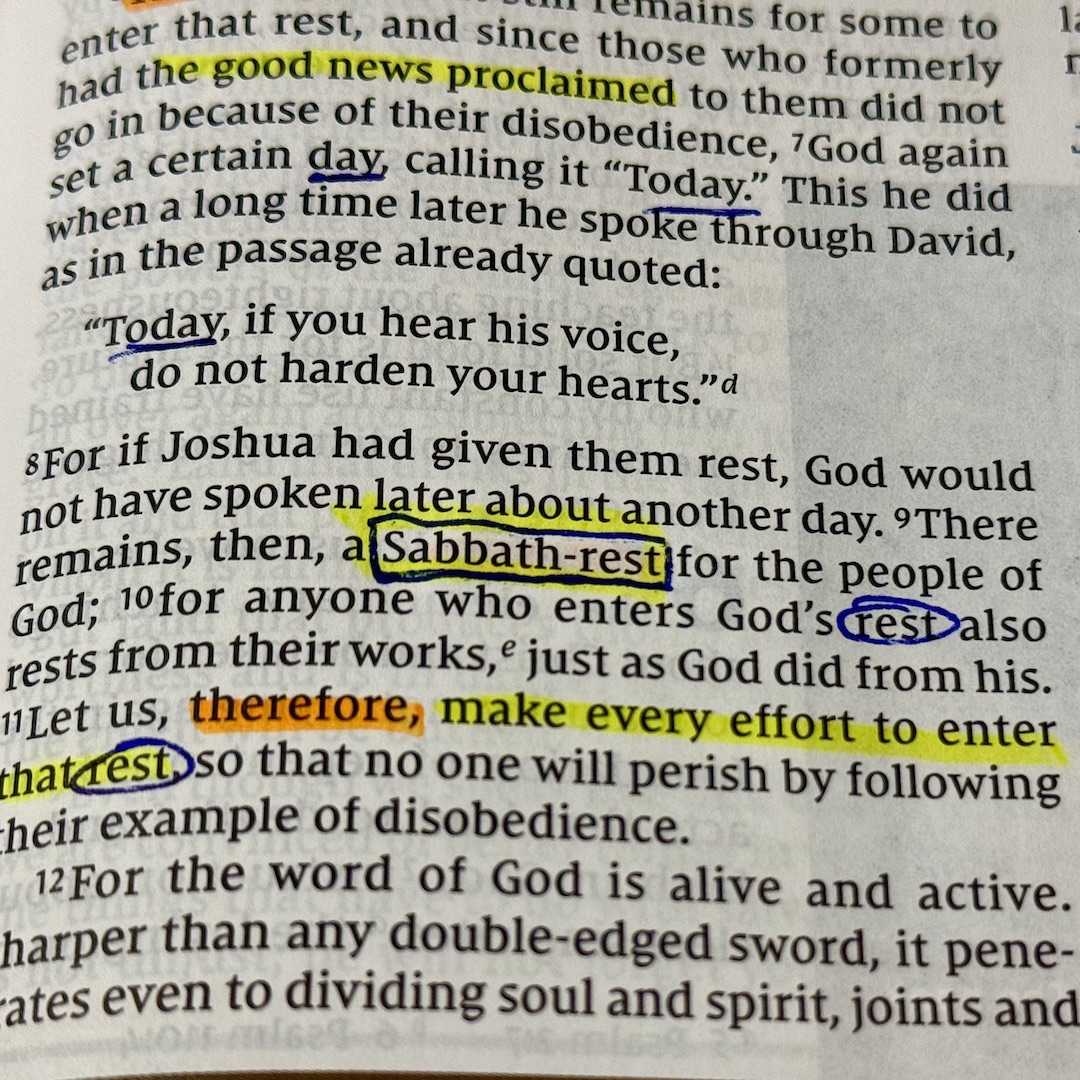
Sabbath-rest

Listen to the podcast of this post by clicking on the player below, and you can also subscribe on Apple, Spotify, or Audible.


There remains a Sabbath-rest for the people of God. (Hebrews 4:9) 

The word Sabbath-rest (Greek: sabbatismos) is unique in all of Scripture. This is the place of total and complete contentment in God’s presence—uninterrupted and undiminished for all of eternity. 

This is a unique word because it is a unique rest that only Jesus made possible for us. 

This rest is exclusive to those who rest “from their works” (v. 10) and stand secure in their loving obedience of God. In other words, this rest is for those who realize that it is only faith in Jesus that can bring them into the Sabbath-rest. 

This is a rest that was promised long before Jesus made His advent on earth. The Greek word katapausis is translated into the English word “rest” and appears eight times in the New Testament—with seven of those showing up in the Book of Hebrews (3:11, 18; 4:1, 3, 5, 10, 11). These references remind us of the frustration of not being able to obtain this rest on our own efforts. 

The only other use of this word for “rest” is in Stephen’s sermon in Acts 7:49, in which he quotes God saying, “‘Heaven is My throne, and the earth is My footstool. What kind of house will you build for Me?’ says the Lord. ‘Or where will My resting place be?’” Again, God is telling us that the place of Sabbath-rest is not within our power to construct on our own. 

Of the seven uses in the Book of Hebrews, most of them are referring to an Old Testament passage in Psalm 95:7-11, echoing the failure of the Israelites to experience the Sabbath-rest because of their sin. But the Old Testament word for “rest” (menuha) keeps pointing to the hope of the Sabbath-rest of Hebrews 4:9. 

Check out the other places menuha is used as it points to the culminating Sabbath-rest that Jesus makes possible. 

The people vainly searching for rest: So they set out from the mountain of the Lord and traveled for three days. The ark of the covenant of the Lord went before them during those three days to find them a place to rest. (Numbers 10:33) 

The realization that the place of rest wasn’t found: Since you have not yet reached the resting place and the inheritance the Lord your God is giving you. (Deuteronomy 12:9) 

Learning that God’s rest is only available because God Himself will fulfill His promise of rest: Praise be to the Lord, Who has given rest to His people Israel just as He promised. Not one word has failed of all the good promises He gave through His servant Moses. (1 Kings 8:56) 

Jesus is portrayed as the Good Shepherd Who leads His people to His resting place: He makes me lie down in fresh, tender, green pastures; He leads me beside the still and restful waters. (Psalm 23:2 AMPC) 

Jesus is prophesied to be the One Who makes this resting place a reality: In that day the Root of Jesse will stand as a banner for the peoples; the nations will rally to Him, and His resting place will be glorious. (Isaiah 11:10) 

Nothing can compare to this Sabbath-rest that Jesus makes possible! No one can create this place. Jesus tells us that if we will be yoked with Him, He will take us into His rest—

Come to Me, all you who are weary and burdened, and I will give you rest. Take My yoke upon you and learn from Me, for I am gentle and humble in heart, and you will find rest for your souls. For My yoke is easy and My burden is light. (Matthew 11:28-30) 

For the Lamb at the center of the throne will be their Shepherd; “He will lead them to springs of living water.” “And God will wipe away every tear from their eyes.” (Revelation 7:17) 

There remains a Sabbath-rest for the people of God. A rest that Jesus died to pay for, and rose from the grave to show that He alone has the power to take you from the grip of sin into His flawless, eternal, perfect, all-satisfying rest! Don’t miss out on this, but come to Jesus as your Savior and Shepherd. 

►► Would you please prayerfully consider supporting this ministry? My Patreon supporters get behind-the-scenes access to exclusive materials. ◀︎◀︎
The Perfection Race

Listen to the podcast of this post by clicking on the player below, and you can also subscribe on Apple, Spotify, or Audible.  

I am wrapping up my first full school year at Cedar Springs Public Schools. It has been a challenging journey—much more challenging than I could have anticipated before I started in this role. Together with my administrators and teammates we have put some new things in place that I hope will serve our staff and students well for years to come. It’s not perfect, but it’s better than it was. Now we get to watch to see what happens next. 

There is another amazing and challenging journey I am on (and so are you). But this is a journey toward perfection.

Some amazing faith-filled people have already ran their race well and their lives are recorded for us in Hebrews 11. The writer tells us, “all these people were still living by faith when they died” (11:13). “These all were commended for their faith, yet none of them received what had been promised, since God had planned something better for us so that only together with us would they be made perfect” (vv. 38-39). 

(See all of the Scriptures verses in this post by clicking here.)

Jesus is the one who makes this perfection accessible:

  • Once made perfect, He became the Source of eternal salvation for all who obey Him (5:9)
  • The Son, who has been made perfect forever (7:28) 
  • For by one sacrifice [Jesus] has made perfect forever those who are being made holy (10:14) 

Even before our forerunners were on earth, the Lamb of God was already slain as the perfect sacrifice to make us perfectly holy in God’s sight. They ran their race by faith without seeing this reality fulfilled (11:13). Now they make up the “cloud of witnesses” (12:1) who are cheering us on in our race. 

They were empowered by faith in their coming Messiah; we are empowered by our faith in the Messiah who has been revealed to us. Their race was as vital to our race, as our race is to theirs. Our race shows them how invaluable their race was. 

It is a race toward the perfection for which Jesus paid such a steep price. 

“You have come to Mount Zion…to the church of the firstborn, whose names are written in heaven. You have come to God, the Judge of all, to the spirits of the righteous made perfect” (12:22–23). 

“Only together” (11:40) do we all get there. My race—the way I am living right now—is as important and indispensable as their race was. So I will keep my “eyes on Jesus, the Pioneer and Perfecter of [our] faith” (12:2) so that I can run and finish my race with perfection! 

I hope you will run with me, with all the saints who have come before us, and with those saints who are still running alongside us today. Your race, run in the perfection of Jesus, matters! 

►► Would you please prayerfully consider supporting this ministry? My Patreon supporters get behind-the-scenes access to exclusive materials. ◀︎◀︎
Seeing The Invisible In The Visible

By faith we understand that the entire universe was formed at God’s command, that what we now see did not come from anything that can be seen. (Hebrews 11:3 NLT) 

Then God said, “Let there be light,” and there was light. (Genesis 1:3) 

The Latin phrase ex nihilo isn’t quite right. God didn’t create something out of nothing, but He created everything out of Himself. 

“God’s command” (Greek: rhema Theos) = “God said” (Hebrew Elohim amar). 

God is not an artist who mixed His paints to apply them to His canvas. He is not a sculptor who chiseled an image out of a block of marble. Nor is He an artisan who fashioned a lump of clay into a beautiful piece of pottery. 

He created the materials by His breath. The sound of His voice created all of the visible universe. His voice still reverberates through His creation, keeping everything from galaxies to electrons in their proper places. 

“We understand”—perceive with our eyes of faith—that “God said” into existence all that we can see. 

We can see our Creator by studying His creation. The more we marvel at the visible universe, the more we will worship the Creator of the universe. 

Check out two related posts:

►► Would you please prayerfully consider supporting this ministry? My Patreon supporters get behind-the-scenes access to exclusive materials. ◀︎◀︎
Links & Quotes

Preaching to ourselves is not only a good rescue from anxiety, but it’s also a good inoculation to keep us from sliding from contentment into crisis.

I have a lot of new video content on my YouTube channel every week. Please check it out and subscribe so you don’t miss anything.

“When you teach a child writing, you hold its hand while it forms the letters: that is, it forms the letters because you are forming them. We love and reason because God loves and reasons and holds our hand while we do it.” —C.S. Lewis, Mere Christianity 

“I attribute my success to this: I never gave or took an excuse.” —Florence Nightingale 

“Be like the brave Spartan who would never lose his shield, but would come home either with it or on it. ‘Cast not away your confidence.’ You trusted in God in those early days, and nothing seemed to daunt you then. ‘Cast not away your confidence.’ Rather, get more to add to it. Let there be no thought of going back, but may there rather be a distinct advance!” —Charles Spurgeon, commenting on Hebrews 10:34-35 

“Nobody can imagine how nothing could turn into something. Nobody can get an inch nearer to it by explaining how something could turn into something else. It is really far more logical to start by saying ‘In the beginning God created heaven and earth’ even if you only mean ‘In the beginning some unthinkable power began some unthinkable process.’” —G.K. Chesterton 

Two Questions About Death

Listen to the podcast of this post by clicking on the player below, and you can also subscribe on Apple, Spotify, or Audible. Check out the video content in this post by clicking here. 

I’m going to spoil some of the surprise right up front. We’re going to look at two questions about death, and the answer to the question, “Is that in the Bible?” is “No” for both questions. 

So the question we are really going to have to wrestle with is: Is it unbiblical—that is the Bible says it is wrong—or is it non-bibilcal—the Bible doesn’t tell us explicitly one way or the other. 

Persisting to do unbiblical things is a sin because we are trying to point out why God is wrong and why our opinion is right. 

But there is also a danger in pursuing non-biblical things, when we try to give our non-biblical opinion or preference  biblical weight, and then look down on anyone who doesn’t believe or act like we do. The Bible does tell us to  be peacemakers (Romans 14:13-21). 

(See all the Scriptures in this post by clicking here.) 

Statement #17—Cremating a loved one exempts them from heaven. Is that in the Bible? No. 

The preferred method in the Old Testament appears to be burial. Sometimes in the ground, but more typically in a cave or man-made crypt. There were exceptions. For instance, the bodies of Saul and Jonathan were cremated (1 Samuel 31:11-13), and King Jehoram could have been cremated, but certainly he wasn’t interred the same way that his father and grandfather were (2 Chronicles 21:1, 4-6, 18-20).  

In the New Testament era there was an end-of-life process the Greeks adopted called ossilegium. The Greeks frequently anointed the body with oil and wine and burned it until just the bones were left. The Jews wrapped the dead body in burial shroud and anointed it with spices—as with Lazarus (John 11:38-44) and Jesus (John 19:38-41). About a year after death, the bones would be collected and placed in an ossuary. Most often, multiple family members’ bones would share the same ossuary. 

Statement #18—Suicide is an unforgivable sin. Is that in the Bible? No. 

We don’t see suicide a lot in Scripture: 

  • Saul died by his own sword—1 Samuel 31:4 
  • Zimri died by self-immolation—1 Kings 16:18 
  • Ahithophel and Judas both hanged themselves—2 Samuel 17:23; Matthew 27:5 

But no where does Scripture speak to this form of death as being a reason to exclude that person from Heaven. These deaths do seem like last-ditch, hopeless acts. Because they are the very last act, it seems like these people have utterly rejected God. It has been a misconception for a long time that the way you die determines your eternal home. Consider a scene in Hamlet by William Shakespeare. Hamlet will not kill Claudius while he’s praying and send him to heaven—

And now I’ll do ’t.
⌜He draws his sword.⌝
And so he goes to heaven,
And so am I revenged. That would be scanned:
A villain kills my father, and for that,
I, his sole son, do this same villain send
To heaven.
Why, this is ⟨hire⟩ and ⟨salary,⟩ not revenge.
He took my father grossly, full of bread,
With all his crimes broad blown, as flush as May;
And how his audit stands who knows save heaven. …
To take him in the purging of his soul,
When he is fit and seasoned for his passage?
No. … 
⌜He sheathes his sword.⌝
When he is drunk asleep, or in his rage,
Or in th’ incestuous pleasure of his bed,
At game, a-swearing, or about some act
That has no relish of salvation in ’t—
Then trip him, that his heels may kick at heaven,
And that his soul may be as damned and black
As hell, whereto it goes.

Here are the truths we see in Scripture: 

  1. We are created in God’s image and given a body—Genesis 1:26-27; 2:7. 
  2. Yet our body is called a temporary tent—2 Corinthians 5:1-3. 
  3. We will be raised either to eternal life or a second and eternal death—Luke 12:4-5; 1 Corinthians 15:42-54, 20-21; Revelation 20:11-15. 

How we die and how our body is disposed of makes no difference to where we will spend eternity. The only thing that matters is if our name is written in the Book of Life. Our name is written there only if we are covered by the blood of Jesus (Hebrews 10:10, 17-22). 

Check out more of the questions we have covered in our Is That In The Bible? series by clicking here. 

►► Would you please prayerfully consider supporting this ministry? My Patreon supporters get behind-the-scenes access to exclusive materials. ◀︎◀︎
The Importance Of “Therefore”

Listen to the podcast of this post by clicking on the player below, and you can also subscribe on Apple, Spotify, or Audible. Check out the video content in this post by clicking here. 

I want to give you a life-changing Bible study tip in just one word: Therefore. 

Check out these “therefores” in Hebrews—1:9, 2:1, 3:1, 4:1, 6:1, 12:1, 13:5. 

Takeaway: Whenever I am studying the Bible, I need to see how each Scripture interconnects, elaborate, clarifies, and strengthens the rest of Scripture. From the Old Testament to the New Testament, and inside each book of the Bible, there is airtight, irrefutable, and life-changing truth that connects with everything else in the Bible. 

►► Would you please prayerfully consider supporting this ministry? My Patreon supporters get behind-the-scenes access to exclusive materials. ◀︎◀︎
Holding On To Help Others Hold On

Listen to the podcast of this post by clicking on the player below, and you can also subscribe on Apple, Spotify, or Audible.  

“Therefore, holy brothers and sisters, who share in the heavenly calling, fix your thoughts on Jesus…” (Hebrews 3:1). 

The phrase “fix your thoughts” is one Greek word (katanoeo) which means a deep, attentive studying.

This isn’t merely a quick glance, but a sustained and deep study. Jesus used this word with the examples He gave of His Father’s provision for us—

Consider [katanoeo] the ravens: They do not sow or reap, they have no storeroom or barn; yet God feeds them. And how much more valuable you are than birds! … Consider [katanoeo] how the wild flowers grow. They do not labor or spin. Yet I tell you, not even Solomon in all his splendor was dressed like one of these. (Luke 12:24, 27). 

The writer of Hebrews says we need this deep studying for two reasons.

First, this deep and sustained look into the glory and supremacy of Jesus is the essential part of our hope and confidence in Him. “And we are His house if indeed we hold firmly to our confidence and the hope in which we glory” (Hebrews 3:6). I want you to remember that phrase “hold firmly” (Greek: katecho) because we will come back to it in just a minute. 

It is very hard to hold firmly to anything if we only have a surface understanding of it. But when we gaze deeply at Jesus and live in awe of His majesty and strength and love, we cannot help but cling evermore firmly to Him! 

The second reason we need to fix our thoughts (katanoeo) on Jesus is to be able to help our fellow saints—our “holy brothers and sisters.” I asked you to remember that phrase “hold firmly” (katecho). Notice how it is linked together with “consider” (katanoeo) in these verses—

Let us hold unswervingly (katecho) to the hope we profess, for He who promised is faithful. And let us consider (katanoeo) how we may spur one another on toward love and good deeds. (Hebrews 10:23-24) 

So the writer of Hebrews is telling us that when we are gazing intently at the majesty of Jesus, we discover more reasons to not only hold firmly to Him ourselves, but we also discover more reasons to encourage others to gaze at Him and hold Him firmly themselves. 

In his letter to the church, James uses katanoeo in the negative sense. In James 1:23-24, he says that those who only casually listen to and meditate on God’s Word—never looking into it deeply—will walk away unchanged.

I want to be changed every time I encounter the glory of God as revealed in the Word of God! 

Deep, sustained gazing stimulates more attentive meditating, which turns into more reasons to hold firmly. The more firmly I hold onto Jesus, the more the life of Jesus changes me. Then my ability to spur on other saints to their own gazing, abiding, and holding is increased exponentially. 

I am holding on to Jesus to help others hold on to Jesus too! 

►► Would you please prayerfully consider supporting this ministry? My Patreon supporters get behind-the-scenes access to exclusive materials. ◀︎◀︎