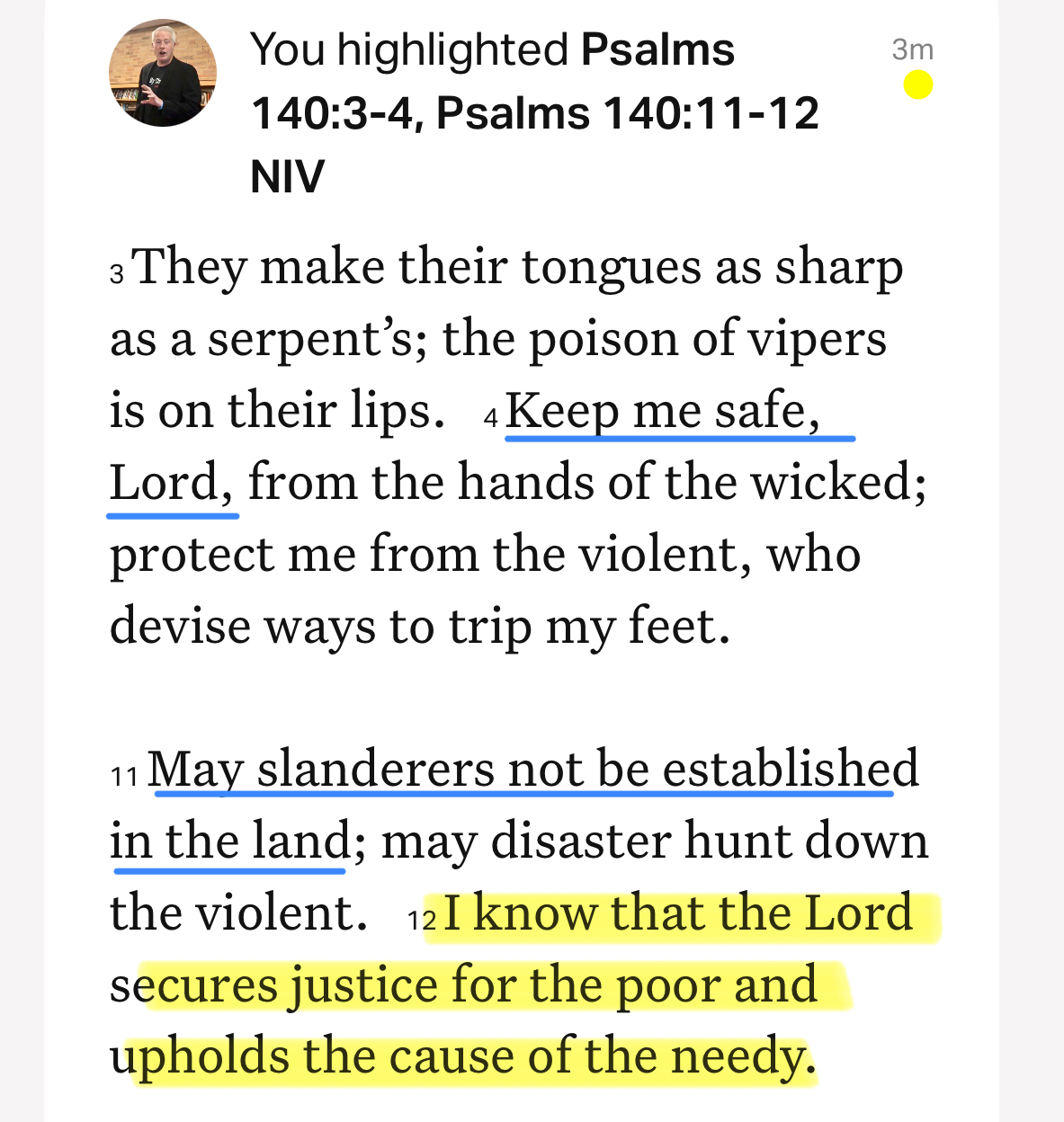
David describes slanderers like this: “They make their tongues as sharp as a serpent’s; the poison of vipers is on their lips” (Psalm 140:3).
I’m sure you have experienced the poisonous, stinging bites of a slanderer’s fangs, just as David did.
Instead of lashing out, David prays:
Keep me safe, Lord, from the hands of the wicked; protect me from the violent, who devise ways to trip my feet. … May slanderers not be established in the land; may disaster hunt down the violent. I know that the Lord secures justice for the poor and upholds the cause of the needy. (Psalm 140:4, 11-12)
Notice what David doesn’t do and does do:
🚫 He doesn’t respond to the evil people that have spewed slander at him.
✅ He does ask God to deal with those gossips and slanderers.
Let’s follow his example. When the attacks come your way, let God respond to those people, and let us follow the example of another prayer of David: “Be merciful and gracious to me, O God, be merciful and gracious to me, for my soul takes refuge and finds shelter and confidence in You; yes, in the shadow of Your wings will I take refuge and be confident until calamities and destructive storms are passed” (Psalm 57:1).
Gossip and slander are two of the painful bites I discuss in my book When Sheep Bite. And you may also be interested in a series of sermons I shared called When Sheep Bite Sheep.
If someone is gossiping to you about others, you can be sure that they are gossiping to others about you—shut it down! Check out this full message about gossips.
I hope you celebrated your Mom on Mother’s Day weekend. This is a great perspective from the Axis newsletter: “Some in our culture say motherhood is a prison, or a trap set by the patriarchy. Pop singer Chappell Roan, for example, recently said she didn’t know any people who have kids and are happy. Others say it’s a paradise—with ‘momfluencers’ online making it look like having kids is a nonstop joyride where the lighting is always perfect and nobody ever cries. When ‘prison’ and ‘perfection’ are presented as the only two options, it’s no wonder U.S. birth rates are declining. One way to honor mothers this year is to admit that motherhood is work—albeit spirit-forming, richly rewarding work—and that we can’t expect to see all the fruit of that labor within our lifetime. Hales writes, ‘Christian parenting is about continually pointing to Jesus as the Author and Perfecter of our faith, clinging to the reminder that He who began a good work in us and our children will complete it.’”
In his study Bible, Dr. Henry Halley offered this comment on 1 Corinthians 6:11. “The greatest proof of the new birth is a changed life. Children of God now suddenly love the following:
They love Jesus. Before conversion the sinner might hold Christ in high esteem, but after conversion they love the Savior (1 John 5:1-2).
They love the Bible. We should love God’s Word as the psalmist did in Psalm 119. There he expresses his great love for God’s Word 17 times.
They love other Christians. ‘We know that we have passed from death to life, because we love each other. Anyone who does not love remains in death’ (1 John 3:14).
They love their enemies (Matthew 5:43-45).
They love the souls of all people. Like Paul, they too can cry out for the conversion of loved ones. ‘Brothers and sisters, my heart’s desire and prayer to God for the Israelites is that they may be saved’ (Romans 10:1).
They love the pure life. John says that if anyone loves the world, the love of the Father is not in them (1 John 2:15-17).
They love to talk to God. ‘Speaking to one another with psalms, hymns, and songs from the Spirit. Sing and make music from your heart to the Lord’ (Ephesians 5:19).”
T.M. Moore and I share the same passion for pastors to operate as shepherds. Moore wrote, “Shepherds equip the saints who take up the works of the ministry that build the church. The work of shepherding is hard. It’s not a program that you run from time to time, hoping to enlist new folks in the training. It is the ongoing, body-building means whereby the Lord’s flocks are nourished and become equipped to use their Spirit-given gifts (1 Corinthians 12:7-11) and power (Acts 1:8) to grow their church in unity and maturity in the Lord.” Moore also wrote an endorsement for my book Shepherd Leadership.
John Piper has a thoughtful and biblical response to a question about Christians losing their rewards in Heaven. In part, he says, “All the good deeds that God approves and rewards are works of faith and the fruit of the Spirit. So, let’s get the idea of merit for these good deeds totally out of our minds.” He goes on to show the Scriptures that secure our promised rewards from God.
Paleontologists have discovered an amazing dinosaur graveyard off the coast of southern Chile. The fossilized remains here gave ample evidence to the global Flood described in the Bible.
Listen to the podcast of this post by clicking on the player below, and you can also subscribe on Apple, Spotify, or Audible.
You may have noticed that the intensity of the pain of these sheep bites has been escalating—from flattery, to criticism, to gossip. Now we come to probably the most painful of bites: slander. This is the bite that will have the strongest pull toward the natural response, which will require our greatest reliance on the Holy Spirit to respond supernaturally.
Remember that gossip has a veneer of truth on it; slander has no truth at all. They are outright lies. They are flimsy lies. They are malicious lies. One of the Hebrew words translated slander means scandal-monger: someone who trades in lies (Jeremiah 6:28 NLT; Leviticus 19:16).
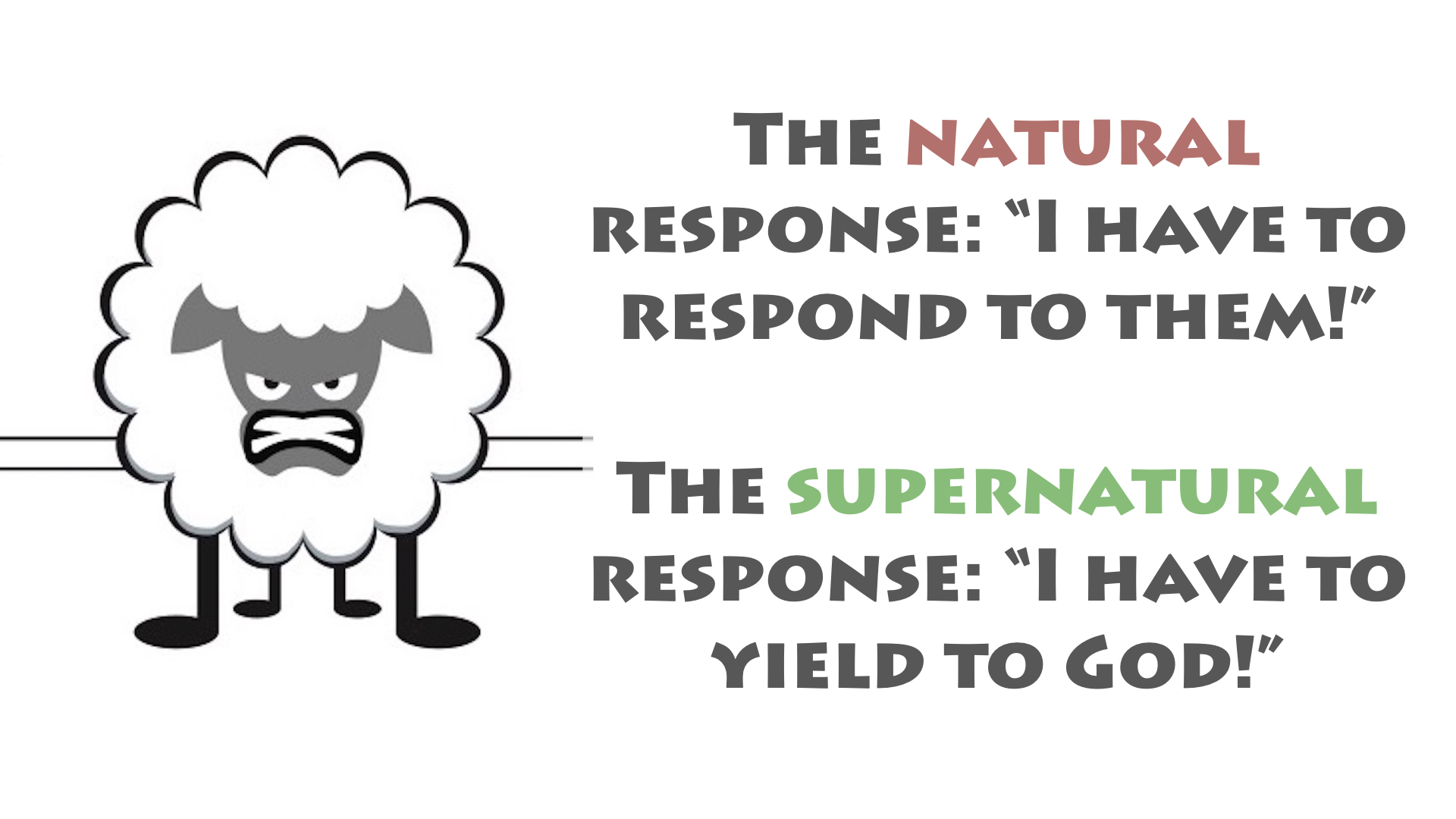
The natural response to slander is, “I have to respond to them!” The supernatural response to slander is, “I have to yield to God!”
The natural response, however, is fueled by my wounded pride. On the other hand, the supernatural response is fueled by humility toward God.
Slanderers are arrogant people too (remember Jeremiah said “they are as hard as bronze and iron” [Jeremiah 6:28]). God’s people are learning to humble themselves to wait for God (Psalm 38:12-15). These humble people are the ones who get God’s help, and not His laughter (James 4:6; Proverbs 3:34 NLT).
Look at how Jesus dealt with the very natural urge to respond to those who slandered Him. After Jesus was arrested by the temple guards, He was hauled before one group after another and each time the slanderous lies were spitefully spit at Him. In front of the Sanhedrin, before Roman governor Pontius Pilate, and in the throne room of King Herod Antipas, angry men unleashed their venomous claims—none of which were true.
There are two common themes we can notice in all of these settings.
The lies were seen for what they were: complete fabrications without any truth behind them—Mark 14:55. Governor Pilate said “I find no basis for a charge against Him” (Luke 23:4), and he added, “Herod came to the same conclusion and sent Him back to us” (v. 15).
The silence of Jesus: “Jesus remained silent and gave no answer” (Matthew 27:13-14; Mark 14:61, 15:5). The only red letters in this interaction with both the Sanhedrin and Pilate are when Jesus is asked a direct question. Jesus quickly answers the questions, “Are You the Messiah,” “Are You a King,” and “Don’t You know the power I have?” (Mark 14:61, 15:2; John 19:10), but He never responds to the slander.
Let me repeat: Our supernatural response can only come from yielding to the Holy Spirit’s influence.
We cannot treat slanderers as anything less than people created in the image of God (Genesis 1:27; Psalm 15:1, 3).
We must take our pain into God’s presence. This is what Jesus did (1 Peter 2:21-23). We can help ourselves by praying imprecatory prayers. These are words for God’s ears only (Jude 1:9; Psalm 58:6-8).
We have to learn to pray for our slanderers. We have to mature from praying against them to praying for them. Look at how Jesus interceded for His slanderers (Luke 23:34), which He calls us to as well (Luke 6:28).
We have to live as overcomers. We overcome by NOT responding to slander in the natural way (Romans 12:21). But we allow our supernatural response to be used as a powerful testimony (2 Corinthians 6:3-10; Colossians 3:1-2, 8, 12-14).
We can do this—the Holy Spirit is empowering us to do this. Let’s not get down in the mud with those who slander us, but let’s yield to God and allow Him to handle this painful situation far better than we ever could.
If you’ve missed any of the messages in this series, you can find them all here. And if you are a pastor, please check out my book When Sheep Bite, which will help you both respond to sheep bites and teach others how to respond as well.
Listen to the podcast of this post by clicking on the player below, and you can also subscribe on Apple, Spotify, or Audible.
A bite we have all experienced is gossip. We called flattery the sneaky bite, but I think gossips believe they are actually being sneaky—that somehow they are getting away with their gossip.I think gossip is also sneaky because we can be pulled into a gossipy conversation almost without realizing what is happening.
That’s because gossip usually has a veneer of truth on it. That thin coating of truth may be sugary sweet, but the words hide a bitter poison that is intended to undermine the one that is being talked about. Twice Solomon says, “The words of a gossip are like choice morsels” (Proverbs 18:8, 26:22). The Contemporary English Version translates this verse even more graphically: “There’s nothing so delicious as the taste of gossip! It melts in your mouth.” But Solomon also warns, “A perverse person stirs up conflict, and a gossip separates close friends” (Proverbs 16:28).
Moses had married a Cushite woman, a marriage that was neither morally nor legally wrong. If someone simply said, “Moses married a woman from Cush” they would have been speaking the truth. The gossips (Miriam and Aaron) want to use a truthful statement for the purpose of making a case to prove their point. These siblings crossed the line when they stopped talking about the idea and start talking about Moses. This is especially true when their conversation about Moses was to make him look inferior or to make themselves look superior.
I think a label that is very apropos for this is “character assassination.” An assassin gets close enough to strike, but also has an alibi to cover themselves. So, too, the gossip can inject their poison to denigrate someone’s character, but then use the alibi of saying, “What? Did I say something untruthful?”
There is truth in their questions that God has used all three of them to delver messages and to sing worship songs, but in light of their statement in verse 1 they are clearly asking these questions with poisonous intent. You can especially spot gossip by this characteristic sign: They talk about a person, but they won’t talk to that person. We are not told to whom Miriam and Aaron may have been speaking to in verse 2, but it certainly wasn’t Moses. That means they were trying to get other people to rally to their side.
When we have been the target of a gossip’s words, we should follow the example that Moses gave us.
Remember that God has heard the gossip (Numbers 12:2b, 4-8).
Check your pride (v. 3). If you feel you must address the gossip, you must address the topic without attacking the gossiper (see Romans 12:17-18).
Be careful of who you are correcting. It’s best to let God do the correcting (Numbers 12:8-9), but if do need to speak to the person, be cautious of adding fuel to the fire (Proverbs 9:7-9).
Desire restoration. Moses interceded for Miriam’s healing (Numbers 12:13), and Jesus has the idea of restoration and unity in the Church in mind in Matthew 18:15-16.
Stay away from the unrepentant gossiper. If the gossiper doesn’t acknowledge their sin, we have to limit our interaction with that sheep (Matthew 18:17) . After Miriam was healed of her leprosy, there is no other mention of her until she died which is probably an indication that Moses didn’t have any additional conversations with her. Paul gave Timothy similar counsel about Alexander (1 Timothy 1:19-20; 2 Timothy 4:14-15).
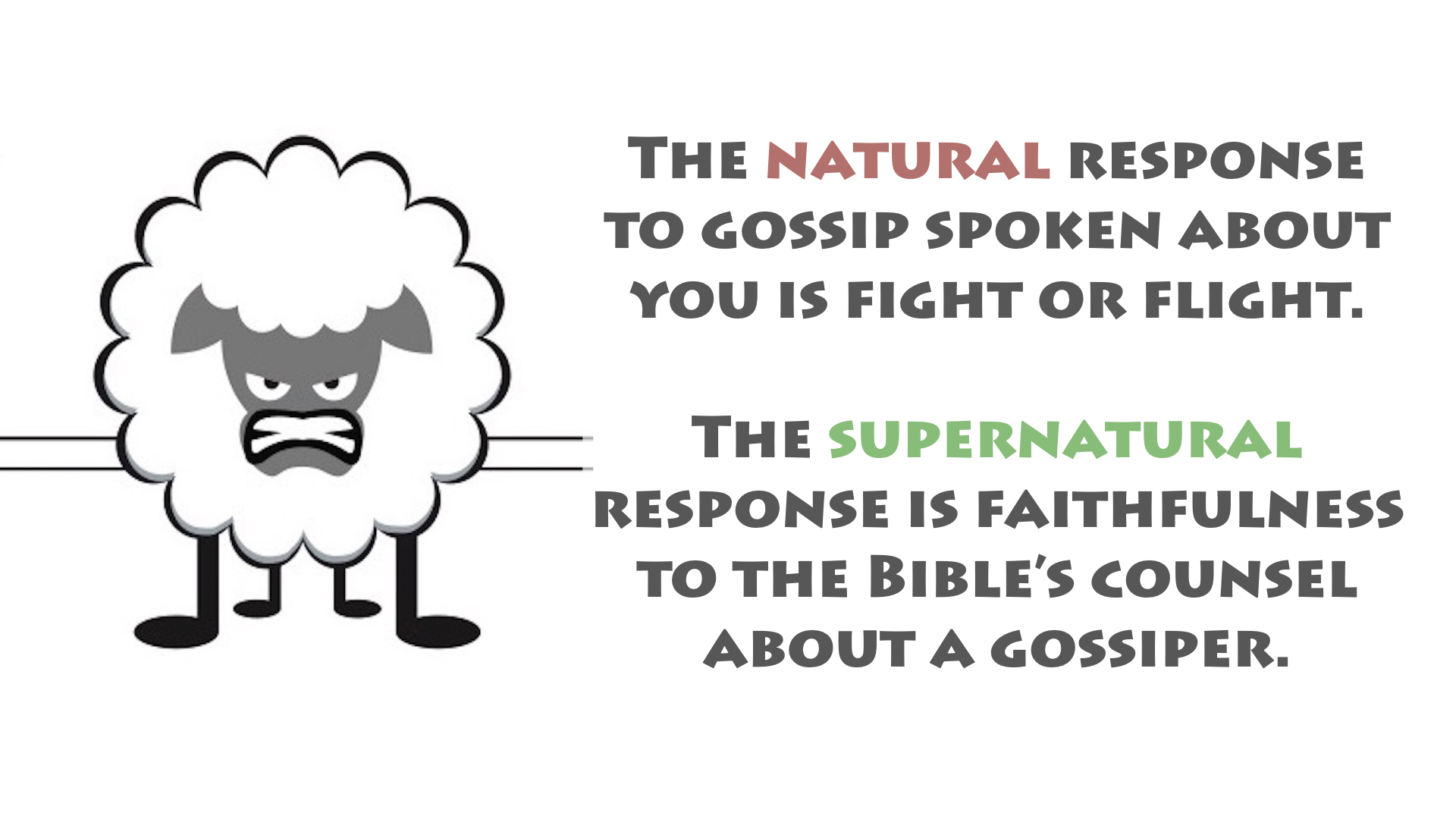
The natural response to gossip spoken about you is fight or flight. The supernatural response is faithfulness to the Bible’s counsel about a gossiper.
And one final word to all of us: Don’t become a gossip yourself!
Just as God hears those gossiping about you, He hears you gossiping about others!
Don’t…
…talk about people who aren’t in the room. Remember the Golden Rule of treating others the way you want to be treated (Luke 6:31).
…share information that isn’t yours to share (Proverbs 25:9).
…listen to a gossip. If they gossip to you about others, they will gossip about you to others!
Gossip, as Solomon warned us, separates even the closest of friends. We must identify it and deal with both the gossip and the gossiper in a God-honoring, biblically-sound way. And we must avoid becoming a gossip ourselves.
If you’ve missed any of the other sheep bites we’ve talked about in this series, you can find them all by clicking here. And if you are a pastor, check out my book When Sheep Bite, where I address the bites of sheep from a leadership paradigm.
Listen to the podcast of this post by clicking on the player below, and you can also subscribe on Apple, Spotify, or Audible.
To you the term “silent killer” might conjure visions of a lone assassin from a spy movie, or perhaps more mundane but equally deadly things like high blood pressure or carbon monoxide leaks. In today’s episode Greg and I are discussing toxic behaviors that creep into the workplace. They aren’t quite as deadly as the ones listed above, but can still cause massive anger, frustration, and discord in your organization. Join us as we discuss some of the most prevalent toxins we’ve seen, and highlight how you as the leader are responsible for being the safeguard against them.
[0:20] Toxic things can sneak into our workplace unless we proactively look for them.
[1:35] Leaders need to be honest with their team so their team feels they can be honest with them in return.
[3:43] Greg and I discuss some of the toxic behaviors we have seen that create problems in the workplace.
[3:54] -Gossip
[4:51] -Office Politics
[6:42] -Negative Competition
[8:37] -Negativity
[10:20] -Bureaucracy
[12:46] -Braggadocio
[14:12] -Bashing
[14:46] Toxicity will come to every organization. We as leaders shine in the way we deal with it.
[17:47] When I wrote Shepherd Leadership, I spent two chapters discussing the balance between confidence and humility because of how important it is.
[19:08] One of our main jobs as leaders is to develop others, but toxicity squashes that.
[20:26] A coach can come alongside you to be the “detector” for the silent killers that might be lurking in your organization.
Check out this episode and subscribe on YouTube so you can watch all of the upcoming episodes. You can also listen to our podcast on Spotify and Apple.
Peter shared the gospel with a group of Gentiles at Cornelius’ house, and not only did they receive Jesus as their Savior, but they were all baptized in the Holy Spirit as well.
A group of Jews approached Peter and were angry with him because of a secondhand report they heard. To their credit, they listened respectfully to Peter’s full account of what happened and ended up changing their minds after they heard the firsthand story.
But Peter began speaking and proceeded to explain to them in orderly sequence…. When they heard this, they quieted down and glorified God, saying, “Well then, God has granted to the Gentiles also the repentance that leads to life.” (Acts 11:4, 18)
There’s a wonderful lesson here for all of us to apply: Verify secondhand reports.
I unpack this more in my book When Sheep Bite in discussing gossip and slander.
Leaders may have to talk about people on their team, but how do we do this without crossing the line into gossip? Greg and I discussed this on a recent episode of our leadership podcast.
I have lots of new content every week, which you can check out on my YouTube channel.
“The Christian ideal has not been tried and found wanting. It has been found difficult; and left untried.” —G.K. Chesterton
“Christianity does not consist in telling the truth, or walking in a conscientious way, or adhering to principles; Christianity is something other than all that, it is adhering in absolute surrender to a Person, the Lord Jesus Christ.” —Oswald Chambers, in Baffled To Fight Better
“Critics may nitpick the Scriptures upon which we base our beliefs, but each year, the Lord will increasingly demonstrate that His Word contains no errors, exaggerations, or omissions. … We won’t feel ashamed of our hope. It will unfold just as the Lord has promised. We will be nourished, guided, blessed, and comforted. Our Lord will return, and then our days of sorrow will be over. How we will exult in the Lord, who first gave us a vibrant hope and then fulfilled that which we hoped for!” —Charles Spurgeon
Listen to the podcast of this post by clicking on the player below, and you can also subscribe on Apple, Spotify, or Audible.
How exactly should we pray for those who have so badly mistreated us? There’s a natural response, and then there’s a supernatural response that Jesus calls us to.
In the New Testament, the Greek word for “bless” is eulogeo. The prefix eu- means “good” and the root logos is “word.” So, in the New Testament context in which we now live, to bless someone literally means to say good words both to them and about them. So when Jesus tells us, “Bless those who curse you and pray for those who mistreat you,” He is telling us to say good words to them, and to say good words about them in prayer to our Heavenly Father. …
Commenting on Psalm 109:4, my friend Kevin Berry said, “While they accuse me like satan, I will pray for them like Jesus.” This is the highest level of Christian maturity: To pray like Jesus did for those who insulted Him, slandered Him, and crucified Him, “Father, forgive them for they don’t understand what they are doing” (Luke 23:34).
I truly believe that When Sheep Bite will be a healing resource for shepherd leaders who are still feeling the pain of their latest sheep bite. Please pick up a copy today!
Listen to the podcast of this post by clicking on the player below, and you can also subscribe on Apple, Spotify, or Audible.
People get into fights for lots of silly reasons. But one thing that causes many hurt feelings and harsh responses is gossip. This is one of the “sheep bites” I discuss in great detail in my book When Sheep Bite.
In the chapter “When Sheep Gossip About You,” I wrote—
The first part of the antidote when you have heard gossip spoken about you is to remember that God has also heard the gossip spoken about you. This is what Jesus demonstrated for us. Peter, who was there to hear all of the gossip spoken about Jesus, wrote, “He did not retaliate when He was insulted, nor threaten revenge when He suffered. He left His case in the hands of God, who always judges fairly” (1 Peter 2:23 NLT). …
There was no need for Moses to respond to these gossipers because the One “who always judges fairly” said to these gossipers, “Why then were you not afraid to speak against My servant Moses?” (Numbers 12:8). When God takes up our cause, let’s not try to take it out of His perfectly just hands. …
Just because God has called you to be His under-shepherd, and just because you may have been innocent of wrongdoing, you don’t have license to “lord it over” those who have gossiped about you. Moses described himself as humble—more humble than anyone else. He wasn’t bragging, but he wrote those words under the inspiration of the Holy Spirit. An insecure leader feels the need to defend himself against any slight against his character, whether it is a real or perceived attack. But the humble leader knows that God’s calling comes with God’s protection.
Solomon wrote, “Avoiding strife is an honor for a person, but any fool will quarrel” (Proverbs 20:3).
Anyone can start a fight—it’s not hard at all! Especially when someone has spoken foolishly, ignorantly, or even maliciously against you in their gossip.
Butonly strong people can walk away from a fight.
Only wise people can remain quiet when a fool tries to provoke them into an argument.
Only God-fearing people can entrust themselves to the One who keeps perfect records of the insults and slander thrown at them—just as Jesus did.
Be that kind of leader!
If you are a pastor, you know the painful bites of gossip. This is just one of several sheep bites I diagnose to help shepherd leaders find a healing, biblical response. Please check out my book When Sheep Bite.
Listen to the audio-only version of this podcast by clicking on the player below, or scroll down to watch the video.
When you are in a leadership role it is unavoidable that you will occasionally have to talk about people. Perhaps it’s gathering more information or discussing an incident with a fellow leader. However, we have to be very careful that these discussions don’t cross the line into gossip. Gossip is toxic for your organization, and left unchecked can lead to disastrous results. Check out this episode where Greg and I discuss how to make your conversations about goals instead of gossip.
[0:31] Leaders have to have lots of conversations on different levels—how do they do this without gossiping about their teammates?
[1:32] Leaders need to have a goal for each of their conversations.
[3:39] What holds leaders back from having the productive (but difficult) conversations?
[6:02] Leaders need to be careful of the diabolic nature of gossip.
[8:58] We need to try to make all of our conversations constructive for us, our teammates, and the entire organization.
[11:01] Productive, healthy conversations must become a part of your organization’s culture.
[13:09] Do your teammates totally trust that you, as their leader, have their best in mind?
[16:51] Leaders need to prioritize transparency at all levels of the organization.
[18:36] Leaders can empower their teammates to make healthy changes.
Check out this episode and subscribe on YouTube so you can watch all of the upcoming episodes. You can also listen to our podcast on Spotify and Apple.



 David describes slanderers like this: “They make their tongues as sharp as a serpent’s; the poison of vipers is on their lips” (Psalm 140:3).










 Craig T. Owens