How To Be Wholly Healthy

healthy-growthA man named Luke recorded a couple of amazing things about the life of Jesus. As both a doctor and an historian, Luke was an excellent “noticer.”

In first-century biographies, a person’s early life usually wasn’t mentioned. So it’s not uncommon that two of the four Gospel writers don’t pick up Jesus Christ’s life story until He was about 30 years old. Even Matthew, who did record something about the birth of Jesus, didn’t go into much detail.

Luke, however, notices two important things.

First, in covering the first 12 years of Christ’s life Luke says, “The Child grew and became strong…” (Luke 2:40).

healthy-growth-001The Greek word Luke uses for grew means a continual process of increasing. Sometimes we mistakenly think this means a continual movement on a graph upward and to the right. But I’ll give you one instance where this is not the case—when we record someone’s height, we do so in feet not in years. In other words, we say someone is 6’4” tall, but we don’t say they are 6-years and 4-months fall. We understand there is a limit to that sort of growth.

What Luke is referring to is a different kind of continual increasing. All of us go through four quadrants as we learn:

  • unconscious incompetence—we’re no good in an area but we don’t even know it
  • conscious incompetence—we know that we’re no good in an area
  • conscious competence—we’re good in an area but we still have to think about what we’re doing
  • unconscious competence—we’ve gotten so good in an area that we no longer need to think about it

healthy-growth-003When Luke said Jesus grew, he meant not upward and to the right, but a continual cycle of learning what He didn’t know and increasing His competence in that area. When Luke said Jesus grew and became strong, he was saying that Jesus learned how to apply the lessons He was continually learning.

Second, in covering Christ’s next 18 years Luke says, “Jesus grew (Luke 2:52), but he uses an entirely different word. This Greek word means to be hammered out, as a blacksmith hammers metal into shape. Notice that Jesus is not the One doing the hammering, but He is the One submitting to His Father’s hammering. He is letting God the Father shape Him into what He needs to be.

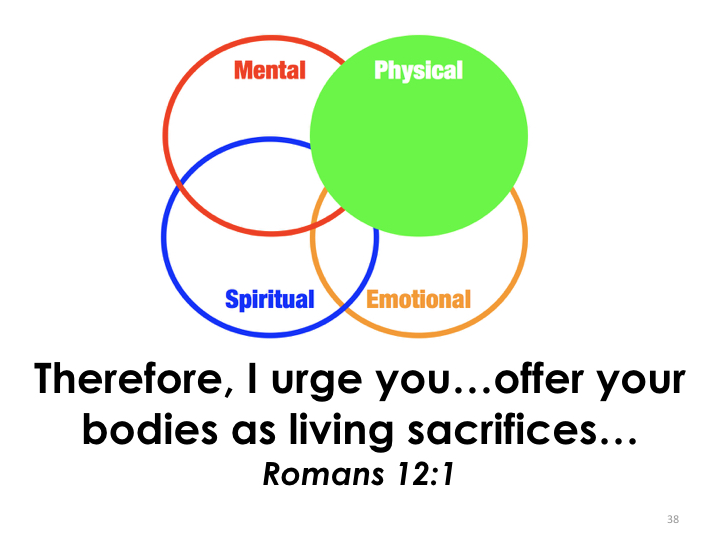
Luke says that Jesus grew in…

  1. …wisdom—mental health
  2. …stature—physical health
  3. …favor with God—spiritual health
  4. …favor with men—emotional (or social) health

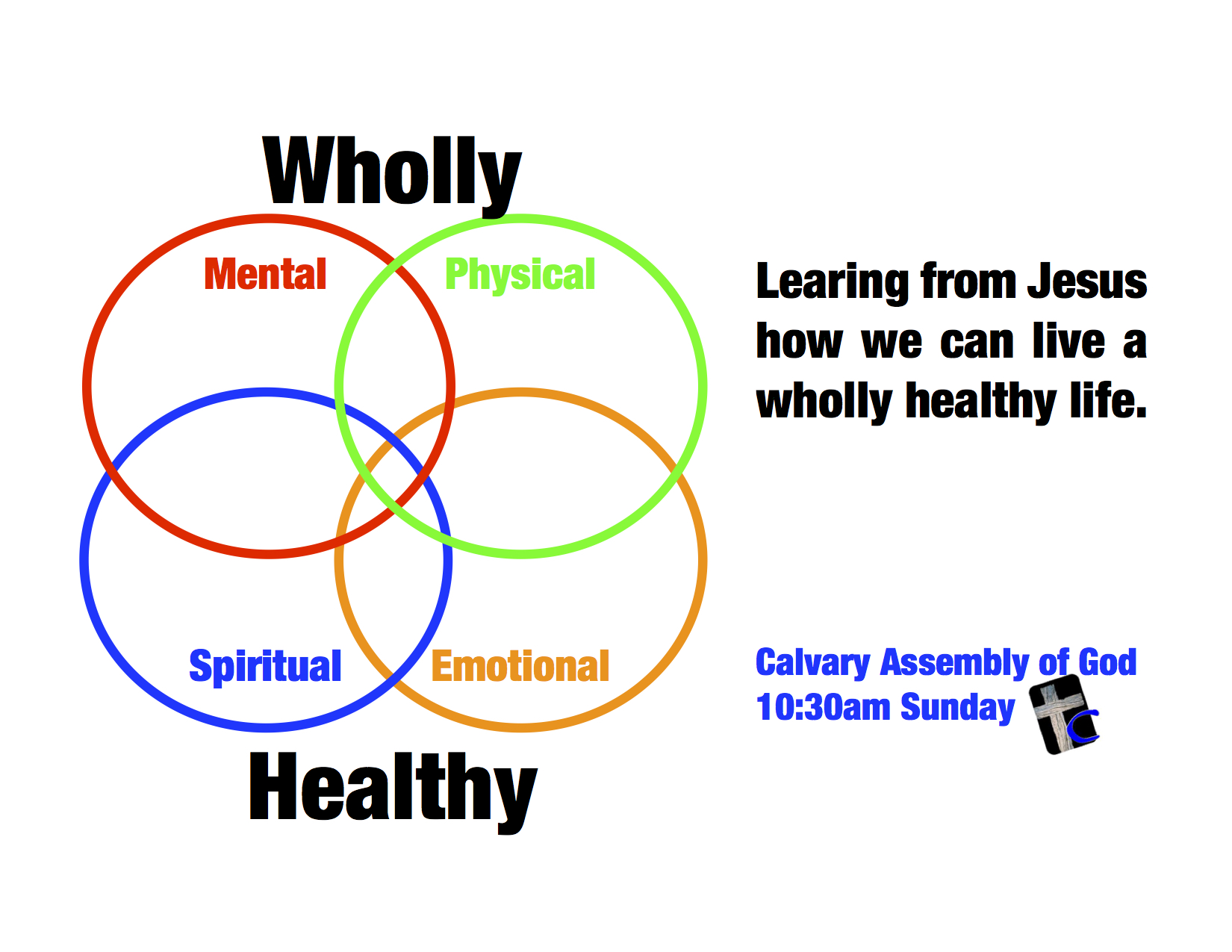
In other words, Jesus was growing in a wholly healthy way. God wants us to be wholly healthy too. He wants us to continually allow Him to point out areas where we are lacking, and then submit to His guidance on how we can improve in those areas.

I’ll be exploring these four areas—mental, physical, spiritual and emotional—over the next few weeks. But in the meantime, why don’t you pray the prayer David prayed and ask God’s Spirit to search out any areas where you are falling short of optimal health. And then submit to God’s work of helping you get wholly healthy in every area of your life.


Wholly Healthy

wholly-healthyHave you ever been tiptoeing through your house in the dark and stubbed your pinky toe? When that happens, is it only your pinky toe that hurts? No! It seems like your whole body gets into the action!

This is a simple way to understand that what affects one part of our life affects all parts of our life. We can’t simply quarantine one part that is having difficulty because that one part will eventually spread its pain everywhere else.

Humans were created as beings with several integrated parts. We have a physical body, we have a mind, we have emotions, and we have a God-breathed soul. If one of these parts becomes diseased, eventually all of the other parts will be affected, unless something is done to bring healing.

If we are dis-eased in any area, our health will be compromised in all areas.

Fortunately for us, Doctor Luke noted something about the health of Jesus during His earthly life. What Luke shows is how God intends for all of us to live—wholly healthy.

Modern medical science and psychology show us what the Bible pointed out long ago: We are integrated beings, and every part needs to be functioning optimally so that our whole being can function optimally.

Join us this Sunday as we begin a new series called Wholly Healthy. You will not only learn the importance of being aware of your health in four key areas, but you will also learn some practical thoughts for maintaining your optimal health.

If you missed any of the messages in this series, check them out here:

Horatius Bonar On What Happens When You Pray

light-and-truth-revelationThis incense was to be ‘offered with’ or ‘laid upon’ so as to cover or envelope the ‘prayers of all saints’—yes, all saints, from Able downwards; for this seems to be the gathering into one of all prayers from the beginning, that at length they may be answered (Luke 18:3, 7). Upon the golden altar in front of the throne the prayers of the saints of all ages have been laid; there they have accumulated; the unanswered ‘How longs?’ not forgotten.

Not one petition, even the poorest or feeblest, has dropped from that altar, or been swept away, or lost in the process of time. All, all are there. In themselves the are poor, having no fragrance; but their intrinsic imperfection cannot change the nature of that altar on which they are laid. There they are preserved— each sigh, each tear, each cry, from child or aged man, from the chief of sinners, from the thief upon the cross, from the chamber of weakness and sorrow, from the crushed spirit and the broken heart—there they are: the groanings that cannot be uttered; the ‘God be merciful to me, a sinner;’ the ‘How long?’ of the tortured martyrs; the moan of the suffering saint upon his tossing sick-bed—there they are: the father’s prayer, ‘Lord, save my child;’ the child’s prayer, ‘Lord, save my father’— there they are: the pleadings for the church of God, for the overthrow of Antichrist, for the binding of satan, for the deliverance of earth, for the consummation of the eternal purpose! Not one cry lost; not one petition gone astray. All there!

There is no such thing as unanswered prayer. Delay will only add to the fullness of the answer, and increase our joy when it comes. And it will come. He is faithful that promised. He cannot deny Himself.” —Horatius Bonar, in Light & Truth: Revelation (emphasis mine)

Praying With The Authority Of The Creator

pray-boldlyJesus had a way of praying that sounds unusual to our ears because He didn’t pray “normal” prayers. His prayers were bold statements! But Jesus also taught us to pray just like He did.

Most prayers that Christians pray sound like they come from the same formula. We may start with something like, “Heavenly Father” or “Dear God.” Then we probably spend some time praising God for His greatness before we make our requests of Him. Often our requests include something like “If this is Your will, I ask You to please heal/help/answer/etc.” And then almost always the prayer concludes, “In Jesus’ name, Amen!”

When Jesus prayed, His prayers sounded more like commands than requests. He would say things like, “Be clean” or “Rise up and walk” or “Blind eyes, be opened.” He usually didn’t ask His Father if it was His will to heal/help/answer/etc. And He never concluded a prayer by saying, “In My name, Amen!”

In Luke 6 there is a story about a man with a withered hand. Jesus healed him by speaking to the man, not to God. He said, “Stretch out your hand,” and when the man did so, his hand was completely restored. Jesus spoke with the authority of the Creator. 

I believe this was possible because Jesus had an unbroken conversation with His Father and the Holy Spirit. Certainly He had set times of prayer (see Mark 1:35, Mark 6:45-46, and Luke 6:12-13 as examples), but Jesus also told us that He only did what His Father told Him to do (John 5:19), and He only said what His Father told Him to say (John 12:49).

I know sometimes people want to say, “Yeah, but this is Jesus we’re talking about! C’mon, He’s the Son of God, so of course He could do these things.” But remember that the miracle of Christ’s Incarnation is that He chose NOT to do these things out of His Deity while He was on Earth, but restricted Himself only to His humanity. That’s why the Bible says that everything we face, Jesus also faced in the flesh (Hebrews 2:14-18).

But perhaps another example from someone who had no Deity in his nature might help. Consider Joshua—this man spent more time in God’s presence, listening to His voice, than even Moses (Exodus 33:11). So when the time came, Joshua could pray an incredibly bold prayer: He actually spoke to the sun and the moon and told them to stand still in the sky, AND THEY OBEYED HIM!

Just like Jesus spoke to the man with the withered hand in the authority of the Creator, Joshua spoke to the sun and the moon in the same authoritative voice. How could these men do that? Because they were familiar with God’s voice, and when He told them to speak out boldly, they simply obeyed.

Jesus said we could pray the same way—Very truly I tell you, whoever believes in Me will do the works I have been doing, and they will do even greater things than these, because I am going to the Father. And I will do whatever you ask in My name, so that the Father may be glorified in the Son. You may ask Me for anything in My name, and I will do it (John 14:12-14, emphasis added).

How can we learn to pray this boldly? We need to spend more and more time in dialogue with God. We need to become increasingly aware of the His abiding presence with us. Then we, too, can pray in the Creator’s authority.

Praying this way glorifies God!

Get together with a friend this week and work through these application questions:

  1. Am I spending time in planned prayer and Bible reading?
  2. How can I make myself more aware of God’s perpetual presence?
  3. What’s holding me back from praying more boldly?

I Heard The Bells On Christmas Day

john-14-1That first Christmas was supposedly a silent night and a holy night. Maybe there was some singing angels involved, but at least their message was about “peace on earth.”

Sometimes that idea of “peace” at Christmas time can make us feel like hypocrites. Sometimes it seems as if there is more turmoil than peace, and more ill-will than goodwill.

Even Henry Wadsworth Longfellow’s poem called I Heard The Bells On Christmas Day starts out in celebration, but then shifts to the dark words, “And in despair I bowed my head: ‘There is no peace on earth,’ I said, ‘for hate is strong and mocks the song of peace on earth, goodwill to men.’”

If you have had a hard time finding peace this Christmas, this short message will bring you hope and encouragement, so that you can truly say, “Merry Christmas!”

If you’ve missed any of the messages in our series The Carols Of Christmas, you can find the full list here.

An Angel’s Story (book review)

an-angels-storyReader’s of my blog will know that I seldom read fiction books, but Max Lucado tricked me into reading this one! I read the introduction to An Angel’s Story and thought, “Wow, this is going to be an interesting take on the Christmas story,” and I began reading. But before I realized I was reading a fictional account, I was hooked and had to keep on reading.

I’m so glad I did! 

We often think of the night of Christ’s birth being—as the Christmas carols tell us—a silent night of wonder, a holy night of rejoicing, a festive night of an angel choir singing in the skies above Bethlehem. Indeed this is the picture we get in the Gospels of Matthew and Luke.

However, the book of Revelation tells a different story.

In Revelation, we see the lengths to which the devil and his hoard went to prevent the Advent of Jesus. And we also read about the angels who remain loyal to God battling against the dark forces in the heavens. Max Lucado imagines what this might of have looked like in the unseen spiritual world around Mary, Joseph, and Jesus.

If you’ve ever read anything from Max Lucado, you know that he is a first-class storyteller, and An Angel’s Story is no exception. Believe me: this book will grab your attention, keep you riveted until the very end, and give you a perspective of the night of Christ’s birth like you’ve probably never seen before. 

I highly recommend this book to you!

7 Quotes From “The Dawning Of Indestructible Joy”

the-dawning-of-indestructible-joyThe Dawning Of Indestructible Joy is a wonderful book from John Piper to prepare your heart for celebrating Christ’s First Advent! It’s arranged as a 25-day countdown until Christmas morning. Check out my review of this book here, and then enjoy a few quotes that caught my attention.

“The coming of Jesus was a search-and-save mission. ‘The Son of Man came to seek and save the lost’ [Luke 19:10]. So Advent is a season for thinking about the mission of God to seek and to save lost people from the wrath to come. … ‘As the Father has sent Me, even so I am sending you’ (John 20:21). It’s the story of how the vertical advent of God in the mission of Jesus bends out and becomes the horizontal advent of Jesus in the mission of the church. In us.”

“If there is a longing in your heart this Advent for something that the world has not been able to satisfy, might not this longing be God’s Christmas gift preparing you to see Christ as consolation and redemption and to receive Him for who He really is?”

“Christmas is about the coming of the Son of Man who ‘came not to be served but to serve, and to give His life as a ransom for many.’ These words in Mark 10:45, as a brief expression of Christmas, are what I hope God will fix in your mind and heart this Advent. Open your heart to receive the best present imaginable: Jesus giving Himself to die for you and to serve you all the rest of eternity.”

“Take the very personal words of the Apostle Paul and make them your own. ‘The life I now live in the flesh I live by faith in the Son of God, who loved me and gave Himself for me’ (Galatians 2:20). This is how Jesus destroyed the works of the devil and rescued us from our sin. Don’t leave Christmas in the abstract. Your sin. Your conflict with the devil. Your victory. He came for this.”

“The point is that when Jesus comes, He confirms the truth of all God’s promises. He shows that God is trustworthy; He keeps His word. … Christ came to prove that God tells the truth, that God keeps His promises. Christmas means that God can be trusted.” 

“It is God’s message of hope this Advent that what is good need never be lost and what is bad can be changed. The devil works to take the good and bring the bad. And Jesus came to destroy the works of the devil [1 John 3:8].”

“This is what God does again and again. He may be doing it for you this Advent season—graciously and tenderly frustrating you with life that is not centered on Christ and filling you with longings and desires that can’t find their satisfaction in what this world offers, but only in the God-man. What a Christmas gift that might be! Let all your frustrations with this world throw you onto the Word of God. It will become sweet—like walking into paradise.”

What Child Is This Anyway?!

christ-the-kingA couple of years ago as we were setting up for our Living Nativity, I was wrapping a towel around the doll we were going to use for the infant Jesus. A young boy from the community was carefully watching me and he asked, “Is that baby Santa?”

“No, it’s not Santa,” I said. “See this manger? We’re getting things setup to tell the story about the very first Christmas, long before St. Nick came on the scene. Maybe you’ve heard about Mary and Joseph?”

The young lad’s eyes lit up as he seem to get the answer. “Oh! Is that baby Moses?!”

Clearly, people don’t know all the facts surrounding the first Advent of Jesus. Sometimes things in culture and church get jumbled—what belongs to which? Is Christmas a pagan holiday? Where do Christmas trees come in? Was the birth of Jesus actually on December 25? What does it all matter anyway?

Instead of running from these questions, Christians should use them to point people in the right direction. 

Have you heard the tune called Greensleeves? It’s been around longer than anyone knows. William Shakespeare referenced it in two of his plays and didn’t feel the need to explain it to his audience. The tune has been set to some pretty bawdy words about New Year’s Eve parties, and even as a mocking song to some folks about to go to the gallows. And then in the mid-1800s William Chatterton Dix used this tune to write words about Christ’s birth in What Child Is This?

What an excellent question! Who exactly is this Child? Is Jesus merely a line on the pages of history? Or is His birth something more? Oswald Chambers noted, “The tremendous revelation of Christianity is not the Fatherhood of God, but the Babyhood of God—God became the weakest thing in His own creation, and in flesh and blood He levered it back to where it was intended to be. No one helped Him; it was done absolutely by God manifest in human flesh.”

The first-century historian Luke simply records that Mary is pregnant with “a child.” That is, until Jesus is taken to the temple in Jerusalem eight days later, and we see that a man named Simeon didn’t just see this Child as any baby, but as a fulfillment of prophecy (see Luke 2:25-32; Isaiah 7:14 and 9:6).

This Child is much more than just a historic person. He not only split history into BC and AD, but He has changed my life, and countless others’ lives as well! That’s why the chorus of this Christmas carol joyfully announces, “This, THIS is Christ the King!”

People may be confused about what tradition belongs to culture or Christendom. You may even be confused about what belongs to which. But none of that should stop us from knowing the Child we celebrate this Christmas. None of that should stop us from helping seekers to find Jesus as their own Savior. None of that should stop us from enthroning Jesus Christ as King and giving Him the highest praise He deserves!

Jesus used common, everyday things—farmers, fish, trees, weather, children’s songs—to tell people about a Heaven that was prepared for them. Paul used the cultural idols and poets to point his community to Jesus. Philip used the Scripture a governmental official was reading to point him to Jesus.

So we, too, can use whatever is around us to point people to Jesus this Christmas! What Child is this? This, THIS is Christ MY King! Merry Christmas!!

If you’ve missed any of the messages in our series The Carols Of Christmas, you can find the full list here.

The First Noël

romans-3-22When I worked in the business field, I was invited to be a teacher for a program called GROW (Grand Rapids Opportunities for Women), where I taught a class on marketing. Then later on, I served as a reviewer as the students turned in their marketing plans.

One of the main points I tried to drive home to my students is a basic Marketing 101 principle which says—you can’t be all things to all people. You have to pick a niche market and then try to dominate that market. There are two general ideas here: (1) Make your product or service pricey and therefore exclusive to a select group, or (2) Make your product or service affordable and accessible for the mass market.

The Incarnation of Jesus totally violates this Marketing 101 principle. (Which goes to show you that God knows more than all the world’s so-called “experts”!)

First, there was a marketing message to shepherds (see Luke 2:8-11). This would have been the “mass market” as shepherds represented the every-day, working-class man. The first two verses of The First Noël carol addresses these “certain poor shepherds in fields where they lay.”

But then there is this appearance of a very exclusive group of Magi (see Matthew 2:1-2, 11). These men were highly educated and had gained great influence and affluence. Verse 3 of The First Noël references these “wise men…from country far” who could present such lavish gifts to Jesus.

God did exactly what I told my GROW students they shouldn’t do if they wanted to be successful!

The Incarnation of Jesus is one of those rarest of rare things that actually can be all things to all people! Why? Because ALL people need what the Incarnation of Jesus brings. That’s why the final verse of The First Noël calls for ALL of us to join in singing our praise to God because of the salvation Jesus had purchased for ALL mankind.

Here’s the reason—

  • ALL we like sheep have gone astray (Isaiah 53:6)…
  •    …and the penalty for that straying from God is death for ALL sinners (Romans 6:23).
  • But Jesus came to ransom ALL from that penalty (Mark 10:45)…
  •    …so that ALL who believe in Him will be saved (Romans 3:22)!

“The coming of Jesus was a search-and-save mission. ‘The Son of Man came to seek and save the lost.’ So Advent is a season for thinking about the mission of God to seek and to save lost people from the wrath to come. … ‘As the Father has sent Me, even so I am sending you’ (John 20:21). It’s the story of how the vertical Advent of God in the mission of Jesus bends out and becomes the horizontal Advent of Jesus in the mission of the church. In us.” —John Piper

You have been rescued, now go be a rescuer. Take this Noël message to ALL … young/old, rich/poor, Black/white, educated/illiterate, healthy/sick, friend/enemy…. the message in the First Noël and every Noël is for everyone! 

If you’ve missed any of the messages in our series The Carols Of Christmas, you can find the full list here.

Rick Warren On What Mercy Means

rick-warren“Mercy means…

…being patient with people’s quirks (James 3:17)

…helping anyone around you who is hurting (Proverbs 3:27)

…giving people a second chance (Ephesians 4:31-32)

…doing good to those who hurt you (Luke 6:35-36)

…being kind to those who offend you (Jude 22-23)

…building bridges of love to the unpopular (premeditated mercy) (Matthew 9:13)

…valuing relationships over rules (Romans 13:10)” —Rick Warren