Help!

David and his men are on the run from King Saul, but they hear that the small town of Keilah is being harassed by the Philistines. The bad guys are stealing the harvest from the people of Keilah, making it a very real possibility that they would starve during the upcoming winter. In his usual habit, David prays and asks God if he should help the people of Keilah, and God gives him the go-ahead to attack.

David and his men defeat the Philistines, not only returning the crops that had been stolen but also delivering some livestock that they took from the defeated Philistines. You might expect that David and his men were given a ticker-tape parade. Instead, as soon as David was within the city’s walls, he finds out that the people of Keilah are planning to sell him out to King Saul. Talk about ingratitude!

David and his men flee to the Desert of Ziph, where they won’t be a bother to anyone. Except the Ziphites get word to King Saul that they will gladly turn him over to the King whenever he asks for it.

What is David’s response? As usual, it’s prayer. His prayer is short and straight to the point—

Help, Lord, for the godly are no more; the faithful have vanished from among men.

In other words, David asks God, “Where have all the decent people gone?” It’s no different in our day, as Paul told his friend Timothy that people will only become more hypocritical liars, with their conscience not bothering them a bit!

What I love about David’s prayer is that he quotes God back to God. Check out the quotation mark: “Because of the oppression of the weak and the groaning of the needy, I will now arise. I will protect them from those who malign them.” And then David is quick to add that God’s words never fail! 

I am convinced that our spiritual battles are largely lost or won in our minds. We need to recall God’s Word—Yet this I call to mind and therefore I have hope: Because of the Lord’s great love we are not consumed, for His compassions never fail (Lamentation 3:21-22).

So we cry, “Help!” to God because He is the only One who can help us: The Lord is my Helper; I will not be afraid. What can man do to me? (Hebrews 13:6).

But David has an important question to ask: “How long do we continue to call for help?” Have you ever asked God that?

Jesus said that the key to our successful praying is for us to remain in Him and for His Words to remain in us, like a branch remains connected to the vine (John 15:7). So let me ask you a question: How long should the branch remain connected to the vine before it’s ready to go off on its own?

The answer is simple—if the branch wants to remain alive and fruitful, it must stay in relationship with the vine forever!

So once again, look at how Jesus answers the “How long?” question—Keep on asking and it will be given you; keep on seeking and you will find; keep on knocking reverently and the door will be opened to you. (Matthew 7:7)

“Help!” is a great prayer that God loves to answer. “How long” do we pray that prayer? Until it’s answered … keep on, keep on, KEEP ON!

Prayer Is The Battle

When I was growing up and struggling with a problem, my Mom would always challenge me with one simple question—“Have you prayed about it?”

This is a great question because it helps us keep the main thing the main thing.

Typically we have three substitutes for prayer—

(1) Ignoring the problem. We’re like the board of directors that was facing falling sales and falling profits, but their solution was to just wait for something magical to happen.

(2) Talking about the problem. Christians often call this “a prayer request.” We take 10 minutes to give our friends all the gory, depressing details of our situation and oftentimes say “please pray for me” as we walk away. Solomon said, “Talk is cheap, like daydreams and other useless activities” (Ecclesiastes 5:7).

(3) Working to solve the problem. This isn’t in the Bible, but many times we act as if it is: God helps those who help themselves. Instead, God wants us to call on Him so He can reveal things to us (see Jeremiah 33:3).

Something that is in the Bible is this: “Ask whatever you wish, and it will be done for you.” But there is a condition for this, and it’s the part of the sentence that comes before the asking that makes all the difference—

If you remain in Me and My words remain in you, ask whatever you wish, and it will be done for you (John 15:7).

Oswald Chambers said, “We are apt to think of prayer as a common-sense exercise of our higher powers in order to prepare us for work; whereas in the teaching of Jesus, prayer is not to fit us for the ‘greater works,’ prayer is the work. Prayer is…the means whereby we assimilate more and more of His mind, and the means whereby He unveils His purposes to us.”

Prayer IS the work!

We don’t ignore the problem, and we don’t just talk about the problem. But neither do we pray and then work on the problem. Prayer is the work!

It can’t be stated enough: Prayer doesn’t prepare us to work, prayer IS the work.

Even the Apostle Paul identified this in his teaching on spiritual warfare. In language similar to what Jesus said in John 15:7, Paul says, “Be strong IN the Lord and IN His mighty power. Put on the full armor of God SO THAT you can take your stand against the devil’s schemes” (Ephesians 6:10-11).

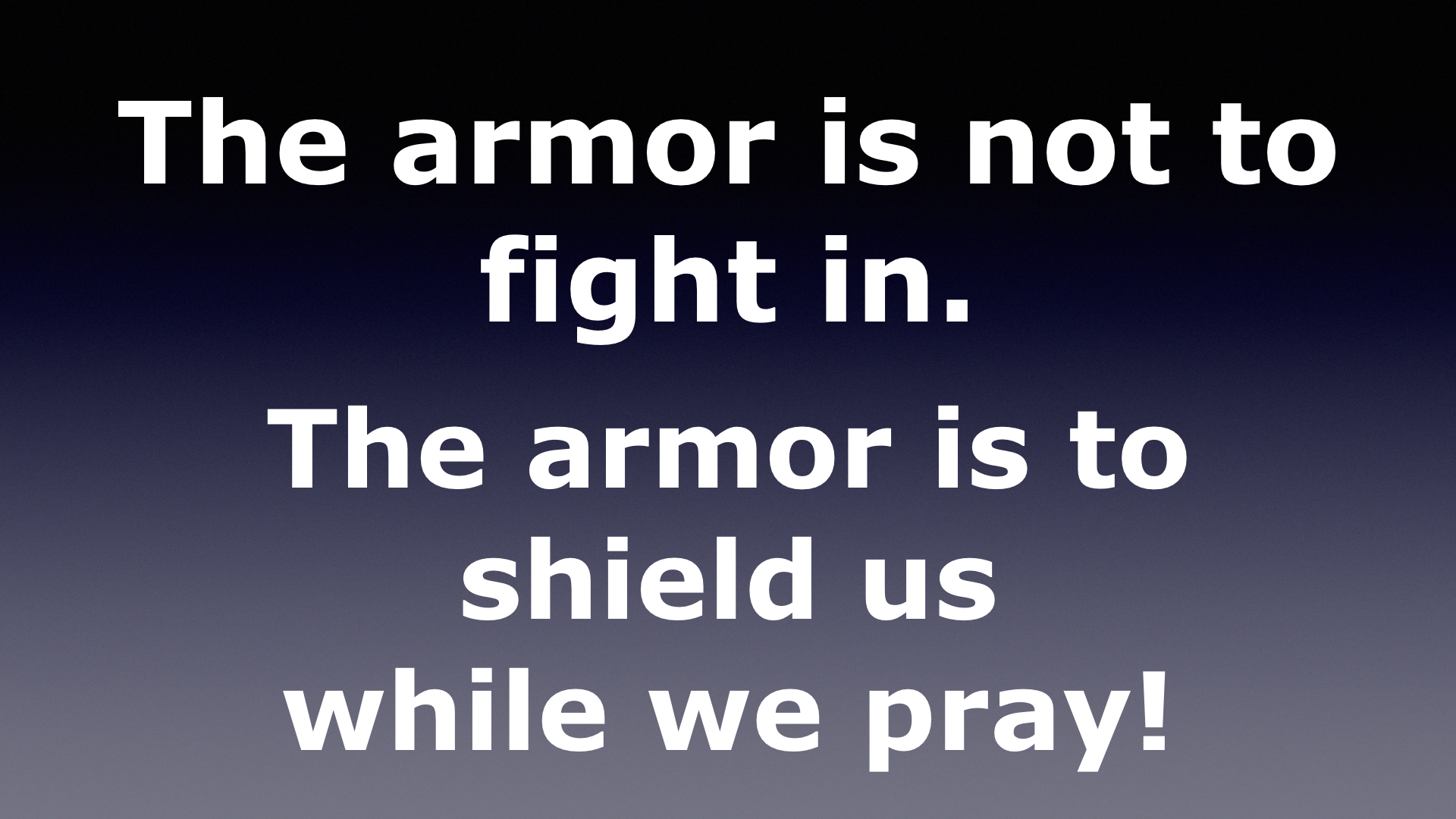
Paul doesn’t tell us to ignore the devil’s schemes, nor does he tell us to talk about them. But neither does he tell us to put on God’s armor to fight against the devil’s schemes. He tells us to put on the armor of God so that we can pray (see Ephesians 6:18-20).

The armor of God is NOT to fight in, but to shield us while we pray!

PRAYER IS THE BATTLE … PRAYER IS THE WORK

When you are facing a difficulty, don’t ignore it, don’t just talk about it, and don’t go to work fighting it. Listen to the Holy Spirit asking you, “Have you prayed about it,” and then drop to your knees and PRAY!

This principle is illustrated so wonderfully in the life of David. We’ll be looking at David’s prayers over the next few weeks, and I hope you will join me in learning that prayer is the battle!

Thursdays With Oswald—His!

Oswald ChambersThis is a weekly series with things I’m reading and pondering from Oswald Chambers. You can read the original seed thought here, or type “Thursdays With Oswald” in the search box to read more entries.

His!

     “They were Yours; You gave them to Me” (John 17:6). It is this aspect of a disciple’s life that is frequently forgotten. We are apt to think of ourselves as our own, of the work as our work. A great point in spiritual nobility has been reached when we can really say, “I am not my own.” … The Son of God is the Highest of all, yet the characteristic of His life was obedience. We have to learn that God is not meant for us, it is we who are meant for God. … “Do you not know…you are not your own” [1 Corinthians 6:19]. 

     His! Does that apply to us? Have we realize that our body is not our own, but His—“the temple of the Holy Ghost”! Have we realized that our hearts and affections are not our own, but His? If so, we shall be careful over inordinate affection. Have we realized that all the ambitions of life are His? We are out for one thing only, for Jesus Christ’s enterprises. …  

     “Since you have kept My command to endure patiently” [Revelation 3:10]. This is not the patience of pessimism, nor of exhaustion, but the patience of joyfulness because God reigns. It may be illustrated by likening the saint to a bow and arrow in the hand of God. God is aiming at His mark, He stretches and strains until the saint says—“I cannot stand anymore,” but God does not heed. He goes on stretching until His purpose is in sight, then He lets fly, and the arrow reaches His mark. … 

     It takes the endurance which comes from a vision of God to go on without seeing results. We are not here for successful service, but to be faithful. Had Jesus any results? Before we go into work for Him we must learn that the disciple is not above his master. We cannot be discouraged if we belong to Him, for it was said of Him—“He shall not fail nor be discouraged” [Isaiah 42:4]. Discouragement is “disenchanted egotism.” “Things are not happening the way I expected they would, therefore I am going to give it all up.” To talk like that is a sure sign that we are not possessed by love for Him, but only by love for ourselves. Discouragement always comes when we insist on having our own way. 

From So Send I You

Can Jesus say of you that you are His? Are you trying to make your own way, or are you simply following Jesus? Are you letting God stretch you until He is ready to release you, or are you becoming exhausted and discouraged in the waiting? Is your love for Jesus absolute, or does it come with conditions?

Silent Night? Holy Night!

A little boy wanted to do something special for his family, so he thought he would do something he had seen his mother do dozens of times: bake a cake. Quickly he looked through a cookbook and got to work.

Dad was the first one to come home and heard an unusual clatter in the kitchen. Peeking around the corner he saw his son wearing his wife’s apron, slightly dusted in flour, and vigorously stirring a big bowl of batter.

“What are you doing, son” Dad asked.

Without looking up from his work the boy proudly answered, “I’m making a cake, Dad!”

Dad looked around the kitchen and saw all the proper ingredients out, so he was somewhat assured when he asked, “So how’s it going?”

The little boy paused and looked up at him, “Pretty good I think. I’m just having a little trouble with the ‘tbls” and ‘tsps.’”

For those of you who have done any baking, you know that “tbls” are tablespoons and “tsps” are teaspoons. If you get those mixed up, the cake might not turn out very well. For instance, adding a teaspoon of baking powder when the recipe calls for a tablespoon might result in a flat cake. Or adding a tablespoon of salt when the recipe asks for a teaspoon might making a rather salty cake.

Abbreviations only work if everyone is on the same page with you. If they’re not, it could be rather unsavory or maybe even dangerous.

In 1816, Joseph Mohr penned the words to what some have called the best-known Christmas carol in the world: Silent Night! Holy Night!

I’m not really sure how “silent” the night Jesus was born really was: a village so filled with people that no bedrooms were available, a mother in labor, a crying newborn, animals in a stable disturbed by the mother and child, singing angels, and curious shepherds. But let’s leave that part alone for a while.

Although it may not have been a silent night, it most assuredly was a Holy Night! That full title gives us the full impact of what happened at Christ’s First Advent.

Holy means something unlike anything else; someone or something devoted to God; something divine; something with God’s fingerprints all of it. I see at least three divinely holy things in this carol.

  1. The virgin birth of Jesus. 

Not only was the birth of Jesus a fulfillment of prophesy (see Isaiah 7:14 and Matthew 1:18-25), but it was also an indication of God’s miracle-working power. The fact the Luke gives so many specific details about that birth night (see Luke 2:1-2) also lets us know that this isn’t a “once upon a time” myth.

  1. The involvement of angels in the affairs of humans. 

Angels bring messages to key people before the birth of Jesus (Luke 1:11, 26; Matthew 1:20) and on the night of His birth (Luke 2:9-14). John also gives us a peek behind the scenes of the massive spiritual warfare taking place the night of Christ’s birth (see Revelation 12:1-5). Paul tells us that we, too, are involved in this spiritual battle, but that because of Christ’s Advent we’re more than conquerors through Jesus (Ephesians 6:12; Romans 8:37).

  1. The full deity and the full humanity of Jesus. 

Jesus was fully Man and fully God (see Philippians 2:5-7; Matthew 26:63-64; John 8:54-58). This is so important, because without this we would be lost. If Jesus wasn’t fully Man, He wouldn’t know how to help us; if He wasn’t fully God, He couldn’t help us.

So when you hear this carol playing, ask someone if they know the title. More than likely they will say, “Silent Night.” To which you can easily reply, “Actually it’s Silent Night! Holy Night! and I’d like to tell you three amazing, holy things that took place!”

Let’s never abbreviate away the miracles. It may or may not have been a Silent Night, but it most certainly was a Holy Night! These supernatural miracles surrounding Christ’s First Advent provided us freedom from sin, and a rock-solid hope of our eternal reward in Heaven at Christ’s Second Advent.

If you’ve missed any of the other Christmas carols we have already looked at, you can check them out by clicking here.

The Advent “Nicknames” Of Jesus

Most of us who have nicknames didn’t receive them at birth, but they were given to us later on. It might have been because of a memorable incident, or even a character trait that we are known for.

But think about Jesus. Even before His first Advent, He was given numerous “nicknames” or titles that foretold what He was going to do. In the Christmas carol “O Come O Come Emmanuel” four of Christ’s nicknames/titles are key for us today.

It’s so important for us to look back at these First Advent titles because they give us perspective for today and hope for Christ’s Second Advent.

Paul makes it clear that we are living in a time of both already and not yet. We have redemption (Ephesians 1:7), and we are waiting for the day of redemption (Ephesians 4:30). Jesus has already paid for our freedom (First Advent), but we are still awaiting the rewards that will come with His Second Advent.

O come, O come…

  1. …Emmanuel

Literally, this means “God is with His people.” The prophesy was originally given to the prophet Isaiah (see 7:14 and 8:6-10), but it was repeated when Jesus was born (Matthew 1:23). Only One Who was fully God and fully Man could pay the price for our ransom from sin.

  1. …Rod of Jesse 

David, the son of Jesse, prayed, “Who am I, Sovereign Lord, and what is my family, that You have brought me this far?” (2 Samuel 7:18). Yet God was going to continue to keep David’s family line alive (although at times it looked like the dead stump of a long-forgotten tree) to give a throne to Jesus as the King of kings that would once and for all crush satan’s tyranny.

  1. …Dayspring 

When I think of Dayspring, I think of light exploding immediately into the darkness (Isaiah 9:2 and Luke 1:77-78). Jesus Himself told us of His victory over the darkness: I have told you these things, so that in Me you may have [perfect] peace and confidence. In the world you have tribulation and trials and distress and frustration; but be of good cheer [take courage; be confident, certain, undaunted]! For I have overcome the world. [I have deprived it of power to harm you and have conquered it for you] (John 16:33, AMP).

  1. …Key of David

Only Jesus holds the key to open wide our heavenly home (Isaiah 22:22; Revelation 1:8)!

What do you need? 

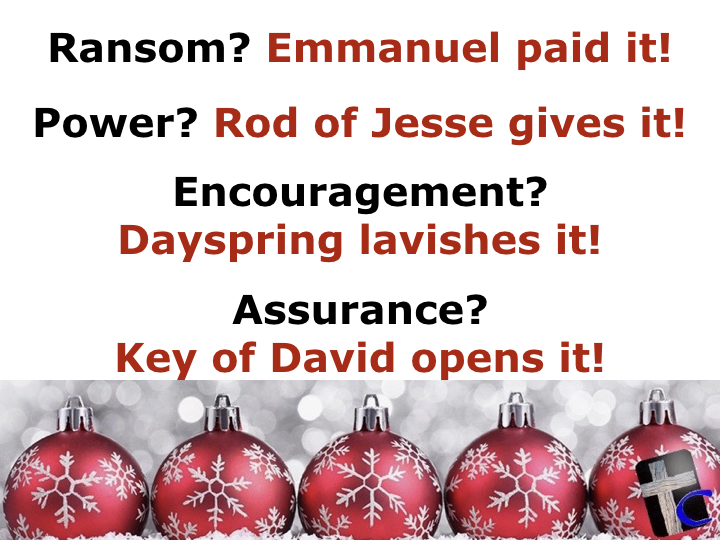
  • Ransom? Emmanuel paid it! 
  • Power to defeat satan? The Rod of Jesse gives it! 
  • Encouragement to press on? The Dayspring lavishes it! 
  • Assurance of your eternal home in Heaven? The Key of David opens it! 

All our longings—all our O come! O come!—are satisfied in Jesus. His First Advent is the already, and His Second Advent gives us hope for the not yet.

If you’ve missed any of the other Christmas carols we have already looked at, you can check them out by clicking here.

11 Quotes From “Interpretation Of The Scriptures”

In my review of A.W. Pink’s book Interpretation Of The Scriptures, I noted that any student of the Bible will benefit from reading this exceptional book. The quotes I want to share today are for that universal audience, but I will also be sharing some additional quotes soon that are specifically aimed at those who are Bible teachers or pastors.

“God does not ask for blind credence from us, but an intelligent faith, and for that three things are indispensable: that His Word should be read (or heard), understood, and personally appropriated.”

“Moreover, the obscurity is not in them [the Scripture], but in the depravity of our nature which resists the holy requirements of God, and the pride of our hearts which disdains seeking enlightenment from Him.”

“It has pleased God to furnish His people with gifted instructors, and instead of haughtily ignoring them we ought (while testing their teaching—Acts 17:11) to accept thankfully whatever help they can afford us.”

“Methods of Bible study are only of relative importance; but the spirit in which it is studied is all-important. It calls for no argument to prove that a spiritual book calls for a spiritually minded reader. … Only where there is honesty of soul and spirituality of heart will there be clearness of vision to perceive the Truth; only then will the mind be capable of discerning the full import of what is read. … None but the Spirit of Truth can write God’s Law on my heart. Here, then, is the first and most essential qualification for understanding and interpreting the Scriptures, namely a mind illumined by the Holy Spirit.”

“That which conflicts with what is taught, plainly and uniformly, in the Scriptures as a whole, and which whole is set before us as the alone rule of our faith and obedience. This requires from the expositor not only a knowledge of the general sense of the Bible, but also that he takes the trouble to collect and compare all the passages which treat of or have a definite bearing upon the immediate point before him, so that he may obtain the full mind of the Spirit thereon. Having done that, any passage which is still obscure or doubtful to him must be interpreted by those which are clear. No doctrine is to be founded on a single passage.”

“By divorcing a verse from its setting or singling out a single clause, one may ‘prove’ not only absurdities but real falsities by the very words of Scripture.”

“The word for ‘search the Scriptures’ (John 5:39) signifies diligently to track out, as the hunter does the spoor of animals. The interpreter’s job is to bring out the sense and not merely the sound of the Word.”

“To a very large extent, and far more so than any uninspired book, the Bible is a self-explaining volume: not only because it records the performance of its promises and the fulfillment of its prophecies, not only because its types and antitypes mutually unfold each other, but because all its fundamental truths may be discovered by means of its own contents, without reference to anything extra or outside itself.”

“Assuredly God has not subordinated His Word to our reason for us to accept only what commends itself to our judgment. Nevertheless, He has furnished His people with this faculty, and though insufficient of itself it is a valuable aid in the understanding of Truth. While reason is not to be made the measurer of our belief, yet it is to be used as the handmaid of faith, by comparing passage with passage, deducing inferences and drawing consequences according to the legitimate laws of logic.”

“The concordance will stand [the Bible reader] in far better stead than the best dictionary.”

“There is a middle ground between hastily condemning or accepting, namely to weigh carefully and prayerfully what is presented, testing it by other passages and by our own experience.”

Saturday In The Psalms—God’s Voice Of Peace

Lord, You have been favorable … You have forgiven … You have covered all their sin. Selah (Psalm 85:1-2).

God’s favor, forgiveness, and covering of sin. Justice would say that God doesn’t have to do any of these things. The people sinned—they violated the holy law—and thus deserve death. But pause and consider this [that’s what Selah means]: God instead shows His favor, deliverance, and forgiveness. All His anger has been turned away!

How do we respond to this? The psalmist asks for restoration and revival. Revival comes when we turn back to God and turn away from our sin, and here we see God initiating revival … making revival possible.

Listen to God’s voice: He speaks peace, which allows us to experience revival. Jesus didn’t say, “Go and sin no more; I do not condemn you.” No! He said, “Neither do I condemn you, now go and sin no more” (John 8:11).

The removal of the wrath of condemnation makes the revival of the soul possible!

Once we hear God’s voice of peace, we can then know His…

  • … mercy
  • … truth
  • … righteousness
  • … goodness
  • … pathway
  • … freedom

God, You are so good! So loving, kind, merciful! Showing Your favor to all who will listen to Your words of peace!

Thursdays With Oswald—What Does It Mean To ‘Confess’ Christ?

Oswald ChambersThis is a weekly series with things I’m reading and pondering from Oswald Chambers. You can read the original seed thought here, or type “Thursdays With Oswald” in the search box to read more entries.

What Does It Mean To ‘Confess’ Christ? 

     We receive the Spirit of Christ as a gift, but we do not receive His mind, we have to construct that [see Philippians 2:5], and this is done in the same way that we construct the natural mind, viz., by the way our disposition reacts when we come in contact with external things. …  

     “You call Me Master and Lord, and rightly so, for that is what I am”; but does it mean any more to us than the mere saying of it? “Now that I, your Lord and Teacher, have washed your feet, you should do as I have done for you” and we cannot do it by sentiment. It was in the hour when Jesus knew “that the Father had put all things under His power, and that He had come from God and was returning to God” that He began to wash the disciples’ feet; and it is when we realize our union with Jesus Christ as our Lord and Master that we shall follow His example. [see John 13:1-4, 12-15] … 

     To “confess” Christ means to say, not only with the tongue, but with every bit of our life, that Jesus has come into our flesh.

From So Send I You

It’s one thing to say, “I am a Christian,” and it’s a completely different thing to live like Christ.

The Holy Spirit will continually bring a Christian into situations where we had the opportunity to develop the mind of Christ. As we develop His mind in us, it will naturally mean that we will “confess” Christ with our thoughts, words, and actions.

My prayer is that we will continually be focused on our Christ-like “confession.”

Is Jesus The Only Way?

“Sometimes people ask me ‘Is Jesus the only way?’ and of course the question alludes to a journey. It occurs to me that when attempting to be helpful in giving directions, some facts are more relevant than others. In this case, perhaps none more so than one: the question of destination. When asking ‘Is Jesus the only way?’ it begs at least one further question, which is ‘To what?’ or ‘To where?’

“In our society, it is not uncommon to hear the statement ‘All religions lead to God.’ Although it’s not a logical statement, I find the second part of it—the ‘lead to God’ bit—very interesting. There seems to be an awareness, however subconscious, however little thought through, that only God Himself is the appropriate destination. Where does this thought come from? …

“Don’t all religions lead to God? No, they don’t even claim to.

“I have found it helpful at times to ask, ‘What is the destination you are aiming for? What is the destination you hope would be true?’ It seems to me that in the search for truth and meaning, many of us are not primarily or only looking for logical answers, but for a response to the existential longing for true life.

“Jesus says that He has come so that we might have life and life in all its fullness—life abundantly. The Message translation puts it as ‘real and eternal life, more and better life than [you] ever dreamed of’ (John 10:10). But what I find so intriguing about this is that Jesus tells us not just that He will give us life, not just that He will change and transform our lives, not just that He will show us the way to life, but that He Himself is the life (John 14:6). In other words, He is the destination. There is one faith that does claim to lead to God: Jesus stands unique across the ages. He is not simply the means through which we might get to some other destination. He is not a means to an end. Relationship with Jesus is the end.” —Tanya Walker, in A New Kind Of Apologist

How Should Christians Handle Unfriendly Earthlings?

Christians are citizens of Heaven who are merely passing through Earth, so this isn’t a Christian’s final home. Because of this, it’s not unusual for Earthlings to mistreat, insult, and even persecute these “aliens and strangers.”

How are Christians supposed to respond to this?

First off, let’s make sure the persecution is for the right reason. Jesus said, “Blessed are you when people insult you, persecute you and falsely say all kinds of evil against you because of Me (Matthew 5:11).

Jesus also told us that this persecution has a blessing in it: we would be able to share our faith in Jesus Christ at the highest levels on Earth: On account of Me you will stand before governors and kings as witnesses to them” (Mark 13:9).

In 1 Peter 3:8, the apostle tells us how to live with everyone, Christian and Earthling alike:

  1. Harmoniously—keep The Main Thing the main thing; don’t get caught up in petty arguments
  2. Empathetically—put yourself in others’ shoes
  3. Kindly—treat everyone like a sibling that shares the same parents with you
  4. Compassionately—be strong enough to handle other people’s stuff
  5. Courteously—remember this: manners matter!

This list may be easy to live out when people are friendly to you, but what about when unfriendly Earthlings are downright mean to you? In the very next verse Peter gives us two Don’ts and one Do:

  1. Don’t repay evil with evil—Jesus is our example of this (see 1 Peter 2:21-23)
  2. Don’t insult the insulters—treat others as you want them to treat you (Luke 6:31)
  3. Do bless those who slander and persecute you—Jesus says we get absolutely no credit if we only treat kind people kindly (see Luke 6:32-33)

In Psalm 35 David is dealing with people who are fighting against him. They are saying mean things and trying to do even meaner things. This prayer shows both God’s part and our part

God’s part—defend me against the evildoers … remind me of Your salvation … pursue those who are falsely pursuing me … stay close to me.

My part—listen to God’s voice of assurance … live quietly … don’t give others cause to mistreat me … pray for those who persecute me … continually turn my thoughts and praise to God.

Peter wraps up this thought with these words—Who is going to harm you if you are eager to do good? But even it you should suffer for what is right, you are blessed (1 Peter 3:13-14).

Don’t give in to mistreatment and lash out in anger. Trust God to handle things. Keep on living a good life that is focused on bringing God all the glory due His name!

If you’ve missed any messages in this series, you may find the complete list by clicking here.