13 Quotes From “Prevailing Prayer”

prevailing-prayerD.L. Moody challenges all Christians to stick with prayer a little longer. Far too many of us give up too soon, and miss out on the miracle God wants to do. Check out my review of Prevailing Prayer by clicking here.

“The two first and essential means of grace are the Word of God and Prayer. … If we read the Word and do not pray, we may become puffed up with knowledge, without the love that buildeth up. If we pray without reading the Word, we shall be ignorant of the mind and will of God, and become mystical and fanatical, and liable to be blown about by every wind of doctrine.”

“The reason we so often fail in moving our fellowmen is that we try to win them without first getting power with God. Jesus was in communion with His Father, and so He could be assured that His prayers were heard.”

“It is not by eloquent sermons that perishing souls are going to be reached; we need the power of God in order that the blessing may come down.”

“Our Master’s prayers were short when offered in public; when He was alone with God that was a different thing, and He could spend the whole night in communion with His Father. My experience is that those who pray most in their closets generally make short prayers in public.”

“In Proverbs 28:9 we read, ‘He that turneth away his ear from hearing the law, even his prayer shall be abomination.’ Think of that! It may shock some of us to think that our prayers are an abomination to God, yet if any are living in known sin, this is what God’s Word says about them.” 

“There is a great deal more said in the Bible about praise than prayer; yet how few praise-meetings there are! David, in his Psalms, always mixes praise with prayer. Solomon prevailed much with God in prayer at the dedication of the temple; but it was the voice of praise which brought down the glory that filled the house. … However great our difficulties, or deep even our sorrows, there is room for thankfulness.”

“Even if nothing else called for thankfulness, it would always be an ample cause for it that Jesus Christ loved us, and gave Himself for us.”

“When the church, the pulpit, and the pew get united, and God’s people are all of one mind, Christianity is like a red-hot ball rolling over the earth, and all the hosts of death and hell cannot stand before it.”

“We are not told that Jesus ever taught His disciples how to preach, but He taught them how to pray. He wanted them to have power with God; then He knew they would have power with man.” 

“It is not the most beautiful or the most eloquent language that brings down the answer; it is the cry that goes up from a burdened heart.”

“Some people think God does not like to be troubled with our constant coming and asking. The only way to trouble God is not to come at all. He encourages us to come to Him repeatedly, and press our claims.”

“The Lord delights in hearing His children make their requests known unto Him—telling their troubles all out to Him; and then we should wait for His time.”

“Let our prayer be that God may advance His work, not for our glory—not for our sake—but for the sake of His beloved Son whom He hath sent.”
How Do You Start A Conversation With God?

pray-through-the-bibleLast week I asked you to imagine how your relationship grew with your best friend. You probably found that this special friendship was formed during hours and hours of talking.

I’m going to guess that at first your conversation was a little on the superficial side. You talked about “tame” topics like sports teams, or your job, or the city you lived in. But at some point you took a huge riskyou became vulnerable by sharing something really personal. Perhaps you shared a time that you got hurt, or something that makes you anxious, or maybe a big dream you carry around in your heart. But if that friend is still your friend, that means they treated what you shared reverently. They didn’t laugh at you, belittle your hurts or dreams, nor did they share with others what you said.

The relationships became deeper and more special because you now knew each other on a more intimate level.

Prayer is a conversation with a Friend. Of course, that Friend is God, so some people wonder, “What do I talk to God about?” The simple answer is anything and everything!

Time and time again God calls us to come closer to Him (see Isaiah 55:1-3), to discuss with Him things we don’t understand (Jeremiah 33:3), or to be assured that He is intimately tuned in to what’s happening in our life (Psalm 139:17; 1 Peter 3:12).

How do we get there? A good place to start is with our Bible. Dwight Moody said:

“The two first and essential means of grace are the Word of God and Prayer. … If we read the Word and do not pray, we may become puffed up with knowledge, without the love that buildeth up. If we pray without reading the Word, we shall be ignorant of the mind and will of God, and become mystical and fanatical, and liable to be blown about by every wind of doctrine.”

Scripture was written to point us to Jesus. So we don’t read the Bible just to read it; we read it to get to know God.

We don’t want to know the Word of God; we want to know the God of the Word. 

A great place to start is in the book of the Psalms. Many of these were written as prayers, so it’s a good way to start our conversation with God. You can also search in the New Testament for all the places that biblical writers said, “I pray…” or “This is my prayer….”

I share a personal example of this in this video, especially if you want to fast forward to the 36:00 minute mark.

Don’t just read through the Bible this week—pray through the Bible. Use it as a means to have a conversation with the very Best Friend you could ever know!

I encourage you this week, as you think about this topic, to get together with an earthly friend and discuss these questions:

  1. How can I use my Bible as a “conversation starter” with God?
  2. How can I get into the regular practice of talking to God as a Friend?

Can We Really Know If The Bible Is God’s Word?

inspired-scriptureHave you ever been stumped by someone’s argument against Christianity or the Bible? Has anyone ever made fun of you because the Bible sounds like a fairy tale? Over 100 years ago Oswald Chambers described how our post-Christian world was beginning to treat Christianity and the Bible on which it’s based—

“We have made ambition and competition the very essence of civilized life. No wonder there is no room for Jesus Christ, and no room for the Bible. We are all so scientifically orthodox nowadays, so materialistic and certain that rationalism is the basis of things, that we make the Bible out to be the most revolutionary, unorthodox and heretical of books.”

It’s that “rationalism” that we need to address. We need to ask scoffers and seekers alike, “What makes you so sure of your beliefs? How did you come to that conclusion?”

Every human being exercises some sort of faith—that the chair will hold them when they sit down, that their spouse will honor their marriage vows, and that their worldview is correct. We need to explore what kind of faith they (and we) have:

  • Unreasonable faith—believing in something in spite of the evidence.
  • Blind faith—believing in something without any evidence.
  • Reasonable faith—believing in something because of the evidence.

I want to show evidence that makes it reasonable to believe in the Bible.

Empirical evidence—

  1. The bibliographical test: determining whether the text of the historical record has been transmitted accurately.

Josh McDowell states, “No other work in all literature has been so carefully and accurately copied as the Old Testament.” He can make this claim because the profession of “scribe” was one of the most professional and exacting of all professions. The rigorous standards employed to prove the accuracy of a copy of a biblical manuscript was higher than for any other literature.

Most of our modern-day Bibles are based on a 1000-year-old manuscript. But after the Dead Sea scrolls were discovered, we found biblical manuscripts going back to 250 B.C. that confirmed the accuracy of the manuscripts we already had. This led Dr. Peter Flint to conclude: “The biblical Dead Sea Scrolls are up to 1,250 years older than the traditional Hebrew Bible, the Masoretic text. We have been using a one-thousand-year-old manuscript to make our Bibles. We’ve now got scrolls going back to 250 BC. … Our conclusion is simply this—the scrolls confirm the accuracy of the biblical text by 99 percent.

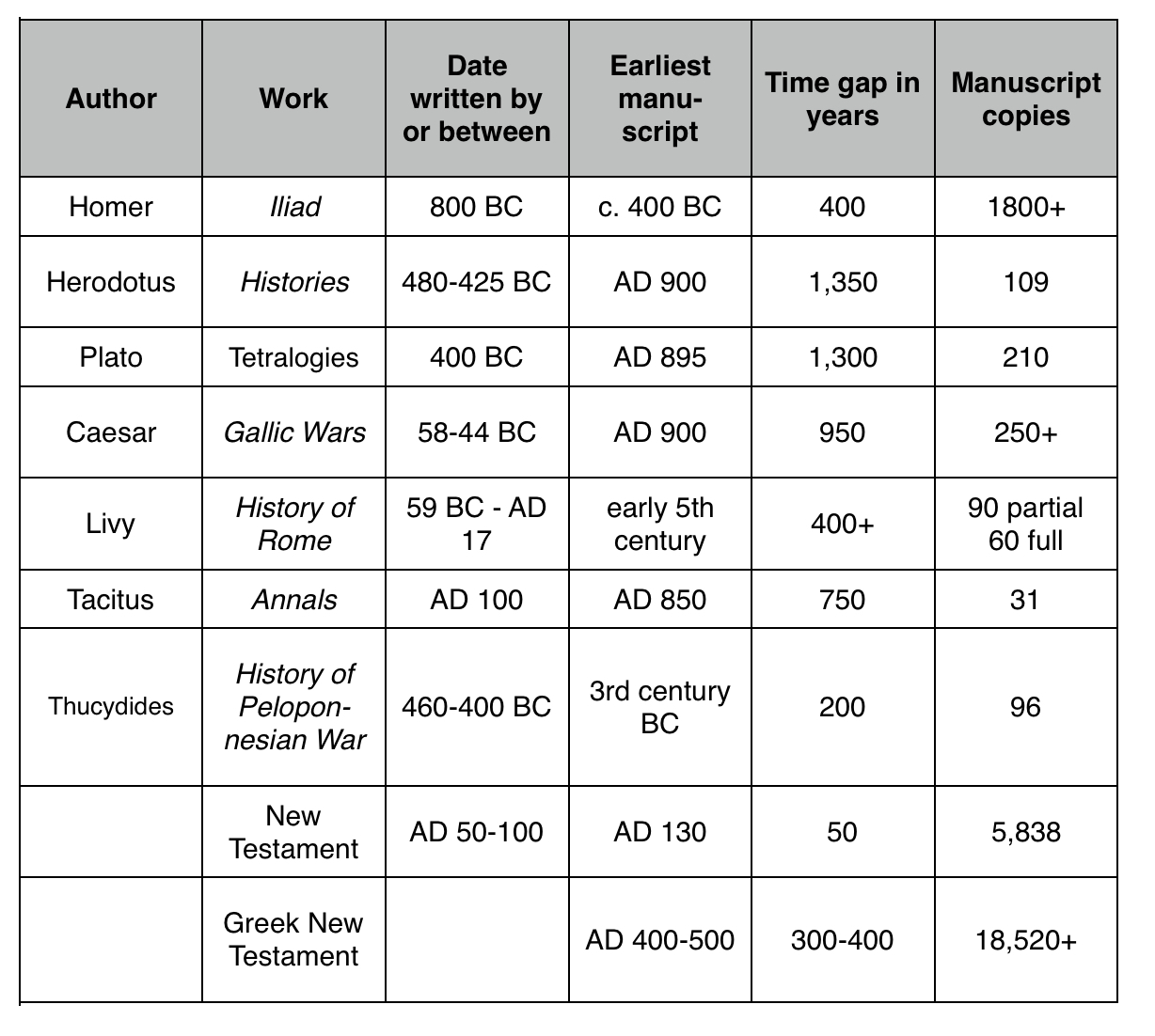
manuscript-evidenceThen regarding the New Testament, Josh McDowell says, “I believe there is more evidence for the reliability of the New Testament than for any other ten pieces of classical literature put together.” Check out this chart reproduced from McDowell’s book God-Breathed to see by comparison to other literature, how close in dating the earliest biblical manuscripts are, and how many of those manuscripts have been discovered!

2.  The external evidence test: determining whether the historical record has been verified or affirmed by data outside of itself.

Over one-fourth of the Bible is prophetic, and two-thirds of its prophesies have already been fulfilled. For example, 700 years before His birth, the city in which Jesus was to be born was identified by a man named Micah.

Time and time again archeologists discover articles that verify the claims in the Bible. This led archeologist Nelson Glueck to conclude, “It may be stated categorically that no archeological discovery has ever controverted a single biblical reference. Scores of archeological findings have been made which confirm in clear outline or in exact detail historical statements in the Bible.”

3.  The internal evidence test: determining how of the historical record stands up to the test of internal validity.

The Bible was written by 45 different authors, over a span of 1500 years, on 3 different continents, and in 3 different languages. Yet there are no contradictions!

Anecdotal evidence—

  1. Changed lives. My life is one that has been amazingly impacted by the God of the Bible, as was a man named Saul, who had a total about-face after encountering Jesus. As a result, Christianity was spread far and fast through his writings and world travels.

2.  Changed societies. Wherever the Christian faith of the Bible has been put into practice, societies improve. Leonard Sweet notes—

“Before Christianity, there were cults that practiced all sorts of human sacrifice as well as self-mutilation and self-castration. Before Christianity, the weak were despised, the poor maligned, the handicapped abandoned. Before Christianity, infanticide was rampant, slavery run-of-the-mill, and gladiatorial combat a form of entertainment. In Jesus’ day, Corinth was famous for its temple prostitutes, continuing a long-standing tradition symbolized by the Corinthian athlete Xenophon.… Aristotle…not only condoned institutionalized slavery but provided an elaborate argument in favor of it. As if that weren’t enough, Aristotle called man ‘begotten’ and woman ‘misbegotten,’ and because a woman’s reasoning was ‘without authority’ accepted no female students.

“Only Jesus and His followers known as the church insisted on the concept of human dignity and the value of every human soul. Only the church built hospitals and took care of the abandoned and disabled. Only the church celebrated charity and selflessness as the highest virtue and elevated the status of women.”

Is all of this “proof positive” that the Bible is God’s Word? No, it’s not. But I think the evidence is compelling enough that it is certainly reasonable to reach this conclusion.

Here are some great application questions from this lesson:

  1. Other than because it says so in the Bible, how do I know that it is God’s Word?
  2. How can I let the Bible “thoroughly equip” me (2 Timothy 3:14-17)?  
  3. Is my worldview pragmatic or biblical? Does it really make a difference?

5 Quotes For The New Year

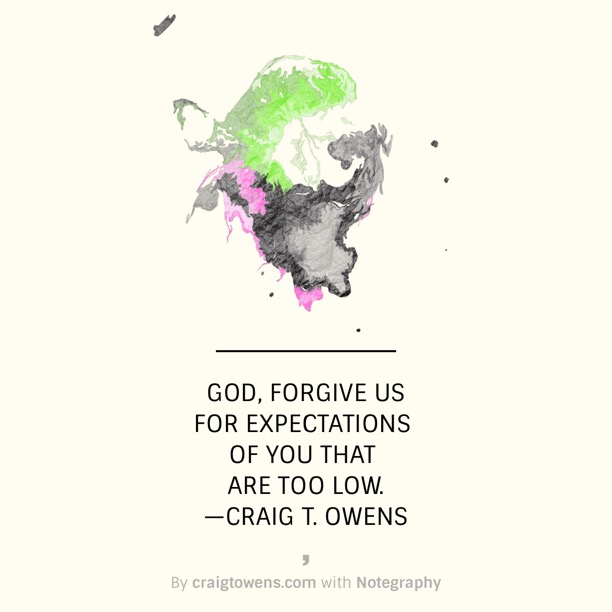
cto-low-expectations“God, forgive us for expectations of You that are too low.” —Craig T. Owens

“I am the God of unlimited creativity; expect Me to do surprising things in this year that stretches out before you.” —Jesus (from Sarah Young’s Jesus Always)

“Be always at war with your vices, at peace with your neighbors, and let each new year find you a better man.” —Benjamin Franklin

“Of all persons the Christian should be best prepared for whatever the New Year brings. He has dealt with life at its source. In Christ he has disposed of a thousand enemies that other men must face alone and unprepared. He can face his tomorrow cheerful and unafraid because yesterday he turned his feet into the ways of peace and today he lives in God. The man who has made God his dwelling place will always have a safe habitation.” —A.W. Tozer

“Real peace is knowing that no matter what I do, God will never stop loving me. Real peace is knowing that no matter what happens, God will never leave me alone. He’ll always be with me. Real peace means that no matter what happens in the New Year, or in the years to come, I know that God is going to give me the strength to handle it. Real peace is living by God’s Word, the Bible, so I can avoid a lot of the needless hang-ups and hurts and habits that mess up my life.” —Rick Warren, in On This Holy Night

Little Is Not Insignificant

gods-promise-to-youPastor Phillips Brooks visited Israel in the mid-1800s. While there he visited a small church just outside of Bethlehem. Listening to the worshipful songs being sung in that quiet countryside, he was inspired to pen the words to O Little Town Of Bethlehem.

Because of that quiet setting, notice how Rev. Brooks notices things we often miss—

  • little town on Bethlehem
  • in thy dark streets
  • while mortals sleep
  • no ear may hear His coming

But little does not mean insignificant. And just because we can’t see or hear something doesn’t mean it doesn’t exist or it isn’t important.

Sometimes we’ve looked and listened and waited and searched for so long that we have given up and we begin to drift off to sleep. We continue to live in our own “little town” surrounded by silence. And we are in danger of missing a miracle right in our midst!

We know today that Jesus was born in Bethlehem. But did you know that this little town was still so obscure in Christ’s day that many people in Israel were unaware of what went on there? (See John 7:41-43). Even after King Herod had gruesomely killed all the baby boys in Bethlehem, scarcely anyone outside of that town knew about it or cared about it.

But God cared. And He knew exactly what He was doing.

But when the proper time had fully come, God sent His Son (Galatians 4:4)—the exact right moment—to be born in Bethlehem—the exact right place (Micah 5:2). Notice even Micah says of Bethlehem though you are small among the clans of Judah, giving birth to the title of Rev. Brooks’ poem.

How small was it? Look at the description of the territory for the tribe of Judah (in Joshua 15), and you can easily glossed over the names of all of the towns. But look more closely and you will see something you didn’t read in that list of towns. Take a close look at all 38 cities: it’s still missing.

There are a couple of very notable figures that dominate the Old and New Testaments, and they have something in common—King David and Jesus both come from the tribe of Judah. And both of them were born in Bethlehem. But in the list of towns in Judah’s territory, there is absolutely no mention of Bethlehem.

This town either didn’t exist, or it was so “insignificant” that Joshua didn’t even think to mention it. It would be almost another 500 years before David would be born in Bethlehem, and then another 900 years after that before Jesus would be born in this little town of Bethlehem.

God had in mind for the greatest earthly king in Israel’s history and the King of all kings to come from such humble origins… from a village that didn’t even make the list. Bethlehem was ready for these kings at just the right moment!

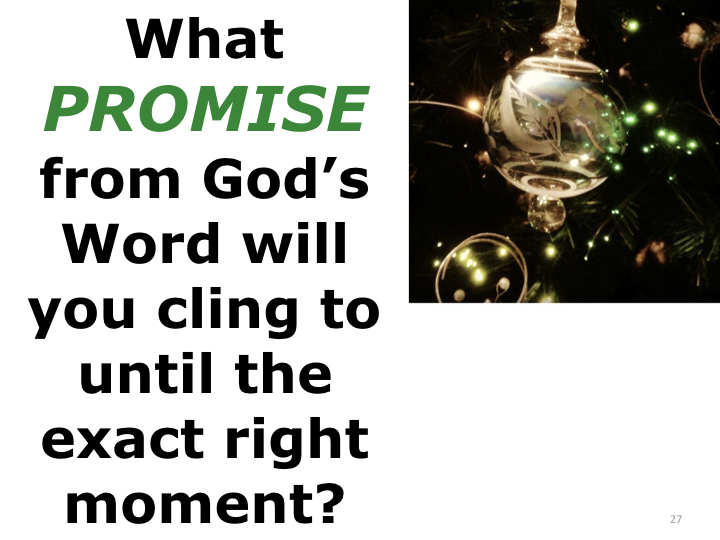
Jesus said heaven and earth will pass away, but His words will never pass away. What promise in His Word do you need to cling to? 

Just as those awaiting the Messiah clung to Micah’s promise until it came to pass, you must find God’s promise for you in His Word, cling to it, and don’t let go until it comes to pass in your little town.

If you’ve missed any of the messages in our series The Carols Of Christmas, you can find the full list here.

T.M. Moore On Prayer

T.M. Moore“God has provided us with inspired scripts to guide us in our prayers. When words fail us in prayer—and they will fail us often—we have God’s own Word to guide us…. The Psalms offer us words to guide our praise and thanks, words to express our fears and failures, words to enlarge the scope of our prayers, enrich the power of them, and rest the hope of them in the mighty and saving works of God. …

“God has given us three great helps to assist us in our prayers. His Spirit groans for us; His Word guides us; and His Son governs and intercedes for us. …

“If we’re not praying, if prayer is not the defining discipline of believers and their churches, then what are we doing in the Name of the Lord? All those programs. All that frenzied activity. Those buildings and staff, budgets and grounds—what’s all this for, if not to promote and practice prayer without ceasing?

“Prayer, in the last analysis, is not about the things of men, but the things of God. It’s not about seeing things or making requests as we see or want them to be, but as God does, according to His agenda in Christ Jesus. If we keep trying to make prayer be about the things of men, we’ll never get to the things God really wants us to realize through prayer. A precondition for effective prayer, therefore, is that we make up our minds going in, that what we want in prayer is God’s will, not ours—the world and our lives as God intends them, not as we might wish they could be. …

“You cannot pray in Jesus’ Name if all you’re really seeking is to add a little comfort, convenience, or pleasure to your life. …

“The grace gained in prayer will flow through us like rivers of living water to touch others with life.” —T.M. Moore

10 Quotes From “Light & Truth—Revelation”

light-and-truth-revelationHoratius Bonar gives excellent insights into the themes in Scripture. Having him as a guide through a challenging text like the Book of Revelation is a precious resource. Check out my review of his commentary Light & Truth—Revelation by clicking here.

“The tendency of the present age is to set aside prophecy as specially belonging to the supernatural, and therefore the incredible and impossible. Let us stand aloof from this incredulity, and welcome the prophetic word as all the more precious because supernatural and specially divine. … Prophecy is a sure word, and it is as blessed as it is sure. Woe to him who slights it! Blessed are all they who meditate on it, seek to know it, and take it for guidance and counsel in the evil day!” 

“Have we realized our own dignity? Do we feel the honour, the privilege, the responsibility of being kings and priests? Do we act, live, speak, feel accordingly? Do our glorious prospects tell upon us now? Are we walking daily in the anticipation of what shall be? Are we working, praying, praising, giving, suffering, denying self, under the influence of that honour which shall so soon be ours?”

“The world scoffs at the message, and believes in no advent save the advent of gold and silver, of commerce and science, of luxury and pleasure. The Church has lost sight of it, and says, ‘My Lord delayeth His coming.’” 

“Is the Church ready for this glorious day? Has she put on her apparel? Has she trimmed and lighted her lamp? Has she filled her vessel with oil? Is she sitting loose from the world? Is she remembering her coming Lord, and seeking to be faithful to Him in His absence? He has entrusted to her His cause, His truth, His honour. Is she alive to her responsibility, and acting accordingly? Is she realizing His nearness and His glory? Is she daily influenced by His sure world of promise, ‘Behold, I come quickly, and my reward is with Me?’ Is she labouring and suffering for Him? Or is she self-indulgent, worldly, indolent?”

“Be patient under wrong, and suffering, and weariness, and hope deferred! Fret not! He that believeth doth not make haste; the Lord is at hand; the kingdom is about to come; the tribulation will soon cease; the joy will soon begin; and once begun, it will never end.”

“Live, and act, and walk as sons of morning. Let the world recognize you as such. Let there be streaks of dawn seen upon you.”

“Pity a dark world, and its dark children, that have no hope and no morning before them. Point out the Morning-star to them; bid them look at it; tell them what its anticipated brightness has done for you. Win souls to Christ. Draw many into the kingdom by your words and by your walk. There is little time to lose; for the coming of the Lord draweth nigh.”

“It is not lukewarmness occasioned by the cold passing gradually into heat, but that produced by the heat passing into the cold. … Church of the living God, beware of letting your temperature sink even one single degree.”

“Be separate from the world. Abstain from fleshly lusts. Lay aside all filthiness. Walk soberly. Beware of earth’s folly and idle laughter. Set your affection on things above. Be prepared for suffering. Endure hardness. Take up your cross daily and bear it aloft, and be not ashamed of it. The footsteps of the old saints are still visible on the sands of time. Follow them. Their voice is still heard, and their hand still waves, beckoning you to follow. Believe what they believed.”

“Watch, for satan tries to lull you asleep. Watch, for the world, with it riches, and vanities, and pleasures, is trying to throw you off your guard. Watch upon your knees. Watch with your Bibles before you. Watch with wide-open eye. Watch for Him Whom not having seen you love.”

I will be sharing more quotes from this powerful book in the near future. You can enter your email address by the box that says “Sign me up!” to be notified immediately when these quotes are posted. And be sure to follow me on Tumblr and Twitter for a daily dose of notable quotes.

Light And Truth—Revelation (book review)

light-and-truth-revelationI love looking at the Scripture through wiser eyes. I have just completed my journey through the New Testament with Horatius Bonar pointing out things I may have otherwise missed. The fourth in his series of commentaries on the New Testament is Light And Truth—Revelation.

In reviewing the first three books in this series, I mentioned that Bonar seldom presents a verse-by-verse commentary on the Scriptures, but more of an overall theme on select passages. In Revelation he departs from this pattern. Frequently there are extensive passages which he dissects word-by-word, going deep into the implication for Christians. This was unexpected, but greatly welcomed.

Since the Bible is inspired by the Holy Spirit, He is the best source of illumination when reading Scripture. But Horatius Bonar is clearly a man immersed in the overall message of the Bible, and guided by the Holy Spirit in his writings. This is an excellent set of commentaries to enhance your study of the New Testament.

Be sure to check out my reviews of Horatius Bonar’s other Light And Truth commentaries on the New Testament:

9 Quotes From “Chase The Lion”

chase-the-lionI loved Chase The Lion by Mark Batterson! Before even reading the first chapter, I was already captured by the Lion Chaser’s Manifesto, and the book only got better from there. Please check out my review of this amazing book, and then check out the first batch of quotes below.

“At the end of our lives, our greatest regrets will be the God-ordained opportunities we left on the table, the God-given passions we didn’t pursue, and the God-sized dreams we didn’t go after because we let fear dictate our decisions.”

“It’s not just our sin that we need to repent of. It’s our small dreams. The size of your dream may be the most accurate measure of the size of your God. Is He bigger than your biggest problem, your worst failure, your greatest mistake? Is He able to do immeasurably more than all you can ask or imagine? A God-sized dream will always be beyond your ability, beyond your resources. Unless God does it, it cannot be done! But that’s how God gets the glory. If your dream doesn’t scare you, it’s too small. It also falls short of God’s glory by not giving Him an opportunity to show up and show off His power.”

“We don’t die when our hearts stop beating. We die when our hearts stop skipping a beat in pursuit of our dreams. We die when our hearts stop breaking for the things that break the heart of God.”

“Impossible odds set the stage for God’s greatest miracles! And apparently God loves long shots. Isn’t that why He removed 9,700 soldiers from Gideon’s army? Isn’t that why He let the fiery furnace be heated seven times hotter? Isn’t that why He didn’t show up until Lazarus was four days dead? … We tend to avoid situation where the odds are against us, but when we do, we rob God of the opportunity to do something supernatural.”

“Get into God’s Word, and God’s dream will get into you.”

“When we fail to take action, we forfeit the future. Make no mistake: just as inaction is an action, indecision is a decision.”

“One misstep can end a dream journey. That doesn’t mean you operate in a spirit of fear. It does mean you operate in a spirit of focus!”

“In my humble opinion, no one is a natural. Sure, some people are more naturally gifted than others. But unless that giftedness is coupled with a complementary work ethic, it’ll only result in wasted potential.”

“I don’t believe our greatest shortcoming is not feeling bad enough about what we’ve done wrong. I think our greatest shortcoming is not feeling good enough about what God has done right. When we undercelebrate, we fall short of the glory of God!”

In the very near future I will be sharing more quotes from this book. To make sure you see them, put your email address in the box to the right and click “Sign me up.” I’ll make sure you’re the first to know when new content is posted.

Also be sure to follow me on Twitter and Tumblr, where daily I share quotes from Mark Batterson and other inspirational authors.

Thursdays With Oswald—The Harmony Of Health

Oswald ChambersThis is a weekly series with things I’m reading and pondering from Oswald Chambers. You can read the original seed thought here, or type “Thursdays With Oswald” in the search box to read more entries.

The Harmony Of Health

     Health, or physical harmony, is a perfect balance between our organism and the outer world. … The great error of the healthy-minded cult is that it ignores a man’s moral and spiritual life. … The attitude to sickness in the Bible is totally different from the attitude of people who believe in faith-healing. The Bible attitude is not that God sends sickness or that sickness is of the devil, but that sickness is a fact usable by both God and the devil. 

   Happiness or moral harmony is a perfect balance between our inclination and our environment. … The Bible reveals that a man can have physical health at the cost of his moral welfare, and happiness at the cost of spiritual welfare. 

   Holiness, or spiritual harmony, is a perfect balance between our disposition and the law of God. … 

   The devil tries to make us think that when we have entered into the sanctified life, all is done; it is only begun. We have entered into Jesus Christ’s finished work, but remember, says Paul, you have attained to nothing yet; everything is perfectly adjusted, now began to attain and to “grow up into him in all things. These three things develop slowly together: first, the basis of spiritual holiness; second, the building of moral happiness; and third, the decoration of physical health. A full-grown man in Christ Jesus is one who has become exactly like Christ Jesus. “Till we all come…unto the measure of the stature of the fullness of Christ” (Ephesians 4:13). 

From The Philosophy Of Sin

Quite simply Oswald Chambers identifies health as a perfect balance:

  • Physical health balances outside germs against inside defenses.
  • Emotional health balances outside circumstances with inside coping mechanisms.
  • Spiritual health balances God’s law (outside) with our obedience to that law (inside).

Furthermore, Chambers says that Jesus Christ is our measuring stick. We must study God’s Word, and watch Jesus closely to see how He lived out the perfect balance of the Scriptural principles so that we can attain “unto the measure of the stature of the fullness of Christ.”