Listen to the podcast of this post by clicking on the player below, and you can also subscribe on Apple, Spotify, or Audible.
There is one word that people seem to speak that is blocking the blessings that God wants to send to them.
Check out this latest episode of The Podcast.
Get into God’s Word, and let His Word build your faith to cling to Him in faith until His promise ultimately appears. Don’t let the negative people around you, or your current circumstance, or anything else cause you to walk away from the blessing God wants to give you!
Listen to the podcast of this post by clicking on the player below, and you can also subscribe on Apple, Spotify, or Audible.
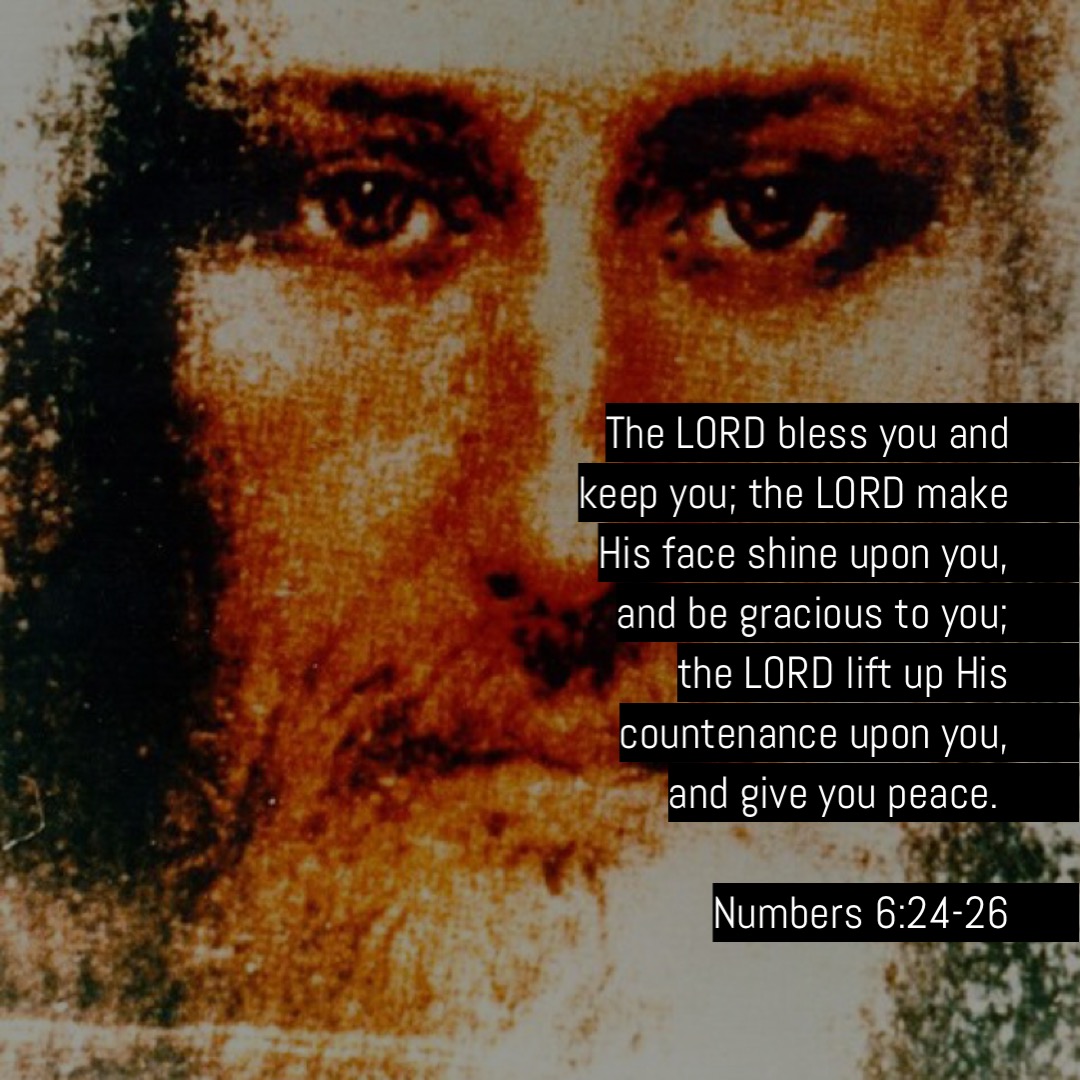
I have always been both intrigued and encouraged by the blessing Moses was instructed to give the the priests to pronounce over God’s people.
Tell Aaron and his sons, “This is how you are to bless the Israelites. Say to them: ‘The Lord bless you and keep you;the Lord make His face shine on you and be gracious to you;the Lord turn His face toward you and give you peace.’” (Numbers 6:23-26)
After giving this blessing, God then says, “And they shall put My name upon the Israelites, and I will bless them” (Numbers 6:27 AMPC).
What does it mean to put God’s name on me?
I think the Bible shows that it means—
I feel the heaviness of His holiness AND
I feel the security of His surrounding presence.
I feel the unapproachableness of His perfect righteousness AND
I feel the welcoming embrace of His atonement.
I feel how unworthy I am AND
I feel how worthy He is.
I know that He knows everything about me AND
I know He still loves me with an unquenchable love.
I know He is the holy Judge AND
I know He is the Forgiver of my sins.
I know that His Holy Spirit convicts me of my sins AND
I know the His Holy Spirit helps me get free of those sins.
What an inexpressible, overflowing-with-joy, irrepressible, unshakable assurance I have in my relationship with my Heavenly Father, through the work of Jesus Christ, and the assurance of the Holy Spirit. This is indeed a blessing that the no one else but my God can put on me!
P.S. You may also be interested in another take on the priestly blessing in my post The Blessing.
The word gospel simply means the good news about the salvation that comes only through Jesus.
Paul loves this word!
Interestingly, although we refer to the first four books of the New Testament as “The Gospels,” the word itself barely appears:
Matthew—4 times
Mark—8 times
Luke—0 times
John—0 times
And even though these four opening books are the Gospels about Jesus, He Himself only uses the word nine times, with the other three times attributed to someone else mentioning what Jesus was doing.
Peter only uses this word twice (Acts 15:7; 1 Peter 4:17). And John uses it just once (Revelation 14:6).
Paul, however, uses this word 64 times!
It becomes such a part of who he is and how he thinks, that he calls it “my gospel” twice (Romans 2:16, 16:25) and “our gospel” three times (2 Corinthians 4:3; Colossians 1:23; 2 Thessalonians 2:14).
For Paul and for us this Good News is—
God’s promises fulfilled
salvation power
the fullness of God’s blessing
the opening of mysteries
the guide for godly living
glorious light
the expression of God’s grace
the standard of all truth
a key part of the Christian’s spiritual armor
the empowerment for ministry
the anchor of unshakable hope
the means by which we experience Christ’s glory
the only door to life and immortality
For those of us who have been called to preach this Gospel, these thoughts should both humble and empower.
For those of us who have been saved by believing this Gospel, these thoughts should cause us to desire to know more, and more, and more about our Savior.
Listen to the podcast of this post by clicking on the player below, and you can also subscribe on Apple, Spotify, or Audible.
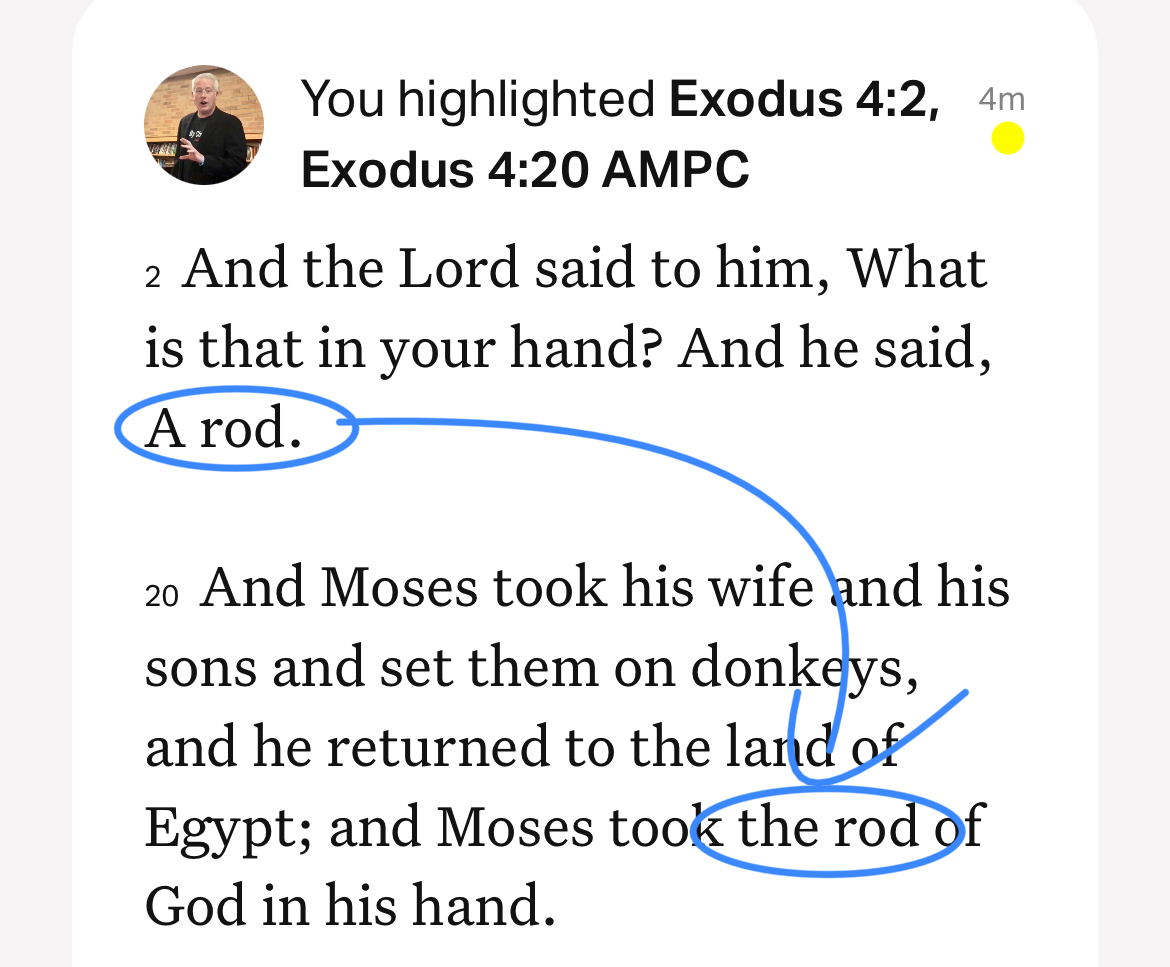
And the Lord said to [Moses], “What is that in your hand?” And he said, “A rod.” … And Moses took his wife and his sons and set them on donkeys, and he returned to the land of Egypt; and Moses took the rod of God in his hand. (Exodus 4:2, 20 AMPC)
What Moses originally called merely “a rod” he later called “the rod of God.” He recognized that what he thought was his was in actuality what God had given him to use.
When we recognize that what’s in our hands isn’t our creation, but a God-given talent, it marks a defining moment in both our maturity and our humility. Or to borrow a phrase I elaborate on in my book Shepherd Leadership, this helps us view our God-given talents or positions with confident humility (or, if you like, humble confidence).
With this shift in Moses’ understanding and language in mind, this is how we should treat every strength God has given us:
• I will have to give an account to God for how I invested or squandered what He entrusted to me
When we realize that we are not self-made men or women, but that any talents, abilities, or opportunities we have are God-appointed, we show a marked maturity in our understanding of our stewardship of God’s gifts. As our maturity grows, our confidence and our humility will grow proportionately. And as we become more confidently humbled in the way we steward God’s gifts, our leadership cannot help but exhibit more of God’s blessing on it.
All of this growth starts with just the simple recognition that what’s in my hands is there only because God placed it there.
Listen to the podcast of this post by clicking on the player below, and you can also subscribe on Apple, Spotify, or Audible.
Like it or not, your example as a leader is making an impact on all the people around you—including the next generation of leaders who will take their positions after you have passed away.
So I have a simple question for you: Are you setting them up for success or failure?
Hezekiah had been sick and God miraculously healed him. When Merodach-baladan, king of Babylon, heard about this, he sent envoys to see King Hezekiah. Instead of bragging on God, Hezekiah bragged about all of his riches.
“Behold, the days are coming when everything that is in your house, and what your fathers have stored up to this day, will be carried to Babylon; nothing will be left,” says the Lord. “And some of your sons who will come from you, whom you will father, will be taken away, and they will become eunuchs in the palace of the king of Babylon.” (Isaiah 39:6-7)
Sadly, Hezekiah responded, “At least it won’t impact me.”
A mark of a godly leader is one who desires to set up future leaders for success.
His son Manasseh became one of the most evil, godless kings that Judah had ever known. And as a result, he experienced the punishment that Isaiah had prophesied.
Thankfully, Manasseh eventually humbled himself, repented of his sin, and got to experience God’s restoration to a small degree—
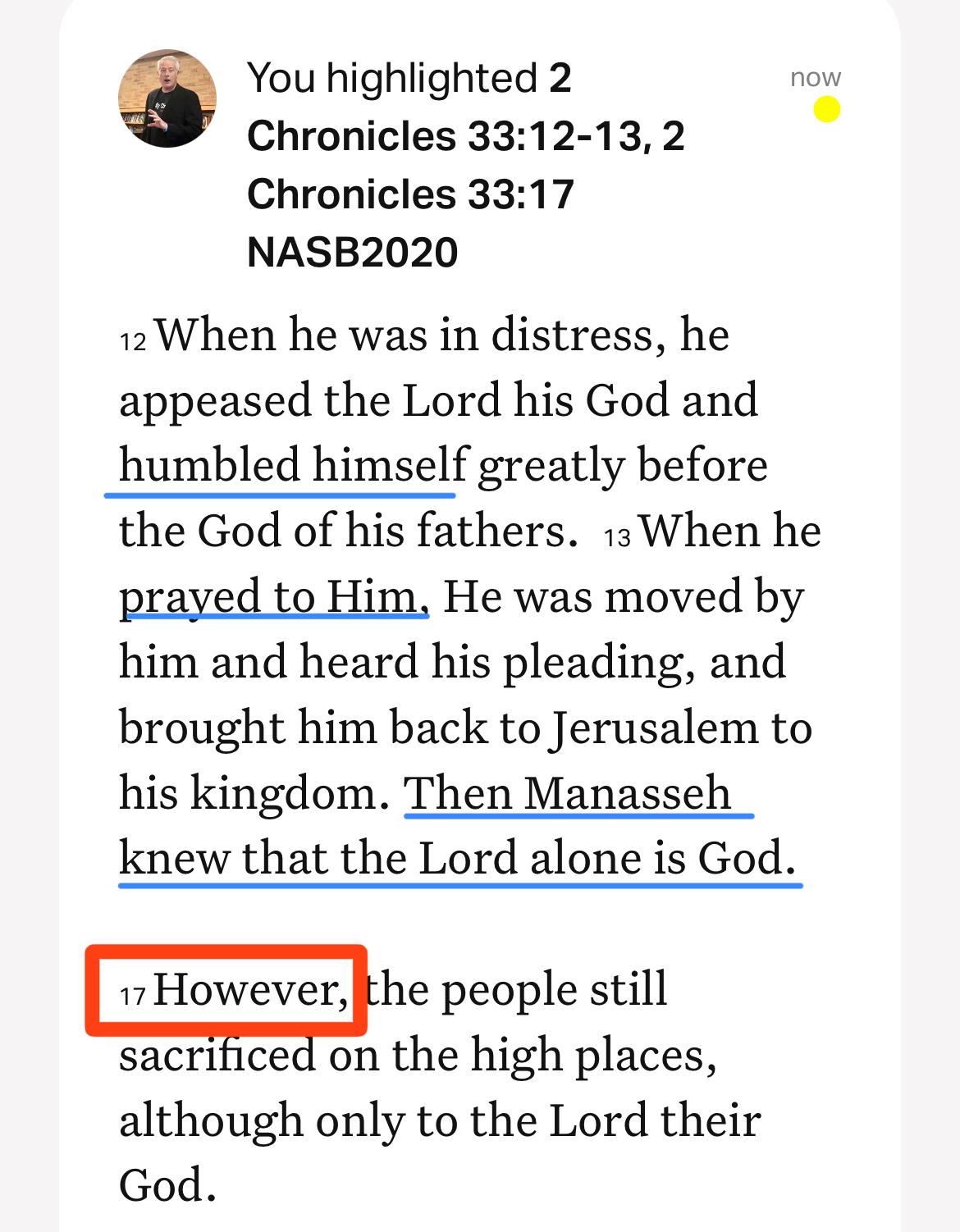
When he was in distress, he appeased the Lord his God and humbled himself greatly before the God of his fathers. When he prayed to Him, He was moved by him and heard his pleading, and brought him back to Jerusalem to his kingdom. Then Manasseh knew that the Lord alone is God. (2 Chronicles 33:12-13)
But there is a sad “however” for Manasseh’s son Amon: However, the people still sacrificed on the high places (2 Chronicles 33:17). This mixing of the worship of God with the worship of pagan idols always pulls people away from God. It certainly did that for Amon because “he did evil in the sight of the Lord, just as his father Manasseh had done. For he walked entirely in the way that his father had walked, and served the idols that his father had served, and worshiped them” (2 Kings 21:20-21). “Furthermore, he did not humble himself before the Lord as his father Manasseh had done, but Amon multiplied his guilt” (2 Chronicles 33:23).
Godly leaders should be just as concerned about the people that come after them as they are about the people around them now. Godly leaders strive to set up future generations for success—so they can receive God’s continued and increased blessings.
This is part 78 in my series on godly leadership. You can check out all of my posts in this series by clicking here.
Listen to the podcast of this post by clicking on the player below, and you can also subscribe on Apple, Spotify, or Audible.
Let’s review the historical background for the Psalms of Ascent. The Jewish people made four pilgrimages to Jerusalem each year, which sit about 2500 fee above sea level, so this was a physical climb. But this also has a spiritual lesson for us today: We are to continue progressing in our walk with God—upward and onward!
The songs of ascent that these pilgrims sang give us life-changing lessons that we can still apply today.
I’m sure there were some pilgrims who thought, “We have to go to Jerusalem.” Just as there are some people today who may something like, “I have to tithe.” But when you have experienced the blessing that comes from obedience, your “have to” turns to “get to” really quickly!
There is a longing in Psalm 128 for God’s blessing. In fact, we see it in nearly every verse: blessed (v. 1), blessing and prosperity (v. 2), blessed (v. 4), bless and prosperity (v. 5), and peace (v. 6).
We have to remember that our obedience doesn’t earn God’s blessing, but rather our obedience keeps us in the place where we can receive God’s ever-flowing blessings. When I have experienced the blessing that followed even my “have to” attitude, I now joyfully “get to” obey because I know that keeps me in a blessed place.
But even knowing that these blessings are flowing for us, sometimes we still get weary. Sometimes it seems as if we are being faithful but we aren’t seeing the results that perhaps we saw before.
Think about these pilgrims ascending 2500 feet year after year after year. It was challenging enough during the golden days of King David and King Solomon, but can you imagine the feelings of futility during the dark days? Perhaps during the exile when the temple was in ruins, or after the exile when the temple didn’t look as it did before and there were overlords ruling Israel? And then it was unquestionably true that the older a pilgrim got, the harder the climb became for them.
But the struggle keeps us reliant on God. Like Solomon said, “The way of life winds upward for the wise, that he may turn away from hell below” (Proverbs 15:24). The longer I walk, the more I get to rely on God’s help, and the sweeter He becomes to me!
I love the line in the hymn Great is Thy Faithfulness, “Strength for today and bright hope for tomorrow—blessings all mine with ten thousand beside.” Because of God’s blessings that I’ve already experienced, I can trust Him for more, even in the struggle of the climb.
Look at some of these promises that come out in other biblical translations.
Blessedare those who fear God (NIV) = “How joyful are those who fear the Lord” (NLT)
Blessing and prosperity will be yours (NIV) = “You will enjoy the fruit of your labor” (NLT) and “You will eat what you worked so hard to grow” (NET)
The middle of this psalm is in verses 3-4. Remember above when I said nearly every verse contains a word of blessing? I didn’t list verse 3, but there is language in this verse that makes it pregnant with blessing—Your wife will be like a fruitful vine within your house; your sons will be like olive shoots around your table.
You may ask, “How is this a blessing?”
The phrase “under their own vine and under their own fig tree” appears throughout the Old Testament. It described a blessed, prosperous, happy, and peaceful home. It was a home at peace within because there was also peace without.
This described the golden era of King Solomon—During Solomon’s lifetime Judah and Israel, from Dan to Beersheba, lived in safety, everyone under their own vine and under their own fig tree (1 Kings 4:25).
After the northern kingdom of Israel fell and the southern kingdom of Judah was surrounded by the Assyrian forces of King Sennacherib, the king’s field commander tried to entice them the people with similar words—
Do not listen to Hezekiah. This is what the king of Assyria says: “Make peace with me and come out to me. Then each of you will eat fruit from your own vine and fig tree and drink water from your own cistern until I come and take you to a land like your own—a land of grain and new wine, a land of bread and vineyards, a land of olive trees and honey. Choose life and not death! Do not listen to Hezekiah, for he is misleading you when he says, ‘The LORD will deliver us.’” (2 Kings 18:31-32)
Notice that he said the land would be “a land like your own.” He was trying to get them to compromise, to no longer listen to God’s voice, to no longer climb up into God’s presence. Much like satan tempted Adam and Eve to eat the forbidden fruit with the promise, “You will be like God.”
But these blessings in Psalm 128 don’t come from fearful “have to” obedience to man, but from reverencing God above all else. So the longing of verses 1-4 become the prayer of verses 5-6 (notice the word may used three times in these verse).
The focus of our longing—where we need to keep our eyes—is on God’s heavenly throne: Zion, Jerusalem, Israel (vv. 5-6; Micah 4:1-5).
In an earlier story, Caleb may have gotten tired while he waited for God to fulfill His promise to him, but he always trusted God as he walked on (see Joshua 14:9-12).
What promises of God are you still praying for?
What are you longing to see accomplished?
What has God already done that you can look back on?
The Hill, though high, I covet to ascend, The Difficulty will not me offend; For I perceive the Way to life lies here. Come, pluck up Heart, let’s neither faint nor fear;
Better, though difficult, the Right Way to go,
Than wrong, though easy, where the End is Woe. (John Bunyan)
Don’t give in.
Don’t give up.
Keep climbing.
Like Caleb say, “It may have been 85 years of walking and climbing, but I’ll keep climbing. GOD, GIVE ME THIS HILL!”
If you would like to check out the other songs of ascent that we’ve already studied, please click here.
God’s laws, precepts, and commands are given to us because He loves us and wants to keep us safe. His laws keep us in a place where we can experience His abundant blessings!
I have lots of new content every week, which you can check out on my YouTube channel.
“Establishing the Kingdom of God means ending evil, which happens not through violent force or coercive threats but through loving-kindness and patient forgiveness. It’s a world compelled by love instead of fear. … This [the outpouring of the Holy Spirit on the Day of Pentecost] is the beginning of a new world. The old world creates enemies and divides people, falsely claiming that some are loveable and others are throwaways, but not so in the Kingdom of God! In God’s empire, all people mutually love one another without partiality.” —Why Is Pentecost Important? reading plan on YouVersion
In the weekly Culture Translator newsletter from Axis Ministry, they had this insightful reminder about the worldview of pornography: “Pornography is not just sexual entertainment; it is a form of propaganda about what human beings are. In the same way that Scripture has a vision for humanity (that all people are God’s beloved children, worthy of honor and respect, with inherent dignity as his image-bearers), pornography also has a vision for humanity: that people (especially women) are objects to be gawked at, violated, and discarded at will. Porn offers a worldview, and like any other worldview, it shapes the way we think about what people are for—and how they should be treated. ‘Pornography teaches us lies that we ingrain into aspects of our relationships and our lives,’ argues Sam Black, Covenant Eyes’ Director of Recovery Education. These lies include the notion that we can’t live without sex, that sex equals love (or acceptance), and/or that what gives humans value is exclusively their sexual attractiveness. ‘Pornography warps our views of our relationships,’ Black continues, ‘and we haven’t even realized it.’”
“I always turn to the sports page first. They record people’s accomplishments. The front page has nothing but man’s failure.” —Chief Justice Earl Warren
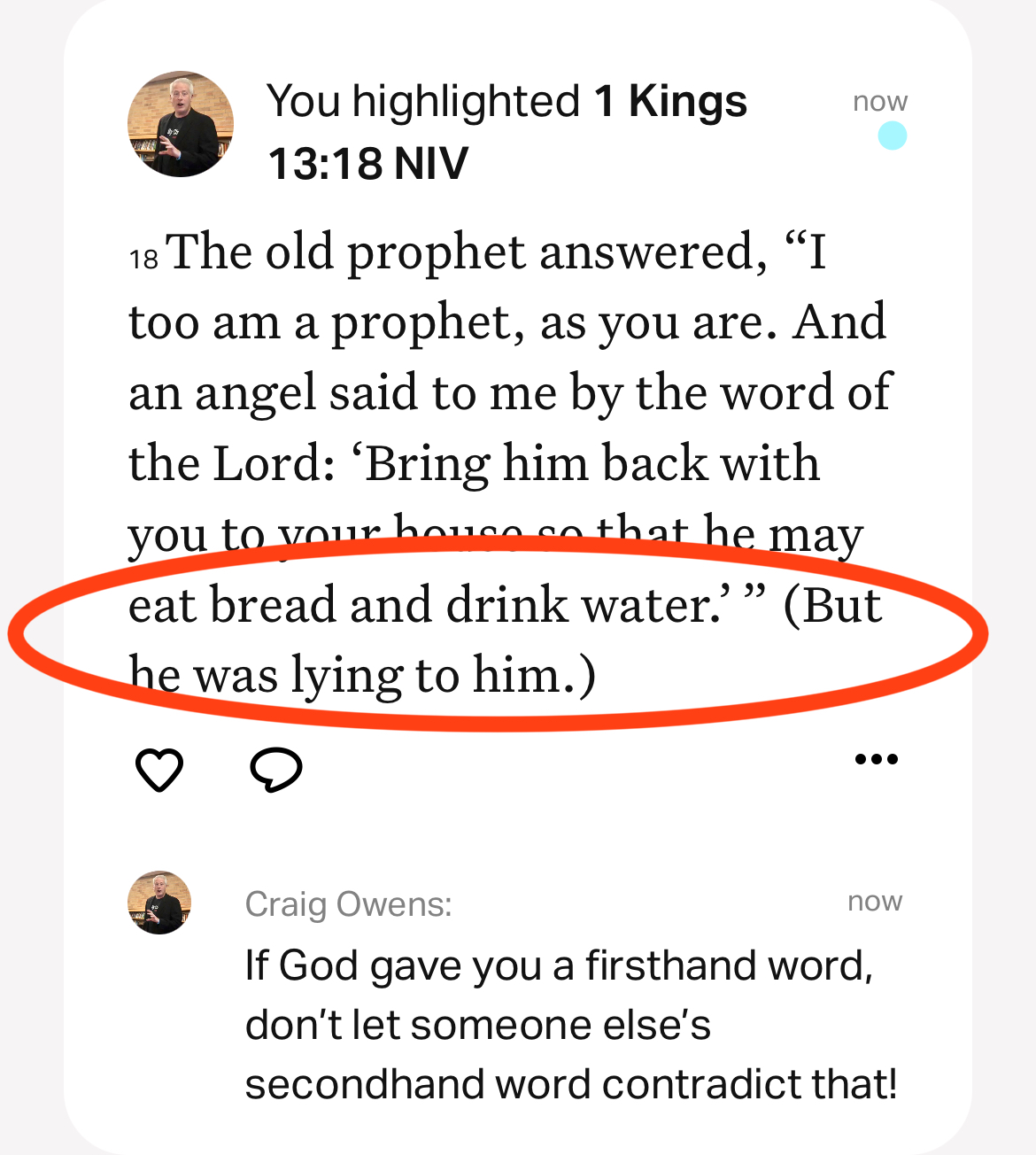
There is a very unusual story told in 1 Kings about a couple of unnamed prophets. One prophet heard from God, delivered the powerful warning God directed him to give, but then disobeyed God because of something another prophet told him that he had heard from God. I shared this commentary on YouVersion, “If God gave you a firsthand word, don’t let someone else’s secondhand word contradict that!”
“All religions are either a preview or a perversion of Christianity.” —C.S. Lewis
“If our relationships with other human beings are going to be meaningful, they will cost us something. Relationships are demanding.” —Herbert Wagemaker
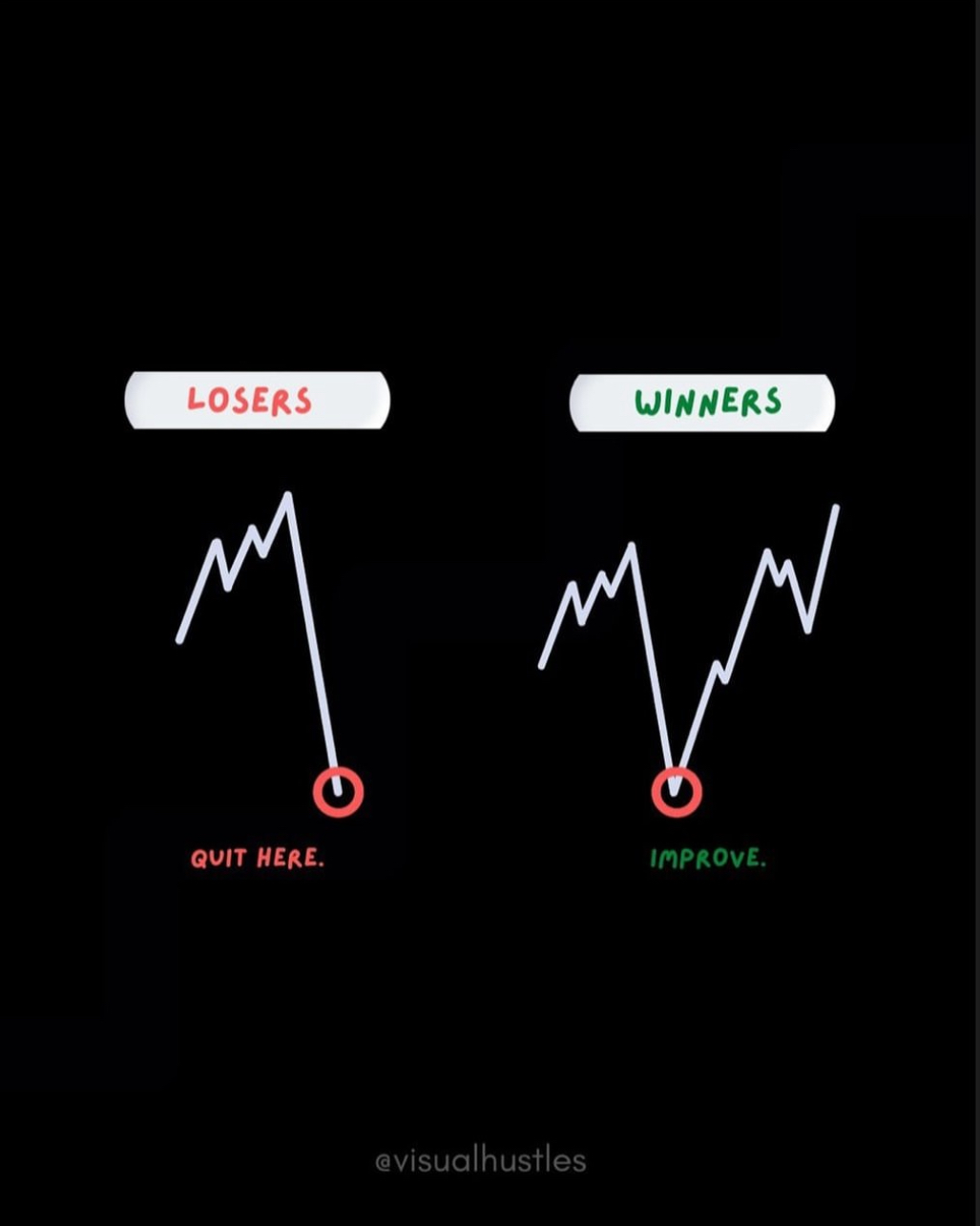
I saw this side-by-side graphic and so many thoughts about perseverance, grit, and stick-to-it-iveness came to mind. It is so true: we all have moments of stumbling. Losers tend to quit when they fall down, but winners learn something from their stumble, improve, and continue to grow. And then I came across this related quote from John D. Rockefeller, “I do not think that there is any other quality so essential to success of any kind as the quality of perseverance.”
God’s blessings are not primarily for me, but they are through me for His glory. This is a short clip from an exclusive video I shared with my Patreon supporters. Become a supporter today! I have lots of new content every week, which you can check out on my YouTube channel.
“What to do with a mistake: recognize it, admit it, learn from it, forget it.” —Dean Smith
Until the mid-1800s, the historicity of King Sargon II (mentioned by Isaiah) was in doubt. Not only has archeology again affirmed the historical statements made in Scripture, but “the way Isaiah spelled Sargon’s name is an indicator that the prophet lived at the time of Sargon II, and that the book was not penned hundreds of years later.” Check out this archeological biography of Sargon II.
And then there is this archeological report about the destruction of Sodom and Gomorrah. Fascinating!
How sweet and gracious even in common speech,
Is that fine sense which men call Courtesy!
Wholesome as air and genial as the light,
Welcome in every clime as breath of flowers—
It transmutes aliens into trusting friends,
And gives its owner passport round the globe. —James T. Fields
“A person always doing his or her best becomes a natural leader, just by example.” —Joe DiMaggio
Not using the spiritual gift God has given you is selfish. He gave you these gifts on purpose so that His kingdom could be made more visible and desirable.
He turned to God and the people put away their idols <or>
He turned from God and the people turned to their idols
It’s true: As goes the leader, so go the people.
In my life, I’ve experienced that the good things that I do over-the-top are only moderately emulated by those around me. But the unhealthy things that I even slightly indulge in are adopted quickly by everyone else.
Godly leaders must be so aware of how their example impacts everyone around them, and they must fight to maintain biblical standards. When we miss the mark, we must be quick to admit our shortcoming, repent, and get back on track.
In Hosea 4:9, God warns that the people will follow the ungodly example of their leaders, which is why God’s punishment is often more severe for those leaders.
On the positive side, in Leviticus 9, Moses and Aaron demonstrate the leadership example of spending time in God’s presence and fully obeying everything God had revealed to them there. Then verse 23 it says that after they came out of His presence, God’s glory appeared to all the people. The positive example of the leaders led to huge blessings for all the people!
A mark of a godly leader is one who increasingly aware of the power of his example.
Leaders, let’s be first to go first in…
…being in God’s presence
…obeying God’s commands
…repenting when we fall short
…asking forgiveness of those who have seen our poor example
…asking God to bless His people because of our good example
This is part 77 in my series on godly leadership. You can check out all of my posts in this series by clicking here.
Listen to the podcast of this post by clicking on the player below, and you can also subscribe on Apple, Spotify, or Audible.
There’s an interesting verb used with both Enoch and Noah that denotes intimate fellowship—the word is “walked.”
Enoch walked with God; and he was not, for God took him. (Genesis 5:24)
These are the records of the generations of Noah. Noah was a righteous man, blameless in his generation. Noah walked with God. (Genesis 6:9)
David uses this same verb when he prays, “Vindicate me, Lord, for I have walked in my integrity, and I have trusted in the Lord without wavering. Examine me, Lord, and put me to the test; refine my mind and my heart. For Your goodness is before my eyes, and I have walked in Your truth” (Psalm 26:1-3).
And Solomon uses the same verb to say that anyone who walks in righteous integrity leaves a legacy of righteousness for his family: “A righteous person who walks in his integrity—how blessed are his sons after him” (Proverbs 20:7).
There is something important that is implied in this walking. God tells us what it is in this question: How can two walk together unless they agree to do so? (Amos 3:3).
But make no mistake, God doesn’t agree with whatever path I choose to walk, but I must agree to walk God’s path.
I must agree that God’s path is best, despite what everyone else is doing—“Then the Lord saw that the wickedness of mankind was great on the earth, and that every intent of the thoughts of their hearts was only evil continually” (Genesis 6:5). Yet Noah didn’t walk with the wicked, but he was commended because he walked with God.
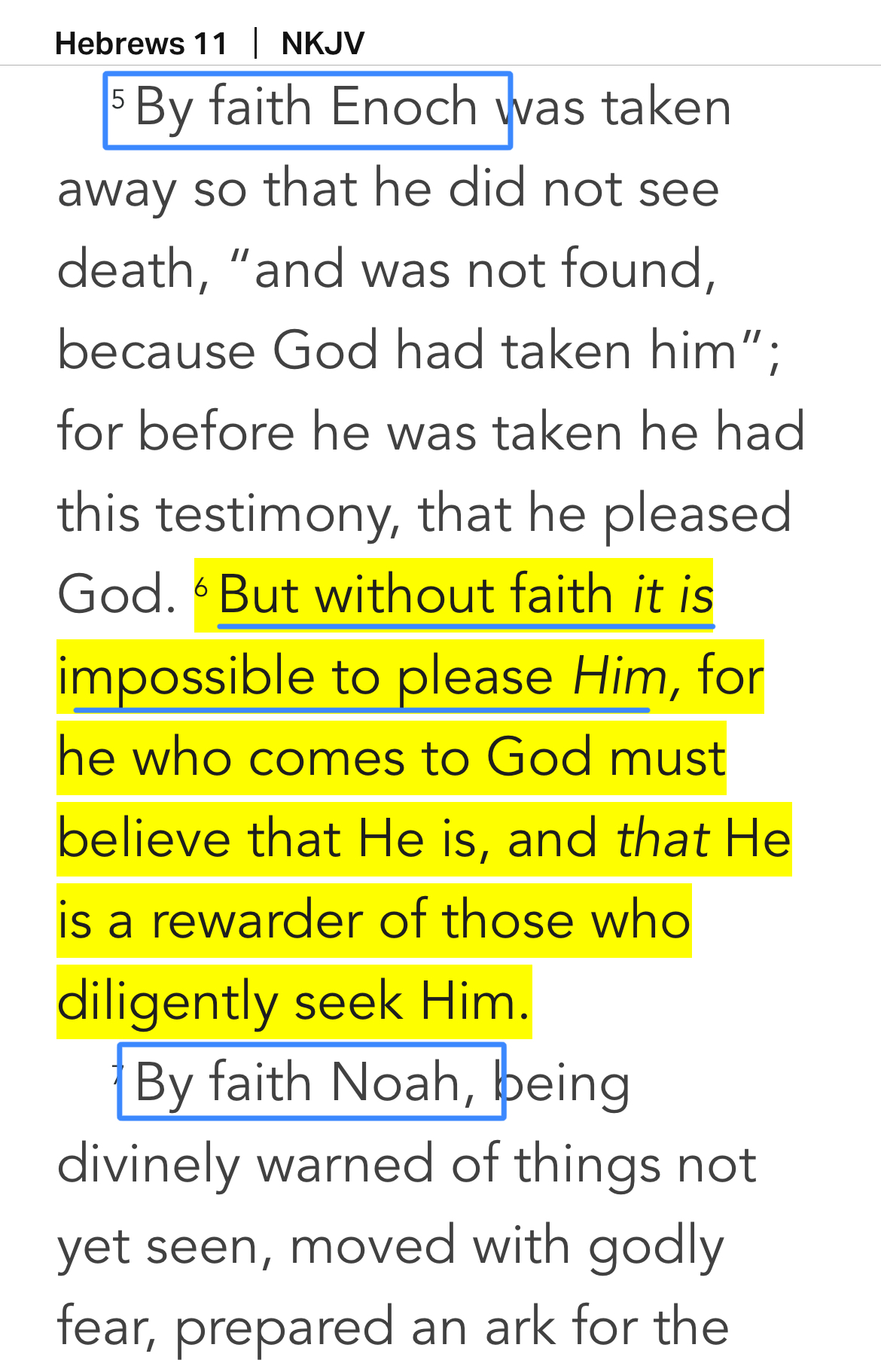
In the New Testament, Enoch and Noah are listed as back-to-back examples of faith (Hebrews 11:5, 7). The verse that connects these two men speaks of the faith-filled integrity that kept them walking with God—
And without faith it is impossible to please Him, for the one who comes to God must believe that He exists, and that He proves to be One who rewards those who seek Him. (Hebrews 11:6)
That word “seek” means to diligently crave. Enoch and Noah and David show us examples of men who diligently craved walking with God above all else. Their faithful, diligent walking made them stand out from all those around them.
What about us? Hebrews 11:6 says we can follow their example. We can choose to walk with God by faith. We can diligently crave Him above all else. When we walk righteously with God, He “rewards those” who do—for ever and ever!










 Craig T. Owens