The Patriot Financier

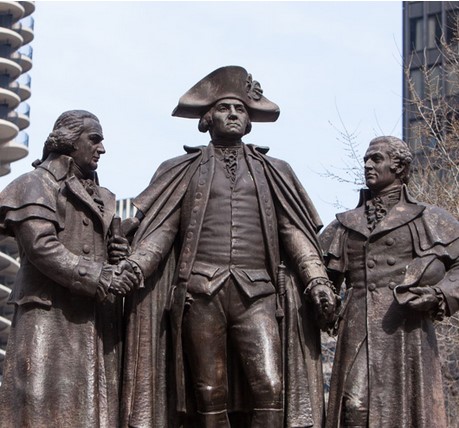
Monument of George Washington with Haym Salomon (L) and Robert Morris (R)

My friend Douglas Carmel shared an amazing story in his monthly newsletter. I am reposting it here with his permission.

July 4th is the “birthday” of America, but we may have never celebrated that date without the contribution of a long-forgotten Jewish man in American history. His name was Haym Salomon.

Haym Salomon’s life was brief (1740–1785), but his impact on America was substantial. A Polish-born Jewish businessman, Salomon advanced from a penniless refugee to become one of the most important financiers of the American Revolution.

Risking his personal fortune, he helped fund General Washington’s army by securing loans. Records show Haym Salomon’s fundraising and personal lending helped provide over $650,000 (over $17 million in today’s dollars) in financing to help George Washington in his war effort.

In August 1781, the Continental Army had trapped British Lieutenant General Charles Cornwallis in the Virginian coastal town of Yorktown. George Washington decided to march to Yorktown and deliver the final blow. But Washington’s war chest was completely empty, as was that of Congress. Without food, uniforms, and supplies, Washington’s troops were close to mutiny.

When he was told there were no more funds and no more credit available, George Washington gave a simple but eloquent order: “Send for Haym Salomon.” Salomon lent even more personal funds and raised even more money for the cause. Washington conducted the Yorktown campaign, which proved to be the final battle. The British were finally defeated. America was now a free country. The war was won!
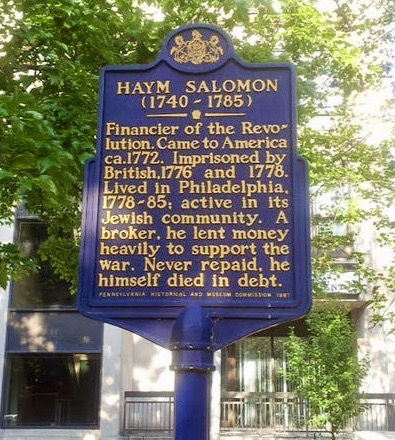
Even after the war was won, Salomon used his own money to help finance America’s newly formed but impoverished government. Sadly, his generosity was not repaid. It seemed that Congress did not recognize their debt to Salomon, refusing to repay the money they borrowed. Salomon died in poverty in 1785, at the age of just 44. His family was left penniless, unable to reclaim their debt from the government. In 1975, the U.S. Postal Service issued a stamp hailing Salomon as a Financial Hero of the American Revolution. 

In 1941, the City of Chicago erected the statue of George Washington, flanked by Haym Salomon and Robert Morris. It stands today at the intersection of Wabash and Wacker Drive. Under the image of Salomon it says, “Haym Salomon—Gentlemen, Scholar, Patriot. A banker whose only interest was the interest of his country.”

Eternally Confident

Listen to the podcast of this post by clicking on the player below, and you can also subscribe on AppleSpotify, or Audible. 

When we hear the word “if” we hear something that is uncertain: “If only I get that job” or “If I have enough money at the end of the month” or “If we get there in enough time.” 

The dictionary tells us “if” has an element of uncertainty. Like when King George III said of George Washington’s decision to step down as the president, “If he does that, he will be the greatest man in the world.” 

Sometimes we think of “if” as a condition to receive some sort of award or recognition. Like Rudyard Kipling’s famous poem If

If you can keep your head when all about you are losing theirs and blaming it on you … [then] Yours is the Earth and everything that’s in it, and—which is more—you’ll be a Man, my son! 

We need to be careful of those paradigms when we come to the next song of ascent in Psalm 124, since the word “if” appears twice in the opening two verses. 

David is not saying, “Weren’t we lucky that God was there for us” or “I wonder if He will be for us again in the future.” I like how the New Living Translation renders this verse: “What if the Lord had not been on our side?” In other words, He was on our side, therefore look what we avoided! 

Far from being a statement of uncertainty, this is a statement of total assurance: It’s saying, “I’m confident of what would have happened if God wasn’t there, and I’m assured of what will happen in the future.” This is why in the next verses David calls on us to praise God in the present tense. 

Every one of these songs of ascent can be sung as stand-alone songs, but the Jewish sages believed that these 15 songs are like the 15 steps that go up to the center of the courtyard. No one climbs the steps from their basement, stops after three or four steps, and says, “I was lucky that the first steps held me! Now I’m wondering if the next step is going to fail me or not.” No, the fact that we have already climbed some steps gives us assurance of the stability of the next step. 

Look at a quick review of the previous steps: 

  • in Psalm 120 pilgrims climb away from the pull of the dark valleys 
  • in Psalm 121 we read the phrase, “I lift my eyes up to the One who is watching over me”  
  • in Psalm 122 we climb the steps knowing that we aren’t climbing to a throne of judgment but a throne of shalom because of the peace Jesus purchased for us
  • in Psalm 123 we are called to only have eyes for our Savior who has lavished His grace on us, and who continues to lavish His grace on us
  • now in Psalm 124 we continue to climb up in growing assurance 

The devil loves to use “if” as a weapon to keep us from this confidence. Perhaps the doubt comes like this, “This song was written by David. If I’m not King David—or even a part of the Jewish nation—can I be assured that God is on my side?” 

Yes, you can! Remember that God’s grace is unearned, undeserved, and unending. And it’s for anyone and everyone who puts their faith in Jesus (Romans 4:23-24; 1 Corinthians 1:30; Romans 8:31-32). 

Or perhaps the devil’s doubt comes like this, “If I sin, will God no longer be on my side?” 

No, neither our efforts nor our shortcomings increase nor decrease God’s love for us. He loved us before we even knew we needed Him, and our sin cannot diminish His love one iota (Romans 5:20-21; 2 Corinthians 5:21; Ephesians 2:4-5). 

When the devil confronted Jesus, he used that little weapon “if” with all three of his temptations. Jesus dismantled those temptations to doubt God by quoting Scripture. So too with Joshua. As he contemplated leading the Israelites into the Promised Land, he may have felt a bit insecure. God told Joshua to continue to meditate on His Word and as a result, Joshua would be strong and courageous. 

David’s closing words in Psalm 124:8 is the Source of our doubt-destroying confidence: “Our help is in the name of the Lord, the Maker of heaven and earth!” 

Whenever the devil plagues you with doubts, keep your eyes on your Maker, keep His Word in your mouth, and then feel His confidence grow in your heart. 

If you’ve missed any of the messages in our Ascending series, you can find all of them here. 

►► Would you please prayerfully consider supporting this ministry? My Patreon supporters get behind-the-scenes access to exclusive materials. ◀︎◀︎

Book Reviews From 2021

Listen to the podcast of this post by clicking on the player below, and you can also subscribe on AppleSpotify, or Audible.

I love reading, and I love sharing my love of good books with others! Here is a list of the books I read and reviewed in 2021. Click on a title to be taken to that review.

24

AC/DC

Churchill’s Ministry Of Ungentlemanly Warfare

Faithlife Illustrated Study Bible

George Whitefield

Hal Moore On Leadership

His Last Bow

Holy Sexuality And The Gospel

How Christianity Changed The World

How I Got This Way

How To Bring Men To Christ

Jesus On Trial

John Adams

Miracles Out Of Somewhere

My Lucky Life

Out Of The Silent Planet

Perelandra

Pilgrim’s Progress

Prayer

Prophet With A Pen

QB

Reading The Bible With The Founding Fathers

Secrets Of Dynamic Communication

Seeing Beauty And Saying Beautifully

Shepherd Leadership

Star Struck

Talking To GOATs

That Hideous Strength

The Art Of Writing And The Gift Of Writers

The Hidden Smile Of God

The Hiding Place

Thompson Chain-Reference Bible

To The Work!

Voice Of A Prophet

Washington’s Immortals

Word-For-Word Bible Comic: Jonah

Here are my book reviews for 2011.

Here are my book reviews for 2012.

Here are my book reviews for 2013.

Here are my book reviews for 2014.

Here are my book reviews for 2015.

Here are my book reviews for 2016.

Here are my book reviews for 2017.

Here are my book reviews for 2018.

       Here are my book reviews for 2019.

Here are my book reviews for 2020.

►► Would you please prayerfully consider supporting this ministry? ◀︎◀︎

Washington’s Immortals (book review)

Listen to the podca

st of this post by clicking on the player below, and you can also subscribe on AppleSpotify, or Audible. 

There’s an old proverb that says,

For want of a nail the shoe was lost,
for want of a shoe the horse was lost,
for want of a horse the knight was lost,
for want of a knight the battle was lost,
for want of a battle the kingdom was lost.
So a kingdom was lost—all for want of a nail.

I thought of this proverb as I began reading Washington’s Immortals by Patrick K. O’Donnell, which recounts the history of a regiment from Maryland that not only turned the tide of a crucial battle in the American Revolutionary War, but who were at the center of nearly every vital battle throughout the war. 

At the outset of the war, the British army and navy nearly overwhelmed George Washington’s forces in New York. One regiment from Maryland stood their ground, keeping the British bottled up for just one hour. But that one hour allowed General Washington precious time to get his retreating army to safety. Without the bravery and tenacity of these Marylanders, the war could have been over almost before it started. So to paraphrase the old proverb above, for want of the brave stand of the Marylanders, the American cause could have been lost! 

As General Washington watched those brave men not only stand their ground, but repeatedly counterattack the far superior British forces, he said, “Good God! What brave fellows I must this day lose!” 

If that were the only service to the American colonies that this elite group had supplied, it would have been enough. But time and time again, General Washington and General Nathaniel Green placed the Marylanders in the most vulnerable or the most crucial places on the battlefield, knowing that these men would not fail to come through. 

O’Donnell follows the movements of the Marylanders from the beginning of the war all the way through to its conclusion in a very readable manner. He shares just enough of the details of the battle for us to get a feel for the gravity of the situation, but not so many details that it becomes laborious reading. 

Any students of American history, military history, or leadership-under-fire will appreciate reading Washington’s Immortals. 

►► Would you please prayerfully consider supporting this ministry? ◀︎◀︎

Poetry Saturday—My Country

America! my own dear land,
O, ‘tis a lovely land to me;
I thank my God that I was born
Where man is free!

Our land—it is a glorious land—
And wide it spreads from sea to sea,
And sister States in Union join
And all are free.

And equal laws we all obey, 
To kings we never bend the knee;
We may not own any Lord but God
Where all are free.

We’ve lofty hills and sunny vales
And streams that roll to either sea,
And through this large and varied land
Alike we’re free.

You hear the sounds of healthful toil,
And youth’s gay shout and childhood’s glee,
And every one in safety dwells 
And all are free.

We’re brothers all from South to North,
One bond will draw us to agree;
We love this country of our birth,
We love the free. 

We love the name of Washington,
I lisped it on my father’s knee,
And we shall ne’er forget the name 
While we are free.

My Land, my own dear native Land,
Thou art a lovely land to me;
I bless my God that I was born
Where man is free! —Sarah Josepha Buell Hale (1788–1879) 

7 Quotes From “Faith Of Our Founding Fathers”

Parents, please download a FREE copy of this book to help educate your children on the biblical faith that informed the decisions of our Founding Fathers (link in the book review). You can read my complete book review of Faith Of Our Founding Fathers by clicking here. 

“The Bible is the best of all books, for it is the word of God, and teaches us the way to be happy in this world and in the next. Continue therefore to read it, and to regulate your life by its precepts.” —John Jay 

“Only a virtuous people are capable of freedom. As nations become corrupt and vicious, they have more need of masters.” —Benjamin Franklin 

“While we are zealously performing the duties of good Citizens and Soldiers we certainly ought not to be inattentive to the higher duties of Religion. To the distinguished Character of Patriot, it should be our highest Glory to add the more distinguished Character of Christian.” —George Washington 

“In this situation of this assembly, groping as it were in the dark to find political truth, and scarce able to distinguish it when presented to us, how has it happened, sir, that we have not hitherto once thought of humbly applying to the Father of lights, to illuminate our understandings? … I have lived, Sir, a long time; and the longer I live the more convincing Proofs I see of this Truth, That God governs in the Affairs of Men! And if a Sparrow cannot fall to the Ground without His Notice, is it probable than an Empire can rise without His Aid?—We have been assured, Sir, in the Sacred Writings, that ‘except the Lord build the House, they labor in vain that build it.’ I firmly believe this; and I also believe that without His concurring Aid we shall succeed in this political Building no better than the Builders of Babel…. I therefore beg leave to move, That henceforth Prayers, imploring the Assistance of Heaven, and its Blessing on our Deliberations, be held in this Assembly every Morning before we proceed to Business.” —Benjamin Franklin 

“And can the liberties of a nation be thought secure when we have removed their only firm basis, a conviction in the minds of people that these liberties are of the gift of God? That they are not to be violated but with His wrath? Indeed, I tremble for my country when I reflect that God is just; that His justice cannot sleep for ever….” —Thomas Jefferson 

“The diminution of public virtue is usually attended with that of public happiness, and the public liberty will not long survive the total extinction of morals.” —Samuel Adams 

“Neither the wisest constitution nor the wisest laws will secure the liberty and happiness of a people whose manners are universally corrupt.” —Samuel Adams

Leaders Listen

“The moment you wake up each morning your wishes and hopes for the day rush at you like wild animals. And the first job of each morning consists in shoving them all back; in listening to that other Voice, letting that other, stronger, larger, quieter Life come flowing in.” —C.S. Lewis 

“God said, ‘Abraham!’ ‘Yes?’ answered Abraham. ‘I’m listening.’” —Genesis 22:1 

Then God came and stood before him exactly as before, calling out, ‘Samuel! Samuel!’ Samuel answered, ‘Speak. I’m Your servant, ready to listen.’” —1 Samuel 3:10 

“How much of God are we missing because we don’t stop to listen to the many voices God uses to speak to us?” —George Washington Carver 

“To answer before listening—that is folly and shame.” —Proverbs 18:13 

“Courage is what it takes to stand up and speak; courage is also what it takes to sit down and listen.” —Winston Churchill

A mark of a godly leader is one who listens to the counsel of other godly leaders. 

“Wise, godly leaders know they must listen to the counsel of wise, godly leaders.” —Craig T. Owens 

“Lead with your ears, follow up with your tongue, and let anger straggle along in the rear.” —James 1:19 

“There are none so blind as those who will not see, none so deaf as those who will not hear, none so ignorant as those who will not listen… and none so foolish as those who think they can change those who will not see, hear, or listen.” —Warren Bennis

“Correct the wise, and they will love you.” —Proverbs 9:8 

“What is a great man who has made his mark upon history? … He is a man who has looked through the confusion of the moment and has seen the moral issue involved; he is a man who has refused to have his sense of justice distorted; he has listened to his conscience until conscience becomes a trumpet call to like-minded men, so that they gather about him, and together, with mutual purpose and mutual aid, they make a new period in history.” —Jane Addams, in a speech about George Washington 

“People don’t lose intimacy when they stop talking, but when they stop listening. Leaders seldom realize how much their listening empowers the other person. Because they are leaders, the sheer act of listening speaks volumes that even a great speech can’t communicate. …   

“A leader’s communication must be consistent, clear, and courteous. But leaders must also be good listeners. When leaders don’t listen: They stop gaining wisdom. … Leaders listen; leaders learn; and then leaders lead.” —John Maxwell 

This is part 43 in my series on godly leadership. You can check out all of my posts in this series by clicking here.

8 Thankful Quotes

“…May we also unite in most humbly offering our prayers and supplications to the great Lord and Ruler of Nations and beseech Him—To pardon our national and other transgressions, To enable us all, whether in public or private stations, to perform our several and relative duties properly and punctually, To render our national government a blessing to all the people, by constantly being a government of wise, just, and constitutional laws, discreetly and faithfully executed and obeyed, To protect and guide all nations and to bless them with good government, peace, and concord, To promote the knowledge and practice of true religion and virtue, and the increase of science, And generally to grant unto all mankind such a degree of temporal prosperity as He alone knows to be best.” —George Washington’s Thanksgiving Proclamation in 1789 

“Let your soul lose itself in wonder, for wonder is in this way a very practical emotion. Holy wonder will lead you to grateful worship and heartfelt thanksgiving. It will cause within you godly watchfulness; you will be afraid to sin against such a love as this.” —C.H. Spurgeon 

“As flowers carry dewdrops trembling on the edge of the petals, and ready to fall at the first waft of wind or brush of bird, so the heart should carry its beaded works of thanksgiving, and, at the first breath of heavenly flavor, let down the shower perfumed with the heart’s gratitude.” —Henry Ward Beecher 

“Thanksgiving will draw our hearts toward God and keep us in fellowship with Him; it will take our attention from ourselves and give the Spirit room in our hearts.” —Andrew Murray 

“If we pray without ceasing, we shall not want matter for thanksgiving in everything. We shall see cause to give thanks for sparing and preventing, for common and uncommon, past and present, temporal and spiritual mercies. Not only for prosperous and pleasing, but also for afflicting providences, for chastisements and corrections; for God designs all for our good, though we at present see not how they tend to it.” —Matthew Henry 

“Blessed is that home which has in it an altar of sacrifice and of prayer, where daily thanksgivings ascend to heaven and where morning and night praying is done.” —E.M. Bounds 

“Not to lose myself and reader in this digression, the sum is, the unspeakable blessings which the priesthood of Christ hath obtained for us are a strong obligation for the duty of praise and thanksgiving; of which that in some measure we may discharge ourselves, He hath furnished us with sacrifices of that kind to be offered unto God.” —John Owen

“Gratitude is from the same root word as ‘grace,’ which signifies the free and boundless mercy of God. Thanksgiving is from the same root word as ‘think,’ so that to think is to thank.” —Willis P. King 

8 Prayers From “Dangerous Prayers”

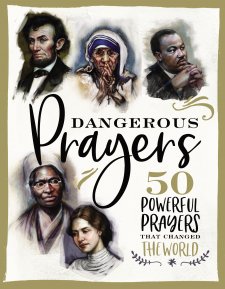
Dangerous Prayers give a brief biography of 50 culture-shifting people, and the world-changing prayers they prayed. Check out my full book review by clicking here, and then enjoy just a few of the prayers from this excellent book. 

“Listen to my supplication, Master, so that my soul doesn’t stagger under Your instruction, so that I don’t stumble in testifying to Your mercies, by which You tore me away from all my ruinous pathways. Thus You’ll grow sweet to me beyond all that led me wrong, in my willingness to follow it. Thus I’ll love You most mightily, and grasp Your hand with all the strength of my inmost being. Thus You’ll tear me away from every trial, clear to the end.” —Augustine 

“Restore me to liberty, and enable me so to live now that I may answer before Thee and before the world. Lord, whatever this day may bring, may Thy name be praised. Amen.” —Dietrich Bonhoeffer, while awaiting execution in a Nazi concentration camp 

“Give us grace, O God, to dare to do the deed which we well know cries to be done. Let us not hesitate because of ease, or the words of men’s mouths, or our own lives. Mighty causes are calling us—the freeing of women, the training of children, the putting down of hate and murder and poverty—all these and more. But they call with voices that mean work and sacrifice and death. Mercifully grant us, O God, the spirit of Esther, that we may say: ‘I will go unto the king and if I perish, I perish.’” —W.E.B. DuBois 

“Because we have need continually to crave many things at Your hands, we humbly beg You, O heavenly Father, to grant us Your Holy Spirit to direct our petitions, that they may proceed from such a fervent mind as may be agreeable to Your holy will.” —John Knox 

“O keep us, we beseech Thee, Lord, for without Thy keeping we cannot keep ourselves.” —Charles Spurgeon 

“Oh Jesus, You who suffer, grant that today and every day I may be able to see You in the person of Your sick ones and that, by offering them my care, I may serve You. Grant that, even if You are hidden under the unattractive disguise of anger, of crime, or of madness, I may recognize You and say, ‘Jesus, You who suffer, how sweet it is to serve You.’” —Mother Teresa 

“I now make it my earnest prayer, that God would have you, and the State over which you preside, in His holy protection, that He would incline the hearts of the Citizens to cultivate a spirit of subordination and obedience to Government, to entertain a brotherly affection and love for one another, for their fellow Citizens of the United States at large, and particularly for their brethren who have served in the Field, and finally, that He would most graciously be pleased to dispose us all, to do Justice, to love mercy, and to demean ourselves with that charity, humility, and pacific temper of mind, which were the Characteristics of the Divine Author of our blessed Religion, and without an humble invitation of whose example in these things, we can never hope to be a happy Nation.” —George Washington 

“God give me a deep humility, a well-guided zeal, a burning love, and a single eye, and then let men or devils do their worst.” —George Whitefield 

Dangerous Prayers (book review)

Prayer changes things. That makes prayer dangerous and the pray-ers themselves a danger to anything that opposes the kingdom of God. Dangerous Prayers is a collection of powerful prayers and a brief biography of those who prayed them. 

Growing up, a constant refrain rang in my ears from my parents whenever I faced a problem: “Have you prayed about it?” I’m not sure why we make prayer our last resort instead of our first response, but it often seems that some of the most heartfelt, passionate prayers are offered up in the darkest of times. 

Dangerous Prayers offers a short biography of some world-changing people who changed the world in large part because of their desperate dependence on God’s help, as seen in the frequent and bold prayers they prayed. Many of these prayers were prayed in dark places—prisons, before the executioner, in the midst of war, in unimaginable poverty, or staring down the evils of slavery. These men and women repeatedly turned to God, and God repeatedly strengthened them to accomplish amazing things. Some of the answers to prayer came in their lifetimes, and some prayers were only answered long after they had died. 

Dangerous Prayers is an excellent coffee table book. By that, I mean it’s a great book to leave out in the open as a conversation-starter. Parents could read these short biographies and prayers with their children, and friends could use them as a bridge from past history to current events. But more than anything, keep Dangerous Prayers close at hand will—I sincerely hope—cause you to turn to prayer frequently and boldly. 

I am a Thomas Nelson book reviewer.