Don’t despair in the middle of the Story! All of History is His Story. No matter how dark it seems, we are assured of God’s victorious outcome!
Bethlehem is our proof:
700 years before it happened, Bethlehem is named as the birthplace of Jesus (Micah 5:2; Luke 2:1-7)
700 years before Jesus was born in Bethlehem, His titles were given and then fulfilled in the way that Jesus lived (see for example Isaiah 9:6 and Hebrews 13:20)
Sometimes God has to let the darkness fall so heavy so that it seems hopeless. In fact, in human power alone it is hopeless and impossible. So God foretells His victory—
“Listen to this, you descendants of Jacob, you who are called by the name of Israel and come from the line of Judah, you who take oaths in the name of the Lord and invoke the God of Israel—but not in truth or righteousness—you who call yourselves citizens of the holy city and claim to rely on the God of Israel—the Lord Almighty is His name: I foretold the former things long ago, My mouth announced them and I made them known; then suddenly I acted, and they came to pass. … Therefore I told you these things long ago; before they happened I announced them to you so that you could not say, ‘My images brought them about; my wooden image and metal god ordained them.’” (Isaiah 48:1-5)
We have seen how Micah prophesied our Messiah coming as the Great Shepherd and as the Prince of Peace, but He also comes as our Mighty Deliverer (Micah 5:1-6). He comes at an incredibly dark time that is described like this: “He will rescue us from the Assyrians when they pour over the borders to invade our land” (Micah 5:6 NLT).
Darkness may appear to have a stranglehold even now in our time. One of the verses in the New Testament that pretty accurately sums up a Christ-less culture says, “The god of this world has blinded the unbelievers’ minds that they should not discern the truth, preventing them from seeing the illuminating light of the Gospel of the glory of Christ” (2 Corinthians 4:4 AMP) .
But this is only temporary darkness. When the mob came to arrest Jesus, He said, “This is your hour—when darkness reigns” (Luke 22:53). Darkness only gets an hour, but the Light of God shines for all of eternity!
One of my favorite Advent texts is found in Hebrews 2:14-15:
Since the children have flesh and blood, [Jesus] too shared in their humanity so that by His death He might destroy him who holds the power of death—that is, the devil—and free those who all their lives were held in slavery by their fear of death.
Our Mighty Deliverer came to destroy satan’s power and free those held hopelessly in darkness. The word “destroy” is a powerful, all-encompassing word. Imagine a tyrannical ruler who sent one of his strongest police officers with an arrest warrant, who then grabbed onto you and subdued you with his vice-like grip.
Only someone stronger than that officer can release you from that grip. That’s what Jesus did when He destroyed satan’s ironclad grip on your soul. Paul asks mockingly, “Where, O death, is your victory? Where, O death, is your sting? The sting of death is sin, and the power of sin is the law. But thanks be to God! He gives us the victory through our Lord Jesus Christ!” (1 Corinthians 15:55-57)
Now you may be free of the grip of that officer, but the arrest warrant still remains—you are still subject to the penalty. But that word “destroy” also means that the charges against you have been set aside so that there is no penalty outstanding against you. The apostle Paul again addressed this when he wrote, “For we know that our old self was crucified with [Jesus] so that the body ruled by sin might be done away with, that we should no longer be slaves to sin. … Who will bring any charge against those whom God has chosen? It is God who justifies” (Romans 6:6, 8:33).
You are now set completely and irrevocably free! “But it has now been revealed through the appearing of our Savior, Christ Jesus, who has destroyed death and has brought life and immortality to light through the gospel” (2 Timothy 1:10).
The Messiah—our Mighty Deliverer—destroys darkness and delivers those who believe in Him!
No matter how hopeless it may seem, the Mighty Deliverer always prevails! Jesus has destroyed every enemy that has opposed God’s people! Jesus our Champion shines a light so brightly that nothing in satan’s arsenal can ever diminish it.
The Light shines in the darkness, and the darkness can never extinguish it (John 1:5 NLT).
So allow me to repeat: Don’t despair in the middle of the Story! All of History is His Story. No matter how dark it seems, Bethlehem is our proof that Jesus has destroyed our enemy and removed from him all grounds for charging us with sin. Bethlehem is our proof that we can live assured of God’s victorious outcome!
Listen to the podcast of this post by clicking on the player below, and you can also subscribe on Apple, Spotify, or Audible.
Last week we saw the dark times in which Micah lived as he prophesied the advent of the Messiah. Israel was both surrounded by enemies as well as lots of practices within their borders that were heartbreaking to God. Many times, our lives can feel the same way: enemies of God all around us and our own turmoil and doubts inside our hearts and minds.
In this dark, hopeless time, the Messiah came as our Great Shepherd. Take a look at what this Shepherd brings us:
He will stand and shepherd His flock in the strength of the Lord, in the majesty of the name of the Lord His God. And they will live securely, for then His greatness will reach to the ends of the Earth. And He will be their peace. (Micah 5:4-5)
We see this idea of Jesus our Great Shepherd bringing peace to our hearts in the New Testament as well:
May the God of peace, who through the blood of the eternal covenant brought back from the dead our Lord Jesus, that Great Shepherd of the sheep, equip you with everything good for doing His will, and may He work in us what is pleasing to Him, through Jesus Christ, to Whom be glory for ever and ever. Amen. (Hebrews 13:20-21)
This peace is also implied in Psalm 23:1 when David wrote, “The Lord is my Shepherd, I shall not be in want.” That phrase “I shall not be in want” really captures the definition of peace.
The Hebrew word for peace is shalom. An easy-to-remember definition of shalom is “nothing lost, nothing missing.” Our Great Shepherd makes sure nothing is lost or missing that would cause us anxiety or doubt, so we can have total peace—we can have shalom!
Jesus said the devil’s agenda was for everything to be lost or missing—“the thief comes only to steal and kill and destroy”—but our Great Shepherd’s agenda is for there to be nothing lost or missing—“I have come that they may have life, and have it to the full” (John 10:10).
Isaiah, who was prophesying at the same time as Micah, sounded a similar note:
Therefore the Lord Himself will give you a sign: The virgin will conceive and give birth to a Son, and will call Him Immanuel. … And He will be called Wonderful Counselor, Mighty God, Everlasting Father, Prince of Peace. (Isaiah 7:14, 9:6)
When this Great Shepherd was born in Bethlehem, the shepherds in the field were the first to hear the good news. Notice what the angels announced: “Glory to God in the highest heaven, and on earth peace to those on whom His favor rests” (Luke 2:14).
Who has God’s favor? Those with faith in Him: “Without faith it is impossible to please God” (Hebrews 11:6). So those with faith in God have God’s favor.
Faith in what? In all that Jesus purchased for us by His blood shed on the Cross: “Therefore, since we have been justified through faith, we have peace with God through our Lord Jesus Christ” (Romans 5:1).
Faith comes from believing that God has made the promise of peace, that God has fulfilled the promise of peace through Jesus, and that God is bringing us to His eternal peace. So now our lives of peace in a world of turmoil can serve as a testimony to others.
Jesus called His followers to be peacemakers (Matthew 5:9) but we cannot do this while we are experiencing anxiety or doubts. To be peacemakers we must be full of peace because of our relationship with the Prince of Peace, who has ensured that nothing is lost and nothing is missing!
If you feel anxious, remember that Bethlehem is your proof that the Prince of Peace has come to remove doubts, anxiety, fear, and inner turmoil. Let every pang of anxiety be immediately a call to run to the Prince of Peace. He has paid an incalculable price to purchase your peace, so don’t leave this gift unopened and unused. A dark, anxious world is looking for peace. Know the author of shalom so that you can introduce others to this Prince of Peace.
During the Advent seasons of 2014-2019, I shared a series of messages called The Carols Of Christmas. I was concerned at how many “old familiar carols” we hear so often Christmas after Christmas until the words have almost lost their meaning. If we’re not careful, any song repeated too often can lose the richness of its original intent. And so we went on a journey to (re)discover the beautiful Advent messages in these old familiar carols.
To make it a little more convenient, I wanted to group all of the messages here for you. In the list below you will find both the title I gave to my message and the title of the Christmas carol in italics.
Listen to the podcast of this post by clicking on the player below, and you can also subscribe on Apple, Spotify, or Audible.
God delights to show up when the situation seems hopeless from any human standpoint. When He does what no one else can do, He alone is glorified!
A very notable dark time took place in Israel about 700 BC as the nation was surrounded by enemies. Micah prophesied the arrival of the Messiah. But he also prophesied that before He came, there would be dark days. He talks about the siege of enemies surrounding them, Israel’s ruler being stuck on the cheek with a rod, not to mention the strongholds, witchcraft, and idolatry that plagued the nation within its own borders (Micah 5:1, 11-13).
But whenever it seems darkest, God is not the least diminished! He always gets the final word, the decisive word, the best word.
So into this inky darkness, Micah prophesies a ray of light—“But you, Bethlehem Ephrathah, though you are small among the clans of Judah, out of you will come for Me One who will be Ruler over Israel, whose origins are from of old, from ancient times” (Micah 5:2).
I’m sure many people thought that Bethlehem was too small of a village for anyone of significance to be born there.
The Last Battle is the final book in C.S. Lewis’ Narnia series. This story also portrays a similar dark time. Shift the ape has convinced Puzzle the donkey to wear an ill-fitting lion skin to pretend to be the great king Aslan. Through tricks, sleight of hand, deception, and the plans of some evil schemers, many of the Narnians come to believe that Puzzle is Aslan. But it’s confusing because this “Aslan” is not the kind, strong king they believed in, so many begin to just look out for themselves.
In a fitting setting, Puzzle is being hidden inside an old stable. A great battle takes place with the true Narnians ending up inside the stable, and yet once inside they discover not a dark stable, but a sunlit land spreading farther than their eyes can see. Lord Digory observes, “Its inside is bigger than its outside.”
But I love this line from Queen Lucy, “In our world too a stable once had something inside it that was bigger than our whole world.”
Inside that Bethlehem stable was born the Great Shepherd! Who was inside that stable and what He would accomplish became so much grander and more beautiful than any human had ever imagined!
Jesus is our Great Shepherd—He will stand and shepherd His flock in the strength of the Lord, in the majesty of the name of the Lord His God. And they will live securely, for then His greatness will reach to the ends of the earth (Micah 5:4).
Jesus is strong, majestic, and great (John 10:10-15).
Jesus equips us to be victorious (Hebrews 13:20-21).
Jesus walks with us every step of the way (Psalm 23:1-6).
And Jesus takes us Home to be with Him forever (1 Peter 5:4).
Our faith is not rooted in some mysterious thing with an uncertain history. It is a faith rooted in real historical events. The Great Shepherd being born in the town that was prophesied 700 years beforehand is one more proof that God is in control, that God loves you, and that God always gets the final word, the decisive word, the best word!
The prophet Micah foretells that the Messiah will arrive in dark times. Enemies will surround Israel, and Israel’s ruler will receive a nasty punch to the jaw. Demonic strongholds, witchcraft, and idolatry will appear to be gaining the upper hand.
And then Micah turns his attention to a small village just south of Jerusalem—a village so small that it is often overlooked—a village from which no one would expect Israel’s Deliverer.
And yet, Micah writes, “But you, Bethlehem Ephrathah, though you are small among the clans of Judah, out of you will come for Me One who will be Ruler over Israel, Whose origins are from of old, from ancient times” (Micah 5:2).
Jesus the Deliverer was born in the little town of Bethlehem, and His birth there 700 years after Micah foretold it is our proof that God always gets the last word, the decisive word, and the best word!
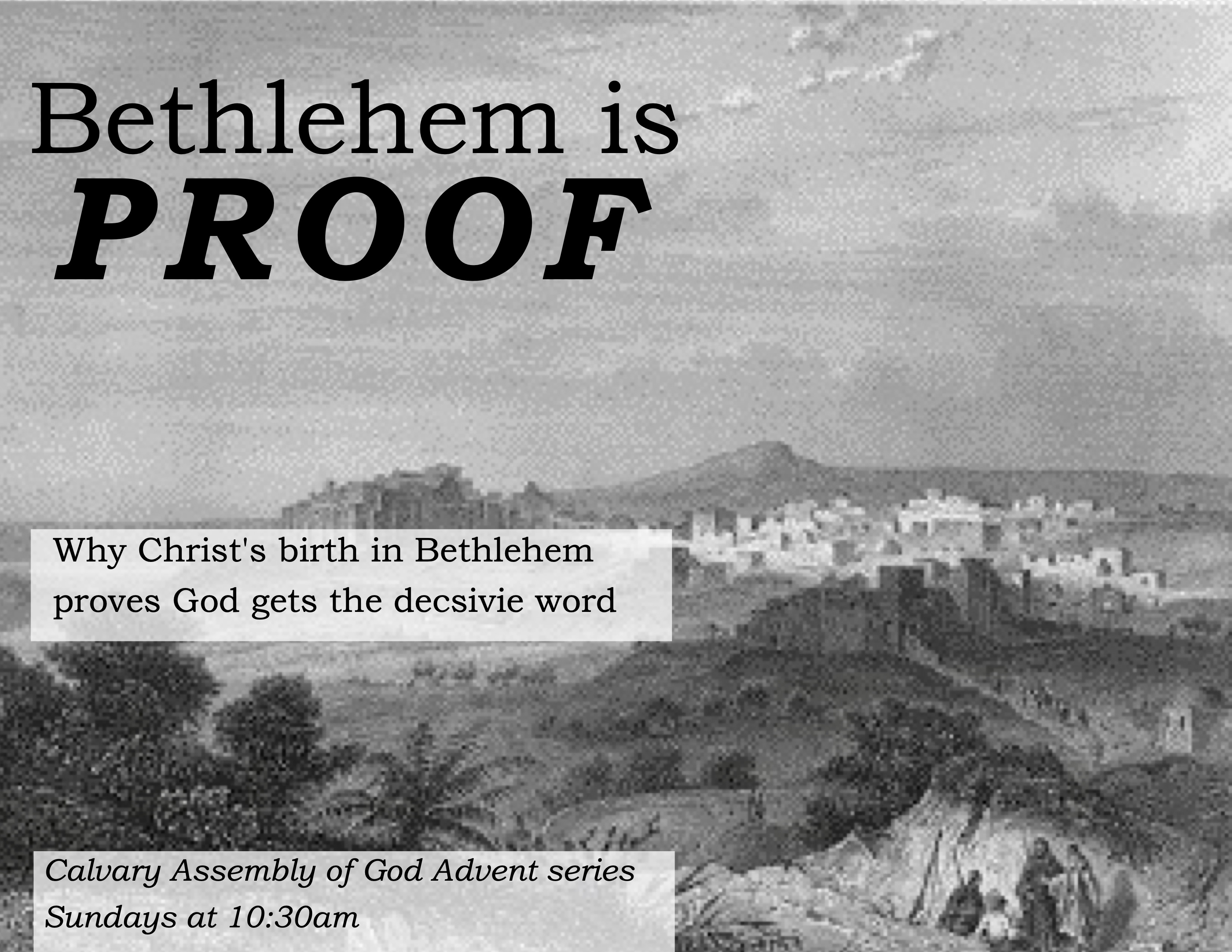
Please join me this Sunday for our Advent series Bethlehem Is Proof! I would love to have you join me in person, but you can also watch the sermons on Facebook or YouTube.
If you’ve missed any of the messages in this series, check them out here:
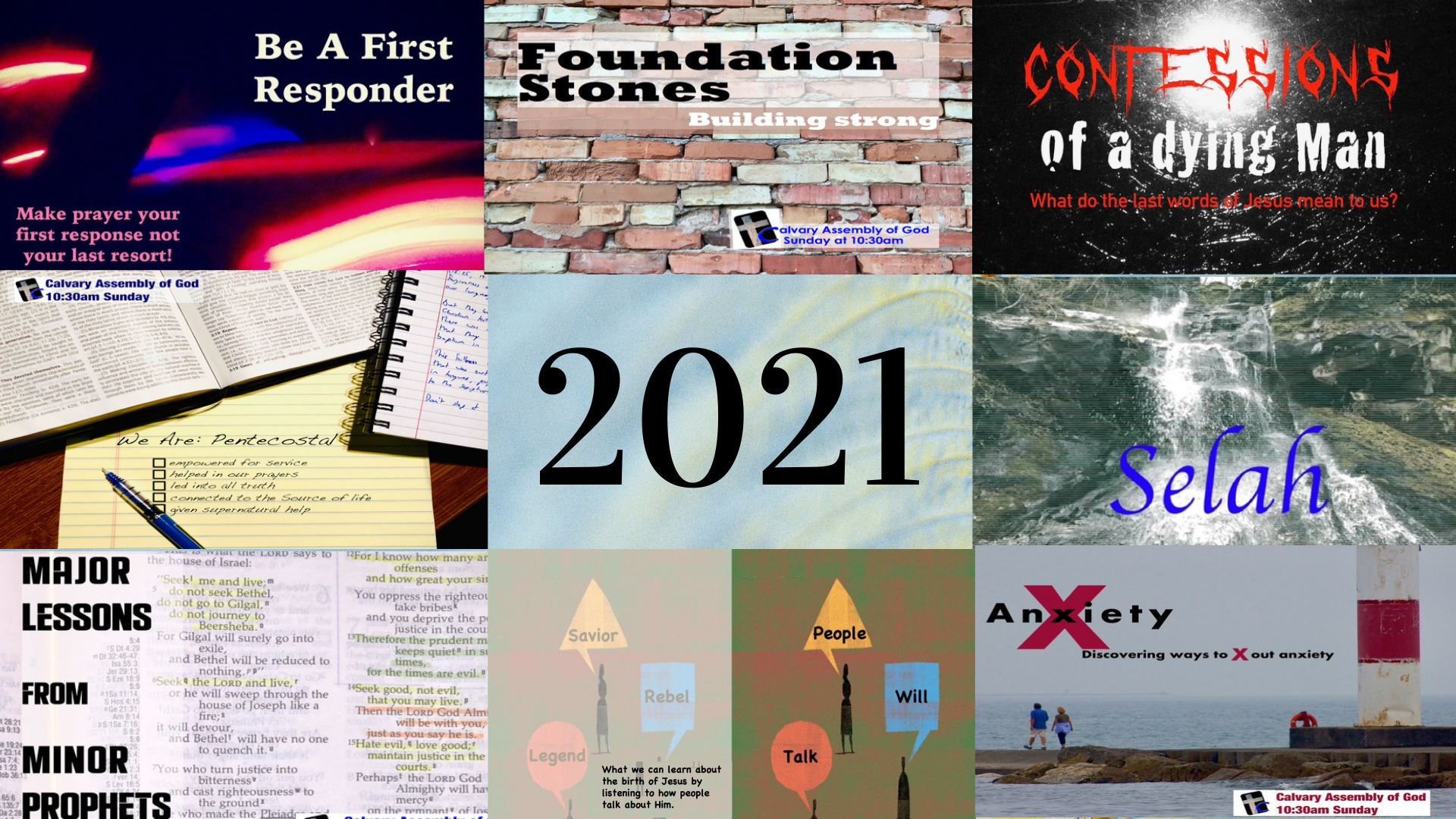
So here are all of the sermon series that I shared in 2021. Clicking on each series title will take you to a list of all of the sermons in that series.
Foundation Stones—Any architect will tell you: You can’t build a great building on a weak foundation. This is just as true in the spiritual realm, which is why John Calvin warned, “Those who are strong only in fervor and sharpness, but are not fortified with solid doctrine, weary themselves in their vigorous efforts, make a great noise…[and] make no headway because they build without foundation.” We have had on the Calvary website since Day 1 a link to “What we believe,” but more than just having them listed there, it is important to discuss them.
Be A First Responder—There is a line in an old hymn that convicts me every time I sing it: “Oh, what peace we often forfeit; Oh, what needless pain we bear all because we do not carry everything to God in prayer.” Why are we so slow to drop to our knees in prayer when trouble strikes? It seems we fool ourselves into thinking the problem is small enough to handle on our own, or we think God isn’t concerned with something that may seem trivial, or we’ve been-here-done-this before and know the way to go. But this isn’t what our Heavenly Father desires; instead, He wants us to come to Him before we try anything else. Instead of making prayer our last resort, why don’t we strive to make it our first response!
Confessions Of A Dying Man—In our justice system, rarely will a judge allow hearsay testimony to be introduced in court. But there is one notable exception: a dying declaration. A dying declaration is the statement of a mortally injured person who is aware he or she is about to die. This statement is admissible testimony in court on the theory that a dying person has no reason not to tell the truth. Jesus was nailed to a Cross. Mortally injured, unable to escape, He had no reason to lie. In His dying moments, struggling to get enough air in His lungs to be able to speak, Jesus choked out seven statements that still have a profound impact on us today.
We Are: Pentecostal—Pentecost for over 1500 years was a celebration in Jerusalem that brought in Jews from all over the world. But on the Day of Pentecost that came just ten days after Jesus ascended back into heaven, the meaning of Pentecost was forever changed! Followers of Jesus—now empowered by an infilling of the Holy Spirit—began to take the good news of Jesus all over the world. These Spirit-filled Christians preached the Gospel and won converts to Christ even among hostile crowds, performed miracles and wonders, stood up to pagan priests and persecuting governmental leaders, and established a whole new way of living as Christ-followers. We, too, can be Pentecostal followers of Jesus Christ today.
Selah—The word Selah appears nearly 70 times in the Bible, almost exclusively in the Psalms. Although it is primarily a musical term, it applies beautifully to our summer series. It means a pause. Throughout the Psalms, Selah appears at the end of a verse, at the end of the psalm, or sometimes even mid-sentence. But each one of them is perfectly placed by the Spirit-inspired authors to get us to take a breath and deeply contemplate what we just read or sang.
Major Lessons From Minor Prophets—Sometimes the naming of things gives us an inaccurate picture of the thing being named. For instance, many people think the “old” in Old Testament means outdated or perhaps updated by the “new” in the New Testament. When in fact, both Testaments are needed to give us the full picture of God’s love and glory. A similar thing happens with the headings “major prophets” and “minor prophets.” It makes it sound like the major prophets have something major to say to us, while we could take or leave the minor messages of the minor prophets. In reality, they were given these headings simply because of the volume of writing—the five major prophets consist of 182 chapters, whereas the 12 minor prophets only have 67 chapters. The volume of their writing may be minor, but their content carries major messages of meteoric power!
X-ing Out Anxiety—Two brothers—one a doctor and one a pastor—addressed the prevalence of anxiety in our culture. They wrote, “A recent survey of primary care physicians in the United States revealed that at least one-third of office visits were prompted by some form of anxiety.” Anxiety can negatively impact our relationships, our ability to think creatively, our physical health, and even our relationship with God. Thankfully, one of the titles given to Jesus is The Prince of Peace. Join us for this freeing series called X-ing Out Anxiety, where we will be learning what God’s Word says about getting free from the anxiety that is robbing us of life, and replacing that anxiety with His peace.
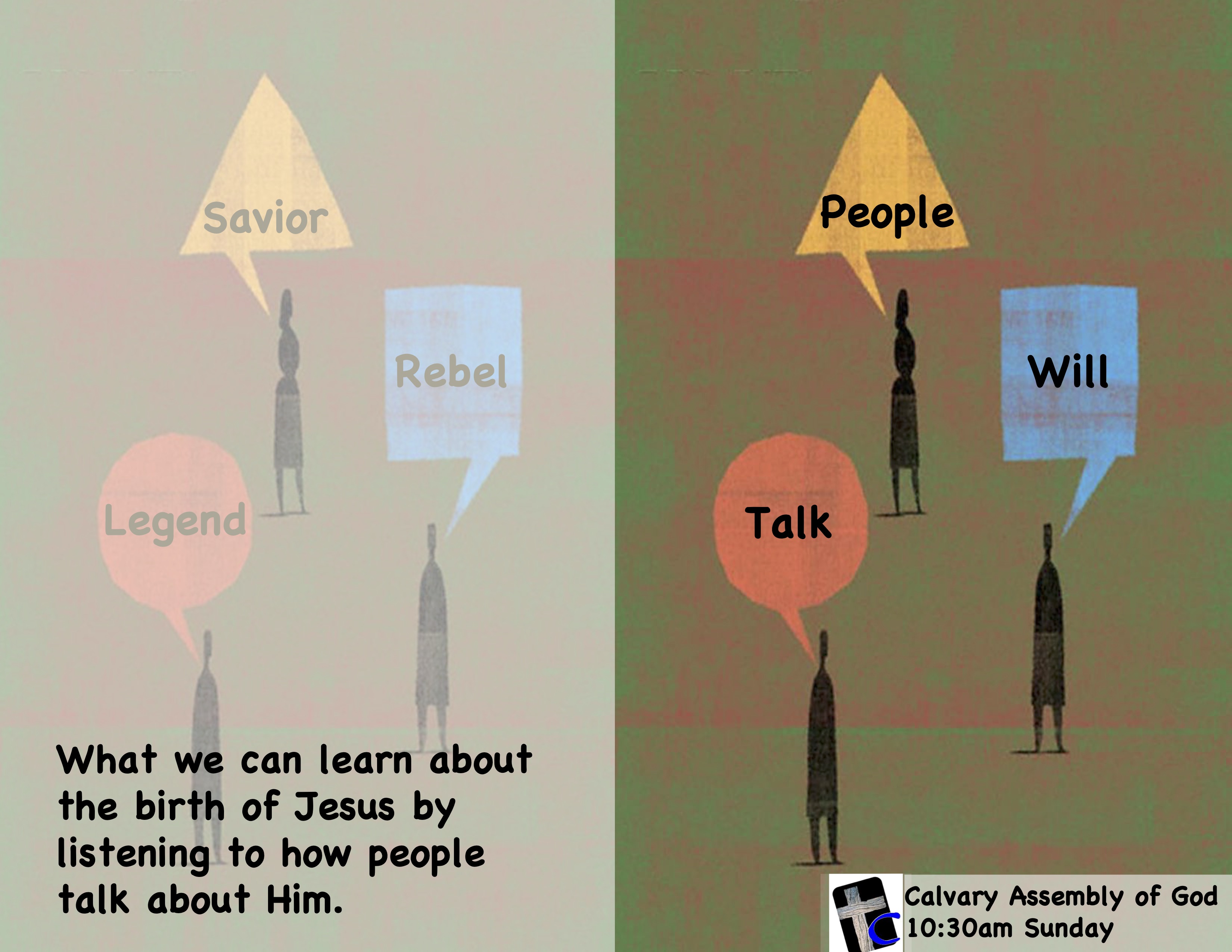
People Will Talk—Sometimes celebrities and other people in the public spotlight will hire a publicist to help promote their cause, build their brand, or present them in the best possible light. If you wanted to stretch the terms, you could say that some of the Old Testament prophets and the New Testament disciples could have been viewed as the “publicists” for Jesus. At least, that’s what critics might point to. But despite the best efforts and high salaries of publicists—both ancient and modern—they cannot control the “word on the street.” What people are actually saying about the one in the spotlight is usually the best evidence of who that person truly is. As we celebrate this Advent season, we are going to look at what the people on the street were saying about Jesus at the time of His birth. Before He ever performed a miracle or presented a parable—before any of His “publicists” could try to make Him look good—people were already talking. And what they said about Him is truly enlightening.
We will be returning to a couple of these series in 2022, and we’ll be launching some brand new ones as well. In either case, if you don’t have a home church in the northern Kent County area, I would love to have you join us!
Listen to the podcast of this post by clicking on the player below, and you can also subscribe on Apple, Spotify, or Audible.
What people were saying about Jesus right from His birth—before He preached a sermon, performed a miracle, or stepped on the toes of religious or political leaders—was revealing the truth.
Daniel served under multiple kings, even as the regimes changed from Babylonian, to Median, to Persian. He never waiver in his adherence to the Truth that God had spoken. He fearlessly told these world leaders, “The Most High is sovereign over all kingdoms on earth and gives them to anyone He wishes” (Daniel 4:25).
Most leaders forget this the moment they obtain power. Such is the case of the man the Magi met: King Herod the Great. Listen to how William Barclay describes this monarch:
“Herod the Great was always despised by the pure-blooded Jews because he was half an Edomite; and we can see the importance that even Herod attached to these genealogies from the fact that he had the official registers destroyed, so that no one could prove a purer pedigree than his own. …
“He had made himself useful to the Romans in the wars and civil wars of Palestine, and they trusted him. He had been appointed governor in 47 B.C.; in 40 B.C. he had received the title of king. …
“But Herod had one terrible flaw in his character. He was almost insanely suspicious. He had always been suspicious, and the older he became the more suspicious he grew, until, in his old age, he was, as someone said, ‘a murderous old man.’ … He murdered his wife Mariamne and her mother Alexandra. His eldest son, Antipater, and two other sons, Alexander and Aristobulus, were all assassinated by him. Augustus, the Roman Emperor, had said, bitterly, that it was safer to be Herod’s pig than Herod’s son. …
“When he was seventy he knew that he must die. … He gave orders that a collection of the most distinguished citizens of Jerusalem should be arrested on trumped-up charges and imprisoned. And he ordered that the moment he died, they should all be killed. He said grimly that he was well aware that no one would mourn for his death, and that he was determined that some tears should be shed when he died.”
Lord Acton famously said, “Power tends to corrupt and absolute power corrupts absolutely. …Despotic power is always accompanied by corruption of morality.” This is so obvious in Herod! So we can understand why the city of Jerusalem was disturbed when the Magi arrived! Whether Herod knew the prophecy of the coming Messiah or not, it’s inescapably true that his days and his legacy were numbered (see Isaiah 9:2-7).
When King Herod heard the announcement from the Magi, his reaction was violent. Perhaps Herod lashed out so ferociously because these words of Truth from the Magi reminded him his end was near, his power was not absolute, he had to answer to The Most High who is sovereign over all.
We are no better. Oswald Chambers defines sin as “my claim to my right to myself.” We want absolute sovereignty over ourselves, but Jesus will allow no rival to His throne! He is either King over all or else He is not King at all.
Beware of your own reaction when the Holy Spirit convicts you of a rival to Christ’s throne in your heart. If you lash out like Herod, dismiss it, or try to justify it, that is proof that you needed to hear that word of Truth. Don’t delay: Repent and allow Christ to have His rightful throne.
Jesus came as a Baby and a Savior at his First Advent. He opened the way for us to enter the presence of The Most High God, but it will cost us something to enter. Oswald Chambers tells us:
“Redemption is easy to experience because it cost God everything, and if I am going to be regenerated it is going to cost me something. I have to give up my right to myself. I have deliberately to accept into myself something that will fight for all it is worth, something that will war against the desires of the flesh, and that will ask me to go into identification with the death of Jesus Christ, and these things produce a struggle in me.”
Christ’s Second Advent will be as the conquering King and righteous Judge of all humanity. We have precious little time to tell others the good news. People may react violently like Herod did, but that is simply proof that they needed to hear that Truth.
Sometimes celebrities and other people in the public spotlight will hire a publicist to help promote their cause, build their brand, or present them in the best possible light.
If you wanted to stretch the terms, you could say that some of the Old Testament prophets and the New Testament disciples could have been viewed as the “publicists” for Jesus. At least, that’s what critics might point to.
But despite the best efforts and high salaries of publicists—both ancient and modern—they cannot control the “word on the street.” What people are actually saying about the one in the spotlight is usually the best evidence of who that person truly is.
As we celebrate this Advent season, we are going to look at what the people on the street were saying about Jesus at the time of His birth. Before He ever performed a miracle or presented a parable—before any of His “publicists” could try to make Him look good—people were already talking. And what they said about Him is truly enlightening.
I hope you can join me each Sunday in December as we walk through this series of messages called People Will Talk. If you’ve missed any of the messages in this series, check them out here:
Listen to the podcast of this post by clicking on the player below, and you can also subscribe on Apple, Spotify, or Audible.
Zechariah pronounces more messianic prophecies than any other biblical writer, with the exception of Isaiah (and he wrote 66 chapters!). These prophecies are fulfilled in Christ’s First Advent, and promised for His Second Advent. Check these out for yourself…
(All of the biblical references for the above chart can be viewed by clicking here.)
Why is it so vital that Jesus fulfilled these prophecies?
(1) The historicity of these fulfilled prophecies gives us a confidence for the future.
These fulfilled prophecies assure us that God is sovereign over all history. There are no accidents, and God needs no help from anyone else in fulfilling what He has promised. As a result, no world event—no matter how big it may seem—should be able to rattle us!
(2) The authenticity of what God has done gives us boldness for today.
When God does the miraculous, He authenticates His Word. This authenticity has always made God’s people stand out (see Genesis 41:39). It’s also why people recognized Jesus as the divine Son of God (John 3:2; 9:30-33). So we can live with the boldness to know that what God says He will do, He will do!
(3) The exclusivity of God’s promises and fulfillment of those promises gives us joy for our testimony.
Only Jesus could have done all of this (Luke 24:26-27, 44), so only Jesus can fulfill what is still remaining to be fulfilled! We can have supreme joy in knowing that only Jesus is our hope of salvation (John 14:6; Acts 4:12).
It’s vital that we know this is true so that we can live confident, bold, and joyful!Our confident boldness and our bold joy both glorify God and attract seekers to Him.