Honoring Friends And “Enemies”

Listen to the podcast of this post by clicking on the player below, and you can also subscribe on AppleSpotify, or Audible.

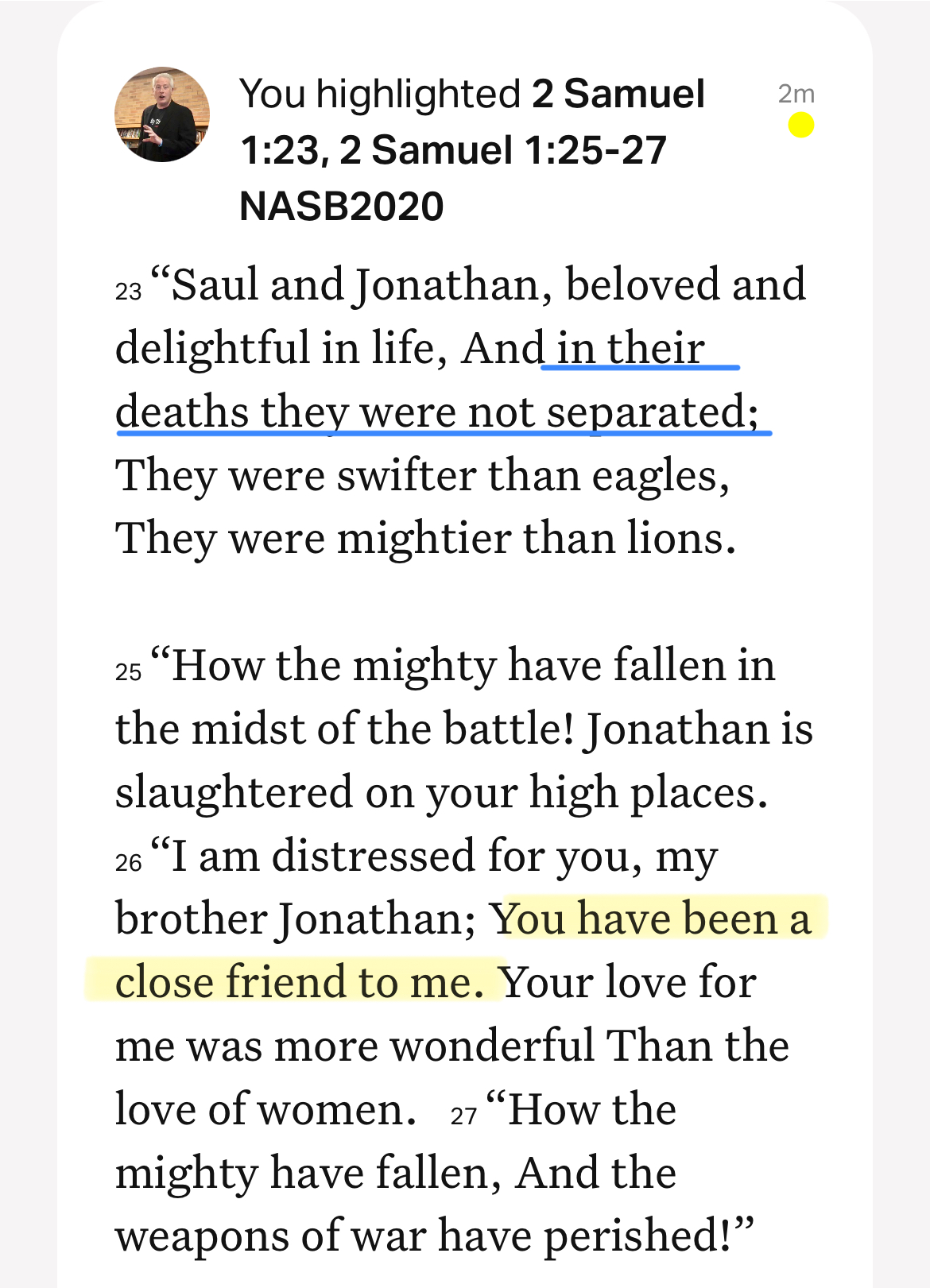
Saul and Jonathan, beloved and delightful in life, and in their deaths they were not separated; they were swifter than eagles, they were mightier than lions. Daughters of Israel, weep over Saul, who clothed you in scarlet, with jewelry, who put gold jewelry on your apparel. How the mighty have fallen in the midst of the battle! Jonathan is slaughtered on your high places. I am distressed for you, my brother Jonathan; you have been a close friend to me. Your love for me was more wonderful than the love of women. How the mighty have fallen, and the weapons of war have perished! (2 Samuel 1:23-27)

It’s not surprising that David honored his friend Jonathan in song after his death. But it is surprising that Jonathan remained faithfully at his father’s side, fulfilling his duties as a son and a prince of Israel, although he did not agree with his father’s treatment of David. 

In Jonathan we see the obedience to the fifth commandment: Honor your father and mother (Exodus 20:12). 

And it is also surprising that David says nothing bad about Saul in this song of lament, but only praises him for his valiant victories as Israel’s king. 

In David we see a true picture of forgiveness—where a forgiven transgression is a forgotten transgression, no longer held by David against his tormentor. Later in his life, David would write about the mind-blowing truth that God obliterates the record of our forgiven sins, never bringing them up again (Psalm 103:10-12)! 

Is it any wonder that David and Jonathan became and remained such close friends? From the moment Jonathan first heard David speaking about his trust in God, they became “one in spirit” and forged a covenant friendship that lasted even beyond Jonathan’s life (1 Samuel 18:1-4). 

May we learn from these two God-fearing, faithful friends what it really means to honor others, whether we call them friends or others might call them “enemies.” 

You may also be interested in a related blog post: How to pray when you’ve been stabbed in the back. 

In my book When Sheep Bite I have a chapter called “When the sheep slander you.” In that chapter, I dive deeper into the lesson leaders can learn from how David treated Saul both during his life and after his death. 

►► Would you please prayerfully consider supporting this ministry? My Patreon supporters get behind-the-scenes access to exclusive materials. ◀︎◀︎
What’s In A Name?

Listen to the podcast of this post by clicking on the player below, and you can also subscribe on AppleSpotify, or Audible.

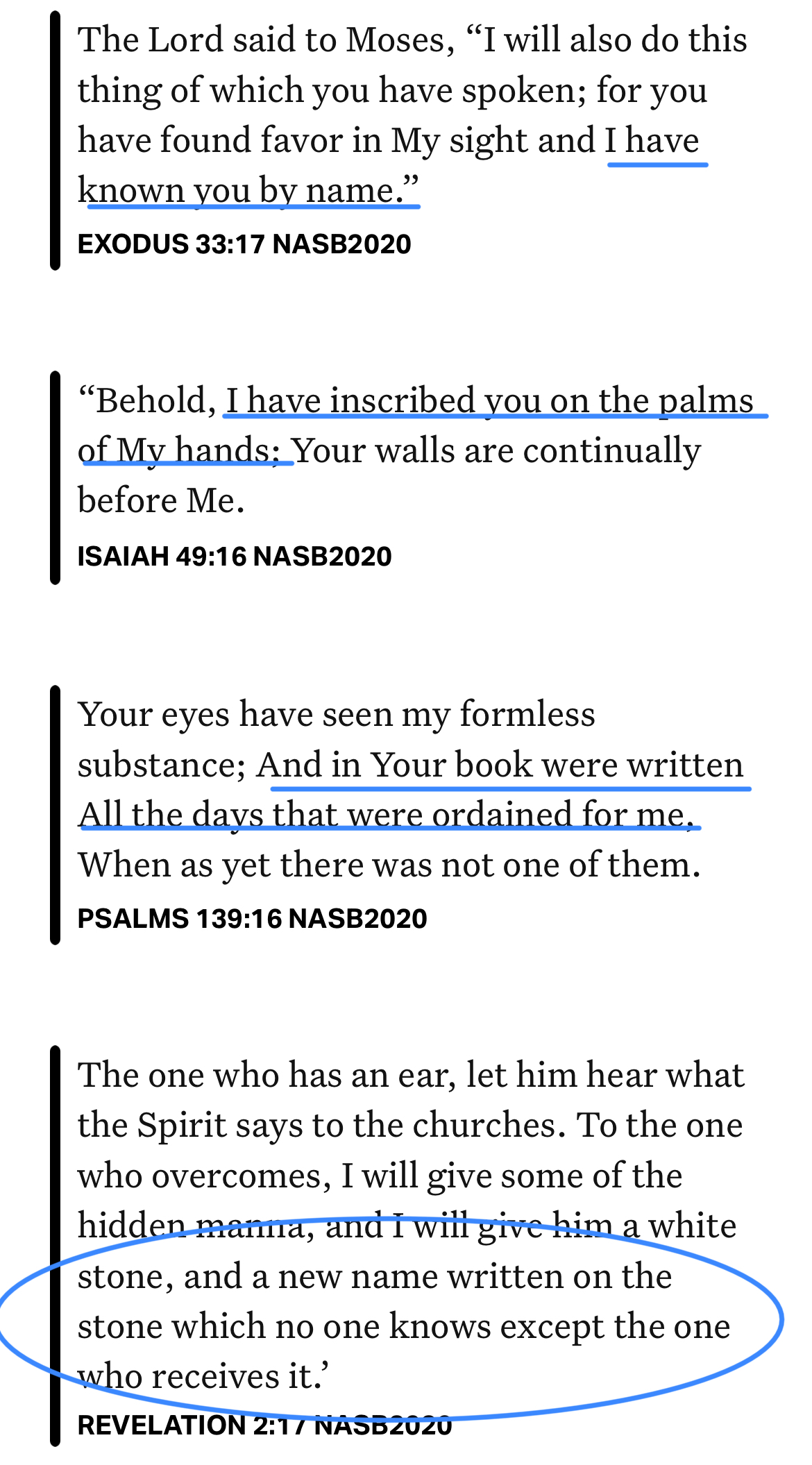
And the Lord said to Moses, “I will do the very thing you have asked, because I am pleased with you and I know you by name.” (Exodus 33:17)

When we use someone’s name properly, our message gets through all of the other noise. That’s why misusing someone’s name or using their name in a hurtful way is so painful. 

Names convey character traits, honoring of the past, and hopes for the future. God knows all of our days and how our name will be remembered at each pivotal moment of our lives (Psalm 139:16). Our names are lovingly tattooed on His hands so He always sees them (Isaiah 49:16).  

God not only knows and uses the name our parents have given us, but He has a name for each of us that only He knows. When we get to Heaven, He will reveal to each of us the unique name He has for us (Revelation 2:17). 

You don’t have to try to make a name for yourself—let God do that for you!

►► Would you please prayerfully consider supporting this ministry? My Patreon supporters get behind-the-scenes access to exclusive materials. ◀︎◀︎
Takin’ Him To Hollywood Boulevard

Listen to the podcast of this post by clicking on the player below, and you can also subscribe on AppleSpotify, or Audible. 

Jesus sent us and the Holy Spirit empowers us to take the Good News to all nations—all the streets (Luke 24:47-49; Acts 1:8)—even the streets of Samaria where we will have more differences than similarities. 

There is one street that has infiltrated and affected every other street more profoundly than any other: Hollywood Boulevard. The constant bombardment of messages through movies, television programs, music, literature, and the arts is almost immeasurable. 

I think Christians rarely stop to ponder how much of the culture on Main Street is influenced by the content from Hollywood Boulevard. Probably because so few Christians are involved in the artistic or creative communities.  

Here’s what we need to remember: All of this creativity is God-given. The opening words in the Bible say, “In the beginning God created…” (Genesis 1:1). 

We specific examples of God-given creative skills in:

  • Bezalel—Exodus 31:1-5 
  • Oholiab—Exodus 31:6, 35:34 
  • craftsmen and craftswomen—Exodus 31:6; 35:10, 22, 25 
  • Huram—1 Kings 7:13-14 
  • food administrators—Acts 6:3 
  • Tabitha—Acts 9:36-39 

(You can check out all of the Scriptures mentioned in this post here.) 

In more modern times, we see notable creative people giving credit to God for their abilities. 

  • William Shakespeare’s use of biblical themes—and even exact phrases—throughout his work is easy to spot. In the opening line of his last will and testament, he wrote, “I commend my soul into the hands of God my Creator, believing through the merits of Jesus Christ, my Savior, to be made a partaker of life everlasting.” 
  • Johan Sebastian Bach, considered by many to be the greatest composer to ever live, placed “S.D.G.” on every one of his musical compositions, which stands for Sola Deo Gloria: only for the glory of God. 

The apostle James tells us that every good and beautiful gift has come to us from God our Creator (James 1:17). And then this is my paraphrase of a similar thought the apostle Peter—

Each of you should use whatever gift you have received to serve others, as faithful stewards of God’s grace in its various forms. If anyone speaks [writes, paints, composes, sculpts], they should do so as one who speaks [writes, paints, composes, sculpts] the very words of God. (1 Peter 4:10-11)

So, here are four thoughts about how we can take the Good News of Jesus to Hollywood Boulevard. 

  1. Create a beautiful culture in your home, your Main Street, your workplace, your school. Ask the Holy Spirit to help you answer the question, “What can I do so that the love and beauty of Jesus will be felt here?” 
  1. Use your creative skills—write poems, compose music, paint a picture, sew clothing, bring innovation to your job.
  1. Support beautiful authors, musicians, moviemakers, painters, etc. Hollywood produces what they think will make money, so if you are supporting creators of beautiful things, they will produce more of those things. 
  1. Leverage Hollywood’s culture to talk to others about heavenly culture. Point out biblical themes, challenge the rationale behind unbiblical lyrics, etc.  

“Christians need to ask themselves a few key questions to help us respond to the society around us. First, what is good in our culture that we can promote, protect, and celebrate? Second, what’s missing in our culture that we can creatively contribute? Third, what’s evil in our culture that we can stop? And fourth, what’s broken in our culture that we can restore?” —John Stonestreet 

Don’t complain—create something better. 

Don’t compromise—promote what is beautiful and edifying. 

The Holy Spirit can empower us to take the Good News of Jesus even to Hollywood Boulevard! 

If you’ve missed any of the other messages in our series Takin’ Him to the Streets, you can find them all here. 

►► Would you please prayerfully consider supporting this ministry? My Patreon supporters get behind-the-scenes access to exclusive materials. ◀︎◀︎

Takin’ Him To Easy Street And Skid Row

Listen to the podcast of this post by clicking on the player below, and you can also subscribe on AppleSpotify, or Audible. 

Jesus sent us and the Holy Spirit empowers us to take the Good News to all nations—all the streets (Luke 24:47-49; Acts 1:8). As we move away from Jerusalem and into Judea, we should expect to see more differences with our audience. And then as we move into Samaria, there will probably be more differences than similarities. Regardless of how little we may have in common with those on other streets, the Holy Spirit still empowers us to witness there. 

(You can find all of the Scriptures I reference in this post by clicking here.) 

When we don’t live on someone else’s street, we tend to make some pretty big assumptions about them. For example, until I married a school teacher, I thought, “How nice it must be to be done with work by 3:00 every afternoon and have three months off in the summer!” 

Mistakenly, we think we can so easily fix the problems people on other streets have—we think we can show them how simple it is to correct anything out of balance on their street. These are natural thought patterns when so little of our circles overlap.

If you live on Main Street, two streets which are quite different from you are Easy Street and Skid Row. When it comes to finances, there tends to be extremes in our thoughts about the Samaritans that live on those streets—

  • Those on Easy Street only cares about themselves
  • Those on Skid Row should work harder 
  • Those on Easy Street have too much—it’s not fair! 
  • Those on Skip Row don’t have enough—it’s not fair! 

But here’s the thing: It’s really not about the money but it’s about our attitude about the money. 

In Luke 21:1-6, Jesus saw both rich people from Easy Street placing their tithe in the temple treasury, and a poor widow from Skid Row doing the same. Jesus said this widow put in more than anyone else. He was talking in terms of quality, not quantity. 

While they were still in the temple, the disciples pointed out how beautifully embellished the temple was. These decorations came from the money those on Easy Street had contributed. Jesus told them not to focus on the temporal temple but on the eternal Kingdom of God.  

As I said, Jesus doesn’t have a problem with money, but He does warn us about our ungodly attitude toward money (Luke 8:1-3; Matthew 27:57; Acts 4:32-5:4; Exodus 20:17; Luke 12:13-22).  

Even though Easy Street and Skid Row seem to be at opposite ends of the spectrum, I think we are effective witnesses for Jesus on these streets in exactly the same way. 

(1) Guard your attitude about money. Remember that Gad often provides for us by giving us a skill, and then making a job available that can use our skill. So let’s be thankful for our God-given jobs. Then we guard our attitude about money by tithing regularly, and making sure that when we bless others financially, we do it without expecting any fanfare (Colossians 3:23; Malachi 3:10; Matthew 6:2-3). 

(2) Let God be unique as unique with these folks on Easy Street and Skid Row as He is with you on Main Street. Don’t try to be someone else, and don’t expect others to be you—simply obey what God has spoken to your heart, just as you allow others to obey what God has spoken to their hearts. 

(3) Don’t tell, but show how you use the resources God has given to you. It’s not our place to “preach” to others about how they should or shouldn’t be handling their finances, but simply live out the biblical principles outlined above, and let your life show your godly attitude. 

(4) Always turn the focus to the eternal. Just as Jesus did with His disciples in the temple, He always reminded people that this world with its perks or tragedies is only temporary. What ultimately matters is where we will spend eternity (Luke 13:1-5). 

Money is always a touchy subject with people, so let’s make sure we have our own attitude aligned with Scripture before we try to bring the subject up with others. 

If you’ve missed any of the other messages in our Takin’ Him To The Street series, you can find them all here. 

►► Would you please prayerfully consider supporting this ministry? My Patreon supporters get behind-the-scenes access to exclusive materials. ◀︎◀︎

What To Do With Complainers

Listen to the podcast of this post by clicking on the player below, and you can also subscribe on AppleSpotify, or Audible. 

As Christians, how are we supposed to handle those who complain about Christianity or things in the Bible? 

Check out this episode of The Podcast.

Some resources from this episode:

Here are a bunch of ways to get in touch with me and follow along with other projects on which I am involved

►► Would you please prayerfully consider supporting this ministry? My Patreon supporters get behind-the-scenes access to exclusive materials. ◀︎◀︎

The Danger In Plenty

Listen to the podcast of this post by clicking on the player below, and you can also subscribe on AppleSpotify, or Audible. 

Jesus is teaching us to pray as citizens of the Kingdom of Heaven, and each phrase of this prayer is a reminder of how we interact with the King of Heaven—Our Father in Heaven, hallowed be Your name. Your Kingdom come, Your will be done on earth as it is in Heaven.  

We all have a desire to feel secure—to feel our needs are going to be met. In fact, our anxiety level is usually tied directly to how insecure we may feel. The problem for many of us, however, is that we have mistaken wants for needs, and when those aren’t met as we think they should be, we again experience increasing levels of anxiety. 

We see this on full display in Luke 12. First, Jesus addresses a man who is greedily desiring his share of his father’s inheritance. Jesus says, “Life does not consist in an abundance of possessions.” 

To illustrate this point, Jesus tells a parable of a rich landowner who harvested more crops than he knew what to do with—a harvest which he calls “plenty.” His solution was to build bigger barns for his abundant harvest, to which God announced, “You fool” (Luke 12:13-21). 

This man was not called a fool because he was successful. He was not called a fool because he had plenty. Rather, he was called a fool because his “plenty” caused him to forget his heavenly Father.   

This is an invaluable lesson. Sadly, we tend to be a very forgetful people! 

After God delivered His people from their bondage in Egypt, and they almost immediately start worrying and then complaining about whether their needs will be supplied. God tells them that He will supply every day exactly what they need (Exodus 16:1-35). 

This provision of manna every single morning when they got up was intended to keep them reliant on God and thankful for His provision. But after a while they thought they deserved more—they wanted plenty (Numbers 11:4-6). Later on, Asaph would pinpoints the main culprit of the Israelites’ stumbled throughout their history: forgetfulness (Psalm 78:11, 22-25). 

Jesus taught us to come to God in prayer as Our Father. Just as Jesus was daily dependent on His Father, so He teaches us to have that same level of daily abiding. 

Jesus reminds us what the daily supply of manna really signified; namely, that He would be our Bread from Heaven for all of eternity (John 6:28-40)! 

So that’s why we pray, “Give us today our daily bread.” Once again, this is an acknowledgement that no one else can provide for us, and it is a request that we would stay daily dependent on Him. It’s not, “Give us today our weekly bread.” Or, “Give us today our daily wants.” Or even, “Give us today plenty of things.” 

We need our Father for daily bread so that we never, ever forget or vital, indispensable connection to Him!  

Even when we don’t have plenty, we are told not to worry but instead to look to our Heavenly Father for His daily supply (Luke 12:22; Philippians 4:6-7).

If you’ve missed any of the other messages in this series on prayer, you can check them all out here. 

►► Would you please prayerfully consider supporting this ministry? My Patreon supporters get behind-the-scenes access to exclusive materials. Like some exclusive quotes from a book I just reviewed. ◀︎◀︎

The King Of Glory

Listen to the podcast of this post by clicking on the player below, and you can also subscribe on AppleSpotify, or Audible. 

I did a series of Advent messages a few years ago called “The Carols of Christmas” with the premise that many of our old familiar carols had become too familiar and we had lost the true meaning in those beautiful songs. 

I think the same is true with the sentiment of wanting to experience the glory of God. Sometimes you will hear people say, “We just want to see God’s glory!” but I’m not sure they really mean this or really want it. 

Throughout the Bible, “glory” comes from the Hebrew word which means weightiness. When God appears—or even one of His angels glowing with His glorious presence—people collapse under the weight of His glory. Look at the examples of Moses, Isaiah, Daniel, and even John the beloved disciple of Jesus (Exodus 3:6; Isaiah 6:3-5; Daniel 8:15-17; Revelation 1:12-17). 

In the light of Christ’s glory everything is exposed. We have no excuses for our sin. We are seen exactly as we are, and the fear of God’s judgment causes us to collapse under that weight. 

But the First Advent story is filled with the phrase “Fear not.” Let me show you two examples. First, notice the strong emotions when the angels appear to the shepherds— 

An angel of the Lord appeared to them, and the glory of the Lord shone around them, and they were terrified. But the angel said to them, “Do not be afraid. I bring you good news that will cause great joy for all the people.” (Luke 2:9-10)

What was this good news that would turn their fear into joy? Listen to the angelic message to Joseph—

Joseph son of David, do not be afraid to take Mary home as your wife, because what is conceived in her is from the Holy Spirit. She will give birth to a Son, and you are to give Him the name Jesus, because He will save His people from their sins. (Matthew 1:20-21) 

Notice the phrase, “HE will save His people from their sins.” Part of what contributes to our fear of God’s glorious presence is knowing that we are helpless to remove our sins. The fact that Jesus would do this for us was foretold in prophecies like Isaiah 25:7-9 and 59:15-16.

How will Jesus do this? In 1 Corinthians 15:53, Paul says that in order to enter into God’s presence our perishable, mortal lives have to be exchanged for something imperishable and immortal. We are unable to do this, but in the Incarnation, the immortal God put on mortal flesh!  

Paul goes on in 1 Corinthians 15 to say, “When the perishable has been clothed with the imperishable, and the mortal with immortality, then the saying that is written will come true: “Death has been swallowed up in victory.” Where, O death, is your victory? Where, O death, is your sting?” (1 Corinthians 15:54-55)! 

If our sins were still clinging to us, spending eternity in the presence of the King of Glory would be torturous! Our fear of His weighty glory is only changed into joy when we accept that He has saved us from the penalty of our sins. Now our fear of His glory isn’t a crippling fear, but as we worship Him for His salvation our fear becomes reverential worship. 

Or we could say it this way—When we fear the King of Glory we fear nothing else! 

Charitie Lees Bancroft captures that idea in these stanzas of her poem:

When satan tempts me to despair
And tells me of the guilt within,
Upward I look and see Him there
Who made an end of all my sin.
Because the sinless Savior died,
My sinful soul is counted free;
For God the Just is satisfied
To look on Him and pardon me. 

Behold Him there! The risen Lamb,
My perfect, spotless righteousness;
The great unchangeable “I AM,”
The King of glory and of grace!
One with Himself I cannot die,
My soul is purchased by His blood;
My life is hid with Christ on high,
With Christ, my Savior and my God.

With our sins forgiven by our faith in Jesus, we can now enjoy an eternity in the weighty, awesome presence of the King of Glory! 

If you’ve missed any of the other messages in our series Long Live the King of Kings, you can find them all by clicking here. 

►► Would you please prayerfully consider supporting this ministry? My Patreon supporters get behind-the-scenes access to exclusive materials. Like this video where I talk about the logic in Psalm 119. ◀︎◀︎

Links & Quotes

Your Heavenly Father never gets tired or distracted. He lovingly keeps His eye on you all the time❣️I have lots of new content every week, which you can check out on my YouTube channel.

“Could you use some high-octane boldness? If you want to outlive your life, you could. As long as you are stationary, no one will complain. Dogs don’t bark at parked cars. But as soon as your accelerate—once you step out of drunkenness into sobriety, dishonesty into integrity, or lethargy into compassion—expect the yapping to begin. Expect to be criticized. Expect to be mocked. Expect to be persecuted. So how can we prepare ourselves? Simple. Imitate the disciples. Linger long and often in the presence of Christ. Meditate on His grace. Ponder His love. Memorize His words. Gaze into His face. Talk to Him. Courage comes as we live with Christ.” —Max Lucado, Outlive Your Life 

J. Warner Wallace has an excellent teaching on why we can trust the truthfulness of the Bible.

“Unbelief robs them of these blessings. It is possible to hear and yet not to perceive the truth. It is possible to read the Word and not share in the life it brings. It is necessary for us to have the Holy Spirit to unfold the Word and bring to us the life that is Christ. We can never fully understand the wonders of this redemption until we are full of the Holy Spirit.” —Smith Wigglesworth

Fascinating evidence from Dr. Joel Kramer for the dating of the biblical exodus from Egypt and the naming of the pharaoh that reigned during that time.

A Proactive Pause

Listen to the podcast of this post by clicking on the player below, and you can also subscribe on AppleSpotify, or Audible. 

Let’s keep in mind why we are learning and working on these spiritual disciplines. The key phrase is “so that”—I get stronger so that we can get stronger.

Today we are looking at spiritual discipline #2—Solitude. We will need discipline to abide with Jesus in our time of solitude—removing all distractions—so that we can respond better to our circumstances, and help other saints respond better too. 

Part of the dictionary definition of solitude is “a place absent of human activity.” Note that important word human activity. Solitude is a time for stepping back from all our human striving to get a heavenly perspective. Solitude is a proactive pause in difficult times so that we can respond with a God-honoring reaction. 

Let me give you five ideal situations to discipline ourselves to find solitude. 

(1) After ministry exertion. I’m sure there have been times when an interaction with another person or a group of people has exhausted you. It’s at these times we should find a place of solitude to be refreshed, just as Jesus did (Luke 5:16). 

(2) In stormy times. When everything around us seems to be unstable, proactively pausing in a time of solitude is saying with the psalmist, “God is our refuge and strength, an ever-present help in trouble,” and then hearing God say to our anxious hearts, “Be still, and know that I am God” (Psalm 46:1, 10). These are the same words Jesus said to both the stormy seas and the disquieted hearts of His disciples (see Mark 4:35-39). 

(3) When we’re between a rock and a hard place. This is when we feel like neither option before us is a pleasant one. Like when the Israelites were caught between the onrushing Egyptian army and the uncrossable Red Sea. Listen to how similar the words of Moses sound, “The Lord will fight for you; you need only to be still” (see Exodus 14:1-14). 

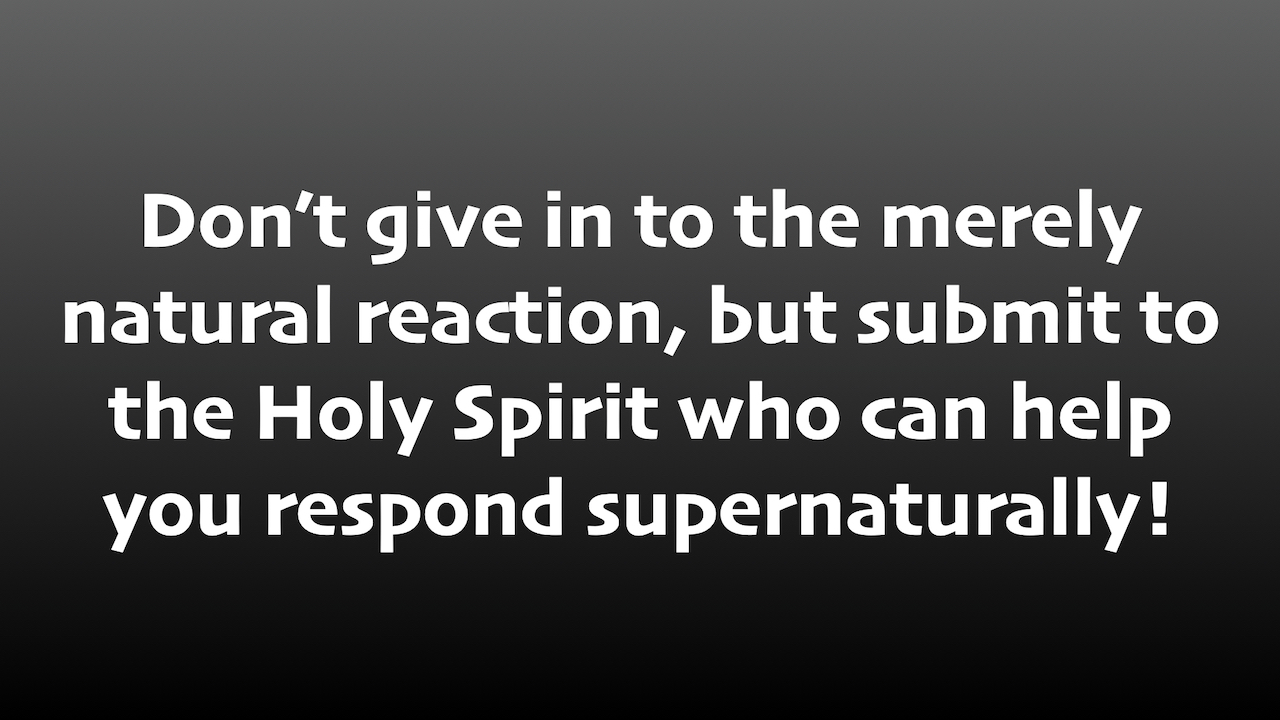
(4) When we have a big decision ahead. We may gather all of the information and do our our research and still feel inadequate to make a good decision. Jesus had hundreds of disciples, but He needed to choose just twelve to serve as His apostles. Before making this decision, Jesus spent the night in solitude with His Father (Luke 6:12-13). 

(5) When we get angry. There are other strong emotions that sometimes seem to overwhelm us, but I’ve noticed that anger causes more people to fly off the handle than most of the other emotions. When Jesus saw the shameful way the temple was being used, He got so angry that His disciples recalled the Psalm that said zeal was burning Him up (Psalm 69:9; John 2:17). Instead of reacting in the heat of the moment, Jesus spent all night in solitude with His Father (Mark 11:11, 19).  

Our solitude time could include Bible reading, but it’s probably more of a time for quieting ourselves—taking a break from human activity—so we can hear the Holy Spirit reminding us of what we’ve already studied (John 14:26).  

Then keep in mind that solitude is not retreating and staying away from others, but solitude is so that I can effectively respond to pressing situations. Christian solitude is not me-time, it’s us-time (where the “us” is me + Jesus) so that I’m ready for we-time (where the “we” is me + others). 

This is such an important discipline for Christians so that we don’t respond inappropriately in an intense situation, but we respond in a Christ-like way that brings glory to God. Pay attention to your strong emotions, listen to the Holy Spirit, and proactively find a place of solitude. 

If you have missed any of the other messages in this series called Saints Together, you can find them all by clicking here.

►► Would you please prayerfully consider supporting this ministry? My Patreon supporters get behind-the-scenes access to exclusive materials, like a 10-minute video I just shared on study tips for the poetic books of the Bible. ◀︎◀︎

The Wait Of Parenting

Listen to the podcast of this post by clicking on the player below, and you can also subscribe on AppleSpotify, or Audible. 

I’ve been called to some challenging leadership roles in my life—many of which made me feel like I was in way over my head! But without a close second, the heaviest mantle I’ve ever felt is the one called “Father.” Holding my firstborn son in my arms was indescribable, and it didn’t feel any lighter or less daunting when our other children arrived.  

The rabbis saw something significant in the Ten Commandments. Some people have noted that the first four Commandments are about our vertical relationship with God, while the next six are about our horizontal relationships with people. But the rabbis saw the Fifth Commandment as the linchpin—with parents in a creator-like role and as the first leader our children will be exposed to, and parents taking on the role as the first and most significant instructor for our children to know God for themselves. 

God gives us the example to follow: He instructs us gently but firmly, anticipating our needs, and giving us exactly what we need (Psalm 103:13-14; Luke 6:36, 12:32; Matthew 6:8).  

And then Jesus tells us to follow this example: “Be perfect, therefore, as your heavenly Father is perfect” (Matthew 5:48). Yikes, talk about a heavy weight! 

In the only song of ascent attributed to King Solomon (Psalm 127) we read both a longing for our families to be with us at the end of our journey to Zion, but also a hint of the difficulty of this. 

In the middle verse of this song, we are assured that our children are given to specific parents by God on purpose. He knew what He was doing in giving them into our care. That means each parent is uniquely equipped for each child’s unique personality, temperament, and gift package. 

Twice in the opening verse, Solomon uses the word “unless.” Unless we seek God’s help in building our children and watching over them, our efforts on their own will be “in vain.” That phrase (“in vain”) is used three times in the opening two verses. Solomon wrote a lot about vanity in the Book of Ecclesiastes. But it’s important to note that Solomon always uses this word in association with the phrase “under the sun.” Unless we get help from God—unless we lift our eyes up higher than this earth—our efforts alone will be frustrating and anxiety-inducing. 

Remember that parents are the linchpin in the Ten Commandments? Those first four Commandments tell us to put God first, don’t create any idols to rival Him, don’t misuse His name, and trust Him enough to rest from your labors (Exodus 20:1-11). That means that we parents cannot put our kids ahead of God (Luke 14:26). Unless God is our first priority, we won’t have the spiritual, emotional, or mental stamina to parent well. Or, as C.S. Lewis noted,  “When I have learned to love God better than my earthly dearest, I shall love my earthly dearest better than I do now.” 

In his collection of proverbs, Solomon told us, “Start children off on the way they should go, and even when they are old they will not turn from it” (Proverbs 22:6). Jesus said there is only one sure foundation, and that is knowledge and obedience of God’s Word (Matthew 7:24-27). 

The final two verses of Psalm 127 assure parents that when we commit our children to God’s hands, He blesses them and uses them as His weapons, His leaders, and His culture changers. 

There is not only a weight in parenting, but there is also a wait in parenting. In the last song of ascent we studied, we learned that we have a promise two times that we will (not “might”) reap a harvest, even if we have to sow seeds in tears (Psalm 126:5-6). 

In the Bible, waiting is never passive. It’s an active watching to see how God will move. We see this in the story of the prodigal son (Luke 15:11-32) where the father waited expectantly for his wayward son to return. This Dad had given his son a firm foundation at the start of his life, and then he waited in prayer until his son “came to his senses”—until he realized that all other ways of living away from God were vanity. 

In the midst of her prayers for her own prodigal son, Monica shared her concerns with Ambrose, bishop of Milan, and he said, “It cannot be that the son of those tears be lost.” Monica continued to wait for her son Augustine, sowing her seeds in tears but fully expecting the song of joy that would come with the harvest. 

Years later, in his autobiography called Confessions, Augustine wrote of his mother, “My mother, Your faithful servant, wept to You for me, shedding more tears for my spiritual death than others shed for the bodily death of a son. You heard her.” 

Parents, as you call out to God on behalf of your children, shed those tears in the joy of the anticipated harvest, knowing that God hears you! 

If you’ve missed any of the other messages in our series looking at these songs of ascent in the Book of Psalms, you can find them all here.  

►► Would you please prayerfully consider supporting this ministry? My Patreon supporters get behind-the-scenes access to exclusive materials. ◀︎◀︎