Links & Quotes

link quote

“The Apostle Paul tells us that a temple of God, properly adorned and maintained, grows in unity and maturity in the Lord Jesus, as pastors and teachers equip church members to do the work of ministry (Ephesians 4:11-16). A building and other facilities can aid in this process, but they are not essential. Indeed, in many ways they can actually distract us from our task by so defining and confining what we do in the name of ministry that our endeavors consistently look more like the ways of the world than the work of the Lord, more like maintaining and maximizing an institution than seeking and advancing a Kingdom not of this world. … As we build our churches let us not lose sight of the fact that what matters most to the Lord is not the number, shape, and usability of the buildings we erect, but the health, growth, and ministries of the people in whom He has come to dwell.” —T.M. Moore

“When we blindly adopt a religion, a political system, a literary dogma, we become automatons. We cease to grow.” —Anais Nin

“The Lord’s Prayer contains 56 words; the Gettysburg Address, 266; the Ten Commandments, 297; the Declaration of Independence, 300; and a recent U.S. government order setting the price of cabbage, 26,911. At the state level, over 250,000 bills are introduced each year. And 25,000 pass the legislatures to disappear into the labyrinths of the law.” —Al Ries and Jack Trout

“For some (even for some Christians), faith is best defined as ‘believing in something that lacks supporting evidence.’ But this is not the definition of faith that is presented on the pages of Christian Scripture.” Read more from J. Warner Wallace on how Christianity Promotes Rational (and Evidential) Exploration.

Frank Turek points out, “Remember, Moses was on the wrong side of the golden calf. And [Abraham] Lincoln’s Emancipation Proclamation was on the wrong side of Dred Scott.…” In this post he shares why same-sex “marriage” proponents are on the wrong side of God, evolution and humanity.

[VIDEO] This 5-minute clip of noted New Testament scholar N.T. Wright on homosexuality is well worth your time—

My son tipped me off to a thought-provoking post on dating relationships: How Our Dating Culture As Already Broken Your Future Wife’s Heart.

C.S. Lewis On The Holy Spirit

I have been studying for my series on the Holy Spirit, and I came across this gem from C.S. Lewis.

C.S. Lewis“It is quite right that you should feel that ‘something terrific’ has happened to you (it has) and be ‘all glowy.’ Accept these sensations with thankfulness as birthday cards from God, but remember that they are only greetings, not the real gift. I mean, it is not the sensations that are the real thing. The real thing is the gift of the Holy Spirit which can’t usually be—perhaps not ever—experienced as a sensation or emotion. The sensations are merely the response of your nervous system. Don’t depend on them. Otherwise when they go and you are once more emotionally flat (as you certainly will be quite soon), you might think that the real thing had gone too. But it won’t. It will be there when you can’t feel it. May even be most operative when you can feel it least.” —C.S. Lewis

...Ever be filled and stimulated with the Holy Spirit. (Ephesians 5:18, AMP).

What God Is Building

Relativity by M.C. EscherI love the drawings of M.C. Escher. But some of his sketches are clearly optical illusions we all know couldn’t work in the real world. We don’t have to be architects or engineers or builders to know that for a building to be functional it has to have (1) a solid foundation, (2) it must be built with quality materials, and (3) it must be constructed by someone who knows what he/she is doing.

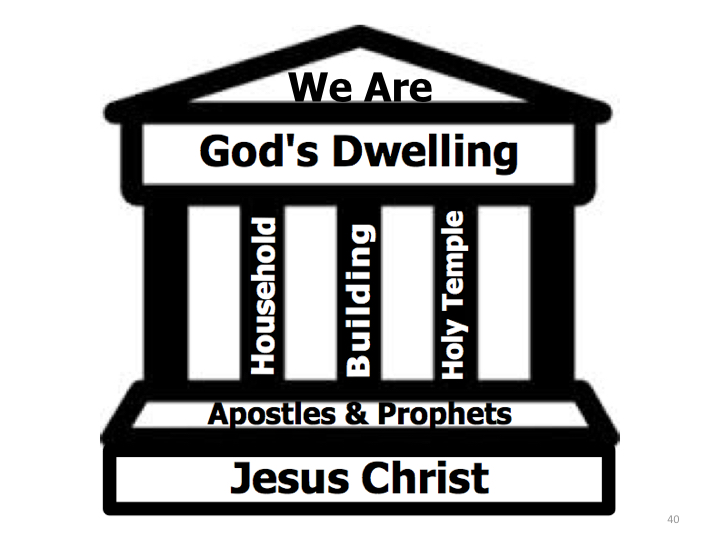
The Apostle Paul tells us that (1) Jesus Christ is the cornerstone of the sure foundation, (2) you and I—God’s saints—are the quality building materials that are being used, and (3) the Holy Spirit knows exactly what He is doing as He joins us together.

A cornerstone is the first stone set in the construction, the reference point for all other stone, which determines the position of the entire structure. Christ Jesus Himself is the cornerstone of His Church (Ephesians 2:20b). Orientated to that cornerstone we have the foundation of the apostles and prophets (2:20a).

This foundation is the Word of God (2 Peter 1:19-2:3 and 2 Timothy 3:14-4:5). We dare not try to replace, nullify, update, or change His Word. Not would this cause the foundation to crumble, but there are dire consequences for the one who tries to do so (Revelation 22:18-19).

Our foundationOn this foundation, God is constructing three things, each one growing in its level of intimacy with Him and with the surrounding saints:

  • God’s household (Ephesians 2:19)—this Greek word means a family home.
  • the whole building (Ephesians 2:21a)—this is a specific part of the family home used for prayer and fellowship.
  • a holy temple (Ephesians 2:21b)—this is the same word used for the Holy Place and Holy of Holies in the tabernacle.

God’s Presence dwells in us individually, but collectively we make a more powerful statement (1 Corinthians 3:16). There is a far greater testimony to the world when individuals willingly and actively allow themselves to be built together; when Christians give up their personal agendas to say, “I want to be a part of something bigger than me—I want to be a part of we.”

We must study God’s Word to make sure we are building on the same foundation. We must allow our lives to be quality building materials. We must allow the Holy Spirit to build us together through prayer and fellowship! This becomes the fulfillment of the prayer Jesus Himself prayed for us (John 17:20-23).

This was the last message (for this time) in our series on the Book of Ephesians. I hope to be able to continue this study next year.

…And Then A Miracle Occurs

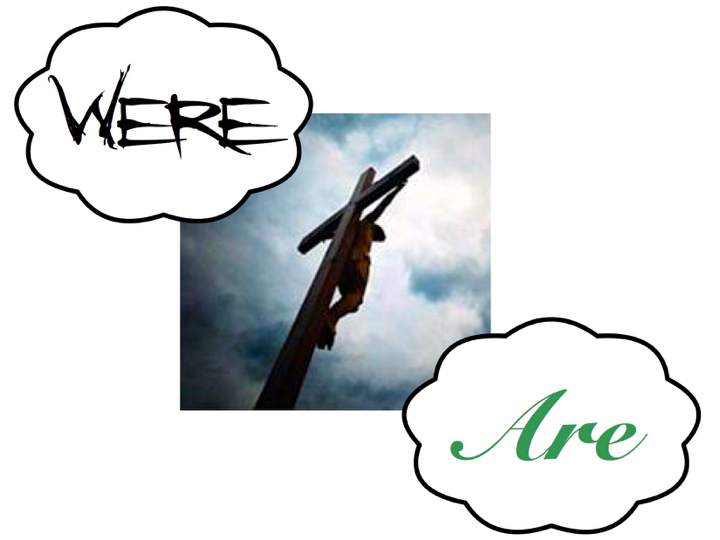
The Miracle of JesusLast week I shared how important it is for us to remember what we were before meeting Christ, and what we now are after meeting Him (you can click here to read that post). But we need to spend some time looking at how we went from “were” to “are.”

First, we need to recall how bad we really were without Christ. We were…

  • …dead (Ephesians 2:1)—this is a rotting corpse.
  • …separated (2:12)—we faced a gaping, unbridgeable, uncrossable chasm.
  • …alienated (4:18)— we were completely shut-out from fellowship with God.
  • …given over (4:19)—this implies an open betrayal which resulted in us running the opposite direction from God.

“The man on the street would simply shrugged his shoulders at this charge and say, ‘Sure, no one’s perfect.’ Even we Christians talk about failures and defeats, but the Bible uses other terms. It speaks of wickedness and rebellion (Leviticus 16:21). The Bible speaks of King David as despising God (2 Samuel 12:9-10). It charges another man of God with defying the word of the Lord… (1 Kings 13:21). It is evident by these descriptive synonyms for sin—rebellion, despising, defying—that God takes a far more serious view of sin than the man on the street or even most Christians.” —Jerry Bridges, in Transforming Grace (bold font added)

…and then a miracle occurs! You who once WERE far away [dead, separated, alienated, disgustingly sinful] HAVE BEEN brought near through the blood of Christ (Ephesians 2:13). Jesus Himself becomes our salvation … He IS the miracle! Notice the wording here—

  • He Himself IS our peace (v. 14a)
  • HE has made the two one (v. 14b)
  • abolishing IN His flesh (v. 15a)
  • create IN Himself (v. 15b)
  • IN this one Body…by which HE put to death their hostility (v. 16)
  • THROUGH Him we both have access to the Father (v. 18)

Jesus Himself IS (1) our peace, (2) our reconciliation, and (3) our atonement.

Not only must we always remember what we WERE and what we ARE, but remember the MIRACLE whereby this transformation could happen: The blood of Jesus spilled for us on the Cross!

We’ll be continuing our walk through the Book of Ephesians next Sunday, and I’d love to have you join us.

But Now

But nowRemembering our past is so important. Forgetting where we’ve come from can make us insensitive to the feelings of others, it can make us falsely proud of what we assume we’ve accomplished for ourselves, and it can make us fearful that God cannot handle what’s coming next.

So God want us to remember two things: what we were, and what we are. In Ephesians the verb tense Paul uses literally says, “Keep on calling this to mind; keep on keeping it fresh in your thoughts” (Ephesians 2:11 & 12).

Keep on remembering what you WERE:

  • separate from Christ
  • excluded from citizenship
  • foreigners to the covenants of the promise
  • without hope
  • without God in the world (v. 12)

And then come two amazing words―BUT NOW (v. 13) keep on remember what you ARE:

  • brought near through the blood of Christ (v. 13)
  • able to access to the Father (v. 18)
  • no longer foreigners and aliens, but fellow citizens with God’s people (v. 19)
  • members of God’s household (v. 19)
  • a dwelling in which God lives by His Spirit (v. 22)

Constantly calling this to mind should produce three attitudes―

  1. Thankful to God for His grace gifts to me.
  2. Graceful to others who are separated from God now like I used to be.
  3. Hopeful of the help Christ can bring through me to others.

We are continuing our study of the Book of Ephesians this coming Sunday. Please join us!

Sit Walk Stand [re-launch]

Sit Walk StandThis coming Sunday we re-start a series at Calvary Assembly of God which we began last year called Sit Walk Stand: A Study In The Book Of Ephesians.

Why Ephesians? Dr. Martin Lloyd-Jones, who preached 232 sermons on this book to his packed-out church, said, “It is very difficult to speak of Ephesians in a controlled manner because of its greatness. Many have tried to describe it. One writer has described it as the crown and climax of Pauline theology. Another has said that it is the distilled essence of the Christian religion, the most authoritative and most consummate compendium of our holy Christian faith. What language! And it is by no means exaggerated.”

It is my desire that our congregation be as biblically literate as I can encourage and resource them to be. So Tom Kaastra, a 38-year veteran pastor, is going to co-teach with me again this year as we continue our attempt to master this powerful epistle.

The name of our series—Sit Walk Stand—comes from Watchman Nee, who wrote, “Of all Paul’s epistles, it is in Ephesians that we find the highest spiritual truths concerning the Christian life. The letter abounds with spiritual riches, and yet at the same time is intensely practical.”

Please join us this Sunday at 10:30am.

Whether you were with us last year or not, I posted some sermon recaps each week which will help prepare you as we re-launch this series. Click on the links below:

More Ministers Needed In The Church

The church goesI always get a bit nervous when someone calls me “the minister of Calvary Assembly of God.” I am not the minister; I’m the pastor and a minister.

There’s a big difference! 

A pastor is one of the gifts Jesus gives the church to equip lots of ministers (see Ephesians 4:7-13). A pastor is not the minister, but a minister-equipper.

Check out this quote from Oswald Chambers—

“Notice the gifts that the Apostle Paul says Jesus sent after He ascended—viz. apostles, prophets, evangelists, pastors and teachers—‘for the perfecting of the saints, for the work of the ministry, for the edifying of the body of Christ.’  The test of a preacher or teacher is that as we listen to him we are built up in our faith in Jesus Christ and in our intimacy with Him; otherwise he is not a gift from God. Today we are apt to test the preacher on the ground of his personality and not by his building up of the saints.” (emphasis added)

I don’t want to be put on a pedestal as the minister. I want Jesus to be exalted. This will only happen when all the gifts to the church—apostles, prophets, evangelists, pastors and teachers—are equipping the entire church to minister.

What do you think?

Altar To Alter

Listen to the podcast of this post by clicking on the player below, and you can also subscribe on AppleSpotify, or Audible.

The process of sanctification—or as I like remember the word: saint-ification—is the process whereby the Holy Spirit develops Christlike character in us. His process is immediate, personalized, and ongoing. In other words, the Spirit is intimately and immediately involved in every aspect of our lives.

Christlikeness in us is described in the Bible with phrases like…

  • Being made new in the attitude of your minds; and putting on the new self, created to be like God in true righteousness and holiness (Ephesians 4:23-24).
  • Conformed to the likeness of God’s Son (Romans 8:29).

The Holy Spirit is often portrayed as fire. In fact, the Bible says that Jesus will baptize you with the Holy Spirit and with fire (Matthew 3:11). This is because in order for Christlike character to be formed in us, that character will have to be forged in us. Forged in the Spirit’s fire.

Look at two examples:

  • Until the time came to fulfill his dreams, the Lord tested Joseph’s character (Psalm 105:19).
  • Even though Jesus was God’s Son, He learned obedience from the things He suffered (Hebrews 5:8).

Here’s what I’ve learned—

We must altar our lives so that the Holy Spirit can alter our lives.

Unless we yield to what the Holy Spirit wants to do with us, He cannot and will not bring about the changes that will lead to more Christlikeness being revealed in us.

It may be painful to altar our lives, but the apostle Paul says, “I consider that our present sufferings are not worth comparing with the glory that will be revealed in us” (Romans 8:18).

You altar, and then watch the Holy Spirit alter your life in a way that reveals God’s glory!

►► Would you please prayerfully consider supporting this ministry? ◀︎◀︎

Links & Quotes

link quote

“A spirit of thankfulness is so at odds with a spirit of coarse jesting that when one rises, the other falls [Ephesians 5:4]. And a spirit that yearns to edify is so at odds with foul talk that when one rises, the other falls [Ephesians 4:29].” —John Piper
“Love for others is the overflow of God-given security for the good of others. It signifies that we have the resources to care about others because God cares for us.” —John Piper


British prime minister David Cameron said recently that “our religion is now the most persecuted religion around the world.” Read this post about The War On Christians.

The Assemblies of God has now shown membership growth for 24 consecutive years, and its attendance grew more in 2013 than the US population did! Check out these God-glorifying stats.

“Let anger be guarded against. If it cannot, however, be averted, let it be kept within bounds. For indignation is a terrible incentive to sin. It disorders the mind to such an extent as to leave no room for reason. The first thing, therefore, to aim at, if possible, is to make tranquility of character our natural disposition by constant practice, by desire for better things, by fixed determination.” —Ambrose of Milan

“There is no true comfort for anyone on this earth except that of the Holy Spirit. This is why you need Him abiding in you. He alone can lay you down at night, as in a warm bed, and fill your heart with perfect peace. He alone can truly comfort you in times of pain and sorrow. He is the one who will assure you, ‘This comfort is not just temporary—it is eternal!’” —David Wilkerson

Guess what? Being popular in high school may hurt you in the long run.

Surprise (or not)! The biggest tax delinquents are US government employees.

Just One Question

Grace's trophyPaul makes it quite clear in Ephesians 2 what we are apart from Jesus Christ:

  • Dead in our transgressions and sins (v. 1)
  • Following the ways of the world and selling out to satan’s dominion (v. 2a)
  • In obstinate opposition to God (v. 2b)
  • Living only for our own wicked cravings (v. 3a)
  • The objects of God’s righteous wrath (v. 3b)

The penalty is a death sentence. Yet God made Jesus—the perfect, sinless One—to be sin in our place so that God’s judgment would fall on Jesus Christ instead of us. That is what Paul describes as God’s great love and rich mercy (v. 4).

Mercy means not getting the punishment we should have received.

It would have been enough if God stopped there by showing mercy, but He didn’t! God brought us back to life, saved us from eternal damnation, and raised us up with Christ to a position of honor (vv. 5, 8-9). What did this? God’s amazing grace! 

Grace means getting blessings that we never should have received. 

God did this in order that we might be trophies of the incomparable riches of His grace and His kindness… (v. 7).

Gordon MacDonald said, “The world can do almost anything as well as or better than the church. You need not be a Christian to build houses, feed the hungry, or heal the sick. There is only one thing the world cannot do. It cannot offer grace.

So just one question…

What does the world learn about God’s grace by watching you and me?