Listen to the podcast of this post by clicking on the player below, and you can also subscribe on Apple, Spotify, or Audible.
Are you in touch with your emotions? While it might sound like something out of a Hallmark movie to some, having a robust emotional quotient is a vital skill for a leader. Join Greg and me as we get all emotional in this episode.
[0:32] There is something more important than IQ, and that’s EQ.
[1:51] Is EQ innate or is it learned?
[4:08] Is EQ a hard skill or a soft skill? How do we measure EQ?
[5:37] EQ is not necessarily emotional regulation, although it is an important component of EQ.
[6:36] Some thoughts on how we can grow our EQ.
[8:07] Humility is absolutely essential to growing in EQ.
[11:27] Leaders who strive to put others first can grow in EQ.
[15:01] We have to get better at truly seeing people and knowing where they are emotionally.
[16:40] Leaders have to be aware of their own emotional state.
[17:31] It’s invaluable to have a third-party who isn’t emotionally invested in your situation come alongside you to give you perspective.
[18:26] Mentors can help us see ourselves more clearly, which helps us see others more clearly.
[21:30] Leaders need to remember that people are no machines, so we cannot think of them in terms of efficiency.
[23:14] Greg and I share examples of people who taught us how to be more aware of our emotional interactions with people.
[27:05] People want to know that leaders see them and hear them. Remembering this will help leaders grow their EQ.
Listen to the podcast of this post by clicking on the player below, and you can also subscribe on Apple, Spotify, or Audible.
Leadership is influence.
Influence doesn’t try to get a following, but people naturally follow a leader who quietly, consistently, and effectively shows up for them.
Jesus saw the needs of people and was moved by compassion to relieve their distress. Peter said He simply went around doing good (Acts 10:38). He gave value to the overlooked, He touched the so-called untouchable, He embraced the rejected.
Jesus said, “I didn’t come to be served but to serve and to give My life away” (Mark 10:45).
This commentary from the folks at He Gets Us is spot-on:
So often our idea of leadership is about asserting dominance and wielding authority; Jesus on the other hand revealed a radically different approach to greatness.
Jesus chose a path that seemed almost counterintuitive, especially to many of those around Him. He showed that true influence doesn’t come from throwing your weight around or flexing your authority—it comes from genuine empathy, authentic care, and intentionally seeing people and going toward them.
Instead of building a platform or demanding attention, Jesus moved quietly through communities, transforming lives through genuine relationships.
He didn’t network with the powerful or chase prestigious connections.
He sat with the overlooked.
He listened to the ignored.
He gave dignity to those society had dismissed.
Jesus’ approach to influence and greatness wasn’t about commanding rooms or dominating conversations—it was about creating spaces where others felt seen, heard, and valued, demonstrating great love in those moments.
When He had opportunities to grasp power, He chose instead to empower others.
His visible leadership wasn’t built on titles or positions, but on authentic relationships He cultivated and the lives He transformed through His genuine care and concern. (‘What is Greatness?’)
Listen to the podcast of this post by clicking on the player below, and you can also subscribe on Apple, Spotify, or Audible.
Comfort is an important word in the apostle Paul’s letter to the saints at Corinth. In just five verses in the opening of his second letter to the Corinthians, he uses the word “comfort” nine times!
Praise be to the God and Father of our Lord Jesus Christ, the Father of compassion and the God of all comfort, who comforts us in all our troubles, so that we can comfort those in any trouble with the comfort we ourselves receive from God. For just as we share abundantly in the sufferings of Christ, so also our comfort abounds through Christ. If we are distressed, it is for your comfort and salvation; if we are comforted, it is for your comfort, which produces in you patient endurance of the same sufferings we suffer. And our hope for you is firm, because we know that just as you share in our sufferings, so also you share in our comfort. (2 Corinthians 1:3-7)
The Greek word conveys the sense of someone who comes near to help us. They come physically near, their heart draws near to us in empathy, and even their words are right on target to provide the help we need.
If that description sounds familiar, it may be because it comes from the same Greek word that Jesus uses for the Holy Spirit—
And I will ask the Father, and He will give you another Comforter (Counselor, Helper, Intercessor, Advocate, Strengthener, and Standby), that He may remain with you forever. (John 14:16 AMPC)
As Paul says, God is “the God of all comfort,” which we would expect. But notice that Paul also says that the Comforter comforts us for a specific purpose: “so that we can comfort those in any trouble with the comfort we ourselves receive from God.”
We cannot give to others what we do not have.
How do we get comfort? The Holy Spirit—the Comforter—comforts us.
When does He comfort us? When we are in distress.
What happens with this comfort we receive? Three things:
We have something to give to others who are in distress
It builds patient endurance in us
It makes our hope in God more firm
Perhaps you’re in a time of distress right now and you’re wondering why you are going through this difficulty. Can I challenge you to reframe this thought: You are going through this so that you may increase your capacity to be a comforter to others. Your comforted distress is allowing you to come alongside another struggling saint with greater empathy and patience and understanding and strength than you would have had before your time of distress.
This is why Paul says, “Praise be to the God and Father of our Lord Jesus Christ.” He is trying to help us see the blessings that can come from this time of distress that could have come in no other way. Don’t allow self-pity to rob you of the comfort the Comforter wants to give to youso that you are able to be a comforter to others who are in distress.
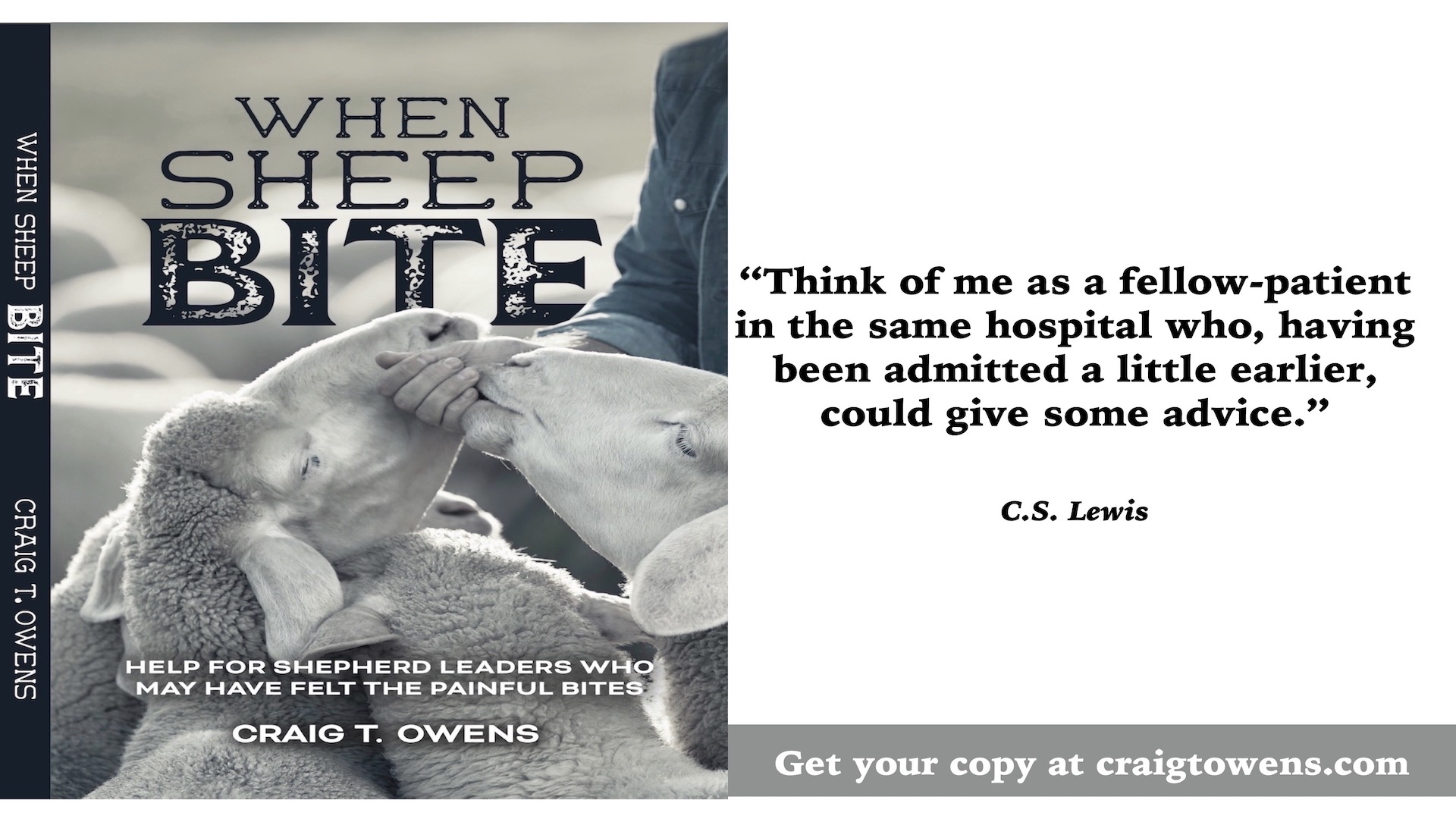
My book When Sheep Bite is all about recovering after difficulties—whether they were created by your mistakes or someone else’s mistakes. In the Introduction to my book I wrote:
I want to give you what I wanted when this happened to me: empathy, insight, a helpful perspective, and a manual of help that God has provided in the Bible. I don’t want to try to one-up your story of pain, because I’m confident that no one could truly know how deeply you’ve been hurt. But I do want to give you some assurance that I know what I’m talking about. …
Your pain and your circumstances are unique. Your pain is real, and it is incomparable to anyone else’s pain. But the biblical principles that God revealed to me—those things that helped me heal and the thoughts I want to share with you—are applicable for any shepherd. These tried-and-true principles can help you not just survive this pain but thrive in spite of this pain. I would say to you something that C.S. Lewis wrote, “Think of me as a fellow-patient in the same hospital who, having been admitted a little earlier, could give some advice.”
Psychologists call it “projection” when I see so quickly in others what’s really in myself.
If I see sin in others, my first response would be to hit my knees and ask the Holy Spirit to search me to point out the same sin in myself.
It’s only after confessing my sin and receiving God’s complete forgiveness that I am equipped with the empathy and mercy to help someone else find the same freedom I have found.
Lord, may I be more sensitive to the sin in my life than I am aware of the sin in the world.
Listen to the podcast of this post by clicking on the player below, and you can also subscribe on Apple, Spotify, or Audible.
We tend to be pretty self-centered creatures, filtering everything through our lens. This becomes especially true when we are going though a difficult time.
When I walked through a dark valley, I battled both physical and spiritual forces. People attacked me, but so did my own thoughts. “Why me?” and “I didn’t do anything to deserve this!” led to prayers like, “God, why didn’t You protect me from this? Why won’t you get me out of this?”
Do you hear a common theme? I didn’t while I was in the midst of the battle, but perhaps you hear it—“Why me? I didn’t do anything to deserve this! God, why didn’t You protect me from this? Why won’t You get me out of this?”
In his book Winning With People, John Maxwell shared ‘The Big Picture Principle’: “The entire population of the world, with one minor exception, is composed of others.”
On the other side of my dark valley I learned something about my time in the dark valley—I had grown:
I could help others diagnose depression
I could empathize with others
I could share helpful strategies to those who were struggling
I could intercede for them in prayer
My definition for intercede is to pray for people in a meaningful way because they are too beat up to pray for themselves.
In order to pray for them, I have to know what and how to pray. I can’t know what and how to pray unless I have firsthand experience. So perhaps my dark valley wasn’t for me, but for someone else (see Romans 8:28; 2 Corinthians 1:3-11).
I have talked and blogged so many times about the phrases “one another” and “each other” throughout Scripture. That means that Christian faith is best seen when we are with each other, supporting one another.
Jesus taught us to pray, “Our Father” (Matthew 6:9). The “our” signifies we are praying…
…with Jesus—John 14:13-14
…with other saints—Matthew 18:18-20
Even more than praying with us, Jesus intercedes for us (Hebrews 4:15-16). And Jesus gives us the Holy Spirit (John 14:26) who also intercedes for us and with us (Romans 8:26-27).
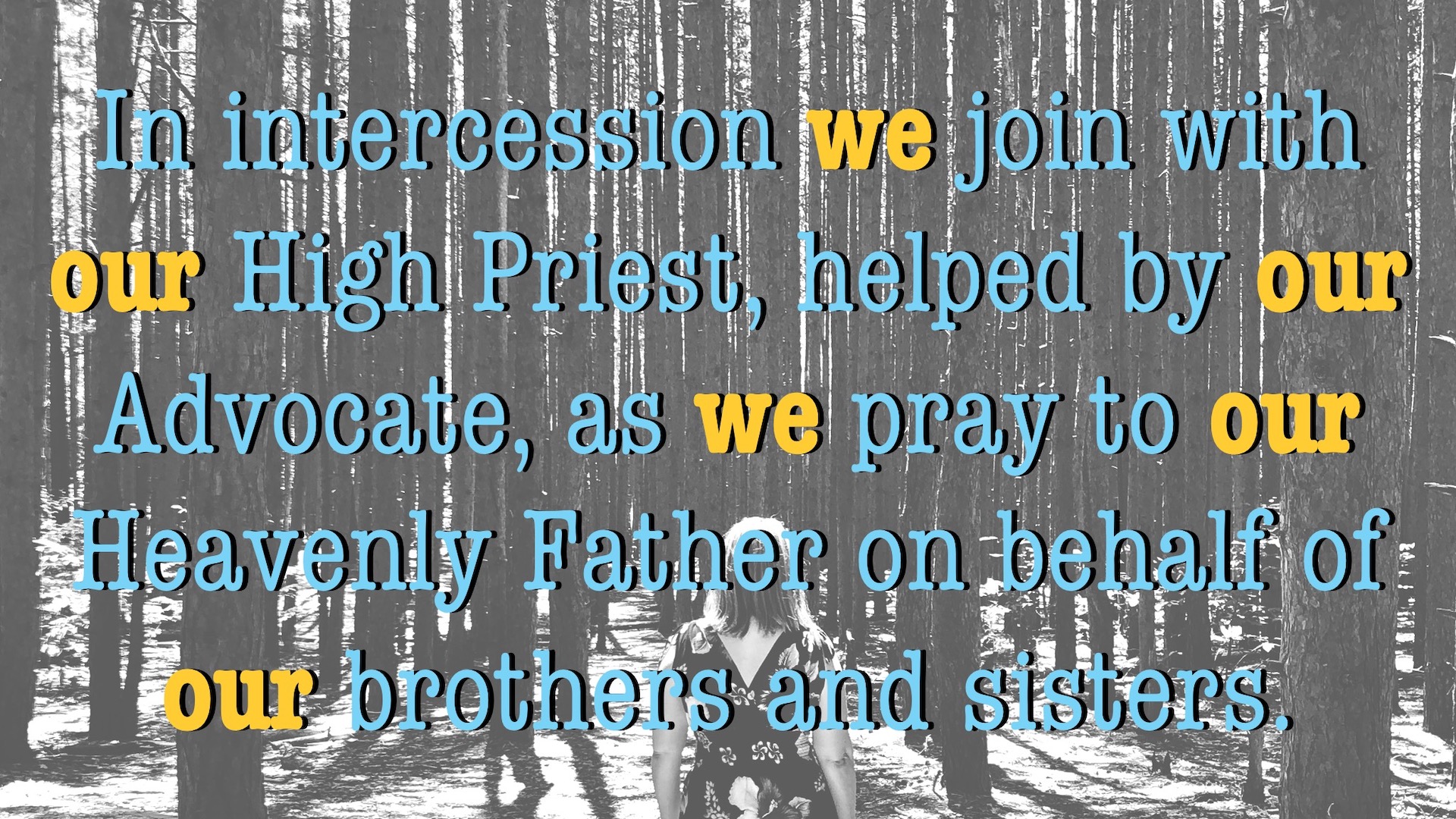
We join with our High Priest, helped by our Advocate, as we pray to our Heavenly Father on behalf of our brothers and sisters.
Listen to the interceding and expectation of a joyful answer that David writes in Psalm 20, and also notice how the saints are together—
May the LORD answer you when you are in distress; may the name of the God of Jacob protect you.May He send you help from the sanctuary and grant you support from Zion.May He remember all your sacrifices and accept your burnt offerings.May He give you the desire of your heart and make all your plans succeed.May we shout for joy over your victory and lift up our banners in the name of our God. May the LORD grant all your requests.Now this I know: The LORD gives victory to His anointed. He answers him from His heavenly sanctuary with the victorious power of His right hand.Some trust in chariots and some in horses, but we trust in the name of the LORD our God.They are brought to their knees and fall, but we rise up and stand firm.LORD, give victory to the king! Answer us when we call!
My cousin Dick Brogden wrote, “Jesus never intended us to suffer alone. We may not physically be able to cross oceans or deserts and sit in lonely cells with colleagues—but we are intended to traverse that distance spiritually and to bear the burdens of our brothers in prayer. Followers of Jesus under duress are empowered to bear unimaginable suffering when they know that they do not agonize alone.”
In your prayer time, I encourage you to ask the Spirit to show you lessons you have learned in your dark valleys, and then begin to intercede for your fellow brothers and sisters with the help you have already received.
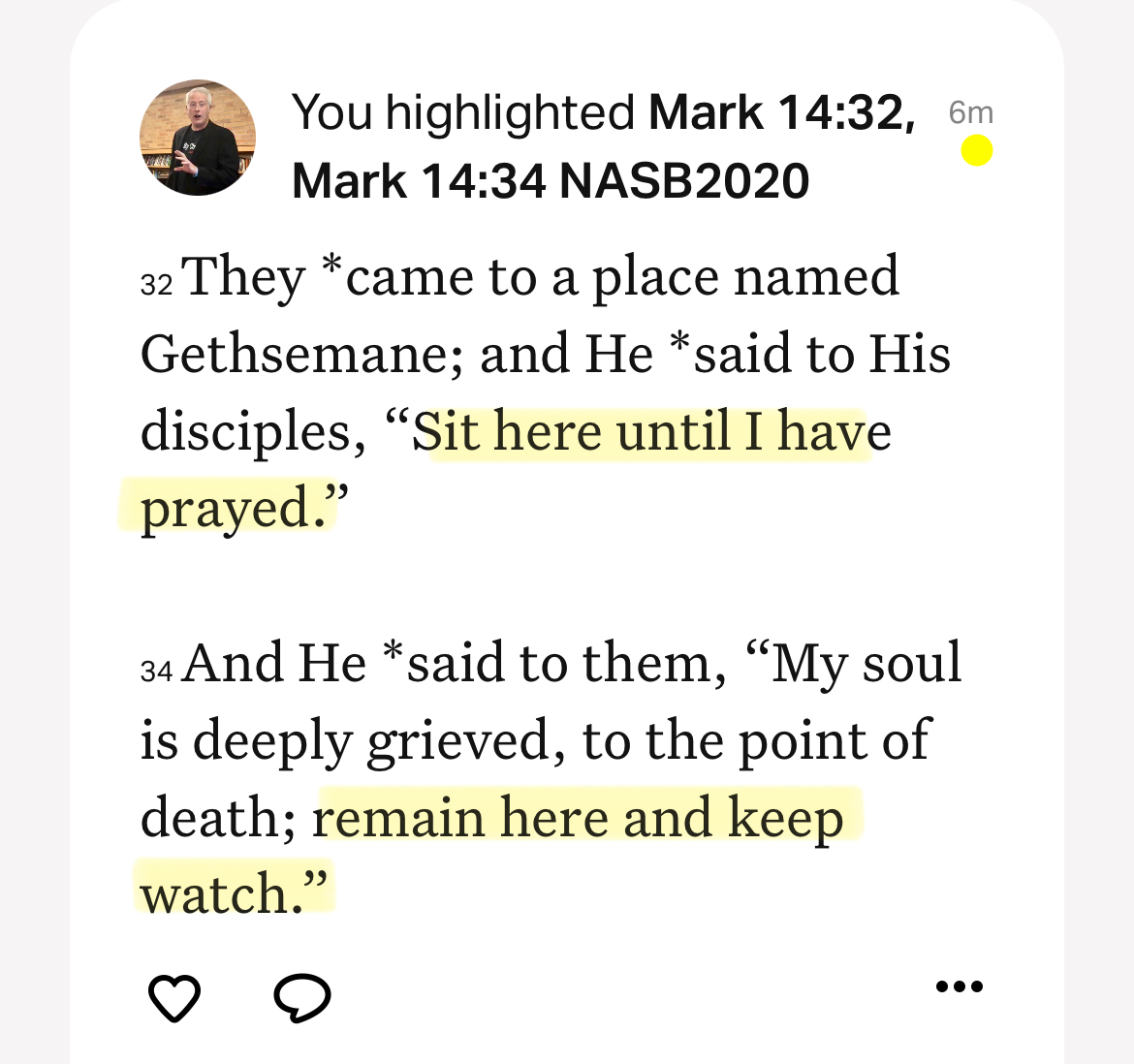
They came to a place named Gethsemane; and He said to His disciples, “Sit here until I have prayed.” … And He said to them, “My soul is deeply grieved, to the point of death; remain here and keep watch.” (Mark 14:32, 34)
Jesus was staring down the most intense, horrific experience anyone on earth had ever faced—more intense than what anyone has ever faced since then. At this moment, He just wanted His friends close by.
Sometimes the best thing we can do for a hurting friend is just be present. Just be there for them. We cannot fully know what battle is raging in our friend’s heart, so we probably won’t have the appropriate words to share. So just be present for them—be physically there in the room with them.
Job’s friends started out well, as they sat silently with their friend. When they tried to counsel Job, they made matters worse. Job called them “miserable counselors” (Job 16:2) and their words made God angry with them too.
Don’t feel like you have to have words to share with your friend. Sometimes just weeping with those who weep is enough to let your friend know that they are not alone.
Listen to the audio-only version of this podcast by clicking on the player below, or scroll down to watch the video.
Empathy is an essential trait for leaders, but it’s not innate in any of us. As I joked, “behind ‘mama’ and ‘dada,’ the first word most babies learn is ‘mine.’” The skill of empathy is like a muscle, the more we practice, the stronger it gets. In this episode, Greg and I discuss why empathy is so important for leaders, and give helpful advice on how to remain proficient in your use of empathy.
[0:24] Empathy is a powerful leadership skill that underlines so many other leadership skills.
[1:08] Empathy has to be earned.
[3:07] What blocks empathy in leaders?
[4:02] When you start learning empathy it will feel awkward, but you have to stick with it.
[5:06] Empathy ≠ sympathy, but it is caring.
[7:07] How do leaders show their empathy to their teammates?
[10:10] Here is an example of how to express empathy.
[12:22] What lessons can we learn when we misfire on empathy?
[14:03] Three things Greg has worked on to enhance empathy.
[16:32] Sometimes leaders do for one team member what they cannot do for all.
[19:51] Leaders need empathetic eyes, ears, and heart. There is a huge leadership power in this.
[21:59] Greg shares an interesting study reported in Forbes.
[25:15] One of the most powerful leadership attributes is simply the leader’s availability.
Check out this episode and subscribe on YouTube so you can watch all of the upcoming episodes. You can also listen to our podcast on Spotify and Apple.
Listen to the audio-only version of this podcast by clicking on the player below, or scroll down to watch the video.
As you may have heard, I have written a new book! In this episode Greg and I sit down and chat about When Sheep Bite, and discuss how the valuable lessons it provides are critical for leaders of any organization.
[0:21] I have a confession to make…
[1:43] This book is for both business leaders and church leaders.
[3:07] Attacks usually lead to to fight-or-flight, but When Sheep Bite offers a new response.
[5:21] It’s healthy to validate our feelings when we’ve been hurt, but then good leaders go deeper.
[8:39] Empathy is health, but making excuses is not healthy.
[10:37] Watch out for the sneaky bite of flattery.
[11:26] Leaders who have been hurt have to guard against harboring that hurt.
[13:23] Leaders need to learn how to confront misbehavior correctly.
[14:46] In order for sheep to bite, and in order for the shepherd to lead, they have to be close to each other. How do both sheep and shepherds set boundaries?
[17:46] We can disagree but we cannot disrespect!
[19:49] Bitterness can rob a leader of vitality, so we have to find effective ways to heal.
[22:46] Fight-or-flight is natural, but we need to strive for the supernatural response of faithfulness to our calling.
[23:40] In many ways WSB points to what a good coach does. Contact Maximize Leadership about how our coaching huddles can help your leadership soar—get in touch with us!
Check out this episode and subscribe on YouTube so you can watch all of the upcoming episodes. You can also listen to our podcast on Spotify and Apple.
Listen to the audio-only version of this podcast by clicking on the player below, or scroll down to watch the video.
Greg and I think that a great way to take your leadership to the next level is by paying attention to people. Keeping an eye out for the small details and remembering them shows people you care, which in turn makes them much more receptive to the leadership you want to pour into their lives.
[0:15] Memorial Day is coming up
[0:54] Great leaders remember the little details about others
[3:05] We share how leaders can leverage their retention of the details of others’ lives
[6:37] Exceptional leaders give way more than they take
[8:21] How do we get out of our own way so we can get to know others better?
[10:47] Greg and I both have some personal examples of how we learned to remember the details
[14:26] Leaders can lift up those around them by just doing the little things well
[16:24] John Maxwell wrote a “people principle” that I unpack
[17:47] Greg learned a lesson from his grandparents about “taking a drive” to observe important people and places
Check out this episode and subscribe on YouTube so you can watch all of the upcoming episodes. You can also listen to our podcast on Spotify and Apple.



 Are you in touch with your emotions? While it might sound like something out of a Hallmark movie to some, having a robust emotional quotient is a vital skill for a leader. Join Greg and me as we get all emotional in this episode.





![Joshua 3.5 and Psalm 19.12 [commentary]](https://i0.wp.com/craigtowens.com/wp-content/uploads/2025/08/joshua-3.5-and-psalm-19.12-commentary.jpg?w=386&h=386&crop=1&ssl=1 "Joshua 3.5 and Psalm 19.12 [commentary]")



 Craig T. Owens