What Does The Bible Say About Church Leaders?

God’s plan has always been for His leaders to organize and oversee His ministry.

The important thing for us to distinguish is “His.” It’s not a man or woman saying, “I will be a leader,” or even a God-appointed leader saying, “I am going to build up my ministry.”

The New Testament gives us a fourfold purpose for the Body of Christ:

  1. Mobilizing for evangelism
  2. Organizing for more meaningful ministry
  3. Making disciple-makers
  4. Caring for one another

We see God’s leaders involved in all of these aspects—

Mobilizing for evangelism—Peter pointed out the need for an apostle to be appointed to replace Judas, thus returning their ranks to the 12 apostles just as Jesus had originally said (Acts 1:15-22).

Organizing for more meaningful ministry—Everywhere Paul founded a church, he also appointed leaders to oversee and shepherd that church.

Making disciple-makers—Paul tells us that God appointed five offices of leaders in the church who had the specific task of preparing church members to do the ministry of building maturity in the church (Ephesians 4:11-16).

Caring for one another—The First Church set the pace for providing care for all who were in need, including organizing leaders to oversee specific care ministries (Acts 6:1-5).

What about a church congregation’s responsibility to their leaders? I see five areas:

  1. Hold them accountable to the Word (Acts 17:11). The Bible has to be THE standard to which leaders are held.
  2. Give them your confidence and submission after they have shown accountability to their biblical mandate (Hebrews 13:17).
  3. Pray for them (Ephesians 6:19).
  4. Pay them (1 Timothy 5:17).
  5. Be very careful about accusing them (1 Timothy 5:19).

A church and its leaders following this biblical pattern is a church that can effectively fulfill the Great Commission which Jesus gave us.

Saturday In The Psalms—God’s Compelling Kindness

An oracle within my heart concerning the transgression of the wicked: There is no fear of God before his eyes (Psalm 36:1).

David believes that fear and reverence of Almighty God would deter the sinner from his sin. This is not a dread of punishment, but a fear of missing out on the wondrous, eternal depths of God’s love.

We are not asking sinners to give up something they enjoy for a better thing. We’re calling them to step into a Relationship that is more real, substantial, fulfilling, enlivening, and satisfying than anything they’ve ever experienced or even dreamed of!

How precious is God loving kindness. How trustworthy His provision. How abundantly satisfying is His fullness. How indescribable His pleasures. How endless is His love!

It is the kindness of God that leads men and women to His presence.

Heavenly Father, may I live in Your kindness and reflect it to all around me, inviting them to share in Your bounty for themselves. Amen.

What can equal in costliness the love of God! Its preciousness is measured by the gift it gave, and by the innumerable gifts contained in that One—life, pardon, salvation, peace, the glory to be revealed. In this love there are unsearchable riches—exceeding riches of grace. There are no riches to be compared to this great love of God. Having it we are rich indeed. Without it we are poor, life is blank, eternity is dark. …

“God’s character is then the basis of human confidence. …

“This love which so suits the sinner and calls forth his confidence is that which is exhibited in the Cross of Christ. That Cross is the revelation of God’s love as a righteous thing; and thus appeals both to man’s heart and his conscience. The love furnishes the ground for trust, and the Cross removes every reason for distrust. …

“These wings [of love] are broad, and large, and strong, fitted to shelter all the sons of Adam. And thus stretched out they themselves invite us. They contain their own invitation. They say, ‘Come and be safe, come and be blessed, come and be sheltered from present wrath and from the wrath to come. Come, for all things are ready; the love is ready, the deliverance is ready, the protection is ready.’” —Horatius Bonar (emphasis mine)

Saturday In The Psalms—Overcoming Overwhelming Problems

…whom shall I fear? … of whom shall I be afraid? (Psalm 27:1)

Not just enemies are confronting David, but entire armies of wicked people had him surrounded! War and trouble are on every side, trying to overwhelm David.

Yet David is not just not afraid, he is filled with joy!

Why? He has heard God, even in the midst of the evil turmoil, say, “Seek My face.” And David responded, “Yes, Lord, I will seek Your face!” In fact, David declared there was nothing more fortifying for him than to be in God’s presence, gazing on God’s beauty and majesty, and learning more of God’s ways.

In this place David has peace, joy, protection, salvation, courage. In this place David’s overwhelming problems are overcome by God.

David’s conclusion is one for all who are experiencing overwhelming problems—

Wait on the Lord;
be of good courage,
and He shall strengthen your heart;
Wait, I say, on the Lord!

How Long??

Four times in the opening two verses of one of his psalms, David cries out, “How long, O Lord?”

“How long, O Lord? Will You forget me forever?”

It does sometimes feel like the unpleasant season is lasting “forever!” David lays it out: “Every day it seems like Your face is hidden, I’m trying to come up with my own escape plans, my heart is breaking, and the bad guys are taking advantage of me! O Lord, how long will You let this last?”

David turns to prayer again and again. He asks God to hear him, enlighten his eyes, and silence his enemies.

Then I love this transition in David’s outlook—
“But I have trusted in Your mercy; [so]
my heart will rejoice in Your salvation.
I will sing to the Lord, because
He will deal bountifully with me.”

I have … I will … You have … You will!

O my soul, keep looking up. Keep crying out.

The God who has STILL will! 

Killing Giants & Lifting Lids

… David … Abishai … Sibbechai … Elhanan … Jonathan …

What do these five men have in common? They all killed giants in one-on-one combat.

David went first.

Before he killed Goliath, there are no recorded giant killers in the Bible. But after David, four men followed David’s lead (see 2 Samuel 21:15-21).

What was once considered impossible became possible because David lifted the lid.

In 1954 Roger Bannister broke another “unbreakable” barrier—he ran one mile in under four minutes (3:59.4 to be exact).

As soon as the myth of the “impossible barrier” was broken, the limit was broken again and again and again in the following months.

Twenty-six different men broke the 4-minute mile 66 times in the following months all because Roger Bannister lifted the lid.

What giants are you taking on?

What “impossible” barriers are you breaking?

What lids are you lifting for other potential giant-killers and 4-minute-milers that are just waiting for you to show them the way?

How To Get Back Up When You Slip Up

“Although your foot may slip often, yet your heart cleaves to God’s commands and will not let you lie where you fell, but you get up again, resolved to watch your step better. Know this, then, that your sincere respect for the commandment is ample evidence of your title to the promise.

“When David confessed to his love for God’s law he did not question his title to the promise: ‘I hate vain thoughts; but Thy law do I love’ (Psalm 119:113). He did not say that he was free from vain thought but that he hated them. And he did not say that he fully kept the law but he loved it, even though he sometimes failed in total obedience. Because of the testimony which conscience gave concerning David’s love for the law, his faith settled the question once for all: ‘Thou art my hiding place and my shield: I hope in Thy Word’ (Psalm 119:114).”

—William Gurnall, in The Christian In Complete Armor

9 Quotes From “Of Antichrist And His Ruin”

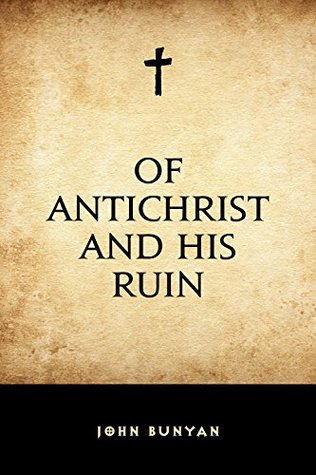
Of Antichrist And His RuinJohn Bunyan’s works are steeped in Scripture. His thoughts about the Antichrist and other end times events are either directly taken from biblical passages, or else his line of reasoning fits perfectly with the intent of the Scriptures. You can read my full book review by clicking here. Below are some quotes I found enlightening.

“Coercion, in anything connected with religion, whether it imposes creeds, liturgies, or modes of worship, is Antichrist: whom to obey, is spiritual desolation, and if knowingly persevered in, leads to death.” —George Offor, editor

“As God therefore did put it into the hearts of the wicked kings of Babylon, to distress in His church and people for their sins; so He put it into the hearts of the kings of the Medes and Persians, who were to be, in a sense, their saviors; to ease them of those distresses, to take off the yoke, and let them go free.”

“This twenty years we have been degenerating, both as to principles, and as to practice; and have grown at last into an amazing likeness to the world, both as to religion and civil demeanor.” 

“Take heed in laying the cause of your troubles in the badness of the temper of governors. … God is the chief, and has the hearts of all, even of the worst of men, in His hand. Good tempered men have sometimes brought trouble; and bad tempered man have sometimes brought enlargement to the churches of God: Saul brought enlargement (1 Samuel 14:28). David brought trouble (2 Samuel 12:10).) Ahab brought enlargement (1 Kings 21:29). Jehoshaphat and Hezekiah did both sometimes bring trouble (2 Chronicles 19:2; 20:35; 32:25). Therefore, the good or bad tempers of men sway nothing with God in this matter; they are the sins or repentances of His people, that make the church either happy or miserable upon earth.”

“Antichrist is the adversary of Christ; an adversary really, a friend pretendedly. So then, Antichrist is one that is against Christ; one that is for Christ, and one that is contrary to Him (and this is that mystery of iniquity [2 Thessalonians 2:7]). Against Him in deed; for Him in word, and contrary to Him in practice. … Christ prefereth His Father’s will above heaven and earth: Antichrist prefereth himself and his traditions above all that is written, or that is called God, or worshiped.”

“Nor can all the fallen angels, with all the members and limbs of Antichrist, cause that their brat should abide so much as one day longer than our God’s prefixed time.”

“Now, by ordinances of Antichrist, I do not intend things that only respect matters of worship in Antichrist’s kingdom, but those civil laws that impose and enforce them also; yea, that enforce that worship with pains and penalties, as in the Spanish Inquisition. … What could the king of Babylon’s golden image have done, had it not been for the burning fiery furnace that stood within view of the worshipers (Daniel 3)? Yea, what could that horrible command, to pray for thirty days to neither God nor man, but to the king, have done, had it not been for the dark den and the roaring lions therein ready to devour those that disobeyed it (Daniel 6)? … For as the furnace would have been next to nothing, if void of fire; and the den as little frightful, if destitute of lions; so these laws will be as insignificant, when Christ has slain that spirit that is in them; that spirit that causes that as many as will not worship the image of the beast, should be killed.”

“What say ye now, ye sons of God! Will you learn to make a judgment of things according to the mystery of the wisdom of God, or will ye longer conclude according to sense and reason?”

“Cold blasts in November are not received with that gentleness as are colder in March and April; for that these last cold ones are but the farewell notes of a piercing winter; they also bring with them the signs and tokens of a comfortable summer. Why, the church is now at the rising of the year; let then the blasts at present, or to come, be what they will, Antichrist is assuredly drawing towards his downfall.”

3 Bible Studies For You To Try

Book by book studyLast week I spoke and wrote about some tools you might use to study your Bible. Now I’d like to share some Bible study projects you might try with those new tools. As always, I recommend that beginning Bible studies go verse by verse through the Bible. I believe you will lay a strong foundation for your faith when you systematically put God’s Word into your heart.

Book By Book

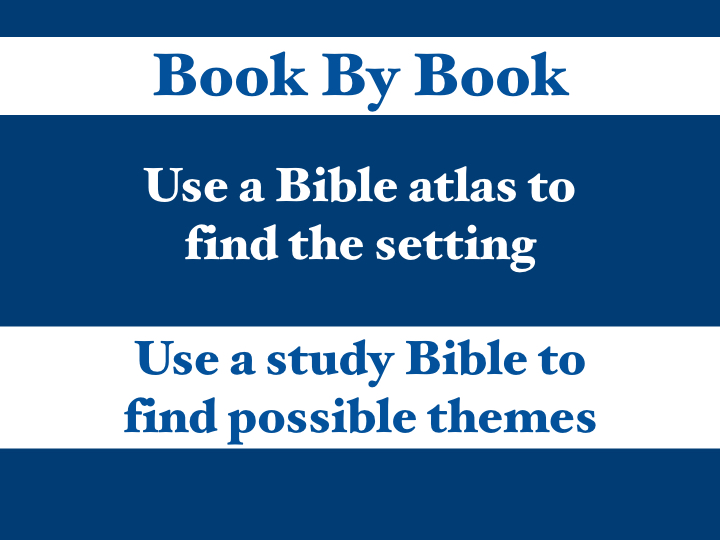
I’ll use the book of Ephesians as an example. Using my Bible atlas I find that the city of Ephesus is located along an important trade route, and it is the Roman capital of the province of Asia. My Full Life Study Bible tells me that because so much trade passed through this city, this letter was probably intended to be a circular letter for all of the communities near Ephesus. As a result, Paul is not addressing any specific problems in this church, but writes theological ideas for a broad spectrum of people.

As I begin reading, I paused in the first verse when I came to the phrase “the faithful in Christ.” I asked myself, “What does it mean to be faithful IN Christ? Can I be faithful outside of Him?” By the time I got to verse 3, I saw a similar phrase: “every spiritual blessing in Christ.” Now I went back and used a blue highlighter (there’s nothing special about blue, it just happened to be the first highlighter I grabbed), and marked those two “in Christ” phrases. I see two more in verse 4: “He chose us in Him” and “holy and blameless in His sight.” Going through the whole book I discovered 36 times the phrases “in Christ” or “in Him.” This is helpful to me to know the kind of security I have in Jesus.

Another thing that stood out to me were Paul’s prayers for the church. I see His very moving prayers in passages like 1:15-19 and in 3:14-21. I also see in 6:18 that he tells us to pray all kinds of prayers for ourselves and for others. And I see in 6:19 that Paul asked the church to pray for him too.

And always look for “therefore” phrases. For example in 4:24-25 or 4:32-5:1. The “therefore” phrases tell us how to live or think in light of the ideas that were just shared.

Chapter By Chapter

A good place to do this is in the Psalms or Proverbs. These are usually stand-alone chapters. When reading the chapters in these two books, I love reading them in parallel with other translations. For example, check out this from Psalm 1.

In Psalm 59, notice the superscript (or introduction). This gives us some background information to the psalm. Using my concordance, I found that this psalm was written this time in David’s life.

There is usually a theme to each chapter of the Proverbs, so try to discover that. In Proverbs 2, I noticed the “if … then” statements. In the first four verses I see things like “IF you will seek wisdom like this,” and then in verses 5-22 I see a whole bunch of blessings that follow the “then” that starts verse 5.

Word By Word

Sometimes I like to go really deep in a passage, so I slow down and look at it word by word. Here you need to use a Strong’s Concordance of the Bible. I like the one available on Blue Letter Bible. For example, next to 2 Peter 1:5, you can hover over the word “Tools” and select “Interlinear.” Clicking on “Interlinear” you will see all of the Greek words that make up this verse. By clicking on the Strong’s number, you can see the definition of that Greek word. Scrolling down a bit, you can see all of the other verses where that Greek word is used in the New Testament.

None of these tools are meant to take the place of the Holy Spirit. He is called the Spirit of Truth, and since He is the One who inspired all of the Scripture, ask His help before you begin any Bible study.

Here are two more Bible studies for you to try.

In this video I go into more detail on how I undertake all of these Bible studies. And be sure to join us next week as we take another look at different types of Bible studies.

The Power Of Confession

God restoresGod wants to meet with us. He loves hearing our voice and talking to us. We can come into His presence at anytime, with anything and everything that’s on our heart, and know for sure that He is waiting to hear from us.

But there is one thing that can short-circuit this intimate relationship. And if we don’t deal with this one thing quickly, it could lead to disastrous results.

This one thing is unconfessed sin.

Adam and Eve sinned, and started a downward slide that we continue in today. First, they tried to cover up their sin (Genesis 3:7). Think about this for a moment. They made clothes out of fig leaves. What happens to leaves when are detached from their vine? Yep, they die and shrivel up!

Next, they tried to hide from God (Genesis 3:8-10). Really? You can hide from God?! That’s sort of like a toddler covering her eyes and thinking since she can’t see daddy, he can’t see her either.

Then they made excuses for their sin (Genesis 3:11-13). Of course, they said, we would have never sinned on our own. She made me do it! The devil made me do it!

None of this worked. Instead it kept them in fear of God’s presence!! 

A beautiful prayer of confession of his sin is David’s prayer in Psalm 51. Notice this:

  • He was assured of God’s unfailing love and His great compassion (v. 1).
  • He confessed his sin without excuse. Five times in verses 1-3 he says my transgression, my sin, my iniquity.
  • He let God restore him (vv. 7-12)

It works so much better when God does the restoring! Instead of the fig leaves which were dying, God Himself made clothes for Adam and Eve (Genesis 3:21). This was a foreshadowing of the of way God will clothe all men and women who confess their sin, and place their faith in Christ’s work on Calvary (Ephesians 5:26-27).

Don’t let unconfessed sin keep you from God’s presence! Quickly confess your sin, and let God clothe you in the righteousness of Jesus.

We’ll be continuing our look at Practical Prayer this Sunday, and I hope you can join me. If you cannot join us in person, check out our live broadcast on Periscope.

Expectation Or Superstition?

Safe placeWhat good is it to pray if we don’t expect to receive anything from God? Isn’t that just making “prayer” a superstition? Instead, the Bible tells us that we can have “a remarkable degree of confidence” that when we take something to God in prayer, we can expect something great (1 John 5:14-15)!

Our prayer closet should be the safest place for us to express ourselves. You might have a close friend with whom you can “be yourself.” You can pour everything out to your friend, knowing that they will still love you. And yet, even with that really close, true-blue friend there are still times you hold back.

God doesn’t want that from us.

Check out David’s prayer closet. He had no problems telling God how he felt about the bad guys who were after him (Psalm 56:5-7; 57:3; 58:6-8; 59:13). Here’s the important thing to note: David poured out these words only in God’s presence. We don’t read anywhere in the Bible where David yelled these words at his enemies, or even shared these thoughts with his close friends.

Instead David said, “Trust in Him at all times, O people; pour out your hearts to Him, for God is our refuge” (Psalm 62:8). Pouring out your heart to anyone else can sound like gossiping, picking a fight, or whining!

When David got it all out in God’s presence, he experienced two really cool things:

  1. His swirling, angry thoughts were quietedfor God alone my soul waits in silence.
  2. He came away with an expectation of God’s helpmy soul, wait thou only upon God; for my expectation is from Him.

What about you? Are you being honest in prayer? Are you pouring out all of your hurts and doubts and frustrations to your Heavenly Father? Do you expect Him to answer you?

Here’s how you can tell if you aren’t praying with total honesty … you will walk out of your prayer closet still in turmoil. When you truly unload your heart in God’s presence, He will give you a peace that is so beyond anything you could have worked up yourself (Philippians 4:6-7).

Check this out…

Join me next Sunday as we continue our look at Practical Prayer.