Full

These are my unedited notes in my personal journal after reading…

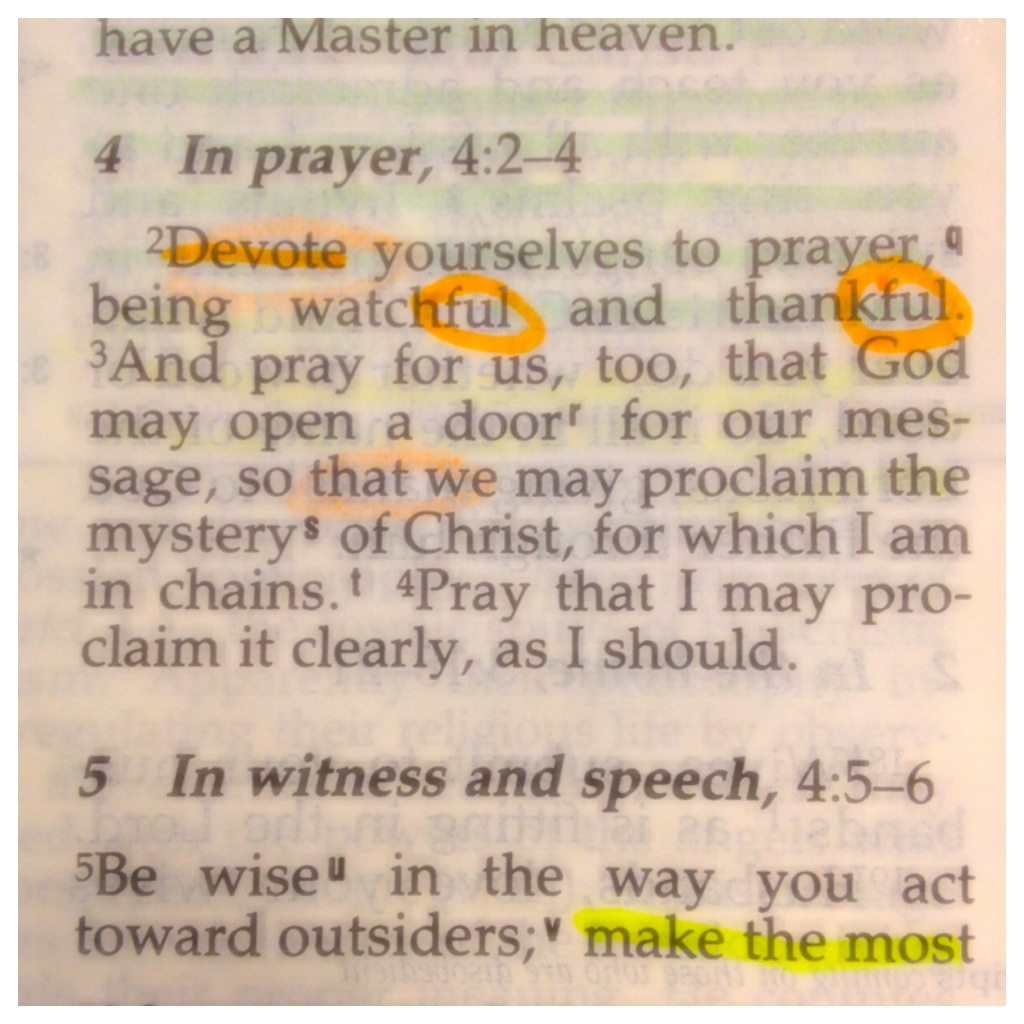
Devote yourselves to prayer, being watchful and thankful. And pray for us, too, that God may open a door for our message, so that we may proclaim the mystery of Christ, for which I am in chains. Pray that I may proclaim it clearly, as I should. Be wise in the way you act toward outsiders; make the most of every opportunity. Let your conversation be always full of grace, seasoned with salt, so that you may know how to answer everyone. (Colossians 4:2-6)

Wisdom = sophia → heavenly wisdom that is earthly practical. I use this wisdom to “let my conversation be always full of grace, seasoned with salt, so that I may know how to answer everyone” (v. 6).

Every opportunity … always full of grace … answer everyone

How do I stay “salty” and graceful?

Grace-full comes from being prayer-full, watch-full, and thank-full (v. 2). And these come from being devoted to those things. I am not grace-full by accident; it is the fruit of prayer-fullness, watch-fullness, and thank-fullness. I don’t accidentally pray, watch, and give thanks; those come because I am devoted to them.

Or rather, devoted to the One who is eternally grace-filled. The One who is supremely worthy to be worshiped, and adored, and served, and glorified. I worship Him and glorify Him best when I tell others about Him. After all, I don’t glorify and promote anything in which I’m only casually interested. My devotion to God spills out in my devotion to prayer, watching, and thanking. And this develops the fruit of grace-fullness, which draws others to God.

O Lord, may I be utterly FULL of You!

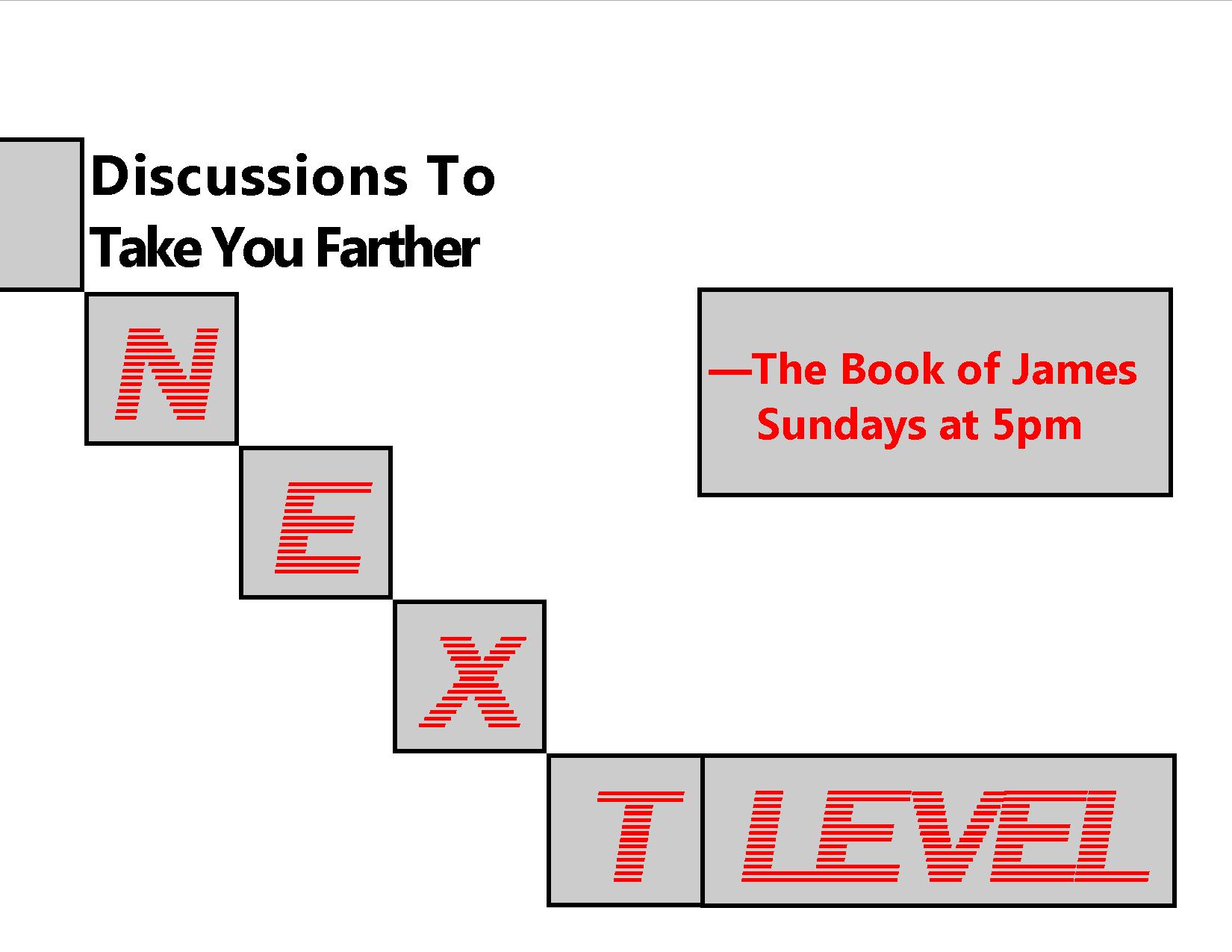
Next Level: James

It was a time of explosive growth. And with that growth came challenges, questions, problems, and opportunities! I’m talking about the Church in its earliest days in Jerusalem.

The Bible tells us that God prepares people in advance (Colossians 2:10) to do the works that He has equipped them to do. Into this environment of rapid growth and previously unheard-of opportunities stepped a man named James. His leadership and wisdom were just what the church needed then.

And his leadership and wisdom are just what the church needs now.

That’s why I’m leading our Next Level study group into an in-depth look at the book James wrote. The wisdom that is found in the Book of James has been called “the proverbs of the New Testament,” and we’ll be learning how to apply those proverbs to our lives and our church.

Please join me for this fascinating and informative study at 5pm each Sunday afternoon.

Intercession

Listen to the podcast of this post by clicking on the player below, and you can also subscribe on AppleSpotify, or Audible.

Intercession is prayer for others. How it must please our Heavenly Father when we long for—and pray for—the advancement of others.

Since the day we heard about you, we have not stopped praying for you. (Colossians 1:9)

The apostle Paul prayed that the Colossians would grow in the knowledge of God’s will, in spiritual wisdom, and in godly understanding. He knew that with these tools they would be able to live a life worthy of the Lord and [be able to] please Him in every way (v. 10). The outward signs of this worthy life, Paul explains, are:

  • Doing good works
  • Knowing God more intimately
  • Developing greater endurance, patience, and empathy
  • Overflowing in thankfulness
  • Building up other saints (vv. 11-12)

Did you catch that last point: building up other saints. One of the “other saints” would be Paul himself!

So when my prayers shift from petition (praying for what I need) to intercession (praying for what others need), as other people grow in God, they build me up!

What an amazing thought:

The way I get what I need from God is to stop thinking about myself and praying for myself, and to start interceding for others.

That is the power and the blessing of intercessory prayer!

►► Would you please prayerfully consider supporting this ministry? My Patreon supporters get behind-the-scenes access to exclusive materials. ◀︎◀︎

Commissioned = Struggling

As I like to do on Fridays, this post is especially for my fellow pastors.

I have become [the church’s] servant by the commission God gave me to present to you the Word of God in its fullness. (Colossians 1:25)

Let’s be honest: What pastor wouldn’t say he/she wants to “serve” the church?

But look at Paul’s definition of a servant of the church (Colossians 1:24-2:5):

  • Suffering
  • Rejoicing in that suffering
  • Proclaiming the gospel
  • Admonishing the saints
  • Teaching with all wisdom
  • Maintaining a passion for everyone’s perfection
  • Laboring
  • Struggling

That’s quite a list!

Paul also says, “I want you to know how much I am struggling for you” (2:1). The word here and in 1:29 come from the same root word meaning: A contest (whether sports or a courtroom trial) in which there is a large audience, and in which one contestant is representing a larger group.

It’s like an Olympic athlete competing for his country, or an attorney speaking on behalf of her clients.

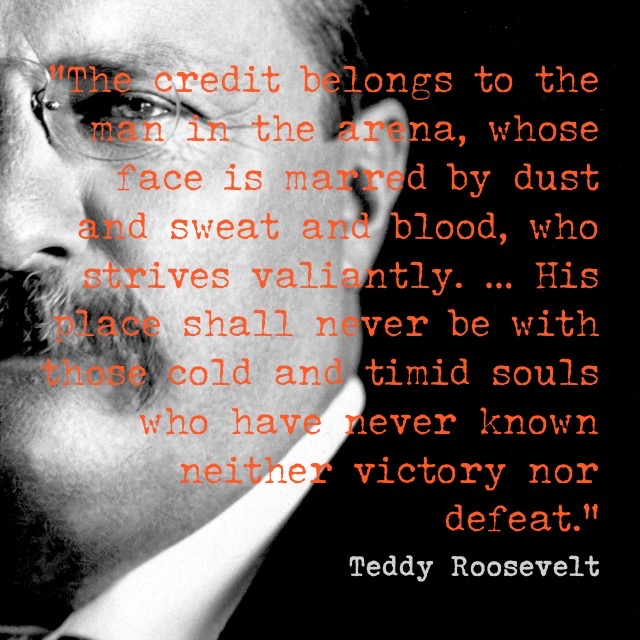
Then Paul adds, “I tell you this so that no one may deceive you by fine-sounding arguments” (2:4). In other words, actions speak louder than words. As Teddy Roosevelt famously said—

“It is not the critic who counts; nor the many who point out how the strong man stumbles, or where the doer of deeds could have done them better. The credit belongs to the man in the arena, whose face is marred by dust and sweat and blood, who strives valiantly…who knows the great enthusiasms, the great devotions, who spends himself in a worthy cause, who at the best knows in the end the triumph of high achievement, and who at the worst, if he fails, at least fails while daring greatly, so that his place shall never be with those cold and timid souls who have never known neither victory nor defeat.”

Pastor, stay in the arena!

Don’t walk away from the struggles!

Persevere through the difficulties!

People are watching you. What people? Specifically those sheep whom God has commissioned you to shepherd in His pasture. So stay in the fight!

I’m praying for you!

Why Do You Read The Bible?

Do you exercise? Why? What’s the purpose of all of your exercises? To get stronger? To last longer? To get or stay healthy? Yes! But to what end? Why do you want to be stronger, have greater endurance, or better health?

I could ask the same question regarding the spiritual realm: Why would you want to do a spiritual workout? To quote more Bible verses? To have more endurance in prayer? But why do you want to know more of the Bible, or pray better or longer?

Our goal should be simply this: To know God more intimately.

We have to be careful about being so focused on the workout that we miss the purpose (or should I say the Person). Andrew Murray wrote this:

“Christian! there is a terrible danger to which you stand exposed in your inner chamber. You are in danger of substituting Prayer and Bible Study for living fellowship with God, the living interchange of giving Him your love, your heart, and your life, and receiving from Him His love, His life, and His spirit. Your needs and their expression, your desire to pray humbly and earnestly and believingly, may so occupy you, that the light of His countenance and the joy of His love cannot enter you. Your Bible Study may so interest you, and so waken pleasing religious sentiment, that—yes—the very Word of God may become a substitute for God Himself, the greatest hindrance to fellowship because it keeps the soul occupied instead of leading it to God Himself.”

Our spiritual workouts should help us integrate God’s presence into our souls. He is not just someone that we know about; He is the One we know. The One we have let into our hearts. The One who is at the very center of our being. He is the CORE of who we are.

So then, just as you received Christ Jesus as Lord, continue to live in Him. Have the roots [of your being] firmly and deeply planted [in Him, fixed and founded in Him], being continually built up in Him, becoming increasingly more confirmed and established in the faith, just as you were taught, and abounding and overflowing in it with thanksgiving. (Colossians 2:6-7 AMP)

Don’t lose sight of WHY you read the Bible, and respond in prayer; of why you glorify God and enjoy Him forever; of why you go through your spiritual workouts. You do all of this because Christ is in you, and you are in Christ, and you want to strengthen this core relationship, and let everything else that you do flow out from this core!

If you have missed any of the messages in our P119 series, you can access them all by clicking here.

Open Door

Listen to the podcast of this post by clicking on the player below, and you can also subscribe on Apple or Spotify.

The phrase open door shows up several times in the New Testament, and it shows up quite a bit in the present-day vocabulary of many Christians too. But I’m not sure we mean the same thing.

I hear Christians saying things like, “I’m praying for God to open a door for a new job,” or “I’m waiting to see what door God will open for my schooling,” or something to that effect. In other words, the open door seems to be for our personal benefit.

The apostle Paul said this:

A great door for effective work has opened to me, and there are many who oppose me (1 Corinthians 16:9).

Let’s get one thing clear: God opens doors (we don’t), and our job is to obediently walk through those open doors (God won’t shove us through them).

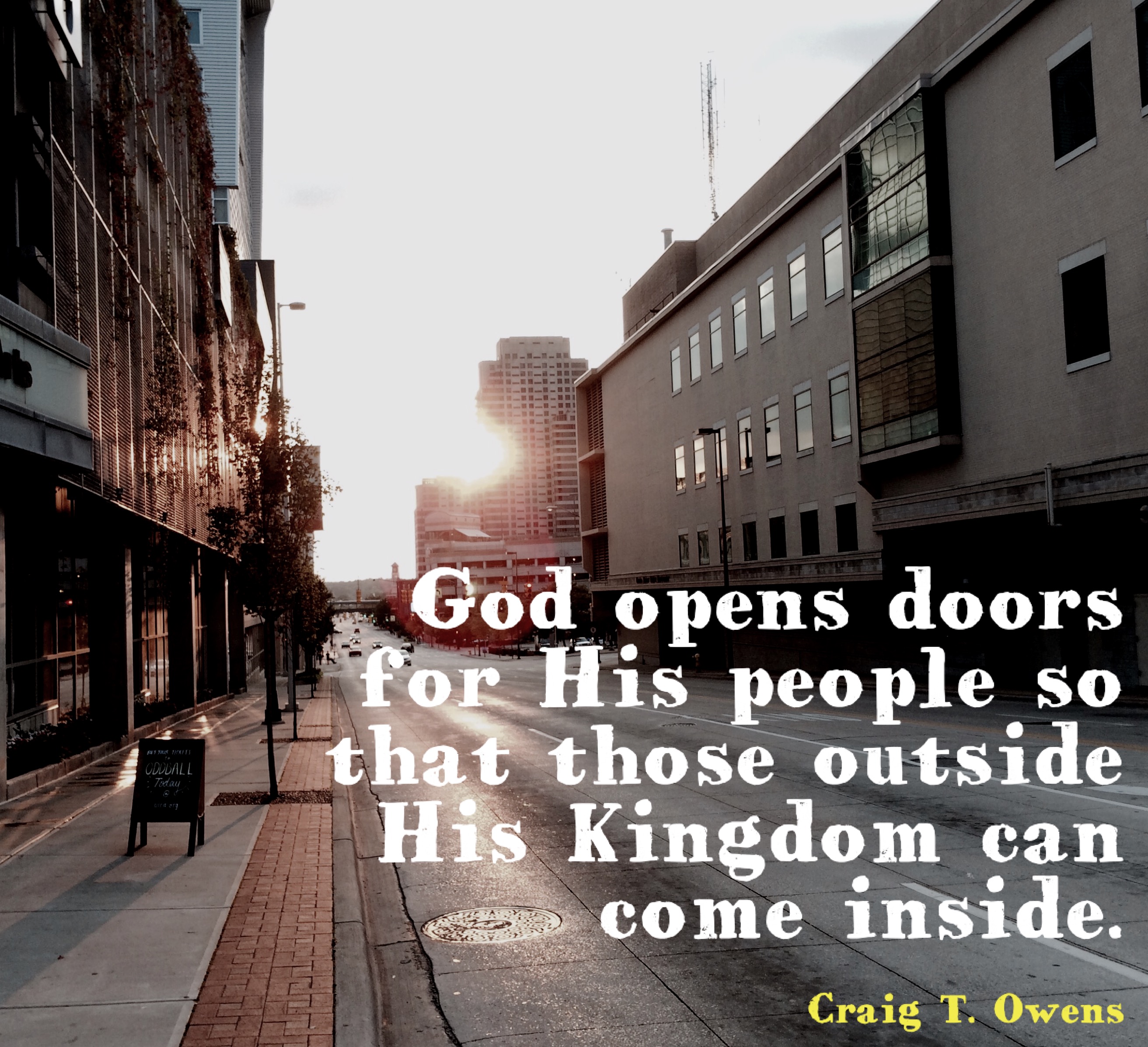
Paul knew that the open door was not for his benefit, but for the benefit of those who were presently outside of the Kingdom of God. God opens doors for His people so that those outside His Kingdom can come inside (see Acts 14:27; 2 Corinthians 2:12; Colossians 4:3).

It might look like God opened a door by providing a job, but that job is His means to help you invite others into His Kingdom. The open door (the job, in this case) isn’t primarily for you; it’s for you to invite others in.

That’s why when God opens doors there will be many who oppose you. They are not really opposing you, but they are opposing the opportunity for the kingdom of darkness to be robbed and the Kingdom of God to be enriched.

So when you pray for open doors, remember:

  • When God opens a door, it’s mainly for the benefit of those outside the Kingdom of Heaven
  • You will be opposed by the kingdom of darkness

If you’re ready for both of those, then by all means pray for open doors!

►► Would you please prayerfully consider supporting this ministry? ◀︎◀︎

Thursdays With Oswald—Destroyed By Neglect

This is a weekly series with things I’m reading and pondering from Oswald Chambers. You can read the original seed thought here, or type “Thursdays With Oswald” in the search box to read more entries.

Destroyed By Neglect

Mortify therefore your members which are upon the earth; fornication, uncleanness, passion, evil desire, and covetousness, the which is idolatry. (Colossians 3:5 RV)

     In this passage Paul mentions things that are of the nature of rubbish, and he mentions them in their complete ugliness. They are the abortion of the stuff human nature is made of, and he says, ‘Mortify them, destroy them by neglect.’ Certain things can only be dealt with by ignoring them; if you face them you increase their power. It is absurd to say, Pray about them; when once a thing is seen to be wrong, don’t pray about it, it fixes the mind on it; never for a second brood on it, destroy it by neglect.

From Biblical Ethics

What things in my life do I need to stop praying about, and simply stop doing them?

Stop praying and mortify them … destroy them by starving them … strangle them by not giving them the oxygen of thought … abandon them like yesterday’s trash.

Some things do require prayer. And other things just need to be neglected.

Thursdays With Oswald—Intercessory Prayer

This is a weekly series with things I’m reading and pondering from Oswald Chambers. You can read the original seed thought here, or type “Thursdays With Oswald” in the search box to read more entries.

Intercessory Prayer

     You cannot truly intercede through prayer if you do not believe in the reality of redemption. Instead, you will simply be turning intercession into useless sympathy for others, which will serve only to increase the contentment they have for remaining out of touch with God. True intercession involves bringing the person, or the circumstance that seems to be crashing in on you, before God, until you are changed by His attitude toward that person or circumstance. Intercession means to ‘fill up . . . [with] what is lacking in the afflictions of Christ’ (Colossians 1:24), and this is precisely why there are so few intercessors. People describe intercession by saying, ‘It is putting yourself in someone else’s place.’ That is not true! Intercession is putting yourself in God’s place; it is having His mind and His perspective.

From My Utmost For His Highest

How arrogant on my part to tell God what He needs to do for me or for someone else!

Instead I need to pray that my eyes of faith will be open. I want to have faith to believe that God knows the plans He has for me (Jeremiah 29:11), and that He is working all things together for the good for those who love Him (Romans 8:28).

Intercessory prayer is hard work. But the rewards are so worth it!

Thursdays With Oswald—Instantly Detecting Compromise

This is a weekly series with things I’m reading and pondering from Oswald Chambers. You can read the original seed thought here, or type “Thursdays With Oswald” in the search box to read more entries.

Instantly Detecting Compromise

     We must be continually renewed in the spirit of our mind so that the slightest beginning of compromise with the spirit of the world is detected. “Well, what’s the harm; there’s nothing wrong in it,” when you hear that you know you have the spirit of the world, because the Spirit that comes from Jesus says, “Does this glorify God?”

From Biblical Ethics

There’s a HUGE difference between a Christian being in the world and of the world. A Christian who is compromising, is slowly becoming of the world. They say, “This isn’t wrong.”

A Christian who is uncompromising, is slowly becoming in the world but of Heaven. They judge everything by whether or not it brings glory to God.

Compromise is the slow erosion. Seldom does one go from a passionate follower of God to a worldly person suddenly. It is the small compromises day after day that are the most dangerous.

So one of my frequent prayers must be—

Search me, O God, and know my heart; test me and know my anxious thoughts. Point out ANYTHING in me that offends You. (Psalm 139:23-24, NLT)

The Blessing Of Fullness

Thanksgiving Day 2011 is over, but the days for giving thanks should never be over. Although that sounds humorous, for many of us it is an important reminder. We need to remind ourselves because it is so easy for us to go from overflowing with thankfulness, to feeling depleted and empty.

This is exactly what Paul reminded the Colossians in part 3 of our Overflowing With Thanks series—

Devote yourselves to prayer, being watchful and thankful. (Colossians 4:2)

Here’s how the cycle works:

  • When we are thank-full to God for His blessings, we enthrone Christ in our hearts.
  • When we are Christ-full, He brings with Him all of the peace we will need.
  • When we are peace-full, the peace of God, which transcends all understanding, will guard your hearts and minds in Christ Jesus (Philippians 4:7).
  • When our hearts and minds are clear, we can better see the blessings for which we can thank God.
  • And when we are thank-full to God for His blessings, we start the cycle all over again.

We don’t have to run dry, or become depleted, or lose our joy, or be robbed of our peace. If we will remain watch-full to be thank-full, we will remain Christ-full, which will keep us peace-full.

May we never lose the blessing of fullness!