Cultivation Of Christian Character (book review)

I’ve always enjoyed reading J. Oswald Sanders. Let me rephrase that: I enjoy the new insights on God’s Word that Sanders’ books have given me, but the confrontation of the Holy Spirit that comes while reading these books can be quite painful at times. Cultivation Of Christian Character is no exception! 

In his opening words, Sanders explains the purpose of “this little volume” (as he calls it)—

“The genuine disciple of Christ earnestly desires a closer walk with God and a greater conformity to Christ. If these are absent, there is reason to doubt the genuineness of the discipleship. But many true lovers of the Lord are beset with a sense of inadequacy and failure in living the Christian life as it ought to be lived. They are very conscious with Paul that they have not already attained, neither are already perfect, but they yearn to know Christ better and to serve Him more worthily.” 

There you have it in a nutshell: If you yearn to be more Christlike, and yet at the same time struggle with how far you still have to go to see the fruits of Christlikeness in your life, this is the book for you. 

The chapters are short enough to read in just a few minutes. But the thought processes and the heart-searching that these short chapters will stimulate will undoubtedly take a long time to assimilate into your daily life. At least, this is the case for me. 

None of J. Oswald Sanders’ books are long books, but all of his books live long inside of me. Dive into Cultivation of Christian Character with an attitude of ready submission to the Holy Spirit, and then watch the amazing fruitfulness and Christlikeness that will begin to blossom from your life. 

I am a Moody Publishers book reviewer. 

7 More Quotes From “Start With The Heart”

Dr. Kathy Koch has given parents—and anyone else who works with children—a marvelously helpful resource in her latest book Start With The Heart. Be sure to check out my full book review by clicking here. 

“God created you and your children with five core, basic needs that must be met. These needs are interrelated. The health of one influences the others:

  • Security—who can I trust?
  • Identity—who am I?
  • Belonging—who wants me?
  • Purpose—why am I alive?
  • Competence—what do I do well?” 

“Children who know their purpose will often choose to look for peers with similar goals and interests. They will want to hang out with people who affirm them and their purpose and be willing to end relationships that are not joyful and purposeful.” 

“When you parent so your children believe three things, their hearts will be impacted and they will be motivated to succeed. This translates into less stress and anxiety and more peace. … Children who believe these things don’t want to be average. They are willing to work for more. … Children’s character will be more Christlike. They’ll want to be more others-centered than self-centered. They’ll be compassionate, brave and able to stand up for themselves and others. 

  1. I have value. Children who do know they have value are often motivated intrinsically, from the inside. They internally recognize what is good for them and respond accordingly.
  2. Learning matters. When children believe they have worth, they are more likely to value learning. … Children who value learning will exhibit many positive character traits, including teachability. This will be true even when they are not convinced that your requests or planned activities are relevant. They’ll pay attention anyway because they know they matter and learning matters. These beliefs strengthen children’s purpose and give rise to competence.
  3. My future can be bright.” 

“Which is better: ‘Be on time!’ or ‘Don’t be late!’? Do you hear the difference? Which one is positive? ‘Be on time’ communicates ‘I believe you’re capable of this.’ It’s more hopeful. It’s about what you want your children to do. ‘Don’t be late’ reminds them of how they’ve frustrated you.” 

“Carol Dweck…has consistently found that children praised for using effort tackled more challenging tasks than those praised just for ability or for the quality of their work.” 

“Sometimes have children tell you what they think they did before you offer your opinions. If they are relatively accurate, affirm them specifically. When they’re not, have the conversation.” 

“Working to provide feedback that can be described with the following attributes will serve you and your children well—specific, believable, helpful, and thoughtful.” 

You can also check out the first set of quotes I shared from Start With The Heart by clicking here.

The Autobiography Of Charles Spurgeon (book review)

For a man who preached up to 10 times per week for nearly 40 years, you would think that people knew all about Charles Spurgeon’s personal life. Although he frequently used some small personal examples in his sermons, he still kept much of his personal life personal. In reading Spurgeon’s Autobiography, I expected to get an inside look, but that was not what I found. 

Like his sermons, Spurgeon’s Autobiography was fascinating. Like his sermons, his recollections of his past are thoroughly steeped in Scripture. I love this! This shows us that this Prince of Preachers didn’t just put on a performance when he stepped into his pulpit, nor did he simply teach Christian principles for others to apply only to their lives; instead, we see a man who truly patterned his life after the Bible. 

I also love the honesty in Spurgeon’s stories. He tells of his struggles before and after his conversion. He talks openly of his disagreements with some “church” people that didn’t behave very Christ-like. He discusses his battles with depression, and with those who were outright critics of his ministry. In other words, Spurgeon reveals himself without putting himself on some sort of pedestal. 

Charles Spurgeon’s sermons are always a delight to read, but I think you will find in his Autobiography a living sermon that we can all emulate. 

Thursdays With Spurgeon—Evidence Of Christian Maturity

This is a weekly series with things I’m reading and pondering from Charles Spurgeon. You can read the original seed thought here, or type “Thursdays With Spurgeon” in the search box to read more entries.

Evidence Of Christian Maturity

     One of the first evidences that anyone is a child of God is that he hates with a perfect hatred and seeks to live a holy, Christlike life. … 

     I bless God that I have learned to have very little respect for the vision of the man with the measuring line. When I see an angel with it, I am glad enough; but when I see a man with it, I tell him that he must give me a warrant from God and show me how he is to know the elect by any other method than that laid down by our Lord Jesus Christ: “Ye shall know them by their fruits” (Matthew 7:16). … 

     He who truly grows in grace does not say, “Dear me! I can feel that I am growing; bless the Lord! Let’s sing a hymn. ‘I’m a-growing! I’m a-growing!’” I have often felt that I was growing smaller; I think that is very probable, and a good thing, too. If we are very great in our own estimation, it is because we have a number of cancers, or foul gatherings, that need to be lanced, so as to let out the bad matter that causes us to boast of our bigness. 

From The Autobiography Of Charles Spurgeon 

Some Dos and Don’ts for Christian growth:

Do—hate those things that keep you from God’s presence
Do—seek to be conformed to the image of Jesus

Don’t—look at other people as your measuring line
Do—make sure your life is fruitful according to God’s standards

Don’t—brag about your growth
Do—humbly thank God for your growth
Do—be quick to repent of un-Christlike things the Holy Spirit reveals to you


Am I Getting Passing Grades?

The Apostle Paul tells us to “be transformed by the renewing of your mind” (Romans 12:2). This implies that there is an ongoing process of evaluation and renewal. This starts when I give up my way of doing things (v. 1), and then the remainder of that 12th chapter is a checklist of changes in behavior that come about because of the renewing of our minds. 

We need a regular report card on—
☐ Seeing myself in the right light of faith
☐ Knowing and using my God-given gifts 
☐ Loving without hypocrisy
☐ Avoiding evil
☐ Promoting good
☐ Loving others like brothers and sisters
☐ Not fighting for my way
☐ Being diligent in my work
☐ Being diligent in my spiritual health
☐ Serving God
☐ Rejoicing even in difficulties 
☐ Growing in patience
☐ Praying regularly
☐ Hospitably serving others
☐ Blessing my enemies
☐ Being appropriately empathetic 
☐ Finding common ground
☐ Remaining humble
☐ Repaying good for evil
☐ Not trying to get even
☐ Being a peacemaker
☐ Overcoming evil with good

Holy Spirit, I need Your honest evaluation. Show me my deficits, and then help me hear Your loving voice that guides me in the changes I need to make. I want Jesus to be seen in my life. Amen! 

The Difficulty In Answered Prayer

“Often it is simply the answers to our prayers that cause many of the difficulties in the Christian life.

“We pray for patience, and our Father sends demanding people our way who test us to the limit, ‘because…suffering produces perseverance’ (Romans 5:3). …

“We pray to be unselfish, and God gives us opportunities to sacrifice by placing other people’s needs first and by laying down our lives for other believers. …

“We pray to the Lord, as His apostles did, saying, ‘Increase our faith!’ (Luke 17:5). Then our money seems to take wings and fly away; our children become critically ill; an employee becomes careless, slow, and wasteful; or some other new trial comes upon us, requiring more faith than we have ever before experienced.

“We pray for a Christlike life that exhibits the humility of a lamb. Then we are asked to perform some lowly task, or we are unjustly accused and given no opportunity to explain….

“We pray for gentleness and quickly face a storm of temptation to be harsh and irritable. 

“We pray for quietness, and suddenly every nerve is tested to its limit with tremendous tension so that we may learn that when He sends His peace, no one can disturb it.

“We pray for love for others, and God sends unique suffering by sending people our way who are difficult to love and who say things that get on our nerves and tear at our heart. …

“The way to peace and victory is to accept every circumstance and every trial as being straight from the hand of our loving Father.” —Lettie Cowman, in Streams in the Desert (emphasis added)

Questions To Ask Myself

“When you are tempted to walk toward vanity, look at Christ’s holy walk and ask yourself…

  • Am I like Him in my thoughts and in the way I spend my time?
  • If He were physically living on earth right now, would He do what I am doing?
  • Would He not choose His words more carefully than I do?
  • Would silly speech come from His lips?
  • Would He enjoy my friends?
  • Would He spend a fortune pampering His body, and swallow enough food at one meal to feed hungry people for a week?
  • Would He be fashion-conscious, even if that made His appearance ridiculous and offensive?
  • Would His hands be busy with games that drive time away?
  • Should I do anything that would make me unlike Christ?”

—William Gurnall, in The Christian In Complete Armor

Thursdays With Oswald—The Fight That Builds Strong Character

Oswald ChambersThis is a weekly series with things I’m reading and pondering from Oswald Chambers. You can read the original seed thought here, or type “Thursdays With Oswald” in the search box to read more entries.

The Fight That Builds Strong Character 

     Morality is not something with which we are gifted, we make morality; it is another word for character. … Morality is not only correct conduct on the outside, but correct thinking within where only God can see. … 

     God gives us a new disposition, the disposition of His Son; then we have to work out what He has worked in, and the way we react in the circumstances God engineers for us produces character. … 

     Remember, morality is produced by fight, not by dreaming, not by shutting our eyes to facts, but by being made right with God; then we can make our morality exactly after the stamp of Jesus Christ. 

From The Fighting Chance

This book focuses on the passage in Romans 8:28-39, in which the Apostle Paul explains that despite any difficulty or uncertainty we face, nothing can separate us from God’s love.

When someone surrenders to God and invites Jesus into their life as Savior and Lord, God gives that person a brand new disposition. This new outlook on life, and this new strength within, allows the Christian to fashion a new morality and strength of character that he was unable to fashion before he was a Christian.

Don’t be afraid of the fight, because in Christ you are a conqueror. Don’t run from the fight, because it builds Christlike character. Don’t despair in the fight, because nothing will ever separate you from the love of God which put His Holy Spirit in you.

Your spiritual fight builds Christlike character in you like nothing else can!

Christlike Wives And Husbands

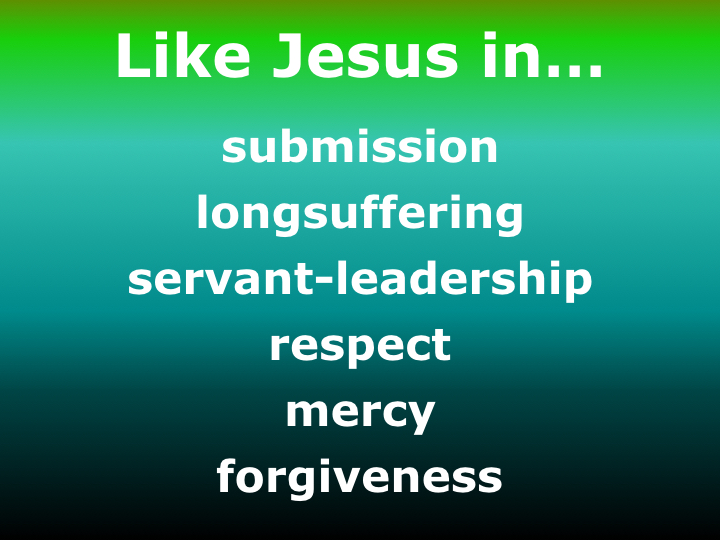
like-jesusTime after time Peter calls Christians to live a counter-cultural lifestyle. The most countercultural example we have ever seen is Jesus Christ.

Peter shows us how Jesus—in the most excruciating situation possible—lived. Heading into the torture of crucifixion…

  • He was submissive to His Father’s will
  • He remained focused on the future glory, not just the immediate pain
  • He continued to be a servant-hearted leader
  • He spoke to those around Him respectfully
  • He extended mercy to His tormentors
  • He prayed for (and purchased with His blood) His tormentors’ forgiveness

Peter then tells Christian wives and husbands they are to behave in the same way as Jesus. Wow!

More specifically Peter challenges Christlike wives to be:

  1. Submissive to their husbands—I like how the Amplified Bible says this in verse 1: “subordinate, not as inferior, but out of respect for the responsibilities entrusted to husbands and their accountability to God, and so partnering with them.”
  2. Christlike in their behavior.
  3. Distinctive by their purity.
  4. Reverent to God, by honoring the image of God in their husbands.
  5. Beautiful from the inside out.
  6. Consistently doing what is right
  7. Not swayed by fear—“do what is right without being frightened by any fear [that is, being respectful toward your husband but not giving in to intimidation, nor allowing yourself to be led into sin, nor to be harmed]” (v. 6 AMP).

Likewise Peter challenges Christlike husbands to be:

  1. Submissive to their wives—remember the in the same way phrase? That applies to the men too. Submit to one another out of reverence for Christ. … Husbands, love your wives, just as Christ loved the church and gave Himself up for her (Ephesians 5:21, 24).
  2. Considerate of her—the King James Version says, “dwell with them according to knowledge.” That word for knowledge means to study your wife and know what she likes and doesn’t like.
  3. Respectful in the way he treats his wife.
  4. Treating her as a partner and heir in your spiritual heritage.
  5. Understanding the part she plays in your spiritual development—“The same goes for you husbands: Be good husbands to your wives. Honor them, delight in them. As women they lack some of your advantages. But in the new life of God’s grace, you’re equals. Treat your wives, then, as equals so your prayers don’t run a ground” (v. 7 MSG).

Here are two questions I think Christian wives and husbands need to seriously consider: Are you thinking about your role as a husband or wife in biblical terms or cultural terms? If you are thinking in cultural terms, are you willing to try it God’s way?

Our Christian marriages should be “alien” to the way the world operates; they should be counter-cultural. That kind of marriage is what points people to a relationship with Jesus!

If you’ve missed any messages in this series, you may find the complete list by clicking here.

5 Ways To Be A Christlike Employee

Work like JesusHave you ever had a bad boss? One who was harsh, unreasonable, overly demanding, or just a plain meany? Do you think working for a “bad boss” means that you get to lower your standards?

Not if you are a Christian!

Christians are on Earth to represent Jesus. We are aliens and strangers here for a short time, but here to also point people toward Heaven. One place we have tremendous opportunity to do this is on our jobs.

Think about it: most people will work 30-40 hours per week, and probably work 40-50 years of their life. That’s a lot of hours in which to show that living for Jesus makes all the difference in the world. 

Peter addresses our work situation in his first epistle. In essence he says, “You may not be able to control your boss’s actions, but you can control your reactions. A Christian has a different attitude about workplace employers than Earthlings do.”

The two things that set Christian employees apart is their submission and their respect.

Submission means understanding the proper order. This isn’t just showing up on time, wearing the right uniform and checking off the right things on your job description. All of those things can be done with a lousy attitude, with an attitude that’s nothing like Christ’s attitude.

Submission means viewing our employers differently—

  • Obeying them like we would obey Jesus (Ephesians 6:5).
  • Being sincere when we say, “Yes, I’d be happy to do that” (Ephesians 6:5).
  • Working hard even when our employer isn’t watching us (Ephesians 6:6).

With that in mind, here are five ways to be an “alien employee.” That is, someone who honors God on-the-job…

  1. Work for God.
  2. Trust God to be your Provider, not your employer.
  3. Trust God to keep perfect records of your faithful service.
  4. Pray for God’s blessing on your employer.
  5. Pray for your employer to see Jesus in your work ethic.

Here’s a great question to ask yourself: If Jesus were filling out my employee evaluation, what would He say about my work ethic? 

If you’ve missed any messages in this series, you may find the complete list by clicking here.