Listen to the podcast of this post by clicking on the player below, and you can also subscribe on Apple, Spotify, or Audible.
I like to take some time at the end of each calendar year to both look back and look forward. Throughout biblical history, whenever God was ready to take His people into a new chapter, He always took time for them to review the ground they had already covered. So as we get ready to go into 2026, here is a look back at the things God taught us in 2025 through these sermon series I shared with the wonderful folks at Calvary Assembly of God.
Our Prayer Book. God has given us an amazing Book! The Bible addresses the human condition—all our desires, frustrations, hopes, and the only path on which we can find eternal and unfading joy. The Bible not only tells us how to live, but it also tells us how to pray. And it’s as we pray that the principles in the Scripture come alive with fresh applications for our daily life. We don’t have to fumble around, attempting to find the right words to pray and then wondering if those prayers were heard on high. We can learn to pray in agreement with God’s perfect will. God has spoken to us through His Word, and He invites us to use His words to form our prayers back to Him. I love beginning each new year with a reminder of the power of prayer.
When Sheep Bite Sheep. No one likes to be mistreated—especially when the one that hurts us is one we would have thought of as an ally or even a friend. These slights become even more painful when they take place inside the Christian community. When sheep bite sheep, our natural response is to lash out to try to even the scales of justice. But the Bible consistently and clearly calls Christians to pursue a supernatural response. This is a highly practical series of messages on how you can respond in a Christ-honoring way when you are bitten by another sheep in God’s pasture.
Grief Into Joy. At the end of your rope … down for the count … nothing but gray skies all around … unable to see any light at the end of the long, dark tunnel. Ever been there? The reality is, we all have been there. But the good news is that we don’t have to stay there! God is always at work to turn our apparent no-win, dark, hopeless situations into something bright and glorious! He is working in ways that no human mind could have dreamed up, and working on our behalf in a way no human power could ever hope to rival. God specializes in turning grief into joy! We are approaching the time of year where we remember the death of Jesus. Without a doubt that was the darkest, most grief-stricken day in all of history. Yet that time of mourning was completely forgotten in the overwhelming joy that exploded from an empty tomb on Resurrection Sunday!
We Are: Pentecostal. Pentecost for over 1500 years was a celebration in Jerusalem that brought in Jews from all over the world. But on the Day of Pentecost which came just ten days after Jesus ascended back into heaven, the meaning of Pentecost was forever changed! Followers of Jesus—now empowered by an infilling of the Holy Spirit—began to take the good news of Jesus all over the world. These Spirit-filled Christians preached the Gospel and won converts to Christ even among hostile crowds, performed miracles and wonders, stood up to pagan priests and persecuting governmental leaders, and established a whole new way of living as Christ-followers. We, too, can be Pentecostal followers of Jesus Christ today. We can experience an anointing and an empowering in our lives that turns ordinary Christianity into extraordinary Christianity!
All Hail King Jesus. The Bible closes with a vivid picture of Jesus as the undisputed King of kings, and we look forward to that time when all creation bows before Him. Even more so, we cannot wait to be with our King for ever and ever! The psalmists of Israel also foresaw the coming of this King, especially in the example they had in their King David. Many of the poetic words they penned esteemed Jesus as the King for Whom they longed. David himself not only saw the future coming of the Eternal King, but he also looked back in time to see Jesus reigning as King before time began. It is these royal psalms that we will be studying as we celebrate the first arrival on Earth of our King and as we anticipate the second coming of our Royal Majesty. The more clear our vision is of this King, the more we will worship Him, follow Him, and invite others to know Him as their own Lord and Master.
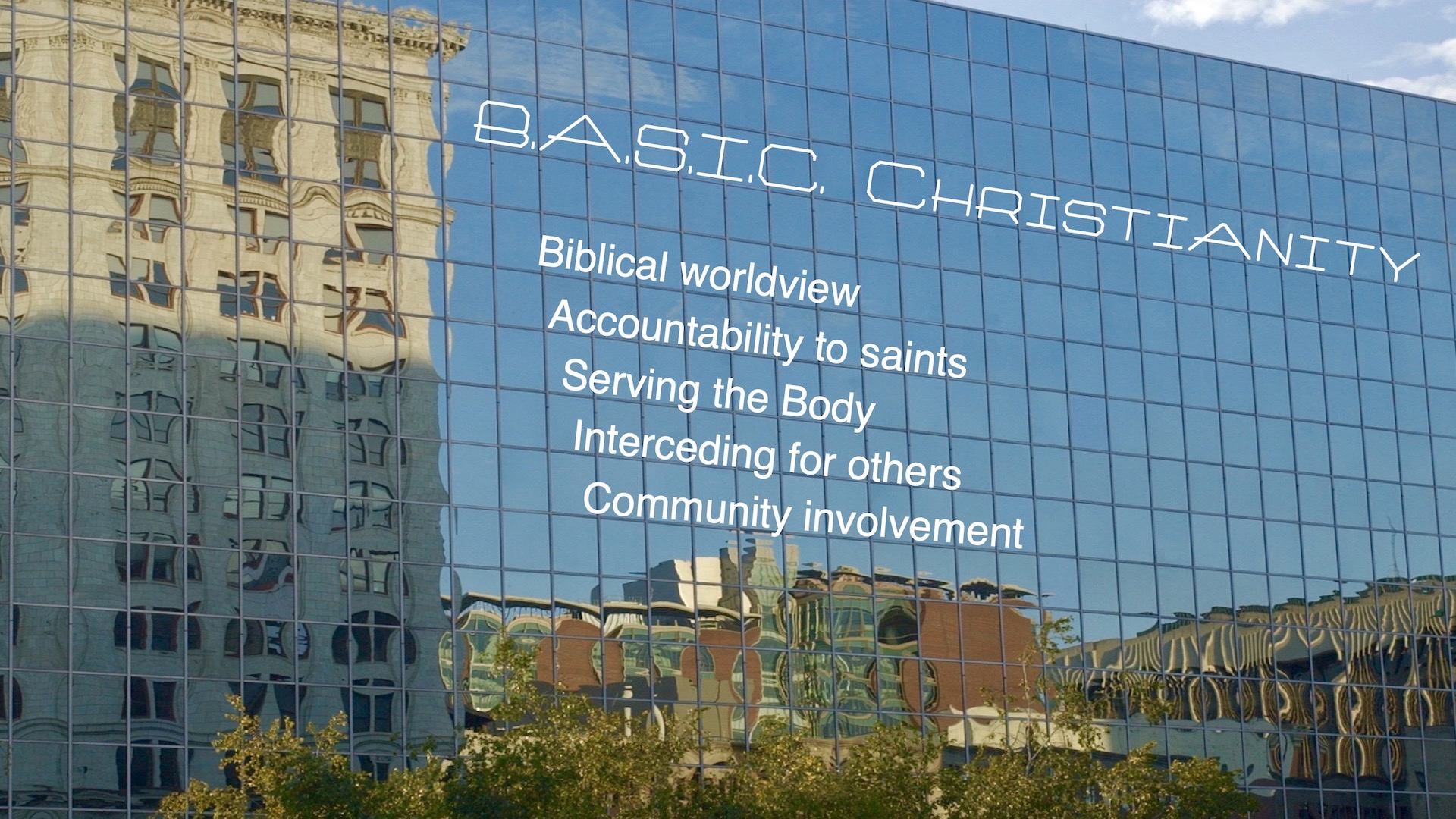
B.A.S.I.C. Christianity. When someone invites Jesus into their heart, they are immediately justified in God’s sight and have the assurance of Heaven as their eternal home. But then the question comes, “Now what?” Our justification is immediate but our sanctification is an ongoing, lifelong process. Sanctification is what brings fruitfulness to a Christian’s life and what allows that fruitful life to be a testimony to others. The Bible gives us the B.A.S.I.C.s of this Christian life, and that’s what we will be exploring over the next few weeks.
Earnestly Contend. Jude, the half-brother of Jesus, wrote a letter to the church. He said he was hoping to write about salvation, but looking at the conditions in the culture around him, he felt urged by the Holy Spirit to challenge Christians to “contend for the faith that was once for all entrusted to the saints.” What does this word “contend” mean for us today? Are Christians supposed to be combative about sharing their faith? Are they supposed to argue with anyone and everyone who disagrees with them on any point? Jude gives us Holy Spirit-inspired wisdom to understand how to deal with those who have departed from the purity of biblical truth.
What To Do In A Crisis. Look back through the pages of history and you will see a common theme. Whether it’s world history or your own personal history, you have so much for which you can give thanks. In tough times, we tend to become forgetful because we are so focused on the intensity of the moment. But if we will simply look back in time, we will see just how faithful God has been to us. We bring our focus back to Him in our trying times when we remember and rehearse “the wonderful things He has done” (Psalm 107). The season of Thanksgiving is a good time for us to be reminded of the powerful resource we have when we are giving thanks for our blessings. Thankful people are confident people because they choose hope in God’s faithful provision over grumbling about their current circumstances.
Jesus Is…. Over 700 years before He was born in Bethlehem, God spoke through the prophet Isaiah to describe the Messiah that was coming. Peter said that until the advent of Jesus, the prophets continued to scour the evidence of who this Messiah was going to be. When Jesus finally came to earth as a Man, young and old alike were thrilled to proclaim that the One they had been longing for had made His long-expected appearing! As Jesus lived on earth, died on Calvary, and was resurrected back to life, He continued to fulfill all that had been prophesied about Him. Isaiah said of Jesus: “He will be called Wonderful Counselor, Mighty God, Everlasting Father, Prince of Peace.” This Advent season we will take some time to unpack what each of these majestic titles mean. We will explore how Jesus demonstrates that He is truly worthy of each of these titles, and we will see how that knowledge should thrill our hearts as we celebrate His first Advent and eagerly long for His Second Advent.
If you live in northern Kent County and don’t have a home church, I would be thrilled for you to visit me at Calvary Assembly of God this year.
When people start throwing mud at you, your natural response is to throw the mud back at them or to run away so the mud can’t reach you. Instead of the natural fight-or-flight response, Jesus shows us a supernatural response. I talk about all sorts of attacks—gossip, slander, betrayal, and more—in my book When Sheep Bite as well as the supernatural, biblical response to these attacks.
“The minute you start talking about what you’re going to do if you lose, you have lost.” —George Schultz
“A decent picture of good leadership: Air-traffic controllers have authority, but they use their authority to enable others to fly.” This is a thoughtful post, but as frequent visitors to my blog might expect, I prefer the term shepherd leader over servant leader.
This post recounts some of the stories people told of how Charles Spurgeon’s sermons led them from the bad news to the Good News. Spurgeon himself noted, “If you really long to save men’s souls, you must tell them a great deal of disagreeable truth. The preaching of the wrath of God has come to be sneered at nowadays, and even good people are half-ashamed of it; a maudlin sentimentality about love and goodness has hushed, in great measure, plain gospel expostulations and warnings. But, if we expect souls to be saved, we must declare unflinchingly with all affectionate fidelity, the terrors of the Lord.”
“Men have not got tired of Christianity; they have never found enough Christianity to get tired of.” —G.K Chesterton
“Advancing the Kingdom economy is not exactly a cakewalk. It’s hard work, like running a marathon, going to war against spiritual adversaries, cultivating a field, or embarking on a long and arduous journey. We may expect to encounter many obstacles and challenges along the way as we seek first the Kingdom of God and His righteousness. … We must neither run from these challenges nor give in to them. Instead, advancing the Kingdom economy requires that we face evil head-on, and determine to overcome it by good works of righteousness, peace, and joy in the Holy Spirit (Romans 14:17-19).” Check out the rest of T.M. Moore’s post Overcoming Evil.
Listen to the podcast of this post by clicking on the player below, and you can also subscribe on Apple, Spotify, or Audible.
As we continue our look at the Book of Jude, let me remind you that Jude calls Christians to contend for the faith with a servant’s attitude and with an all-in attitude that will not give in even when the going gets tough.
What exactly are we contending for? Jude calls it “…the faith once for all entrusted to the saints” (Jude 3).
It might be helpful to look at this phrase in the AMPC: “…to contend for the faith which was once for all handed down to the saints—the faith which is that sum of Christian belief which was delivered verbally to the holy people of God.”
During the Reformation there was a phrase that became prominent: “Sola Scriptura” which means the Bible is our authoritative guide for everything in our lives. Jesus addressed the religious leaders who added to the Scripture (Mark 7:8-9, 13), and here Jude is now addressing those who took away from Scripture (Jude 4).
We have to be so careful here. Contending doesn’t meet fighting for our traditions, nor does it mean compromising with the whims of culture. Jesus told us to preach the Gospel, not to argue nor give in to avoid problems. Jude says this Gospel message have been entrusted to us.
Ronald Reagan was talking about the freedoms in the United States of America, but his warning sounds like it originated with Jude: “Freedom is never more than one generation away from extinction. We didn’t pass it to our children in the bloodstream. It must be fought for, protected, and handed on for them to do the same, or one day we will spend our sunset years telling our children and our children’s children what it was once like in the United States where men were free.”
We don’t want to spend our sunset years telling our children and grandchildren how it used to be when we contended for the faith that was entrusted to us, but we want to tell them how we are still winsomely and consistently contending for this faith still to this day!
So how do we contend for this faith the right way?
(1) Study God’s Word and then study it some more. I like what Charles Spurgeon said of John Bunyan,“Why, this man is a living Bible! Prick him anywhere—his blood is Bibline, the very essence of the Bible flows from him. He cannot speak without quoting a text, for his very soul is full of the Word of God. I commend his example to you, beloved.” May that be said of us!
James encourages Christians to receive God’s Word in their hearts. The Amplified Bible says it this way: “the Word which [is] implanted and rooted in your hearts.” But I really love the KJV rendering that calls it “the engrafted word.” We study God’s Word to us so that it can become a living, breathing part of who we are—the very fabric of our thoughts and attitudes.
(2) Wrestle with the whole counsel of Scripture. This is hard work, but it is the most rewarding work of all! Don’t stick with only passages of the Bible that are enjoyable to read, but consider the whole counsel of God’s Word. Ask yourself things like: What did it mean then? What does it mean now? What does it mean for me? Where can I cross-reference this with another place in Scripture?
(3) Make your “No” merciful, peaceful, and loving. This is how Jude calls us to live in v. 2, and the apostle Peter said something very similar in 1 Peter 4:1-5.
(4) Make your “Yes” compelling and attractive. Remember that we want to be known more for what we’re for, not for what we’re against. Again, Peter sounds this same note in 1 Peter 3:13-16.
As saints entrusted with the faith, we have to learn to contend for this faith without becoming contentious and without compromising the truth.
If you’ve missed any of the other messages in this series Earnestly Contend, you can find them all here.
Christian saints have the joyful privilege of being able to step up for fellow saints. It’s hard work at times, but if we remember who those saints really are, it’s never heavy work!
“A people that values its privileges above its principles soon loses both.” —Dwight D. Eisenhower
“[Jesus] draws us to Himself daily, to seek His beauty in Scripture, dwell before the beauty of His glorious face, bask in the beauty of His heavenly throne room, and become, increasingly, His beauty in and to the world. No matter how long we’ve known Him or how careful and earnest our study of Him has been, His fresh beauty remains fresher still.” —T.M. Moore
“Christianity is always out of fashion because it is always sane; and all fashions are mild insanities.” —G.K. Chesterton
Replace the “sandwich method” of feedback with this: (1) Tell the person why you are giving them feedback, (2) Give them the feedback, and (3) End with a belief statement.
G.K. Chesterton penned these words over a century ago. If they were true then, imagine how much more so they are now: “These are the days when the Christian is expected to praise every creed except his own.”
“The only way to do great work is to love what you do. If you haven’t found it yet, keep looking. Don’t settle.” —Steve Jobs
Epaphras literally put his life on the line to tell others about Jesus (Colossians 1:7; Philemon 23) and then tenaciously wrestled in prayer for the saints he led to the Lord (Colossians 4:12). That is a life worth emulating!
Sarah Young uses passages of Scripture and writes in the first-person voice as though Jesus Himself was speaking to us. “When you bring Me prayer requests, lay out your concerns before Me. Speak to Me candidly; pour out your heart. Then thank Me for the answers that I have set into motion long before you can discern results. When your requests come to mind again, continue to thank Me for the answers that are on the way. If you keep on stating your concerns to Me, you will live in a state of tension. When you thank Me for how I am answering your prayers, your mind-set becomes much more positive. Thankful prayers keep your focus on My Presence and My promises.”
Listen to the podcast of this post by clicking on the player below, and you can also subscribe on Apple, Spotify, or Audible.
The letters we’ve looked at so far—B, A, S, and I—are bringing about greater fruitfulness and joy-fullness in our lives, which is then enhancing our personal testimony. So the B, A, S, and I all lead up to the C—community involvement.
One of the first things we need to consider about our community is our role—both what the Bible says is and isn’t our area of concern. Jesus helps us with a parable about wheat and weed and its explanation a few verses later (Matthew 13:24-30, 36-43).
From Jesus we learn that the world was created good—that’s what God said at each day of Creation. Since the fall of man, satan has sown his evil seeds alongside Christ’s good seeds.
Our responsibility isn’t about pointing out what’s wrong in the world
It isn’t about rooting out the evil in the world
It isn’t about judging the evil or even the evildoers in the world
Our responsibility is to proclaim how good our God is
Our responsibility is to bear as much God-honoring fruit as we can
Our responsibility is to embody biblical principles and proclaim the benefits of God’s Kingdom to others
The apostle Paul helps us see our role in our community with his payer in Ephesians 1:17-20. Paul desires that we know…
The hope to which God has called us. A rock-solid, irrevocable, eternal hope!
The riches of His inheritance in His saints. The treasure is in us. We get to be God’s blessing to those around us.
God’s incomparably great power for us. We’re never lacking anything because His power is for us—God Himself is for us!
When our eyes are opened to this, we can see better how to live in our communities. God has placed us and equipped us to proclaim His glorious Gospel in our Personal Mission Field. The PMF includes places like our:
Family—John 1:35-42
Friend group—John 1:43-46
Neighborhood—Colossians 1:3-8
Workplace—Ephesians 6:5-9
How do we do this?
We talk about the daily interactions you have with Jesus—make it clear that He is a real Person with Whom you have a relationship.
We live out our biblical worldview.
We stay in fellowship with out saints so that we are sharpened and prepared to give an answer for the reason for the hope we have.
We continually monitor our conversation and attitude to make sure they are Christ-like.
Let us saints be known for what we’re for more than for what we’re against!
Instead of railing on the evil, proclaim the favor of God, proclaim the soul-satisfying joy of a relationship with Jesus, and proclaim the advantages of the Holy Spirit’s continual counsel.
If you’ve missed any of the previous messages in our series B.A.S.I.C. Christianity, you can find them all here.
Listen to the podcast of this post by clicking on the player below, and you can also subscribe on Apple, Spotify, or Audible.
Sanctification (“saint-ification”) is an ongoing process that usually involves the help of other saints. We learn this by having a biblical worldview (that’s the “B”), being accountable with saints (“A”), and serving the Body of Christ (“S”). These are the things that bring out increased fruitfulness in our lives, make us more joy-full people, and enhance our testimony to others.
What a blessing it is to be involved in all of these saint-ification things alongside other brothers and sisters. Isn’t nice to know that you’re not all alone on your journey?
Two brothers walked up the hill to the park every afternoon to play baseball. One day a neighbor who lived near the bottom of the hill saw the younger brother pulling his older brother up the hill in a wagon. He observed this for a couple of days before he finally asked what was going on.
The younger brother said, “My big brother broke his leg so I pull him in the wagon so he can watch us play baseball and can be our coach.”
“He must be heavy,” the neighbor replied.
“He’s not heavy,” the little boy said, “he’s my brother!”
In the first brothers that the Bible shows us, we see the origin of the phrase “brother’s keeper.” Cain was jealous of the way God was blessing his younger brother, and so he murdered Able. God came to Cain and asked him, “Where is your brother Able?”
Cain responded with another question, “Am I my brother’s keeper?” (Genesis 4:9).
The word brother is someone connected to me by blood or some other common bond. Cain used the same word for brother but then asked if He was supposed to be his brother’s keeper—his guard, helping to keep him in bounds, celebrating his victories.
The clear teaching of Scripture is that the answer to Cain’s question is an emphatic “Yes!”
That definition of brother’s keeper sounds a lot like the definition of an intercessor. In the Hebrew, that word mean to go to God on someone else’s behalf (Genesis 25:21; 2 Samuel 24:25). The Greek of the New Testament sounds more intense (hyperentygchano): to meet a person of the purpose of conversation in behalf of someone else.
Remember that the Hebrew word for brother was pretty narrow? The Christians in the New Testament took the word for relative-by-blood (adelphos) and made it a synonym for fellow saint, regardless of where they are from (Acts 9:17; 2 Corinthians 13:11).
John used Cain’s misunderstanding of brother’s keeper to show us the spiritual responsibility we have to our adelphos (1 John 3:12, 15-16).
When we intercede for our adelphos—our fellow saints—we are participating in the same work as both the Spirit and Jesus (Romans 8:26-27, 34;Hebrews 7:25; 1 John 5:16).
A couple of weeks ago we looked at Philemon’s service to the Body of Christ. Look at how Paul’s intercession may have released Philemon to do this (Philemon 7, 16, 20).
As Paul said to Philemon, I say to you—
I appeal to you on the basis of love: Be your brother’s keeper!
Guard your adelphos, keep them in bounds, and celebrate both their righteousness and God’s blessing on their lives.
Listen to the podcast of this post by clicking on the player below, and you can also subscribe on Apple, Spotify, or Audible.
Last week we were reminded that sanctification (or as I call it “saint-ification”) is an ongoing process that usually involves the help of other saints. There is something else we need to do with other saints: serve them.
We are all a part of the same Body so it is beneficial for the whole Body if we care for every part of the Body (1 Corinthians 12:25 AMPC; Ephesians 5:30).
In order to serve others, we are going to have to check our attitude. We have been called to have the attitude that Jesus had about the Church (Ephesians 5:29; Philippians 2:3-7; John 13:3-5, 14-17).
We must all know:
I have a gift—notice the phrase each of you in 1 Peter 4:10
I must use my gift to serve the Body of Christ (Luke 17:10)
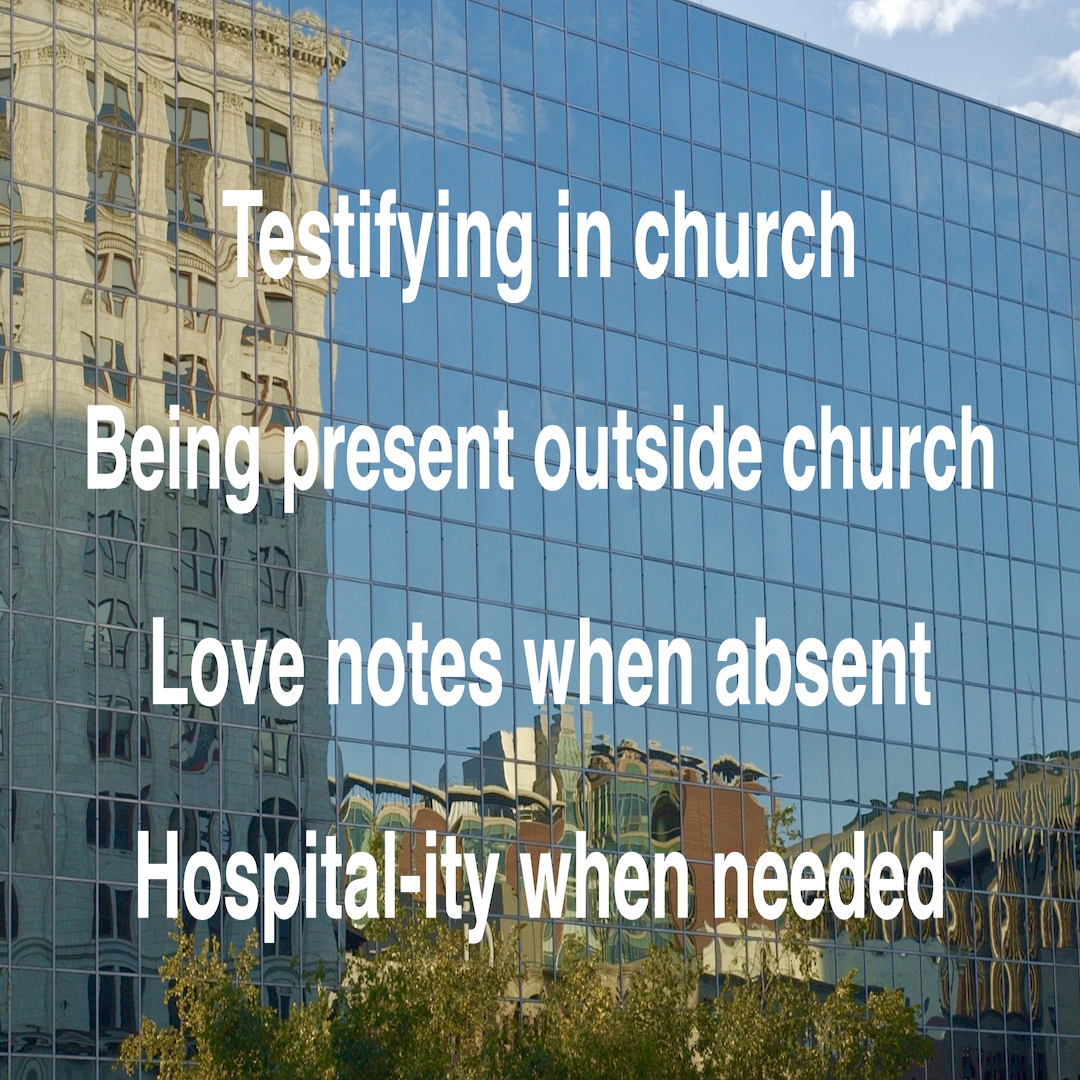
In the early Church, we see so much togetherness that they rewrote the definition of the Greek word koinonia (see Acts 2:42). Here’s what koinonia looks like in the Church:
(1) Testifying in church (Psalm 40:9-10 NLT)
(2) Being present with saints outside of church. From Acts 20-28, the pronouns “we” and “us” are used over 80 times! Paul was blessed simply by Luke being with him, just as saints are blessed when you are truly with them.
(3) Love notes when a saint is absent. The apostle John was brilliant at this. Look at his three epistles:
dear children 9x in 1 John
chosen / dear lady 2x in 2 John
dear friend 4x in 3 John
(4) Hospital-ity whenever it’s needed. Be a place of healing and refreshment for the saints God has placed in your life, just as Philemon did (Philemon 2-7, 22).
What a testimony it is when we live this way (Romans 12:10, 13)!
Remember the saint-ification process brings fruitfulness, joy-fullness, and an enhanced testimony. I love this quote from Richard Stearns, “The beautiful simplicity of our faith is that it distills down to the exact same bottom line for both the brilliant theologian and the five-year-old child: love God and love each other—period. Everything else derives from that.”















 Craig T. Owens