Poetry Saturday—Pressed

Annie Johnson FlintPressed beyond measure ; yes, pressed to great length.
Pressed so intensely, beyond my own strength;
Pressed in the body and pressed in the soul,
Pressed in the mind till the dark surges roll.
Pressure from foes, and pressures from dear friends.
Pressure on pressure, till life nearly ends.

Pressed into knowing no helper but God;
Pressed into loving His staff and His rod.
Pressed into liberty where nothing clings;
Pressed into faith for impossible things.
Pressed into living my life for the Lord,

Pressed into living a Christ-life outpoured. —Annie Johnson Flint

6 Quotes From “The Fi5th Gospel”

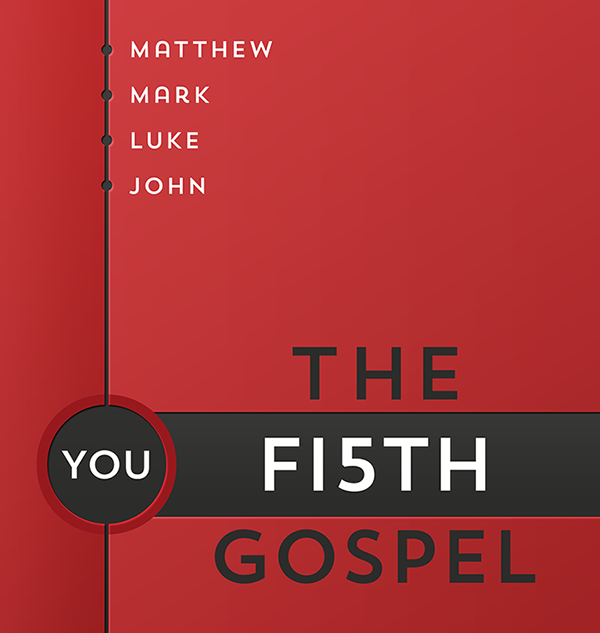
The Fi5th GospelI have been watching the One Minute Apologist videos from Bobby Conway for quite awhile, and find them very helpful. Recently I finished a reading plan in YouVersion based on Bobby’s book The Fi5th Gospel. Here are a few quotes that especially caught my attention.

“If I am the only Gospel people will ever experience are they experiencing the true Gospel?”

“At no other time in human history has God so plainly and blatantly revealed Himself than at Calvary. At no point has He so graphically uncovered His heart for mankind. It was there, on a hill outside Jerusalem, the Messiah bled for us, suffering hellish agony and sin-induced banishment, all the while enduring the brutal wrath of a holy and righteous God.”

“The exclamation point to this graphic love letter to us was the resurrection—Jesus’ conquering moment of triumph over sin, satan, and the grave. This is what Christians are all about right? It’s how we are saved. Take away the Cross and we’re no different from any other religious idea. It’s Jesus Christ, His death and resurrection. Strip away all the modern church fluff and this is what you find at the core of our faith. It’s essential. Nonnegotiable. Undeniable. It’s what makes us who we are. It’s what makes Christians ‘Christian.’ And it’s why Jesus is the answer to all of life’s deepest issues.”

“The sacrifice [God] requires isn’t death on a cross, but rather death to our pride and fear of what other might think. God just wants us to be proud of Jesus and what He has done for us. He wants us to be unashamed of His Son.”

“Though we were originally created in God’s image, God’s reflection in us was marred in the Garden of Eden when Adam and Eve sinned. And though His image wasn’t completely erased, it was defaced and tarnished. When you trusted in Christ, the Holy Spirit began a beautiful work of ‘image restoration’ in you; masterfully remaking you to more accurately reflect God’s virtue. He began sculpting, forming, and transforming your character to better display Christ to the world. You become His image-bearer, and His ongoing work in your life distinguishes you from the world. This is a lifelong process, by the way, and one God is committed to completing.”

“None of us will ever perfectly represent God’s character. As long as we’re on this earth, we’ll have imperfections. And it’s these imperfections that some unbelievers are quick (and happy) to point out and expose. But there is value in listening to what others say, of taking an honest look in the mirror, of stepping into an unbeliever’s shoes to see what they perceive about Jesus and His bride. Think of it as a spiritual awareness-building exercise.”

Thursdays With Oswald—6 Questions About Your Relationship With Jesus

Oswald ChambersThis is a weekly series with things I’m reading and pondering from Oswald Chambers. You can read the original seed thought here, or type “Thursdays With Oswald” in the search box to read more entries.

6 Questions About Your Relationship With Jesus

“How much more shall the blood of Christ, Who through the enteral Spirit offered Himself without blemish unto God, cleanse your conscience from dead works to serve the living God?” (Hebrews 9:14)

     Our right to ourselves in every shape and form was destroyed once and for ever by the death of Jesus, and we have to be educated into the realization of what this means in all its fullness. We have to come to a relationship to the Cross in thought as well as in life. … 

     We are here with no right to ourselves, for spiritual blessing for ourselves; we are here for one purpose only—to be made servants of God as Jesus was. …

   “How much more” does the death of Jesus mean to us today than it ever has before? Are we beginning to be lost in wonder, love and praise at the marvelous loosening from sin, and are we so assimilating the nature of Jesus that we bear a strong family likeness to Him?

     The most devout among us are too flippant about this great subject of the death of Jesus Christ. When we stand before the Cross, is our every common pious mood stripped off? … 

     How does all the profound thought underlying the death of Jesus touch us? The writer to the Hebrews instantly connect it with conscience—“How much more shall the blood of Christ,…cleanse your conscience from dead works to serve the living God?” Has conscience the place in our salvation and sanctification that it ought to have? … 

     Are you thankful to God for your salvation and sanctification, thankful He has purged your conscience from dead works? Then go a step further; let Jesus Christ take you straight through into identification with His death until there is nothing left but the light at the foot of the Cross, and the whole sphere of the life is hid with Christ in God. 

From The Philosophy Of Sin

I challenge you: take some time to thoughtfully answer these questions.

Letters To A Birmingham Jail (book review)

Letters To A Birmingham JailIt’s been fifty years since Dr. Martin Luther King wrote his amazing Letter From A Birmingham Jail. His letter was written in response to some clergy who had exhorted Dr. King to slow down a bit in his drive to abolish segregation. Now, fifty years later, some of our notable clergy members are responding to Dr. King in Letters To A Birmingham Jail.

Ten different clergymen—from different races, ages, and parts of the country—all responded to Dr. King’s seminal letter with gratitude, passion, and a unified voice for the twenty-first century church. Gratitude for Dr. King’s tireless trailblazing work, and for the indelible mark he made on each author’s life; passion for the church to rise up and fulfill its calling as a symbol of God’s picture of racial reconciliation in the world; and a united voice calling all Christians to follow in Dr. King’s footsteps, making the church look more like Heaven.

As a student of both history, leadership, and the church, Letters To A Birmingham Jail hit on multiple fronts for me. In the case of two of the authors, I got to witness Dr. King’s impact on both a father and son. In all the authors, I could see what a passionate, persuasive leader can do to change the attitudes and paradigm of an entire nation. Now, listening to these impactful church leaders calling us to fulfill the mandate of Jesus to evangelize “all nations,” I can see principles I can apply to my life, my community, and my church.

We owe a huge “thank you” to Bryan Loritts for dreaming up this book idea and pulling together such passionate and articulate voices from across our nation, to sound a unified and clear call to all Christians. I am confident that any one who desires to see the Church return to its apostolic roots will enjoy reading this book.

I am a Moody Press book reviewer.

Horatius Bonar On Spiritual Warfare

Horatius Bonar“The devil’s object in the present day is to persuade us that he does not exist, that we have to fight no such battle, that we need no sword nor shield, that we can do without anything beyond our own human power and skill.” [Ephesians 6:12]

“We must fight. There is no choice here. Whether we will or not, we must fight; for we are thrown upon a battlefield, and if we fight not, we perish. Woe be to the man who thinks there is no need of fighting now; that there is no danger and no enemy. Fight the good fight of faith.”

“satan persuades us that we can combat evil by the appliances of modern intellect and science and civilization. Let us beware. To try to suit religion to the spirit of the age, is to play into satan’s hands. Only divine weapons will avail in a battle with the powers of darkness.”

“Is the Christianity of our day of the lofty kind of which apostolic men have left us so bright an example? Is it not feeble, indolent, self-indulgent, second-rate? Is there in it anything of the presentation of ‘living sacrifices’ to God, which is our acceptable and reasonable service? Are we not seeking our own, not the things which are Jesus Christ’s? Are we not feasting when the world is starving? Are we not at ease in Zion? Are we not sitting still and in luxurious comfort, when many noble and self-sacrificing ones amongst us are rushing into the toil or the war, and, for want of being supported by their fellow Christians, are sinking under the burden and heat of the day?” [Philippians 4:19]

“It is inner warfare. The 7th of the Romans is the description of this, the battle between faith and unbelief, between the spirit and the flesh. This war is private, solitary, with no eye upon the warrior; fought in the closet, on the knees, with the Bible as his weapon. …

“It is outer warfare. The enemies are legion; the world, with all its enmities, snares, pomps, pleasures; satan, with his principalities and powers; both of these in combination hating, persecuting, attacking. This is ‘the great fight of afflictions’ (Hebrews 10:32). Thus it is so far public, before men; ‘we are made a spectacle to the world, and to angels, and to men.’ …

“It is daily warfare. It is not one great battle, but a multitude of battles, constant warring: there is no intermission and no discharge in this war. The enemy wearies not, ceases not; nor must we. We wake to warfare each morning, and go out to warfare each day. Everywhere we find the enemy posted, sometimes openly, sometimes in ambush. The conflict is life-long, and it is daily. …

“It is warfare not fought with human arms. The weapons of our warfare are not carnal. We do not war after the flesh. It is in divine strength; with the sword of the Spirit; clothed in the whole armor of God. …

“It is warfare in which we are sharers with Christ. He first fought the good fight, as the Captain of our salvation, the Lord strong and mighty; the Lord mighty in battle. The inner warfare indeed was not His, but all the rest was. He fought, when here, the same battles as we; and it is into His warfare that we are called to enter.”

All quotes from Horatius Bonar’s book Light And Truth.

40 Questions About Your Religion

The Mathematical Proof For ChristianityDan Delzell wrote a very thought-provoking book—The Mathematical Proof For Christianity—which gives skeptics a lot of evidence to contemplate. As I said in my review of this book (which you can read here), this is a good book for Christians to read with a skeptic as a great conversation-starter about the Christian faith.

Dan also presented this list…

“The true religion is a match to all 40 questions:

  1. Which religion was started by a prophet who never did anything wrong?
  2. Which religion produces scores of people who speak out against injustice and work hard to correct it?
  3. Which religion fulfills hundreds of prophecies that were written down hundreds of years before the prophet fulfilled them?
  4. Which religion produces followers who have established thousands of hospitals, orphanages, and homeless shelters?
  5. Which religion, when practiced correctly, empowers followers to turn the other cheek when being mistreated?
  6. Which religion began with a leader who died, but then came back to life?
  7. Which religion, when practiced correctly, produces followers who do not judge others or look down on them?
  8. Which religion produces a tender love for God in heaven, rather than lingering fear and trepidation?
  9. Which religion do people turn to in tough times and when disaster strikes?
  10. Which religion has done the most to advance the rights of women?
  11. Which religion details historic events that are supported by plenty of archeological evidence?
  12. Which religion is based upon documents that are better preserved and more numerous than any other ancient writings?
  13. Which religion began with a prophet who is loved and even worshipped by millions of followers?
  14. Which religion has been around for thousands of years and continues to expand around the world?
  15. Which religion teaches that eternal life in paradise is a free gift through faith in its prophet?
  16. Which religion has millions of followers who experience tremendous peace as a result of their prophet?
  17. Which religion, when practiced correctly, produces followers who are quick to forgive rather than to seek vengeance?
  18. Which religion offers the forgiveness of sins based solely on the goodness and sacrifice of the prophet?
  19. Which religion, when practiced correctly, produces genuine humility before God and man?
  20. Which religion teaches that you cannot earn your way to heaven?
  21. Which religion produces men and women of justice who speak out when others are committing atrocities?
  22. Which religion, when practiced correctly, lines up with the humble and compassionate attributes of the prophet?
  23. Which religion seeks to bring help to the hurting, comfort to the sorrowful, and encouragement to the downcast?
  24. Which religion, when practiced correctly, produces genuine love, joy, peace, and patience?
  25. Which religion requires divine revelation in order to understand it?
  26. Which religion rules not by force, but by love, as demonstrated by the prophet?
  27. Which religion has produced the most freedom of religion in the world?
  28. Which religion turns man’s body into a temple where the Spirit of God comes to reside?
  29. Which religion, when practiced correctly, has done the most to advance the rights of minorities?
  30. Which religion gives followers the grace to say ‘no’ to ungodly passions?
  31. Which religion produces people who long to improve the lives of those from other religions?
  32. Which religion cares as much for the unborn and elderly as it done for the youthful and strong?
  33. Which religion has done more than any other to help turn communities into places of freedom and safety for all?
  34. Which religion provides a personal assurance of salvation based solely on the sacrifice of the prophet?
  35. Which religion has a prophet whose name is used by many as a curse word?
  36. Which religion, when practiced correctly, produces followers who focus on their own sins rather than the sins of others?
  37. Which religion can turn a terrorist into a loving peacemaker?
  38. Which religion teaches that your works become ‘good’ in God’s eyes only after you accept the prophet through faith?
  39. Which religion will you wish you had followed on Judgment Day?
  40. Which religion is the answer to all 40 questions?”

To read some of the other quotes I shared from this book, please click here.

Thursdays With Oswald—Jesus Doesn’t Counteract satan

Oswald ChambersThis is a weekly series with things I’m reading and pondering from Oswald Chambers. You can read the original seed thought here, or type “Thursdays With Oswald” in the search box to read more entries.

Jesus Doesn’t Counteract satan

     If all Jesus Christ can do is to run a parallel counteraction with what satan can do, His right name is “Culture,” not “Savior”; but His revealed nature was stated by the angel to Mary, and repeated over and over again, “Thou shalt call His name Jesus; for He shall save His people from their sins.”

     The slight views of salvation, the sympathetic drifty views that all Jesus Christ can do is to put in us a principle that counteracts another principle, will cause anyone who is got to the last limit to blaspheme God for a thing like that. It all comes from a flimsy, wrong view of sin. If that is all He can do, what is the good of calling Him Savior? … 

     It is sin that He came to cope with; He did not come to cope with the poor little mistakes of men, they cope with their own mistakes; He came to give them a totally new stock of heredity, that is, He came to implant into them His own nature, so that satan’s power in the soul is absolutely destroyed, not counteracted.

From The Philosophy Of Sin

For far too long, far too many people in church circles have bought into a lie. The lie is that Jesus and satan are fighting-it-out to see who will come out as champion. As though the outcome of the struggle was somehow in doubt!

Jesus has already won! He already holds the keys to death, hell and the grave. He already defeated satan. He is already Champion: King of Kings and Lord of Lords!

The only thing that is still in doubt is this: Will you allow Jesus to “implant His own nature” in you? Will you allow Him to be Champion of your life?

Chambers also wrote, “Sin is the radical twist with a supernatural originator, and salvation is a radical readjustment with a supernatural Originator.” Let the Champion Originator—the One who has already won!—implant a new life in you.

Charles Spurgeon To Christians: Don’t Be Afraid

C.H. Spurgeon“Poverty, you may walk through my door, but God is already in my house, and He has chosen me. Sickness, you may intrude into my life, but I have a cure standing ready—God has chosen me. Whatever occurs in the valley of tears, I know He has chosen me. Dear Christian, do not be afraid, for Jesus is with you. Through all your fiery trials, His presence is both your comfort and safety. He will never forsake those He has chosen for His own. ‘Do not be afraid, for I am with you’ (Genesis 26:24) is His unfailing word of promise to His chosen ones who are experiencing ‘the furnace of affliction.’” —Charles Spurgeon

How Christians Can Overcome Ridicule

Much ridicule and contemptHave you ever been…

  • …told to keep your religious beliefs to yourself?
  • …laughed at for living out your biblical convictions?
  • …excluded from the “in” crowd?
  • …put down because your morals are too strict?

The writer of the song of ascent in Psalm 123 must have experienced this quite a bit. He uses phrases like we have endured much contempt and we have endured much ridicule.

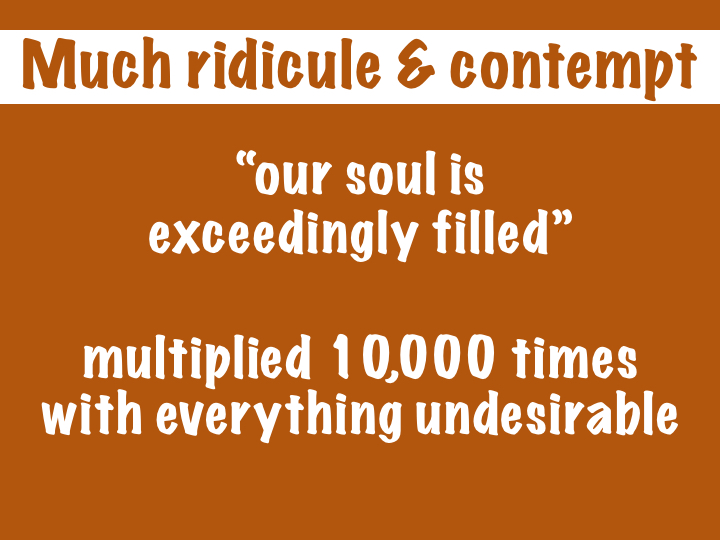
These are not words which the songwriter could easily brush off. One translation says, “our soul is exceedingly filled with the scorning” of these ridiculing people. In other words, it’s not something he could just brush off by thinking, “They don’t know what they’re talking about.”

Literally translated, the phrases exceedingly filled mean bad things multiplied 10,000 times! 

The ridicule and the contempt hurts! So the psalmist cries out Mercy! three times. This isn’t like saying “Uncle,” or having your cornerman throw in the towel, or even tapping out in a UFC match. This is a soul crying out, “God, if You will give me Your gracious favor for one more round, I will not tap out, I will not go down, I will go through!”

So he looks to the only One who can help him—my eyes wait upon Jehovah. Just like a servant who is completely dependent on his master for his daily bread, just like a maid who is trusting her mistress will give her favor, this guy says, “My eyes are fixed on Jehovah! If He can’t help me, no one can.”

The songwriter’s conclusion is this: “I will continually lift my eyes up to You, to You Whose throne is in heaven.” There are distractions, and hurts, and those who ridicule me—lots of them!—but I will develop the habit of redirecting my eyes UP to look to God.

  • When I feel anxious: I will redirect my eyes UP.
  • When I feel scorned: I will redirect my eyes UP.
  • When I’m hurt by others: I will redirect my eyes UP.
  • When I’ve had my fill of ridicule and contempt: I will redirect my eyes UP.
  • When I don’t think I can answer the bell for another round: I will redirect my eyes UP.
  • No matter what: I will redirect my eyes UP!

Check out the full video of this encouraging message. And if you are in the area, join us this Sunday as we continue our look at the Psalms of Ascent.

If you’ve missed any of the messages in this series, you can access the complete list by clicking here

5 Blessings You Should Expect From Your Church Experience

Place of peaceKing David loved God, and he loved God’s people. He was passionate about everyone getting as deeply connected with God as he was, so he wrote worship songs, setup worship teams, and organized the temple for worshippers.

The first song of ascent he wrote was one anticipating how good it was going to be when everyone got to the temple in Jerusalem to worship.

In fact, David was so excited about what he was expecting to happen in their worship together that he practically glowed with joy! Really! The word for rejoiced in his song means to be so cheerful and happy that you make others around you bright by your happiness. 😀

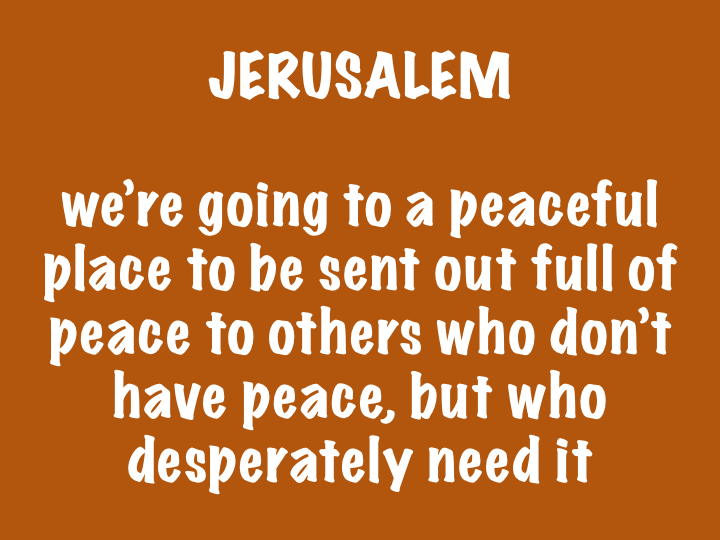
What was it that David thought was going to happen? First of all, we need to look at the name Jerusalem. Traditionally this means the City of Peace, but the two words that make up “Jerusalem” are much richer than that. Yes, -salem means “peace.” But the first part of the word (yara-) literally means water flowing through, or an arrow being shot out.

In other words, David anticipated that we are going to a peaceful place to be sent out full of peace, to take that peace to others who don’t have it, but desperately need it.

While we are in our “Jerusalem” (for us in the New Testament, this is our “church,” even if it’s just two or three people getting together), here are five blessings you should expect—

  1. Unity—with all the “tribes” joining together.
  2. Praise—joining together to tell God how great He is!
  3. Learning—we come together to learn God’s statutes.
  4. Judgment—what?! How is judgment a blessing? If you are nervous about being judged, just remember Who does the judging in God’s temple: the Holy Spirit. He judges us in a loving way, and in a way that allows us an opportunity to see our sin, repent from it, and experience unconditional forgiveness. That is exciting!
  5. Peace, security, prosperity—the word shalom is used multiple times in the closing verses of this song. The best definition of shalom is: nothing missing, nothing broken. In other words, when we gather together to worship we should expect that God will heal any dis-ease we have, that He will supply what has fallen short, that He will fill up what’s empty.

With those five blessings in mind, here’s the declaration all Christians can make—

Inside these walls…
we live in unity
we praise the Lord
we learn God’s laws
we judge ourselves by God’s standards
repenting, confessing, forgiving, and being forgiven
we fight for peace
we bless God and one another
We descend back to the valleys
to take this message to valley-dwellers
that they, too, may pilgrimage
with us to Jerusalem
It starts here in God’s family!
It starts with me!


Check out the full video of this message, where I explain each of these ideas more fully. And if you’re in the area, join us on Sunday as we continue our look at the Psalms of Ascent.

If you’ve missed any of the messages in this series, you can access the complete list by clicking here