Where’s God Today?

Transitions are always hard things. We are leaving the known for the unknown. Even if the known is unhealthy or painful, it’s still hard to go to the unknown. 

Why are these transitions so difficult? Perhaps it’s because I’ve learned how to cope with the known, or I’ve gotten used to this “normal” life, or even I’ve simply learned to navigate any dysfunctional areas.

But is that really living? Am I managing my life or is God? When I’m against transitions, aren’t I really saying that I’ve put God’s plan for my life in my box?

Those questions trigger even more questions in my mind: Where’s God in all of this? Why can’t He just make my known better? Why is He leading me (or maybe even pushing me) into this unknown? 

Jesus didn’t endure the unimaginable horrors of the Cross just so you could cope with life. Jesus came to bring us abundant life—not a barely-getting-by life or just a coping life!

How does He bring us into this abundant life? By leading us through transitions. And where is He in all our transitions? Closer than you think! 

Moses sang a song to conclude his sermon in Deuteronomy. In that song, he mentions God taking care of His people the way an eagle cares for its eaglets.

Adults eagles build their extremely large nests in the highest point they can find. Their nests are made of massive branches. In fact, they build some of the largest nests of all birds, and build them in the most inaccessible of places. Before their eggs are laid, the adult eagles will soften their nest with feathers pulled from their own body. From the time the eggs are laid until the eaglets leave the nest, they are never without a parent present—while one parent hunts, the other watches. 

Eaglets first test their stumpy wings by jumping around in the nest, mimicking their parents. Eventually they will start “branching”—jumping to nearby branches—and then “fledging”—taking their first short flights from the nest. All under the watchful eye of the parents. Finally, the adult eagles will “stir up” their nest by blowing away all of the comforts of their plucked feathers, encouraging the eaglets to soar. 

Moses said that this is how God cares for His children. First by shielding and guarding us, and then by stirring up our nest and encouraging us to soar! 

Much like when Jesus ascended back to Heaven. He was going to physically leave His disciples, but He knew He had adequately trained his “eaglets” to soar without Him with them in bodily form. 

But Jesus never leaves us spiritually. He said that His ascension back to heaven would allow for the Holy Spirit to be resident in each of His followers (see John 16:7-15). It is the Holy Spirit that continues to guide us, teach us, empower us, correct us, and lead us to SOAR into abundant, God-honoring, Christlike living. 

There are many, many times of transition as we soar, but He never leaves us. The Holy Spirit is our constant Counselor. God shows His love for us by caring for us. God also shows His love for us by making us uncomfortable with the status quo. 

May the times of transition cause us to rely even more on the very present help of the Holy Spirit.

Continue to follow along with me in a new series of posts looking at how the Holy Spirit helps us to soar!

Where’s God When I Fear Death?

Is death the #1 fear people have? The simple and complicated answer is: It depends. Fear of dying is a BIG fear in those that statistically are the least likely to die: the young. But fear of dying is very LOW for those on death row, the elderly, and the terminally ill.

I hope to convince you of a fourth group that shouldn’t fear death. It’s a group that all of us can be a member of: Those who understand that physical death is not the end. 

In the Garden of Eden, God planted one tree that was off-limits, and He said that the penalty for eating from this tree was death (Genesis 2:16-17). satan tried to get Adam and Eve to doubt what God said, and after they ate the fruit, it appeared satan was correct—they didn’t die. At least not physically.

But their sin did something far, far worse—it separated them from God’s presence. Now when God appeared, Adam and Eve hid in fear. In fact, Jesus even told His followers that the greatest fear wasn’t physical death but spiritual death (Luke 12:4-5). 

Jesus came to lift our hope to something beyond this physical world. He said, “God so loved the world that He sent His one and only Son, that whoever believes in Him would not die, but would have eternal life” (John 3:16). 

Famed atheist Bertrand Russell said, “I would never die for my beliefs because I might be wrong.” 

On the other hand, Jesus DID die for His beliefs and proved He was right by His resurrection! 

Friend, listen to me—We’re definitely not living our best life now. We are all terminal. Unless Jesus returns, the chances of our physical death are 1-in-1. 

But physical death is not the end! Death of the body means freedom for the soul. Jesus has defeated Death once for all! “Do not be afraid. I am the First and the Last. I am the Living One; I was dead, and now look, I am alive for ever and ever! And I hold the keys of death and Hades,” Jesus said (Revelation 1:17-18) 

Death has been swallowed up in victory. Where, O death, is your victory? Where, O death, is your sting? The sting of death is sin, and the power of sin is the law. But thanks be to God! He gives us the victory through our Lord Jesus Christ. (1 Corinthians 15:54-57) 

Invite Jesus into your life right this moment!! 

Once you have invited Jesus into your life, and your sins have been forgiven, and your destiny following your physical death is assured, this is how you should now live: 

  1. Live in joyful hope. Not optimism—that’s just the belief in what you think you can do. But hope is the belief in what you know Jesus has already done!
  1. Live free of all anxiety and the fear of death. Because nothing can separate you from God’s love and presence (Romans 8:38-39).  
  1. Live telling others about your Risen Savior. It’s the most loving thing that you could do for anyone. 

I don’t think it’s a stretch to say that to be a Christian and to be fearful of death is a sin. A fearful Christian gives God no praise, robs Him of glory, and paints God in a bad light. A happy, secure Christian knows the Lord is his strength, his comfort, his supply. A happy Christian lifts God high and invites others to know this All-Good, All-Happy God too! 

We can live this way because Jesus died to pay the penalty for your sins that separated you from God, and He was resurrected back to life to assure you that your eternal home in God’s presence is secure!

Where’s God When I Feel Abandoned?

Have you ever felt abandoned by someone? 

You stood up for someone, but when you needed someone to stand up for you they disappeared Or you did what was right, but no one recognized you for it? Or you were the encourager, but when you needed encouragement no one was around for you? Or maybe even you obeyed God down to the very last detail, and yet it seemed God abandoned you when you needed Him most? 

Jesus knows what every single one of these scenarios feel like! He stood up for the downtrodden, but they screamed, “Crucify Him!” He poured His life into teaching and encouraging His friends, but they all ran when the heat was on, leaving Jesus all by Himself. He obeyed God down to the very last detail, and yet it seemed like God abandoned Him when He needed Him most. 

Have you ever felt abandoned by God? 

Jesus did. 

Hanging from the Cross He cried out, “My God, My God, why have You forsaken Me?!” 

I cannot help but notice two things about the state of mind Jesus was in heading to the horrific treatment He would face (see Matthew 26:31-44; 27:27-46). 

  1. Jesus knew all of this was going to happen to Him. Notice the phrases “for it is written” and “so that the Scriptures would be fulfilled” and “so that the writings of the prophets might be fulfilled. Even His cry from the Cross was a literal quotation of Old Testament Scripture (Psalm 22:1).
  2. God was silent. Even though Jesus called out to His Father three times in prayer, “My Father!” there was no heavenly response. 

Why would God remain silent during this trial? God didn’t need to speak to His Son during the trial because He had already spoken to Him before the trial! 

It’s the same in our trials—

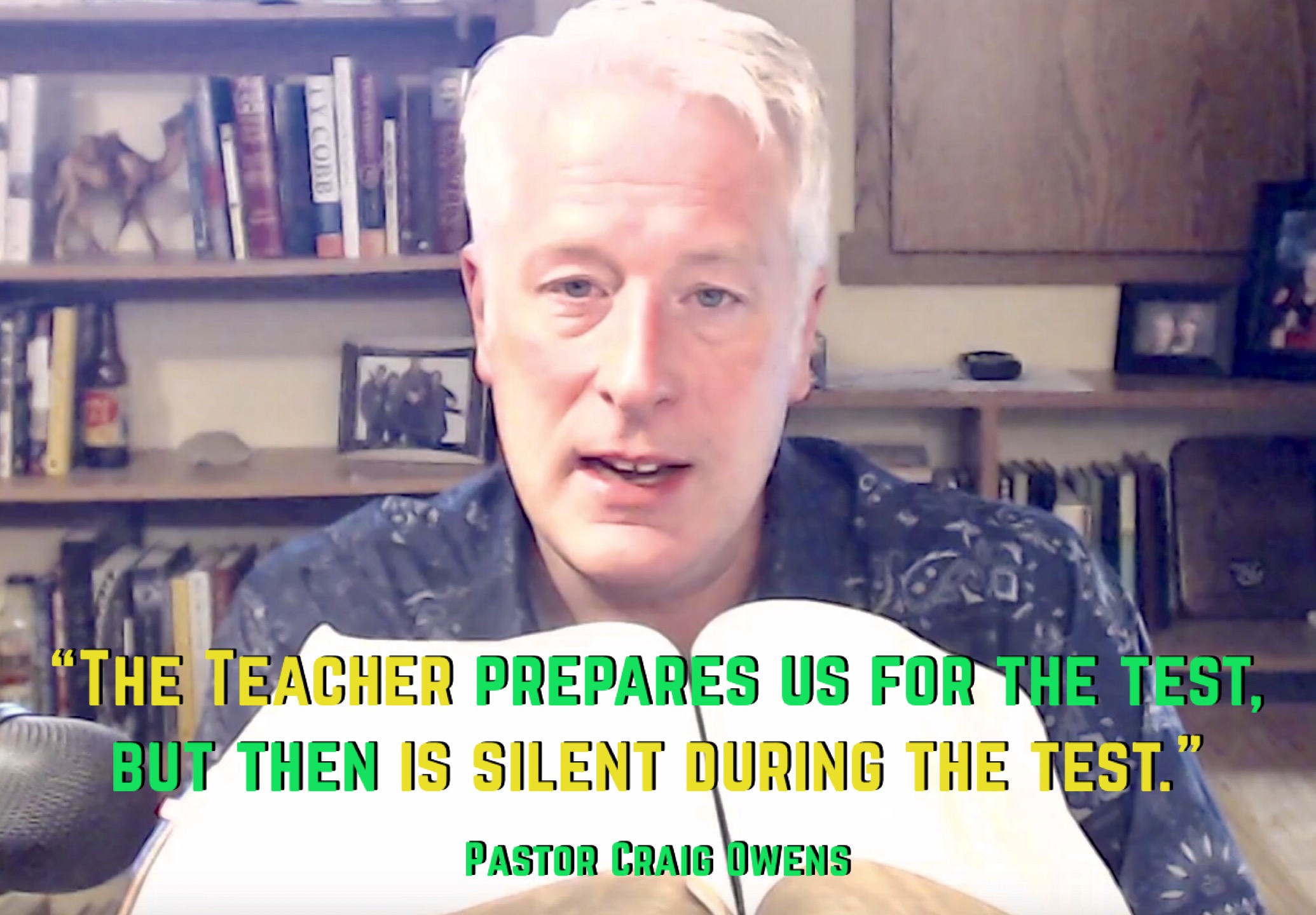
The Teacher prepares us for the test, but then is silent during the test. 

God’s silence is not His rejection or abandonment. Just as God provided for Jesus in His moment of trial, God has provided for us in our trials too—For no temptation (no trial regarded as enticing to sin), [no matter how it comes or where it leads] has overtaken you and laid hold on you that is not common to man [that is, no temptation or trial has come to you that is beyond human resistance and that is not adjusted and adapted and belonging to human experience, and such as man can bear]. But God is faithful [to His Word and to His compassionate nature], and He [can be trusted] not to let you be tempted and tried and assayed beyond your ability and strength of resistance and power to endure, but with the temptation He will [always] also provide the way out (the means of escape to a landing place), that you may be capable and strong and powerful to bear up under it patiently. (1 Corinthians 10:13 AMP) 

So let’s learn three invaluable lessons we can learn from Christ’s time of supreme suffering. 

1. Be honest in God’s presence 

Jesus didn’t hide His feelings, nor did He try to couch His vocabulary in “churchy” sounding words. God already knows what’s in your heart, so pour it out raw and honestly! Go to the Psalms and see raw emotions on full display in prayer. 

2. Lean all your weight on Jesus

Jesus prayed, “My Father!” and He cried out from the Cross, “My God!” His death on the Cross took away the barriers that kept up from coming into God’s presence (see 2 Corinthians 5:21). After His resurrection, Jesus sent this message to His friends: “Go instead to my brothers and tell them, ‘I am ascending to MY Father and YOUR Father, to MY God and YOUR God’” (John 20:17). 

3. Go to the Word of God

This is what Jesus did. In His moment of abandonment, He quoted Psalm 22 from the Cross. Jesus fulfilled ALL of the Scriptures, so now we can pray with greater assurance—For no matter how many promises God has made, they are “Yes” in Christ. And so through Him the “Amen” is spoken by us to the glory of God (2 Corinthians 1:20). 

God’s silence is NOT God’s abandonment. God’s silence is His invitation for us to be honest, to lean on Jesus, and to trust every promise in His Word. Every single promise that is Yes! and Amen! 

If you’ve missed any of the other messages in our Where’s God? series, please check out: 

And join me this Sunday as we take a look at how Jesus has conquered humanity’s ultimate enemy. 

Refined By The Fire

Where is God in our trials? When we call, Jesus runs to our cry. He is able to help us because He knows exactly what our cries sound like. Aren’t you glad He does?! 

While we are in these difficult times, you might find yourself asking a question I have asked, “Okay, God, I believe You are doing something, but what exactly are You doing?” 

I can’t tell you specifically what God is doing in your life, because your story is unique and special. But I can tell you that during the hard, painful chapters of our lives, God is accomplishing at least five things in all of us.

  1. God is opening our eyes to new paradigms

We will learn lessons in these fiery trials that we couldn’t possibly learn any other way. 

  1. God is building empathy in us which we didn’t have before

One dictionary defines empathy as “the power of understanding and imaginatively entering into another person’s feelings.” It’s only because of our trials that we no longer have to imagine what someone else is feeling, but instead we know exactly what they’re feeling and how we can help. 

  1. God is growing our patience 

It’s been said that patience is the “mother of all other virtues.” Paul said that “these troubles produce patience” (Romans 5:3). As God grows your patience, He will also help you to grow all of the other Christlike virtues. 

  1. God is refining His character in us 

Paul went on to add that not only does trouble produce patience, but “patience produces character” (Romans 5:4). During the times of difficulty and uncertainty, we become more aware of deficiencies in our character. 

  1. God is building in us an unshakable hope in His future grace 

Hope is not wishful thinking; it’s well-founded believing! 

I want to circle back to that word refining because I think that best sums up what God is doing in our painful times. Romans 8 tells us—The Spirit Himself thus testifies together with our own spirit, assuring us that we are children of God. And if we are His children, then we are His heirs also: heirs of God and fellow heirs with Christ—sharing His inheritance with Him; only we must share His suffering if we are to share His glory. But what of that? For I consider that the sufferings of this present time—this present life—are not worth being compared with the glory that is about to be revealed to us and in us and for us and conferred on us! (Romans 8:15-18) 

So where’s God in this time of fire? He is overseeing our trial as a Perfect Refiner. Do you know how the silversmith knows he has purified the impurities from the silver ore? The silver is pure when he can see his own reflection in the silver! 

In the heat of your trial, God is close to you. He knows the perfect temperature and the precise time that it will take to allow His face to be seen in you! 

Sometimes you will see what God is doing through your furnace time, sometimes you won’t. But don’t ever bail out! God IS working! He is giving you a new perspective, a deeper empathy, more patience, an unshakable hope, and most of all—He is removing the impurities that will allow His face to be seen more clearly in you! 

Join me this Sunday as we continue to learn where God is in our darkest times. And if you didn’t catch the previous messages in this series, please check out The God That Runs To You and How Long Will This Last?

How Long Will This Last?

Chaos is all around us! There’s infighting both politically and religiously. Government officials are imposing new laws and regulations and restrictions. Lots of rival voices are clamoring to be heard. Loss of personal freedoms, civil liberties, and even the freedom of worship. Uncertainty about the future. Fear in the present. 

Although this may sound like current conditions in the USA, I’m actually describing life in Israel around 31 BC. 

The people of Israel were frustrated beyond words with the restrictions they faced. They thought they were living in their land and that they should be able to govern themselves as they saw best. 

Have you ever been in that place of utter frustration? Are you there now? “What’s happening? Why is this not going according to plan? Isn’t there anything I can do? How long is this going to last? God, where are You in all of this?! 

We humans like to think we are in control. Or at least we like to think that we know God’s timetable. Throughout the Bible—and still today—the questions persist: 

  • How long will this last? 
  • When will this take place? 
  • What about him? 
  • Is this the right time? 

(see Psalm 13:1-2; Matthew 24:3; John 21:21; Acts 1:6; Revelation 6:9-10) 

When we ask God, “How long?” He never answers us by pointing to the calendar or the clock, but He points us to principles in His Word.

Here are four principles that we need to ask the Holy Spirit to help us grasp: 

  1. God’s timing was determined before Time even started. 
  2. God is using this “How long?” time to perfect us for His service.
  3. God is using this “How long?” time to empower us to point others to Him.
  4. God is calling us to trust Him alone during our “How long?” times. 

(see Psalm 90:2; Isaiah 46:10; Psalm 13:5-6; Romans 5:3-4; Matthew 24:13-14; Acts 1:7-8; John 21:21) 

Those Israelites I described earlier were so frustrated with asking “How long?” and apparently getting no answer, that they frequently took matters into their own hands. This never turned out well for them. But God’s perfect timing was heading toward His perfect fulfillment.  

We may not perceive it, but God IS doing more than we will ever know during our “How long?” times. 

God’s perfect timing for His people couldn’t be until Caesar Augustus came on the scene and brought an end to the political uncertainty that kept everything in chaos. Nearly 30 years before Jesus was to be born in Bethlehem, Augustus was launching the pax Romana—the peace of Rome—all over the world. Pax Romana was creating the perfect environment in which Jesus could be born and minister, as well in which His followers could then take the Good News all over the world. 

Jesus was born “in the fullness of time” (Galatians 4:4), around 5 BC, in a land where a Jordanian king (Herod the Great) served an Italian emperor (Caesar Augustus) to a people frustrated with waiting. But God knew exactly when and where and how to send His Son to be our Savior!

So, my friends—Trust God in the “How long?” times! 

God’s perfect plan includes YOU, so guard against any anxious thoughts that would make you bail out of His perfectly-timed plan early. (see Psalm 139:16, 23-24)

Join me this Sunday as we continue our series called Where’s God? 

The God That Runs To You

I’m sure you’ve experienced what I’ve experienced. My nice, orderly world came crashing down all around me. It totally blindsided me! I got on my knees to do some serious soul searching and I prayed, “God I know you called me here. I know I’ve done what You’ve asked me to do. What’s happening? Why am I being attacked? Where are You, God?

I’m sure you’ve been there too. “Where’s God?” has been the cry of countless people from the oldest book of the Old Testament until this very day. In dark times our world seems to shrink, and the weight of the entire world seems to rest on our shoulders. We begin to at first sigh and say, “Why me?” and then those sighs become sobs of “God, where are You?!” 

“Left to ourselves we tend immediately to reduce God to manageable terms. We want to get Him where we can use Him, or at least know where He is when we need Him. We want a God we can in some measure control. We need the feeling of security that comes from knowing what God is like.…” —A.W. Tozer 

Here’s the truth: We are always in a spiritual battle. It’s just hard to see it in the “good ol’ days.” But in the “bad ol’ days” we realize we don’t have it all figured out! The dark days are simply the reality of spiritual warfare revealed. 

Answers don’t come easily because there are no easy answers!

One of Job’s friends named Zophar thought he had God all figured out. He concluded his easy answer that the wicked have a bad life and the righteous have a good life. So if things were going badly for Job, he must have messed up somewhere. Except Zophar was wrong! God Himself pronounced Job righteous (see Job 20:1-8; 1:8). Zophar’s easy answer now doesn’t seem so easy, does it? 

I’ll say it again: In the hard times, answers don’t come easily because there are no easy answers. 

In fact, Jesus told us, “I have told you these things, so that in Me you may have peace. In this world you will have trouble. But take heart! I have overcome the world” (John 16:33). 

How did Jesus overcome the world of hurt and pain? He did it by taking a hands-on approach—Since the children have flesh and blood, [Jesus] too shared in their humanity…. For this reason He had to be made like His brothers in every way…. Because He Himself suffered when He was tempted, He is able to help those who are being tempted (Hebrews 2:14, 17-18). 

The phrase “He is able to help” literally means that He runs to the cry! 

In order to be able to run to our cry, Jesus has to know what our cries sound like and what our pain feels like. He had to taste all our pain for Himself. He had to feel all of them in a human body. The Limitless God was incarnated in limited flesh to experience everything we would ever feel. 

Now that Jesus has died and been resurrected, our cries bring Him running to us with ALL of His LIMITLESS love and power and empathy! 

In the good ol’ days we may not recognize just how close God is to us. But when the bad days come and we cry out to Him, He comes running. Jesus may be closer when you say, “I don’t know where You are!” than He’s ever been before. 

Go ahead and cry out. Jesus knows those cries. He hears you, He knows your pain, He runs to your cries, He comes close to help.

Join me next week as we continue this series asking “Where’s God?” in the specific difficulties that we face. We’ll ask questions like, “Where’s God in my depression?” and “Where’s God in my divorce?” and “Where’s God in this national calamity?” Please don’t miss these encouraging messages! 

Where’s God?

We’ve all asked that question. Something happens that rocks our world, and we wonder where in the world God is. 

We call out to God and He seems silent. We search our hearts to see if we can discern something we’ve done wrong, and seeing nothing amiss we cry out again, “God, where are You?” 

So where is God in our heartache? In our abandonment? In our sorrows? In our distress? In death? Believe it or not, God may be closer in His silence than you’ve ever perceived before. 

Join me this Sunday as we begin a new series called Where’s God? I hope you can join me in person, but if you can’t, please join me on Facebook Live.

In case you missed any of the posts in this series, you can find them all here:

Fasting Power

We are always engaged in an intense spiritual battle. Sometimes we feel the intensity of the battle, sometimes we don’t. But it’s always happening. 

This is why we need to make prayer an ongoing discipline. If we do, we will be much more likely to turn to prayer when we feel the intense moments, and our faith in those intense moments will be strengthened and ready to respond. 

Every day we are either preparing or repairing. Prayer is either helping us prepare for the challenges we will be facing, or it’s helping us recover from the battle we just fought. Believe me: it’s much better to be preparing than it is to be repairing!

One time the disciples of Jesus got stymied in a spiritual battle. A father brought his demon-possessed son to them, asking that they cast out the demon. But this distraught father then had to report to Jesus, “They couldn’t do it” (see Matthew 17:14-21). 

Why couldn’t they? These men had been taught how to pray by Jesus Himself, and they already had experienced ministry success (Matthew 6:9-13; Mark 6:13). So were they stumped now? 

Jesus told them, “It’s because you have so little faith.” He went on to tell them that these intense spiritual battles require an ongoing lifestyle of prayer. Jesus wasn’t suggesting that they should have said to that father, “Come back in a few days after we have prayed and fasted.” 

But what Jesus was really saying was that all of us need to stay connected to the Source of our spiritual power at every single moment (John 15:5, 7). Sometimes this requires taking our eyes off ourselves and our own appetites. 

In a word: we need to fast. 

The word fasting means “to cover the mouth” or “to close the mouth.” 

  • often fasting is in response to calamity or as a sign of mourning 
  • sometimes it’s alongside an intense prayer 
  • ideally it should be a regular discipline in our lives. In Matthew 6:16-18, notice the phrase “when you fast.” Not “if you fast,” but when. Jesus assumed that we would do this, and since this teaching appears right after Jesus teaches us how to pray, it makes sense that prayer and fasting go well together.  

Fasting is not…

Fasting intensifies our focus on God in the quiet times so that we can keep our eyes on Him in the crashing storms. 

Fasting helps us tune in to the unmistakable Voice of the Holy Spirit in the peaceful moments so that we can still recognize His Voice in the tumult of battle. 

Is there a comfort food you tend to run to? Is there a coping activity that you typically use to de-stress? Is there someone or something other than God that is your go-to in times of trouble? Perhaps we should start there and fast from those things for a short period of time. 

Fasting in the quiet times will strengthen us for the intense battle times. 

Let’s prepare daily for victory, instead of having to repair after a failure.

4 + 4 Strategies To Eliminate Distractions To Your Prayer Time

There’s a quote that has been the theme for this series on prayer: “Prayer pursues joy in fruitful fellowship with Jesus, knowing that God is glorified when we bear fruit in answer to prayer. Why do God’s children so often fail to have consistent habits of happy, fruitful prayer? Unless I’m badly mistaken, one of the reasons is not so much that we don’t want to, but that we don’t plan to.” —John Piper 

And unless I’m badly mistaken, the most obvious thing we need to plan to eliminate is distractions. 

Some people say they can juggle a lot of things at once. “I’m a really good multitasker,” they say. But science says differently. MIT neuroscientist Earl Miller concluded that our brains are “not wired to multitask well…. When people think they’re multitasking, they’re actually just switching from one task to another very rapidly. And every time they do, there’s a cognitive cost.” What is that cognitive cost? “Multitasking can drop IQ as much as 15 points, essentially turning you into the cognitive equivalent of an 8-year-old” (Inc. Magazine). 

If the devil can make you think you can multitask prayer with other things, he has seriously inhibited the effectiveness of your prayers. 

Jesus was not a multitasker—but He was singularly focused on His Father’s plan. And yet He accomplished more in His three years of public ministry than anyone else in history! 

Here are 4 strategies to help you get ready to pray:

  1. Try to have your prayer time in the same place and at the same time. Your brain likes routine and it will help you zero-in during your scheduled prayer times. 
  2. Silence your cell phone or other noisy distractions. 
  3. Keep a notepad handy for random thoughts that pop into your head. Writing them down will keep your brain from switching back-and-forth to them.
  4. Focus on listening, not on talking—Eugene Peterson said, “Prayer is first of all a means of listening. Prayer is an act of attention.” 

When we get right down to it, prayer is spiritual warfare (2 Corinthians 2:11; Ephesians 6:10-18). In the context of warfare, the word strategy means the maneuvering that takes place prior to the battle. The devil is a masterful tactician, and he will do everything he can to keep you distracted. 

That’s why three times Peter tells us to be clear-minded and singularly-focused in our thoughts SO THAT we can pray without the hindrances of distractions (1 Peter 1:13-14; 4:7; 5:8-9). And Paul tells us to take all our thoughts captive, so that no un-Christlike thoughts are inhibiting our prayer time (2 Corinthians 10:4-5). 

Here are 4 strategies to help you stay focused in prayer:

  1. A—adoration. Enter into God’s presence with a Psalm or worship music. 
  2. C—confession. Deal with unconfessed sin, unforgiveness, or relationship strife as quickly as possible (Psalm 66:18; Matthew 5:21-24). 
  3. T—thanksgiving. Paul counseled us, “Do not be anxious about anything, but in everything, by prayer and petition WITH thanksgiving, present your requests to God” (Philippians 4:6).  
  4. S—supplication. Intercede for your brothers and sisters in the battles they are facing (James 5:16; Job 42:10; Ephesians 6:18).  

Remember—

Prayer isn’t preparation for the battle; prayer IS the battle! Let’s not be distracted from that!

Enjoying The Meal

I am so active every day that I need to eat about 2700 calories just to maintain my weight. Eating that often, if I’m not careful, I can just simply put food in my mouth and really not taste it. 

I think most people realize that there is a difference between eating and enjoying their food. Not only is gulping not very pleasurable, but doctors have even found some negative impacts on habitual food-gulpers. Things like: 

  1. Indigestion 
  2. Weight gain 
  3. Disconnection from hunger/full signals 
  4. Increasingly likelihood of unhealthy food choices 

In the same way, there’s a difference between praying and enjoying our time with God (see Mark 6:30-31 and Revelation 3:20).

Just as there are many physical benefits to enjoying healthy food, there are also many spiritual benefits to enjoying our time in God’s Word and God’s presence. This spiritual eating and digestion process is called meditation. 

Allow me to put a couple of thoughts together to show you the value of this spiritual discipline: 

  • The apostle Paul told us, “Pray continually” (1 Thessalonians 5:17). 
  • God told Joshua, “Keep this Book of the Law always on your lips; meditate on it day and night, so that you may be careful to do everything written in it. Then you will be prosperous and successful” (Joshua 1:8).

So the way we pray continually is to have something healthy to digest. We can feast on God’s Word and then allow the Holy Spirit to extract all of the healthy spiritual nutrients that will allow us to grow and mature. 

David said, “Taste and see that the Lord is good” (Psalm 34:8). Don’t gulp down your meal of the Scripture—taste it. Don’t rush through your prayer time—enjoy it. Keep mulling over what you have read. Keep chewing on it to help the digestion of the good stuff you need to be healthy.

We meditate on the Word of God to learn how to continually commune with the God of the Word. 

Meditating on God’s Word with the Holy Spirit’s help means you will never lack material for praying continually.