Still Maturing

Listen to the podcast of this post by clicking on the player below, and you can also subscribe on AppleSpotify, or Audible. 

Have you ever said to yourself… 

  • …I should have known better?  
  • …why I am going through this again?  
  • …I thought I was over this hurdle? 
  • …you would think I would have matured enough by now to not have to deal with this?  

Maybe the author of Psalm 129 felt this way: “Here I am on the 10th step and I’m still having to deal with this! When will I finally arrive at the top and be done with these issues?” (compare Psalm 129:1-2 with 124:1-5). 

(Check out all of the Scriptures I use in this post by clicking here.) 

I think those statements—“I should have known better” or “I thought I was over this”—pre-suppose that we will reach a point in our life where we “arrive.” If nothing else, this psalm is a reminder that we are still on the journey, that we are still a work-in-progress, that the saint-ification process is still ongoing. It’s clear from Scripture that we never “arrive” until we arrive in Heaven and hear our Master say, “Well done, good and faithful servant.” 

While we are ascending up toward our heavenly home, these great oppressions and plowings remind us that there is still work to be done in us and through us to bring glory to God (Romans 5:3-4; James 1:2-4, 12). 

Of his Soviet prison, Alexander Solzhenitsyn said, “I bless you, prison—I bless you for being in my life—for there lying on rotting prison straw, I learned the object of life is not prospering as I had grown up believing, but the maturing of the soul.” 

The reality is God is using all of those things for my good and for His glory (Romans 8:28). 

What happens as I am oppressed and plowed? 

(1) I am refined—Psalm 66:8-12, 16-20. God is removing the impurities from my life. 

(2) My prayers are matured. Psalm 129:5-8 is an imprecatory prayer, a prayer that says, “Get ‘em, God!” These have their place, but for us they are to be our emergency release valve (which I discuss in more depth in my book When Sheep Bite). But Jesus calls for our prayers to mature from imprecatory to intercessory (Matthew 5:43-45). In my book I write, “This is the highest level of Christian maturity: To pray like Jesus did for those who insulted Him, slandered Him, and crucified Him, ‘Father, forgive them for they don’t understand what they are doing’ (Luke 23:34)” 

(3) I develop more intimate God-dependence—2 Corinthians 1:8-10. 

(4) I am better equipped to help others—2 Corinthians 1:3-6.  

(5) Others feel more inclined to pray for me—2 Corinthians 1:7, 11.  

“God uses broken things. It takes broken soil to produce a crop, broken clouds to give rain, broken grain to give bread, broken bread to give strength.” —Vance Havner 

Oppressed? Yes! Defeated? No! 

Plowed? Yes! Enslaved by the plow’s cords? No! 

God uses this to bring us closer and closer to Him until He can eventually say to us face-to-face, “Well done, good and faithful servant!” That’s when we truly arrive! Until then, we keep on ascending. 

If you’ve missed any of the other messages in our series looking at these songs of ascent, you can check them all out here. 

►► Would you please prayerfully consider supporting this ministry? My Patreon supporters get behind-the-scenes access to exclusive materials. ◀︎◀︎

Moderate Stress Is Healthy

Listen to the podcast of this post by clicking on the player below, and you can also subscribe on AppleSpotify, or Audible. 

We do ourselves and the world around us a huge disservice if we are constantly striving for a stress-free life. 

First, I don’t think that is even possible! Adam and Eve in the perfection of the Garden of Eden faced a stressful decision. And Jesus, the Perfect Man, was constantly dealing with the stressors that pushed in on Him. 

But more importantly, stress is vital for healthy growth. In this case, I am talking about the healthy stress that doctors call eustress. This is the push against the forces that would ultimately pull down our physical health, our relationships, our mental health, and a host of other things if we simply opt to “go with the flow.” 

I read this in a recent article from Fight The New Drug

“In a world that often sells ways to avoid stress, it’s crucial to remember that stress can be healthy in moderation. Stress and anxiety can trigger neural and chemical processes in your body designed to help you respond to challenges. Stress researcher Daniela Kaufer explains that ‘some amounts of stress are good to push you to the level of optimal alertness for behavioral and cognitive performance.’ Her research on stress in rats has even demonstrated that intermittent stressful events can create new brain cells in the rats that actually improve their future mental performances.”  

The Bible makes it clear that persevering through the stressors that come against us can make us stronger, healthier, and better equipped for the next challenge. We are also fortified to help others through their times of stress (James 1:2-4; Romans 5:3-5; 2 Corinthians 1:3-5). 

As I’ve often said, easy, stress-free roads teach very few valuable lessons! 

The poet Epictetus noted this about the mighty Hercules—

“What would have become of Hercules do you think if there had been no lion, hydra, stag or boar—and no savage criminals to rid the world of? What would he have done in the absence of such challenges?
“Obviously he would have just rolled over in bed and gone back to sleep. So by snoring his life away in luxury and comfort he never would have developed into the mighty Hercules.
“And even if he had, what good would it have done him? What would have been the use of those arms, that physique, and that noble soul, without crises or conditions to stir into him action?” —Epictetus, The Discourses 

So the next time you are thinking about avoiding something that causes stress in your life, why don’t you reframe that thought. Instead, think about how you can become stronger, healthier, and more empathetic toward others because you are committed to successfully navigating that stressful situation. 

Don’t ask God to get you out of this situation, but ask Him to help you get something out of this situation. 

►► Would you please prayerfully consider supporting this ministry? My Patreon supporters get behind-the-scenes access to exclusive materials. ◀︎◀︎

Takin’ Him To Hollywood Boulevard

Listen to the podcast of this post by clicking on the player below, and you can also subscribe on AppleSpotify, or Audible. 

Jesus sent us and the Holy Spirit empowers us to take the Good News to all nations—all the streets (Luke 24:47-49; Acts 1:8)—even the streets of Samaria where we will have more differences than similarities. 

There is one street that has infiltrated and affected every other street more profoundly than any other: Hollywood Boulevard. The constant bombardment of messages through movies, television programs, music, literature, and the arts is almost immeasurable. 

I think Christians rarely stop to ponder how much of the culture on Main Street is influenced by the content from Hollywood Boulevard. Probably because so few Christians are involved in the artistic or creative communities.  

Here’s what we need to remember: All of this creativity is God-given. The opening words in the Bible say, “In the beginning God created…” (Genesis 1:1). 

We specific examples of God-given creative skills in:

  • Bezalel—Exodus 31:1-5 
  • Oholiab—Exodus 31:6, 35:34 
  • craftsmen and craftswomen—Exodus 31:6; 35:10, 22, 25 
  • Huram—1 Kings 7:13-14 
  • food administrators—Acts 6:3 
  • Tabitha—Acts 9:36-39 

(You can check out all of the Scriptures mentioned in this post here.) 

In more modern times, we see notable creative people giving credit to God for their abilities. 

  • William Shakespeare’s use of biblical themes—and even exact phrases—throughout his work is easy to spot. In the opening line of his last will and testament, he wrote, “I commend my soul into the hands of God my Creator, believing through the merits of Jesus Christ, my Savior, to be made a partaker of life everlasting.” 
  • Johan Sebastian Bach, considered by many to be the greatest composer to ever live, placed “S.D.G.” on every one of his musical compositions, which stands for Sola Deo Gloria: only for the glory of God. 

The apostle James tells us that every good and beautiful gift has come to us from God our Creator (James 1:17). And then this is my paraphrase of a similar thought the apostle Peter—

Each of you should use whatever gift you have received to serve others, as faithful stewards of God’s grace in its various forms. If anyone speaks [writes, paints, composes, sculpts], they should do so as one who speaks [writes, paints, composes, sculpts] the very words of God. (1 Peter 4:10-11)

So, here are four thoughts about how we can take the Good News of Jesus to Hollywood Boulevard. 

  1. Create a beautiful culture in your home, your Main Street, your workplace, your school. Ask the Holy Spirit to help you answer the question, “What can I do so that the love and beauty of Jesus will be felt here?” 
  1. Use your creative skills—write poems, compose music, paint a picture, sew clothing, bring innovation to your job.
  1. Support beautiful authors, musicians, moviemakers, painters, etc. Hollywood produces what they think will make money, so if you are supporting creators of beautiful things, they will produce more of those things. 
  1. Leverage Hollywood’s culture to talk to others about heavenly culture. Point out biblical themes, challenge the rationale behind unbiblical lyrics, etc.  

“Christians need to ask themselves a few key questions to help us respond to the society around us. First, what is good in our culture that we can promote, protect, and celebrate? Second, what’s missing in our culture that we can creatively contribute? Third, what’s evil in our culture that we can stop? And fourth, what’s broken in our culture that we can restore?” —John Stonestreet 

Don’t complain—create something better. 

Don’t compromise—promote what is beautiful and edifying. 

The Holy Spirit can empower us to take the Good News of Jesus even to Hollywood Boulevard! 

If you’ve missed any of the other messages in our series Takin’ Him to the Streets, you can find them all here. 

►► Would you please prayerfully consider supporting this ministry? My Patreon supporters get behind-the-scenes access to exclusive materials. ◀︎◀︎

Always Ready

Listen to the podcast of this post by clicking on the player below, and you can also subscribe on AppleSpotify, or Audible. 

A large crowd surrounded Jesus. “He welcomed them and spoke to them about the kingdom of God, and healed those who needed healing. Late in the afternoon the Twelve came to Him and said, ‘Send the crowd away so they can go to the surrounding villages and countryside and find food and lodging, because we are in a remote place here.’ He replied, ‘You give them something to eat’” (Luke 9:11-13). 

Why did the crowds seek out Jesus? They came to Him because they knew He had wisdom, healing, and food for them. As disciples of Jesus, we never know when people will be around us that are in need. In fact, the closer we walk with Jesus, the more needy people will begin to gravitate toward us.

Jesus never intends that we simply give them a verbal blessing like, “Go, be filled and be warm” (James 2:16).

Jesus wants us to give them something substantial.

This means we need to both prepare and stock up ahead of time (be proactive) and we need to be sensitive to the prompting of the Holy Spirit in each encounter we have with a needy person (be reactive).

Jesus told us that the Holy Spirit would remind us of His words (John 14:26), but that means we have to study His words ahead of time. The Holy Spirit can then give us those words to share in the heat of the moment (Matthew 10:19–20). 

Jesus also instructed us to have available both old and new treasures to share with people around us (Matthew 13:52). The old speaks to being proactive, and the new is reactive to each thing that we are learning and experiencing.

One of my life’s mottos is: Leave every place better than I found it.

That means I also want to leave every person better than they were before we crossed paths. 

In order to do this, I have to have something substantial—something eternally significant—to give to them. When needy people show up, it is too late for me to prepare.

I want to be always ready. That means I need to be always abiding with my Savior. I need to be learning at the feet of Jesus, filled with the power of the Holy Spirit, and saturated in the love of God, so that I always have something good to give. 

Jesus, when you tell me, “Give them something to eat,” I want to give them You. Help me to proactively prepare so that I am ready to react in a way that glorifies You every single time.

►► Would you please prayerfully consider supporting this ministry? My Patreon supporters get behind-the-scenes access to exclusive materials. ◀︎◀︎

The Bitter Helps The Sweet

Listen to the podcast of this post by clicking on the player below, and you can also subscribe on AppleSpotify, or Audible. 

Have you ever been going through a difficult time in your life and wondered to yourself, “What in the world is going on here?” I might have a different way for you to think about that!

Check out this episode of The Podcast.

Some resources from this episode:

The Scriptures I reference: Romans 5:3-5; James 1:2-4; 1 Peter 1:7; Romans 8:28

Here are a couple of blog posts with some additional thoughts on this: Hard Times and Probably Not a Straight Path.

And this video—How can Christians best process difficulties?  

My new book When Sheep Bite is available for pre-order!

Here are a bunch of ways to get in touch with me and follow along with other projects on which I am involved

►► Would you please prayerfully consider supporting this ministry? My Patreon supporters get behind-the-scenes access to exclusive materials. ◀︎◀︎

Prepared To Pass The Test

Listen to the podcast of this post by clicking on the player below, and you can also subscribe on AppleSpotify, or Audible. 

The prayer that Jesus taught His follower is a prayer for citizens of the Kingdom of Heaven. These are not just some magical words to pray whenever we don’t know what to pray. 

We come to a part of the prayer that has confused some people. Jesus instructed us to pray, “And lead us not into temptation, but deliver us from the evil one” (Matthew 6:13). 

So some people have asked, “Does God tempt us?” 

No, He doesn’t! The temptations flare up when the ungodly desires within us are given an opportunity to seize what we think will make us happy (see James 1:13-15). 

All three of the synoptic Gospels tell us that Jesus was led by the Holy Spirit to the place where the devil would tempt Him (Matthew 4:1; Mark 1:12-13; Luke 4:1-2). 

Jesus went through all of this so that He would be assured that He was fully equipped for the intense scrutiny He was going to undergo for the next 3+ years. At the end of that time neither the Sanhedrin, Pontius Pilate, nor Herod Antipas could find any semblance of sin in His life. 

The word Jesus uses for temptation in Matthew 6:13 comes from the root word peirazo, which means to assay. We don’t use that word too often today, but it means a testing, an experiment, or a trial, to prove something’s fidelity, integrity, or virtue. 

Just like an assayer would test a rock for the quality and quantity of a precious metal found in it, so we are tested to determine our fitness for what God has in store for us. Remember that the beginning of this prayer is a desire for God’s name to be hallowed and His Kingdom to be made visible through our lives. 

Jesus endured His intense time of testing for you and me. The writer of Hebrews tells us that Jesus underwent every temptation we would ever face, without once giving in and sinning. He did all of this so He could be the perfect High Priest that knows how to intercede for us in our time of testing (Hebrews 2:14; 4:15; 2:10, 18; 5:7-9, 4:16). 

Hebrews 5:9 says that Jesus was perfected (the Greek word is telios), which is exactly what Jesus wants for us—Be prefect [telios] even as your Heavenly Father is perfect [telios] (Matthew 5:48).

In order to know this perfecting process, we have to be tested and assayed (James 1:12, 2-4). 

Temptations reveal hidden sins in our lived, and temptations keep us humbly reliant on God (Psalm 19:12; 1 Corinthians 10:12-13; James 4:1-7). 

Like all of the other phrases in this prayer, this one is both an acknowledgment (I will face temptations) and a petition (I need Your help to overcome the temptation). This is not necessarily a prayer to keep us from temptation, but to keep us through the temptation. We want to be empowered to pass the test. 

A loving teacher prepares us for the test, gives us the test, and then gives us the results so that we know we are prepared for the next level. So remember that this prayer is addressed to our loving Heavenly Father. He prepares us for the test so that we can pass the test. We never walk an unknown path—we never are given a test unless He has fully prepared us for it. 

So let me give you four thoughts to consider:

  1. Don’t rush ahead because that’s pride. Jesus went when the Holy Spirit led Him.
  2. Don’t lag behind because that’s fear. Think of the Israelites who fearful of the “giants” in the land and wouldn’t move forward. 
  3. Don’t be discouraged by a temporary failure. The phrase immediately before this says, “Forgive us our debts.” If you fall short, ask for forgiveness and move forward again. 
  4. Do give in to the righteousness Jesus has made available for you. This is what will help you stand firm in your time of testing (1 Peter 1:6-7).

Just like Jesus, our Father wants to perfect you and lead you up to higher levels. 

If you’ve missed any of the previous messages in this series looking at the model prayer Jesus taught us, you can find them all here. 

►► Would you please prayerfully consider supporting this ministry? My Patreon supporters get behind-the-scenes access to exclusive materials. ◀︎◀︎

Moving Toward Maturity

Listen to the podcast of this post by clicking on the player below, and you can also subscribe on AppleSpotify, or Audible. 

Our sixth spiritual discipline—confession—is at the pinnacle of our growth as maturing saints. That’s because many of the other disciplines will culminate in one saint confessing to another saint. Confession not only keeps us strong as individuals, but it keeps the whole Christian community in a strong, healthy place. 

The story has been told about two monks who had woven plenty of baskets to sell in town on market day. On the way to town they devised a strategy where one monk would sell at one end of the market and the other at the opposite end. At the end of the day they would meet at a designated place to go back to the monastery. One monk sold all of his baskets and returned to the meeting place. He waited, and waited, and waited. It wasn’t until the next morning that the second monk appeared. 

“I cannot return to the monastery with you,” he told his waiting friend. “I have committed a terrible sin. I was tempted, and I gave into the temptation and committed fornication last night. I have broken my vows to my brothers and to God, so you will have to go back without me.” 

The first monk listened to his friend and then answered, “Come, my friend. We will go back to the monastery and repent together.” 

He was really saying to his friend, “I can identify, because under the same circumstances I might have done the same thing. Perhaps if I had stayed at your side I could have held you accountable, so I bear mutual responsibility for your stumble.” 

The early church is described in terms of togetherness. James, the early leader of the church in Jerusalem, was a part of this togetherness and used it as an important conclusion to his book of instructions to the saints—

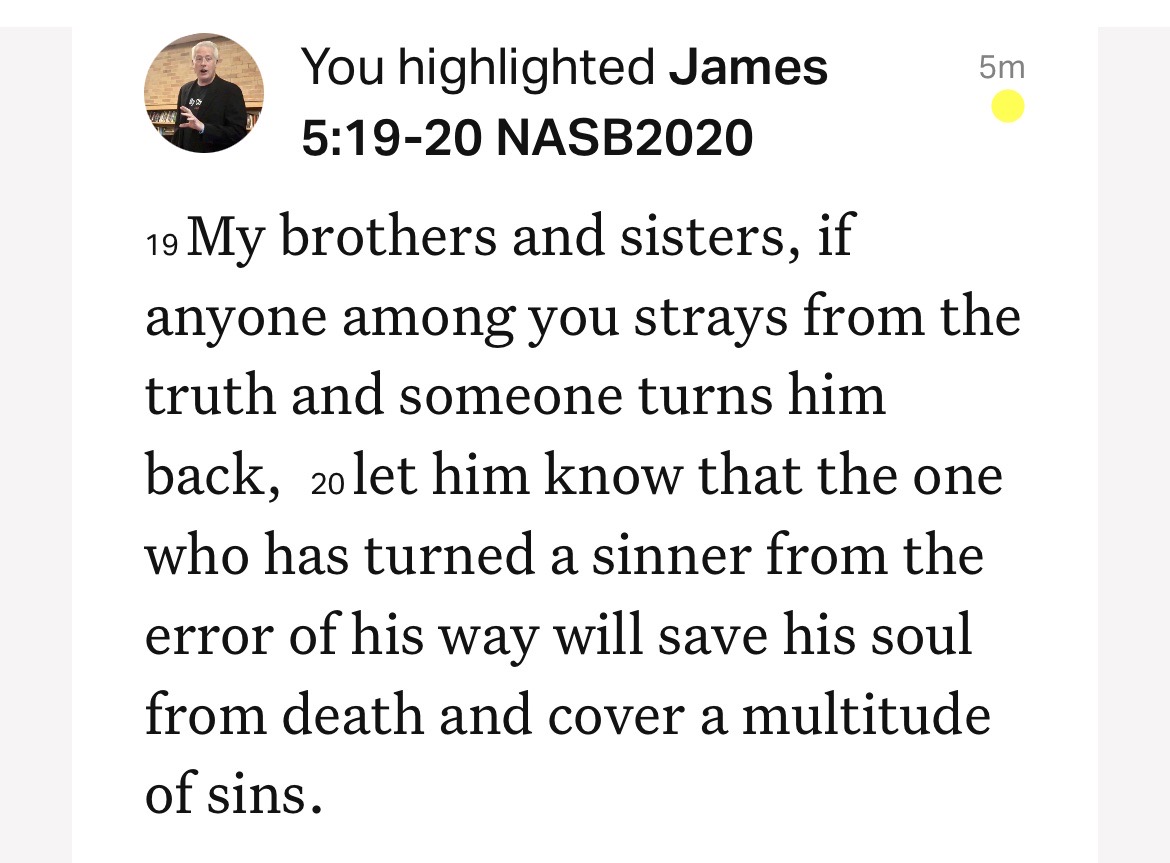
Is anyone among you in trouble? Let them pray. Is anyone happy? Let them sing songs of praise. Is anyone among you sick? Let them call the elders of the church to pray over them and anoint them with oil in the name of the Lord. And the prayer offered in faith will make the sick person well; the Lord will raise them up. If they have sinned, they will be forgiven. Therefore confess your sins to each other and pray for each other so that you may be healed. … My brothers and sisters, if one of you should wander from the truth and someone should bring that person back, remember this: Whoever turns a sinner from the error of their way will save them from death and cover over a multitude of sins. (James 5:13-16, 19-20) 

James wants the saints to be together in prayer, together in worship, together in confession, and together in rescuing their fellow brothers and sisters. The word he uses for “confession” means an out-loud profession or agreement. When he says, “confess your sins” he uses a word that means a deviation from a standard, or a falling short of God’s word. 

James sees this ongoing confession as a preventative to “a multitude of sins.” In this instance, the word he uses is an outright violation of God’s laws. In other words, the small deviations can add up to something deadly. 

Paul uses a similar idea when he writes, “Let us purify ourselves” (2 Corinthians 7:1). The implication again is that we are confessing both individually and corporately. I can be a huge blessing to my brothers and sisters by going first in confession (Matthew 7:1-5). 

Confession also helps others know they are not alone (1 Corinthians 10:12-13). 

As an individual saint I mature by continually closing the gap between realizing a shortcoming in my life and confessing that shortcoming to God and to another saint. Then as saints together we can love, encourage, help, and hold each other accountable. I have said before that I think confession may be the most under-used resource for Christians to gain power in prayer and victory over falling into temptation! 

In each of our previous five spiritual disciplines I’ve shared a “so that” statement to help us keep perspective of why we need to employ those disciplines. For confession, here’s our focal point: I confess to other saints so that we can be mutually accountable in our growth toward purity and maturity. 

Confession is good for us individually and corporately, so let’s continue to use this to strengthen everyone. 

If you’ve missed the messages covering the other spiritual disciplines, you can find all of them by clicking here. 

►► Would you please prayerfully consider supporting this ministry? My Patreon supporters get behind-the-scenes access to exclusive materials, like this recent video where I explain how God reveals previously-unknown truths to us. ◀︎◀︎

Living Out The Living Word

Listen to the podcast of this post by clicking on the player below, and you can also subscribe on AppleSpotify, or Audible. 

Last week I challenged you to free up some time in your schedule so that you could begin to apply these six spiritual disciplines we are going to discuss. 

Let’s keep in mind why we are learning and working on these disciplines. The key phrase is “so that”: I’m going to get stronger so that I have something to give to others, so that they will have something to give to others (and to me), and on and on it goes. Each of us needs all of us, and all of us need each of us!  

I love to read. In fact, I’m usually reading several books at the same time. Without a close second, my favorite book is my Bible. I say “my Bible” because I’ve made it mine—it’s underlined, circled, notated, and marked. It’s the Book I’m in every day, and it’s the Book that helps me glean the best knowledge from all the other books I read. 

G.K. Chesterton, the famous British writer, was once invited to a meeting of the leading intellectuals in England. They were discussing what one book they would want to have with them if they were shipwrecked on an island. Everybody expected Chesterton to say, “My Bible.” But when it came to his turn to speak, Chesterton said, “If I were shipwrecked on a desert island, I’d like to have Thomas’s Guide to Practical Shipbuilding.” 

Chesterton wasn’t saying the Bible wouldn’t have been of benefit to him on that island, but he was saying that those who study the Bible have the most practical insights! The Bible doesn’t just have lofty ideas, but it gives us heavenly wisdom that is highly practical to our everyday lives. 

The first spiritual discipline we are considering in our series Saints Together is: Studying our Bible. Notice I didn’t say just to read the Bible, but to really study the Book of books. 

The apostle Paul wrote, “So then faith comes by hearing, and hearing by the Word of God” (Romans 10:17). How do we know our faith is growing? It must be tested. Look at what James had to say about growing our faith—“the testing of your faith produces perseverance” (James 1:3). 

Testing really comes down to this: Does what I believe work in my everyday life? Can I truly put what the Bible teaches me into action? James went a little deeper with this in James 2:17-19. 

Allow me to share four indispensable components of our Bible study time. You will notice that for all of these components, I am giving you verses from the 119th chapter of the Psalms. This single chapter mentions God’s Word in every single one of its 176 verses. As an added bonus, this chapter is divided into twenty-two 8-verse sections. Scientists tell us that if you do anything for twenty-one days in a row, you will have gone a long way toward making it a permanent habit. So reading one section of Psalm 119 every day is a great place to start on this spiritual discipline of studying your Bible. 

Here are the four components:

(1) Read the Word. You cannot study something you haven’t read. I would suggest you pray before reading (Psalm 119:18, 33). I’d also suggest you leverage the power of your brain using a well-worn path by setting aside the same time, same place, and same method of study every day. 

(2) Pray the Word. The Bible is not just a Book to study, it’s a Book to pray too (Psalm 119:41-48). So pray for insight before you read, then turn what you have read into a personalized prayer.  

(3) Meditate on the Word. Take time to mull over what you have just read and prayed (Psalm 119:15, 99). This allows the Holy Spirit to bring it back to your mind. 

(4) Live out the Word. Apply it by allowing it to make a change in your life. Notice the action words in Psalm 119:1-4: walk … keep … walk … fully obey…. Or as God said to Joshua—

“Keep this Book of the Law always on your lips; meditate on it day and night, so that you may be careful to do everything written in it. Then you will be prosperous and successful.” (Joshua 1:8) 

This is how Jesus lived His life and it’s also how He said the Holy Spirit would help us live our lives in a God-glorifying way (John 12:49-50, 14:26). 

Every day we should be living out the living Word of God! 

I invite you to follow along as we continue learning all six of these important spiritual disciplines. You can find them all by clicking here. 

►► Would you please prayerfully consider supporting this ministry? My Patreon supporters get behind-the-scenes access to exclusive materials. ◀︎◀︎

Dismantling Lies

Listen to the podcast of this post by clicking on the player below, and you can also subscribe on AppleSpotify, or Audible. 

Lies, half-truths, and fake news: All of those can steal joy from a Christian’s life. How do we dismantle these joy-stealers?

Check out this episode of The Podcast.

Resources mentioned in this video:

►► Would you please prayerfully consider supporting this ministry? My Patreon supporters get behind-the-scenes access to exclusive materials. ◀︎◀︎

Avoiding The Bad Days

Listen to the podcast of this post by clicking on the player below, and you can also subscribe on AppleSpotify, or Audible. 

Would you like to avoid having a bad day? I have the solution for you!

Check out this episode of The Podcast.

Resources mentioned in this video:

►► Would you please prayerfully consider supporting this ministry? My Patreon supporters get behind-the-scenes access to exclusive materials. ◀︎◀︎