Love = Patience

PatienceLast week I wrote about how we can be empowered to get along with everyone, everywhere. But something I didn’t mention (which might be obvious) is this: Connecting with everybody, everywhere is hard work!

We have to remember that relationship is the goal. We’re not trying to make converts to Christianity and rack up some sort of high score. We’re building relationships with people because we love people; and that love for them should motivate us to:

  1. Want what’s best for them
  2. Be willing to serve them

The Bible says this: And we urge you, brothers, warn those who are idle, encourage the timid, help the weak, be patient with everyone.

Everyone?! There’s that word again!

This word patient has five parts to its definition. I’m struck by how these aspects of patience also echo the definition of love in 1 Corinthians 13

  • Patience doesn’t lose heartLove is patient (1 Corinthians 13:4a)
  • Patience endures misfortuneLove is not self-seeking (13:5a)
  • Patience is slow to angerLove is not easily angered (13:5b)
  • Patience bears with the offenses of othersLove keeps no record of wrongs (13:5c)
  • Patience perseveres bravelyLove always protects, always trusts, always hopes, always perseveres. Love never fails (13:7-8)

How are you doing in your relationships? Are you losing heart? becoming angry? about ready to throw in the towel on a difficult relationship? Ask God to renew your love, and your patience level will increase as well. 

Let’s all strive to love others—even the difficult “others”—the way God loves us!

Bono & Eugene Peterson Discuss The Psalms

Thursdays With Oswald—The Right Ingredients For Spiritual Growth

Oswald ChambersThis is a weekly series with things I’m reading and pondering from Oswald Chambers. You can read the original seed thought here, or type “Thursdays With Oswald” in the search box to read more entries.

The Right Ingredients For Spiritual Growth 

     God engineers the circumstances that are best fitted for the development of the life of His Son in us. … 

     We hear it asked, “What is the good of all this study and reading of the Bible? We get no ‘change’ out of it.” Most of us want something to show for what we do. We are not interested in God’s life in us, but only in our life in God. We are not after the development of the unconscious life of the Son of God in us, but after the “small change” which enables us to say, “I did this and that.” The life of the Son of God grows feeble in a life of that order.

     Every mind has two stories, the conscious and the unconscious. Most of what we hear passes out of our conscious mind into our unconscious mind and we think we have forgotten it, but we have not, we never forget anything; we cannot always recall it when we want to, but that is a different matter. We forget nothing; it is there, although not in the conscious mind, and when certain circumstances arise, suddenly the thing we thought we had forgotten is there to our amazement right enough. 

     This is exactly what Jesus said the Holy Ghost would do, “He shall…bring all things to your remembrance whatsoever I have said unto you” [John 14:26]. The Holy Spirit is forming the unconscious mind all the time, and as we “mop up” His teaching—simply take it in, not try to estimate it as we would a mathematical study—we shall find God is putting in the right soil for His life to grow in.

From The Psychology Of Redemption

God knows the soil, and the circumstances that will best make His life grow in us. Will I let Him have His way?

The best “fertilizer” for this growth is the Holy Spirit bringing out the Word of God in the circumstances in which God places us. Notice Jesus said the Spirit would remind us the Word. Which means it is my responsibility to put the Word into my mind as regularly as I can. Am I daily in His Word?

Abundantly Able

Yet Abraham did not waver through unbelief regarding the promise of God, but was strengthened in his faith and gave glory to God, being fully persuaded that God had power to do what He had promised. (Romans 4:20-21)

A.B. Simpson“The literal translation of this passage from the Greek expresses the thought in this way: God is not merely able but abundantly able, bountifully and generously able, with an infinite surplus of resources, and eternally able ‘to do what He had promised.’ He is the God of limitless resources—the only limit comes from us. Our requests, our thoughts, and our prayers are too small, and our expectations are too low. God is trying to raise our vision to a higher level, call us to have greater expectations, and thereby bring us to greater appropriation. Shall we continue living in a way that mocks His will and denies His Word?” —A.B. Simpson

How To Make New Communications Habits

Making new habitsPreviously I wrote about NOT trying to change our bad behaviors. That’s because our behavior is a natural outcome of several other factors (read more about that by clicking here). The important progression goes like this: Thoughts → Values → Attitudes → Behaviors.

The two areas we can address are our thoughts and attitudes. When it comes to interacting with other people, notice carefully the words Jesus said: “Love your neighbor as yourself” (Mark 12:31).

Jesus says that our thoughts about ourselves can limit our thoughts about others. If your thoughts are limited, your value on people and healthy relationships will slide. If those values drop, your attitude about others will begin to sour. And with those thoughts, values and attitude dropping, isn’t it natural to expect that you will struggle getting along with others?

So you must get this clear—

  • God had a plan for you from before the beginning of time (Ephesians 2:10)
  • God knit you together in your mother’s womb (Psalm 139:13-18)
  • God put just the right gifts and talents in you to change the world (Romans 12:3-6; 1 Corinthians 12:4-7).
  • God made you unique (you-nique!).
  • You are a one-of-a-kind masterpiece!

Because you are you-nique, you hear and see the world uniquely, and you respond uniquely. You and I respond mostly by habit.

Habits are good when they are healthy. But unhealthy habits create assumptions and blind spots that can hinder our relationships.

To make new relationship habits requires three things:

  1. Knowledge (what do I need to do)
  2. Skill (how do I need to do it)
  3. Desire (I really want to make this change)

If you want to make some new communication habits, get knowledge from people who love you and from reading the Bible. Then read some books or attend some seminars that will give you new skills. Then combine those with your sincere desire to want to improve your relationship habits, and watch for great things to happen!

I am leading our church through a training on our communication styles. Please join us on Sunday as we learn how to better get along with others. I’d love for you to join us either in person or on our Periscope broadcast.

Thursdays With Oswald—The New Life In Me

Oswald ChambersThis is a weekly series with things I’m reading and pondering from Oswald Chambers. You can read the original seed thought here, or type “Thursdays With Oswald” in the search box to read more entries.

The New Life In Me

     Oswald Chambers points out several things which affirms that one has experienced the new birth of salvation.

     “If Christ is formed in us, the great characteristic is that we know Him and perceive Him for ourselves. We do not need anyone to tell us about Him now, He is our Lord and Master.” 

     “Where do we go in a crisis? If we are born from above and Jesus Christ is Lord and Master, we will go direct as a homing pigeon to Him.” 

     “When Christ is formed in us, we are a satisfaction to our Lord and Master wherever He places us. The point of importance is to know that we are just exactly where He has engineered our circumstances. There is no ‘foreign field’ to our Lord.” 

     “Another evidence of new birth is that we see the rule of God. We no longer see the haphazard of chance for fate, but by the experience of new birth we are in able to see the rule of God everywhere. … We all see the common occurrences of our daily life, but who amongst us can perceive the arm of the Lord behind them? The saint recognizes in all the ordinary circumstances of his life the hand of God and the rule of God, and Jesus says we cannot do that unless we are born from above. … Nothing happens by chance to a saint, no matter how haphazard it seems. It is the order of God.” 

     “Do we seek to stop sinning, or have we stopped sinning? We are always inclined to make theoretical what God makes practical. Learned divines and others talk about the sin question, and make it a doctrinal matter of dispute. In the Bible it is never, Should a Christian sin? The Bible puts it emphatically: A Christian must not sin. … 

     “When we are born into the new realm the life of God is born in us, and the life of God in us cannot sin (1 John 3:9). That does not mean that we cannot sin; it means that if we obey the life of God in us, we need not sin. God never takes away our power to disobey; if He did, our obedience would be of no value, for we should cease to be morally responsible. By regeneration God puts in us the power not to sin.” 

From The Psychology Of Redemption

As you read through this list, what do you think? Are you trying to be a Christian, or are you letting this new birth simply do its work in you?

11 Quotes From “The Duty Of Pastors”

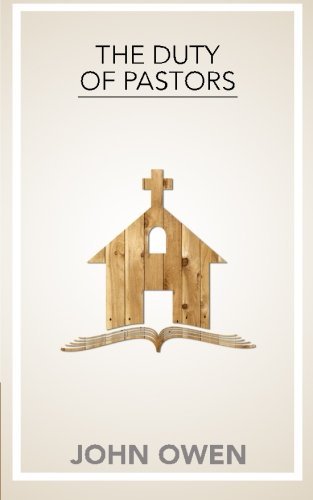
The Duty Of PastorsJohn Owen has some fascinating insights on pastors and ministers (hint: they’re not the same thing) in his book The Duty Of Pastors. Here are some of the quotes I liked from this book. Remember this book was written in the 17th-century, so don’t let the Old English keep you from discovering the rich truths in these passages.

“Why should any speak where the Holy Ghost is silent? … Where things are obscured, it is a safer way to prove the practice of men by God’s precept, charitably supposing them to have been obedient, than to wrest the divine rule to their observation, knowing how prone men are to deify themselves by mixing their inventions with the worship of God.”

“The lights which God maketh are sufficient to rule the seasons for which they are ordained. As, in creating of the world, God ‘made two great lights, the greater light to rule the day, and the lesser light to rule the night;’ so, in the erection of the new world of His church, He set up two great lights, the lesser light of the Old Testament to guide the night, the dark space of time under the law, and the greater light of the New Testament to rule the glorious day of the gospel. And these two lights do sufficiently enlighten every man that cometh into this new world. There is no need of the false fire of tradition where God sets up such glorious lights.”

“All faithful ministers of the gospel, inasmuch as they are ingrafted into Christ and are true believers, may, as all other true Christians, be called priests; but this inasmuch as they are members of Christ, not ministers of the gospel. It respecteth their persons, not their function, or not them as such.”

“Thus, this metaphorical appellation of priests is, in the first place an intimation of that transcendent privilege of grace and favour which Jesus Christ hath purchased for everyone that is sanctified with the blood of the covenant.”

“Not to lose myself and reader in this digression, the sum is, the unspeakable blessings which the priesthood of Christ hath obtained for us are a strong obligation for the duty of praise and thanksgiving; of which that in some measure we may discharge ourselves, He hath furnished us with sacrifices of that kind to be offered unto God.” 

“That the name of priests is nowhere in the Scripture attributed peculiarly and distinctively to the ministers of the gospel as such. … And yet, when Christ ascended on high, He gave some to be prophets, for the edification of His body, Eph. iv. 11; none, as we find, to be priests. Priests, then (like prelates), are a sort of church-officers whom Christ never appointed.”

“Never fear the equity of what God sets thee upon. No excuses of disability or any other impediment ought to take place; the Lord can and will supply all such defects.”

“God never sendeth any but whom He doth so extraordinarily and immediately call and ordain for that purpose; and that this may be manifested unto others, He always accompanieth them with His own almighty power, in the working of such miracles as may make them be believed, for the very works’ sake which God by them doth effect.”

“We do not read of any such miracles wrought by the prophet Amos, and yet he stands upon his extraordinary immediate vocation, ‘I was no prophet, neither was I a prophet’s son, but the Lord took me,’ etc. It sufficeth, then, that they be furnished with a supernatural power, either in, 1. Discerning; 2. Speaking; or 3. Working. … The sum is, that seeing such men pretend that their revelations and miracles are from heaven, let us search whether the doctrine they seek to confirm by them be from heaven or no.”

“There is a general obligation on all Christians to promote the conversion and instruction of sinners, and men erring from the right way.”

“For a public, formal, ministerial teaching, two things are required in the teacher: first, Gifts from God; secondly, Authority from the church (I speak now of ordinary cases). He that wants either is no true pastor.”

Be sure to check out my review of The Duty Of Pastors by clicking here.

The Duty Of Pastors (book review)

The Duty Of PastorsJohn Owen is one of the influential and powerful voices of the Puritans from the mid-17th century. One of the things that makes him influential is the source of his wisdom: Everything he writes is thoroughly grounded in Scripture. This is especially true for his book The Duty Of Pastors.

Originally this book was entitled The Duty Of Pastors and People Distinguished. As you might be able to tell from this original title, Owen lays out from Scripture the roles of ministers and pastors. These two titles and roles are distinct, although many people want to lump them together. Owen points out that any one who is a Christian can minister to people (and thus be called a “minister”), but there are special God-appointed roles for those called “pastors.”

Owen writes, “The first and principal duty of a pastor is to feed the flock by diligent preaching of the Word.” Indeed, this is one of the main thing which distinguishes pastors from ministers.

Owen also takes to task those in religious circles who would put artificial (in other words, things not commanded in Scripture) barriers for people to answer God’s call to the pastorate.

This is not a very long book, but given that fact that it is older, it is a bit of a challenging read. But for anyone who is interested in the roles of pastors and ministers, or for anyone who wants to know how to support their pastors, The Duty Of Pastors is well worth your time and effort.

12 More Quotes From “The Place Of Help”

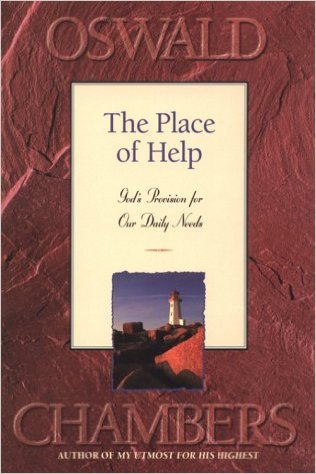
The Place Of HelpAs always, there are more quotes from Oswald Chambers’ books than I have space to share them. So here are a few more from The Place Of Help.

“If we are going to be used by God, He will take us through a multitude of experiences that are not meant for us at all, but meant to make us useful in His hands. There are things we go through which are unexplainable on any other line, and the nearer we get to God the more inexplicable the way seems. It is only on looking back and by getting an explanation from God’s Word that we understand His dealings with us.”

“The essence of Christianity is that we give the Son of God a chance to live and move and have His being in us, and the meaning of all spiritual growth is that He has an increasing opportunity to manifest Himself in our mortal flesh.”

“Temptation is a short cut to what is good, not to what is bad. satan came to our Lord as an angel of light, and all his temptations center around this point—‘You are the Son of God, then do God’s work in Your own way; put men’s needs first, feed them, heal their sicknesses, and they will crown You King.’ Our Lord would not become King on that line; He deliberately rejected the suggested short cut, and choose the long trail, evading none of the suffering involved (cf. John 6:15).”

“God expects His children to be so confident in Him that in a crisis they are the ones upon whom He can rely. … God expects of us the one thing that glorifies Him—and that is to remain absolutely confident in Him, remembering what He has said beforehand, and sure that His purposes will be fulfilled.”

“God has never promised to keep us immune from trouble; He says ‘I will be with him in trouble,’ which is a very different thing.”

“The Bible characters never fell under weak points but on their strong ones; unguarded strength is double weakness.”

“Do we trust in our wits or do we worship God? If we trust in our wits, God will have to repeat the same lesson until we learn it.”

“The coming of Jesus Christ is not a peaceful thing, it is a disturbing thing, because it means the destruction of every peace that is not based on a personal relationship to Himself.” [Matthew 10:34]

“The peace that Jesus gives is never engineered by circumstances on the outside; it is a peace based on a personal relationship that holds all through. ‘In the world ye shall have tribulation: … in Me … peace.’”

“God is a holy God, and the marvel of the Redemption is that God the Holy One puts into me, the unholy one, a new disposition, the disposition of His Son.”

“In the Sermon on the Mount our Lord teaches us not to look for justice, but never to cease to give it. That is not commonsense, it is either madness or Christianity.”

“When the love of God is in me I must learn how to let it express itself; I must educate myself in the matter; it takes time. Acquire your soul with patients, says Jesus [Luke 21:19]. Never give way to this spirit—‘Oh well, I have fallen again, I will stay down now.’ Have patience with yourself, and remember that this is salvation not for the hereafter, but for the here and now.”

You can read the first set of quotes from The Place Of Help by clicking here.

My review of The Place Of Help is here.

And be sure to look for “Thursdays With Oswald” to read quotes and thoughts from the current Chambers’ book I am reading.

Thursdays With Oswald—Work Out What God Has Worked In

Oswald ChambersThis is a weekly series with things I’m reading and pondering from Oswald Chambers. You can read the original seed thought here, or type “Thursdays With Oswald” in the search box to read more entries.

Work Out What God Has Worked In

     If we have experienced regeneration, we must not only talk about the experience, we must exercise it and work out what God has worked in (Philippians 2:12-13). We have to show it in our finger-tips, in our tongue, and in our bodily contact with other people, and as we obey God we find we have a wealth of power on the inside. … 

     The practicing is ours, not God’s. God regenerates us and puts us in contact with all His divine resources, but He cannot make us walk according to His will. If we will obey the Spirit of God and practice through our physical life all that God has put in our hearts by His Spirit, then when the crisis comes we shall find that we have not only God’s grace to stand by us but our own nature also, and the crisis is passed without any disaster, but exactly the opposite happens, the soul is build up into a stronger attitude towards God.

From The Psychology Of Redemption

God doesn’t make us a new person, but He gives us the power to become a new person. The key is our obedience to what the Holy Spirit reveals to us from the Bible. Will we obey what He shows us? If we do, we can expect “a wealth of power on the inside.” If we don’t, people will probably call us hypocrites.

Will you obey? Will you work out what God has worked in?