“How odd that the most famous Bible in history should bear the name of a hard-drinking, foul-mouthed, ego-driven homosexual who rejected all demands for reform within the church.
“James VI of Scotland, son of imprisoned Mary, Queen of Scots, was raised in drafty Scottish castles by self-serving lords. He grew up religious and well-trained in theology. He went to church every day. But he was rude, rough, loud, conceited, and bisexually immoral. He was also shrewd.
“At age 37 he managed to succeed his cousin, Elizabeth I, as England’s monarch. As he traveled from Scotland to London, he met a group of Puritans bearing a ‘Millenary Petition’ signed by nearly 1,000 pastors. It demanded renewal within the church. The Puritans, stirred by the Geneva translation of the Bible and by Foxe’s popular Book of Martyrs, wanted to purify the church. The established clergy opposed Puritan demands, and the new king realized his kingdom was torn.
“He convened a conference for church leaders at his Hampton Court estate on January 12, 1604, and the Puritans vigorously presented their concerns. James rejected their requests, sometimes thundering against them, white with rage. At the conclusion of the conference he flung his arm toward the Puritans, shouting, ‘I shall make them conform or I will harry them out of this land, or do worse.’ Many of the dispirited Puritans, abandoning hope for the Anglican Church, began worshiping in small groups as they felt the Bible taught them. They were tagged Separatists, but from these persecuted cells came the Baptists in 1611, the Pilgrims who fled to America in 1620, and other dissenting groups.
“But on one issue at Hampton Court the king and Puritans had agreed. When Puritan John Rainolds requested a new translation of the Bible, James promptly approved it, saying, ‘I have never yet seen a Bible well-translated. But I think the Geneva is the worst.’ Seven years later the Authorized Version was unveiled, ironically making vice-prone King James one of the best-recognized names in English church history.” —Robert Morgan, On This Day
Last week I asked you to imagine how your relationship grew with your best friend. You probably found that this special friendship was formed during hours andhours of talking.
I’m going to guess that at first your conversation was a little on the superficial side. You talked about “tame” topics like sports teams, or your job, or the city you lived in. But at some point you took a huge risk—you became vulnerable by sharing something really personal. Perhaps you shared a time that you got hurt, or something that makes you anxious, or maybe a big dream you carry around in your heart. But if that friend is still your friend, that means they treated what you shared reverently. They didn’t laugh at you, belittle your hurts or dreams, nor did they share with others what you said.
The relationships became deeper and more special because you now knew each other on a more intimate level.
Prayer is a conversation with a Friend. Of course, that Friend is God, so some people wonder, “What do I talk to God about?” The simple answer is anything and everything!
Time and time again God calls us to come closer to Him (see Isaiah 55:1-3), to discuss with Him things we don’t understand (Jeremiah 33:3), or to be assured that He is intimately tuned in to what’s happening in our life (Psalm 139:17; 1 Peter 3:12).
How do we get there? A good place to start is with our Bible. Dwight Moody said:
“The two first and essential means of grace are the Word of God and Prayer. … If we read the Word and do not pray, we may become puffed up with knowledge, without the love that buildeth up. If we pray without reading the Word, we shall be ignorant of the mind and will of God, and become mystical and fanatical, and liable to be blown about by every wind of doctrine.”
Scripture was written to point us to Jesus. So we don’t read the Bible just to read it; we read it to get to know God.
We don’t want to know the Word of God; we want to know the God of the Word.
A great place to start is in the book of the Psalms. Many of these were written as prayers, so it’s a good way to start our conversation with God. You can also search in the New Testament for all the places that biblical writers said, “I pray…” or “This is my prayer….”
I share a personal example of this in this video, especially if you want to fast forward to the 36:00 minute mark.
Don’t just read through the Bible this week—pray through the Bible. Use it as a means to have a conversation with the very Best Friend you could ever know!
I encourage you this week, as you think about this topic, to get together with an earthly friend and discuss these questions:
How can I use my Bible as a “conversation starter” with God?
How can I get into the regular practice of talking to God as a Friend?
I would like for you to get a really clear picture in your mind of your best friend. This is someone you have opened your heart to, and they have opened their heart to you as well. This is the friend that encourages you when you’re down, but never when you’re on a self-destructive path. This is the companion that cries with you when something is broken, but who also challenges you to accept responsibility if you are the one who broke it.
Do you have that friend clearly in mind?
Now I’d like you to imagine if your interaction with your friend went something like this. Every day around 7 o’clock in the morning, you call your friend and say…
“Good morning! I’m so grateful you took my call. Listen, I’ve got a few things that I’d love for you to help me with today. I’ve been fighting a cold and I’d really like you to help me feel better. My Aunt Sally is in the hospital, and it would be great if you could stop in to see her. Also, that guy at work has really been on my nerves lately and so I need some insight on how to deal with that. It would so great if you could help me with all of this. If you do, I’ll be singing your praises to everyone I meet. Have a great day. Thanks!”
And then you hang up and never talk to your friend again until the next morning when the exact same scenario is repeated. How do you think your relationship would progress? Do you see your relationship getting deeper over time, or becoming more distant? I’m guessing that, like me, you don’t see a future in this relationship.
Sadly, this is how many people treat prayer! We come to God once a day with our list of concerns, ask Him for His help, then say “goodbye” and never think about Him again until the next day. Or until we find ourselves in desperate need.
But we forget: God never leaves us!
We also forget something even more vital—God wants us to talk with Him, and He wants to talk with us, as a friend to a friend.
Abraham was called a friend of God—Abraham believed God, and it was credited to him as righteousness, and he was called God’s friend (James 2:23).
Moses, too, was also God’s friend—The Lord would speak to Moses face to face, as one speaks to a friend (Exodus 33:11).
This isn’t something that was just for them, but it’s relationship that’s available for ALL of us—For since our friendship with God was restored by the death of His Son while we were still His enemies, we will certainly be saved through the life of His Son. So now we can rejoice in our wonderful new relationship with God because our Lord Jesus Christ has made us friends of God (Romans 5:10-11).
From the moment we accepted Jesus as our Lord and Savior, His Holy Spirit took up residence in our heart. Before Jesus ascended to Heaven, He promised us, “I will talk to the Father, and He’ll provide you another Friend so that you will always have someone with you. This Friend is the Spirit of Truth” (John 14:16).
Amazing! Astounding! Mind-blowing! But totally true—Prayer is conversation with a Friend!
How would your day go differently if you kept up a conversation with your Best Friend all day long? How much more wisdom do you think you would receive? How many mistakes could you avoid if He was telling you which way to go and what to say?
You don’t have to live with the “what ifs.” He IS your constant Companion, your most loyal Friend, your wisest Counselor. All you have to do is keep the lines of conversation open!
Application questions:
How can I know God wants to be my Friend?
Have I been introduced to God?
How can I make the time to deepen my friendship with God?
Have you ever been stumped by someone’s argument against Christianity or the Bible? Has anyone ever made fun of you because the Bible sounds like a fairy tale? Over 100 years ago Oswald Chambers described how our post-Christian world was beginning to treat Christianity and the Bible on which it’s based—
“We have made ambition and competition the very essence of civilized life. No wonder there is no room for Jesus Christ, and no room for the Bible. We are all so scientifically orthodox nowadays, so materialistic and certain that rationalism is the basis of things, that we make the Bible out to be the most revolutionary, unorthodox and heretical of books.”
It’s that “rationalism” that we need to address. We need to ask scoffers and seekers alike, “What makes you so sure of your beliefs? How did you come to that conclusion?”
Every human being exercises some sort of faith—that the chair will hold them when they sit down, that their spouse will honor their marriage vows, and that their worldview is correct. We need to explore what kind of faith they (and we) have:
Unreasonable faith—believing in something in spite of the evidence.
Blind faith—believing in something without any evidence.
Reasonable faith—believing in something because of the evidence.
I want to show evidence that makes it reasonable to believe in the Bible.
Empirical evidence—
The bibliographical test: determining whether the text of the historical record has been transmitted accurately.
Josh McDowell states, “No other work in all literature has been so carefully and accurately copied as the Old Testament.” He can make this claim because the profession of “scribe” was one of the most professional and exacting of all professions. The rigorous standards employed to prove the accuracy of a copy of a biblical manuscript was higher than for any other literature.
Most of our modern-day Bibles are based on a 1000-year-old manuscript. But after the Dead Sea scrolls were discovered, we found biblical manuscripts going back to 250 B.C. that confirmed the accuracy of the manuscripts we already had. This led Dr. Peter Flint to conclude: “The biblical Dead Sea Scrolls are up to 1,250 years older than the traditional Hebrew Bible, the Masoretic text. We have been using a one-thousand-year-old manuscript to make our Bibles. We’ve now got scrolls going back to 250 BC. … Our conclusion is simply this—the scrolls confirm the accuracy of the biblical text by 99 percent.”
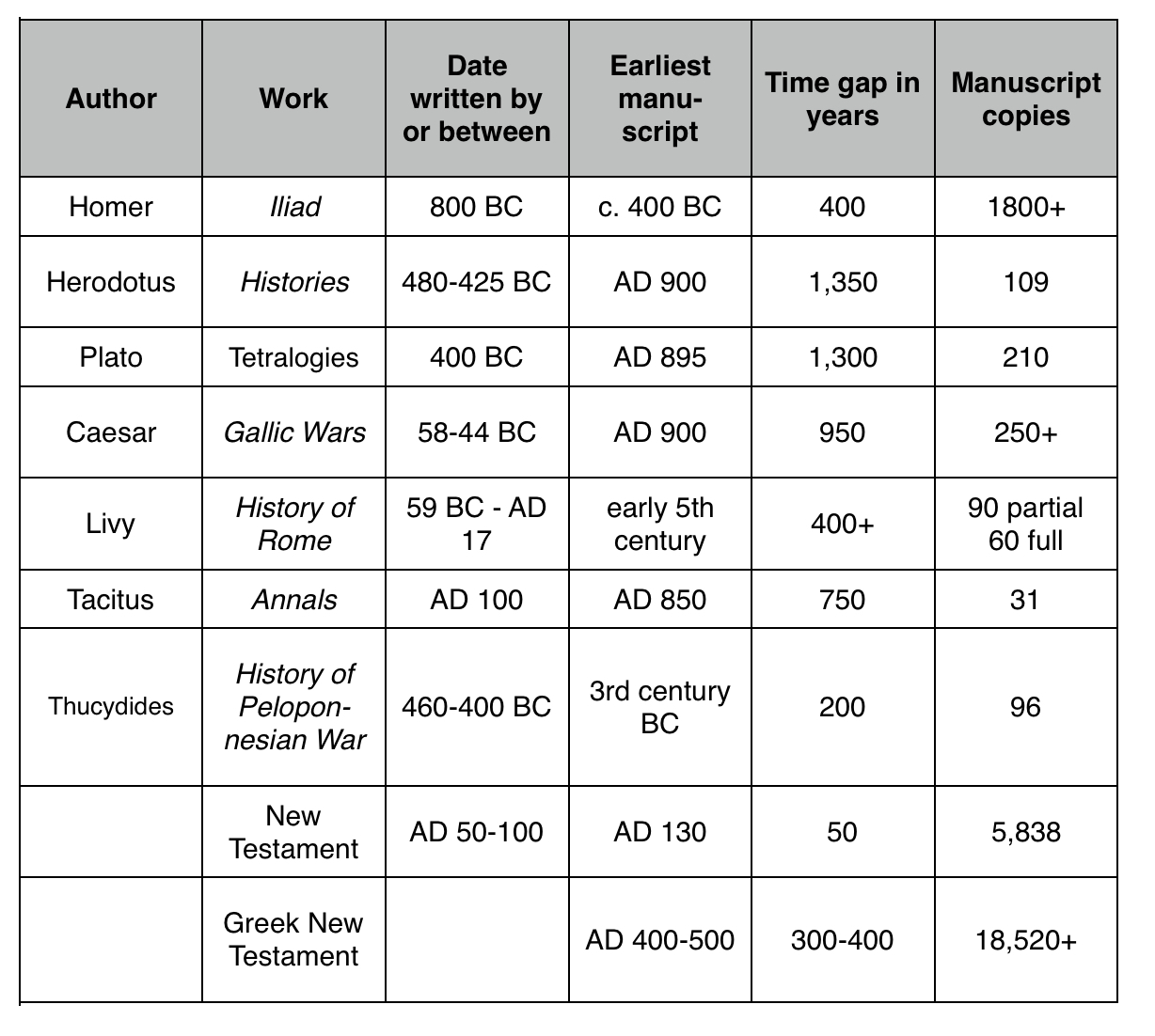
Then regarding the New Testament, Josh McDowell says, “I believe there is more evidence for the reliability of the New Testament than for any other ten pieces of classical literature put together.” Check out this chart reproduced from McDowell’s book God-Breathed to see by comparison to other literature, how close in dating the earliest biblical manuscripts are, and how many of those manuscripts have been discovered!
2. The external evidence test: determining whether the historical record has been verified or affirmed by data outside of itself.
Over one-fourth of the Bible is prophetic, and two-thirds of its prophesies have already been fulfilled. For example, 700 years before His birth, the city in which Jesus was to be born was identified by a man named Micah.
Time and time again archeologists discover articles that verify the claims in the Bible. This led archeologist Nelson Glueck to conclude, “It may be stated categorically that no archeological discovery has ever controverted a single biblical reference. Scores of archeological findings have been made which confirm in clear outline or in exact detail historical statements in the Bible.”
3. The internal evidence test: determining how of the historical record stands up to the test of internal validity.
The Bible was written by 45 different authors, over a span of 1500 years, on 3 different continents, and in 3 different languages. Yet there are no contradictions!
Anecdotal evidence—
Changed lives. My life is one that has been amazingly impacted by the God of the Bible, as was a man named Saul, who had a total about-face after encountering Jesus. As a result, Christianity was spread far and fast through his writings and world travels.
2. Changed societies. Wherever the Christian faith of the Bible has been put into practice, societies improve. Leonard Sweet notes—
“Before Christianity, there were cults that practiced all sorts of human sacrifice as well as self-mutilation and self-castration. Before Christianity, the weak were despised, the poor maligned, the handicapped abandoned. Before Christianity, infanticide was rampant, slavery run-of-the-mill, and gladiatorial combat a form of entertainment. In Jesus’ day, Corinth was famous for its temple prostitutes, continuing a long-standing tradition symbolized by the Corinthian athlete Xenophon.… Aristotle…not only condoned institutionalized slavery but provided an elaborate argument in favor of it. As if that weren’t enough, Aristotle called man ‘begotten’ and woman ‘misbegotten,’ and because a woman’s reasoning was ‘without authority’ accepted no female students.
“Only Jesus and His followers known as the church insisted on the concept of human dignity and the value of every human soul. Only the church built hospitals and took care of the abandoned and disabled. Only the church celebrated charity and selflessness as the highest virtue and elevated the status of women.”
Is all of this “proof positive” that the Bible is God’s Word? No, it’s not. But I think the evidence is compelling enough that it is certainly reasonable to reach this conclusion.
Here are some great application questions from this lesson:
Other than because it says so in the Bible, how do I know that it is God’s Word?
This is the fourth set of quotes I’ve shared from Josh McDowell and Sean McDowell’s book The Beauty Of Intolerance. You can check out the other quotes here, here, and here; and if you missed my review of this book, please click here to read that.
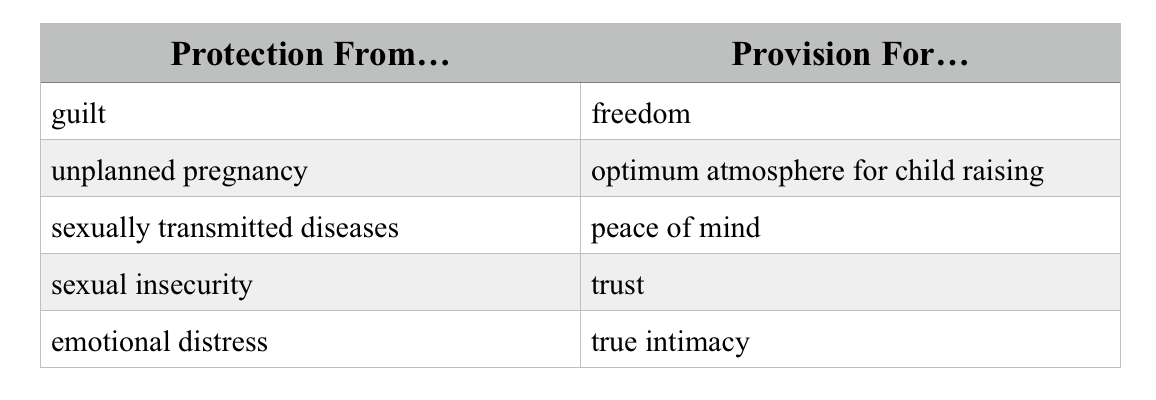
“Respecting the boundaries of sexual morality and prohibitions for extramarital and premarital sex does bring protection and provision. Here are just a few ways it does this:
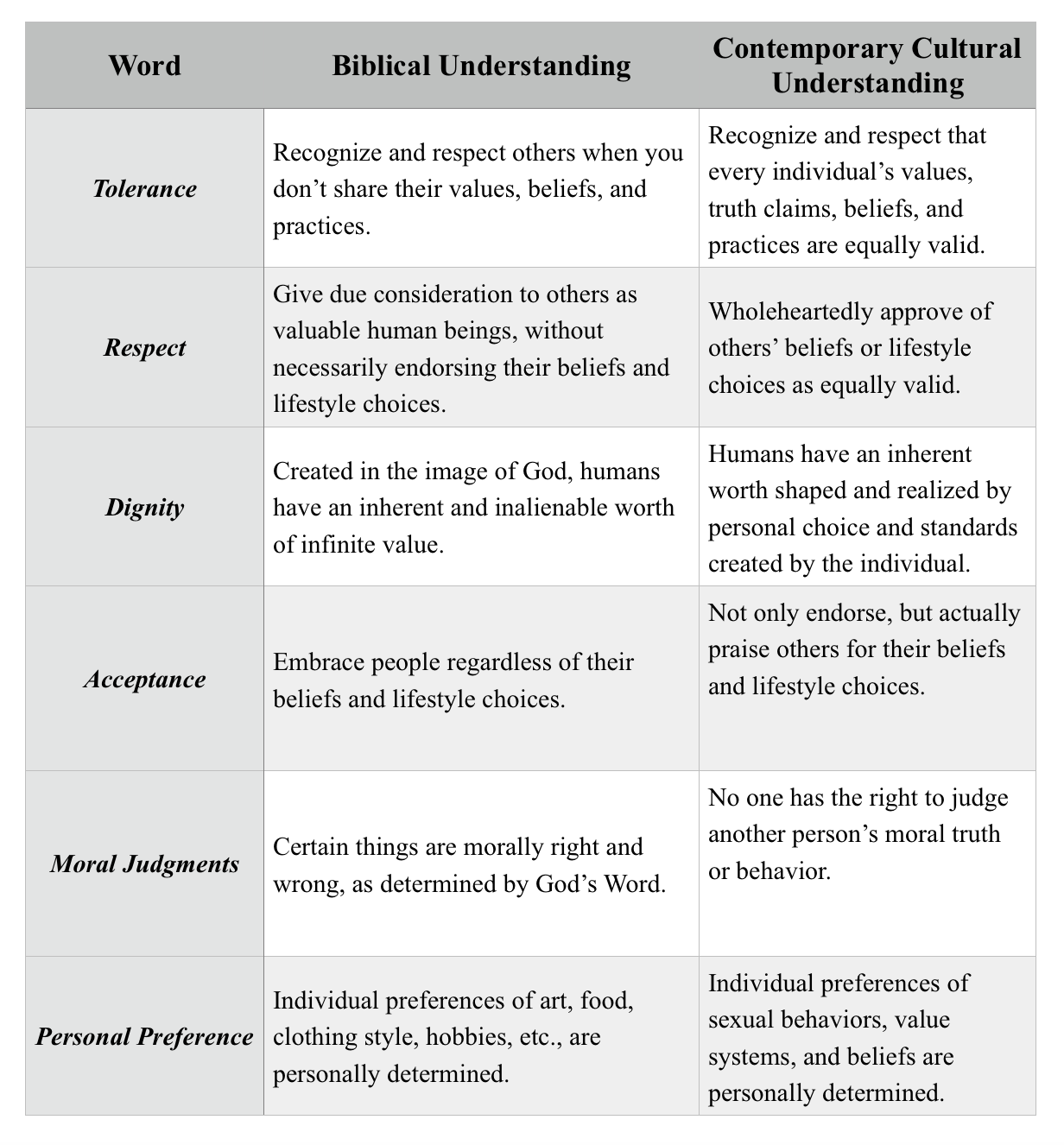
“Although sin has separated us from God, His original intent for us and the reality that we were created in His image have not changed. What we do or don’t do may distort that image, but our worth to God as human beings never changes.”
“So how has Christ loved you? He values all people for their inherent worth and offers grace freely to all people without exception. Cultural tolerance, on the other hand, claims to accept everyone’s differing beliefs, values, and lifestyles, yet it qualifies that acceptance. … What distinguishes God’s unconditional acceptance from that of our culture is authentic love. His love is intended to make the security, happiness, and welfare of another as important as His own. It is other-focused, not performance-focused. … Real valuing of another’s personhood expressed in the context of authentic love separates doing from being and sees the acts of sin distinct from the sinner (which, by the way, is all of us).”
“The beauty of intolerance is its opposition to wrong and evil in the world—in alignment with God’s righteous and perfect standard of justice, equality, human rights, and caring for others. Intolerance of evil is not mean-spirited and condemnatory; it is actually the only way to be loving and caring. Far from being judgmental, it advances God’s righteous kingdom.”
“Most people in America subscribe to a view of morality called ‘cultural ethics.’ In other words, they believe that whatever is acceptable in that culture is moral; if the majority of people say a thing is right, then it is right. … But there’s a problem with that. If that is true, then how can we say the ‘aborting’ of six million Jews in the Holocaust was wrong? In fact, the Nazis offered that very argument as a defense at the Nuremberg Trials. They argued, ‘How can you come from another culture and condemn what we did when we acted according to what our culture said was acceptable?’ In condemning them, the tribunal said that there is something beyond culture, above culture, that determines right and wrong.”
“We are all entitled to our own beliefs, but this doesn’t mean each of us has our own truths. Our beliefs describe the way we think the world is. Truth describes the objective state of the world regardless of how we take it to be. Beliefs can be relative, but truth cannot. … Moral truth was never meant to be spoken or understood outside of a loving relationship. Being like Christ and speaking the truth in love are synonymous.”
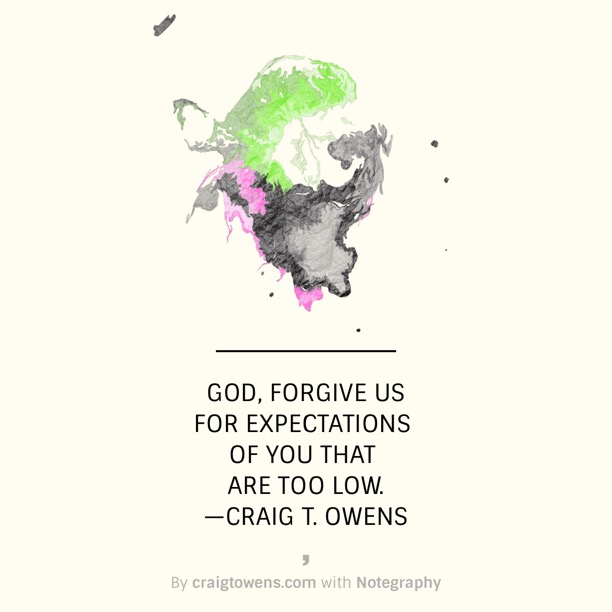
“God, forgive us for expectations of You that are too low.” —Craig T. Owens
“I am the God of unlimited creativity; expect Me to do surprising things in this year that stretches out before you.” —Jesus (from Sarah Young’s Jesus Always)
“Be always at war with your vices, at peace with your neighbors, and let each new year find you a better man.” —Benjamin Franklin
“Of all persons the Christian should be best prepared for whatever the New Year brings. He has dealt with life at its source. In Christ he has disposed of a thousand enemies that other men must face alone and unprepared. He can face his tomorrow cheerful and unafraid because yesterday he turned his feet into the ways of peace and today he lives in God. The man who has made God his dwelling place will always have a safe habitation.” —A.W. Tozer
“Real peace is knowing that no matter what I do, God will never stop loving me. Real peace is knowing that no matter what happens, God will never leave me alone. He’ll always be with me. Real peace means that no matter what happens in the New Year, or in the years to come, I know that God is going to give me the strength to handle it. Real peace is living by God’s Word, the Bible, so I can avoid a lot of the needless hang-ups and hurts and habits that mess up my life.” —Rick Warren, in On This Holy Night
The Dawning Of Indestructible Joy is a wonderful book from John Piper to prepare your heart for celebrating Christ’s First Advent! It’s arranged as a 25-day countdown until Christmas morning. Check out my review of this book here, and then enjoy a few quotes that caught my attention.
“The coming of Jesus was a search-and-save mission. ‘The Son of Man came to seek and save the lost’ [Luke 19:10]. So Advent is a season for thinking about the mission of God to seek and to save lost people from the wrath to come. … ‘As the Father has sent Me, even so I am sending you’ (John 20:21). It’s the story of how the vertical advent of God in the mission of Jesus bends out and becomes the horizontal advent of Jesus in the mission of the church. In us.”
“If there is a longing in your heart this Advent for something that the world has not been able to satisfy, might not this longing be God’s Christmas gift preparing you to see Christ as consolation and redemption and to receive Him for who He really is?”
“Christmas is about the coming of the Son of Man who ‘came not to be served but to serve, and to give His life as a ransom for many.’ These words in Mark 10:45, as a brief expression of Christmas, are what I hope God will fix in your mind and heart this Advent. Open your heart to receive the best present imaginable: Jesus giving Himself to die for you and to serve you all the rest of eternity.”
“Take the very personal words of the Apostle Paul and make them your own. ‘The life I now live in the flesh I live by faith in the Son of God, who loved me and gave Himself for me’ (Galatians 2:20). This is how Jesus destroyed the works of the devil and rescued us from our sin. Don’t leave Christmas in the abstract. Your sin. Your conflict with the devil. Your victory. He came for this.”
“The point is that when Jesus comes, He confirms the truth of all God’s promises. He shows that God is trustworthy; He keeps His word. … Christ came to prove that God tells the truth, that God keeps His promises. Christmas means that God can be trusted.”
“It is God’s message of hope this Advent that what is good need never be lost and what is bad can be changed. The devil works to take the good and bring the bad. And Jesus came to destroy the works of the devil [1 John 3:8].”
“This is what God does again and again. He may be doing it for you this Advent season—graciously and tenderly frustrating you with life that is not centered on Christ and filling you with longings and desires that can’t find their satisfaction in what this world offers, but only in the God-man. What a Christmas gift that might be! Let all your frustrations with this world throw you onto the Word of God. It will become sweet—like walking into paradise.”
“I call you by name and lead you. I know you—I know every detail about you. You are never a number or statistic to Me; My involvement in your life is far more personal and intimate than you can comprehend. So follow Me with a glad heart. After My resurrection, when Mary Magdalene mistook Me for the gardener, I spoke one word: ‘Mary.’ Hearing Me say her name, she recognized Me and cried out in Aramaic, ‘Rabboni!’ (which means teacher). Beloved, I also speak your name in the depths of your spirit.When you read your Bible, try inserting your name into appropriate passages. … Take time to ‘hear’ Me speaking to you personally in Scripture, reassuring you of My love.” —Jesus (in Sarah Young’s book Jesus Always)
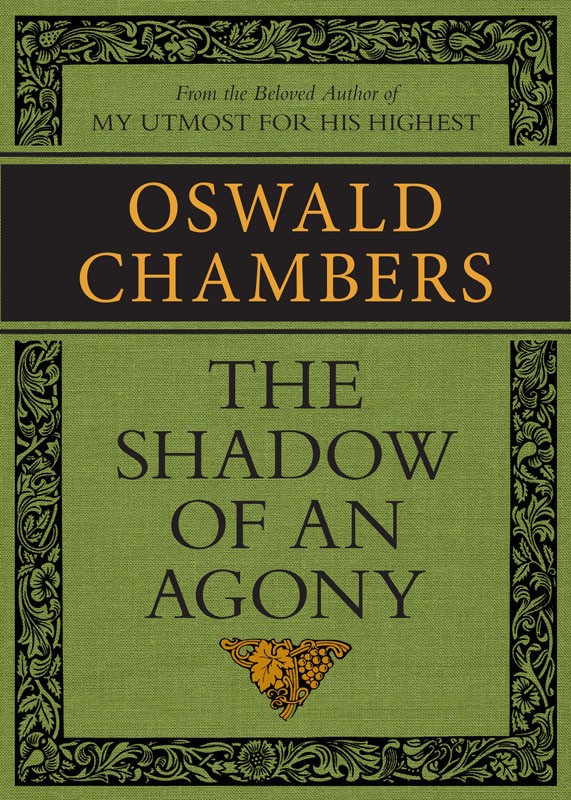
In The Shadow Of An Agony, Oswald Chambers explores how we should process the hard events of our lives which seem to totally rock our neat and orderly world. Check out my book review by clicking here, and then enjoy a few quotes from this book.
“If Jesus Christ were only a martyr, His Cross would be of no significance; but if the Cross of Jesus Christ is the expression of the secret heart of God, the lever by which God lifts back the human race to what it was designed to be, then there is a new attitude to things.”
“The agony of a man’s affliction is often necessary to put him into the right mood to face the fundamental things of life. The Psalmist says, ‘Before I was afflicted I went astray: but now I have kept Thy Word.’ The Bible is full of the fact that there has to be an approach to the holy ground. If I am not willing to be lifted up, it is no use talking about the higher heights. … No man can do wrong in his heart and see right afterwards. If I am going to approach the holy ground, I must get into the right frame of mind—the excellency of a broken heart.”
“Jesus Christ did not come to give us pretty ideas of God, or sympathy with ourselves; He came from a holy God to enable men, by the sheer power of His Redemption, to become holy.”
“No man is the same after an agony; he is either better or worse, and the agony of a man’s experience is nearly always the first thing that opens his mind to understand the need of Redemption worked out by Jesus Christ.”
“The attitude of the Bible to the human race is not a common-sense one. The Christian aspect deals with the a specimen of a human race which is a magnificent ruin of what it was designed to be. Supposing the view of the Bible to be right, to whom it is it ‘up to’ to right the wrong? The Creator. Has He done it? He has, and He has done it absolutely single-handed. The tremendous revelation of Christianity is not the Fatherhood of God, but the Babyhood of God—God became the weakest thing in His own creation, and in flesh and blood He levered it back to where it was intended to be. No one helped Him; it was done absolutely by God manifest in human flesh. God has undertaken not only to repair the damage, but in Jesus Christ the human race is put in a better condition than when it was originally designed.”
“We have been taken up with creeds and doctrines, and when a man is hit we do not know what to give him; we have no Jesus Christ, we have only theology. For one man who can introduce another to Jesus Christ by the way he lives and by the atmosphere of his life, there are a thousand who can only talk jargon about Him.”
“The New Testament view of a saint is a more rugged type. You and I are a mixture of dust and Deity, and God takes that sordid human stuff and turns it into a saint by Regeneration. A saint does not mean a man who has not enough sin to be bad, but a man who has received from Jesus Christ a new heredity that turns him into another man.”
“Our guide as to what emotions we are going to allow is this—What will be the logical outcome of this emotion? If it has to do with sin and satan, then grip it on the threshold of your mind and allow it no more way. You have no business to harbor an emotion the outcome of which you can see to be bad; if it is an emotion to be generous, then be generous, or the emotion will react and make you a selfish brute.”
“When I receive the Spirit of God, I am lifted not out of reason, but into touch with the infinite Reason of God.”
“Any fool will give up wrongdoing and the devil, if he knows how to do it; but it takes a man in love with Jesus Christ to give up the best he has for Him.”
“Churchianity is an organization; Christianity is an organism. Organization is an enormous benefit until it is mistaken for the life.”
“The stupendous difference between the religion of Jesus Christ and every other religion under heaven is that His religion is one which brings help to the bottom of hell, not a religion that can deal only with what is fine and pure.”
Every Thursday I share a section of the current Oswald Chambers book I am reading, in a series called “Thursdays With Oswald.” If you would like to be notified when these posts go live, just enter your email address in the box on the right, and then click “Sign me up!”
What happens when all of your perfect plans, all of your neat and tidy ideas, come crashing down around you because of a tragedy? This is the topic Oswald Chambers took on in his book The Shadow Of An Agony when The Great War (or what we now call World War I) was ravaging the nations.
Many people have had their worldviews rocked because a tragedy hit them out of nowhere. What then? Do you throw out all you have believed was true? Oswald Chambers explorers this topic in depth in this book, and comes to the conclusion that these shaking events should send us back to the foundation of the Bible.
For example, Chambers says, “In the past the error of the Christian faith was that it paid no attention to a man’s actual life; it simply used human beings and made them catspaws for a religious line of things. The present error is that humanity utilizes Christianity; if Jesus Christ does not coincide with our line of things, we toss Him overboard; Humanity is on the throne. In the New Testament the point of view is God and Man in union.”
Throughout this book you will see that Jesus Christ stepped into our agony to make a way for us to go through it as more than conquerors.
In commenting on The Shadow Of An Agony, Samuel M. Zwemer said, “Oswald Chambers points out that because Jesus Christ is so like unto His brethren we can face this turmoil and stress, and stand with Him in the shadow of a great agony, undiscouraged and unafraid.”
And Pastor Walter H. Armstrong noted, “This book deals with root or rock principles. It comes, not from the surface, but ‘out of the depths.’ It is the work of a great brain and a great heart. It does not shirk the problems of life, but it looks them straight in the face. Over against the tragedy of sin and suffering it brings us to the tragedy of the Cross of Christ.”
If you are walking through a difficult time in your life, the insights Oswald Chambers shares in this book may be just the lifeline you’re looking for. This is also an excellent book to read to prepare yourself for any tragedies which may be lurking around the corner. Don’t get caught unaware, but use these faith-building thoughts to prepare you to stand firm through the trials of life.



 “How odd that the most famous Bible in history should bear the name of a hard-drinking, foul-mouthed, ego-driven homosexual who rejected all demands for reform within the church.




 Craig T. Owens