This coming Sunday we re-start a series at Calvary Assembly of God which we first began in 2014, and re-launched in 2015, called Sit Walk Stand: A Study In The Book Of Ephesians.
Why Ephesians? Dr. Martyn Lloyd-Jones, who preached 232 sermons on this book to his packed-out church, said, “It is very difficult to speak of Ephesians in a controlled manner because of its greatness. Many have tried to describe it. One writer has described it as the crown and climax of Pauline theology. Another has said that it is the distilled essence of the Christian religion, the most authoritative and most consummate compendium of our holy Christian faith. What language! And it is by no means exaggerated.”
It is my desire that our congregation be as biblically literate as I can encourage and resource them to be. So Tom Kaastra, a 38-year veteran pastor, is going to co-teach with me again this year as we continue our attempt to master this powerful epistle.
The name of our series—Sit Walk Stand—comes from Watchman Nee, who wrote, “Of all Paul’s epistles, it is in Ephesians that we find the highest spiritual truths concerning the Christian life. The letter abounds with spiritual riches, and yet at the same time is intensely practical.”
Whether you were with us last year or not, I posted some sermon recaps each week which will help prepare you as we re-launch this series. Click on the links below:
It’s not often that philosophy and theology appear in the same sentence, let alone in the same book! But a special mind like Oswald Chambers is one who can masterfully pull that off, and he does so in his book The Philosophy Of Sin.
Chambers describes sin and salvation from sin like this: “Sin is the radical twist with a supernatural originator, and salvation is a radical readjustment with a supernatural Originator.” Philosophy is the science of getting to the root of the matter, applying all the wisdom we can muster. As you might image, in this book Chambers digs deeper than most theologians do, and thinks wider than most philosophers do.
Chambers takes a graduate-level look at topics like sin, redemption, salvation, judgment, backsliding, temptation, conscience, and humanity. This book is a real paradigm-expander and shouldn’t be read by anyone who is looking for some “light” reading. You will need to have your Bible open as you read this book, because Chambers will shine a light on biblical passages probably unlike anyone else has. But, wow!, what a payoff you will have from working through this weighty book!
If you are a seasoned Christian who is ready for a mental challenge, The Philosophy Of Sin is for you.
Have you ever noticed that nowhere in the New Testament do we see an “order of service” for a church congregation? It’s simply not there.
Neither is there a list of acceptable songs, or the design of a church building, or how or when Communion is served, or even what clothing the pastor is supposed to wear. Yet we modern-day Christians seem to spend a lot of time not only arguing about these non-essentials, but even (gasp!) evaluating the “churchness” of a church based on these things.
It’s understandable, then, when someone says, “I enjoy being a Christian, but I really don’t like going to church.” Or even insisting that they can be a Christian without attending a church.
But here’s where those statements miss the mark: “Church” was never intended to be merely a group of people who met at a designated address once a week.
The Church that Jesus described—and the Church the apostles were a part of—was a living organism. It was fellow followers of Jesus Christ interacting with each other as they worshiped the Lord.
The Apostle Peter describes a gathering of Christians in just one verse. In this verse he gives five descriptors of how Church should be done. To stress the point that every gathering of Christians is unique, three of Peter’s five descriptors are found nowhere else in Scripture.
Live in harmonywith one another (the first unique word)
One translation has this as “one mind.” Paul has a similar thought in 1 Corinthians 14:20. The bottom line—get on the same page working toward the same goal. What’s that goal? Pointing people to Jesus!
2. Besympathetic (the next unique word)
A definition we may better understand is “empathy.” This world literally means to “vibrate with others.” Be on in tune with what they’re going through that you can feel it just like it was happening to you.
3. Love as brothers
This is the Greek word philadelphos, which means to treat other Christians like they’re from the same womb as you.
4. Becompassionate
That is: be strong enough to step into other people’s stuff. Keep on increasing your capacity to carry a bigger load for someone else (Galatians 6:2).
5. Be humble (the last unique word)
The King James Version translates this “courteous.” Not just being strong enough to help, but gentle enough that your help will be accepted.
Let me repeat: The Church is not a physical address where we gather once per week.YOU are the temple of God’s presence, which is why Jesus said if just two of His followers get together, He is right there with them. That’s right—two Christians can have “church” wherever they happen to meet!
Don’t just go to church, BE the church. Don’t miss an opportunity to encourage, pray with, instruct, or learn from another Christ-follower whenever and wherever you happen to meet.
Zondervan did an amazing job on this project! I love reading the Bible, and I love studying history, and this study Bible helped me to do both of those things without getting lost on too many “rabbit trails.” Some study Bibles I have read require a lot of page flipping to follow a thought or do a little research. But the ABS kept the historical articles, maps, and graphics close at hand to the biblical text I was reading, so page flipping was kept to a minimum.
At over 2300 pages, there is so much history that came alive as I read through the Bible. I also read through the Bible in chronological order, so I really felt like the ABS was helping me move seamlessly along the timeline of history.
Purchasing this Bible gives you access to an online gallery of many of the photos and other study materials. I also purchased the Kindle version of this Bible, to make searching for content much easier.
If you are looking for a fresh way to study the history surrounding the Scripture, I highly recommend the Archeological Study Bible to you.
Submissiveto their husbands—I like how the Amplified Bible says this in verse 1: “subordinate, not as inferior, but out of respect for the responsibilities entrusted to husbands and their accountability to God, and so partnering with them.”
Christlike in theirbehavior.
Distinctive by theirpurity.
Reverentto God, by honoring the image of God in their husbands.
Beautifulfrom the inside out.
Consistently doing what isright
Not swayed by fear—“do what is right without being frightened by any fear [that is, being respectful toward your husband but not giving in to intimidation, nor allowing yourself to be led into sin, nor to be harmed]” (v. 6 AMP).
Submissive to their wives—remember the in the same way phrase? That applies to the men too. Submit to one another out of reverence for Christ. … Husbands, love your wives, just as Christ loved the church and gave Himself up for her (Ephesians 5:21, 24).
Considerate of her—the King James Version says, “dwell with them according to knowledge.” That word for knowledge means to study your wife and know what she likes and doesn’t like.
Respectful in the way he treats his wife.
Treating her as a partner and heir in your spiritual heritage.
Understanding the part she plays in your spiritual development—“The same goes for you husbands: Be good husbands to your wives. Honor them, delight in them. As women they lack some of your advantages. But in the new life of God’s grace, you’re equals. Treat your wives, then, as equals so your prayers don’t run a ground” (v. 7 MSG).
Here are two questions I think Christian wives and husbands need to seriously consider: Are you thinking about your role as a husband or wife in biblical terms or cultural terms? If you are thinking in cultural terms, are you willing to try it God’s way?
Our Christian marriages should be “alien” to the way the world operates; they should be counter-cultural. That kind of marriage is what points people to a relationship with Jesus!
The Apostle Peter uses an appropriate term for Christians living on Earth: “Aliens and strangers.” This means that those who call Jesus their Lord are to live a counter-cultural lifestyle. Not a lifestyle that changes with the popular culture, but one that stays true to God’s Word.
There probably has never been a more controversial subject in any day or culture than marriage and the relationship between the sexes. Why are these terms “controversial”? I suspect it is because we are naturally bent toward being pragmatic people.
In pragmatism, the outcome determines meaning. If I find something easy to do, convenient for me, and I seem to get applause from those around me, then what I did must be right. However, if it’s challenging to stick with something, and seemingly only a few people approve of how I do it, then it must be wrong. That is letting culture determine morality, instead of letting God determine it.
As Peter begins to address the topic of marriage, and the interaction between spouses, he uses two similar phrases—“Wives, in the same way … Husbands, in the same way (vv. 1, 7).”
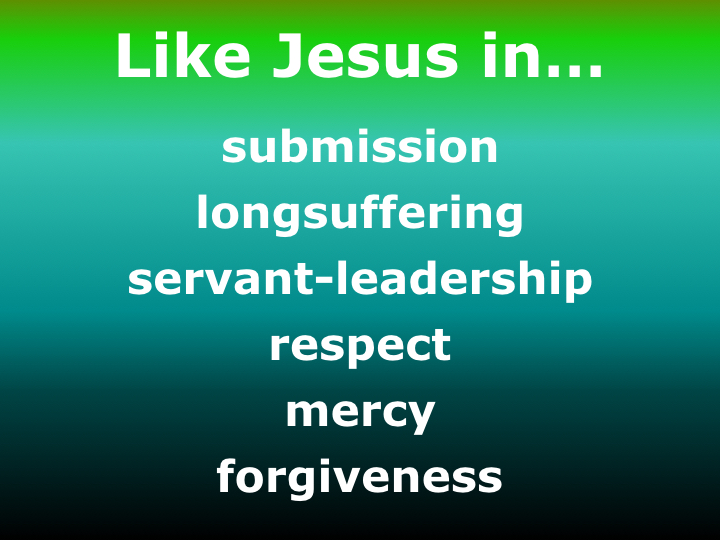
In the same way as what? Actually, if you look at the five verses that come before this you will see that it’s not what but Whom. Those verses are talking about our example in Jesus. Peter points out that Jesus showed:
submission to God’s purpose—His prayer was, “Not My will, but Yours be done.”
longsuffering—He did not retaliate nor threaten His persecutors, but for the joy set before Him, He endured the shame of the Cross.
servant-leadership—At the last meal He had with His followers before being crucified, He washed their feet, and told them He had given them an example of how they were to serve others.
respectful behavior—Jesus willingly suffered the penalty for the world’s sin. He fulfilled the prophecy of Isaiah which said He remained silent before His accusers.
mercy—This always means not getting the penalty we deserve. Jesus came to save us when we were the least worthy of His love.
forgiveness—As the spikes were being driven through His wrists, Jesus said, “Father, forgive them for they don’t know what they’re doing.”
Pragmatism looks at God’s design and says, “Yes, I understand that, but….” Pragmatism tries to find an “out” or a “loophole” that let’s someone change a definition or skip out on doing something God’s way.
If anyone ever had the authority to say, “Yes, Father, I know what You want Me to do, but look how they’re treating Me” it was Jesus.
A wife with a difficult husband may want to say, “Yes, I know I’m supposed to submit to my husband, but….” A husband with a nagging wife may say, “Yes, I know I’m supposed to treat my wife with consideration and respect, but….”
But Peter says, “Wives and husbands, exhibit the same submission, longsuffering, servant-leadership, respectful behavior, mercy and forgiveness toward your spouse as Jesus exhibited toward you!”
So the question we need to ask is: Am I thinking about marriage—a husband’s role, a wife’s role—in counter-cultural biblical terms or in popular cultural terms?
If I find I am thinking culture’s thoughts, am I willing to try God’s way?
Have you ever noticed that kids would prefer to eat dessert more than vegetables? Well, maybe you’re an adult and you still feel the same way! But “veggies before dessert” is still a good motto to live by.
Why?
What happens if you eat only dessert? Do you eventually get healthier or are you setting yourself up for some unfavorable health conditions? What about if you only eat vegetables? The flavor may not be as good, but at least you’ll be getting healthier.
Jesus told His followers to expect the “veggie” times in time. He said, “In this world you will have trouble.” And He told us, “Then you will be handed over to be persecuted and put to death, and you will be hated by all nations because of Me.” There were no ifs or maybes in those statements!
As Christians living on Earth, the Apostle Peter calls us “aliens and strangers.” That means that both our attitude and our lifestyle should be, well, alien compared to Earthlings. Especially when we’re in a veggie time of life.
Jesus was the Perfect Man. He never said anything wrong, and He never did anything wrong. Yet He was insulted, persecuted, and eventually killed in the most horrific way imaginable. But here’s the amazing thing: Jesus went through all of this without retaliating or threatening judgment on His persecutors. Peter said that the way Jesus went through this was intended to be an example for us.
The writer of Hebrews agreed—Let us fix our eyes on Jesus, the Author and Perfecter of our faith, Who for the joy set before Him endured the Cross, scorning its shame, and sat down at the right hand of the throne of God. Consider Him Who endured such opposition from sinful men, so that you will not grow weary and lose heart.
Notice it says, “for the joy set before Him.” Other translations say “because of the joy awaiting Him” or “He never lost sight of where He was headed” or “He never lost sight of the joy ahead of Him.” In other words, Jesus knew what God’s plan was from before the beginning of time, so He—as Peter said—kept on entrusting Himself to God.
We have to do the same thing!
I have to confess something. When I quoted the “veggie” part of a couple of verses earlier in this post, I left off the “dessert” part…
“I have told you these things, so that in Me you may have peace. In this world you will have trouble. But take heart! I have overcome the world.” (John 16:33)
“Blessed are those who are persecuted because of righteousness, for theirs is the kingdom of heaven. Blessed are you when people insult you, persecute you and falsely say all kinds of evil against you because of Me. Rejoice and be glad, because great is your reward in heaven….” (Matthew 5:10-12)
Have you ever had a bad boss? One who was harsh, unreasonable, overly demanding, or just a plain meany? Do you think working for a “bad boss” means that you get to lower your standards?
Not if you are a Christian!
Christians are on Earth to represent Jesus. We are aliens and strangers here for a short time, but here to also point people toward Heaven. One place we have tremendous opportunity to do this is on our jobs.
Think about it: most people will work 30-40 hours per week, and probably work 40-50 years of their life. That’s a lot of hours in which to show that living for Jesus makes all the difference in the world.
Peter addresses our work situation in his first epistle. In essence he says, “You may not be able to control your boss’s actions, but you can control your reactions. A Christian has a different attitude about workplace employers than Earthlings do.”
The two things that set Christian employees apart is their submission and their respect.
Submission means understanding the proper order. This isn’t just showing up on time, wearing the right uniform and checking off the right things on your job description. All of those things can be done with a lousy attitude, with an attitude that’s nothing like Christ’s attitude.
Submission means viewing our employers differently—
Obeying them like we would obey Jesus (Ephesians 6:5).
Being sincere when we say, “Yes, I’d be happy to do that” (Ephesians 6:5).
Working hard even when our employer isn’t watching us (Ephesians 6:6).
I love reading. But hands-down, without a doubt, my favorite book to read is the Bible. So I’m always intrigued by any resource that can help me get more out of my time in the Scriptures. In The Gospels Side-By-Side by Rose Publishing, I found a goldmine.
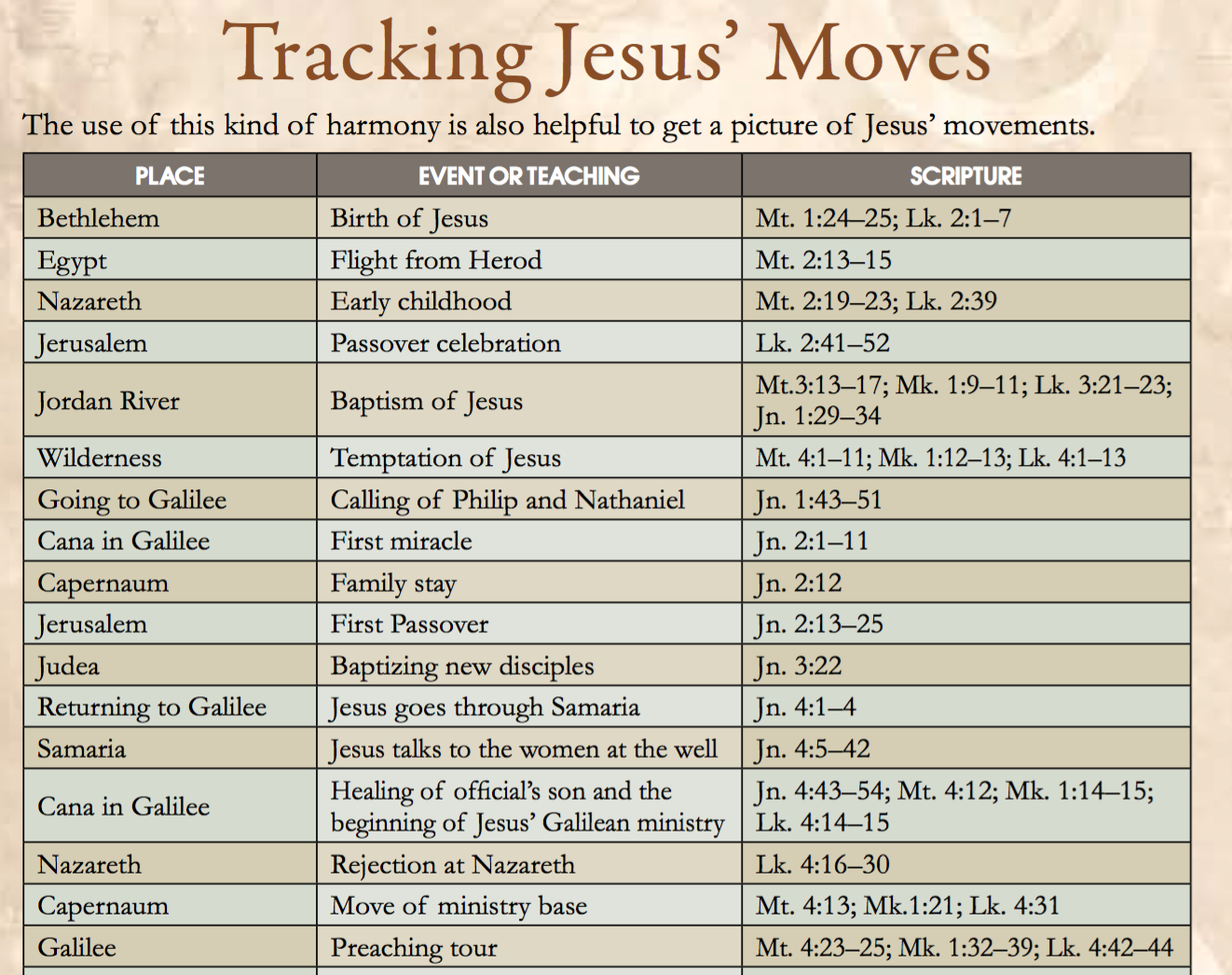
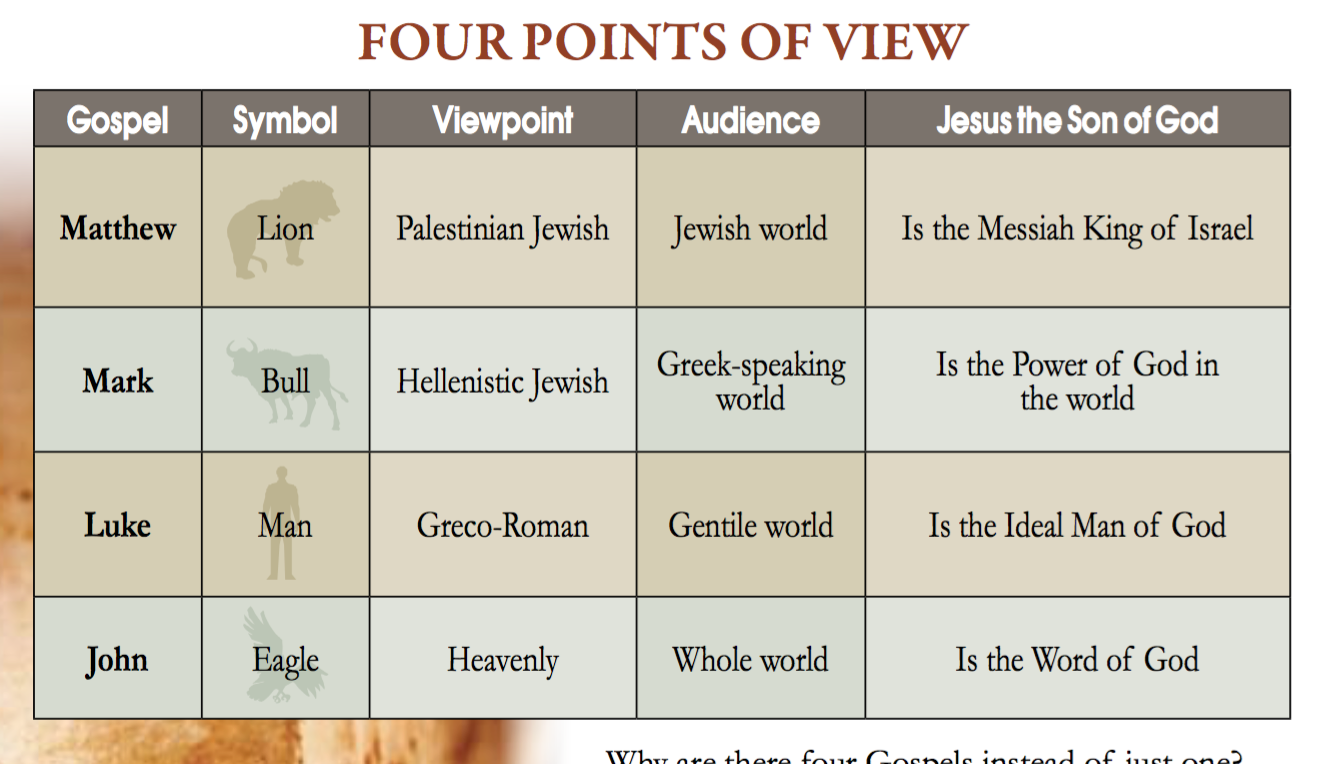
This short pamphlet is chockfull of graphics, charts, maps and historical background information that helped me see the bigger picture of the story of Jesus that the Gospel writers were conveying to us. It begins with the unique perspective of each Gospel writer, and launches us deeper into the Bible from there.
In this book you will see things like:
The events of Christ’s life, and which Gospel tells particular events
The miracles of Jesus
The parables of Jesus
The chronological movements of Jesus
How Jesus celebrated Passovers during His public ministry
How these biblical biographies compare to other biographies of the era
Even the historical harmony of the Gospel message in the post-apostolic age
This should bring new life to any Bible student’s reading time! I highly recommend you check out not only this pamphlet, but many of the other resources available at Rose Publishing.
I have noticed a lot of similarities between the September back-to-school rush, and New Year’s Day. Except instead of resolutions, in the fall most people set new goals, or try to readjust their schedules to take advantage of a new season.
This is an excellent idea, and the perfect time to do it.
In a psalm written by Moses, he tells us to understand the value of our days, and be as wise as we can with what we do with each day God has given us (Psalm 90:12).
The Apostle Paul echoes these thoughts:
Be very careful, then, how do you live—not as unwise but as wise, making the most of every opportunity, because the days are evil. Therefore do not be foolish, but understand what the Lord’s will is. (Ephesians 5:15-17)
One way for us to make the most of every day is to wisely set some goals. Here are four tips that I’ve discovered to help me.
(1) The fewer the goals, the better.
Craig Groeschel said, “To do more things, do less things better.” I totally agree. I would suggest limiting yourself to just 1-2 goals at a time. Then put these one or two goals on your calendar first. In other words: Don’t prioritize your schedule, but schedule your priorities.
(2) Don’t fall into the sacred/secular trap.
So many people—even Christians—think that there are spiritual goals and non-spiritual goals. But the Bible says, “So whether you eat or drink or whatever you do, do it all for the glory of God” (1 Corinthians 10:31). Every goal you set is a spiritual goal, because every goal should help you live your life wisely, in a way that honors and glorifies God.
(3) Make your goals S.M.A.R.T.
You may have heard these before, but I really like to use them. Make your goals:
Specific—not “I want to eat better” but “I want to eat two servings of fruits or vegetables each day.”
Measurable—have a way to track your progress toward your goal. How many pages did you read? how many calories did you eat? how many minutes did you work out?
Achievable—don’t set a goal to run 5 miles a day if you’ve only been a couch potato. Ramp your goals up little by little in a way that’s achievable for you.
Relevant—I like to ask a “so that?” question about each of my goals in make sure it’s moving me forward. “I want to exercise for 20 minute three times per week, so that my blood pressure comes down, so that I can live medicine-free, so that I can….” I think you get the idea. Keep going to make sure your goal is relevant for your life.
Time to review—set a date to revisit your goals and see if you need to adjust anything.
(4) Make a “stop doing” list.
You cannot do everything, so focus on the important, not the urgent. And remember not everything can stay on your calendar. For instance, if you want to read more in the evenings, you may have to eliminate some TV time; if you want to exercise in the mornings, you may have to eliminate that second cup of coffee.
Just a couple of verses after Moses challenges us to make the most of every day God has given us, he asks God for His help—May the favor of the Lord our God rest upon us; establish the work of our hands for us—yes, establish the work of our hands.
May God give you wisdom as you make new goals, and may He bless the work of your hands as you implement your new strategies.



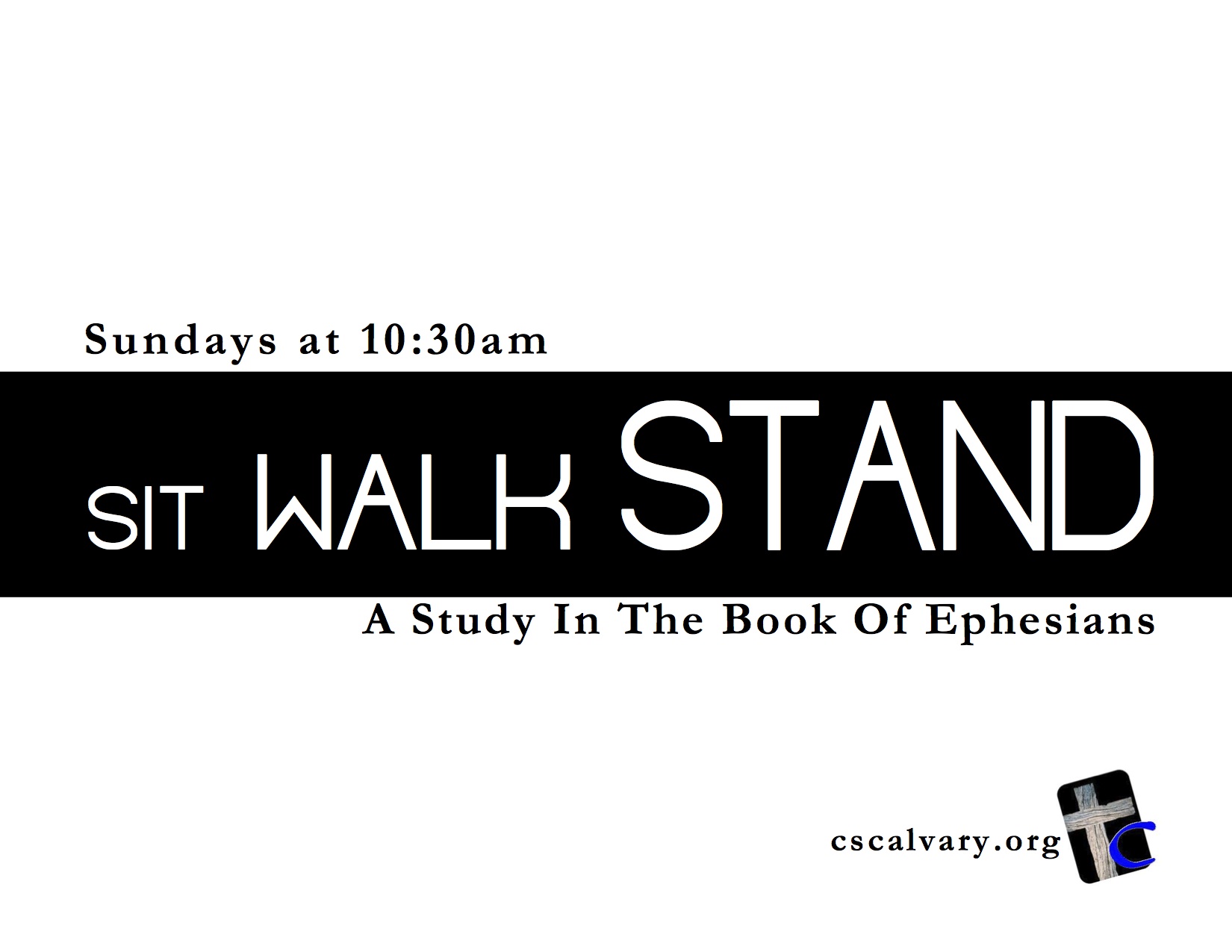 This coming Sunday we re-start a series at Calvary Assembly of God which we first began in 2014, and re-launched in 2015, called Sit Walk Stand: A Study In The Book Of Ephesians.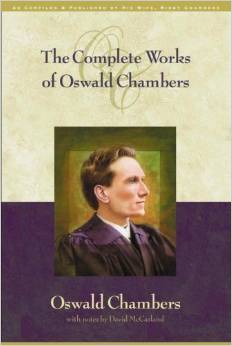








 Craig T. Owens