Favorable Influence

Listen to the podcast of this post by clicking on the player below, and you can also subscribe on AppleSpotify, or Audible. 

Twice the 80th psalm declares—Restore us, O Lord God Almighty; make Your face shine upon us, that we may be saved (Psalm 80:19). 

But if we are already a Christian that has been saved from the penalty of our sin and saved to an eternal reward, then that also means that God’s face IS already shining on us, He HAS already restored us, and He HAS already given us His favor. 

I like how the Amplified Bible renders this verse: Restore us, O Lord God of hosts; cause Your face to shine in pleasure, approval, and favor on us, and we shall be saved! 

What we have received is too wonderful for us to keep to ourselves, so we must let His pleasure, approval, and favor now shine out of us! 

“If the result of our experience of God does not compel and propel us into global mission, it is doubtful whether we have really encountered the God of the Bible.” —Dick Brogden 

Jesus stated His mission simply and then sent us out on the exact same mission (Luke 4:18-19; John 20:21). We do this best by living closely among people so they can also see us shine with God’s favor.
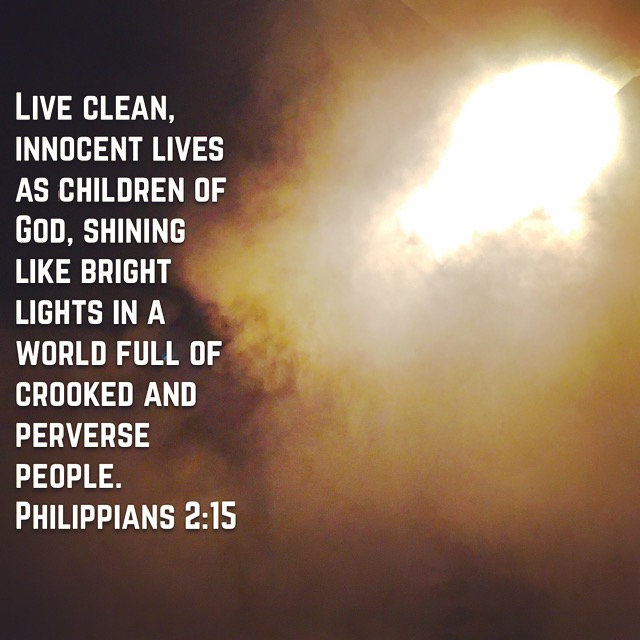
Paul called us to shine as well: Live clean, innocent lives as children of God, shining like bright lights in a world full of crooked and perverse people (Philippians 2:15). I believe this is a perfect definition of the word influence. The origin of the word meant the supposed flowing of ethereal fluid from the stars thought to affect the actions of men. Christians that let their good deeds shine in the darkness can influence the entire culture around them!

“Radical Christianity is not going on a missions trip or a big conference. Radical Christianity is staying steady for decades.” —Mike Bickle 

Being a person that shines with favorable influence requires staying involved for the long haul so that you can build trustworthiness. It’s being in visible places not to get glory, but to let people see God’s glory. When they see His glory shine on you and out of you, they will want what you have too!

Solomon said, By the blessing of the influence of the upright and God’s favor—because of them the city is exalted (Proverbs 11:11). So, my fellow Christian, let me ask you: 

  • Has God shined on you?
  • Are you letting Him shine out of you? 
  • Are you living a noteworthy, trustworthy, visible life in your dark community? 

“It’s your choice: You can be a part of your city’s elevation or its deterioration.”

—Craig T. Owens

►► Would you please prayerfully consider supporting this ministry? My Patreon supporters get behind-the-scenes access to exclusive materials. ◀︎◀︎

Thursdays With Spurgeon—Study The Right Things

This is a weekly series with things I’m reading and pondering from Charles Spurgeon. You can read the original seed thought here, or type “Thursdays With Spurgeon” in the search box to read more entries.

Study The Right Things

     It is very advantageous to the Christian mind frequently to consider the deep and unsearchable attributes of God. … If we study man and make him the only object of our research, there will be a strong tendency in our minds to exaggerate his importance. We will think too much of the creature and too little of the Creator, preferring the knowledge that is to be found out by observation and reason to the divine truth that revelation alone could make known to us. … 

     The fleeting things of human life and the fickle thoughts and showy deeds of men are as movable and as changeable as the waters of the treacherous deep. But when we mount up, as it were, with eagles’ wings to Him Who sits upon the circle of the earth, before Whom all its inhabitants are as grasshoppers (Isaiah 40:22), we nestle in the Rock of Ages that from its eternal socket never starts and in its fixed immovability can never be disturbed.

From The Infallibility Of God’s Purpose

I read a lot of books. But in the hands-down, it’s-not-even-close category, I read the Bible more than anything else. It is the Book of books because it reveals the eternal Wisdom behind the earth’s wisdom. 

Zig Ziglar used to say, “Every morning I read my Bible and I read the newspaper. That way, I know what both sides are up to.” That’s pretty good!

We read the Bible not just to know the Bible, but to know the One Who authored the Bible. Or, as I like to say it—

My goal in reading the Word God is to get to know the God of the Word better and better.

Charles Spurgeon would never say—nor do I—that you shouldn’t study a variety of topics. Just make sure that your priority is God’s Word. This will give you the greatest insight into other topics and will protect you from humanistic error. 

Read Your Bible More

“Read your Bible more and more every year. Read it whether you feel like reading it or not. And pray without ceasing that the joy return and pleasures increase.

“Three reasons this is not legalism:

  1. You are confessing your lack of desire as sin, and pleading as a helpless child for the desire you long to have. Legalists don’t cry like that. They strut.
  2. You are reading out of desperation for the effects of this heavenly medicine. Bible-reading is not a cure for a bad conscience; it’s chemo for your cancer. Legalists feel better because the box is checked. Saints feel better when their blindness lifts, and they see Jesus in the Word. Let’s get real. We are desperately sick with worldliness, and only the Holy Spirit, by the Word of God, can cure this terminal disease.
  3. It is not legalism because only justified people can see the preciousness and power of the Word of God. Legalists trudge with their Bibles on the path toward justification. Saints sit down in the shade of the Cross and plead for the blood-bought pleasures.

“So let’s give heed to Mr. Ryle and never grow weary of the slow, steady, growth that comes from the daily, disciplined, increasing, love affair with reading the Bible. 

‘Do not think you are getting no good from the Bible, merely because you do not see that good day by day. The greatest effects are by no means those which make the most noise, and are most easily observed. The greatest effects are often silent, quiet, and hard to detect at the time they are being produced. Think of the influence of the moon upon the earth, and of the air upon the human lungs. Remember how silently the dew falls, and how imperceptibly the grass grows. There may be far more doing than you think in your soul by your Bible-reading’ (J.C. Ryle, in Practical Religion).” —John Piper 

How To Respond To Evildoers

I’m sure if I asked for a show of hands, everyone of you would put up a hand (or maybe even two!) to the question, “Has someone done something bad to you?” 

The real issue is not if we’ve been the victim of evildoers doing evil things; the real issue is how to respond to evildoers that do evil things. 

In Psalm 52, David tells us that he wrote this prayer after a vile man named Doeg had done atrociously evil things to a whole town of innocent people. Worse yet: these people were simply trying to help David!

David was fleeing for his life from King Saul, forcing him to leave home with just the clothes on his back. He stopped at the village of Nob and asked Ahimelech the priest for food and a weapon. That act, in King Saul’s mind, was worthy of death. None of Saul’s soldiers would carry out his command to execute the priest, but Doeg quickly responded. Doeg not only killed Ahimelech, but he killed the 85 priests with him, and then he proceeded to annihilate everything and everyone left in the village of Nob. Only one man escaped to tell David what happened. 

When David begins this psalm, he uses the words you or your 14 times in just the first five verses. David is addressing Doeg, almost holding up a mirror to his evil deeds. By contrast, the word I is used five times in just the last two verses of this prayer. 

That tells me that we have to work on this problem of evil from two different directions. We need to see evildoers in their evil, and we need to see a godly response to evildoers. As with many Hebrew poems, the most important principle is in the middle—Surely God will bring evildoers down to destruction, but He will protect the righteous (v. 5). 

In the opening words, David asks Doeg, “Why do you boast of evil?” The word for boast in Hebrew is halal—this is usually the word we translate Hallelujah! In other words, Doeg has put his evil on the throne of his life and is saying “Hallelujah!” to it. A downward slide of all sorts of evil words and evil deeds spiral out from this until the climax: Surely God will bring judgment. 

Notice David says “God” (not you) “will” (not might) take care of this. 

Now let’s look at it from a righteous perspective. Working backwards from verse 9 to verse 5, we see whereas Doeg was praising his evil deeds, David is praising God. David recognizes that it’s only in God’s presence that he can be free, and it’s only God that can ultimately balance the scales of justice. 

▶️ My friend, you cannot make things right. Only God can do this. Please, please, take your eyes off the evildoer that did evil things to you, and put your eyes on the Perfect Judge. He alone can balance the scales of justice. ◀️

So here are four lessons for all of us to learn—

  1. When evildoers do evil things to you, talk to God about them; don’t talk to your enemies and don’t even talk to your friends.
  2. Continue to redirect your heart and thoughts to God’s unfailing love, and away from thoughts of retribution—even if you have to do this a hundred times a day.
  3. When evildoers afflict you, look in the mirror of God’s Word to see if there is anything for which you need to repent and then ask forgiveness.
  4. When judgment comes, don’t gloat. John Bradford, when he saw a cartful of men going off to be hanged said, “There goes John Bradford but for the grace of God.”

In this video I reference our series on the Selahs in the book of Psalms. If you missed any of these, please click here to find a list of the other topics we covered.

Thursdays With Spurgeon—The Best Study To Expand Your Mind

This is a weekly series with things I’m reading and pondering from Charles Spurgeon. You can read the original seed thought here, or type “Thursdays With Spurgeon” in the search box to read more entries.

The Best Study To Expand Your Mind

     The highest science, the loftiest speculation, the mightiest philosophy that can ever engage the attention of a child of God is the name, the nature, the person, the work, the doings, and the existence of the great God whom he calls his Father. … It is a subject so vast that all our thoughts are lost in its immensity, so deep that our pride is drowned in its infinity. …

     But while the subject humbles the mind, it also expands it. He who often thinks of God will have a larger mind than the man who simply plods around this narrow globe. …

     Nothing will so enlarge the intellect, nothing so magnify the whole soul of man as a devout, earnest, continued investigation of the great subject of the Deity. …  

     There is one name on which mutability can never be written. One heart never can alter. That heart is God’s; that name Love. 

From The Immutability Of God

The vastness—the infiniteness—of God is something which should much consume us! The psalmists frequently write of the time they spent meditating on God and His awesomeness. 

That word “meditate” means to mull something over and over in your mind; literally, it means “to hum.” Perhaps that’s why the psalms were written as songs, so that it would be easier for people to hum their pondering on how majestic our All-Powerful, All-Loving God is. 

It’s not about the quantity of your Bible reading, but it’s about the quality of your reading. And it’s about what you do with what you have read. Soak in it. Meditate on it. Hum it over and over again throughout the day. Let the truth of God’s majesty lift your mind and spirit to new heights!

This is truly the greatest topic on which you can muse. The illumination of God will expand your mind like no other study in the world can.

Oh Lord my God when I in awesome wonder
consider all the worlds Thy hands have made.
I see the stars, I hear the rolling thunder
Thy power throughout the universe displayed.
Then sings my soul, my Savior God, to Thee,
How great Thou art! How great Thou art! (Stuart Wesley Keene Hine)

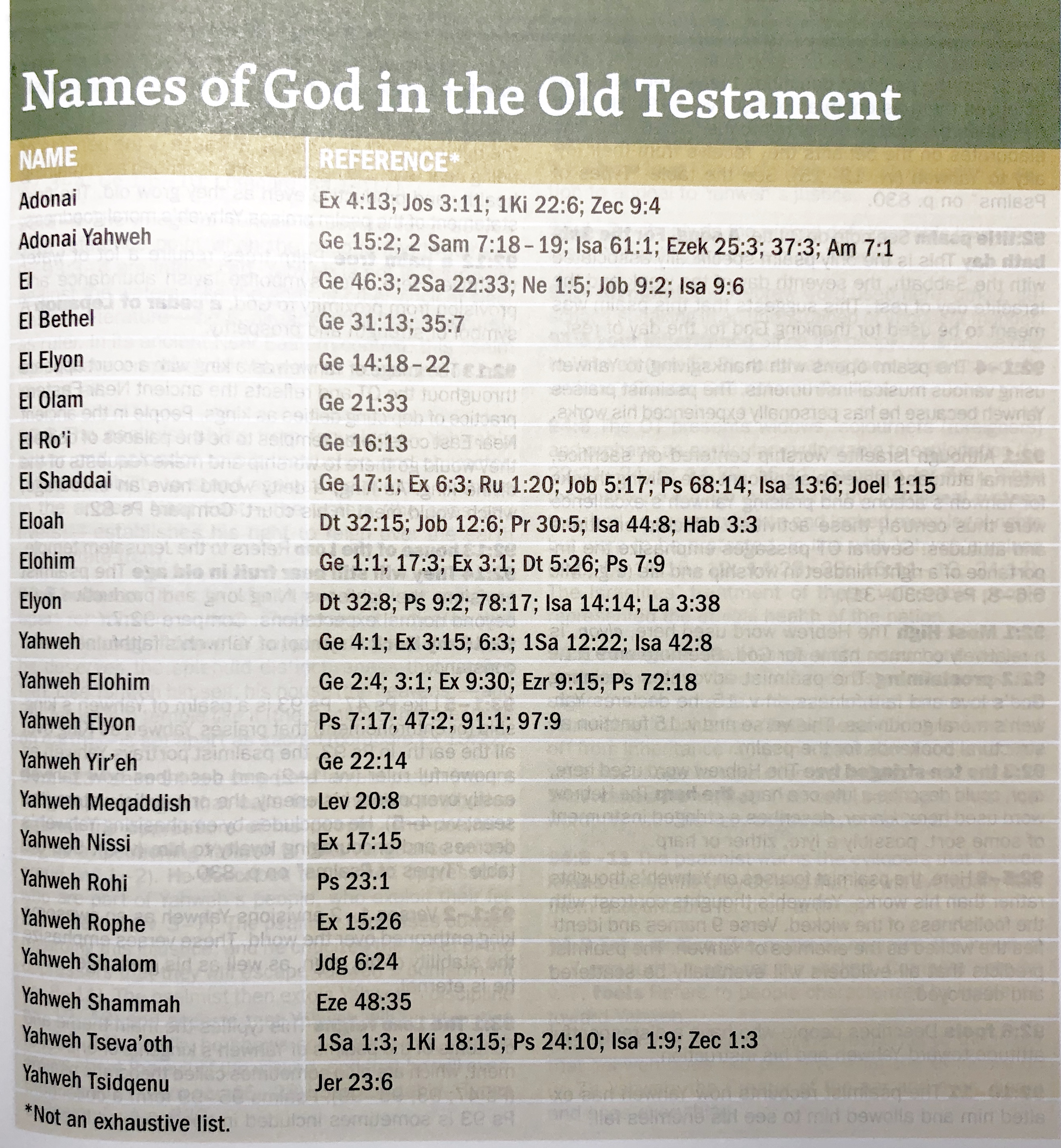
Names Of God In The Old Testament

I love my Faithlife Illustrated Study Bible! I found this gem while reading in the Psalms.

יהוה (yhwh)

The name יהוה (yhwh) is known as the Tetragrammaton, and was probably pronounced as Yahweh. In the Old Testament, it is the proper name of God and is the most common term used to refer to Him (e.g., Gen 4:1). Exodus 3:13–15 connects this name with the verb הָיָה (hayah) “to be”; in this passage, God uses two related names for Himself that are not used elsewhere in the Bible: אֶהְיֶה אֲשֶׁר אֶהְיֶה (ehyeh asher ehyeh, “I am who I am”) and the abbreviated אֶהְיֶה (ehyeh, “I am”), and declares that יהוה (yhwh) is His name. By the time that the Septuagint version of the Torah was translated in the third century bc, Jews avoided pronouncing the Tetragrammaton to avoid committing blasphemy; in reading the Scriptures, the name אֲדֹנָי (adonay, “Lord”) was substituted, and the Septuagint translated this with the Greek word κύριος (kyrios, “Lord”). In English translations of the Bible, יהוה (yhwh) is usually represented as “the Lord,” using capital or small-capital letters to distinguish it from “Lord” as a translation for other Hebrew words. The English representation of this name as “Jehovah” is based on a misunderstanding of a scribal convention that combined the consonants of יהוה (yhwh) with the vowels of אֲדֹנָי(adonay) to remind the reader to pronounce Adonai in place of the Tetragrammaton.

For further details, see these articles: YHWH; Tetragrammaton; Tetragrammaton in the New Testament; Jehovah; I Am Who I Am.

Compound names with יהוה (yhwh)

Sometimes the name יהוה (yhwh) was combined with other terms characterizing God to produce a compound name. The most important of these is יְהוָה צְבָאוֹת (yhwh tseva’oth, “YHWH of Hosts”; e.g., 1 Sam 1:11), which expresses God’s position as the leader of the armies of heaven. Some compound names involving יהוה (yhwh) are translated in the King James Version or in other English translations using the erroneous representation “Jehovah.”

For further details, see these articles: Lord of Hosts; Jehovah-Jireh; Jehovah-Tsidkenu; Jehovah-Nissi.

אֱלֹהִים (elohim) and Related Words

Hebrew אֱלֹהִים (elohim) is by far the most common member of a small group of Hebrew and Aramaic words used to refer to God and other deities. This word is plural in form, but is most often used with singular meaning as a name for the one God of Israel; in this meaning, it occurs with singular verbs (e.g., Gen 1:1). It can also be used with plural meaning to refer to deities of polytheistic belief; in this case, any verbs and adjectives that go with it are plural (e.g., Deut 13:13).

The other words in this family also refer either to the one God or to a polytheistic deity. These are Hebrew אֵל (el, “god”; e.g., Num 12:13; Deut 32:12), Hebrew אֱלוֹהַּ (eloha, “god”; e.g., Job 11:7; Dan 11:38), and Aramaic אֱלָהּ (elah, “god”; e.g., Ezra 6:3; Dan 6:7).

For further details, see these articles: Elohim; Eloah.

Compound Names with El

Hebrew El (“God”) sometimes occurs with other terms in compound names for God. These compound names differ from one another in several ways. For example, the name אֵל שַׁדַּי (el shadday) combines El with the word שַׁדַּי (shadday), which also occurs by itself as a name for God—often translated “Almighty.” The compound name El Shaddai is not frequent, but does occur in several passages (e.g., Gen 17:1; Ezek 10:5). By contrast, the name אֵל רֳאִי (el ro’iy) “God of seeing, God who sees me” occurs only in Gen 16:13, and רֳאִי (ro’iy) does not occur independently as a name of God.

For further details, see these articles: El Roi; El Elohe Israel; El Shaddai; El Elyon.

אָדוֹן (adon) and אֲדֹנָי (adonay)

The Hebrew word אָדוֹן (adon, “master, lord”) is not specifically a divine title. It can be used of humans, indicating a person who has authority (e.g., Judg 19:11; Gen 45:8). It is sometimes used to describe God, emphasizing His authority (e.g., Josh 3:13).

The divine title אֲדֹנָי (adonay) is related to אָדוֹן (adon) and is used only of God (e.g., Psa 2:4). Its form is very close to and may be derived from אֲדֹנַי (adonay, “my lords”), which is simply the plural of אָדוֹן(adon) followed by a first-person singular suffix (e.g., Gen 19:2); but it has a short a vowel in the suffix while the divine title אֲדֹנָי (adonay) has a long a vowel. The divine title may have originated as a respectful title used to address God (e.g., Exod 4:10), using a plural form to express extra respect. However, in the Old Testament it is used not merely to address God, but also to talk about Him (e.g., 2 Kgs 7:6).

For further details, see this article: Adonai.

שַׁדַּי (shadday)

The origin of the name שַׁדַּי (shadday) is uncertain, but it is used as a title for God, especially in the book of Job (e.g., Job 13:3). Its original meaning is debated, but it is often translated “Almighty.” It is sometimes combined with אֵל (el, “god”) in the compound name אֵל שַׁדַּי (el shadday) (e.g., Gen 17:1), but more often occurs alone.

For further details, see these articles: Shaddai; El Shaddai.

עֶלְיוֹן (elyon)

The word עֶלְיוֹן (elyon) means “high, highest”; as a title for God, it is commonly translated “Most High.” It most often occurs alone (e.g., Psa 91:1), but also occurs in compounds with other names of God, including El(e.g., Gen 14:18–22), YHWH (e.g., Psa 7:17), and Elohim (e.g., Psa 57:2).

For further details, see this article: El Elyon.

Other Names

A variety of other names and titles are used for God. A few examples include צוּר (tsur, “Rock”; e.g., Isa 17:10), רֹעֵה (ro’eh) (“Shepherd“; e.g., Gen 49:24), and בּוֹרֵא (bore’, “Creator”; e.g., Isa 40:28). In Psalm 68:4, the Masoretic Text refers to him as “Rider through the Desert”; this is sometimes taken to be a modification of an expression “Rider on the Clouds” which was applied to Ba’al in Ugaritic. In Hosea 2:16, God declares that Israel will no longer call Him בַּעֲלִי (ba’aliy) “my master, my Ba’al” but will instead call him אִישִׁי (ishiy, “my husband”); these names are not used elsewhere in the Old Testament.

Please check out my review of the Faithlife Illustrated Study Bible and pick up a copy for yourself.

Rejoicing At The Coming Of The Judge

In Psalm 50, we read the first-of-twelve psalms written by King David’s handpicked worship leader, a man named Asaph. On the day that Asaph first took up his position as worship leader, David gave him a special song, which definitely influenced Asaph’s songwriting.  

Psalm 50 has a pretty easy outline: an introduction in the first six verses, followed by 17 verses of God speaking to His people—speaking to you and me! In between the introduction and God’s speaking is the word selah.

Selah means a time for us to pause and carefully consider. So Asaph is essentially saying, “God is getting ready to speak with us, so we need to selah—pause from what we are doing so that we can pay careful attention to His words!”  

Asaph sets the stage in the first verse, telling us that the Mighty One, God, the Lord speaks. The words that are about to be spoken come from THE I AM—the All-Sufficient One, the Omnipotent, the All-Knowing, All-Powerful Ruler of the Universe. Asaph also reminds us that He is coming as THE Judge.

When you hear that THE All-Powerful, All-Knowing One is THE Judge that has summoned you into His courtroom, it’s quite likely that your heart would skip a beat. Especially when God lists some of the sins you and I are guilty of breaking in verses 16-20. 

It’s also possible that the news that you have to appear before THE Judge could cause you to rejoice. What? How can we rejoice at that?! David taught Asaph this concept in the song he gave him: God’s people should rejoice over God’s judgments. 

You see, in Psalm 50 God says, “I do not rebuke you for your sacrifices, or for all your attempts to follow the rules.” It’s not in the practices of the law that we find salvation.

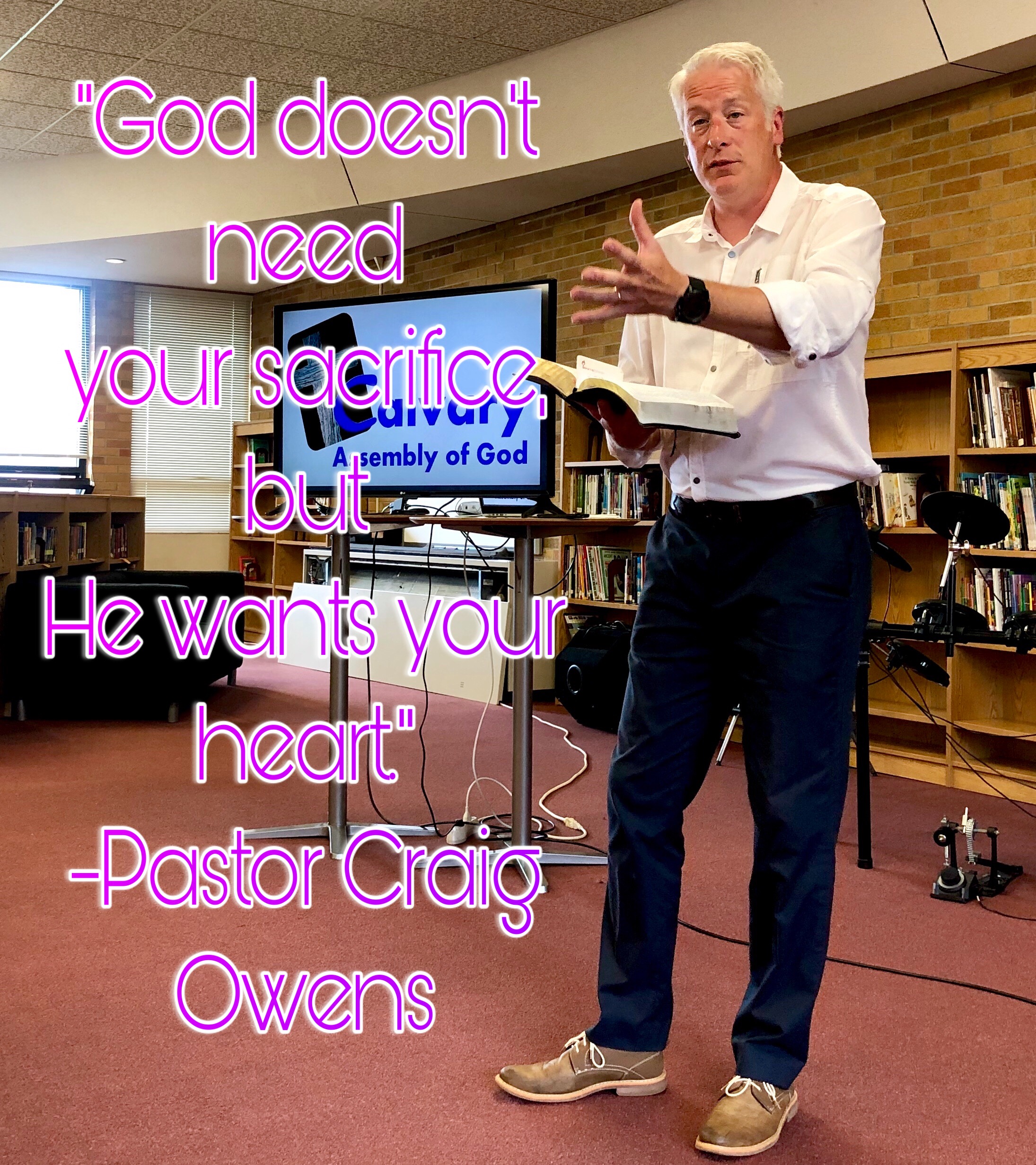
God doesn’t need our sacrifices, but He wants our hearts. 

In order to win our hearts for Himself, THE Judge did something absolutely mind-blowing—THE I AM became flesh like us. And then He became the once-for-all sacrifice for our sins, paying our penalty Himself when He died on the Cross (see Hebrews 2:14-17; 7:17-27). 

This is why we can rejoice when we hear we have to stand before THE Judge. When you have placed your faith in what Jesus did for you on the Cross, when THE Judge opens His perfect record book to your page He will read this inscription written in the crimson red blood of Jesus: PAID IN FULL!

This is why we can rejoice at the thought of seeing THE Judge face to face!

Join me next Sunday as we wrap up this summer looking at the Selahs in the Psalms. We plan to restart this series next summer, unless the Judge calls us home before then!

Thursdays With Spurgeon—Following The Prompting

This is a weekly series with things I’m reading and pondering from Charles Spurgeon. You can read the original seed thought here, or type “Thursdays With Spurgeon” in the search box to read more entries.

Following The Prompting

     I once while preaching at New Park Street Chapel. I had passed happily through all the early parts of divine service on the Sabbath evening and was giving out the hymn before the sermon. I opened the Bible to find the text, which I had carefully studied as the topic of discourse, when, on the opposite page, another passage of Scripture sprang upon me like a lion from a thicket with vastly more power then I had felt when considering the text that I had chosen. The people were singing and I was sighing. I was in a strait between two, and my mind hung as in the balances. I was naturally desirous to run in the track that I had carefully planned, but the other text would take no refusal and seemed to tug at my skirts, crying, “No, no, you must preach from me! God would have you follow me.” I deliberated within myself as to my duty, for I would neither be fanatical nor unbelieving, and at last I thought within myself, Well, I should like to preach the sermon that I have prepared, and it is a great risk to run to strike out a new line of thought, but as this text constrains me, it may be of the Lord, and therefore I will venture upon it, come what may.

     I had brought myself into great difficulty by obeying what I thought to be a divine impulse, and I felt comparatively easy about it, believing that God would help me and knowing that I could at least close the service should there be nothing more to be said. I had no need to deliberate, for in one moment we were in total darkness. The gas had gone out…. Having no manuscript, I could speak just as well in the dark as in the light…. When the lamps were lit again, I saw before me an audience as rapt and subdued as ever a man beheld in his life. … Thus, providence befriended me. I cast myself upon God, and His arrangements quenched the light at the proper time for me. Some may ridicule, but I adore; others may even censure, but I rejoice.

From The Autobiography of Charles Spurgeon

God can speak to pastors as clearly in his or her sermon preparation time as He can in the very moments before the sermon begins. The key is our obedience to follow the prompting of the Holy Spirit. 

Spurgeon would never advocate that preachers “wing it” every time they step into the pulpit. His own life showed a man of diligent study of the Scripture. But neither would Spurgeon say that preachers have to stick to their prepared remarks no matter what. What I think he would say is: Trust God when you’re studying for a sermon, and trust God when you’re delivering a sermon. Allow the Spirit to change your course at any moment. 

Is this a bit nerve-wracking? Spurgeon would say, “Yes, only when deliberating whether to strike out on the new course.” But notice how once he obeyed that prompting, he felt completely at ease.

Spurgeon also reminds us, “I do not see why a man cannot speak extemporaneously upon a subject that he fully understands. Any tradesman, well versed in his line of business, could explain it without needing to retire for meditation, and surely I ought to be equally familiar with the first principles of our holy faith. I ought not to feel at a loss when called upon to speak upon topics that constitute the daily bread of my soul.”

12 Quotes From “The Autobiography Of Charles Spurgeon”

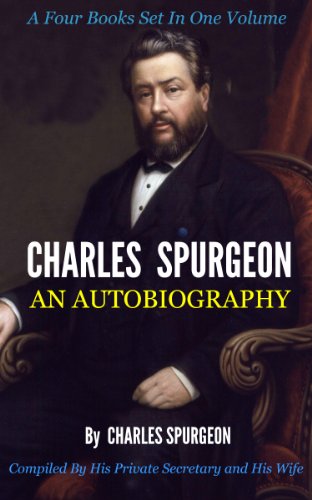
Charles Spurgeon lived exactly as he preached. What a delight that is! Check out my full book review of his Autobiography by clicking here. Also, be sure to check out my weekly Thursdays With Spurgeon series, where I share longer passages from this Prince of Preachers. 

“My sole hope for heaven lies in the full atonement made upon Calvary’s Cross for the ungodly. On that I firmly rely. I have not the shadow of a hope anywhere else.” 

“While my brief term on earth shall last, I should be the servant of Him who became the Servant of servants for me.” 

“For I am persuaded there are more delights in Christ, yea, more joy in one glimpse of His face than is to be found in all the praises of this harlot-world, and in all the delights that it can yield to us in its sunniest and brightest days.” 

“I have found, in my own spiritual life, that the more rules I lay down for myself, the more sins I commit. The habit of regular morning and evening prayer is one that is indispensable to a believer’s life, but the prescribing of the length of prayer, and the constrained remembrance of so many persons and subjects, may gender unto bondage and strangle prayer rather than assist it.” 

“There is nothing that more tends to strengthen the faith of the young believer than to hear the veteran Christian, covered with scars from the battle, testifying that the service of his Master is a happy service, and that, if he could have served any other master, he would not have done so, for His service is pleasant and His reward everlasting joy.” 

“I went to my chamber and told my little griefs into the ears of Jesus. They were great griefs to me then, though they are nothing now. When on my knees I just whispered them into the ear of Him who had loved me with an everlasting love, oh, it was so sweet! If I had told them to others, they would have told them again, but He, my blessed Confidant, knows all my secrets, and He never tells again.” 

“That God predestined, and yet that man is responsible, are two facts that few can see clearly. They are believed to be inconsistent and contradictory to each other. If, then, I find taught in one part of the Bible that everything is foreordained, that is true; and if I find, in another Scripture, that man is responsible for all his actions, that is true. And it is only my folly that leads me to imagine that these two truths can ever contradict each other.” 

“It was said of an old Greek philosopher that he wrote over his door, ‘None but the learned may enter here.’ But Christ writes over His door, ‘He who is simple, let him turn in hither.’” 

“I used to think, sometimes, that if they had degrees who deserved them, diplomas would often be transferred and given to those who hold the plow handle or work at the carpenter’s bench; for there is often more divinity in the little finger of a plowman than there is in the whole body of some of our modern divines. ‘Don’t they understand divinity?’ someone asks. Yes, in the letter of it, but as to the spirit and life of it, D.D. often means Doubly Destitute.” 😀

“When I came to New Park Street Chapel, it was but a mere handful of people to whom I first preached; yet I can never forget how earnestly they prayed. Sometimes they seemed to plead as though they could really see the Angel of the covenant present with them, and as if they must have a blessing from Him. More than once, we were all so awestruck with the solemnity of the meeting that we sat silent for some moments while the Lord’s power appeared to overshadow us. All I could do on such occasions was to pronounce the benediction and say, ‘Dear friends, we have had the Spirit of God here very manifestly tonight; let us go home and take care not to lose His gracious influences.’ Then down came the blessing; the house was filled with hearers, and many souls were saved. I always give all the glory to God, but I do not forget that He gave me the privilege of ministering from the first to a praying people.” 

“It is the extremity of unwisdom for a young man, fresh from college or from another charge, to suffer himself to be earwigged by a clique, and to be bribed by kindness and flattery to become a partisan, and so to ruin himself with one half of his people.” 

“It is of no use to rise before an assembly and hope to be inspired upon subjects of which one knows nothing. If anyone is so unwise, the result will be that, as he knows nothing, he will probably say it, and the people will not be edified. But I do not see why a man cannot speak extemporaneously upon a subject that he fully understands. Any tradesman, well versed in his line of business, could explain it without needing to retire for meditation, and surely I ought to be equally familiar with the first principles of our holy faith. I ought not to feel at a loss when called upon to speak upon topics that constitute the daily bread of my soul.” 

Awesome God, Awesome Praise

Last I week I told you how Hebrew poetry often puts the climax in the middle. In Psalm 47 that middle climax is in verse 5—God has ascended. This is one of seven “psalms of enthronement” in the Psalter. Since all of the Scripture points to Jesus, let’s look at the definition of this word ascend and see how it fits with Jesus: 

When a king is coronated—when he is heading toward his throne—we can expect the people to be happy. So the psalmist tells us that in God’s case the people are clapping and shouting (v. 1), telling God how awesome He is (v. 2), thanking Him for subduing their enemies (v. 3), and expressing their gratitude that He has established them as His people (v. 4). 

Then comes the Selah / Pause—what is happening during this pause? The King is being crowned. He has ascended to His rightful throne. So this is selah/pause is really a deep breath that’s about to explode in a crescendo of praise! 

Now there are shouts of joy (v. 5a). In our earthly understanding, it would be something like: “LONG LIVE THE KING!!” There is also a sounding of trumpets (v. 5b) which literally means a thundering of trumpets. And then there’s the singing—lots and lots of singing. In fact, the word sing appears five times in the next two verses. 

From The Infographic Bible (click the image for more)

There are so many ways to say LONG LIVE THE KING—singing, dancing, raising our hands, falling down on our knees. shouting.  

Our God is praise-worthy. He is clap-worthy! He is sing-worthy! He is dance-worthy! He is shout-worthy! He is bowing-worthy! 

Our awesome God deserves awesome praise! 

Why does it seem that we are prone to worship so quietly? Perhaps we need to take it up a notch or two (or three or four). Perhaps we haven’t gazed into His awesome beauty enough to realize just how incredible He is! 

Do you think shouting praises to the King of kings is too undignified? Did you know that when the King of kings returns, He is going to shout and there is also going to be a thundering trumpet? For the Lord Himself shall descend from heaven with a shout, with the voice of an archangel, and with the trumpet of God (1 Thessalonians 4:16)! 

Here are 4 important lessons from this Psalm of Enthronement—

  1. God is the King of all kings, enthroned on the Throne above all thrones. He is worthy of your “undignified” praise and acclamation. 
  2. God should always get your best praise. In verse 7 the phrase sing praises with understanding really means to sing with insight and skill. 
  3. God deserves a holy vocabulary. We see the word awesome in verse 2. Every time this word is used in the Scripture, it’s speaking of God. So why would we use a word like this for something like a hamburger!?!
  4. All nations and kings and peoples and tribes will bow before God at the end. They will bow in either acclamation for their King, or in abject terror of the All-Righteous Judge. Let’s remain missional so more people in the end are crowning Him as their All-Merciful King. 

I hope you can join me this next Sunday as we continue our series looking at the Selahs in the Psalms.