Listen to the podcast of this post by clicking on the player below, and you can also subscribe on Apple, Spotify, or Audible.
We are getting ready to kick off a new series at Calvary Assembly of God based on the Book of Jude. When I read the opening line of this letter, it makes me pause. Jude writes, “Jude, a servant of Jesus Christ and a brother of James” (v. 1).
Men like Peter and John had spent years in Christ’s company, and they called Him Lord and said they were His servants. Paul had supernatural encounters with the risen Savior, and said that he was a man devoted to His service. James and Jude shared a home and family with Jesus, and they call themselves His servant.
How could I ever claim a title any higher than servant?
Even if Jude didn’t say it in a bragging fashion, if he simply stated, “Jesus is my Brother,” I am pretty sure that has got to be a door opener for him! People would probably give him an audience and an opportunity—perhaps they would even give his words greater weight—simply because of the fact that they were brothers. But Jude uses this open door to point people to Jesus, not to himself.
So that got me thinking, “What will I do with the open doors, the opportunities, and the listening audiences that are before me? Will I use those things to promote my own agenda or will I use those things to promote Jesus? Will I speak what’s on my mind or what the Holy Spirit puts in my mind?”
I pray that I may use every opportunity to turn as many eyes and hearts as I am able to Jesus. May I use every open door to invite others to come closer to Christ. May I never promote my agenda, but merely be a servant who is speaking the words which I’ve been instructed and anointed to share.
Listen to the podcast of this post by clicking on the player below, and you can also subscribe on Apple, Spotify, or Audible.
David declared that the Holy Spirit inspired the words he penned. “The Spirit of the Lord spoke in and by me, and His word was upon my tongue” (2 Samuel 23:2).
Both Jesus and Peter affirm this in the New Testament as well when they make mention that David’s words were given to him by the Holy Spirit (Matthew 22:43; Mark 12:36; Acts 1:16, 4:25).
It’s not just the words of David, but all Scripture is God-breathed (2 Timothy 3:16; 2 Peter 1:21)! This is why we would be wise to pray before reading our Bibles to ask the One Who inspired the Scripture to illuminate our minds to understand it and guide us into its daily application (John 14:26, 16:13).
Jesus desired that we go even farther than this. His directive to His followers was for them to be baptized in the Holy Spirit. This initial baptism took place on the first Pentecost celebration after Jesus had ascended to Heaven. Luke records it this way—
And they were all filled (diffused throughout their souls) with the Holy Spirit and began to speak in other (different, foreign) languages (tongues), as the Spirit kept giving them clear and loud expression in each tongue in appropriate words. (Acts 2:4 AMPC)
And in the subsequent verses Luke makes it clear that these were intelligible languages and intelligent words that served as a testimony to the worldwide visitors that were in Jerusalem—
And when this sound was heard, the multitude came together and they were astonished and bewildered, because each one heard them—the apostles—speaking in his own particular dialect. And they were beside themselves with amazement, saying, “Are not all these who are talking Galileans? Then how is it that we hear, each of us, in our own (particular) dialect to which we were born? Parthians and Medes and Elamites and inhabitants of Mesopotamia, Judea and Cappadocia, Pontus and the province of Asia, Phrygia and Pamphylia, Egypt and the parts of Libya about Cyrene, and the transient residents from Rome, both Jews and the proselytes to Judaism from other religions, Cretans and Arabians too—we all hear them speaking in our own native tongues and telling of the mighty works of God!” (vv. 6-11 AMPC)
In his sermon that followed this event, Peter states that the baptism in the Holy Spirit—with the physical evidence of speaking in tongues—is an evidence of Christ’s resurrection. “Being therefore lifted high by and to the right hand of God, and having received from the Father the promised blessing which is the Holy Spirit, He has made this outpouring which you yourselves both see and hear” (v. 33).
God answers their prayer powerfully! “And when they had prayed, the place in which they were assembled was shaken; and they were all filled with the Holy Spirit, and they continued to speak the word of God with freedom and boldness and courage” (v. 31).
The Holy Spirit gave us the Scripture, and He illuminates the Scripture to us.
The Holy Spirit assures us of our salvation, and He empowers us to share this Good News with others.
The Holy Spirit gives us words to speak, and He gives us the boldness and courage to speak them.
He speaks, He illuminates, He empowers, He emboldens! If your theology limits the work of the Holy Spirit to some obscure corner of your world, you are robbing yourself of the power to live a God-glorifying, Jesus-promoting life.
You may be interested in some additional posts and sermons where I discuss more about the initial physical evidence of speaking in tongues as the Holy Spirit empowers Christians—
Listen to the podcast of this post by clicking on the player below, and you can also subscribe on Apple, Spotify, or Audible.
Even with the Voice of the Holy Spirit in our ear and the Mind of God giving us insight, we still “miss it” sometimes. Maybe it’s fear or impatience or immaturity, but we try something on our own and the results are painful.
I like the maxim, “Sometimes you win, sometimes you learn.” It’s true, but in order to learn I need a proper lens or a wise tutor to help discover those lessons from my experiences. This is what the Holy Spirit does for us: He helps us make senses of our “misses.” Otherwise, if I don’t learn from these painful experiences I will become either arrogant and God opposes this kind of pride (Proverbs 14:7; James 4:6a), or I remain ignorant (Proverbs 15:32; James 4:6b).
Peter heard from Jesus that the baptism of the Holy Spirit was intended to empower the Christians to take the Good News of Jesus to all people—including Gentiles. Peter struggled with this part, as would all good Jews. In their minds, Gentiles weren’t eligible for the blessings of God, especially not the gift of eternal life which would allow them to be in God’s presence forever!
Before we look at Peter, we need to remember what was happening with Saul/Paul at the same time. Saul met Jesus (Acts 9:3-15), and he then went to Jerusalem (vv. 26-28; Galatians 1:13-19).
Now let’s go back to Peter. He had just seen a vision from God and heard the Voice of the Spirit (Acts 10:9-16, 19-20). In obedience to this Voice, he went to Cornelius’ house and was given the Mind of God to preach to them. These Gentiles not only accepted Jesus as their Savior but were baptized in the Holy Spirit (vv. 44-48).
Now let’s switch back to Paul for a moment. Antioch became the home base for Paul and Barnabas (where the believers were first called Christians), and apparently there was a large Gentile population there. At one point, Peter came to visit and struggled with whether or not the Gentile Christians must then convert to Judaism. Peter was struggling with obedience to the vision that God had shown him, his disobedience was beginning to affect others (including Barnabas), and Paul called Peter out on this (Galatians 2:1, 7-14).
Back in Jerusalem, the Jewish Christians were insisting that the Gentile Christians become Jews. It was this controversy that prompted the Jerusalem Council. At this Council, Peter responded like one who had throughly learned a lesson from his previous “miss” (Acts 15:5-11).
I like this verse in the Amplified Bible, particularly one phrase: I will praise and give thanks to You with uprightness of heart when I learn by sanctified experiences Your righteous judgments (Psalm 119:7 AMPC).
Sanctified experiences. A “miss” that the Holy Spirit uses to teach us. The “miss” has been sanctified to become a learning experience. This is what Jesus said the Spirit of Truth would do for us (John 16:13).
There are things we simply experience, and then there are “sanctified experiences” where the Holy Spirit teaches us an invaluable lesson. These sanctified experiences are what the Holy Spirit uses to bring our thought and conduct into alignment with the perfect standard of God’s Word.
The Holy Spirit never condemns us for our missteps (Romans 8:1), but uses them for God’s glory (v. 28).
Just as Paul had to help Peter learn to pay attention to the Voice of the Spirit, the Holy Spirit wants to make us learner-teachers as well. In Psalm 119:7 the Hebrew word for “learn” is lamad which is also the word for “teach.” In other words, I’ve learned it well enough to teach it to another person. Even David with his sinful behavior—a really big “miss”—learned from the lesson from the Spirit of God so well that he could teach others (Psalm 51:10-13).
Spirit-baptized Christians can lean into the Spirit of Truth to help them learn sanctified experiences from even the difficult things that have happened to them.
Listen to the podcast of this post by clicking on the player below, and you can also subscribe on Apple, Spotify, or Audible.
Don’t be too quick on this one: I’m wondering if criticism can ever be a good thing?
Check out this episode of The Podcast.
The Scriptures that I reference in this video are found in Acts 10-11.
I mentioned my blog post where I talk more about Peter’s rooftop vision and how we went from confused to enlightened. The post is Clearing Up the Confusion.
In the chapter on the bite of criticism, I wrote this—
Treating our critic as an opponent we have to defeat is sure to injure them and provide an opening for the enemy of our souls to pounce. Perhaps instead we should consider these wise words from A.W. Tozer: “Never be afraid of honest criticism. If the critic is wrong, you can help him; and if you’re wrong, he can help you. Either way, somebody’s helped.”
On the other hand, if you come into your meeting with a critic with a humble, willing-to-learn attitude, you will immediately soften the mood in the room. This kind of quietness keeps tempers from flaring (Proverbs 15:1).
See beyond the criticism to the critic. … Keep reminding yourself that this is a person to be loved, not an argument to be dismantled.
Listen to the podcast of this post by clicking on the player below, and you can also subscribe on Apple, Spotify, or Audible.
The apostle Peter had a very unusual encounter with a vision and with the voice of Jesus.
It was so unusual that Luke records that Peter was “wondering“ and later on “still thinking“ about what he had seen and heard, and what the implications of the vision were (Acts 10:17, 19). In the KJV, the word for “wondering” is translated “doubted within himself.” The Greek words that Luke uses here mean perplexed and entirely at a loss. In essence, Peter was asking, “What did I just see? What in the world does this even mean?!”
The vision came to Peter as he was praying on the roof of Simon‘s house. Because he was still on the roof when some men from Cornelius the centurion arrived, I believe this means that Peter stayed in an attitude of prayer while he was still wondering. That is an excellent posture for us to remain in as well when we are unclear as to what to do next.
As I mentioned, Luke says that Peter “was still thinking” about what he had seen and heard (v. 19). This is a different Greek word which means to revolve in mind. In other words, Peter didn’t brush it off or think it was simply too complex for him to grasp, but he continued to look at it, wondering about what it could mean.
I believe Peter is desirous to obey God, but he just doesn’t know what that obedience is supposed to look like. Instead of shutting down or launching out too quickly, Peter continues to wait for some illumination.
It was at this point—while still in a prayerful, thoughtful posture—that the Holy Spirit could speak to him. The Holy Spirit simply said, “there are some men here to see you. You must not hesitate to go with them“ (vv. 19-20).
Although Peter couldn’t see this yet, his obedience would actually be the first step toward understanding and applying the vision.
It was as Peter talked with his visitors that afternoon, and then as he heard Cornelius‘ story the next day, that the application became clear to him. We can gather this when we hear Peter say, “God has shown me“ (v. 28). As he was retelling this story to some Jewish Christians later, he also said, “then I remembered what the Lord had said” (11:16).
For Peter and his companions that traveled with him, God’s message in the vision became crystal clear when they all saw “that the gift of the Holy Spirit had been poured out even on Gentiles” (10:45-47).
Here are some important takeaways for all of us. When God speaks a word to us that seems to be confusing, we must stay in a prayerful, expectant posture. Don’t brush it off, and don’t jump to any conclusions. Like Peter, stay in prayer and wait for a clearer word from the Holy Spirit. When the Holy Spirit reveals something else to you, walk forward in the part that is clear. It is as you are walking in obedience that God‘s full message will become clear to you.
Let’s not let the candidate for whom we vote be something that separates us from others in the Body of Christ. As the apostle Paul says, “Let’s agree together in the Lord.” Check out my full sermon How Christians Can Live Biblically in an Election Season.
I have lots of new content every week, which you can check out on my YouTube channel.
“It was from Joppa (Acts 10:5) that God sent Jewish Peter to Gentile Cornelius. In this same Joppa, 800 years before, God had to use a little extra persuasion on Jewish Jonah to get him to go to Nineveh, a city of Gentiles (Jonah 1:3).” —Henry Halley, Halley’s Study Bible
“We don’t stop playing because we grow old; we grow old because we stop playing.” —George Bernard Shaw
“No big challenge has ever been solved, and no lasting improvement has ever been achieved, unless people dare to try something different.” —Tim Cook, CEO of Apple
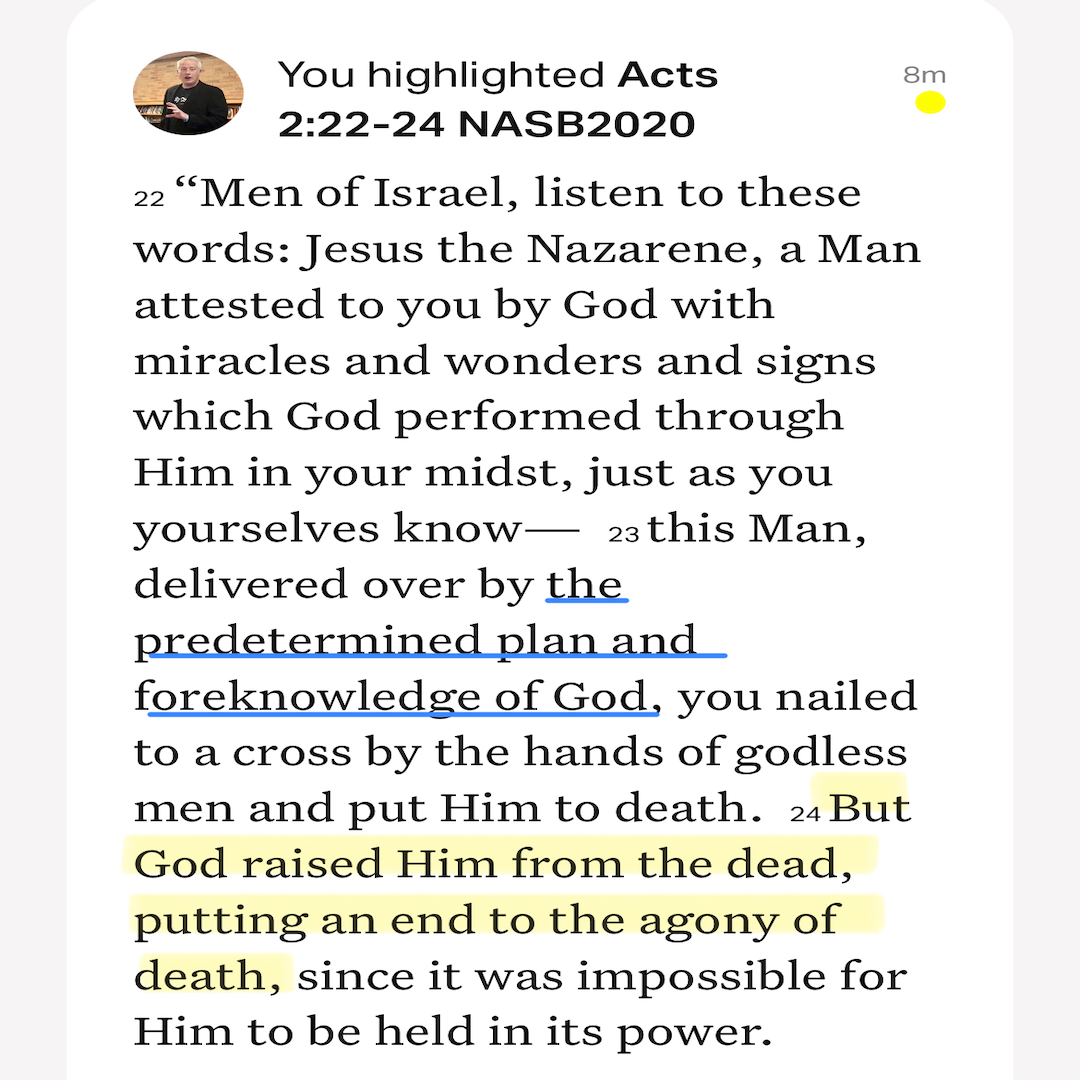
Jesus went to the Cross to fulfill His Father’s “predetermined plan.” This brought glory to God and joy to Jesus. God has a plan for your life, too. He sees you, He planned for you, He equipped you. As you live for Him, your life is also bringing glory to your Heavenly Father and joy to your heart. Unlike Jesus, you may not see how your part fits into God’s plan, but you will know it completely when you hear your Savior say, “Well done, good and faithful servant!”
Peter shared the gospel with a group of Gentiles at Cornelius’ house, and not only did they receive Jesus as their Savior, but they were all baptized in the Holy Spirit as well.
A group of Jews approached Peter and were angry with him because of a secondhand report they heard. To their credit, they listened respectfully to Peter’s full account of what happened and ended up changing their minds after they heard the firsthand story.
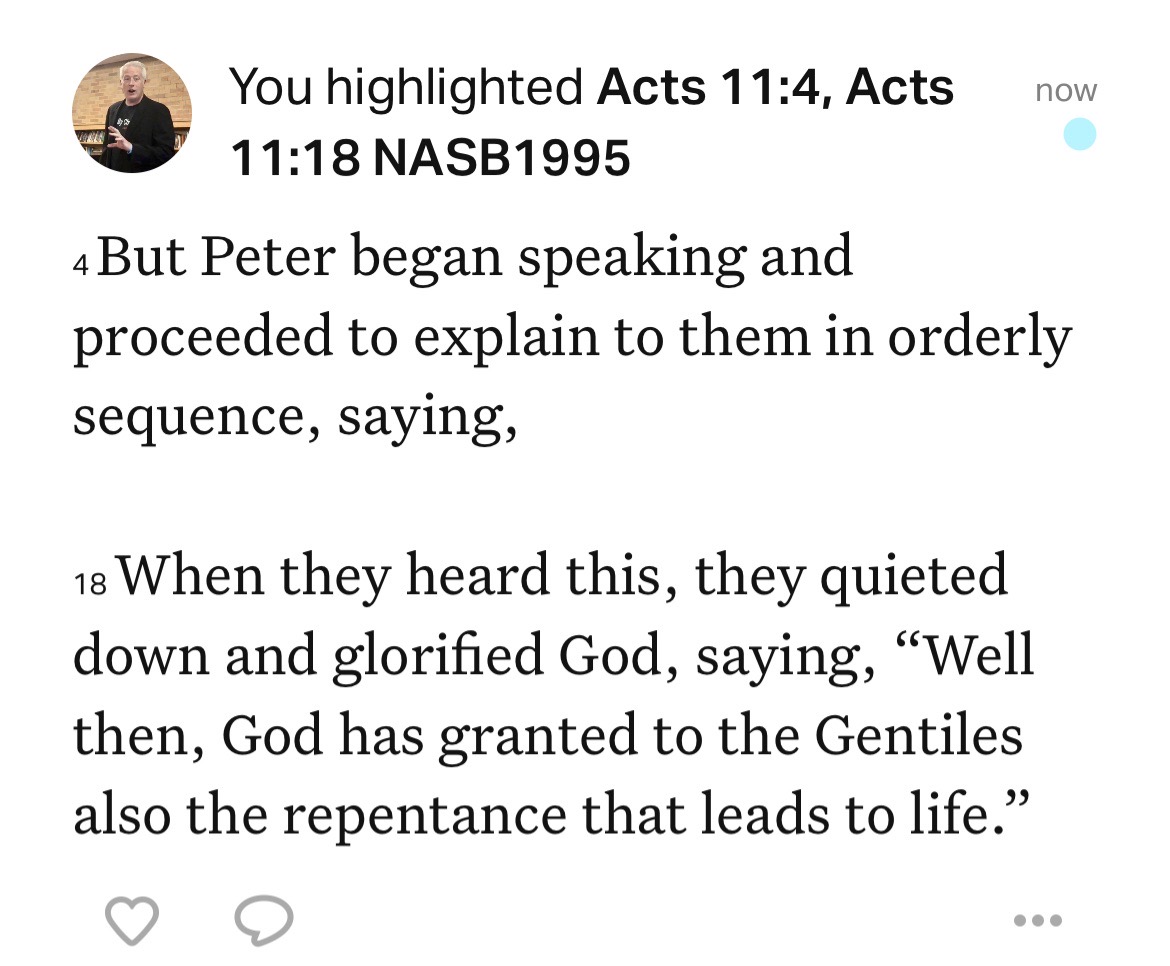
But Peter began speaking and proceeded to explain to them in orderly sequence…. When they heard this, they quieted down and glorified God, saying, “Well then, God has granted to the Gentiles also the repentance that leads to life.” (Acts 11:4, 18)
There’s a wonderful lesson here for all of us to apply: Verify secondhand reports.
I unpack this more in my book When Sheep Bite in discussing gossip and slander.



 We are getting ready to kick off a new series at Calvary Assembly of God based on the Book of Jude. When I read the opening line of this letter, it makes me pause. Jude writes, “Jude, a servant of Jesus Christ and a brother of James” (v. 1).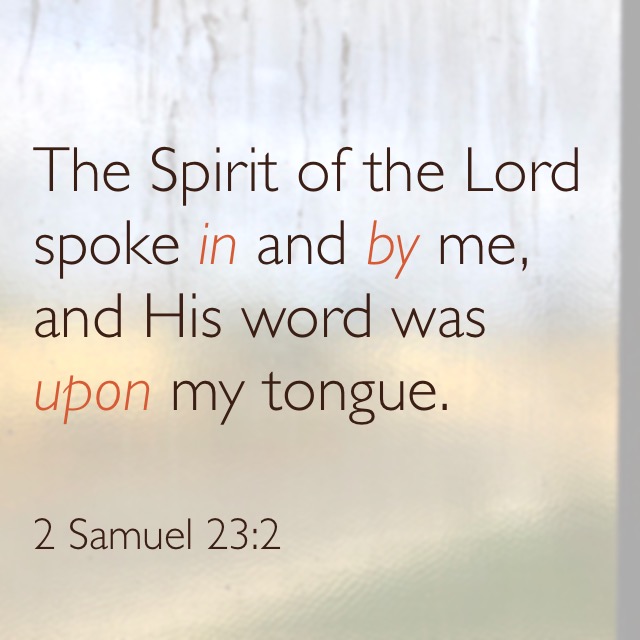




 Craig T. Owens