A Chronology Of The Life Of Paul

The Apostle Paul is a fascinating figure that looms so large across the New Testament and beyond.

I recently came across these amazingly helpful study tools to put the life of Paul into perspective. These are both from the Faithlife Illustrated Study Bible, which I highly recommend to you for adding a new depth to your Bible study time.

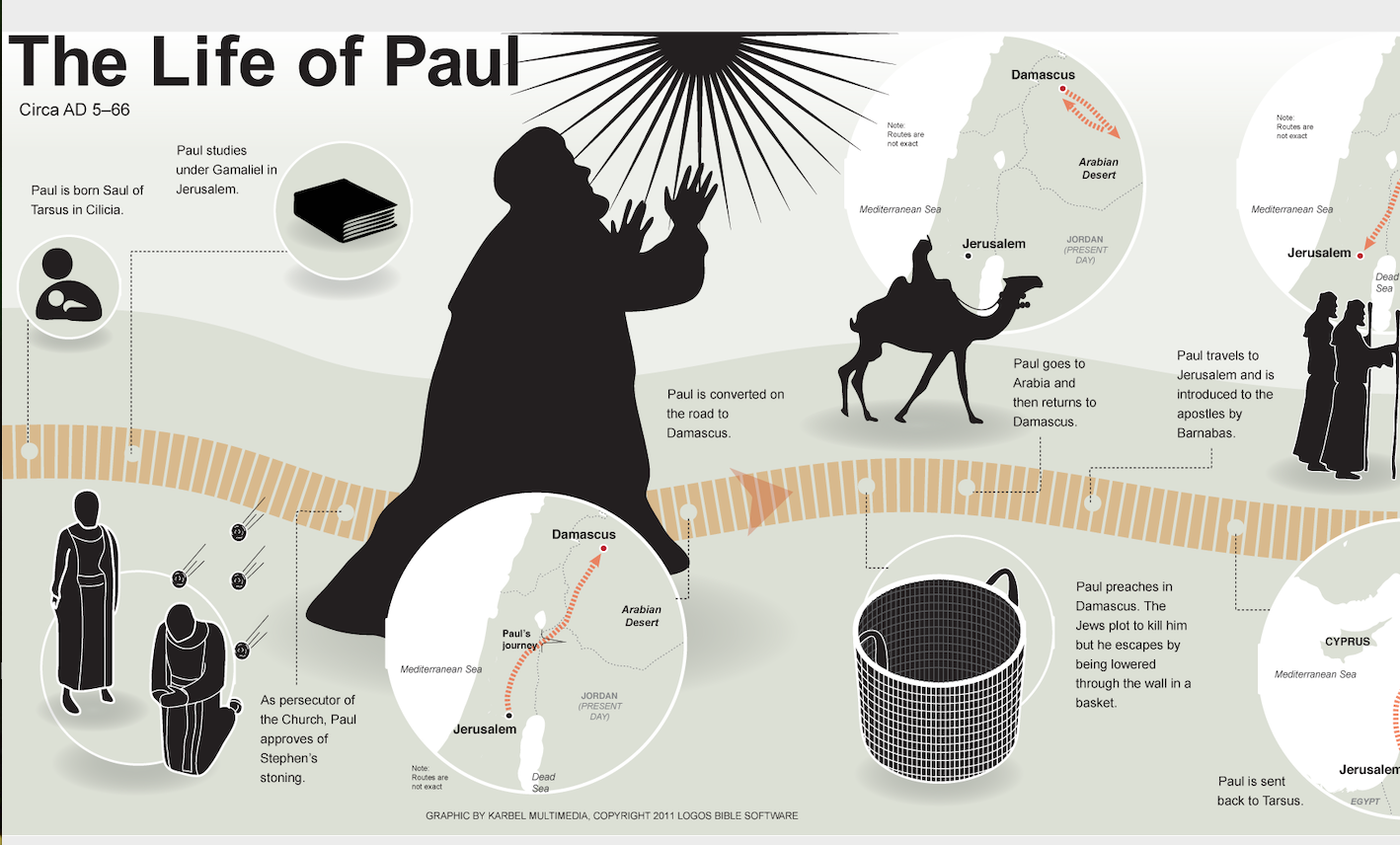
This is an illustrated timeline of the key dates and events of Paul’s life. Click on the graphic to view it better, or check it out on the Biblia website.

If you would like to research both the biblical texts and the attestations of Paul’s ministry outside of the New Testament, you may want to download this PDF chart → Apostle Paul Chronology

And it’s worth repeating: get a copy of the Faithlife Illustrated Study Bible for yourself as soon as you can!

9 Quotes From “Shepherding God’s Flock”

T.M. Moore has given pastors a phenomenal training resource in Shepherding God’s Flock. Please be sure to check out my full book review by clicking here. 

“The work of church leaders today—and especially of that class of leaders called elders, with which this study is concerned—has been shaped and conditioned more by the temper of our times than by the teaching of God’s Word.” 

“According to Paul, any church that does not have in place elders—and other leaders working with them—who are functioning as shepherds is a church that is not in order.… A church without a strong ministry of shepherding is a flock without genuine pastoral care, oversight, and equipping. It may be very active, even happy, and may be ‘growing’ in what some consider impressive ways. But without shepherding as the framework and integrating dynamic, such a church will always be something less than what God intends.” 

“Where the work of shepherding is being faithfully pursued, the gospel goes forth with power, lost sheep are located, and the flocks of God grow as He adds new souls to the fold.” 

“Where faithful shepherds are at work, the Lord’s sheep will be well fed. Both milk and the meat of the Word will be their daily diet, according to the needs and callings of each. Well-fed sheep are healthy, strong, and fruitful in their own contributions.” 

“The work of shepherding begins in relationships of mutual love and trust, spiritual friendships where sheep and shepherd know, love, and care about one another.” 

“Only when the people feel known and loved, and only when they know and love those who are called to lead them—only then will they be willing to follow where the shepherds of the church are seeking to take them.” 

“In the Christian life, people tend to live up to or achieve, not the level of their abilities, for their abilities are virtually limitless, given the presence of the indwelling Spirit of God. Rather, they tend to live up to the level of their vision—of what they see for their lives in Christ. Unless we are leading them into God’s vision for their lives, the people of God will settle for something less than the prize of the upward call of God in Christ Jesus.” 

“When temptation arises we can follow one of two courses. Either we will fall through temptation into sin, or we will grow through temptation into a higher stage of sanctification. … The shepherd’s task is twofold: first, he must help the Lord’s sheep to recognize temptation, by grounding them firmly in the law and Word of God; second, he must equip and encourage them in finding the way of escape from temptation, so that they may grow as the Lord intends.” 

“Jesus’ approach to bearing witness was thus energetic, proactive, continuous, compassionate, and pioneering. Should we expect anything less from the shepherds He has left to bring other lost sheep into His fold?”

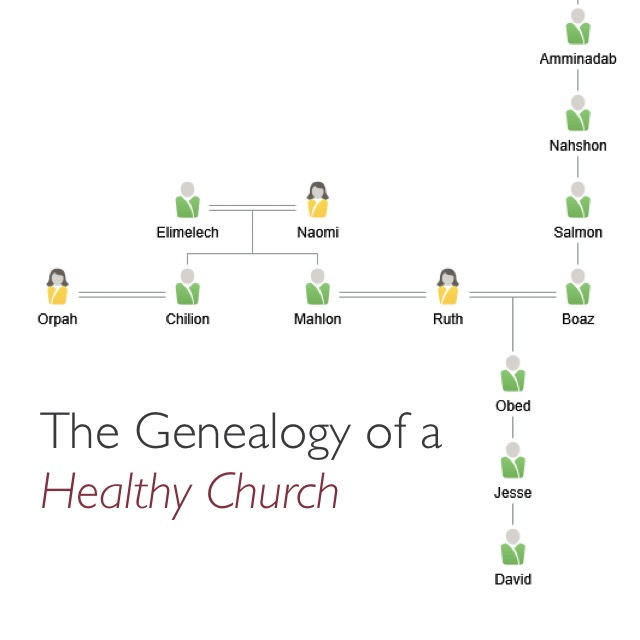
The Genealogy of a Healthy Church

And the things you have heard me say in the presence of many witnesses entrust to reliable people who will also be qualified to teach others. (2 Timothy 2:2)

Paul list four generations in this healthy church—Paul ➡️ Timothy ➡️ faithful Christians ➡️ others. 

We all have a role to play, and every role is vital in a healthy church. Are you a…

Paul: a first generation Christian that needs to start the ball rolling?

Timothy: one who needs to pass along what you have learned to the next generation?

faithful Christian: someone that is actively living out what has been taught to you?

member of the Body of Christ: one that needs to reach out to someone who isn’t a part of the Body yet?

Every single role is indispensable if the Church is going to remain healthy. If any part of this genealogy is lost, the whole Church suffers.

Thursdays With Spurgeon—Our Fight For Faith

This is a weekly series with things I’m reading and pondering from Charles Spurgeon. You can read the original seed thought here, or type “Thursdays With Spurgeon” in the search box to read more entries.

Our Fight For Faith

     Our faith at times has to fight for its very existence. The old Adam within us rages mightily, and the new spirit within us, like a young lion, disdains to be vanquished; and so these two strong ones contend, till our spirit is full of agony. …

     Christ alone was tempted in all points as we are, though without sin. No one man is tempted in all points exactly like another man, and each one has certain trials in which he must stand alone amid the rage of war, with not even a book to help him, or a biography to assist him—no man ever having gone that way before except that one Man whose trail reveals a nail-pierced foot. He alone knows all of the devious paths of sorrow. Yet even in such byways, the Lord is with us, helping us, sustaining us, and giving us grace to conquer at the close. … 

     So satan, loath to leave a soul, pursues it hotfoot. He will have it back if he can; and often, soon after conversion, there comes a time of dreadful conflict, when the soul seems as if it could not live. … 

     Once, when the tempter had grievously assailed me, I went to see my dear old grandfather. I told him about my terrible experience, and then I wound up by saying, “Grandfather, I am sure I cannot be a child of God, or else I should never have such evil thoughts as these.” 

     “Nonsense, Charles,” answered the good old man. “It is just because you are a Christian that you are thus tempted. These blasphemies are no children of yours; they are the devil’s brats, which he delights to lay at the door of a Christian. Don’t you own them as yours; give them neither house-room or heart-room.” 

From The Autobiography Of Charles Spurgeon

The apostle Peter says our adversary the devil continually prowls around looking for a follower of Jesus that he can devour. This shouldn’t be surprising to us since Jesus said that the devil’s agenda was to steal, kill, and destroy. (See 1 Peter 5:8-9; John 10:10.)

But the apostle Paul also tells us that we aren’t supposed to be unaware of the devil’s schemes. Instead, we are to capture every thought and make them obedient to Jesus (2 Corinthians 10:5). That means, as Spurgeon’s grandfather counseled him, we recognize those evil thoughts as the devil’s brats and don’t allow them to take up room in our house nor our heart. 

Stand firm—those who are in Christ are more than conquerors! 

Thursdays With Spurgeon—How satan Attacks

This is a weekly series with things I’m reading and pondering from Charles Spurgeon. You can read the original seed thought here, or type “Thursdays With Spurgeon” in the search box to read more entries.

How satan Attacks

     Our faith at times has to fight for its very existence. The old Adam within us rages mightily, and the new spirit within us, like a young lion, disdains to be vanquished; and so these two strong ones contend, till our spirit is full of agony. …

     Christ alone was tempted in all points as we are, though without sin. No one man is tempted in all points exactly like another man, and each one has certain trials in which he must stand alone amid the rage of war, with not even a book to help him, or a biography to assist him—no man ever having gone that way before except that one Man whose trail reveals a nail-pierced foot. He alone knows all of the devious paths of sorrow. Yet even in such byways, the Lord is with us, helping us, sustaining us, and giving us grace to conquer at the close. … 

     So satan, loath to leave a soul, pursues it hotfoot. He will have it back if he can; and often, soon after conversion, there comes a time of dreadful conflict, when the soul seems as if it could not live. … 

     Once, when the tempter had grievously assailed me, I went to see my dear old grandfather. I told him about my terrible experience, and then I wound up by saying, “Grandfather, I am sure I cannot be a child of God, or else I should never have such evil thoughts as these.”

     “Nonsense, Charles,” answered the good old man. “It is just because you are a Christian that you are thus tempted. These blasphemies are no children of yours; they are the devil’s brats, which he delights to lay at the door of a Christian. Don’t you own them as yours; give them neither house-room or heart-room.” 

From The Autobiography of Charles Spurgeon 

The spiritual attacks—especially on new Christians—can be intense. Even “veteran” Christians aren’t immune to such attacks. 

Although every Christian shares some commonality in the ways in which we are tempted, no one experiences an identical attack. The devil is a cunning schemer and he can tailor-make his attacks to each individual. Gratefully, there is One who knows every minute detail of our temptation. Jesus was tempted in every way that we are, and He overcame those temptations without sinning. Now our victorious Savior stands before God’s throne interceding on our behalf as we battle the tempter. 

Spurgeon’s grandfather was right—don’t own these satanic blasphemies as your own! Remind yourself that you are in a war. Then say with the apostle Paul, “Thanks be to God that Jesus Christ has rescued me from all these. There is now no condemnation for me because I am in Christ Jesus, and there is absolutely nothing that can separate me from that love!” (see Romans 7:25; 8:1, 31-39)

My Conscience

…my conscience also bearing me witness in the Holy Spirit (Romans 9:1). 

Conscience is that God-implanted part of a human soul that can distinguish between…

  • …the morally good and the morally bad 
  • …the things that attract God’s presence and the things that repel God’s presence
  • …commending things and condemning things
  • …the things that please the Holy Spirit and the things that grieve the Holy Spirit

Sin corrupts a conscience. Sin tries to blur the lines between good and evil. Sin looks for loopholes. 

Paul said his conscience was aligned with the Holy Spirit—my conscience bearing me witness in the Holy Spirit. 

The word for witness is the Greek word martyreo. Martyreo helps me distinguish because of personal experience OR divine revelation. In the case of a Holy Spirit-baptized Christian, it isn’t OR, it’s AND. Jesus used the same word when He said the baptism in the Spirit would empower His followers to be martyreo (Acts 1:8). 

The Holy Spirit aligns my conscience with God’s righteousness. The Spirit grieves when I fall short, and He rejoices when I obey. 

Following the other uses of martyreo in the New Testament, we can see that a Spirit-aligned conscience…

Can you say with Paul, “My conscience is aligned with the Holy Spirit”? You can if you make it a daily habit to listen for the Spirit’s voice and then obey His promptings. 

Don’t let sin corrupt your conscience, but let the Holy Spirit align your conscience with God’s righteousness. 

Thursdays With Spurgeon—Blessed Assurance

This is a weekly series with things I’m reading and pondering from Charles Spurgeon. You can read the original seed thought here, or type “Thursdays With Spurgeon” in the search box to read more entries.

Blessed Assurance

     The Holy Spirit, who enabled me to believe, gave me peace through believing. I felt as sure that I was forgiven as before I felt sure of condemnation. I had been certain of my condemnation because the Word of God declared it, and my conscience bore witness to it; but when the Lord Jesus justified me, the same witnesses made me equally certain. The Word of the Lord in the Scripture says, “He who believes in Him is not condemned” (John 3:18), and my conscience bore witness that I believed, and that God in pardoning me was just. Thus I had the witness of the Holy Spirit and also of my own conscience, and these two agreed in one. …  

     I find the apostle Paul speaking by the Holy Spirit and saying, “Having been justified by faith, we have peace with God” (Romans 5:1). If I know that my trust is fixed on Jesus only, and that I have faith in Him, were it not ten thousand times more absurd for me not to be at peace than for me to be filled with joy unspeakable? It is but taking God at His Word, when the soul knows as a necessary consequence of its faith that it is saved. …  

     Has Jesus saved me? I dare not speak with any hesitation here; I know He has. His word is true; therefore I am saved. My evidence that I am saved does not lie in the fact that I preach, or that I do this or that. All my hope lies in this, that Jesus Christ came to save sinners. I am a sinner, I trust Him, then He came to save me, and I am saved. I live habitually in the enjoyment of this blessed fact, and it is long since I have doubted the truth of it, for I have His own Word to sustain my faith.

From The Autobiography Of Charles Spurgeon

The joy that Spurgeon recounts in his conversion is the same joy that is available to all who call on Jesus in faith. As Spurgeon was prone to quoting passages of hymns in his sermons and books, these words of his remind me of a favorite hymn as well—

Blessed assurance, Jesus is mine;
Oh, what a foretaste of glory divine! 
Heir of salvation, purchase of God,
Born of His Spirit, washed in His blood. 
This is my story, this is my song,
Praising my Savior all the day long!

5 Lessons From An Amazing Mother

There is a Pentecostal Christian woman that we first meet in the Book of Acts, and then we see her name scattered throughout Paul’s letters. She may be the most prominent woman among all of the Apostle Paul’s companions and probably is responsible for spreading the Gospel more and farther than any other woman recorded in the Bible. 

Scripture doesn’t tell us if she had children of her own but she is certainly the spiritual mother of more Christians than we will ever be able to count!

Prisca is her birth name. She is a Jew, and most likely a freeborn Roman (just as Paul was). She is from the prominent Acilius family, so combined with Prisca her name is called Priscilla. She married Aquila and they both worked as leather makers (also known as tentmakers). 

Let’s take a look at Priscilla’s travel itinerary—

Pricilla left Rome because of Emperor Claudius’ decree in 49 AD and traveled to Corinth, where she met Paul (Acts 18:1-3, 11, 18-19). 

After spending almost 2 years with Paul in Corinth, they traveled to Ephesus with Paul, where she met and mentored Apollos (Acts 18:24-26). Apollos became a trusted friend to Paul; in fact, Paul calls him a synergos (where we get our English word for synergy). In other words, Paul thought his ministry was more effective because of his partnership with Apollos, but that is all thanks to Priscilla’s involvement! 

Priscilla returned to Rome sometime after Claudius’ death in 54 AD. She probably returned home to prepare the way for Paul’s visit there (Romans 1:10-11; 15:23-24; 16:3). 

And at some point she returned to Ephesus, probably to help Timothy as he pastored the church there (2 Timothy 4:19). 

Here are 5 lessons we can learn from Priscilla’s life—

  1. Be baptized in the Holy Spirit. This is what she taught to others, so it is undoubtedly how she lived as well. 
  1. Use the gifting God has given you. Except for one place, Priscilla is always listed first ahead of her husband. This is unprecedented anywhere else in the New Testament. That tells us that despite what the Greco-roman culture tried to enforce, Priscilla was the predominant teacher/preacher in her family.
  1. Work hard. Priscilla had to be fairly well-to-do to be able to travel to at least three major cities and to host churches in her home, and yet we see her working with her hands to provide for her family and for the church. 
  1. Be bold. Jesus said the baptism in the Holy Spirit would give us boldness, and Priscilla demonstrated that powerfully (Romans 16:4). 
  1. Be synergistic. Paul also called Priscilla a synergos. Paul used this word sparingly for people who had put everything on the line for the sake of the Gospel. He used synergos for people like Apollos, Timothy, Titus, and Luke. Priscilla is the only woman who gets this invaluable term.  

We don’t know if Priscilla was a biological mom, but she was definitely a spiritual mom. She was empowered by the Holy Spirit, and probably is responsible for spreading the Gospel more than any other woman recorded in the Bible. You can follow in her footsteps! 

If you missed any of the messages in this series, you can access the full list of messages by clicking here. 

Thursdays With Spurgeon—Keep The Focus On The Savior

This is a weekly series with things I’m reading and pondering from Charles Spurgeon. You can read the original seed thought here, or type “Thursdays With Spurgeon” in the search box to read more entries.

Keep The Focus On The Savior

     I have heard men tell the story of their conversion, and of their spiritual life, in such a way that my heart has loathed them and their story, too, for they have told of their sins as if they did boast in the greatness of their crime, and they have mentioned the love of God, not with a tear of gratitude, not with the simple thanksgiving of the really humble heart, but as if they as much exalted themselves as they exalted God. Oh! When we tell the story of our own conversion, I would have it done with great sorrow, and with great joy and gratitude, remembering how little we deserve these things. … 

     My Master, I cannot understand how You stoop Your awful head to such a death as the death of the Cross, how You could take from Your brow the coronet of stars that from old eternity had shone resplendent there. But how You should permit the thorn-crown to gird Your temples astonishes me far more. That You should cast away the mantle of Your glory, the azure of Your everlasting empire, I cannot comprehend. But how You should have become veiled in the ignominious purple for a while and then be mocked by impious men who bowed to You as a pretended king; and how You should be stripped naked to Your shame, without a single covering, and die a felon’s death. This is still more incomprehensible. But the marvel is that You should have suffered all this for me! … 

     I, a lad, found the Lord of glory. I, a slave to sin, found the great Deliverer. I, the child of darkness, found the Light of Life. I, the uttermost of the lost, found my Savior and my God. I, widowed and desolate, found my Friend, my Beloved, my Husband. Oh, how I wondered that I should be pardoned! It was not the pardon that I wondered at so much; the wonder was that it should come to me. 

From The Autobiography Of Charles Spurgeon

How sad that many times the story of our salvation focuses more on how bad we were, and gives so little glory to how amazing our Savior’s rescue was. 

Just as the Apostle Paul called himself the chief of sinners, and stood in amazement that Christ’s love would reconcile him to God, so Spurgeon stood amazed that Jesus would stoop to die for “the uttermost of the lost.” 

It’s fine to tell people what used to be, but please make sure your story focuses more on how amazing it is that God’s love saved you from those sins. Amazing love! How can it be that You, my King, would die for me? 

Let’s keep the focus on the Savior! 

Hope In The Storm

And in all we were two hundred and seventy-six persons on the ship … they all escaped safely to land (Acts 27:37, 44). 

Paul knew he would be spared dying at sea because God had already told him that he would testify in Rome (23:11). But no one else on that tempest-tossed ship had that same assurance. Luke (who was on the ship with Paul) even wrote, “All hope that we would be saved was finally given up” (27:20). 

Luke wrote those words only three days into the storm. Little did he know that the storm would rage for another 11 days!! 

On the storm’s fourteenth day, Paul called everyone together with good news: “An angel from God visited me. He assured me that the ship will be wrecked, but all of you will be saved. The only condition is you must stay on the ship with me. Therefore, take heart, men, for I believe God that it will be just as it was told me” (vv. 22-26). 

Just as Paul told them, the ship ran aground and all 276 people on board made it safely to the shores of Malta! 

When God gives a promise, hold fast to it. Don’t let the storms—no matter how many days they may rage on—cause you to give up hope. 

And when God graciously gives you a word for others, be quick to be the message of encouragement to your storm-tossed, hope-lost companions who so desperately need something to cling to. 

God’s word never fails. God’s word is never lost at sea or in any other calamity. Hold on … be encouraged … and give hope and courage to others too.