Links & Quotes

I’ve got a great Christmas gift idea for you to give to your favorite pastor: a copy of my book When Sheep Bite. I promise you that your pastor has been bitten and that there will be more bites in the future. This book will bring about the healing and restoration that your pastor needs.

I have lots of new content every week, which you can check out on my YouTube channel.

“Good advice is always certain to be ignored, but that’s no reason not to give it.” —Agatha Christie 

Skeptics of the Bible will often point to incidents in the Scripture that they would consider genocide. How are Christians to respond to these claims? J. Warner Wallace helps us respond thoughtfully and biblically. 

Our Creator crafted a perfect environment for life to flourish on Earth. This isn’t random chance, but intelligent precision. Check out this short clip that outlines the devastation that would occur with even the smallest of changes.

“Let us remember, dear friends, that as we meet at our tables today with our sisters and brothers from distant parts, we are also invited by our elder Brother, our divine Friend, to join with Him in a higher feast, the way there sprinkled with His own blood. Let us not forget, as we are blessed with the providential bounties for the nourishment of these frail bodies that Christ the Lord summons us to a spiritual feast.” —Rev. James Cruickshanks, November 21, 1861 

“The apostle Paul explained that the power of God at work within us, the power of His indwelling Holy Spirit, is exceedingly abundantly greater than all we could ever ask or think (Ephesians 3:20). Greater for what? For a clearer vision of Christ and more intimate communion with Him (Colossians 3:1-3; 2 Corinthians 3:12-18). More continuous and abundant yields of spiritual fruit (Galatians 5.22-23). Greater consistency and effectiveness in the exercise of spiritual gifts for ministry (1 Corinthians 12:7-11). More power to bear witness for Christ, to love God and our neighbors, and to advance His rule of righteousness, peace, and joy on earth as it is in heaven (Acts 1:8; Matthew 22:34-40; Romans 14:17-18).” —T.M. Moore [check out all of the Scripture here

Don’t Take Advice From Armchair Quarterbacks

Listen to the podcast of this post by clicking on the player below, and you can also subscribe on AppleSpotify, or Audible. 

There are some know-it-alls who want to tell pastoral leaders how they should have done things differently. Much like the “armchair quarterbacks” that seem to know all the right calls a team should make, even though they have virtually no experience. 

Pastor, pay very little attention to those armchair quarterbacks that would speak into your life!

Check out this short clip from my time on the Leading From Alignment podcast.

To put the quote that Jim shared from When Sheep Bite into context, here is the full passage—

     Jesus is our perfect example of a Shepherd Leader. His example was to lay it all on the line, regardless of how the sheep were behaving or misbehaving: “I am the Good Shepherd. The Good Shepherd lays down His life for the sheep” (John 10:11). By contrast, Jesus warns us that those who are not willing to put their lives on the line for the sheep are worse than armchair pastors—Jesus calls them mere hired hands: “The hired hand is not the shepherd and does not own the sheep. So when he sees the wolf coming, he abandons the sheep and runs away. Then the wolf attacks the flock and scatters it. The man runs away because he is a hired hand and cares nothing for the sheep” (John 10:12-13). 

     If I am called to be a shepherd leader, attacks will come from both sheep and wolves. It’s what I do in those hard times that shows whether I am truly called or merely acting as an armchair shepherd. 

Please check out both When Sheep Bite and Shepherd Leadership. And get in touch with me if you would like someone to talk to. 

You can check out the full conversation I had with John Opalewski and Jim Wiegand on their Leading From Alignment podcast here.

►► Would you please prayerfully consider supporting this ministry? My Patreon supporters get behind-the-scenes access to exclusive materials. ◀︎◀︎

The Bias Of Human Agendas

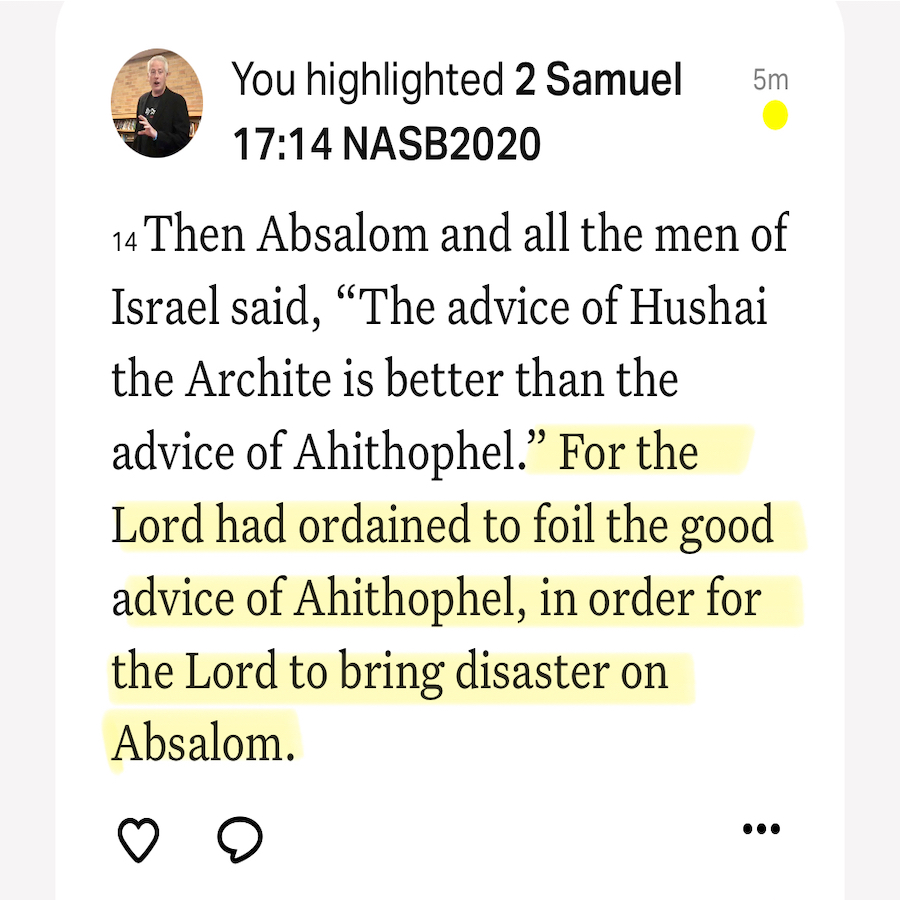
Absalom said to Ahithophel, “Give us your advice. What should we do?” … Ahithophel said to Absalom, “I would choose twelve thousand men and set out tonight in pursuit of David. I would attack him while he is weary and weak. I would strike him with terror, and then all the people with him will flee. I would strike down only the king and bring all the people back to you….” This plan seemed good to Absalom and to all the elders of Israel. 

But Absalom said, “Summon also Hushai the Arkite, so we can hear what he has to say as well.” When Hushai came to him, Absalom said, “Ahithophel has given this advice. Should we do what he says? If not, give us your opinion.”

Hushai replied to Absalom, “The advice Ahithophel has given is not good this time….” 

Absalom and all the men of Israel said, “The advice of Hushai the Arkite is better than that of Ahithophel.” For the Lord had determined to frustrate the good advice of Ahithophel in order to bring disaster on Absalom. (2 Samuel 16:20; 17:1-7, 14). 

Absalom (unlike his father) didn’t consult God, but consulted men. 

Ahithophel had a personal agenda. All he wanted to do is get revenge on David for what he had done to Uriah and Bathsheba. Notice Ahtihophel’s wording: “I will kill only the king” (v. 2). 

What was Ahithophel’s beef with David? Uriah—the man whose wife David stole, the man whom David had killed to cover up his affair—was Ahithophel’s son (2 Samuel 23:34, 11:3)! 

Hushai, the the other man who gave Absalom counsel, also had an agenda. Hushai is repeatedly given one description: Friend of David (2 Samuel 15:37, 16:16-17; 1 Chronicles 27:33). So Hushai’s sole focus is saving his friend’s life. 

Humans always give their advice with their own bias or agenda. 

It’s okay to talk to men and get their counsel, but always allow God to confirm or reject their advice.

Links & Quotes

Romans 8:28 tells us that God uses ALL things to accomplish His purpose for our lives. Too many times I tried to rush through things without getting anything out of it. I have lots of new content every week, which you can check out on my YouTube channel.

He is 98 years old and he’s still busy serving other people! I pray we can all be as selfless and vibrant in ministering to others until the day God calls us home.

“When with an eye of faith we behold Christ crucified we ought to weep, not for Him, but for ourselves. We must not be affected with the death of Christ as with the death of a common person whose calamity we pity, or of a common friend whom we are likely to part with. The death of Christ was a thing peculiar; it was His victory and triumph over His enemies; it was our deliverance, and the purchase of eternal life for us. And therefore let us weep, not for Him, but for our own sins, and the sins of our children, that were the cause of His death; and weep for fear (such were the tears here prescribed) of the miseries we shall bring upon ourselves, if we slight His love, and reject His grace, as the Jewish nation did, which brought upon them the ruin here foretold.” —Matthew Henry, on Jesus’ word, “Do not weep for Me” in Luke 23:28

J. Warner Wallace shares three responses Christians can give to those who make the claim that Jesus didn’t think He was God. In this video, Detective Wallace talks about a section of his website that gives further evidence. You can find that section here.

The Institute for Creation Research is a group of scientists explaining how science points to a Creator. What does Creation have to do with Easter? “Any view of Christianity that incorporates long ages of death and suffering before Adam makes a sham of the Cross. This Easter season, as we remember our salvation made possible by the death of our Lord Jesus Christ on the Cross and His triumphant resurrection from the grave, let us understand it within the ‘big picture’ of a ‘very good’ creation that was ruined by our rebellion but restored by the willing sacrifice of our great Creator-Savior.”

“One measure of the greatness of a man is not only that he practices what he preaches, but also that he doesn’t consider himself above the ordinary means of grace that all Christians need.” —John Piper

“Beware of idleness—satan sows most of his seed in fallow ground.” —Thomas Watson

He prayeth best who loveth best
All things both great and small;
For the dear God who loveth us,
Hath made and loveth all. —Samuel T. Coleridge

Saturday In The Proverbs—Relationship Builders And Killers (Proverbs 27)

[Each chapter in the Book of Proverbs contains thoughts that fit into a theme; they are not just random thoughts gathered together. In this “Saturday In The Proverbs” series, I will share a theme that I see in each chapter. But the cool thing about God’s Word is that you may see an entirely different theme. That’s great! If you do, I would love for you to share it in the comments below.]

Do not boast… (Proverbs 27:1).

This proverbs has some noteworthy relationship builders and relationship killers. 

Relationship Builders

  • Humility (v. 2) 
  • Confronting in love (vv. 5a, 6a)
  • Contentment (v. 7)
  • Minding your own business (v. 8)
  • Giving good advice (v. 9)
  • Investing in family friendships (v. 10)
  • Exercising wisdom (v. 11)
  • Using foresight (v. 12a)
  • Investing in yourself so that you can invest in others (v. 17)
  • Serving others (v. 18)
  • Honest self-assessment (v. 19)
  • Good work ethic (vv. 23-27) 

Relationship Killers

  • Boasting (vv. 1, 2)
  • Provoking a foolish argument (v. 3)
  • Jealousy (v. 4)
  • Unexpressed love (v. 5b)
  • Insincere flattery (vv. 6b, 14)
  • Ignoring the signs of impending trouble (v. 12b)
  • Cosigning a loan (v. 13)
  • Arguing (vv. 15, 16)
  • Envy (v. 20)
  • Not handling praise humbly (v. 21) 
  • Not listening to correction (v. 22)

To keep our relationships strong and vibrant, let’s kill the killers and build the builders! 

Links & Quotes

link quote

“In this version of the Lord’s Prayer (Luke 11:2-4) Jesus says, ‘When you pray say’ … and then in verse 4 He includes this petition, ‘and forgive us our sins.’ So, if you connect the beginning of the prayer with the middle, what He says is, ‘Whenever you pray say … forgive us our sins.’ I take this to mean that this should be as much a part of all our praying as ‘Hallowed be Thy name.’ Which means that Jesus assumes that we need to seek forgiveness virtually every time we pray. In other words, we are always sinners. … It doesn’t matter how obedient we have been before we pray. We always come to the Lord as sinners—all of us. And God does not turn away the prayers of sinners when they pray like this.” —John Piper

“What if I say that it is not unjust but according to law that when a woman gets into debt her husband should bear it? And with the church of God sinning, it was but right that her Husband, who had espoused her unto Himself, should become the debtor on her behalf. The Lord Jesus stood in the relationship of a married Husband unto His church, and it was not, therefore, a strange thing that He should bear her burdens.” —Charles Spurgeon

“We can have confidence in our ability, through reason, to help our unbelieving friends consider the Good News of Jesus Christ and His Kingdom. We know this because God Himself is reasonable, and we believe He commends the use of reason in making Himself and His will known to men.” —T.M. Moore

“Listen to your conscience. Don’t be afraid not to join the mob—if you feel inside it’s wrong. Don’t confuse being ‘soft’ with seeing the other guy’s point of view. … Avoid self-righteously turning on a friend, but have your friendship mean enough that you would be willing to share with your friend your judgment. Don’t assign away your judgment to achieve power.” —George H.W. Bush, in a letter to his sons during the Watergate scandal

Some interesting lessons in Fast Company’s list of the 50 most well-liked CEOs in the United States.

“satan has tripped up many Christians by convincing them they’ve lost something in the Lord.” But David Wilkerson urges us to forget those things!

If you are praying for one of your loved ones to accept Jesus as their Savior, Tim Dilena has an encouraging word for you in The Amazing Now Becomes More Amazing.

[VIDEO] Conrad Mbewe shows how the so-called prosperity gospel isn’t honest with the entirety of Scripture—

Thursdays With Oswald—The Will Of God

This is a weekly series with things I’m reading and pondering from Oswald Chambers. You can read the original seed thought here, or type “Thursdays With Oswald” in the search box to read more entries.

Oswald Chambers

The Will Of God 

     Supernatural voices, dreams, ecstasies, visions and manifestations, may or may not be an indication of the will of God. The words of Scripture, the advice of the saints, strong impressions during prayer, may or may not be an indication of the will of God.

     The one test given in the Bible is discernment of a personal God and a personal relationship to Him, witnessed to ever after in walk and conversation. 

From Christian Disciplines

The will of God may or may not come to you in a thundering voice or even in a still, small impression in your heart. But the way you walk and talk will absolutely attest to what you believe the will of God is. The way you walk and talk witnesses to what you believe.

So when you look at you, do you see God’s will on display?

Your Part In The Battle

The story about David defeating the giant Goliath in battle is familiar to just about everyone. (If it’s not a familiar story to you, you can read it here.) I was struck by how David saw his part in this fight. Look what he said:

All those gathered here will know that it is not by sword or spear that the Lord saves; for the battle is the Lord’s.

After the fight was over, and Goliath lay dead at David’s feet, the biblical writer said the same thing:

So David triumphed over the Philistine with a sling and a stone; without a sword in his hand he struck down the Philistine and killed him.

If you are a God-follower, then your battles are really God’s battles. David recognized that it was God’s battle, but David also knew that he played a part in this too.

1.  He had to train. David had to know how to use a sling with deadly accuracy.

2.  He had to reject “good” advice. Saul advised David, “Here, wear my armor.” That sounded like good advice, but it didn’t fit for David. He had to be true to what the Spirit of God spoke to his heart, even as he rejected what seemed like good advice.

3.  He had to have faith. David truly believed that God was going to do something big—something no one else could even imagine.

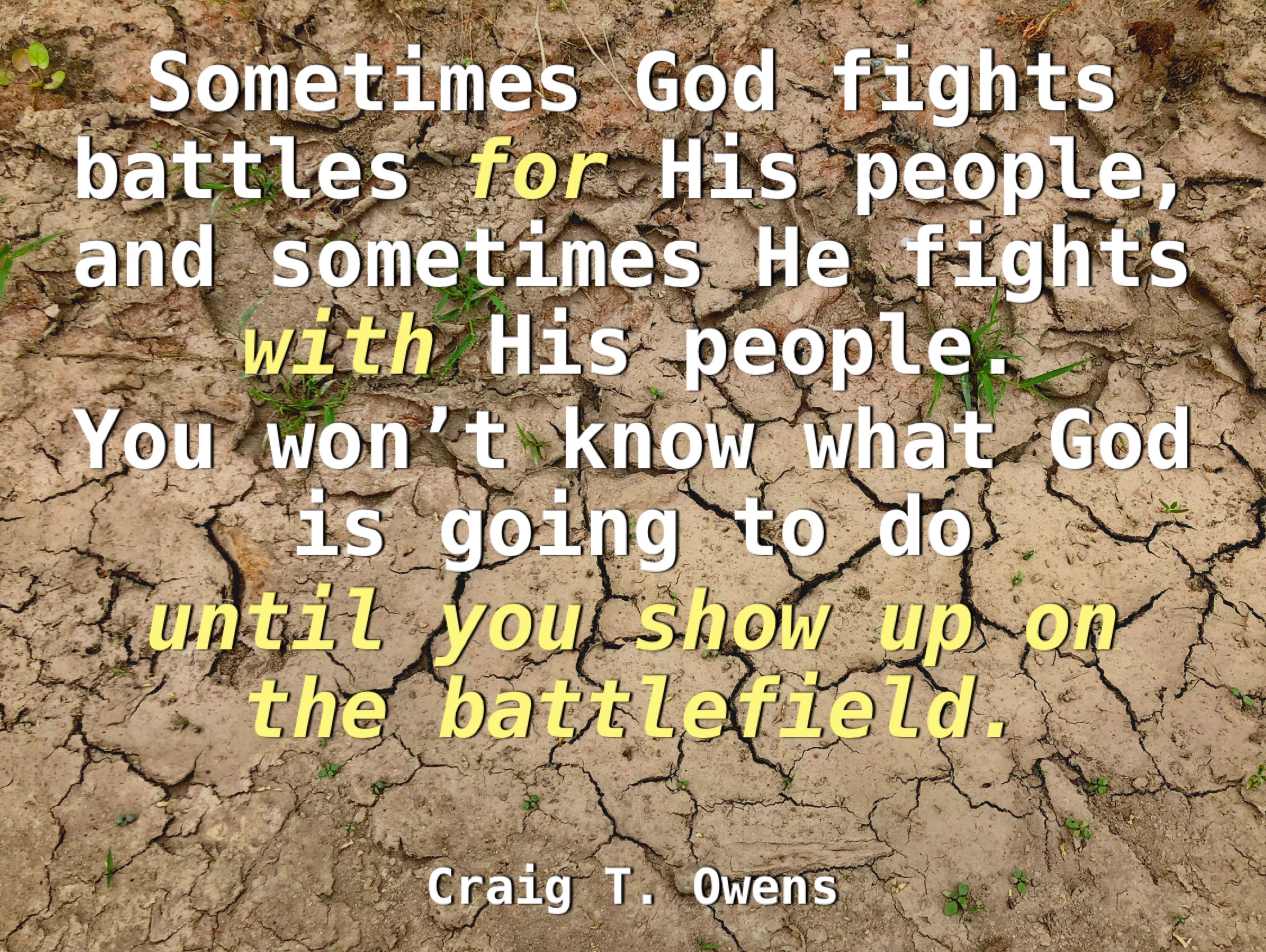
4.  He had to show up. Sometimes God fights battles for His people, and sometimes He fights with His people. David didn’t know what God was going to do in this instance until he showed up on the battlefield.

God wants you to win big battles. And if you’re following God, He will bring the victory. But you still have a very important part to play. Train hard, reject advice that is contrary to what God has told you, have faith, and then show up for the battle. These are the keys to victory.

Let Me Give You A Piece Of Advice

How many times have you heard someone say you, “Let me give you a piece of advice”? Ah, yes, everyone has some advice to share. Everyone has an opinion. Everyone wants to give you a piece of their mind. Everyone is an expert in an area where they think you’re deficient.

I remember going through comment cards at the end of a long week of youth camp. I’d read one card that would say the food was excellent. Just a couple of cards later some “expert” would share how terrible the food was. One would say they loved the evangelist, another would give their “advice” on where the evangelist missed it.

Whom should I listen to? Who should get my ear?

In William Shakespeare’s Hamlet, Polonius gives this counsel to Laertes “Give every man thine ear, but few thy voice: Take each man’s censure, but reserve thy judgment.”

Nice prose, but how do we live it out?

I like the example I see from a man named Jethro in the Bible. Jethro is Moses’ father-in-law, and he really only appears on the scene in just one chapter (Exodus 18), but his method of giving advice should be a model for us all.

Credentials—Jethro was a God-fearing man. If you are a follower of Jesus Christ, weigh carefully the advice given to you by those who don’t have the same biblical foundation.

Relationship—Jethro had a personal relationship with Moses, he wasn’t just a business acquaintance. That means Jethro had a vested interest in Moses’ success or failure.

Firsthand—Jethro heard about what was happening, but he came to see it for himself. Beware of those “experts” who only have secondhand information about you or your situation.

Up-Close—Jethro spent an entire day right by Moses’ side just watching and listening. He saw what was going on from the front row.

Questions—Jethro led with questions, not with advice. Before giving Moses his opinion, Jethro asked clarifying questions.

Wisdom—Only after all of this did Jethro give his opinion to Moses. The words that he shared were then received by Moses as God-given wisdom.

Your counselors should earn the right to be heard. Just because someone has an opinion doesn’t make him an expert. And just because someone has been-there-done-that doesn’t mean that her way should be your way.

Screen out the clamoring voices by making sure they have credentials, a relationship with you, firsthand experience, and godly wisdom.

Sharper

Yesterday was one of those days that I was in “receive” mode. As a pastor, I usually spend more days in the “dispense” mode: teaching, counseling, advising. But yesterday I was blessed to sit back and soak in some great counsel. And I’m sharper for it.

It’s too bad that many people never take the time to allow others to advise them. Or, if they do go through the motions of “listening” to advice, they never put that counsel into action.

I met with a seasoned pastor yesterday morning. He asked me several questions to assess where I was personally and professionally, and then he gave me some invaluable insight. He’s one of those “been-there-done-that” guys who has learned the lessons of history well, and he was gracious to share with me.

Last night I invited my Impact teaching team over to my house. After sharing dinner together I listened as they weighed in on our upcoming series in our youth services. Since they are closer in age to our students, their insight into the teenage mind was so keen. They were able to help me better understand the challenges and culture of middle and high school students. And I’m sharper for it.

A few thoughts from some other wise counselors:

“A wise man will hear, and will increase learning; and a man of understanding shall attain unto wise counsels.” —Proverbs 1:5 (KJV)

“Those who will not be counseled, cannot be helped. More souls are ruined by pride than by any other sin whatever.” —Matthew Henry

“Without good direction, people lose their way; the more wise counsel you follow, the better your chances.” —Proverbs 11:14 (The Message)

“Plans fail for lack of counsel, but with many advisers they succeed.” —Proverbs 15:22 (NIV)

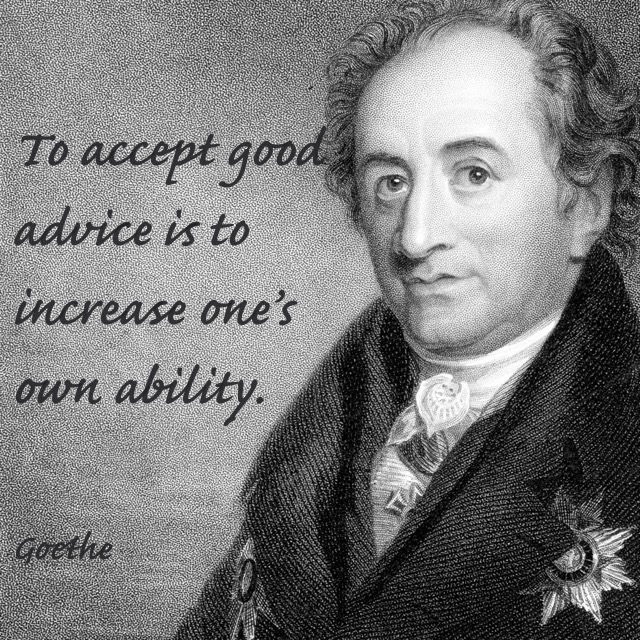
“To accept good advice is to increase one’s own ability.” —Goethe

Are you getting sharper? Are you listening to good advice?