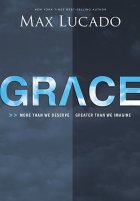
10 Quotes From “Grace”

Max Lucado’s newest book Grace is a wonderful reminder of how extravagant God is toward us (you can read my full review by clicking here). Here are 10 of my favorite quotes from Grace

“God’s guilt brings enough regret to change us. satan’s guilt, on the other hand, brings enough to enslave us. … It boils down to this choice: Do you trust your Advocate or your accuser?”

“Sin is not a regrettable lapse or an occasional stumble. Sin stages a coup against God’s regime. Sin storms the castle, lays claim to God’s throne, and defies His authority. Sin shouts, ‘I want to run my own life, thank you very much!’ Sin tells God to get out, get lost, and not come back. Sin is insurrection of the highest order, and you are an insurrectionist. So am I. So is every single person who has taken a breath. … God didn’t overlook your sins, lest He endorse them. He didn’t punish you, lest He destroy you. He instead found a way to punish the sin and preserve the sinner. Jesus took your punishment, and God gave you the credit for Jesus’ perfection.”

“Grace-a-lots believe in grace, a lot. Jesus almost finished the work of salvation, they argue. In a rowboat named Heaven Bound, Jesus paddles most of the time. But every so often He needs our help. So we give it. We accumulate good works the way Boy Scouts accumulate merit badges on a sash. … We find it easier to trust the miracle of resurrection than the miracle of grace. We so fear failure that we create the image of perfection, lest Heaven be even more disappointed in us than we are. The result? The weariest people on earth. Attempts at self-salvation guarantee nothing but exhaustion. We scamper and scurry, trying to please God, collecting merit badges and brownie points, and scowling at anyone who questions our accomplishments. Call us the church of hound-dog faces and slumped shoulders. Stop it! Once and for all, enough of this frenzy. ‘Your hearts should be strengthened by God’s grace, not by obeying rules’ (Hebrews 13:9 NCV). Jesus does not say, ‘Come to Me, all you who are perfect and sinless.’ Just the opposite. ‘Come to Me, all who are weary and heavy-laden, and I will give you rest’ (Matthew 11:28 NASB).”

“Give the grace you’ve been given. You don’t endorse the deeds of your offender when you do. Jesus didn’t endorse your sins by forgiving you. Grace doesn’t tell the daughter to like the father who molested her. It doesn’t tell the oppressed to wink at injustice. The grace-defined person still sends thieves to jail and expects and ex to pay child support. Grace is not blind. It sees the hurt full well. But grace chooses to see God’s forgiveness even more. It refuses to let hurts poison the heart. ‘See to it that no one misses the grace of God and that no bitter root grows up to cause trouble and defile many’ (Hebrews 12:15 NIV). Where grace is lacking, bitterness abounds. Where grace abounds, forgiveness grows.

“Find a congregation that believes in confession. Avoid a fellowship of perfect people (you won’t fit in), but seek one where members confess their sins and show humility, where the price of admission is simply the admission of guilt. Healing happens in a church like this.”

“Plunge a sponge into Lake Erie. Did you absorb every drop? Take a deep breath. Did you suck the oxygen out of the atmosphere? Pluck a needle from a tree in Yosemite. Did you deplete the forest of foliage? Watch an ocean wave crash against the beach. Will there never be another one? Of course there will. No sooner will one wave crash into the sand than another appears. Then another, then another. This is a picture of God’s sufficient grace. Grace is simply another word for God’s tumbling, rumbling reservoir of strength and protection. It comes at us not occasionally or miserly but constantly and aggressively, wave upon wave. We’ve barely regained our balance from one breaker, and then, bam, here comes another. ‘Grace upon grace’ (John 1:16 NASB). We dare to hang our hat and stake our hope on the gladdest news of all: if God permits the challenge, He will provide the grace to meet it. We never exhaust His supply. ‘Stop asking so much! My grace reservoir is running dry.’ Heaven knows no such words. God has enough grace to solve every dilemma you face, wipe every tear you cry, and answer every question you ask.”

“How long has it been since your generosity stunned someone? Since someone objected, ‘No, really, this is too generous’? If it has been awhile, reconsider God’s extravagant grace. ‘Forget not all His benefits, who forgives all your iniquity’ (Psalm 103:2-3 RSV).”

“Your identity is not in your possessions, talents, tattoos, kudos, or accomplishments. Nor are you defined by your divorce, deficiencies, debt, or dumb choices. You are God’s child. You get to call Him ‘Papa.’ You ‘may approach God with freedom and confidence’ (Ephesians 3:12 NIV). You receive the blessings of His special love (1 John 4:9-11) and provision (Luke 11:11-13). And you will inherit the riches of Christ and reign with Him forever (Romans 8:17).”

“To live as God’s child is to know, at this very instant, that you are loved by your Maker not because you try to please Him and succeed, or fail to please Him and apologize, but because He wants to be your Father. Nothing more. All your efforts to win His affections are unnecessary. All your fears of losing His affection are needless. You can no more make Him want you than you can convince Him to abandon you. The adoption is irreversible. You have a place at His table.”

“Where there is no assurance of salvation, there is no peace. No peace means no joy. No joy results in fear-based lives. Is this the life God creates? No. Grace creates a confident soul who declares, ‘I know Whom I have believed, and am convinced that He is able to guard what I have entrusted to Him for that day’ (2 Timothy 1:12 NIV). … Trust God’s hold on you more than your hold on God. His faithfulness does not depend on Yours. His performance is not predicated on yours. His love is not contingent on your own.”
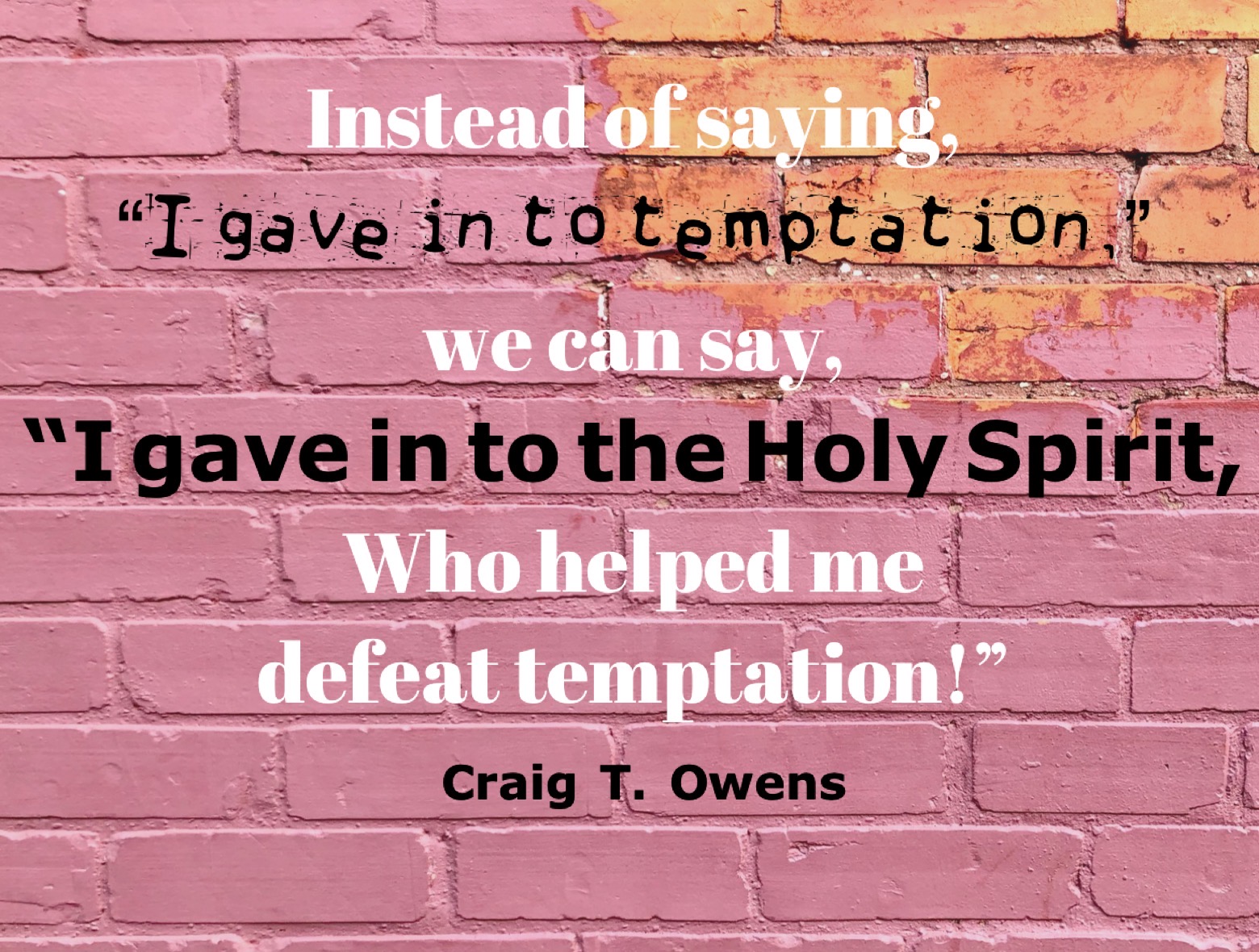
Victory!

Twice in Romans 7, the Apostle Paul uses the phrase “but sin, seizing the opportunity” (vv. 8, 11).

Sin always seizes any opportunity it gets. The devil always prowls around looking for an opportunity to tempt and destroy. And my flesh is always only too eager to give in to the pull of sin and the devil (v. 25).

If we want victory over sin and the devil, we have to be AWARE and be PREPARED.

When the devil had finished all this tempting, he left Jesus until an opportune time” (Luke 4:13).

The devil will bide his time.

“…satan has asked to sift you as wheat…” (Luke 22:31).

It’s not always the big shakings that will cause us to sin, but the little siftings can wear us down.

Stay alert! Watch out for your great enemy, the devil, prowls around like a roaring lion, looking for someone to devour. Resist him, standing firm in the faith” (1 Peter 5:8-9).

Keep awake and watch and pray constantly, that you may not enter into temptation; the spirit indeed is willing, but the flesh is weak” (Mark 14:38).

If you haven’t been tempted lately, or if you’ve recently overcome a temptation, stay humble. “So, if you think you are standing firm, be careful that you don’t fall!” (1 Corinthians 10:12).

And then stay ready: “Put on all of God’s armor so that you will be able to stand firm against all strategies of the devil” (Ephesians 6:11).

A warrior in a combat zone never has a single day he is without his armor.

There’s a time to take a stand against the devil: “So be subject to God. Resist the devil [stand firm against him], and he will flee from you” (James 4:7).

And there’s a time to run toward something else: “Shun youthful lusts and flee from them, and aim at and pursue righteousness…” (2 Timothy 2:22).

Victory is yours IF you will be aware and be prepared. You don’t have to give in to the devil’s temptation to sin! Fight victoriously today!

Preparing The Preacher

A friend of mine was preparing to preach his first sermon at a new church, and he was (as anyone might understand) nervous. He had all sorts of concerns: Is this the right word for this congregation? Will my thoughts make sense to them? Have I prepared enough for this message?

It was that last question that jogged my memory of a quote I had read from Oswald Chambers in his book Approved Unto God. The title of that book comes from a passage a Scripture in which preachers are told to correctly handle the Word of God as a worker that is approved unto God (2 Timothy 2:15).

Check out this pearl of wisdom:

“Keep yourself full to the brim in reading; but remember that the first great Resource is the Holy Spirit Who lays at your disposal the Word of God. The thing to prepare is not the sermon, but the preacher.” —Oswald Chambers (my emphasis)

God doesn’t need His Word prepared—it’s already perfect. But He does need to prepare me to deliver the message. He needs to remove my opinions, my preconceived ideas, my hang-ups with that particular passage, my hesitation to share it.

The Holy Spirit of God needs to prepare me. And I need to let Him do it.

It’s a heavy, awesome responsibility to be “the one” sharing God’s Word to a group of precious people. I dare not even attempt it unless I have let the Spirit prepare me first.

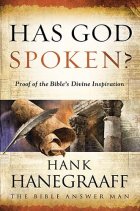
Has God Spoken? (book review)

The Bible has quite a bit to say about apologetics — defending what you believe. Paul tells Christians to study God’s Word so that we won’t be ashamed of it, and Peter tells Christians to always be prepared to answer anyone who questions our faith in Christ. But how do we know the Bible is true? Hank Hanegraaff’s latest book, Has God Spoken?, is an excellent resource to help you answer that question.

You may know Hank as host of the Bible Answer Man, and have come to appreciate his wit and wisdom. In Has God Spoken? you will be well-armed to answer any critics who claim that the Bible is not all that Christians claim it to be.

And I love the format that Hank uses to share all of his wisdom. Just like musicians learned their musical notes through such statements as, “Every Good Boy Deserves Fudge,” Hank uses a variety of acrostics to make his evidence so easy to recall. In addition, this book is fully documented, with nearly 100 pages of endnotes, so you can dig a little deeper into the evidence and proofs that he presents.

The puritan pastor Thomas Watson wrote, “The Bible is a rock of diamonds, a chain of pearls, the sword of the Spirit; a chain by which the Christian sails to eternity; the map by which he daily walks; the sundial by which he sets his life; the balance by which he weighs his actions.” But if someone ever doubts the accuracy, inspiration and inerrancy of the Bible, he will never know the treasures and life resources within its pages. That’s why this book is so valuable, and I highly recommend it to both Bible believers and Bible skeptics.

I am a Thomas Nelson book reviewer.

I Didn’t Choose This

Hello, my name is Craig Owens and I’m a pastor. I wasn’t a PK (pastor’s kid). This isn’t the profession I chose for myself. I envisioned myself doing other things, but God had different plans for me.

He called, and I said “yes.” He called me to be a pastor and so He equipped me for the pastorate. I can relate to what the Apostle Paul wrote—

By God’s grace and mighty power, I have been given the privilege of serving Him by spreading this Good News. (Ephesians 3:7)

Paul, too, didn’t choose be a minister telling people about Jesus Christ. But God had different plans for him.

And so, since God has called me to do this, I must do it to the best of my ability. I don’t have the natural ability for it, I simply have God’s grace and mighty power. And to that grace and power I must add my best effort—

Study and be eager and do your utmost to present yourself to God approved (tested by trial), a workman who has no cause to be ashamed, correctly analyzing and accurately dividing [rightly handling and skillfully teaching] the Word of Truth. (2 Timothy 2:15, AMP)

I like the counsel of Charles Spurgeon:

Again, the theme of a minister should be Christ Jesus in opposition to mere doctrine. Some of my good brothers are always preaching doctrine. Well, they are right in so doing, but I would not care myself to have as the characteristic of my preaching doctrine only. I would rather have it said, ‘He dwelled much upon the person of Christ and seemed best pleased when he began to tell about the atonement and sacrifice. He was not ashamed of the doctrines; he was not afraid of threatening. But he seemed as if he preached the threatening with tears in his eyes, and the doctrine solemnly as God’s own Word. But when he preached of Jesus, his tongue was loosened, and his heart was at liberty.’”

I didn’t choose this, but God chose me. And for that I am extremely humbled and grateful.

Final Words

I’m working on a message for a funeral that I will speak at tomorrow. It’s very humbling to think that a family has chosen me to say the final words about their loved one. How do I accurately sum up someone’s life in just a few minutes?

This process always gets me thinking about what final words I would want to have said about my life. I have three passages in the Bible that I would love to have said about me:

He had no great joy than knowing his family all walks in the truth. (3 John 4)

He always took the spiritual truths that he heard and taught and entrusted them to reliable people who were also qualified to teach others. (2 Timothy 2:2)

He fought the good fight, he finished the race, he kept the faith. (2 Timothy 4:7)

What about you? What final words do you want people to say at the end of your life?

Stephen Covey wisely advises us to begin with the end in mind. See your goal—your final words—clearly fixed in your mind now, then live to fulfill it.

Still Learning

I live by the axiom, “If you’re through learning, you’re through.” So I try to learn something new every day.

I just finished a class called New Testament Survey: a quick overview of the 27 books that compromise the New Testament of the Bible. Here’s a couple of interesting factoids I picked up from my studies:

  • The earliest-written book was James. Interesting, because at one point James thought Jesus (his half-brother) was nuts.
  • Only Matthew uses the term kingdom of heaven; all of the other writers use kingdom of God.
  • Mark uses the word immediately more times than anyone else. Perhaps because his source (Peter) was always doing things so quickly… sort of a ready, FIRE!, aim kinda guy.
  • Luke wrote what is called “the global gospel” for everyone, so he included 45 teachings/events that no one else records.
  • John doesn’t record any of Jesus’ parables.
  • John uses the word believe nearly 100 times— way more than any other writer.
  • Luke talks about the Holy Spirit nearly 60 times in the 28 chapters of Acts.
  • Romans is the longest of Paul’s epistles with 7101 words; Philemon is the shortest with just 355 words.
  • With the exception of the pastoral epistles (1 Timothy, 2 Timothy, Titus) Paul’s letters are arranged in the Bible from longest to shortest.
  • In 1 & 2 Thessalonians (only 136 verses) Paul refers to God, Christ, the Holy Spirit, or a combination thereof more than 150 times.
  • Paul gives Timothy seven word pictures to describe the kind of pastor he should be: son, soldier, athlete, farmer, workman, instrument, and servant.
  • Hebrews is called “the book of better things” so better is used 13 times. This word is used only six times in the remaining 26 books of the New Testament.
  • James wrote 108 verses but issues 50+ direct commands.
  • In John’s three short epistles he uses the word know 33 times, and the word dear ten times.

Keep on learning! There’s a lot of good stuff out there. What have you learned lately?

Fill ’Er Up!

Listen to the podcast of this post by clicking on the player below, and you can also subscribe on AppleSpotify, or Audible.

I sort of remember the days of full-service gas stations. My Dad would drive in and say, “Fill ’er up!” and the gas station attendant would jump into action. Filling up the gas tank, cleaning the windshield, checking the oil level, and even checking the air pressure in the tires.

But, alas, those days of full service seem to be long gone, replaced by highly-efficient, less-personal self-serve stations. And I’m not necessarily talking just about gasoline stations either.

All of our lives seem to have become more efficient and less personal. We are a more do-it-yourself, leverage-technology kind of society today. And I wonder if the result is that many people aren’t getting filled up like they used to.

There is a well-known Bible story in 2 Kings 4. A widow is facing what would amount to foreclosure today. Except this foreclosure was on her sons. Her husband, a God-fearing man, had died and left her with debts she could not pay. The practice in that society was for her sons to be “sold” to pay off the debts. These boys would have to work all day long for someone else, and whatever money they would have earned for their labors would go to the creditors.

In her desperation, the widow turned to the prophet Elisha. He asked her if she had anything of value in her house, and she replied, “Just a little oil. But not enough to pay off my debts.” The counsel Elisha gave her is applicable for our self-serve society today—

Elisha said, “Go around and ask all your neighbors for empty jars. Don’t ask for just a few” (v. 3).

Elisha asked the woman and her family to humble themselves—ask all your neighbors. Sometimes this is one of our biggest hindrances: pride which keeps us from admitting we have a need. And this was no small task because she had to ask ALL her neighbors to, “Fill ’er up!”

Elisha asked them to be persistent—don’t ask for just a few. Not just a jar here and there, but ask for every available jar to, “Fill ’er up!”

The principles in this story shouldn’t just apply to times of desperation in our lives. Because maybe if we worked on being around our neighbors and asking what needs they have, and sharing our needs as well, maybe we wouldn’t get into such desperate situations.

In the story in 2 Kings, the oil stopped flowing only after every available jar had been filled. If I want God to continue to pour His oil of blessing into my life, He has to have room in which to pour. That means that I need to be pouring into others’ lives as often as I can. Listen to the blessings when we, “Fill ’er up!”—

     I want you to know how delighted I am to have Stephanas, Fortunatus, and Achaicus here with me. They partially make up for your absence! They’ve refreshed me by keeping me in touch with you. (1 Corinthians 16:17-18, The Message paraphrase)

     In addition to our own encouragement, we were especially delighted to see how happy Titus was, because his spirit has been refreshed by all of you. (2 Corinthians 7:13)

     God bless Onesiphorus and his family! Many’s the time I’ve been refreshed in that house. And he wasn’t embarrassed a bit that I was in jail. The first thing he did when he got to Rome was look me up. May God on the Last Day treat him as well as he treated me. (2 Timothy 1:16-18, The Message paraphrase)

     Your love has given me much joy and comfort, my brother, for your kindness has often refreshed the hearts of God’s people. (Philemon 7 NLT)

Get around other “full” people and let them fill you up.

Seek out “empty” people and pour abundantly into them.

The more you pour out into others, the more room there is for God to pour into you.

God is always pleased when our lifestyle is one of “Fill ’er up!”

►► Would you please prayerfully consider supporting this ministry? My Patreon supporters get behind-the-scenes access to exclusive materials. ◀︎◀︎