One Word

RedemptionWhen it comes right down to it, there is really just one word that makes Christians peculiar. Just one word changes our citizenship from Earth to Heaven. One word took us from a path where our sins had us headed toward an eternity in Hell.

Jesus stepped in where He didn’t have to go. Jesus became our sin to pay-off our sin debt. Jesus took us back from satan’s possession, and made us a part of His Father’s family.

Jesus redeemed us! 

I wonder if we truly understand that word redemption?

Peter is speaking to us as “strangers here in reverent fear” on Earth, and he calls us to live up to God’s call—Be holy, because I am holy (1 Peter 1:16; Leviticus 11:44-45). He asks us to obediently follow God’s Word (1:22), to get rid of Earth-bound things (2:1), and instead taste that the Lord is good (2:3).

Why? Because we’ve been “redeemed from the empty way of life…by the precious blood of Christ” (1:18-19) We don’t live holy lives to try to earn redemption, but because we have been redeemed we are now capable of living holy lives!

To help illustrate his point, Peter quotes a couple of verses from Isaiah 40. In this chapter, we are invited to weigh the greatness and love and knowledge and power of God against the things we can provide for ourselves on Earth. Please check out the video below, where I go through this 40th chapter of Isaiah.

If you’ve missed any messages in this series, you may find the complete list by clicking here.
A Whole New Revelation

The Word and the SpiritHow would you like to have better insight than prophets like David, Isaiah, Jeremiah, Ezekiel or Daniel? How would you like to have a greater revelation of who Jesus is than even in the angels in Heaven? You can!

Peter tells us aliens and strangers how we should live on Earth as citizens of Heaven (1 Peter 1:13-16):

  • Our minds prepared for action
  • Self-controlled (another translation says sober)
  • Fully hopeful of God’s promises
  • Obedient children
  • Not conformed to the world’s standards
  • As holy as God is

If that sounds like a challenging list, it’s because it is a challenging list! But notice an important word that starts verse 13: Therefore. This tells us we must look at what came before the therefore to know how to respond to what comes after the therefore.

In the verses preceding (vv. 10-12) we read about Old Testament prophets and New Testament preachers. But notice the similarities between these two—They both spoke about grace and salvation, and they both spoke with the Holy Spirit’s guidance. The Word of God was inspired by the Holy Spirit, and it is the same Holy Spirit that wants to give you a full revelation of what is in the Word.

The prophets searched carefully, but they never got to see Jesus come to Earth and fulfill the prophesies. The angels in Heaven have seen the story played out, but they don’t know what it is to have received a complete pardon for their sins that would have damned their souls to Hell.

That’s why Spirit-filled Christians who regularly study the Word of God have better insight than the prophets, and greater revelation than the angels!

What about you?

  1. Have you invited Jesus into your heart?
  2. If you have, are you regularly reading your Bible?
  3. If you are, have you allowed God to baptize you in His Holy Spirit?

This combination not only makes you peculiar to Earthlings, it makes you peculiar to prophets and angels too!

If you’ve missed any messages in this series, you may find the complete list by clicking here.
The Joy Of Trials

Drawing othersA quick show of hands: How many of you would consider your difficult situations a blessing from God?

Probably not a lot of hands went up, but it’s true.

Peter lists six blessings of God for which we can bless Him (see 1 Peter 1:3-3-9):

  1. God’s great mercy
  2. New birth
  3. Living hope
  4. An inheritance that can never perish
  5. God’s shielding power
  6. Trials

Trials?! Yep!

Peter is quick to tell us that trials only last for a little while, but they are sent our way to prove that our faith is genuine. He says that trials result in praise, glory and honor from God to us, and that successfully going through our trials lead to “an inexpressible and glorious joy.”

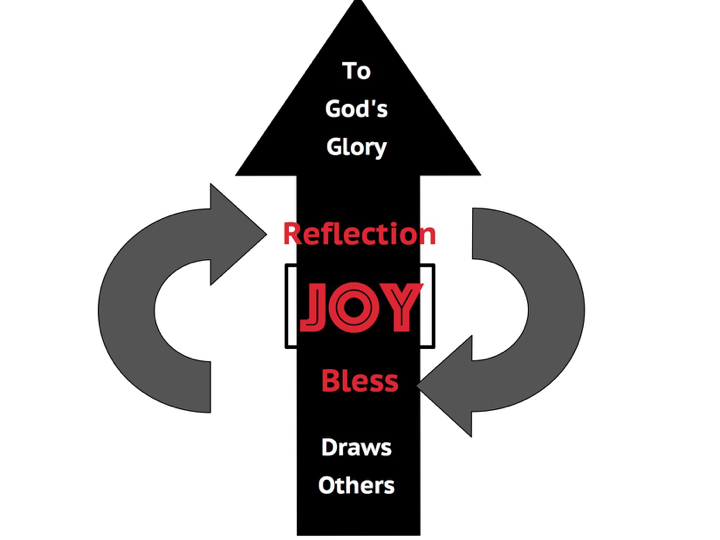
In trials you probably don’t feel like praising God, but our God-breathed soul is made up of more than just emotions. We also have been given a mind and a will. So here’s what I would suggest—in your trials, use your mind to reflect on the blessings of God. Then use your will to open your mouth. When you you do this, you will experience the emotion of an inexpressible and glorious joy.

In other words: you are more likely to act yourself into feeling than you are you feel yourself into action!

Look at how David did this in Psalm 34. In a huge trial…

  • …he used his mind and will: I will extol the Lord at all times.
  • …then his emotions kicked in: My soul will boast in the Lord.
  • …his worship helped others: let the afflicted hear and rejoice.
  • …and this pointed everyone to God: Glorify the Lord with me; let us exalt His name together.

Seeing your trials as a way to bless God not only benefits you, but it draws others to God’s sustaining power as well.

If you’ve missed any messages in this series, you may find the complete list by clicking here.
A Letter To Exiles

Aliens and StrangersWe are two weeks into our series called Aliens and Strangers, in which we are looking at the book of 1 Peter on how Christians are to live as citizens of Heaven. I have greatly appreciated John Piper’s teaching called “Look At The Book,” where the Scripture is front-and-center.

Pastor Piper has just begun a series on 1 Peter as well. Here is his introduction to this book—

If you are in the Cedar Springs area and don’t have a home church, I would love for you to visit us this Sunday morning. If you cannot make it in person, please tune-in via Periscope (search for @craigtowens) at 10:30am.

Reconnecting the Disconnection

DisconnectThere is a disconnection problem in the United States of America. Consider this:

  • John Adams, one of our nation’s founding fathers said, “The general principles on which the fathers achieved independence were the general principles of Christianity.”
  • Every president from George Washington to Barak Obama has invoked the name of God in his inaugural address.
  • 96% of Americans say they believe in God.
  • 80% of Americans call themselves Christians.

And yet:

  • Our grade schools make no mention of “God”, some even to the point of not reciting the pledge of allegiance.
  • Higher education is openly antagonistic toward God and Christians.
  • The entertainment industry normalizes lifestyles that are openly unbiblical.
  • Even our US government has done things like legalizing murder in the form of abortion, and sanctioning homosexuality by calling their unions “marriage.”

The Bible calls Christians “aliens and strangers in the world.” Perhaps the term “aliens” is not so much for what we say we believe, but how we live what we believe. 

So Peter opens his letter to “strangers in the world” by telling Christians how to live in a way that can reconnect this disconnection.

  • Humble—because we sinners have been chosen (v. 2a) to become citizens of Heaven.
  • Confident—because of the foreknowledge of God the Father (v. 2b) that can never be thwarted.
  • Teachable—because the process of the sanctifying work of the Spirit and obedience to Jesus Christ (v. 2c) requires us to be humbly-confident, teachable servants.
  • Graceful and peaceful (v. 2d)—because what we believe about God’s invitation to come to Him, Christ’s payment that makes that possible, and the Holy Spirit’s sanctification should be lived out in graceful and peaceful lives.

Would your Earthling family members say you are graceful and peaceful? 

Would your Earthling coworkers say you promote grace and peace on the job? 

Would your Earthling neighbors say you make the neighborhood graceful and peaceful? 

Would the Earthling business owners you frequent say your gracefulness and peacefulness is more evident than in the citizens of Earth?

Search me, God, and know my heart test me and know my anxious thoughts. See if there is ANY offensive way in me, and lead me in the way everlasting. (Psalm 139:23-24).

If you’ve missed any messages in this series, you may find the complete list by clicking here.

Making Hearts Burn

Living WordThere is an interesting line the angels speak to the ladies who came to anoint Christ’s dead body in the tomb: “Why are you looking for the living among the dead?” (Luke 24:5).

That phrase sums up much of our culture. People are looking for life, but they are looking for it among dead things. Wise King Solomon wrote that God has placed a God-shaped void in the heart of every human being (Ecclesiastes 3:11). But Solomon went on to say that anything “under the sun” that we try to use to fill that God-void will be utterly meaningless.

Peter wrote to aliens and strangers about living such good lives that will point people to God. This means Christians need to help people who are looking for the living among the dead see that real life is in Christ. To do this, we need to be immersed in the Living Word of God.

In the conversations after Christ’s resurrection, look at the references to God’s Living Word:

  • Remember how He told you … Then they remembered His words (Luke 24:6-8)
  • what was said in all the Scripture concerning Himself… (Luke 24:27)
  • …written about Me in the Law of Moses, the Prophets and the Psalms … so they could understand the Scriptures ( Luke 24:44-45)

There is life in God’s Word! When the two disciples of Jesus remembered His Living Word, they said their hearts burned inside them (Luke 24:32).

If you want to help those searching for life to find it, let them hear God’s Living Word coming from your lips. This will make their hearts burn, and lead them to a personal relationship with Jesus Christ.

If you’ve missed any messages in this series, you may find the complete list by clicking here.

Aliens and Strangers

Christians are not citizens of Planet Earth. Our citizenship is in a place called Heaven, and yet we are traveling on Earth during our present lifetime. So the question is: How is a citizen of Heaven supposed to act while visiting Earth?

The Apostle Peter was one of the most active disciples of Jesus. During Christ’s first visit to Earth, Peter is recorded as speaking more than all of the other disciples combined. And not surprisingly, Jesus speaks more words directly to Peter than He does to all of the other 11 disciples combined. Peter got a lot of training!

With that background, Peter gives us invaluable instructions in his first letter to the church. He calls Christians things like: strangers in the world, chosen people, peculiar people, and aliens and strangers in the world. He tells us travelers not only how to behave while traveling on Earth, but why we should travel in a God-honoring way.

I will be continuing to teach through these fascinating themes of Peter’s instructions for aliens and strangers this Sunday. If you don’t have a home church in the Cedar Springs area, I would love to have you join us. If you cannot join us in person, we will be broadcasting each message live on Facebook.

I am excited to rejoin this journey of discovery with you!

Here are the sermons we have addressed in this series:

Links & Quotes

link quote

“The very first words [of the Lord’s Prayer] are Our Father. Do you now see what those words mean? They mean quite frankly, that you are putting yourself in the place of a son of God. To put it bluntly, you are dressing up as Christ. If you like, you are pretending. Because, of course, the moment you realize what the words mean, you realize that you are not a son of God. You are not being like The Son of God, whose will and interests are at one with those of the Father: you are a bundle of self-centered fears, hopes, greeds, jealousies, and self-conceit, all doomed to death. So that, in a way, this dressing up as Christ is a piece of outrageous cheek. But the odd thing is that He has ordered us to do it.” —C.S. Lewis, in Mere Christianity

“Prayer is the form of faith that connects us today with the grace that will make us adequate for tomorrow’s ministry.” —John Piper

“When you fulfill your spiritual gift to serve someone tomorrow, you will be serving ‘by the strength that God supplies’ tomorrow. The word is supplies, not supplied. God goes on, day-by-day, moment-by-moment, supplying the ‘strength’ in which we minister.” —John Piper, commenting on 1 Peter 4:10-11

“Never say you will pray about a thing; pray about it. … It is not part of the life of a natural man to pray. We hear it said that a man will suffer in his life if he does not pray; I question it. What will suffer is the life of the Son of God in him, which is nourished not by food but by prayer.” —Oswald Chambers

For all my fellow Detroit Tigers fans, this is an interesting post about the greatest Tiger of all-time: Cobb or Kaline. In my book, they both were phenomenal, but I would give the slight edge to Ty Cobb.


God-Oriented & People-Focused

God-oriented & People-focusedYou can spin it around, roll it down the stairs, throw it high in the air, and still it isn’t phased one bit. It doesn’t matter if you’re moving fast or slow, if you’re at high altitudes or in Death Valley, it still works. The needle of the compass always points north.

It can’t help it: it is naturally oriented to the north pole. Whether it’s pitch-black outside, or 40 degrees below zero; whether you feel like north is “north” or not, the needle will always point its way back to north.

Jesus could be cheered by the crowds or jeered by them. People could shout “Hosanna!” or “Crucify Him!” The weather could be calm or stormy, His disciples could be courageous or scared to death, and still Jesus was oriented to His Father.

Every word Jesus said, every action He undertook, every lesson He taught, every prayer He prayed was God-oriented.

But not only that, even as much as people ridiculed Him, snubbed Him, rejected Him, or denied Him, Jesus was still people-focused. After being so cruelly treated, I think I may have turned from some people, or even turned on some people with some not-so-kind words. I may have even begun to withdraw from people. But despite the way people mistreated Him, Jesus remained lovingly people-focused (see 1 Peter 2:21-23).

Jesus us told us that if we stand for Him, we will be mistreated as well (see Luke 21:17 and John 15:20). But He also told us there was a reward for that mistreatment (see Matthew 5:11-12).

When asked what the greatest of all the commandments was, Jesus replied that it was to be God-focused and people-oriented

Jesus replied, “The most important commandment is this: ‘Listen, O Israel! The Lord our God is the one and only Lord. And you must love the Lord your God with all your heart, all your soul, all your mind, and all your strength.’ The second is equally important: ‘Love your neighbor as yourself.’ No other commandment is greater than these.” (Mark 12:29-31)

So a good check-up question for us all: How am I doing at being God-oriented and people-focused, no matter what the circumstances are?

UPDATE: I explore the example of how Jesus responded to His critics in a couple of chapters of my book When Sheep Bite.

The Domineering Pastor

I wrote to the church, but Diotrephes who loves to be first, will have nothing to do with us. (3 John 9)

The King James Versions says that Diotrephes loveth to have the preeminence. He loved his title, his position of authority, and having everything in the church flow through him.

He wanted not only to approve who spoke in the church, but even with whom church people could socialize outside of church. He wielded his positional authority like a sword and cut off people from the fellowship of the church if they didn’t join lockstep with him.

He used fear and intimidation to demand people follow him, and wouldn’t receive a loving letter from the Apostle John. To counteract any who would question him, Diotrephes engaged in gossip and character assassination of any he perceived to be a threat to his position as pastor.

For shame! 

This type of attitude has no place in the Body of Christ, especially among the pastorate! Jesus came to serve, and taught us to do likewise. Jesus didn’t snuff out the smoldering wick or stomp on the bruised reed, but ministered lovingly to all. Peter told shepherds to never use their position to lord it over others.

My fellow pastor, having the title of pastor doesn’t mean I’m the smartest person in the room, or that I have all the answers. I am one member of the Body of Christ. Each member of the Body needs all the other members of the Body. I should humbly serve, never demanding allegiance to me or blind obedience to my wishes. I should never try to hide behind my title, but be the most transparent, the most willing to admit my mistakes, and the first to forgive and to ask forgiveness.

Lord, guard my heart against the spirit of Diotrephes!!

UPDATE: This is one of the seed thoughts that went into my book Shepherd Leadership.