Links & Quotes

God’s laws, precepts, and commands are given to us because He loves us and wants to keep us safe. His laws keep us in a place where we can experience His abundant blessings!

I have lots of new content every week, which you can check out on my YouTube channel.

“Establishing the Kingdom of God means ending evil, which happens not through violent force or coercive threats but through loving-kindness and patient forgiveness. It’s a world compelled by love instead of fear. … This [the outpouring of the Holy Spirit on the Day of Pentecost] is the beginning of a new world. The old world creates enemies and divides people, falsely claiming that some are loveable and others are throwaways, but not so in the Kingdom of God! In God’s empire, all people mutually love one another without partiality.” —Why Is Pentecost Important? reading plan on YouVersion

In the weekly Culture Translator newsletter from Axis Ministry, they had this insightful reminder about the worldview of pornography: “Pornography is not just sexual entertainment; it is a form of propaganda about what human beings are. In the same way that Scripture has a vision for humanity (that all people are God’s beloved children, worthy of honor and respect, with inherent dignity as his image-bearers), pornography also has a vision for humanity: that people (especially women) are objects to be gawked at, violated, and discarded at will. Porn offers a worldview, and like any other worldview, it shapes the way we think about what people are for—and how they should be treated. ‘Pornography teaches us lies that we ingrain into aspects of our relationships and our lives,’ argues Sam Black, Covenant Eyes’ Director of Recovery Education. These lies include the notion that we can’t live without sex, that sex equals love (or acceptance), and/or that what gives humans value is exclusively their sexual attractiveness. ‘Pornography warps our views of our relationships,’ Black continues, ‘and we haven’t even realized it.’”

“I always turn to the sports page first. They record people’s accomplishments. The front page has nothing but man’s failure.” —Chief Justice Earl Warren
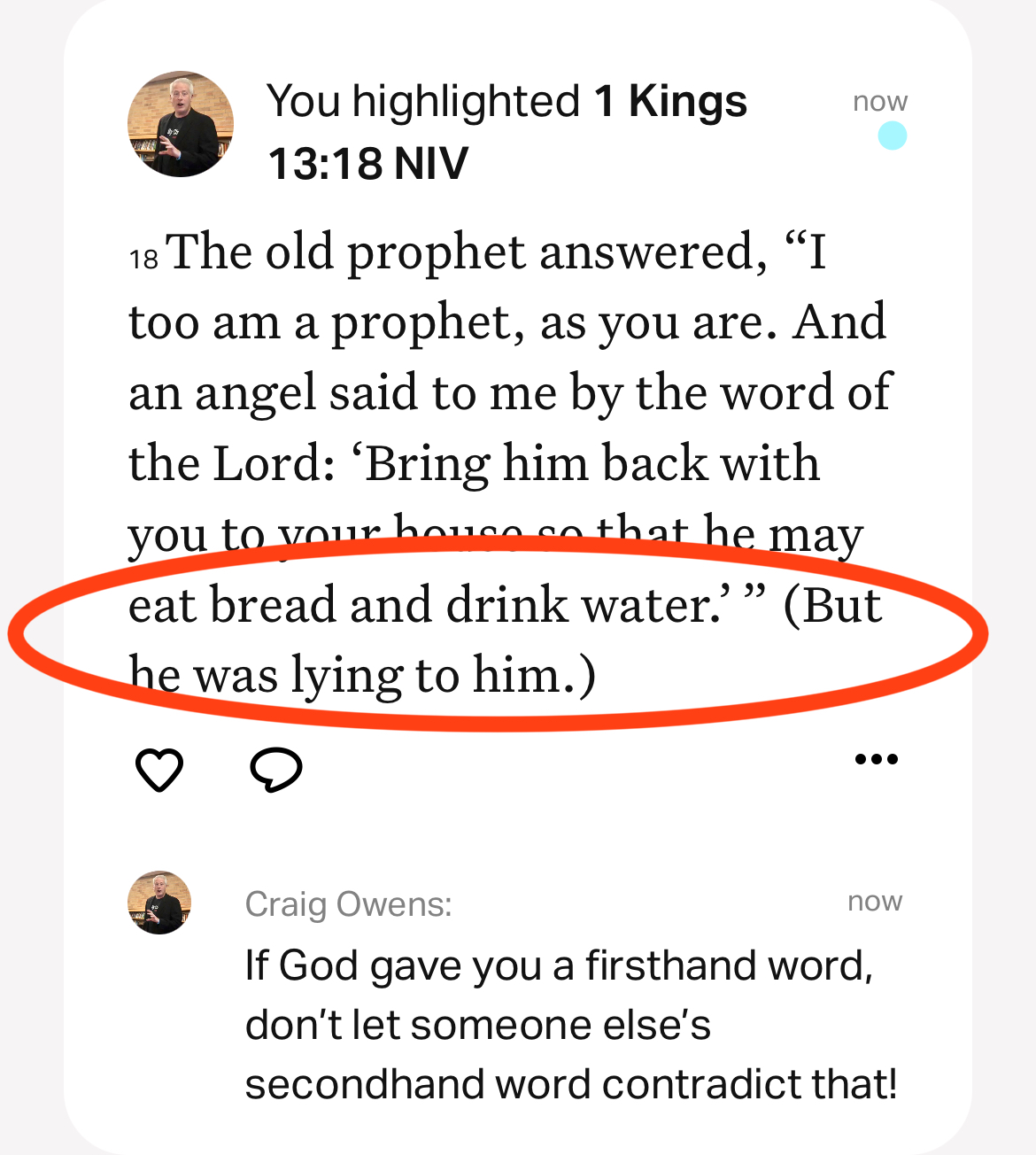
There is a very unusual story told in 1 Kings about a couple of unnamed prophets. One prophet heard from God, delivered the powerful warning God directed him to give, but then disobeyed God because of something another prophet told him that he had heard from God. I shared this commentary on YouVersion, “If God gave you a firsthand word, don’t let someone else’s secondhand word contradict that!”

“All religions are either a preview or a perversion of Christianity.” —C.S. Lewis

“If our relationships with other human beings are going to be meaningful, they will cost us something. Relationships are demanding.” —Herbert Wagemaker
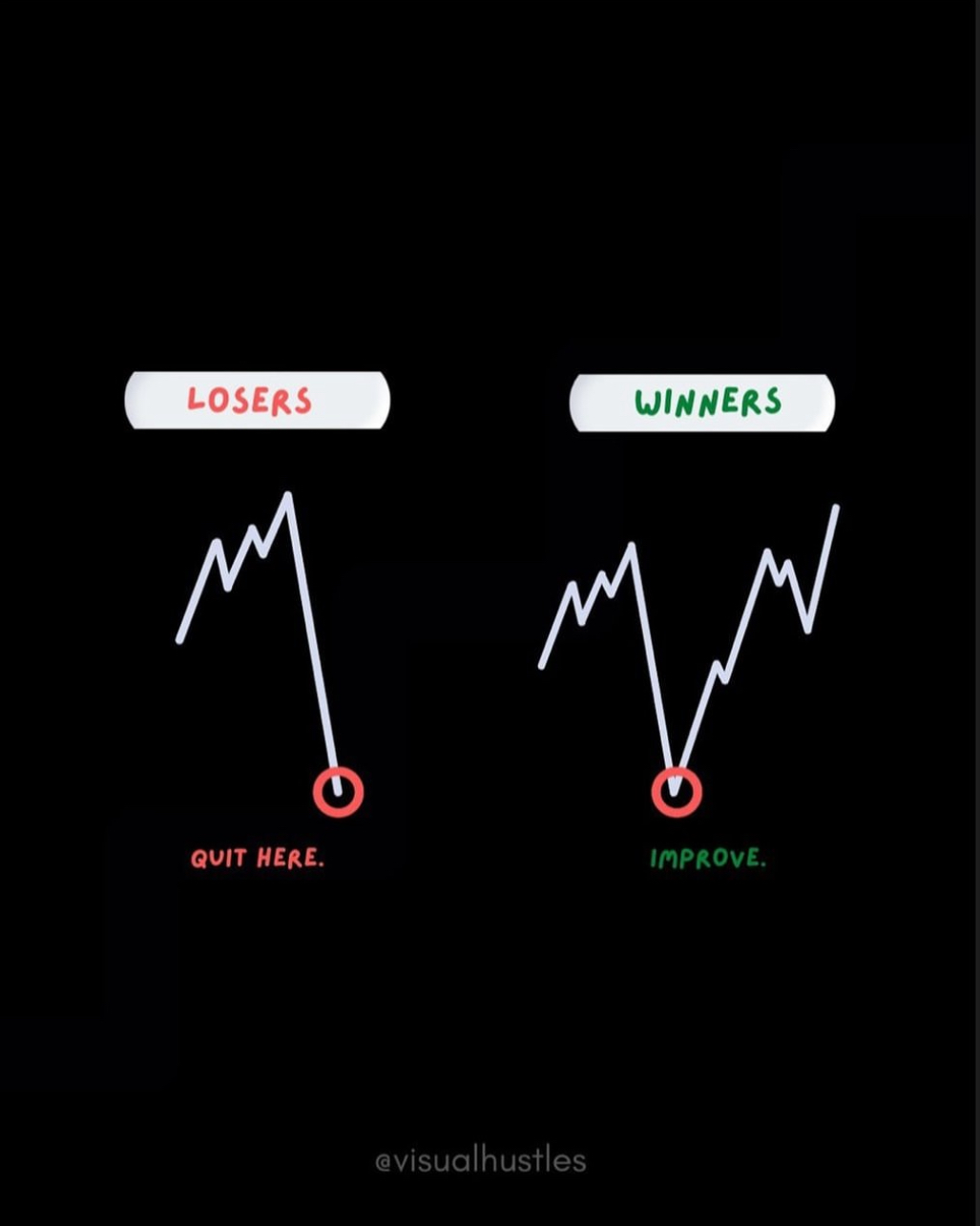
I saw this side-by-side graphic and so many thoughts about perseverance, grit, and stick-to-it-iveness came to mind. It is so true: we all have moments of stumbling. Losers tend to quit when they fall down, but winners learn something from their stumble, improve, and continue to grow. And then I came across this related quote from John D. Rockefeller, “I do not think that there is any other quality so essential to success of any kind as the quality of perseverance.”

Kept To Keep

Listen to the podcast of this post by clicking on the player below, and you can also subscribe on AppleSpotify, or Audible. 

Last week I reminded you that the main point in Hebrew literature is usually found in the middle. In Psalm 121 that would be the first phrase of verse 5: The Lord watches over you. 

But I notice something that seems contradictory in the New Testament. Whereas the message here is, “God watches over you,” the message in some New Testament verses seems to be, “You watch over yourself” (see for example Matthew 26:41; 1 Thessalonians 5:6; 1 Timothy 4:16). Paul even said to the Christians at Corinth, “I worked harder than all of them” (1 Corinthians 15:10). 

So which is it: Is God watching over us or are we to watch over ourselves? It’s actually both, but something important has to come first. We cannot watch over ourselves unless we are assured that the Lord is watching over us to sustain us. 

Okay, I was being a bit sarcastic when I said those verses seemed contradictory, as I clearly quoted them out of their context. For instance, in that statement from Paul in 1 Corinthians, check out the full verse, “But by the grace of God I am what I am, and His grace to me was not without effect. No, I worked harder than all of them—yet not I, but the grace of God that was with me.” Paul is clearly saying that he could only work hard because he was empowered by God’s grace. Notice that it is decidedly not the other way around: Paul doesn’t say, “I worked hard to earn the grace of God.” 

Remember that these psalms of ascent remind us of our upward look and our upward journey. We need to keep our eyes on the prize, which is God Himself (Psalm 121:1-2). Using the apostle Paul’s life as an example again, he said something very similar—

Not that I have already obtained all this, or have already arrived at my goal, but I press on to take hold of that for which Christ Jesus took hold of me. Brothers and sisters, I do not consider myself yet to have taken hold of it. But one thing I do: Forgetting what is behind and straining toward what is ahead, I press on toward the goal to win the prize for which God has called me heavenward in Christ Jesus. (Philippians 3:12-14) 

The middle verse of Psalm 121 foretells what appears six times in just eight verses: the Hebrew word samar. Depending on the translation of the Bible, this word is either “watch over” or “kept.” In either case, the meaning is a concentrated focus, not turning aside to the left or the right, not distracted, eyes on the ultimate prize. And all six of these instances are God’s unwavering, loving focus on us. In this song, we are told: 

  • God never slumbers or is even momentarily distracted (vv. 3-4) as opposed to other deities that were thought to sometimes be unavailable to their worshippers (see 1 Kings 18:27). Instead, our God watches us so closely that He notices if even a single hair falls from our head (Matthew 10:30-31). 
  • God stands beside us to protect our places of vulnerability (vv. 5-6). The Amplified Bible says, “The Lord is your shade on your right hand—the side not carrying a shield.”
  • God keeps us from the entrapment of evil (v. 7). Jesus told us that He was praying this way for us so we can have confidence to pray this for ourselves (Luke 22:32; Matthew 6:13).  
  • God protects us as His most precious treasure. David uses this same word samar in Psalm 17:8, “Keep me as the apple of Your eye; hide me in the shadow of Your wings.” 
  • God is our eternal Protector. The last phrase of this psalm says He watches over us “both now and forevermore” (v. 8).  

The other places the word samar is used in the Bible is a call for us to keep God’s commands. But just as we saw with Paul that he was committed to running his race well because he was assured of the prize Jesus had secured for him, so for us, we can only keep God’s commands because we are kept secure by God. 

Because we are kept by God we can keep His commands. In Deuteronomy 4, Moses applies the word samar to God’s people. We are to..

  • keep the commands of the Lord (v. 4) 
  • watch ourselves closely so we don’t forget what God has done for us (v. 9) 
  • be careful not to forget the covenant God paid for us (v. 23)
  • keep God’s decrees and commands as way a way to pass on God’s blessing to future generations (v. 40)

If God is not the One keeping and preserving me, it will be impossible for me to keep His commands on my own. The promise of His watchful keeping and preserving should fuel our prayer to watch over ourselves with all diligence. Read His promises, pray His promises, be assured of His ever-present help so that you can use His help to look out for yourself. 

If you’ve missed any of the others messages in our look at the Psalms of Ascent, you can find them all here.

►► Would you please prayerfully consider supporting this ministry? My Patreon supporters get behind-the-scenes access to exclusive materials. ◀︎◀︎

A Leader’s Commitment To Lifelong Learning

Listen to the podcast of this post by clicking on the player below, and you can also subscribe on AppleSpotify, or Audible. 

Bruce Barton said, “When you’re through changing, you’re through!” I think the same thing could be said about a leader’s learning—when you think you’ve learned it all, your leadership is beginning to crumble. 

I never want to get to the place where I think I have “arrived” as a leader, but I want to be humble enough to admit that there are so many things I have yet to learn. Jesus reminded us, “Every student of the Scriptures who becomes a disciple in the kingdom of heaven is like someone who brings out new and old treasures from the storeroom” (Matthew 13:52 CEV). 

“New and old treasures” tells me that there’s some good stuff we need to protect, and also some good stuff we haven’t yet learned. 

A mark of a godly leader is his commitment to being a lifelong learner. 

Here are three new things the Holy Spirit has recently taught me: 

Acts 6:3 says, “Choose seven men from among you who are known to be full of the Spirit and wisdom. We will turn this responsibility over to them.” 

My lesson: The résumé for those that are to be placed in ministry leadership positions should include servant-heartedness, Christlike character, wise experience for the task, and reliance on the Holy Spirit.

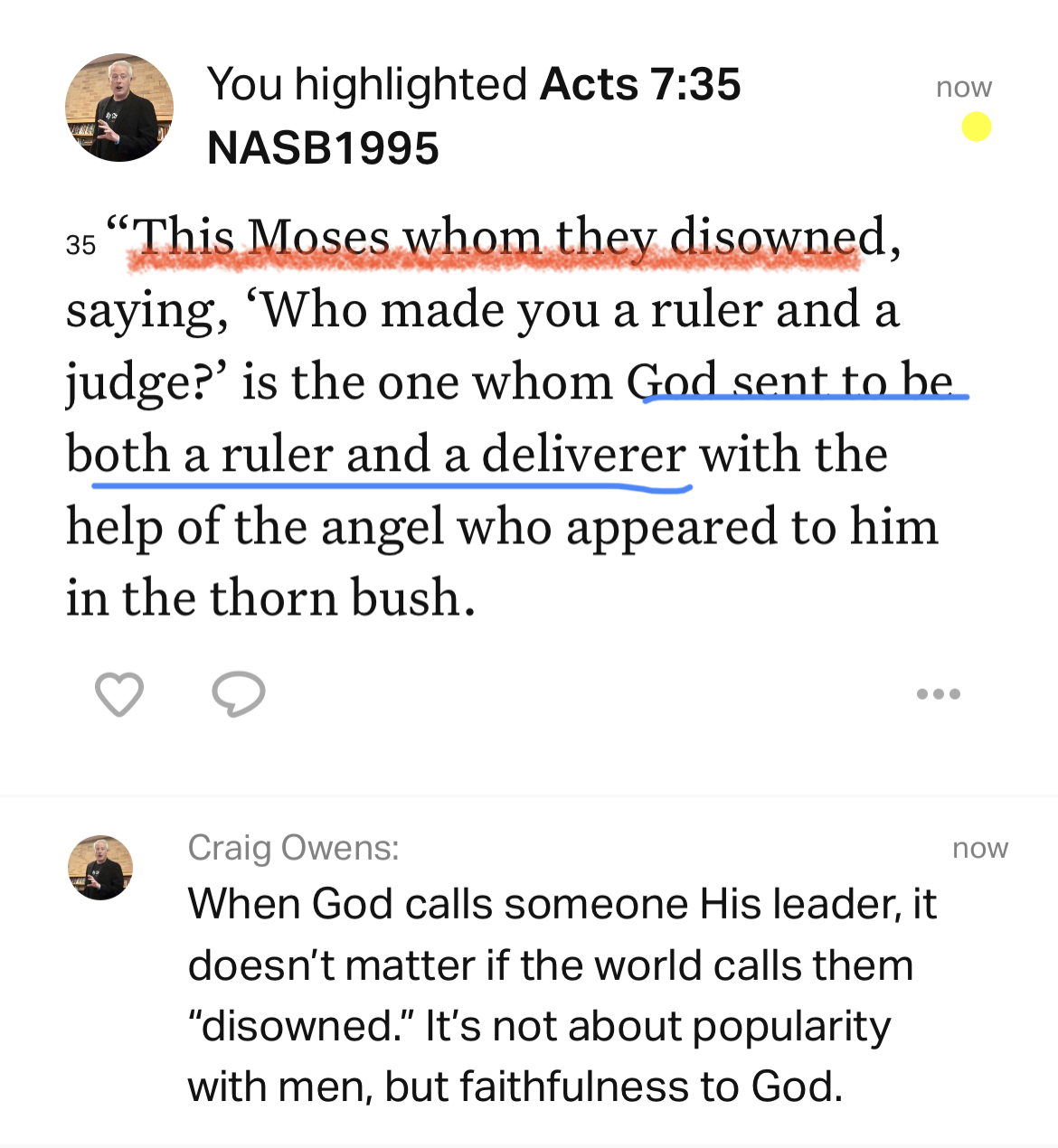
“This Moses whom they disowned…is the one God sent to be both a ruler and a deliverer” (Acts 7:35). 

My lesson: When God calls someone His leader, it doesn’t matter if the world calls them disowned. It’s not about popularity with men, but faithfulness to God.

Notice the plural pronoun “they” in 1 Kings 11:33. 

My lesson: When King Solomon sinned, he then gave license to the people to follow his example. As the leader goes, so go the people.

I hope you are learning new things every day. In fact, feel free to share in the comments something new you’ve learned. 

This is part 73 in my series on godly leadership. You can check out all of my posts in this series by clicking here.

►► Would you please prayerfully consider supporting this ministry? My Patreon supporters get behind-the-scenes access to exclusive materials. ◀︎◀︎

All In

Listen to the podcast of this post by clicking on the player below, and you can also subscribe on AppleSpotify, or Audible. 

A mark of a godly leader is one who goes all-in right from the beginning.

Here are the biblical passages I referenced in this video—Hebrews 11:8; 1 Kings 19:21; Daniel 1:8; Matthew 4:18-22; Mark 2:14.

This is part 69 in my series on godly leadership. You can check out all of my posts in this series by clicking here.

►► Would you please prayerfully consider supporting this ministry? My Patreon supporters get behind-the-scenes access to exclusive materials. ◀︎◀︎

Come To God And Keep Walking With Him

Listen to the podcast of this post by clicking on the player below, and you can also subscribe on AppleSpotify, or Audible. 

I have been so grateful for the insights of Dr. Gary Chapman in his book The Five Love Languages. I have found this book to be of immense value in helping couple prepares for marriage, and in helping married couples get beyond a place where intimacy has become stuck. 

In short, the five love languages are words of affirmation, quality time, gifts, acts of service, and physical touch. The goal of learning the other person’s love language—and learning to speak it consistently and fluently—is an increased level of intimacy. In the book of Amos, God asks, “Can two people walk together without agreeing on the direction?” (Amos 3:3 NLT), and speaking the right love language definitely helps people agree! 

The whole reason we come to God in prayer as a Father, as a Brother, and as a Counselor is so that we can hear Him speaking our love language and we can continue to walk in deeper intimacy with Him. 

When my then-girlfriend Betsy and I first met, we spent hours and hours getting to know each other. We would ask questions, share stories, and tell things we did and didn’t enjoy. This is the epitome of intimate conversation: getting to know the other person’s heart as you open up your heart to them as well.

I’ve shared this analogy before, but intimacy grows stale and can eventually disappear altogether if those in a relationship are no longer walking together. It doesn’t work if I say, “Betsy, I’m looking forward to spending an hour with you each week,” or even if I say, “I’ll give you 15 minutes each morning.” Instead, our relationship needs to be one of continual walking. 

It’s the same thing for us as Christians: we cannot only give God an hour at a church service on Sunday mornings, nor is intimacy going to increase if I only walk and talk with my Savior for a few minutes in my morning devotions. 

Walking closely with Him is what God has desired right from the beginning. He walked with Adam and Eve each evening. This phrase “walking with God” is used consistently throughout the Bible of those who had an intimate relationship with their Father, Brother, and Counselor—Noah, Abraham, Isaac, the people of Israel (Genesis 3:8, 6:9, 17:1, 48:15; Leviticus 26:12). And even as the New Testament era dawns, we read, “And they [Zechariah and Elizabeth] were both righteous before God, walking in all the commandments and ordinances of the Lord blameless” (Luke 1:6 NKJV). 

But I’m especially intrigued by the story of Enoch in Genesis 5:21-24. Twice in four short verses, we read “Enoch walked with God.” Remember that verse in Amos—“Can two people walk together without agreeing on the direction?”—so Enoch and God had to be in agreement. In fact, that’s exactly what we read about Enoch in the Book of Hebrews: 

By faith Enoch was taken from this life, so that he did not experience death: “He could not be found, because God had taken him away.” For before he was taken, he was commended as one who pleased God. And without faith it is impossible to please God, because anyone who comes to Him must believe that He exists and that He rewards those who earnestly seek Him. (Hebrews 11:5-6)

If you’ve taken Dr. Chapman’s love language assessment, you probably found that you were pretty lopsided: maybe you scored very highly in one love language and then barely registered in another. We may be lopsided in our love language skill, but God speaks every language perfectly! 

  • Words of affirmation—Hosea 2:14; Isaiah 40:2 
  • Quality time—Deuteronomy 31:6; Psalm 23:3-4
  • Gifts—James 1:17; 2 Peter 1:3
  • Acts of service—Philippians 2:13; Romans 8:28
  • Physical touch—Psalm 139:13-15; Luke 24:39 

(Click here to check out all of those verses.) 

Dr. Chapman noted that when our love language is being spoken to us sincerely and consistently, our love tank is filled, and all of the love languages begin to become more meaningful. 

Just as God walked with Enoch until the day He brought him Home, so He wants to walk with us. 

  • Walk in obedience to all that the Lord your God has commanded you, so that you may live and prosper. (Deuteronomy 5:33) 
  • The Lord will establish you as His holy people, as He promised you on oath, if you keep the commands of the Lord your God and walk in obedience to Him. (Deuteronomy 28:9) 
  • May He turn our hearts to Him, to walk in obedience to Him and keep the commands. (1 Kings 8:58) 
  • Blessed are all who fear the Lord, who walk in obedience to Him. (Psalm 128:1) 
  • And this is love: that we walk in obedience to His commands. As you have heard from the beginning, His command is that you walk in love. (2 John 6) 

When we walk in loving intimacy with Him, our intimacy grows deeper and more mature. Sometimes they will say of couples who have been married for a long time and walk in increasingly deeper intimacy with each other, “They seem to know each other’s thoughts.” That’s because they know each other’s hearts—and that’s what God wants to do with us. He did it with Enoch, and He will do that with us too (Jude 14; Jeremiah 33:3; Habakkuk 3:19). 

Enoch walked intimately with God for 365 years. Let us walk intimately with God for 365 days a year, for as many years as He gives us until God takes us away with Him forever! 

If you’ve missed any of the messages in our prayer series called Intimate Conversation, you can find all of the messages by clicking here. 

►► Would you please prayerfully consider supporting this ministry? My Patreon supporters get behind-the-scenes access to exclusive materials. ◀︎◀︎

The Rewarding Exchange

Listen to the podcast of this post by clicking on the player below, and you can also subscribe on AppleSpotify, or Audible. 

In Romans 3:23 we read, “For all have sinned and fall short of the glory of God.”  What does it mean to “fall short” of God’s standard? John Piper describes it this way: “It means that none of us has trusted and treasured God the way we should. We have not been satisfied with His greatness and walked in His ways. We have sought our satisfaction in other things, and treated them as more valuable than God.” 

A couple of chapters earlier in Romans, Paul tells us about an exchange that people make. They exchange a relationship with the eternal God for things which they can grab immediately. Sadly, these immediate things are only temporal things that fall short of God’s awesome glory and leave us perpetually unsatisfied (Romans 1:21-25). 

We were created by God to crave. Craving is what gives us staying power and brings fulfillment. Think of it this way: Would you rather…

  • …go to a job that is mundane, boring, and only focused on making money OR go to a job that is fascinating, using our talents, and trying to make a difference in the world? 
  • …eat food that tastes like cardboard OR eat savory food? 
  • …serve a god that is temporary, fickle, and unreliable OR serve a God that is eternal, faithful, strong, and loving? 

Or think of it another way: Which of those jobs would you want to go to? Which job would call out your best effort? Which food would you want to eat? Which food would make you want to praise the chef? And which God would you want to spend eternity with? Which God would want to invite others to worship? 

God gives us cravings that can only be satisfied in Him. The devil perverts these cravings to get us to go for quick, easy, self-made pleasures. Just think about how he tempted Adam and Eve (Genesis 3:1-6). 

Both the Old Testament and New Testament tell us of the joys of eternal cravings being satisfied and the consequences of giving in to temporal cravings. For example: 

  • God gives a craving for future meat, but satisfies us with manna while we wait. The devil temps us to have our meat now (Deuteronomy 12:20; Psalm 106:12-14; Numbers 11:34). 
  • God gives a craving for satisfying relationships. The devil tempts us to indulge our passions now by grabbing the most alluring relationship (Proverbs 5:18-19; Deuteronomy 5:21; Romans 1:24, 26). 
  • God gives a craving for success and significance in His timeframe. The devil tempts us to get ahead now (1 Kings 11:37-38; Genesis 3:6). 

(Check out all of these passages by clicking here.)

It’s a terrible exchange when we give up the glorious eternal for the fading temporal! Romans 1 describes the results as sinful, degrading, shameful, unnatural. That’s because the things of earth are temporary; only God is eternal. 

For all that is in the world—the lust of the flesh—craving for sensual gratification—and the lust of the eyes—greedy longings of the mind—and the pride of life—assurance in one’s own resources or in the stability of earthly things—these do not come from the Father but are from the world itself. And the world passes away and disappears, and with it the forbidden cravings (the passionate desires, the lust) of it; but he who does the will of God and carries out His purposes in his life abides (remains) forever. (1 John 2:16-17 AMP) 

We have to trust the One who gave us His unshakable promises—Be delighted with the Lord. Then He will give you all your heart’s desires (Psalm 37:4 TLB). Be delighted with Him and He will—not “may” or “hopefully He will” but He will—give you ALL your heart’s desires! 

There is an ultimate reward in Heaven but there are incredibly satisfying rewards along the journey to Heaven as well. Rewards like happiness, security, insight, and divine counsel from the Holy Spirit (2 Timothy 4:8; Psalm 119:2, 10, 16, 18, 24).

If we will resist the temptation to satisfy our cravings by exchanging the eternal for the temporal, we will be rewarded with divine satisfaction here and rewards beyond imaging forever in God’s presence! 

If you’ve missed any of the message in our series called Craving, you can find all of them by clicking here. 

►► Would you please prayerfully consider supporting this ministry? My Patreon supporters get behind-the-scenes access to exclusive materials. ◀︎◀︎

Thursdays With Spurgeon—God’s Part, Our Part

This is a weekly series with things I’m reading and pondering from Charles Spurgeon. You can read the original seed thought here, or type “Thursdays With Spurgeon” in the search box to read more entries.

God’s Part, Our Part

     The lesson is clear to all: The wind turns mills that men make. It fills sails that human hands have spread. And the Spirit blesses human effort, crowns with success our labors, establishes the work of our hands upon us, and teaches us all through that ‘the hand of the diligent makes rich’ (Proverbs 10:4). And ‘if anybody will not work, neither shall he eat’ (2 Thessalonians 3:10). … 

     Let us do our part faithfully, spread every sail, make all as perfect as human skill and wisdom can direct, and then in patient continuance in well-doing await the Spirit’s propitious gales, neither murmuring because He tarries nor being taken unawares when He comes upon us in His sovereign pleasure to do that which seems good in His sight.

From The Holy Spirit Compared To The Wind 

We cannot do what only God can do, and God will not do what we are supposed to do. It is the Holy Spirit who can help us keep those two thoughts clear. 

It’s wrong to say, “God only helps those who help themselves.” But it’s equally as wrong to say, “I don’t need to do anything except wait for God.” In example after example in the Bible we see people doing their part while at the same time believing for God to do something miraculous:

We don’t take matters into our own hands, but neither do we sit idle waiting for something miraculous to happen. We plant, and water, and tend, and then God brings the harvest.

Stand Up For God’s Word

…Josiah read in their hearing all the words of the book of the covenant… (2 Kings 23:2).

The leader must go first.
The leader must go big.
The leader must be visible.
The leader must be consistent.

This is the only way to affect real change.

Josiah did this extremely well. In fact, he did it better than any other king!

Josiah called all the people together and read “in their hearing” God’s word. Then he made it his own and took a public stand to confirm it (v. 3). Josiah went first, and “then all the people pledged themselves to the covenant.” 

The rest of Josiah’s reign is punctuated by telltale phrases like:

  • in accordance with the Word of the Lord
  • as it is written in this book of the covenant
  • fulfilled the requirements of the law

Here’s one of the most amazing things to me: Josiah’s wholehearted obedience to God ends up fulfilling perfectly a 300-year-old prophecy that God gave through a prophet of Judah (v. 16; 1 Kings 13:1-3).

A mark of a godly leader is his public alignment with God’s Word.

When the leader goes public and then wholeheartedly follows through on his commitment to God, others will follow his lead. May all of us be that kind of pacesetting leader. 

This is part 51 in my series on godly leadership. You can check out all of my posts in this series by clicking here. 

Check All The Boxes

Then King Rehoboam consulted the elders … [and] consulted the young men… (1 Kings 12:6, 8). 

As King Rehoboam ascended Israel’s throne, the people met with him to ask if there could be a change in policies. They stated that Rehoboam’s father, King Solomon, had worked them hard building God’s temple and Solomon’s palace. They asked for a bit of reprieve. 

Rehoboam took this suggestion to both the elders who had consulted his father, as well as to his friends that were his own age. 

Sometimes the older generation wants to stick with “the way we’ve always done things” because it appears tried and true; they are usually hesitant to make any changes.

Sometimes the younger generation wants to change nearly everything because they think there must be a better way; they are usually anxious to make changes. 

So when the elders suggested a change from Solomon’s policies, Rehoboam should have taken notice. “This is not typical for the elders to suggest a change, so perhaps I should ponder this more closely.” For the young leaders to suggest a change was typical for their generation, so Rehoboam should have expected that. 

Also notice that the elders’ advice was toward servant leadership, while the young men’s advice was toward more top-down, heavy-handed leadership. Although there is no record of either Rehoboam nor his advisers seeking God’s counsel, the elders’ advice is clearly more in line with God’s heart. God spoke through Moses about how He carried (or served) His people (Exodus 19:4), so a reprieve from hard labor would have been more God-honoring. 

Sadly, Rehoboam rejected the advice of the elders, making the working conditions even harsher for the people of Israel. This terrible decision had disastrous consequences, as Israel was henceforth split into two nations: Israel in the north and Judah in the south. Rehoboam missed the cues from both the older and younger generations, as well as God’s own example, that could have preserved a united nation. 

For our decision making today we have the additional example of Jesus who came not to be served but to serve others, and who gave us a similar servant-hearted command (Mark 10:45; John 13:12–17). 

When God-fearing people are facing a key decision, here are three important things to consider: 

  1. Are the seasoned, God-fearing elders advocating a change? 
  2. Will this decision help me better serve the people I lead? 
  3. Is this decision exemplifying Christ’s servant-leadership? 

This is so important—I need a “YES” in all three boxes if I am going to move forward! 

If any box is unchecked, I need to seriously re-evaluate making a change.

Miracle Of Miracles

…Lord, the God of Israel, there is no God like You… (1 Kings 8:23).

Yahweh is unique. He isn’t #1 in the categories that men use to rank things—He embodies the categories; He is in those categories all by Himself. He has no peer, He has no rival. He is the I AM. 

This seemingly unapproachable God approaches us—miracle of miracles! He makes a covenant of love, and He keeps that covenant. He makes promises, and He fulfills all those promises. He is the Judge, and yet He provides for the atonement and total restoration of the guilty sinner. He knows every human heart (v. 39) and every human sin (v. 46), and yet He does not abandon, but saves!

Miracle of miracles! He is the one who gives to me a heart that wants to walk in obedience to Him…

  • …so that He can keep all of His promises that are reserved for those who walk in obedience to Him
  • …so that all the peoples of the earth may see and know “that the LORD is God and that there is no other” (v. 60)

Miracle of miracles! The unique I AM wants me to be in a relationship with Him. The One who is complete in Himself wants me to be in this blessed completeness with Him forever! How could I ever say no to such an invitation?! How could I ever refrain from telling others about this invitation?!

God loves me and He has done everything necessary for me to be in an eternal relationship with Him—miracle of miracles indeed!