The Craig And Greg Show: Personal Development Grows Leadership

Listen to the audio-only version of this podcast by clicking on the player below, or scroll down to watch the video.

As leaders, it’s our responsibility to help our organization grow. As Greg and I discuss in this episode of The Craig And Greg Show, one of the best ways to do that is by focusing on your own personal development. It might seem counterintuitive, but by focusing inward we make ourselves more flexible, robust, and prepared leaders. This, in turn, enables us to better influence and encourage others in our leadership roles.

  • [0:20] Why should leaders set goals?
  • [0:45] What do we mean by “personal development”?
  • [2:15] I discuss healthy personal development in Shepherd Leadership.
  • [3:38] Greg wonders why personal development takes us so far.
  • [6:19] Why do people procrastinate on their own personal development? 
  • [8:29] Where does delayed gratification come in when we are growing and learning?
  • [10:50] Personal development is not about fixing something in ourselves.
  • [12:54] The book Strengths Finder can help leaders know where they should develop themselves .
  • [13:21] How can we identify and lift lids in our lives?
  • [16:04] Watch your self-talk!
  • [17:21] Check out some of the benefits of personal development.
  • [19:15] It’s important to self-reflect on the areas where we’ve already grown.
  • [20:34] More benefits that come with personal development.
  • [23:10] Personal development is the best resume.

  • [25:07] I have seen that as I develop myself I am able to be a greater help for my team’s development.
  • [26:14] Comparing is a personal development killer.
  • [27:24] Progress is exciting!
  • [29:22] Greg and I would love to help coach you in your personal development.

Check out this episode and subscribe on YouTube so you can watch all of the upcoming episodes. You can also listen to our podcast on Spotify and Apple.

“So That…”

Listen to the podcast of this post by clicking on the player below, and you can also subscribe on AppleSpotify, or Audible. 

There are so many things a leader can do to develop themselves and develop the people around them. In fact, at times there may be too many things from which we could choose! 

So how do we narrow it down? How do we know which things to guard in our schedule, which things to drop, and which things to add? 

One thing that has been immensely helpful for me is asking the question, “Why do I want to do this, or learn this, or make a commitment to this?” And then answer the question with these two words, “So that…. 

What is the “so that” I am aiming for? How will that thing enhance my leadership or develop me personally? I need to keep asking that question again and again until I hit upon the key factor that needs to be added to my schedule and then guarded in my schedule. 

I co-host a leadership podcast called The Craig And Greg Show with my lifelong friend Greg Heeres. On a recent episode, we were discussing the value of personal development and we got into this “so that” topic.

A mark of a godly leader is one who is regularly asking the question, “Why am I doing this?” and then continually drilling down to a solid “so that” reason. 

If I can help coach you through this process in your leadership journey, please reach out to me. 

This is part 68 in my series on godly leadership. You can check out all of my posts in this series by clicking here.

►► Would you please prayerfully consider supporting this ministry? My Patreon supporters get behind-the-scenes access to exclusive materials. ◀︎◀︎
CEO Or Pastor?

Listen to the podcast of this post by clicking on the player below, and you can also subscribe on AppleSpotify, or Audible. 

CEO stands for “chief executive officer” and usually designates the person who is at the top of the organization’s flowchart. Those who occupy that office frequently exhibit a top-down mindset, where everyone below them is only in that position to serve the CEO. 

This may work well in the corporate world, but this is not at all the heart Jesus demonstrates toward us. Therefore, it shouldn’t be the mindset or practice of Christ’s under-shepherds—those whom He has called to pastor His sheep. The sheep aren’t in the pasture to serve the shepherd, but the shepherd is in the pasture to serve the sheep and to provide what they need to be healthy. 

Check out this conversation I had when I joined a pastoral staff that is using my book Shepherd Leadership as a study guide. 

Jesus was confident in who He was and what His Father’s plan was: “Jesus knew that the Father had given Him authority over everything and that He had come from God and would return to God” (John 13:3 NLT). 

Yet Jesus also said, “For even the Son of Man came not to be served but to serve others and to give His life as a ransom for many” (Mark 10:45 NLT). 

If you are a pastor, you have been charged with caring for the sheep under your care, and not the other way around—

Tend (nurture, guard, guide, and fold) the flock of God that is your responsibility, not by coercion or constraint, but willingly; not dishonorably motivated by the advantages and profits belonging to the office, but eagerly and cheerfully; not domineering—as arrogant, dictatorial, and overbearing persons—over those in your charge, but being examples (patterns and models of Christian living) to the flock (the congregation). (1 Peter 5:2-3 AMP)

If I can serve your staff by meeting with you, please contact me. I also have a special offer for pastors (and for those who love their pastor) which you can check out by clicking here.

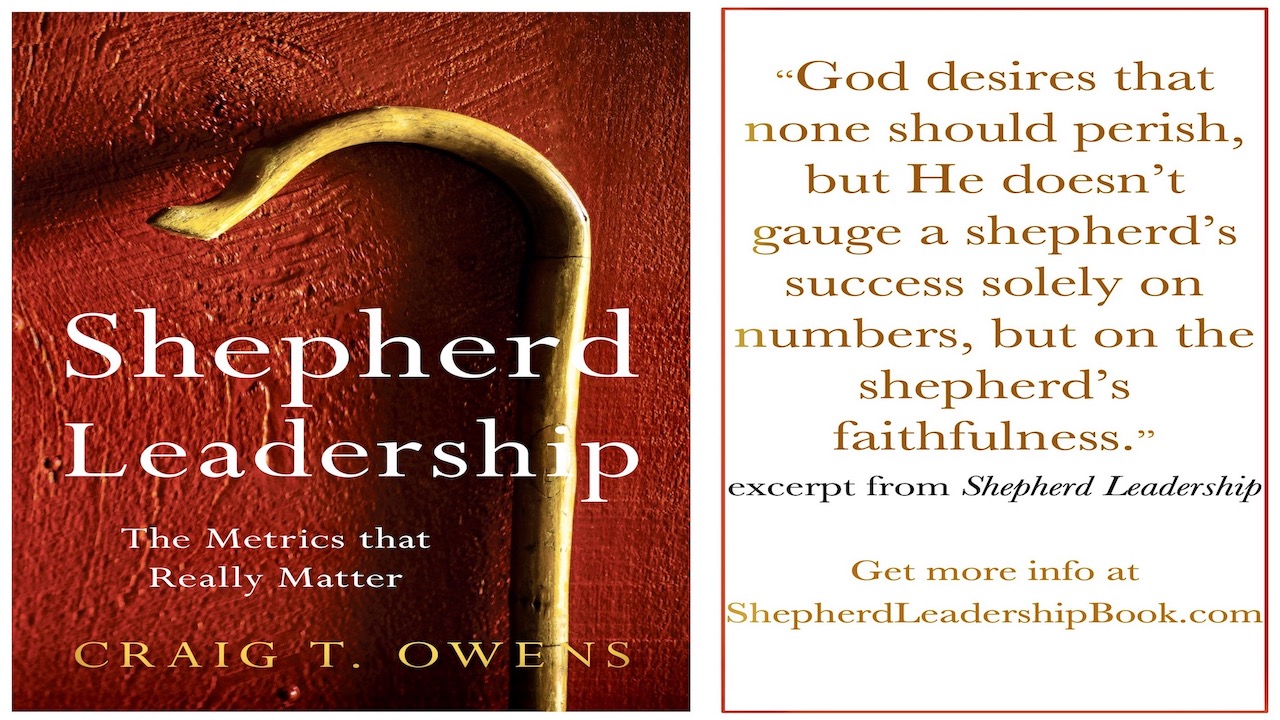
My book Shepherd Leadership: The Metrics That Really Matter is available in print or ebook, and in audiobook through either Audible or Apple.

►► Would you please prayerfully consider supporting this ministry? My Patreon supporters get behind-the-scenes access to exclusive materials. ◀︎◀︎

Come To God As A Counselor

Listen to the podcast of this post by clicking on the player below, and you can also subscribe on AppleSpotify, or Audible. 

I’ll bet you have “go-to” people in your life. The ones you immediately call when you need computer help, relationship insights, household or car repairs, Bible questions, or even cooking instructions. 

We love having these go-to people in our lives, but I’m also going to guess that none of us has someone who possesses all of these go-to skills. After all, all of us are only human, with limitations and deficiencies. 

We’ve learned that in prayer we can come to God as a Father—calling Him our Abba Father. We can also come to God as a Brother—knowing that Jesus has walked every path we will ever walk, and He intercedes to the Father on our behalf. 

In fact, we saw last week that Jesus was never at a loss of what to say, what path to take, or what prayer to pray. He spoke what He did, and did what He did, and prayed what He did because of the help of the indwelling Holy Spirit. 

This is the same Holy Spirit that is in us as Christians. It’s because of this that we can come to God as a Counselor. The Holy Spirit is THE Go-To Resource for everything! 

Jesus said that both He and our Father love to give us the Holy Spirit as our Counselor, and then the Holy Spirit loves to reveal our Father and our Brother to us (Luke 11:13; John 14:26, 16:15; Galatians 4:6; Matthew 16:17). 

Andrew Murray wrote, “Prayer is simply the breathing of the Spirit in us; power in prayer comes from the power of the Spirit in us as we wait on Him. Failure in prayer is the result of a spirit that is not yielded to the Spirit of God.” 

What does it mean to yield to the Holy Spirit? It means that we don’t look for other go-to people for certain situations, but we trust the Spirit to be the Go-To Resource for everything. This is what Jesus did. 

As Jesus relied on the Counselor, so must we. As the Counselor helped Jesus, so He will help us. 

Let’s break this down. 

First, Jesus was never at a loss of what words to say, and the Holy Spirit will give us the right words to say as well (John 12:49; Matthew 10:19-20; Luke 1:67; Acts 2:14). 

Second, Jesus was never at a loss of what path to take, and neither do we have to experience any confusion about what to do and when to do it (Matthew 4:1; Luke 2:27; Acts 16:6-10).

Finally, Jesus was never at a loss of what prayer to pray, and so too will the Holy Spirit help us go deeper into our prayer time (Luke 10:21; Romans 8:26-27; Ephesians 3:14-21). 

In addition, there is not one issue we will ever face that God hasn’t already addressed for us in Scripture (Ephesians 3:4-5). We see Jesus being totally reliant on Scripture (Luke 4:4, 8, 12). In an identical way, the Holy Spirit will help illuminate and apply the Scripture to our lives (John 14:26; 1 Corinthians 2:13). 

Let me repeat this vital truth: The Holy Spirit is THE Go-To Resource for everything!

  • We are vulnerable to temptation without the help of our Go-To Counselor. 
  • We are limited in our understanding of Scripture without the help of our Go-To Counselor.
  • We have a shallow prayer life without the help of our Go-To Counselor. 
  • We will be frequently confused about words to use or paths to take without the help of our Go-To Counselor. 

Let us learn to rely on our Counselor, as we keep our eyes on our Brother, and as we go together to our Father in childlike prayer. This is what leads to true intimate conversation! 

If you’ve missed any of the other messages in our prayer series Intimate Conversation, please click here. 

►► Would you please prayerfully consider supporting this ministry? My Patreon supporters get behind-the-scenes access to exclusive materials. ◀︎◀︎
Links & Quotes

Let’s celebrate others 🎉 Don’t just rattle off, “How are you?” and not even listen for the answer. Let’s ask more specific, meaningful questions to help people celebrate what’s good in their lives. Check out my latest Monday Motivation video, and then please subscribe to my YouTube channel.

Dan Reiland has a great post “7 Guideposts to Lead Yourself Well.” Dan wrote an endorsement of my book Shepherd Leadership, and we share the same passion for godly leaders to lead well.

Speaking of Shepherd Leadership, I received another really nice note this week from a pastor who has benefitted from reading it. If you are a pastor (or if you love your pastor), please take advantage of the special offer I have going for my book.

This post from the Institute for Creation Research is an excellent reminder about the importance of context when interpreting the Bible. This post is specifically talking about biblical passages related to Creation, but the points in this post pertain to all biblical interpretation. You may also be interested in a previous blog post I wrote called Context Is King.

Check out my exclusive Patreon video teaching on this idea of the lessons that can be learned whether we are delivered from trials or whether we go through trials.

Conquering Two Roadblocks To Sabbathing

Listen to the podcast of this post by clicking on the player below, and you can also subscribe on AppleSpotify, or Audible. 

I thought it was very appropriate that I got to be a guest on the Thriving In Ministry podcast with Kyle Willis while his podcast partner Dace Clifton was on sabbatical. It was appropriate because Kyle and I talked about the importance of pastors finding time to rest. 

Proper rest is absolutely vital for longevity and vitality. I hope you will listen to this short segment from this conversation. 

I shared with Kyle two main roadblocks to sabbathing. 

(1) Trying to be something you’re not. 

We are all wired differently. God wired us that way on purpose. So if you’re an early bird, guard those morning hours for your creative work and use the evenings for rest. If you’re a night owl, don’t try to copy the early birds, but rest early in the day and do your creative work when you are at your best. 

→ So the key concept to overcoming this roadblock is personalization. 

(2) Getting distracted by the non-essentials. 

Two things have really helped me with this one: Sticking to sustainable daily routines, while at the same time being sensitive to the Holy Spirit’s redirection (check out my post on the idea I call I.T.L.W.). 

→ The key concept here is flexible focus. 

I talk more about this concept of sabbathing and a leader’s overall healthiness in my book Shepherd Leadership. You can also check out some other posts about sabbathing by clicking here.

►► Would you please prayerfully consider supporting this ministry? My Patreon supporters get behind-the-scenes access to exclusive materials. ◀︎◀︎
When Confidence Becomes Hubris

Listen to the podcast of this post by clicking on the player below, and you can also subscribe on AppleSpotify, or Audible. 

In my book Shepherd Leadership, I take two chapters to dive deep into the healthy tension that is helpful for leaders. This is an important tension to maintain our effectiveness as leaders. 

When I was interviewed on the Leading From Alignment podcast, we took two episodes to talk about this healthy tension.  

As I said in this interview, every leader should take the proactive steps to make sure that our healthy leadership confidence doesn’t cross the line and become unhealthy leadership hubris. Keep healthy friends around you, enlist the help of a wise mentor, pray that searching prayer from Psalm 139, and pick up a copy of Shepherd Leadership. 

I have a special offer just for pastors (and for those who love their pastor). For just $12 I will send you an autographed copy of my book and a download link to get the audiobook of Shepherd Leadership free of charge. All you need to do is complete this form and I’ll have the materials right out to you.

►► Would you please prayerfully consider supporting this ministry? My Patreon supporters get behind-the-scenes access to exclusive materials. ◀︎◀︎

Come To God As A Brother

Listen to the podcast of this post by clicking on the player below, and you can also subscribe on AppleSpotify, or Audible. 

Being the firstborn, I didn’t have a big brother, but I took being the big brother to my little sister very seriously! Like when young men would come to pick her up for a date, I would meet them on the front porch and say, “I hope you have a really nice evening. Just so you know, I will be home all evening waiting by the phone. You’d better pray that my little sister doesn’t have to call me!” Hopefully, that let my sister know I was ready to protect her whenever she may need it. 

 Whenever we go into any situation for the first time, there is always a natural fear of the unknown. What’s going to happen? How do I behave? What do I say? How will others treat me? How will I know who to trust? Or even, how will I know what to pray for? 

Those unknowns cause fear, and fear prevents intimacy. The Bible says, “There is no fear in love” (1 John 4:18). Where there is love, fear has to leave. But when there is fear, love is pushed aside. 

We learned that we can come to God in prayer as a Father—we can bring Him all our fears and concerns and problems—but did you know that we can also come to God in prayer as coming to a Brother? 

Jesus loves the fact that we can come to our Abba Father just as He did, which is why He taught us to begin our prayers with, “Our Father in heaven.” 

How wonderful it is to have a “big brother” to show us the ropes, to walk with us, to give us his counsel! One that says, “I’ve already been to that high school … I know that employer … I have experience with that kind of relationship … I’ve solved that problem … I’ve tasted that pain.…” That’s exactly what Jesus does for us. He is our perfect Big Brother! 

Jesus knows everything we will experience in life. There might be unknown things that we walk into, but they are never unknown to Him. And more importantly, they are never unexperienced by Him. Check out these assuring words from the Book of Hebrews—

Both the One who makes people holy and those who are made holy are of the same family. So Jesus is not ashamed to call them brothers and sisters. … For this reason He had to be made like them, fully human in every way, in order that He might become a merciful and faithful high priest in service to God, and that He might make atonement for the sins of the people. Because He Himself suffered when He was tempted, He is able to help those who are being tempted. (2:11, 17-18) 

For we do not have a high priest who is unable to empathize with our weaknesses, but we have one who has been tempted in every way, just as we are—yet He did not sin. Let us then approach God’s throne of grace with confidence, so that we may receive mercy and find grace to help us in our time of need. (4:15-16) 

Jesus has been there, done that, and has the scars to prove that He is victorious! 

  • We never have to be at a loss of what to say (John 12:49-50)
  • We never have to be at a loss of what path to take (John 14:6) 
  • We never have to be at a loss of what prayer to pray (John 16:23)

(Check out all of those verses by clicking here.) 

Charles Spurgeon said, “The Lord Jesus Christ is always ready to take the most imperfect prayer and perfect it for us. If our prayers had to go up to heaven as they are, they would never succeed; but they find a Friend on the way, and therefore they prosper.” 

Solomon wrote, “Trust in the Lord with all your heart; do not depend on your own understanding. Seek His will in all you do, and He will show you which path to take (Proverbs 3:5-6). 

Commenting on these verses in his book Proverbs: Amplified and Applied, Dick Brogden wrote:

“We tend to crave God’s explicit direction for the momentous choices of life—marriage, study, career, transition, promotion, change—but sail through a thousand daily choices independent of consultation with Him. Functionally, we act as if we only need God’s help for big things because we can handle the small things without Him. The error in this dichotomy of dependence (thinking we only need God’s help for big decisions) is twofold. First, big decisions are not divorced from small decisions; they are simply the crowning act, the summary of a legion of choices. Second, big decisions are not more important than small decisions. It is the small, simple, silent, serial choices of daily living that make one wise. When we acknowledge the Lord in all the minutia, our course is chosen and our path is set, and we do not stand bewildered at the critical crossroads of life.” 

Walking with Jesus as our Brother keeps us free from fear. His perfect love opens our hearts to have intimate conversation with our Heavenly Father. You can trust our Brother to help you with every single decision at every single moment. Let’s learn to lean on Him more! 

If you’ve missed any of the messages in our series on prayer called Intimate Conversation, you can find all of the messages by clicking here. 

►► Would you please prayerfully consider supporting this ministry? My Patreon supporters get behind-the-scenes access to exclusive materials. ◀︎◀︎
Links & Quotes

When Jesus says, “I need you,” will you be able to say, “I’m ready for You”? Here is a great example of a man who stayed ready year after year for that precise moment when Jesus said, “It’s time.” Please subscribe to my YouTube channel.

Pastors, I was challenged by the insight from T.M. Moore, and I hope you will take a couple of minutes to read the full post and even subscribe to his regular emails. “John Calvin explained that one of the marks of a true church is that the Word of God is faithfully proclaimed and heard. He did not consider a church to be fulfilling its mission simply by sound preaching. Sound preaching had to be coupled with sound hearing and obedience, for only as believers do the Word to they receive it as God intends.

“In this, Calvin and Columbanus are in agreement: ‘While we preach often we improve slowly; often are we offended, seldom patient, often conquered, seldom conquerors, often led astray, seldom wise. Then what will help us, like weak and unskilled fighters whose weapons turn and wound them, while it is no credit to hear these things, but to accomplish them? For the law does not make holy by hearing, but doubtless by performance; each should honour the Lord, not simply by words and bodily toil, but by ripeness of character and purity of heart’ (Sermon II).”

The Craig And Greg Show: Dream With A Plan

Listen to the audio-only version of this podcast by clicking on the player below, or scroll down to watch the video.

On this episode of “The Craig And Greg Show” we talk about: 

  • [0:24] We want you to dream!
  • [1:47] What are some reasons people don’t set goals?
  • [3:10] The trap of comfort zones.
  • [5:14] Are you afraid of achievement?
  • [5:57] The balance of internal and external discipline.
  • [9:21] We would love to help you stretch to the next level!
  • [10:30] Why do people set goals?
  • [13:42] Why are goals hard to attain?
  • [14:31] Time is not manageable.
  • [15:30] Self-awareness and clarity are tools to help set goals.
  • [17:48] Be a goal-influencer by supporting others’ goals.
  • [19:20] Take time to celebrate reaching goals.
  • [22:40] Sharing goals with others lets them know what’s important to you.
  • [23:31] Celebrating steps toward a goal helps maintain motivation.
  • [25:00] I love this quote from Andrew Wood on incremental steps.

Check out this episode and subscribe on YouTube so you can watch all of the upcoming episodes. You can also listen to our podcast on Spotify and Apple.