“While we may not be able to take every thought captive in every situation we face every day, we can learn to take one thought captive and, in doing so, affect every other thought to come. So what is the one thought that can successfully interrupt every negative thought pattern? It’s this: I have a choice.
“When we’re spiraling in noise or distractedness, we have a choice to shift our minds back to God through stillness. When we’re spiraling in isolation, we have a choice to shift our minds back to God through community. When we’re spiraling in anxiety, we have a choice to shift our minds back to God through trust in His good and sovereign purposes. When we’re spiraling in cynicism, we have a choice to shift our minds back to God through worship. When we’re spiraling in self-importance, we have a choice to shift our minds back to God through humility. When we’re spiraling into victimhood, we have a choice to shift our minds back to God through gratitude. When we’re spiraling in complacency, we have a choice to shift our minds back to God through serving Him and others.
“If you have trusted in Jesus as your Savior, you have a God-given, God-empowered, God-redeemed ability to choose what you think about. You have a choice regarding where you focus your energy. You have a choice regarding what you live for. You are not subject to your behaviors, genes, or circumstances. You are not subject to your passions, lusts, or emotions. You are not subject to your thoughts.
“No fixation exists outside God’s long-armed reach. Because we are a ‘new creation,’ we have a choice.
“When we think new thoughts, we physically alter our brains. When we think new thoughts, we make healthier neural connections. When we think new thoughts, we blaze new trails. When we think new thoughts, everything changes.” —Jennie Allen, from the YouVersion reading plan Get Out Of Your Own Head
This is a weekly series with things I’m reading and pondering from Charles Spurgeon. You can read the original seed thought here, or type “Thursdays With Spurgeon” in the search box to read more entries.
The Holy Spirit Is Our Teacher
The question arises: How may I know whether I am enlightened by the Spirit’s influence and led into all truth? First, you may know the Spirit’s influence by its unity. He guides us into all truth. Second, by its universality. He guides us into all truth. …
The true child of God will not be led into some truth but into all truth. When he first starts he will not know half the truth. He will believe it but not understand it. He will have the germ of it but not the sum total in all its breadth and length. There is nothing like learning by experience. A man cannot set up for a theologian in a week. Certain doctrines take years to develop themselves. …
It needs but little intellect to be taught of God. If you feel your ignorance, do not despair. Go to the Spirit, the great Teacher, ask His secret influence, and it will come to pass that He will guide you into all truth. …
Whenever any of our brethren do not understand the truth, let us take a hint as to the best way of dealing with them. Do not let us controvert with them. I have heard many controversies but never heard of any good from one of them. … Few men are taught by controversy, for ‘a man convinced against his will is of the same opinion still.’ Pray for them that the Spirit of truth may lead them into all truth. Do not be angry with your brother, but pray for him. Cry, ‘Lord! Open his eyes that he may “behold wondrous things from Your law”’ (Psalm 119:18).
From The Holy Spirit: The Great Teacher
The Holy Spirit wants to help us understand the Book that He inspired. Jesus said that the Holy Spirit would guide us into all truth (John 16:13).
Since all of God’s Word is inspired, use all of God’s Word. Don’t get bogged down in a single verse or passage, but ask the Spirit to show you the full counsel of the Bible.
Learn how to handle difficult passages in a productive way (check out this post).
Strive for unity among fellow believers.
Avoid controversies among fellow believers and non-believers. Simply present the Word of God and let the Spirit do the work that needs to be done.
May our study of Scripture with the Spirit’s help bring illumination, empowerment, and unity.
“The greater our weakness, the greater glory will be God’s as we work in His power.”
“We are busier than God intends us to be if we are too busy to take time for relaxation.”
“It is characteristic of the earthly mind that it always covets the service of others: it desires to avoid toil and drudgery. This is one of the factors which makes wealth so desirable—it can secure the service of others. The mind of Christ manifested itself in His words: ‘I am among you as He that serves’ (Luke 22:27). ‘The Son of Man came not to be ministered to, but to minister’ (Matthew 20:28). It was His delight to be servant of all.”
“How are we to obtain the mind of Christ? … Is not the secret hinted at in the exhortation, ‘Let this mind be in you, which was also in Christ Jesus’? It is the work of Another. Is not the supreme work of the Holy Spirit to reproduce in the yielded believer the inner disposition of Christ? What is the fruit of the Spirit (Galatians 5:22-23) but the mind of Christ? As we willingly consent to the crucifixion of the earthly mind and purposefully yield to the sanctifying influences of the Holy Spirit, He will perform the miracle. Our minds will be transformed in ever-increasing degree by the renewing of the Holy Spirit.”
“Nothing so tends to inflate a man with a sense of his own importance as the possession of great gifts of intellect and the enjoyment of special and unusual experiences. And there is nothing which more surely disqualifies from spiritual usefulness than spiritual pride.”
“It will be recalled that the favored three disciples were not permitted to encamp on the Mount of Transfiguration. They must exchange the vision glorious for the convulsions of a demon-possessed boy. So must Paul descend into the valley if he is to be God’s messenger to a distraught humanity. He must learn that the mountain is only as high as the valley is deep. The higher he ascends in spiritual experience, the more deeply must he be identified with his crucified Lord.”
“Even God’s honored servants cannot break His physical laws with impunity, nor are they immune from the onslaught of despondency. … We must seek physical and spiritual renewal if we are not to be put to flight by our enemy. If we shift our center from God to self, even for a period, we lay ourselves open to this malady of the spirit.”
“Discouragement over the apparent failure of our best efforts, if not met with the shield of faith, will react disastrously on our spirits and degenerate into self-pity and despair.”
“We seldom give God time to deal with us radically and deeply. Even when we experience conviction of failure and sin, we do not allow the Holy Spirit to work in us so strongly that we are brought to hate the sin. We lightly assent to our sinfulness without seriously and permanently dealing with it. We act as though new results would take the place of heart repentance and renunciation. [see Hosea 6:4]
I don’t read very many fiction books, but I am a huge fan of Sir Arthur Conan Doyle’s character Sherlock Holmes! I just finished listening to a wonderful collection of short adventures from the book The Return Of Sherlock Holmes. The audiobook I listened to was expertly narrated by Stephen Thorne.
Without being as wordy as some authors, Doyle paints such descriptive pictures of Dr. Watson, Holmes, his clients, his villains, and the crime scenes. I can “see” exactly how the characters look and “hear” how they talk, and can feel the emotions they are feeling. And the crime scenes are also painted in such vivid detail by Doyle, that I can catch all of the same details the Sherlock Holmes is taking in.
I cannot stand how some detective story authors “uncover” some hidden details at the very end that magically helps their protagonist solve the crime. The “magic” of Sherlock Holmes’ solutions is that Doyle allowed you to see everything Holmes saw. The real art is in the way Holmes uses his gift of deductive reasoning to solve the clues.
These mysteries are not always crimes. Often times they are simply perplexing problems. I’ve never been called upon to solve a crime before, but I certainly am called upon to find solutions to thorny problems. In that regard, I owe a debt to Sir Arthur Conan Doyle for helping me learn from Sherlock Holmes how to deduce the most logical solution to my mysterious situations.
These are also great stories to read aloud, especially to your kids.
Jonah is the only narrative in the minor prophets. He was a prophet during the reign of Jeroboam II when Israel was temporarily growing in strength. He is the first of Israel’s prophets to be sent to a non-Jewish population.
Critics have raised questions about this book. Questions like: Did Jonah write this book himself or is it just a story about him? Is this book historical or allegorical?
The five biggest objections that are raised to Jonah’s historicity are:
The hyper-nationalistic feel is more like when Ezra and Nehemiah led people back to Jerusalem after their captivity in Babylon, and not during the time of Jeroboam II.
Parts of Jonah appear copied from the prophet Joel.
There are no (or incorrect) details about the major city of Nineveh that Jonah visited.
There are no extra-biblical historical records of a revival in Nineveh.
Jonah was swallowed by a fish?!
I think there are very good reasons to believe that Jonah was both autobiographical and historically accurate.
First, there was a revival of sorts (although not religiously) in Israel during the time of Jeroboam II. This was a time that Israel felt like it could flex its muscles again, so Jonah would not be acting out of character to be so pro-Israel.
Second, Jonah 3:9 and Joel 2:14 sound similar, but scholars cannot tell which was written first. Couldn’t God amplify a message? Consider how many parts of the Gospel of Mark are used in the Gospels of Matthew and Luke. And it’s a regular practice for authors even today to directly quote other sources.
Third, regarding the lack of details about Nineveh, the biblical writers give very few details of any places outside of Israel or Judah. The only “incorrect” detail skeptics point to is Jonah 3:3 stating that the city was so big that it would take three days to walk around it. Nineveh was a city of about 120,000 inhabitants, so it could easily take three days of walking and preaching in order to get the message to everyone.
Fourth, the revival in Nineveh was clearly short-lived. Jonah was probably in Nineveh around 760 BC. Assyria was rising politically and militarily during that time and defeated Israel just 40 years after Jonah’s preaching. Assyria itself was then defeated in 605 BC.
Finally, Jonah was swallowed by a fish?! The root word for fish in Hebrew means something that has grown to such an enormous size that it overshadows everything else. But notice that what caused the sailors to be in awe of God was not the whale/fish swallowing Jonah, but the immediate calming of the ocean when Jonah was thrown overboard (Jonah 1:15-16). Miracles appear throughout this book. And throughout the entire Bible!
Why should the appearance of miracles surprise us? Some people have a bias against the supernatural, where they wrongly believe that we can know everything through naturalistic means. C.S. Lewis pointed out, “I use the word Miracle to mean an interference with Nature by supernatural power. … Nature as a whole is herself one huge result of the Supernatural: God created her.”
I don’t think this story is a parable or an allegory because nowhere else in the Bible are such details given in the form of a parable.
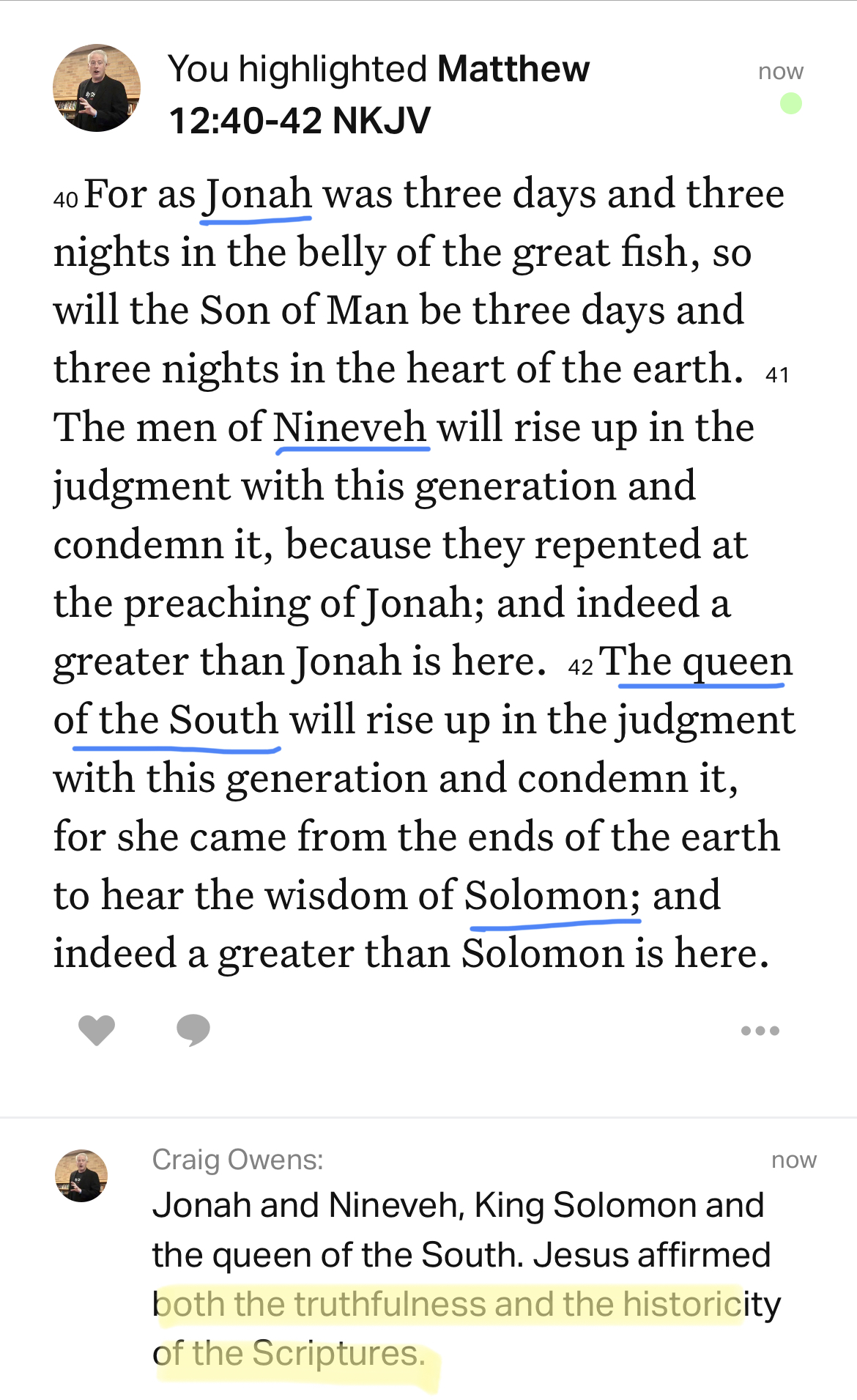
I believe this story is historical because Jesus talked about the historicity of Jonah in the same breath as He talked about other historical people: the Queen of the South and Solomon (Matthew 12:38-42). Jesus clearly viewed Jonah as historically reliable and accurate. To call Jonah into question is to call into question the truthfulness of Jesus Himself!
History matters because all of History is God’s story!
Our belief in the message of the Bible is not based upon “once upon a time” or “a long time ago in a galaxy far, far away.” It’s based upon real people in real places, especially the historicity of Jesus (notice all of the historical details Luke lists in the birth account of Jesus).
Jonah was clearly one of those historical people, in an historic place, and at a precise moment in world history that tells the story of Jesus and our redemption which He purchased!
If you want to check out all of the messages in our series on the major lessons from the minor prophets, you can find that list by clicking here.
This is a weekly series with things I’m reading and pondering from Charles Spurgeon. You can read the original seed thought here, or type “Thursdays With Spurgeon” in the search box to read more entries.
Light In A Dark Cave
Now I must have an illustration. I must compare truth to some cave or grotto that you have heard of, with wondrous stalactites hanging from the roof and others starting from the floor—a cavern, glittering with spar and abounding in marvels. Before entering the cave you inquire for a guide, who comes with his lighted flambeau. He conducts you down a considerable depth and you find yourself in the midst of the cave. He leads you through different chambers. Here he points to a little stream rushing from amid the rocks and indicates its rise and progress. There he points to some peculiar rock and tells you its name. Then he takes you into a large natural hall, tells you how many persons once feasted in it, and so on. Truth is a grand series of caverns. It is our glory to have so great and wise a Conductor. Imagine that we are coming to the darkness of it. He is a light shining in the midst of us to guide us. And by the light He shows us wondrous things. In three ways the Holy Spirit teaches us—by suggestion, direction, and illumination.
First, He guides us into all truth by suggestion. There are thoughts that dwell in our minds that were not born there but that were exotics brought from heaven and put there by the Spirit. It is not a fancy that angels whisper into our ears and that devils do the same. Both good and evil spirits hold converse with men. …
Sometimes He leads us by direction. … The Spirit gives a direction and tendency to our thoughts. Not suggesting a new one but leading a particular thought, when it starts, to take such and such a direction. …
Perhaps the best way in which the Holy Spirit leads us into all truth is by illumination. … Beloved, you may read to all eternity and never learn anything by it, unless the Holy Spirit illuminates it. And then the words shine forth like stars. … Blind men may read the Bible with their fingers, but blind souls cannot. We want a light to read the Bible by; there is no reading it in the dark. Thus the Holy Spirit leads us into all truth by suggesting ideas, by directing our thoughts, and by illuminating the Scriptures when we read them.
From The Holy Spirit: The Great Teacher
A good prayer every time you open your Bible is this: “Open my eyes to see wonderful things in Your Word” (Psalm 119:18).



 “While we may not be able to take every thought captive in every situation we face every day, we can learn to take one thought captive and, in doing so, affect every other thought to come. So what is the one thought that can successfully interrupt every negative thought pattern? It’s this: I have a choice.







 Craig T. Owens
Think On This…
September 11, 2020 — Craig T. OwensMy t-shirt from To Write Love On Her Arms that says, “You make today better.”
Think on this: Am I being intentional about making other people’s today better? Am I expressing my gratitude to those who are making my today better?
Share this: