Trespassers

Psalm 59 is the prequel to David being betrayed by the Ziphites as well as the incident in the cave between himself and King Saul. 

This psalm is also called an imprecatory psalm, which is the theological way of saying, “Get ‘em, God!” Since King Saul has sent assassins to try to kill David, you can understand why David is praying this way. But I sort of wonder why he inserts a Selah pause after two rather angry-sounding sentences in verses 5 and 13. 

When we are reading—or even praying—an imprecatory prayer, here are some important things to keep in mind: 

  • This prayer is inspired by the Holy Spirit. All of the words in the prayer, including the Selah pauses, are directed by the Holy Spirit. Getting our angry thoughts out in God’s presence is the safest place to vent. 
  • This is a prayer for justice because an injustice has been done, not just a prayer because David is upset with someone. 
  • Since this prayer says, “Get ‘em, God,” it’s a prayer that turns matters over to God as the Ultimate Judge, taking the judgment out of my hands. 

Really this is a prayer that seeks to balance something vital: The desire to see evil punished while at the same time desiring to see all evildoers come to salvation. 

Think of it this way: When I sin, do I want to meet a God of justice or a God of mercy? Since we are to treat others the way that we would want to be treated, if I want to receive God’s mercy, I have to desire that for others too. Even those evildoers who have hurt me. 

David’s first Selah pause comes after saying that he is innocent of any offense or wrongdoing. When we pray an imprecatory prayer, we would do well to ask the Holy Spirit to search our hearts to reveal any trespasses we have committed (see Psalm 19:12-13; 139:23-24). 

David’s second Selah pause comes after he says, “Then it will be known to the ends of the earth that God rules over Jacob.” Is my “Get ‘em, God” prayer a desire for me to be seen as the overcomer or for God to be seen as glorious? 

As long as my focus is on my trespassers, my focus is off my God. 

I cannot be consumed by thoughts of “them” because then I rob myself of thoughts of Him! 

So when you get angry enough at someone who has trespassed against you that you want to pray a “Get ‘em, God” prayer, Selah pause and pray, “Holy Spirit… 

  • …show me my trespasses; 
  • …help me forgive my trespassers; and
  • …help me to focus on my God, and not on my trespassers or my forgiven trespasses.” 

If you have missed any of the other messages in our Selah series, you can find links to all of them listed here. 

Poetry Saturday—New Every Morning

Every day is a fresh beginning,
Every morn is a world made new.
You who are weary of sorrow and sinning,
Here is a beautiful hope for you—
A hope for me and a hope for you.

All of the past things are past and over;
The tasks are done and the tears are shed.
Yesterday’s errors let yesterday cover,
Yesterday’s wounds which smarted and bled,
Are healed with the healing which night has shed.

Yesterday is now a part of forever,
Bound up in a sheaf, which God holds tight,
With glad days, and sad days, and bad days, which never
Shall visit us more with their bloom and their blight,
Their fullness of sunshine or sorrowful night.

Let them go, since we cannot re-live them,
Cannot undo and cannot atone;
God in His mercy receive, forgive them!
Only the new days are our own;
Today is ours, and today alone.

Here are the skies all burnished brightly,
Here is the spent earth all re-born,
Here are the tired limbs springing lightly
To face the sun and to share with the morn
In the chrism of dew and the cool of dawn.

Every day is a fresh beginning;
Listen, my soul, to the glad refrain,
And spite of old sorrow and older sinning,
And puzzles forecasted and possible pain,
Take heart with the day, and begin again. —Susan Coolidge

Thursdays With Spurgeon—Seeds Of Revival

This is a weekly series with things I’m reading and pondering from Charles Spurgeon. You can read the original seed thought here, or type “Thursdays With Spurgeon” in the search box to read more entries.

Seeds Of Revival 

     How did Jesus Christ save souls in olden times? By the foolishness of preaching. And if you will look down through church history, you will find that, wherever there has been a great revival of religion, it has been linked with the preaching of the gospel! … Ah, my dear friends, the world will never be saved by Methodist doctors, or by Baptist doctors, or anything of the sort! But multitudes will be saved, by God’s grace, through preachers! It is the preacher to whom God has entrusted this great work! Jesus said, ‘Preach the gospel to every creature’ (Mark 16:15). 

     But men are getting tired of the divine plan. They are going to be saved by the priest, going to be saved by the music, going to be saved by the theatricals, and who knows what! Well, they may try these things as long as they like, but nothing can ever come of the whole thing but utter disappointment and confusion—God dishonored, the gospel travestied, hypocrites manufactured by thousands, and the church dragged down to the level of the world! Stand to your guns, brothers, and go on preaching and teaching nothing but the Word of God, for it still pleases God, by the foolishness of preaching, to save those who believe! And this test still stands true: ‘Jesus Christ is the same yesterday, today, and forever.’ …  

     Well, you may try to do without prayer meetings if you like, but my solemn conviction is that, as these decline, the Spirit of God will depart from you and the preaching of the gospel will be of small account. …  

     The Holy Spirit works all the good that is ever done in the world, and as the Holy Spirit honors Jesus Christ, so He puts great honor upon the Holy Spirit. If you and I try, either as a church or as individuals, to do without the Holy Spirit, God will soon do without us. Unless we reverently worship Him and believingly trust in Him, we will find that we will be like Samson when his locks were shorn. He shook himself as he had done before, but when the Philistines were upon him, he could do nothing against them. Our prayer must always be, ‘Holy Spirit, dwell with me! Holy Spirit, dwell with Your servants!’ We know that we are utterly dependent upon Him. Such is the teaching of our Master, and ‘Jesus Christ is the same yesterday, today, and forever.’

From The Unchangeable Christ 

Charles Spurgeon is exactly right. Only the gospel of Jesus Christ can change our world today. For this message to go out in all of its life-changing power requires three things: 

  1. Pastors who will preach the Word of God. Music, opinions, and theatrics will not change lives. 
  2. Prayer. Both those in the pulpit and those in the seats of the church must be praying. 
  3. Reliance on the Holy Spirit. Without the Holy Spirit’s empowerment, we won’t be effective at all. 

Do you want to see a revival? Encourage your pastor to preach well, keep on praying, and keep on asking for the Spirit’s empowerment!


’…And Yet We May Not Be Christians’

Something serious for all Christians to ponder…

The disciples had life before our Lord breathed on them, but then they attained more. They had life before Pentecost, but then they obtained more. … Thus a man may be very like a saint and yet not be one. A church or a congregation may be very like a Christian one, with a fair appearance and compact organization; all in excellent bustling order, numerous, liberal, united, earnest after a sort; and yet lack one thing which neutralizes and paralyzes all the rest—the breath of life.

“Our creed may be sound, and yet we may not be Christians.

“Our religion may be externally complete, and yet we may not be Christians. … Mechanical religion may do for the gods of Greece and Rome, but not for the living and true God. … Your sanctuary attendance may be regular and reverent; but what if there be no breath in it? Your prayers and praises may be punctual and unexceptionable, but what if there be no breath in them? Will God accept them? Will they satisfy you? Will they make you happy? Will they not be irksome and intolerable? And the more you multiply them, the more intolerable.

“Our good works may be numerous and praiseworthy, yet we may not be Christians. It is not the work that makes the Christian, but the Christian that makes the work.

Our life may be exemplary, and yet we may not be Christians.” —Horatius Bonar, in Light & Truth—The Old Testament

[see Ezekiel 37:8, and this post that talks about the difference between the Holy Spirit being on a Christian versus in a Christian]

Seeking God

…David sought the face of the Lord… (2 Samuel 21:1). 

בָּקַשׁ פָּנִים יְהֹוָה

The Hebrew phrase is baqash paniym YHWH: 

  • baqash is to ask for, beg, desire “specifically in worship or prayer.” It’s a “searching as done by touching.” 
  • paniym literally means the face, but it carries the idea of being in someone’s presence.
  • YHWH (Yahweh) is Jehovah God. 

David repeatedly asked, sought, and begged through both prayer and worship that he might be in God’s presence. “Almighty God, I want to be with You. I want to know your heart intimately. I want to see Your face. I’m not seeking help from any other source, but I am resolutely seeking You alone.” 

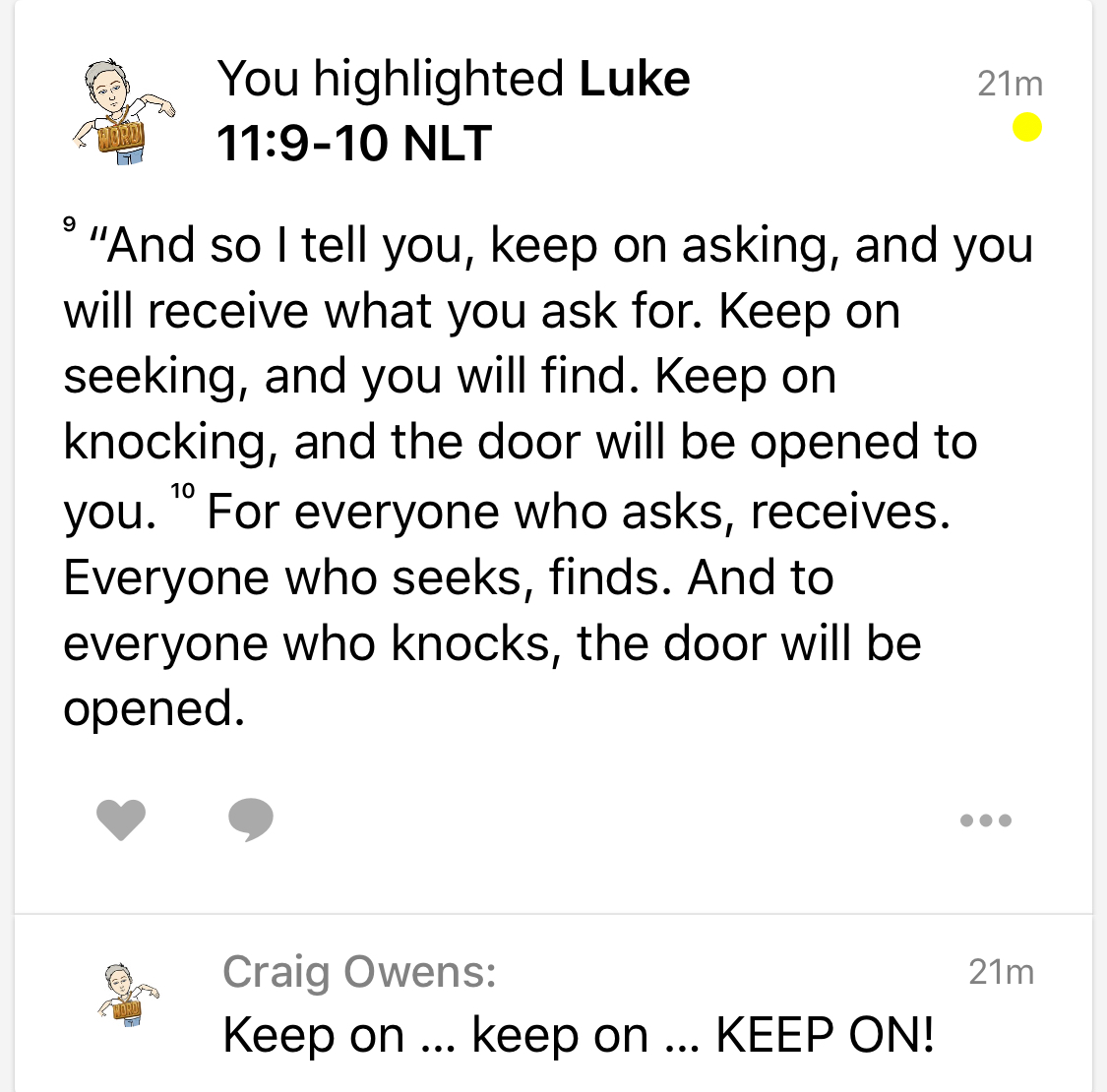
Perhaps Jesus had this in mind when He told us, “Keep on asking, keep on seeking, keep on knocking. You will get an answer, you will find what you’re seeking, the door to God’s presence will be opened to you. Your Father—YHWH, God Almighty—longs to reveal Himself to you.” 

Q: How long did David seek the face of the Lord? 

A: Until God spoke, until God delivered, until God opened the door. 

Q: How long am I willing to keep on seeking the face of the Lord? 

A: I hope I can say until God speaks, until God delivers, until God opens the door.

Messes

My good friend Josh Schram shared a powerful message in our Selah series. 

David is the anointed king, but instead of living in a palace, he’s living in a cave. From this cave, David gave us Psalm 57. 

Here are some of my takeaways from Josh’s message, but I would encourage you to watch this 20-minute video for yourself

Takeaways: 

  • To get where God needs me to be, I often have to go through things I never expected. 
  • Even my “cave times” are directed by God. 
  • “David didn’t get down on Saul’s level; he got down on his knees.” —Josh Schram 
  • If David had taken matters into his own hands, what would his legacy have been? Instead, he worshiped God, and let God take care of Saul. 
  • “We don’t worship God because our circumstances are good but because our God is good.” —Josh Schram 
  • My little messes become big messes when I try to handle them myself. I need to run to my Heavenly Father for help with all of my messes! 

If you have missed any of the messages in our Selah series, you can access all of them by clicking here. 

Poetry Saturday—Remember Three Things

Remember three things that come not back;
The arrow sent upon its track—
It will not swerve, it will not stay
Its speed; it flies to wound or slay. 

The spoken word, so soon forgot
By thee; but it has perished not;
In other hearts ’tis living still;
And doing work for good or ill.

And the lost opportunity,
That cometh back no more to thee. 
In vain thou weepest, in vain dost yearn. 
Those three will nevermore return. —Arab Proverb

Thursdays With Spurgeon—Stick To The Revealed Word Of God

This is a weekly series with things I’m reading and pondering from Charles Spurgeon. You can read the original seed thought here, or type “Thursdays With Spurgeon” in the search box to read more entries.

Stick To The Revealed Word Of God

Remember your leaders, who spoke the Word of God to you. Consider the outcome of their way of life and imitate their faith. Jesus Christ is the same yesterday and today and forever. Do not be carried away by all kinds of strange teachings. It is good for our hearts to be strengthened by grace, not by eating ceremonial foods, which is of no benefit to those who do so. (Hebrews 13:7-9) 

     From the connection it is evident that our text refers to the teaching of Christ, who is ‘the same yesterday, today, and forever.’ This is not according to the so-called development folly. Theology, like every other science, is to grow, watered by the splendid wisdom of this enlightened age, fostered by the superlative ability of the gentlemen of light and leading of the present time, so much superior to all who came before them! 

     We think not so, brothers and sisters, for the Lord Jesus Christ was the perfect revelation of God. … In previous ages, God has spoken to us by His prophets, but in these last days He has spoken to us by His Son [Hebrews 1:1-2]. Now as to that which was a complete revelation, it is blasphemous to suppose that there can be any more revealed than has been made known in the Person and work of Jesus Christ, the Son of God! … And as He shuts up the book that contains the written revelation, He bids you never dare to take from it, lest He should take your name out of the Book of Life! And never dare to add to it, lest He should add to you the plagues that are written in this book [Revelation 22:18-19]!

From The Unchangeable Christ 

BEWARE when someone tells you they have discovered some new revelation from God that they—and they alone—have uncovered. God’s Word doesn’t need anyone’s “help.” 

But DO pray before you read the Bible to ask the same Holy Spirit that inspired the Word of God to now illuminate it to your mind as you read and study. 

(P.S. Oswald Chambers had some sobering words about false prophets.)


God Is The Majority

…all of them were leaders of the Israelites (Numbers 13:3). 

Caleb and Joshua were two of the ten leaders who were sent out to explore the land of Canaan in advance of the Israelites’ crossing the Jordan River.

One of their areas of exploration was Hebron, the city where God first promised this land to Abraham and his descendants. It was here that the explorers saw the giants of Anak. Next, they went to the Valley of Eschol and took a sample of the gigantic-sized fruit. The explorers all experienced the same journey, but they did not all come to the same conclusion.

Ten of the explorer said, “The food is gigantic but so are the people. We cannot defeat them!” (13:26-29)

“Then Caleb silenced” those naysayers and said, “We can do it!” And Joshua joined Caleb in declaring, “Their protection is gone, but the Lord is with us. Do not be afraid of them” (13:30; 14:6-9).

The majority rules, right?

No! God did not send them in as a committee to vote on His plan. God had already said, “Take possession of the land”—that wasn’t up for debate or vote!

The naysayers said, “It looks like a good land, but….” 

Caleb and Joshua said, “They look like giants, but….” 

The majority saw the negatives and made excuses. They saw their situation as bigger than God.

The minority saw God as bigger than the giants. God by Himself is always the Majority. Always. My vote doesn’t change a thing. In fact, I don’t even get a vote! My only decision is whether or not to trust God and obey Him. Obedience—faithful, trusting obedience in God’s word—puts me on God’s side.

A mark of a godly leader is one who makes sure he is always on God’s side. 

This is part 48 in my series on godly leadership. You can check out all of my posts in this series by clicking here.

Interrupt Your Anxious Thoughts

Listen to the podcast of this post by clicking on the player below, and you can also subscribe on Apple or Spotify.

David taught us how to pray after we’ve been stabbed in the back. Aren’t you glad that you can pray this prayer just once and everything is all better?! 

Oh, wait. It doesn’t really work that way, does it? At least it hasn’t for me. After I’ve been hurt, it takes quite a while to get to a place of healing. We have cliches for this sort of thing—phrases like “Once bitten, twice shy” and “Fool me once, shame on you; fool me twice, shame on me.” 

We begin to react to the past instead of reflecting and responding in the present.  

It’s interesting that those who compiled the Psalter placed Psalm 55 where they did. There is no introduction that gives us a background or setting, but David still seems to be looking for those “Ziphites” that betrayed him to King Saul. 

Here’s an important physiological and psychological truth: Our brains cannot tell the difference between a real threat and an imagined threat. Our physical bodies react the same way in response to any threat. 

It’s interesting to note that both Selahs in Psalm 55 are in the middle of a sentence, almost as if David is interrupting his own thoughts. Which, I believe, is exactly what he’s doing. 

As this psalm opens David is still praying, but he’s praying about his internal threats: 

  • my thoughts trouble me 
  • I am distraught 
  • I notice the conversations and the stares of potential enemies  
  • my heart is in anguish 
  • I feel like terrors of death, fear and trembling, and horror are closing in on me! 

This leads to David’s fight/flight response (although really, it’s his flight response): “Oh, that I had the wings of a dove! I would fly away and be at rest—I would flee far away and stay in the desert.

David has been listening to himself, and he finally at least attempts to put a halt to these distressing thoughts with his first Selah—which means “pause, and calmly think of that.” 

Most of our natural reactions are driven by fear. But fear—by its very nature—is limiting. Fear keeps us tunnel-visioned on the perceived threat. Fear closes us off to accepting any new information. Fear limits our creative responses. Fear perpetuates more fear. 

So David tries a second time to Selah. He is attempting to interrupt his negative thoughts—to stop listening to himself and start talking to himself. To move from a self-preserving reaction to a God-glorifying response requires a Selah pause to reflect. Reflecting on things like:

  • Where will these thoughts ultimately take me? 
  • How has God responded before? 
  • What does God’s Word say? 
  • Could I imagine Jesus responding the way I’m responding? 
  • What changes can I make? 

I love David’s conclusion: “But as for me, I TRUST IN YOU.” He’s saying, “I’m not going to listen to those negative fears anymore. It’s time to put my trust in God.”  

David had to do this “evening, morning, and noon”—again and again and again! Until finally he could say, “I will cast all my cares on the Lord and He will sustain me; He will never let me fall” (Psalm 55:22). 

This is what Jesus promises us, “Come to Me, all of you who are tired and have heavy loads, and I will give you rest” (Matthew 11:28). 

If you’ve missed any of the messages in our Selah series, you can access them all by clicking here.