Ruth + Boaz—The Father’s Day Version

Listen to the podcast of this post by clicking on the player below, and you can also subscribe on Apple or Spotify.

On Mother’s Day that we saw how Ruth’s obedience allowed her to realize God’s favor, part of that favor is being included in the genealogy of Jesus Christ. Of course, Ruth can’t give birth to her son Obed without there being a father, which makes Boaz’s part in this story just as important. 

[This whole story of Ruth + Boaz is just four short chapters, so I’d encourage you to take a couple of minutes to read it.] 

When we first meet Boaz, he is described as “a man of standing.” Some Bible translations say “a man of wealth,” which is an acceptable definition. In fact, the word can mean strength, wealth, valor, or prominence, but the root word means something brought forth out of travail and pain. That tells us that Boaz wasn’t born a man of standing, he became a man of standing by going through difficult times, not giving in to the downward slide of culture, and remaining true to God. 

Boaz had a steel-forged integrity! 

Believe me, it would have been easy for Boaz to compromise! This was a dark time of selfishness in Israel’s history. A time where just doing the bare minimum was acceptable because most of the Israelites were selfishly doing whatever would benefit them (Judges 21:25). 

The other description we read about Boaz is that he is a “kinsman-redeemer.” This same word is used in this verse: “Plead my cause and redeem me; revive me and give me life according to Your word” (Psalm 119:154). A redeemer is one who is close by to help, has the strength or resources to help, and is willing to help. Of course, the perfect example of a Kinsman-Redeemer is Jesus, who became our human kinsman so that He could rescue us (see Hebrews 2:14; Philippians 2:7-8). 

Boaz was given the opportunity to do this for Naomi and Ruth, and he seized the opportunity with gusto. Far from being a “bare minimum” man, Boaz always went the second mile to bless Ruth and Naomi:

  • he practiced the “hospitality clause” plus he protected Ruth and gave her more than was required 
  • he provided food for his workers plus he provided food for Ruth and Naomi 
  • he blessed his workers plus he blessed Ruth in the name of the Lord 

Ultimately, Boaz did indeed become the kinsman-redeemer for Naomi (by paying off all the debts of her deceased husband) and for Ruth (by marrying this non-Israelite woman and bringing her into the family line of Jesus). 

Boaz was King Solomon’s great-great-grandfather. When Solomon was completing the temple in Jerusalem, he erected two pillars at the entrance: one was named Boaz, and the other was Jakim (with means “God will establish”). Taken together these pillars proclaim the message: By His integrity and faithfulness, God establishes and makes firm. 

Boaz exhibited integrity at every opportunity, which is what forged his character and made him “a man of standing.” Boaz demonstrated that integrity is really faith in God plus faith-filled, second-mile, others-focused actions.

“Faith without works is just wishful dreaming.
Works without faith is just religious posturing.
Works with faith is God-glorifying!” —Craig T. Owens

Men of God, please remember this: 

  • Every Word of God that you read or hear is a test—will you obey Him or will you compromise? 
  • Every setback you go through is a test—will you learn and grow or will you sulk and shrink back? 
  • Every success you experience is a test—will you bless others or will you hoard your blessings? 
  • Every decision you make in a dark culture is a test—will you just have faith, just have bare-minimum works, or will you exhibit the steel-forged integrity that comes from putting your faith to work? 

God’s blessing on your life of integrity will show others a picture of Jesus. God’s blessing on your life of going the second mile will show others that it is God who establishes and makes firm. 

Don’t rob your family, don’t rob us, don’t rob future generations of the outpouring of God’s blessing because you are selfish or compromising. Stand strong, trust God, go the second mile, be the kinsman-redeemer for those in need, and then watch for God’s blessings! 

If you missed Ruth’s vital part in this story, please check that out by clicking here.

►► Would you please prayerfully consider supporting this ministry? ◀︎◀︎
Poetry Saturday—Sunday Choice (Complaint #1)

Listen to the podcast of this post by clicking on the player below, and you can also subscribe on Apple or Spotify.

I’d shut down once the text is read,
and wish I’d just stayed home instead.
What do they teach these guys in school?
Must boredom be their guiding rule?
When insipid’s their claim
to weekly homiletic fame,
and sin can sit at ease, unfazed
with all the rest whose eyes are glazed,
while humor or some story take
the place of exposition—wake
me when it’s over, if you please.
The devil’s tools are such as these.
Before them lies the Word of Life:
It should dissect us like a knife
and cause our sin-sick souls to howl
to be exposed so dark and foul.
We should be ushered through the gate
of glory, crushed beneath its weight
and, listed by a skillful hand,
there made with joy to safely stand
before our Savior’s beaming face,
secure in His redeeming grace,
and all astounded to be seen
in His eyes loved, forgiven, clean,
and fitted to His bidding do.
Instead, we are subjected to
some moral exhortation in
the name of Him who died for sin,
which most accept too readily
since it requires no change, you see,
but serves to reassure them that
God’s fine with them right where they’re at.
The Church thus weekly sermonized
is steadily more marginalized.
The Kingdom’s coming waits until
those called to preach their calls fulfill
with courage and consistency,
to vaunt Christ, with humility. —T.M. Moore

►► Would you please prayerfully consider supporting this ministry? ◀︎◀︎

Thursdays With Spurgeon—Context Is King

This is a weekly series with things I’m reading and pondering from Charles Spurgeon. You can read the original seed thought here, or type “Thursdays With Spurgeon” in the search box to read more entries.

Listen to the podcast of this post by clicking on the player below, and you can also subscribe on iTunes or Spotify.

Context Is King

And the glory that You gave Me I have given them, that they may be one just as We are One: I in them, and You in Me; that they may be made perfect in one, and that the world may know that You have sent Me, and have loved them as You have loved Me. (Jesus in John 17:22-23)

     Some words serve many uses and have many meanings. We are very apt to make mistakes if we give the same sense in all places to the same word. The word world throughout Scripture is used with a very remarkable variety of meaning, and one had need to have his wits about him and to read carefully in order to know what is the precise source of the term in each place where it occurs. …  

     I say again, the word world, therefore, has many shades of meaning ranging from that jet black meaning in which the world lies in the wicked one—‘Love not the world, neither the things that are in the world’ (1 John 2:15)—upward to the milder sense in John 1:10, ‘He was in the world, and the world was made through Him, and the world did not know Him.’ And yet higher to the bright meaning, ‘The kingdoms of this world have become the kingdoms of our Lord and of His Christ’ (Revelation 11:15). It is not in the worst sense that our text speaks of the world, but in the same manner as we find it used in such passages as these: ‘The Lamb of God who takes away the sin of the world!’ (John 1:29). ‘God was in Christ reconciling the world to Himself, not imputing their trespasses to them’ (2 Corinthians 5:19). And again in 1 John 2:2, ‘And He Himself is the propitiation for our sins, and not for ours only but also for the whole world.’ 

     It is certain that ‘God so loved the world that He gave His only begotten Son, that whoever believes in Him should not perish but have everlasting life’ (John 3:16), and we cannot suppose that the great Redeemer would refuse to pray for those whom He was given. I understand in this particular place by the word world the whole mass of mankind upon the face of the earth who are not as yet converted. … 

     For the sake of the world, He would have the church in a high state of holy beauty and strength. May His gracious prayer be answered in all of us by the working of the Holy Spirit! … Our wish is to bring multitudes to the Savior and to conquer province after province of this revolted world for King Jesus. ‘Let the whole earth be filled with His glory’ (Psalm 72:19) is a prayer that we cannot, we dare not, we would not fail to pray! 

From The Glory, Unity, And Triumph Of The Church

When we are studying our Bibles, we must remember that context is so vital. We have to read each inspired word in its proper context so that we know how to believe, think, live, and pray. I urge you to slow down in your Bible reading—aim for better and richer comprehension than to just try to read a lot in one sitting. Sometimes in my own personal Bible study time, I may spend several minutes just thinking about one phrase, and that may be the only part that I read on that particular morning. 

I would also counsel you to use some trustworthy Bible study tools. I have a list here of 8 must-have Bible study tools, and you can find some new ways to use these tools in this post about three types of Bible studies you may not have considered before. 

However you read your Bible, make sure you are reading each part in its proper context. Pray before you begin reading and ask the Holy Spirit—Who inspired the Scriptures—to illuminate them to your heart and mind. These thoughtful Bible studies will do more to grow your spiritual maturity than simply rushing through your reading time.

Ruth + Boaz

This is one of my all-time favorite stories in the Bible! It’s a story of disappointment, death, heartache, hope, redemption, and legacy. 

But mostly it’s a story of unexpected love. It’s a perfect portrayal of God’s redemption, and it’s beautifully lived out by an unlikely heroine and hero: It’s the eternal love story of Ruth + Boaz. 

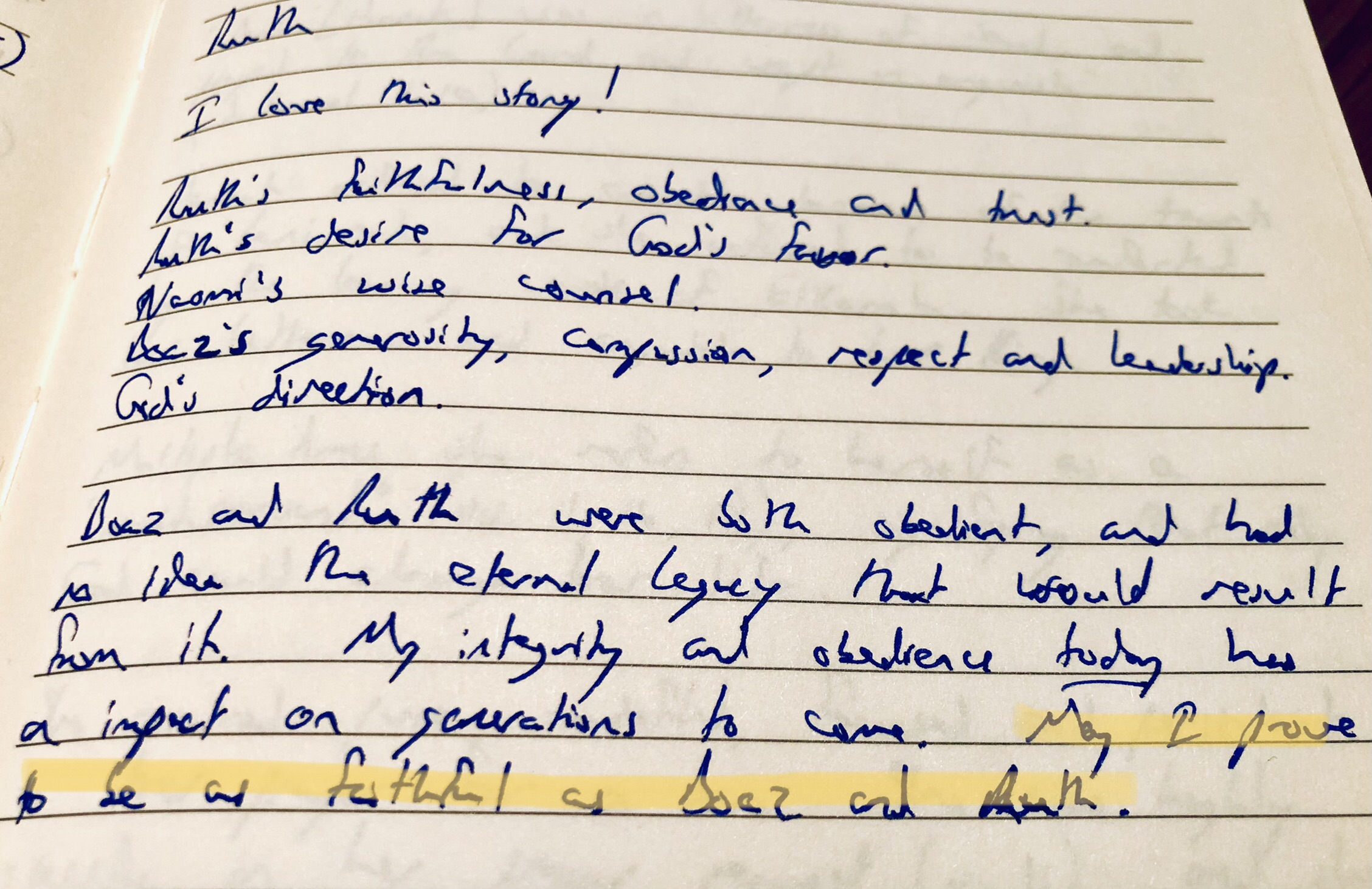
While thinking about this story, I wrote in my journal nearly four years ago, “May I prove to be as faithful as Boaz and Ruth.” Indeed, it’s hard to find better examples! 

This story is still teaching lessons to us today. On Mother’s Day, we looked at this love story through the eyes of Ruth, and on Father’s Day, we saw the lessons Boaz lived out for us. 

  • You can check out the Mother’s Day message about Ruth by clicking here.
  • And the Father’s Day look at Boaz is here.

The “Ologies”

Listen to the podcast of this post by clicking on the player below, and you can also subscribe on Apple or Spotify.

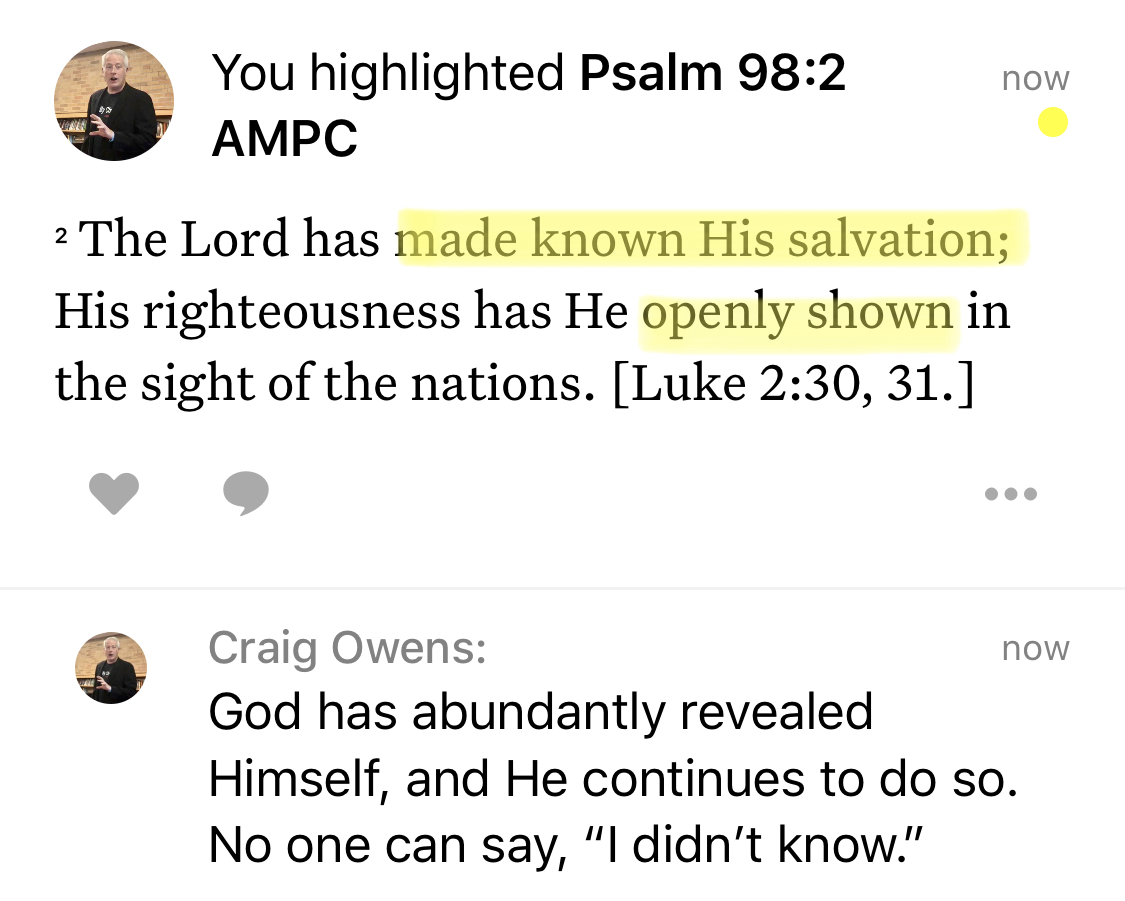
…God has done marvelous things; His right hand and His holy arm have wrought salvation for Him (Psalm 98:1 AMP). 

I like The Message paraphrase of this verse too: “Sing to God a brand-new song. He’s made a world of wonders! He rolled up His sleeves, He set things right! 

This psalmist happily extols all of the ways God the Creator has revealed Himself to mankind:

  • He has done marvelous things
  • the Lord has made His salvation known
  • He has revealed His righteousness to the nations
  • the ends of the earth have seen the salvation of our God
  • let the sea resound, and everything in it
  • let the world praise, and all who live in it
  • let the rivers clap their hands
  • let the mountains sing together for joy

This tells me how fitting it is for us to use all of the sciences—every “ology” to declare God’s greatness: biology, astronomy, cosmology, chemistry, psychology, anthropology, and even theology. All observations point to the glory of God. 

C.S. Lewis wrote, 

“If I swallow the scientific cosmology as a whole (that excludes a rational, personal God), then not only can I not fit in Christianity, but I cannot even fit in science. If minds are wholly dependent on brains, and brains on biochemistry, and biochemistry (in the long run) on the meaningless flux of the atoms, I cannot understand how the thought of those minds should have any more significance than the sound of the wind in the trees. And this is to me the final test. … Christian theology can fit in science, art, morality, and the sub-Christian religions. The scientific point of view cannot fit in any of these things, not even science itself. I believe in Christianity as I believe that the Sun has risen not only because I see it but because by it I see everything else.” 

The apostle Paul agreed with this psalmist, telling us that creation itself is enough proof that there is a God. But God went further: He gave us His word, He gave us prophets to remind us of His word, and ultimately, He sent His Son Jesus to earth. Paul concluded that “men are without excuse—altogether without any defense or justification” for refusing to believe in God. 

Don’t ever buy into the lie that science and Christianity are incompatible. All of the discoveries of science point to a Creator. We use all of these “ologies” because we never know which one may eventually get someone’s attention. 

Famed scientist Sir Isaac Newton noted, “In the absence of any other proof, the thumb alone would convince me of God’s existence.” 

Let’s join our minds, our hearts, and our voices in declaring the greatness of our Creator at every opportunity we have! 

►► Would you please prayerfully consider supporting this ministry? ◀︎◀︎
Holy Sexuality And The Gospel (book review)

Listen to the podcast of this post by clicking on the player below, and you can also subscribe on Apple or Spotify.

I’m not sure there could be a more timely book for our current generation than Christopher Yuan’s Holy Sexuality and The Gospel. 

My wife was reading Dr. Yuan’s memoir, which he co-wrote with his mother, called Out Of A Far Country, and she continually raved to me about the powerful message in their story. As I began to look at that book, I saw his more recent release—Holy Sexuality—and immediately got pulled into its timely message. 

It appears dialogues about sexuality, sexual orientation, and what God condones or condemns regarding sex are taking place everywhere. Dr. Yuan clearly addresses these issues by taking us back to the foundational truths of the Scripture. 

Dr. Yuan’s clear message is not about heterosexuality or homosexuality, but about holy sexuality. That is, what does God say about sexuality, and how does this tie in to the Gospel of Jesus Christ? This book is unabashedly Bible-centric, but it’s presented in concepts and language that everyone can grasp. 

In my opinion, this book is a must-read for pastors, youth pastors, and parents who engage the younger generations in conversations about sexuality. Pop culture has a message they are promoting in every movie, TV show, and music album, so thoughtful, loving Christians need to be armed with the truth from God’s Word on how to get to the root of both the cultural message and the biblical message. Dr. Yuan will help you be more attuned to the message in our current culture, as well as how to have loving and meaningful conversations about what is a very sensitive subject for many people. 

►► Would you please prayerfully consider supporting this ministry? ◀︎◀︎
Maturing Reactions

Listen to the podcast of this post by clicking on the player below, and you can also subscribe on Apple or Spotify.

Jesus lived out the example of wholly healthy growth. The way Dr. Luke records it, the pinnacle of Christ’s health (and our health too) is seen in our relationships with other people.  

Why is relational maturity at the peak of the pinnacle? How else could you know whether you truly have mental, physical, and spiritual health unless it’s put to the test? And the ultimate test is how we react when we’re caught off guard. Our so-called Freudian slips can reveal an area of immaturity. C.S. Lewis reminds us that the suddenness of the provocation that caused the slip didn’t create our immature response, but it actually revealed what is really inside our hearts. Surely our unplanned reactions are a better indicator of our spiritual maturity than our planned actions! 

Jesus told us that our “slips” reveal what’s really inside (Matthew 15:19), but are these really unknown to us? If we’re really honest, how many times do we think unpleasant things without saying them or doing them? The Holy Spirit—the Spirit of Truth—knows so well what’s on the inside (Psalm 139:1-4). 

When we experience one of these slip ups, the devil loves to pounce! Paul calls it “sin seizing an opportunity” (Romans 7:7-11). But even as sin pounces, Paul assures us, “Therefore there is no condemnation for those who are in Christ Jesus” (Romans 8:1). 

What is the “therefore” there for? After the “therefore” the Holy Spirit as the Spirit of Adoption reminds us we are in Jesus and children of God, and the Holy Spirit as the Spirit of Intercession help us pray perfect, childlike prayers. So what comes before the “therefore” must be something that makes us feel unworthy, distant, and condemned. 

Paul explains that “we died to sin” (Romans 6:2). That word “died” means to be separated from one thing which brings about the destruction of the other thing. When we are separated from God by our sin we are dead, when are separated from our sin by God we are alive. At that moment of salvation, we stand before Almighty God justified—just as if I’d never sinned. That is irrevocable: God will never go back on that, we will never slip away from His grace. But that moment of salvation also begins a lifelong process of sanctification—or as I like to say it saint-ification. 

Remember that pyramid of growth Jesus demonstrated for us? Paul says, “I myself in my mind am a slave (Romans 7:25). The mind is where the Spirit of Truth begins His maturing, saint-ifying process in us. As our minds are transformed, then our bodies and our mouths can live out a Christlike lifestyle (see Romans 12:1-2). It’s this mind and body transformation that matures our spiritual health, which is then revealed in our relationships with others.  

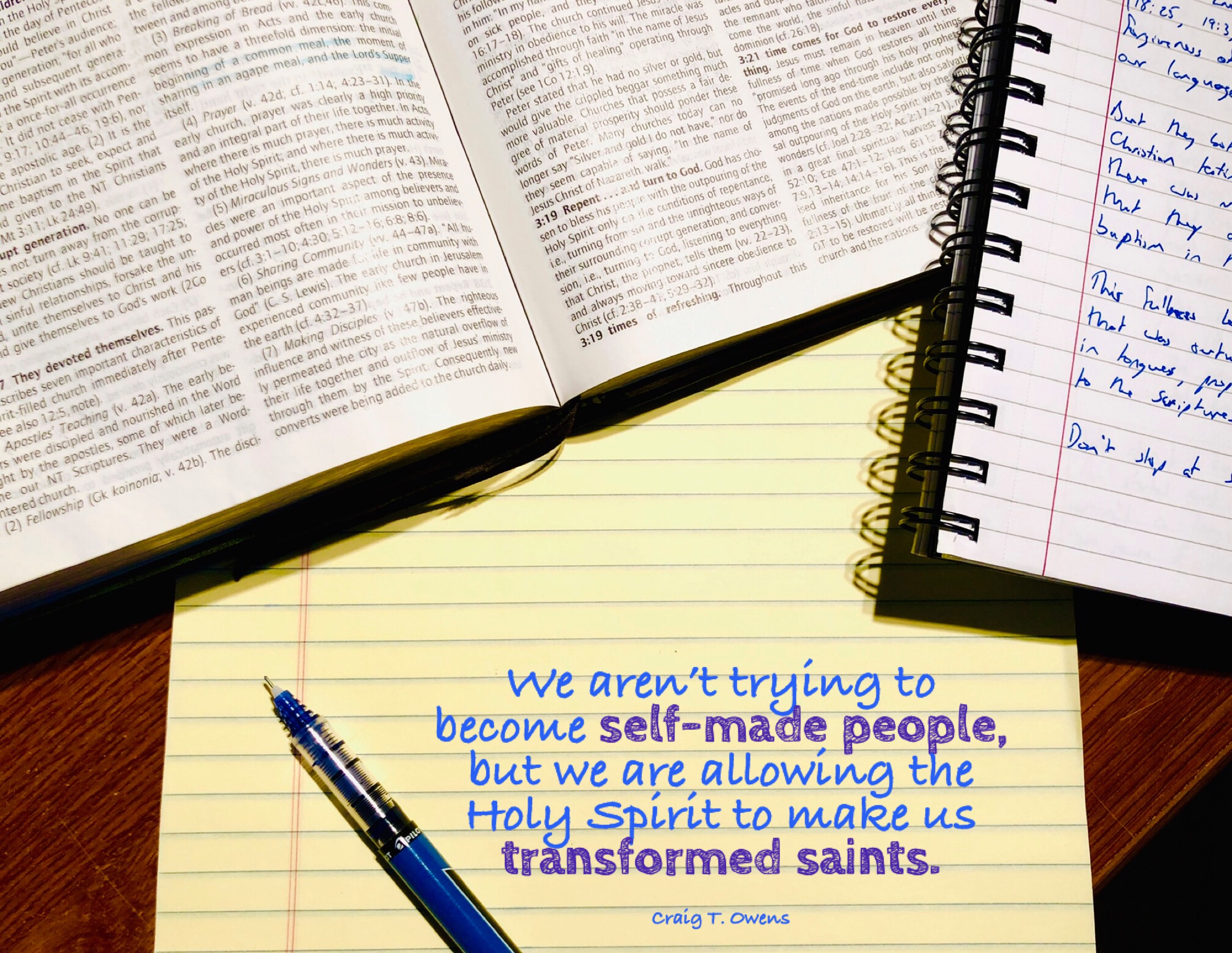
Notice that it is after we have been through this transformation of mind, body, and spirit that Paul tells us the standard for God-honoring living. This is where we see even our unplanned reactions becoming more and more Christ-like (Romans 12:9-21). We cannot live out this Romans 12 mandate solely on our own willpower. We aren’t trying to become self-made people, but instead, we are allowing the Holy Spirit to make us transformed saints. Transformed saints that are known by their unplanned Christlike reactions. 

This is why I keep stressing for Christians to not stop at salvation, but to press on to be baptized in the Holy Spirit. 

If you’ve missed any of the messages in our series We Are: Pentecostal, you can access the full list by clicking here.

►► Would you please prayerfully consider supporting this ministry? ◀︎◀︎
Poetry Saturday—Upon A Life I Have Not Lived

Listen to the podcast of this post by clicking on the player below, and you can also subscribe on Apple or Spotify.

Upon a Life I have not lived,
Upon a Death I did not die,
Another’s Life; Another’s Death,
I stake my whole eternity.

Not on the tears which I have shed,
Not on the sorrows I have known,
Another’s tears; Another’s griefs,
On these I rest, on these alone.

O Jesus, Son of God,
I build on what Thy Cross has done for me;
There both my death and life I read,
My guilt, and pardon there I see.

Lord, I believe; O deal with me,
As one who has Thy Word believed!
I take the gift, Lord, look on me,
As one who has Thy gift received. —Horatius Bonar

►► Would you please prayerfully consider supporting this ministry? ◀︎◀︎
Two Perfect Prayers

Friends, I recently shared a message in which I talked about how the Holy Spirit helps us in our prayer life, specifically how the Spirit reminds Christians that we have been adopted into God’s family. 

In this clip from that sermon, I talk about the only two times that we can pray perfect prayers, and I make reference to two passages of Scripture: John 14:26 and Romans 8:26-27. Take a listen… 

The Spirit of Truth reminds us of everything God has said to us in His Word, and He helps us turn those promises into prayers (see John 14:26). 

The Spirit of Intercession gives us a prayer language unknown to our logical mind, whereby we pray in a language in which we have no control over the words being spoken (see Romans 8:26-27; 1 Corinthians 12:4-10). 

Only when we pray God’s Words directly back to Him, or when we pray in tongues as the Holy Spirit enables us, are we praying a perfect, unselfish, God-glorifying prayer.

►► Would you please prayerfully consider supporting this ministry? ◀︎◀︎

Thursdays With Spurgeon—The Basis Of Our Hope

This is a weekly series with things I’m reading and pondering from Charles Spurgeon. You can read the original seed thought here, or type “Thursdays With Spurgeon” in the search box to read more entries.

Listen to the podcast of this post by clicking on the player below, and you can also subscribe on iTunes or Spotify.

The Basis Of Our Hope

     If there is no resurrection, apostolic preaching fails. ‘If Christ is not risen, then our preaching is empty’ [1 Corinthians 15:12-22]. … If Christ was not raised, the apostles were false witnesses. When a man bears false witness, he usually has a motive for doing so. What motive had these men? What did they gain by bearing false witness to Christ’s resurrection? It was all loss and no profit to them if He had not risen. They declared in Jerusalem that He had risen from the dead, and straightway men began to haul them to prison and to put them to death! Those of them who survived bore the same testimony. They were so full of the conviction of it that they went into distant countries to tell the story of Jesus and His resurrection from the dead. … They were brought before Roman emperors again and again, and before the proconsuls, and threatened with the most painful of deaths, but not one of them ever withdrew his testimony concerning Christ’s resurrection! …  

     If Christ is not raised, your faith is in vain. If it is in vain, give it up! Do not hold on to a thing that is not true! I would sooner plunge into the water and swim or wade through the river than I would trust myself to a rotten bridge that would break down in the middle. If Christ did not rise, do not trust Him, for such faith is in vain! But if you believe that He did die for you and did rise again for you, then believe in Him, joyfully confident that such a fact as this affords a solid basis for your belief! …  

     If [Jesus] died for you and rose again for you, that is the groundwork of your confidence, and I pray you keep to it. … Go your way and sing, ‘The Lord is risen indeed,’ and be happy as all the birds in the air, till you are, by and by, as happy as the angels in heaven through Jesus Christ our Lord. Amen.

From If There Is No Resurrection 

I shared a series of messages that said, “I know Jesus is A.L.I.V.E. because of…” and each of the letters of ALIVE reminded us of a convincing proof of His resurrection. I would especially direct your attention to two of those letters. 

The “L” stands for lives changed. When someone has a complete about-face life change because of their interaction with Jesus, that is pretty strong proof that their encounter was with a living Savior. 

And the “E” stands for the engagement of Christ’s followers. It’s astounding to see how much of our world’s history has been positively impacted because of the influence of Christians. Their lives had become so radically different because of the life of Jesus in them that they could not help but change the culture around them. 

As I said last in the last Thursdays with Spurgeon installment, always remember that the one with a personal experience is never at the mercy of the one with an argument. If your life has been changed by personal and ongoing interactions with Jesus Christ, don’t keep that good news to yourself. Let that assurance you have be a bright and winsome witness to all who are around you.