The Holy Spirit loves to give us those “lightbulb moments” when the Word of God almost leaps off the page! I have lots of new content every week, which you can check out on my YouTube channel.
It has long been believed that some migratory animals use the earth’s magnetic force to help them navigate. Some researchers discovered that moths can see both the magnetic fields and the stars to plot their course. The lead researcher wrote, “If you have this tiny insect with a brain a tenth the volume of a grain of rice and eyes smaller than a pinhead, that they can do this is surprising.” The protein in their eyes that allow them to do this is unevolved—it’s always been there, implant from the beginning by our awesome Creator!
In the God Speaks Science reading plan on YouVersion, John Von Sloten wrote, “Creation is God’s first book. To read it we need science. Science is not the enemy of the Christian faith; it’s an ally! … We need to read biblical creation references with the Author’s omniscience and original intent in mind. To do that, we need science. … What if you try to connect the next scientific truth you encounter to an attribute of our ever-near God? If everything comes from God’s mind, then everything has something to say about God’s nature.”
Competitive leaders need to keep both winning and losing in perspective. Check out the full conversation Greg and I had about competition on The Craig and Greg Show.
Put the good stuff from the Bible in your heart and mind regularly. When you do, the Holy Spirit can remind you of what you’ve studied and help you apply it to your daily situations. I have lots of new content every week, which you can check out on my YouTube channel.
“It pays to know the enemy—not least because at some time you may have the opportunity to turn him into a friend.” —Margaret Thatcher
John Stonestreet and Dr. Glenn Sunshine shared this, “The despicable and horrendous attacks by Hamas against civilians last week, including beheading children and kidnapping the elderly, seems a throwback to some distant, barbaric past of human history. We may have thought the world had long ago outgrown such barbarity, but it hasn’t. In fact, as shocking as it is, the kinds of atrocities carried out by the Hamas terrorists are the norms of warfare, at least throughout most of human history.” What changed this? Quite simply: a Christian worldview of just warfare.
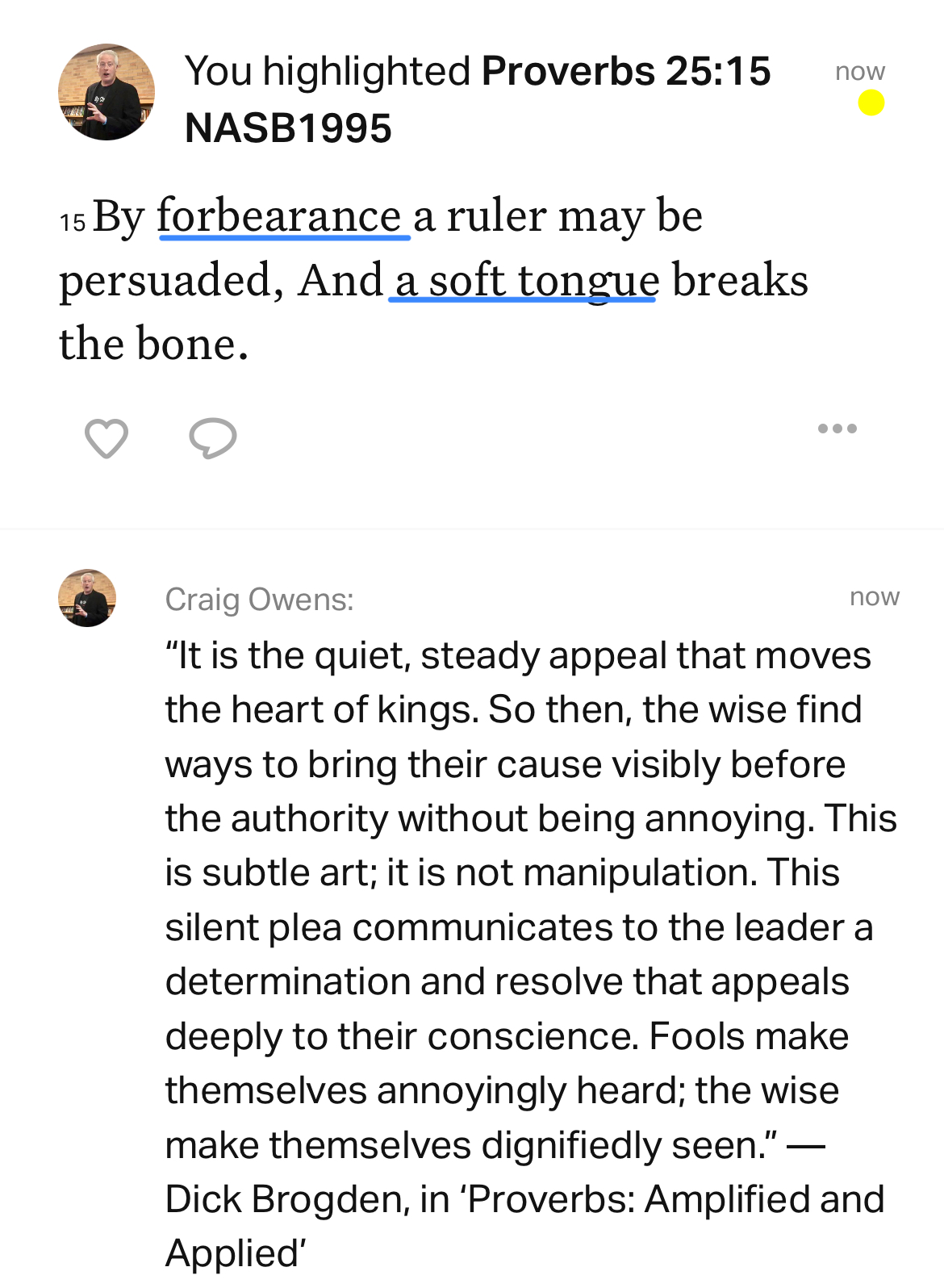
“It is the quiet, steady appeal that moves the heart of kings. So then, the wise find ways to bring their cause visibly before the authority without being annoying. This is subtle art; it is not manipulation. This silent plea communicates to the leader a determination and resolve that appeals deeply to their conscience. Fools make themselves annoyingly heard; the wise make themselves dignifiedly seen.” —Dick Brogden, in Proverbs: Amplified and Applied
Questions engage people more than statements do. Check out the full conversation Greg and I had on The Craig And Greg Show. I have lots of new content every week, which you can check out on my YouTube channel.
“In America, we have a tendency to worship our work, work at our play, and play at our worship.” —Lenny Esposito
“Young people are told, ‘You’ve got plenty of time, live a little, first,’ as if life ends after the wedding. The truth about marriage, however, is that it is, statistically, the single best predictor of long-term happiness. Making this even more important to understand is that for at least the last 20 years now, Americans have been steadily getting less happy.” Here’s how John Stonestreet shares this report from the University of Chicago.
T.M. Moore shared an interesting component of early-colonial American lawmaking: “Peruse the civil codes of the American colonies and you will discover a curious phenomenon. Frequently, colonial legislators drafted their civil codes by looking to the Old Testament Law of God.”
Dr. Tim Clarey said, “The global Flood also answers why dinosaurs were still alive and flourishing until the end of the Cretaceous. At that moment in the Flood, they were likely trying to stay on the highest ground available as waters encroached closer, week by week. As the dry land rapidly disappeared, many species herded together. This explains why varied types of dinosaurs were buried together at the end of the Cretaceous. The Flood’s tsunami-like waves eventually crashed over the remaining dinosaurs and entombed them in what’s called Upper Cretaceous strata.” Check out more evidence for the Flood that is recorded in the Book of Genesis.
Listen to the podcast of this post by clicking on the player below, and you can also subscribe on Apple, Spotify, or Audible.
Staying power is something special. It especially stands out to us when someone holds their position for years and continues to remain one of the go-to people in the organization. For Christians, the key to staying power may not be as difficult to obtain as you may think.
The timeline between Nebuchadnezzar and Belshazzar:
Nebuchadnezzar died in 562 and was succeeded by his son Amel-Marduk.
Amel-Marduk was assassinated by his brother-in-law, Nergal-Sharezer, two years later (560 BC), who then assumed the throne.
Four years later (556 BC) Nergal-Sharezer died, and he was succeeded by his son, Labashi-Marduk.
Before a year had passed, Labashi-Marduk was assassinated by a group of malcontents headed up by Nabonidus, who then assumed the throne.
Five years later (550 BC), Nabonidus died and was succeeded by his son, Belshazzar.
Darius—a common name for Medo-Persian rulers. “Darius the Mede” (Daniel 5:31) is a more mysterious figure who, so far, appears only in the Bible. Historians think he may have been Gubaru, an officer in Cyrus’ army who became governor of the Persian province of northern Babylon. In this case, he’s the military leader who invaded Babylon, killed Belshazzar, and effectively ended the reign of Babylon. Persia was now the new world power.
Darius I, called the Great, reorganized the government into satraps and extended the boundaries of the empire (Daniel 6:1-3). Daniel was appointed as one of three presidents over the 120 satraps but was being considered as the chief of the three.
Cyrus the Great was king of Persia from 550-529 BC. When Cyrus became ruler of the Persian district of Anshan, the district was subject to the Medes; five years later he led a rebellion against the Medes that resulted in the capture of King Astyages and the overthrow of the Median Empire. Thereafter Cyrus called himself king of Persia. In 539 BC the kingdom of Babylon fell to Cyrus.
Listen to the podcast of this post by clicking on the player below, and you can also subscribe on Apple, Spotify, or Audible.
The events in the Bible are rooted in history. These are actual events in which real people lived in a moment in recorded history. The songs of ascent were sung both pre-exile and post-exile. The post-exile pilgrims were returning to Jerusalem after the edict of King Cyrus (2 Chronicles 36:22-23).
The first pilgrims to go up to Jerusalem after the exile were the rebuilders of both Jerusalem and the temple, and they faced heavy opposition (Ezra 4:1-5; Nehemiah 4:1-3, 7-8). In light of these events, I think the song of ascent in Psalm 125 is especially pertinent to this situation.
The middle verse of Psalm 125 contains a warning to godly people. God’s followers may be tempted to grab earthly political power to try to make things right—to “fight fire with fire.” The phrase “the scepter of the wicked” symbolizes the royal authority of a foreign conqueror. In other words, we might justify using the scepter of the wicked because we think “the ends justify the means.” But notice the warning if we do: “the righteous might use their hands to do evil.”
You can see this in a couple of other biblical translations. The Amplified Bible says, “lest the righteous (God’s people) stretch forth their hands to iniquity and apostasy,” and the New Living Translation says, “the godly might be tempted to do wrong.”
Instead, we are called to look to God for our security. Psalm 125:1-2 sounds like an echo of Psalm 121, in which we are reminded that our God is unshakable, unrivaled, and eternal. Political parties come and go, even evil dictators and tyrannical regimes come and go, but the Sovereign God remains forever. All of History is His story!
Chuck Colson used to frequently remind his audiences, “Salvation does not arrive on Air Force One!”
The motto on our US currency is still accurate: In God we trust! Psalm 125:4 says the same thing: God does good to those who trust Him.
Earlier I mentioned the opposition that Ezra and Nehemiah recorded. Let me also share with you how these God-fearing men instructed the Jewish people to respond. Ezra says that the prophets called them to remember “the name of the God of Israel, who was over them,” and three times Nehemiah records that their response was prayer to God (Ezra 5:1; Nehemiah 4:4, 9; 6:9).
In God we trust, not in political power. On the flip side, Psalm 125:5 warns us that God treats as evildoers those who look to the worldly scepter to try to get ahead.
So when opposition and even persecution come, we should pray to God and ask for Him to remove the scepter of the wicked. Let’s pray for God to put His favor in the hearts of even ungodly leaders. Ezra recognized this when he said—
Praise be to the Lord, the God of our ancestors, who has put it into the king’s heart to bring honor to the house of the Lord in Jerusalem in this way and who has extended His good favor to me before the king and his advisers and all the king’s powerful officials. Because the hand of the Lord my God was on me, I took courage and gathered leaders from Israel to go up with me.(Ezra 7:27-28)
The New Testament calls on Christians to pray for those in governmental leadership over us (1 Timothy 2:1-2). But perhpas you ask, “What exactly are we to pray for these leaders?” Solomon wrote, “The king’s heart is like channels of water in the hand of the Lord; He turns it wherever He wishes” (Proverbs 21:1). So perhaps a God-honoring prayer is to ask for our leaders’ hearts to be moved as King Cyrus’ heart was.
“God is King of kings and ultimately always wins, always gets His way. Even when it seems that earthly authorities continually rebel against the Lord and His Anointed, the reality is that even their most heinous acts are turned against them. It must be very frustrating to be the devil and to constantly see how God turns situations to gospel good and God’s unique glory. God is so wise that He turns the hearts of authorities without them knowing it. Smug on their decaying thrones, the power brokers of this world revel in their supposed autonomy and imagined resistance, never realizing how foolish they look to the angel hosts who are privy to God’s unmatched strategic dominance.”
Let’s never try to fight fire with fire, but let’s turn repeatedly to God in prayer whenever opposition arises against God-fearing people anywhere.
We can look back to learn or we can look back to relive. Looking back to learn is healthy, but looking back in regret to try to relive our past is unhealthy and unproductive. Learning vs. reliving makes all the difference. See my full message on this mental health thought here. I have lots of new content every week, which you can check out on my YouTube channel.
“I’ve learned one thing: You only really get to know a person after a fight. Only then can you judge their true character.” —Anne Frank
Lenny Esposito is an outstanding Christian apologist. Check out this podcast where Lenny discusses the historical facts about the crucifixion and resurrection of Jesus Christ.
“Life with God is not immunity from difficulties, but peace in difficulties.” —C.S. Lewis
“I believe it will only be known on the Last Day how much has been accomplished in missionary work by the prayers of earnest believers at home.” —James Fraser
This is a good reminder from Axis for parents with students returning to school. The heading of this section of Axis’ weekly Cultural Teanslator is “Back to Backpacking.”
“What it is: As a new school year begins, teens might have mixed feelings of excitement, anxiety, and feeling overwhelmed.
How to approach this season: As Hannah King writes in Christianity Today, all seasons of transition bring with them an element of loss. Starting a new school year might mean making new friends, meeting new teachers, or starting a new curriculum. It can also mean the loss of free time, increased stress levels, and more difficulty creating intentional moments as a family. For parents, the beginning of a new school year might also feel like a reminder that time with their teens living at home is dwindling down, a feeling which can bring its own set of griefs, pressures, and regret. King recommends allowing space for teens and adults to name the things they’re disappointed about or not looking forward to, noting that repressed sadness can keep us from ‘entering freely into [the] joy’ of a new thing.
“Start the conversation: What will you miss the most about this summer?”
“Either you deal with what is the reality, or you can be sure that the reality is going to deal with you.” —Alex Haley
My courage and my success are directly tied to my obedience of God’s Word. The life of Joshua is just one example. Check out this full message here. I have lots of new content every week, which you can check out on my YouTube channel.
“Christ is more of an Artist than the artists. He works in the living spirit and the living flesh; He makes men instead of statues.” —Vincent van Gogh
Bryan Windel echoes something I’ve frequently said on this blog, “The Bible is rooted in real history. This is why archaeology is such a valuable tool; it helps us uncover the biblical world and provides us with important background knowledge about the people, places, and events described in the text.” Bryan was a part of a dig at Shiloh (where Joshua and Samuel play key roles) and he shares some of his observations and discoveries.
“I trained four years to run nine seconds, and people give up when they don’t see results in two months.” —Usain Bolt
“Those who have turned the tide of history have turned it by means of prayer. This should be the motto of every follower of Jesus Christ. Never stop praying, no matter how dark and hopeless it may seem.” —Billy Graham
I love these stories of hope from To Write Love On Her Arms. They have lots of great words of encouragement for you to share with others.
Listen to the podcast of this post by clicking on the player below, and you can also subscribe on Apple, Spotify, or Audible.
Have you ever wondered why the Roman soldiers treated Jesus so cruelly? After all, these are professional soldiers so why are they acting in such an unsoldierly way (see Mark 15:16-20)?
Perhaps they thought that Jesus was just another criminal that was in cahoots with Barabbas—a murderer and insurrectionist. But where would they get that idea? It must have come from the lies and slander that the Sanhedrin were spewing.
Perhaps the soldiers had a low value of all human life. Where would this come from? First from their leadership: particularly the way history tells us that Pontius Pilate treated the Jews. But we can go a little broader because we also know from history the disregard the Romans had for the weak, the young, the sick, and the aged.
The bottom line is this: Anytime there is a departure in even the slightest degree from the Great Commandment—love God, love yourself, and love your neighbor—the resulting society is dark and ugly, with people mistreating others in the most inhumane of ways.
We stand as a check against the decay in societal values. Our high view of God’s power and love, our proper understanding of each person’s worth in God’s sight, and the way we express genuine love for others—especially the weak and marginalized—is a preservative to the moral decay.
It’s so easy to get caught up with the loud voices around us. Pontius Pilate did, the Roman soldiers did, the Sanhedrin did, and the crowds that listened to these leaders did too.
If you are concerned about the moral decay you see in your neighborhood, the movies and music that are released, or the behavior of our elected officials, we must adhere all the more closely to the Great Commandment: Love God with all your being, maintain a healthy self-image in light of God’s love for you, and then love your neighbor—allof your neighbors—in the same way God loves you.
I shared several videos this week while I was on vacation. If you missed any, you can check them out on my YouTube channel.
A good definition of apologetics is found in Acts 17:2-3. We need to share (1) reasons from Scripture, (2) logical explanations, and (3) verifiable evidence. I have written quite a bit on my blog on the topic of apologetics, including several book reviews of apologetics books that you may want to check out.
“The life we speak over others they will pass on. While it is true that hurting people hurt others, it is just as true that healed people heal others, blessed people bless others, loved people love others, and ‘mercied’ people mercy others—if, that is, they have any sense of gratefulness.” —Dick Brogden, in Proverbs: Amplified and Applied
“The Kingdom of God will be present within us to the extent that we maintain a clean and good conscience. The conscience is the valuing center of the soul. It holds the priorities which serve to clarify and direct both the mind and the heart for Kingdom presence. As thoughts or affections stir in the soul, the conscience reads the Law of God, which is written on the heart and settled in the mind (Romans 2:14-15), and engages the will to act in line with the vision of Christ and the counsel of His Word.” —T.M. Moore
“Value those people who tell you the truth, not just those people who tell you what you want to hear.” —Pat Summitt
Some people claim those with a biblical worldview and lifestyle are “extremists.” I think this chart (I cannot find the author to give credit on this one) explains it well.
“Life without love isn’t worth anything. Justice without love makes you hard. Intelligence without love makes you cruel. Kindness without love makes you a hypocrite. And faith without love makes you a fanatic.” —Mother Teresa
Listen to the podcast of this post by clicking on the player below, and you can also subscribe on Apple, Spotify, or Audible.
The Bible is not only the inspired Word of God but it is rooted in history too. Every prayer was prayed by a real person in distress, and every song of praise was lifted up by someone who personally experienced God’s deliverance.
The reason why this is so important is that it makes God’s Word relatable and applicable to us. If the Bible merely contained moral stories set in some make-believe world, we may have a hard time seeing how to apply the principles to our daily lives. But, thankfully, this isn’t the case. We can read the real-life experiences of real historical people and then we can allow the Holy Spirit to help us apply this inspired Word to our lives.
There is a collection of 15 songs in the Book of Psalms called “The Songs of Ascent.” Even these songs have an important historical background.
Second Chronicles ends with this proclamation from King Cyrus: “The Lord, the God of heaven, has given me all the kingdoms of the earth and He has appointed me to build a temple for Him at Jerusalem in Judah. Anyone of His people among you—may the Lord his God be with him, and let him go up” (2 Chronicles 26:23).
The phrase “let him go up” is both literal (since Jerusalem is 2500 feet above sea level) and spiritual. Listen to these words from King Solomon, “The way of life winds upward for the wise, that he may turn away from hell below” (Proverbs 15:24 NKJV).
The Songs of Ascent were a rallying cry—an encouragement to all pilgrims to keep climbing up.
In Hebrew literature, the main point is usually found in the middle of the poem or story, unlike our Western literature which puts the payoff at the end. In the first Song of Ascent, the middle is verse 4. But the second half of Psalm 120 seems out of place for people ascending up to Jerusalem to worship God. Verse 5 begins with the words, “Woe to me.”
The psalmist is expressing his pain in living among the people of Meshech and Kedar. The people of Meshech were vicious people who traded human lives for money and who conducted themselves as terrorists (Ezekiel 27:13; 32:26). Their name literally means “drawing away.” The people of Kedar were nomadic sons of Ishmael. Being nomadic means they were never at rest. Their name literally means “dark place.” Very noteworthy is that there is no mention of God in verses 5-7.
The middle verse of this song (v. 4) turns the people of Meshech and Kedar over to God. It is a reminder that we are not the ones to dispense justice. If God knew how to overthrow the powerful kingdoms of Judah, Babylon, and the Medes, if He knew to call Cyrus by name at just the right moment, He also knows how to deal with these sinners.
This Song of Ascent shows the stark contrast between keeping our eyes on the dark culture around us versus keeping our eyes on the God who is never weighed down by the darkness. As we go higher up, we focus more on God; as His saints focus on Him, His light shines on them; as His light shines on them, they point sinners living in dark valleys to the God of light and love.
Staying down is easy. Getting up requires intentional effort. Going up requires us to overcome the pull of sin and the frustration of watching for judgment to fall on sinners.
Continually going up glorifies God, has eternal rewards for saints, and creates a compelling testimony for sinners.
Going up is a lot of effort, but the rewards are so worth it! As the apostle Paul reminded his friends in Rome, “I consider that our present sufferings are not worth comparing with the glory that will be revealed in us” (Romans 8:18). Let’s keep climbing up and let’s keep lifting our eyes to the only One who has the eternal light.