The Non-Christmas Christmas Carol

No more tearsImagine that I invited you to my house for a Christmas party. When you arrived, I greeted you at the door with a cheerful hello and warmly welcomed you into my home. But as you hung out with the other guests, you might begin to wonder if we were truly celebrating Christmas. After all, when you looked around my house, you saw no Christmas tree, no ornaments, no wrapped gifts, no mistletoe, no Christmas stockings, no manger scene. You might be tempted to say that you were invited to a non-Christmas Christmas party! (By the way: my house IS fully decorated for the season!)

One of our 300-year-old Christmas carols sounds remarkably like my make-believe party. Joy To The World has no mention of angels, no wisemen, no manger, no nativity scene, no virgin birth, no star in the east. It seems like a non-Christmas Christmas carol! 

That’s because at this time of year, Christians aren’t celebrating Christmas, but we’re celebrating Advent. Actually we’re celebrating both Advents. 

Jesus was born in a Bethlehem manger (His First Advent), but He is also coming again to bring all of earth’s history to a close (His Second Advent). So we celebrate the First Advent, and then look with hopeful anticipation to the Second Advent. That’s exactly what Joy To The World does!

Each of the stanzas of this well-known hymn looks forward with joy to Christ’s ultimate fulfillment of all the prophesies of the Bible. The final joy comes when He reigns as King of Kings and Lord of Lords. But we can still live with joy right now!

The third stanza of this hymn says that Christ has come to make His blessings known far as the curse is found. The Apostle Paul says the same thing—sin used to reign, but the grace of God far exceeds the thorns of sin (see Romans 5:19-21; 6:8-12).

Our ultimate joy comes at the Second Advent of Christ when “He will wipe away every tear from their eyes. There will be no more death or mourning or crying or pain, for the old order of things has passed away” (Revelation 21:4).

So the next time you hear the non-Christmas Christmas carol Joy To The World, be reminded that it’s not Christmas we are celebrating, but Christ’s First Advent. And it’s not some shapeless, indefinable future that awaits us, but we can live in the joy of anticipating Christ’s Second Advent.

Check this out—

If you have missed any of the messages in our series The Carols Of Christmas, you can find the full list by clicking here.
6 Facts About Angels

Angels from the realms of gloryAngels play a fairly visible role in the First Advent story. As a result, we can begin to piece together some facts about angels from the biblical accounts. In my series on The Carols Of Christmas, I was looking at Angels From The Realms Of Glory, and there is information about the angels in this carol that is well-support from the Scripture.

  1.  Angels were created before the Earth was created, and they celebrated as God created our universe (Job 38:4-7). The Christmas carol says, “ye who sang Creation’s story now proclaim Messiah’s birth,” which we see in Luke 2:8-14.
  2. Angels are messengers sent from God, and they carry a message from God to turn people toward God (Daniel 10:12; Matthew 1:20-23; Luke 1:11-20, 26-38). In the Christmas carol they remind us to leave our contemplations and “seek the great Desire of nations.”
  3. Angels are not to be worshiped, because they are created beings. Lucifer’s desire to be worshipped is what led to his rebellion against God and expulsion from Heaven (Isaiah 14:13-14). And he still tries to appear today as an angel of light (2 Corinthians 11:14).
  4. Angels long to look into the Gospel that humans can know by personal experience (1 Peter 1:12).
  5. Angels know that Christ’s First Advent is a reminder of His Second Advent (Acts 1:10-11; see also 1 Thessalonians 4:13-18).
  6. We have been given an angelic responsibility to tell others about Christ’s First and Second Advents (notice that the messengers in the churches are called angels in Revelation 2:1, 8, 12, 18; 3:1, 7, 14; 22:16). The carol reminds us that it’s “all creation” (that includes us!) that joins the angels in praising God.

One of the biggest lessons we need to learn from this Christmas carol, and the corresponding verses about angels, is that we aren’t just celebrating the First Advent. We are anticipating and looking forward to the Second Advent as well! 

Next Sunday we will be continuing our look at the rich messages in the familiar Christmas carols. Please join me!

In the video below, we had some slight technical difficulties. But it clears up about the 5-minute mark, so hang in there!

If you have missed any of the messages in our series The Carols Of Christmas, you can find the full list by clicking here.
Is “Christian” Just A Label?

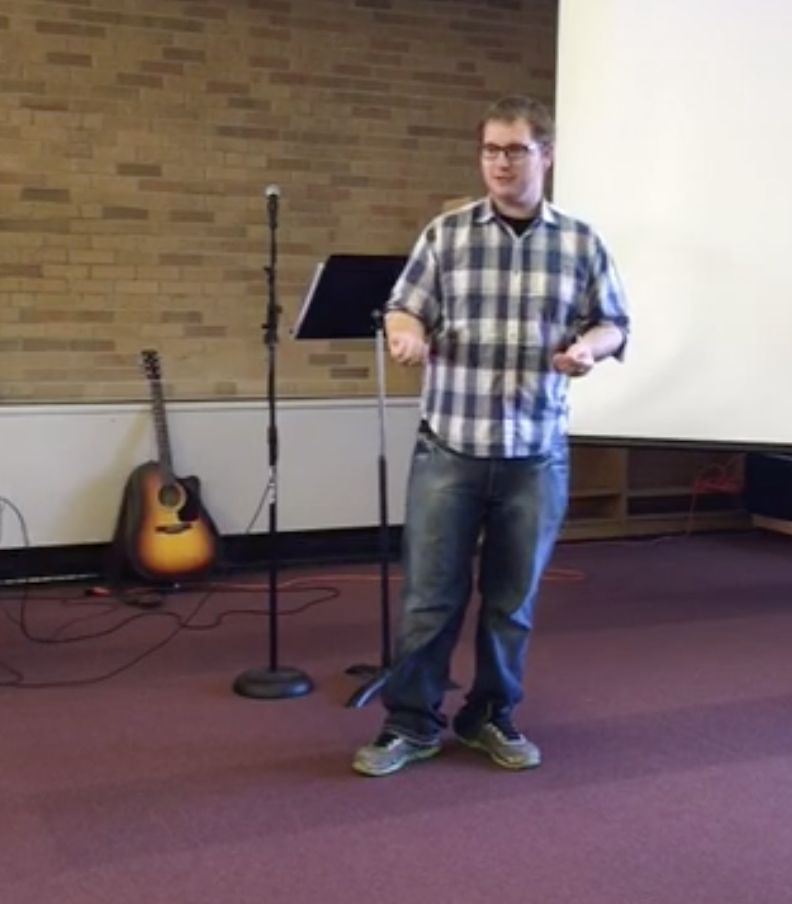
Josh SchramOur youth pastor, Josh Schram, shared a message yesterday which really convicted me. Here are my notes just as I took them Sunday morning.

Some stereotypes of Christians aren’t very flattering. If we ask someone to think of a farmer or a plumber, we probably all get the same sorts of images in our minds. But when we say “Christian,” there are a lot of images that come to mind. And many of them aren’t very flattering.

The word Christian only appears three times in New Testament (in the NIV)—Acts 11:26; Acts 26:28; 1 Peter 4:16.

The followers of Jesus preferred to call themselves disciples (see Acts 26:11). That signals a lifestyle, not just a label.

Does my lifestyle reflect the fact that I’m a follower of Jesus, or am I just happy with the title “Christian”? Am I trying to justify not doing the discipleship work that Jesus commanded me to do, namely loving God and loving others (Luke 10:25-37)? Notice especially this verse: But he wanted to justify himself, so he asked Jesus, “And who is my neighbor?” (Luke 10:29).

Why don’t Christians want to put their love into action? They say they’re busy, or don’t have enough resources, or don’t want to get involved, or they think helping may be a trap. But the priest and Levite who didn’t stop to help may have saved the injured man’s life! How much so the Christian of today!

Does my faith in Jesus change the way I live, or is “Christian” just a title I’m happy to live with?

As kids, when we play “follower the leader” we follow all the actions of the leader. But Christians seem to change the rules: “I just need to believe what He says, but I don’t have to do what He says.”

To truly be called a “Christian”—a disciple of Jesus—my LOVE should be in action, just like Jesus (Luke 10:27-28; c.f. Acts 10:38).

If you’re ready to be challenged, check out Josh’s message for yourself—

You Are God’s Lavish Gift To Others

GratefulI have noticed a couple of things about thank-full people (people who are full of thanks). In a single word the difference is ABUNDANCE.

  • Thank-full people have an abundance mentality—they believe there’s plenty for everyone; that God’s grace overflows and is boundless.
  • Thank-full people want others to find this abundant life too. As Charles Spurgeon prayed, “I would then that the quickening Spirit would come down upon me, and upon you, upon every one of us in abundance, to create men valiant for truth and mighty for the Lord.”

This abundance mentality is what Paul is referring to when he writes, “Let the word of Christ dwell in you richly” (Colossians 3:16). Both words dwell and richly convey someone who is so saturated in the abundance of God, that they cannot help wanting to share it with everyone!

So how do Christians lavish their thank-fullness and peace-fullness on others? The rest of that verse in Colossians tells us:

  1. We teach.
  2. We admonish with all wisdom.
  3. We sing.

Teaching others is always rooted in love, and is for the benefit of the other person (Ephesians 4:15, 25, 29).

Wisdom is the Greek word sophia. It means heavenly insight that is extremely practical. That’s what we need when we admonish those we love. This word means to warn people if they are on a wrong path. We love them enough to speak a loving word of warning (Proverbs 27:5-6).

And we sing out of our abundant overflow. The word of Christ dwells in us so richly that it literally bursts out of us in song! Have you ever been around someone so full of God’s presence that their words almost seem to be a song?

But don’t miss out on this. The lavish gift God wants to pour out on people is YOU! Notice how many times the pronoun you is used in Colossians 3:15-17. YOU are God’s gift to your family, your friends, your co-workers, your community!

Don’t rob others of this amazing gift by becoming ungrateful.

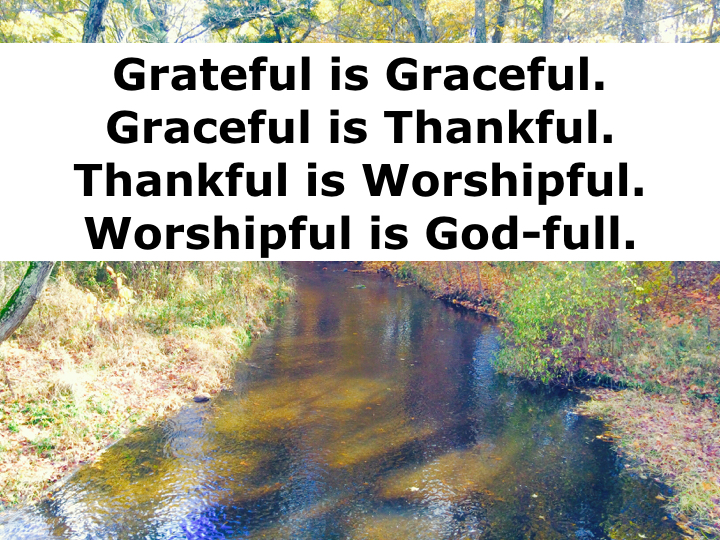
Grateful is graceful. 
Graceful is thankful. 
Thankful is worshipful.
Worshipful is God-full.

“The essence of Christianity is that we give the Son of God a chance to live and move and have His being in us, and the meaning of all spiritual growth is that He has an increasing opportunity to manifest Himself in our mortal flesh.” —Oswald Chambers

What will you do to remain thank-full, and remain God’s lavish gift to others?

Part three of our 3-part series on gratitude is coming up this Sunday. If you don’t have a home church in the Cedar Springs area, I would be so thank-full to have you come join us!

Persecuted Christians

Persecuted Christians [2]This Sunday, November 8, is the International Day of Prayer for persecuted Christians around the world. We will be praying at Calvary Assembly of God, and I hope wherever you are you will be praying too.

Links & Quotes

link quote

“With such prayer [‘Praying in the Holy Sprit’ (Jude 20)] it is an absolute certainty that I must succeed with God in prayer. If my prayer were my own prayer, I might not be so sure of it, but if the prayer which I utter be God’s own prayer written on my soul, God is always one with Himself, and what He writes on the heart is only written there because it is written in His purposes.” —Charles Spurgeon

“In the passage where the New Testament says that every one must work [Acts 20:34-35], it gives as a reason ‘in order that he may have something to give to those in need.’ Charity—giving to the poor—is an essential part of Christian morality.” —C.S. Lewis

“Security comes as we put God’s precepts into practice. We’re only as strong as our obedience.” —Max Lucado

Dan Reiland shares 6 things God says to church leaders.

“Mountain lions detect vulnerabilities in their prey and attack the weakest—the young, the sick, the injured. Studies have confirmed this instinctive cruelty. It’s how the mountain lion lives, following the scent of suffering and feasting on whatever he finds. The enemy of your hope and happiness hunts with that same instinct, with a cold-hearted and ruthless hunger for the weak or hurting. satan prowls like a roaring lion.” Read how to overcome the prowlings of the devil.

For anyone struggling with pornography, here is a great source of help: MyPilgrimage.com. Watch the introductory video, and then subscribe!

Here is some good advice for students who are addicted to pornography—

Misbehaving Government

Misbehaving governmentChristians are to have an “alien” response to earthly governments. Simply stated: the Bible says we should not rail against governing authorities the way Earthlings do. Christians should respond with proper submission (check this out).

But what if those earthly governors are misbehaving? What then?

We can still be in God-honoring submission to them in the way we call out their misbehavior. 

Look at some examples—

  • Daniel asked permission to go against the king’s wishes (Daniel 1:8), proposed an alternative plan (v. 12), but ultimately agreed to submit to the authority’s decision (v. 13).
  • Shadrach, Meshach and Abednego didn’t argue with King Nebuchadnezzar (Daniel 3:16-18), but respectfully took their stance for God (notice the use of the phrase “O king” as a title of respect).
  • Peter and John simply stated, “We must obey God rather than human authority” (Acts 5:29).

This is exactly what Jesus told us to do when He said, “Give to Caesar what is Caesar’s, and to God what is God’s” (Luke 20:25). Jesus said something very similar to Pilate, when that governor said, “Don’t you realize I have the power to set You free?” Jesus said, “You would have no authority over Me if it were not given to you from above” (John 19:10-11).

So how do we respond to misbehaving governors?

[1] With respect to their office.

[2] With reverent fear of God (see 1 Peter 2:17). “Because we reverence God as the Lord of history, we see beyond the fear and intimidation of the moment.” —James W. Thompson

[3] Leaving the results to GodDaniel 3:26-29, 6:16-27; Acts 5:40-42.

[4] With lots of prayer1 Timothy 2:1-4.

Throughout history, Christians have always had the opportunity to confront ungodly governors. HOW they did it is what set them apart from the Earthling response, and what brought glory to God.

Here’s the video of my full message on this topic—

Next Sunday, November 8, is a day of prayer for those facing persecution for their Christian faith around the world. Join us in a time of prayer for them. If you’ve missed any messages in this series, you may find the complete list by clicking here.

Alien Government

Are we submittingPerhaps you can relate to one or more of these quotes about our government:

  • “Government is like a baby: …a big appetite at one end and no sense of responsibility at the other.” —Ronald Reagan
  • “If you ever injected truth into politics you have no politics.” —Will Rogers
  • “The word ‘politics’ is derived from the word ‘poly,’ meaning ‘many,’ and the word ‘ticks,’ meaning ‘blood sucking parasites.’” —Larry Hardiman
  • “Politics have no relation to morals.” —Nicolo Machiavelli

But if you are a Christian, the Bible calls you to not give in to the cynicism that many feel toward our government. As aliens and strangers on Earth, we are called to to interact with government officials in a peculiar way.

In a single word, the Bible calls us to submit. The Greek word that both Peter (1 Peter 2:13) and Paul use (Romans 13:1, 5) has a couple of definitions. On the one hand it carries a military meaning to arrange troops under the command of a leader. On the other hand, it’s also a voluntary attitude of cooperating, assuming responsibility, and carrying a burden for the common good.

No where does submission imply letting leaders abuse us, or remaining silent and uninvolved if their activities are immoral or unbiblical. Instead submission recognizes that government officials have been placed in their positions by God (Daniel 4:25, 32the Most High is sovereign over all the kingdoms of men, and gives them to anyone He wishes), and that they are God’s servants (Romans 13:4, 6) who have to give an accounting to God for their actions.

Our alien response of properly submitting is our way of supporting them in their God-given responsibilities. How do we do this?

  1. Treat them with respect (Romans 13:7; 1 Peter 2:17).
  2. Separate the person [loved by God] from the policy [may or may not line up biblically], then disagree with the policy, not with the person.
  3. Pray for them (1 Timothy 2:1-4).

This way of interacting with them will bring glory to God (1 Timothy 2:3; 1 Peter 2:15).

Here’s a good question to ask ourselves: Are we submitting like servants of the King of kings?

If you’ve missed any messages in this series, you may find the complete list by clicking here.

You may also be interested in my video The Church should be pre-political.

Christians As Priests

Priesthood of ChristiansThere are some extraordinary pictures in the Old Testament that take on new life when viewed through the lens of Jesus Christ. One picture is how God chose the Jewish people out of all the people on earth, how He then chose the tribe of Levi to serve as His priests, and then how He chose Aaron from the Levites to be the high priest.

The Jewish people, the Levites, and then Aaron became God’s special possession because He chose them; it’s not that He chose them because they were special. God did this to give us a picture of what He wants to do with all of us.

Although the Levites were chosen as priests, God tells all of Israel—

You will be for Me a kingdom of priests and a holy nation. (Exodus 19:6)

For you are a people holy to the Lord your God. That the Lord your God has chosen you out of all the peoples on the face of the earth to be His people, His treasured possession. (Deuteronomy 7:6)

When the Apostle Peter is speaking to New Testament Christians, he uses the same type of language. He calls all Christians:

Christians are ‘a kingdom of priests and a holy nation’ that are to carry out their priestly roles while on Earth. 

Peter also talks about where Christian priests are to minister. In the Old Testament, the priests had a set location where ministry was done. But Peter says we are living stones built on the Living Stone (2:4). That means that the place of worship today is not brick and mortar, but flesh and blood.

Christian priesthood is mobile, adaptable, empathetic, and responsive to the the needs of the people.

If you are a Christian, here are some good questions to ask yourself:

We will be continuing our series about how citizens of Heaven should live on Earth this Sunday. If you don’t have a home church in the Cedar Springs area, please come join us. If you’ve missed any messages in this series, you may find the complete list by clicking here.

One Word

RedemptionWhen it comes right down to it, there is really just one word that makes Christians peculiar. Just one word changes our citizenship from Earth to Heaven. One word took us from a path where our sins had us headed toward an eternity in Hell.

Jesus stepped in where He didn’t have to go. Jesus became our sin to pay-off our sin debt. Jesus took us back from satan’s possession, and made us a part of His Father’s family.

Jesus redeemed us! 

I wonder if we truly understand that word redemption?

Peter is speaking to us as “strangers here in reverent fear” on Earth, and he calls us to live up to God’s call—Be holy, because I am holy (1 Peter 1:16; Leviticus 11:44-45). He asks us to obediently follow God’s Word (1:22), to get rid of Earth-bound things (2:1), and instead taste that the Lord is good (2:3).

Why? Because we’ve been “redeemed from the empty way of life…by the precious blood of Christ” (1:18-19) We don’t live holy lives to try to earn redemption, but because we have been redeemed we are now capable of living holy lives!

To help illustrate his point, Peter quotes a couple of verses from Isaiah 40. In this chapter, we are invited to weigh the greatness and love and knowledge and power of God against the things we can provide for ourselves on Earth. Please check out the video below, where I go through this 40th chapter of Isaiah.

If you’ve missed any messages in this series, you may find the complete list by clicking here.